The Architecture of Retribution: How a Quiet Military Veteran Weaponized Bureaucracy to Dismantle an HOA Tyrant
CHAPTER 1: THE WEIGHT OF CEDAR
The edge of the plastic dumpster lid bit into my palm through the heavy leather of my work gloves, but the physical sting was entirely secondary to the cold geometry forming in my mind. Ten precision-engineered nesting habitats, built to the exact specifications of the National Audubon Society, lay crushed into a chaotic heap of kindling and twisted aluminum.
Karen had called them unauthorized structures. She had stood on my perfectly manicured Bermuda grass with her clipboard held like a scepter, delivering her ultimatum with the practiced certainty of someone who had never once faced a counter-move. But thirty years in military logistics teaches you a fundamental truth about chaos: you never waste energy reacting to the noise. You catalog the damage, you secure the perimeter, and you wait for the target to illuminate itself.
I let the heavy plastic lid drop. The resulting crash made her flinch, a microscopic shudder in her jawline that confirmed what my tactical assessment already knew—she was operating on impulse and power, while I was operating on timing.
“The covenants are very clear, Mr. Miller,” she had said, her voice dripping with manufactured administrative grace.
She believed she had cleared the board. She believed a quick toss into the municipal waste bin would erase months of data collection, micro-cameras, and federally tagged bluebird monitoring equipment. She did not realize that every single board she had broken was cataloged in a triplicate filing system back in my office, backed by certified mail receipts signed in her own sloppy, hurried scrawl six months prior.
I turned away from the curb, my boots crunching softly on the asphalt, and walked back up the driveway. The sun beat down on the asphalt, casting razor-sharp shadows against the brick exterior of the house. Every surface looked harder, stripped of its domestic warmth and rendered in stark, uncompromising lines.
Inside the house, the hallway was silent save for the steady, rhythmic ticking of the grandfather clock. I walked straight to my office, a spartan room where my framed retirement shadow box stared down from the wall with unblinking bronze eyes. My fingers hovered over the keyboard of my laptop, instantly opening a blank document.
I did not smash my fist against the wall. I did not indulge the white-hot current of rage pulsing through my veins. Instead, I began typing with cold, mechanical precision, logging the exact coordinates of the destruction, the timestamp of the confrontation, and the serial numbers of the missing data loggers.
The screen glowed in the dim light of the closed blinds, casting a pale, clinical blue across my knuckles. I drafted the initial memo to Dr. Aris Thorne at the national headquarters, keeping the prose strictly factual, devoid of emotion, and lethal in its brevity.
When the draft was complete, my cursor hovered over the send icon. My phone buzzed against the polished mahogany desk, vibrating with a silent text message notification from an unknown local number.
CHAPTER 2: THE ARCHIVE OF PROOF
The screen of my laptop cast a sharp, clinical blue across the grain of the mahogany desk, illuminating the unread notification light of my phone. It buzzed against the polished wood once, twice—a low, rhythmic thrum that mirrored the disciplined cadence of my own pulse. I did not reach for it immediately. In logistics, an unscheduled transmission is an incoming vector; you do not open the channel until you have verified your own coordinates.
I minimized the draft to Dr. Aris Thorne and opened the master directory labeled Project Bluebird. Inside lay the three-ring digital binder containing every architectural blueprint, every correspondence, and the crucial piece of evidence that Karen had conveniently chosen to overlook: the certified mail return receipt bearing her own hurried, sprawling signature from six months prior.
The vibration stopped, leaving a heavy, pressurized silence in the spartan office. Outside the window, the late afternoon sun cut long, razor-sharp shadows across the lawn, slicing the green Bermuda grass into alternating bands of bright light and deep, charcoal darkness.
My fingers settled back onto the keyboard. I created a new sub-folder titled Incident_01. Into this folder, I transferred the eighty-seven high-resolution photographs I had taken of the wreckage out on the driveway. Every splintered piece of cedar, every bent aluminum tag, and every crushed micro-camera lens was meticulously timestamped and geotagged. I added a structured spreadsheet detailing the replacement value of the specialized hardware, calculating the total to the exact dollar: four thousand and twelve dollars.
Yet, as I stared at the numbers glowing on the screen, I knew the real value wasn’t financial. It was structural leverage.
Karen had operated under the assumption that a neighborhood dispute could be swept away with a municipal dumpster and a smug smile. She believed her clipboard gave her absolute jurisdiction over the lives of everyone on this street. But she had violated a federal statute—the Migratory Bird Treaty Act—and more importantly, she had left a paper trail that linked her direct authorization to the destruction of registered scientific monitoring assets.
My phone buzzed again, this time flashing an email notification preview from the national headquarters of the Audubon Society.
I double-clicked the notification. Dr. Aris Thorne’s response was instantaneous, stripped of pleasantries, and charged with cold, academic fury. He acknowledged receipt of the initial brief and confirmed that their legal counsel was already reviewing the file for immediate forwarding to the United States Fish and Wildlife Service. The phrase potential criminal liability sat in the text like a live round in a chamber.
I leaned back in my ergonomic chair, the leather creaking slightly under my weight. My eyes drifted to the shadow box on the opposite wall, where my service medals caught the fading amber light of the window. Thirty years of moving assets, managing supply chains, and anticipating friction points had prepared me for this exact micro-environment.
A knock at the front door broke the silence. It wasn’t the aggressive, demanding rap of an HOA president wielding a clipboard, but a hesitant, double-tap that barely registered against the heavy oak.
I stood up, my joints moving with silent efficiency, and walked down the short hallway. The air inside the house felt dense, cool, and detached from the humid suburban afternoon waiting just beyond the threshold. I unlocked the deadbolt and pulled the door open.
Mrs. Gable stood on the welcome mat, clutching a stack of envelopes to her chest as if they were a shield. Her silver hair caught the fading light, and her eyes darted nervously toward the empty street behind her, checking for any sign of patrolling authority.
“Mr. Miller,” she whispered, her voice trembling slightly. “I saw… I saw what they put in the newsletter today. And I heard about your birdhouses. I couldn’t just stay quiet anymore.”
I looked down at her, seeing the suppressed tension in her posture—the posture of someone who had lived under an unyielding shadow for far too long. The perimeter was shifting. The first breach in the enemy’s front line had opened right at my doorstep.
“Step inside, Mrs. Gable,” I said, my voice level and calm. “Let’s talk about what’s really happening on this street.”
CHAPTER 3: THE RECONNAISSANCE WALK
The heavy oak door clicked shut behind Mrs. Gable with a muffled, solid thud, sealing out the humid haze of the afternoon street. She stood just inside the foyer, her knuckles white as she clutched a sheaf of yellowed correspondence and old violation notices against her chest. The silence of the hallway pressed down on us, heavy with the quiet desperation of a street governed by fear.
“Sit down, Mrs. Gable,” I said, gesturing toward the wingback chair in the corner of the study. My voice was even, stripping away any room for panic.
She moved slowly, her joints stiff with age and years of accumulated stress, sinking into the cushions as if she expected the chair itself to be declared an infraction under some obscure subsection of the neighborhood bylaws. I crossed the room to the heavy mahogany filing cabinet, pulled open the drawer labeled Project Bluebird, and slid a clean, empty red binder onto the desk surface. This was no longer just about nesting boxes or migratory data sets. The perimeter had expanded.
“You mentioned a rose garden,” I said, sitting opposite her across the polished wood. “Tell me exactly what happened to it.”
For the next twenty minutes, the study transformed into a debriefing room. Mrs. Gable spoke in fragments at first, her eyes darting toward the window, but as she detailed the systematic campaign of weekly fines, the threats of placing a lien on her property, and the ultimate humiliation of having her son come with a shovel to tear out the bushes her husband had planted before his passing, the tremor in her voice hardened into a cold, quiet anger. She wasn’t just recounting a memory; she was delivering testimony.
I documented every date, every dollar amount, and every citation number in a fresh document on my screen. Karen hadn’t merely enforced rules; she had operated a tollbooth of intimidation, monetizing petty grievances to maintain absolute control over the community’s compliance.
When Mrs. Gable finally stood to leave, promising to compile whatever paperwork she had left in her attic, I walked her back to the door. The sun had begun its descent, casting long, bruised purples and deep charcoal shadows across the perfectly manicured lawns of Creekwood Commons. Every house on the block looked uniform, orderly, and entirely sterile—a facade maintained at the point of a clipboard.
Once the door was secured, I didn’t return to the desk. I reached for my heavy weather-resistant utility jacket hanging by the hall closet, zipped it to the collar, and stepped out onto the front porch.
The air outside was thick with the scent of freshly cut grass and scorched asphalt. My mission tonight was straightforward: reconnaissance. If Karen’s regime relied on selective enforcement—punishing infractions in yards she targeted while ignoring identical violations among her allies—I needed to map the layout of the entire subdivision.
I set off down the sidewalk at a measured, deliberate pace, my phone gripped tightly in my right hand, the camera application locked and loaded. The streetlights flickered to life one by one overhead, casting a harsh, jaundiced glow over the pavement. The sharp edges of concrete curbs and manicured hedges stood out in stark relief against the gathering dusk.
Two doors down, the secretary’s property loomed behind an unpainted, peeling wooden shed that clearly breached Section 6 of the architectural covenants regarding exterior maintenance. I paused beside a towering oak tree, raised the phone casually as if checking a text message, and captured three high-resolution timestamps of the peeling paint and sagging roofline.
Further down, near the cul-de-sac where Karen’s inner circle resided, the violations multiplied. A garish cluster of pink plastic flamingos stood sentinel in a front yard belonging to a board member. A massive satellite dish was bolted directly to the front-facing fascia of another ally’s roof, an explicit violation of the covenant clauses Karen loved to weaponize. Each photograph was geotagged instantly, cataloged into a secure folder titled Selective_Enforcement.
I walked in silence, my boots rhythmically clicking against the concrete. No one was outside; the neighborhood had the eerie, hollow quiet of a garrison town waiting for an order. Karen had engineered an environment of absolute compliance, but in doing so, she had left every single one of her allies exposed to identical administrative penalties. She had built a fortress out of double standards, and every brick was stamped with hypocrisy.
Rounding the corner onto Elm Street, I caught sight of a familiar silhouette standing near a bright yellow mailbox. Karen was conducting her evening patrol, clipboard tucked firmly under her arm like an officer inspecting the ranks. She didn’t see me standing deep within the pooling shadows of the overhead maple branches.
She stopped outside a neighbor’s driveway, leaning over to inspect a small decorative border of stones around a flower bed, her jowls tightening into a familiar knot of condemnation. She pulled out a small notepad, scribbled a note with sharp, aggressive strokes of her pen, and jammed a pink warning slip beneath the windshield wiper of a parked sedan.
She was looking for targets, hunting for minor infractions to justify her authority, completely unaware that the perimeter behind her had already been breached. I stood motionless in the gloom, watching her rhythmic, robotic movements, my thumb resting quietly over the screen of my phone. The evidence was accumulating. The strategic architecture of the counter-offensive was falling perfectly into place.
CHAPTER 4: THE ESCALATION LETTER
The amber glow of the desk lamp caught the edge of the legal-pad paper as my pen moved in measured, deliberate strokes. Standing under the shadows of Elm Street had crystallized the operational reality: Karen wasn’t acting as an isolated anomaly; she was protecting a closed ecosystem of rule enforcement that selectively ignored her allies while crushing anyone outside her inner circle.
My phone sat face down beside the keyboard, silent but heavy with the weight of the upcoming administrative strike. The selective enforcement folder on my laptop now contained over forty distinct photographic exhibits—peeling paint on the secretary’s shed, illegal satellite dishes, non-compliant fence extensions, and unauthorized yard displays belonging exclusively to members of the board.
A sharp rap at the front door broke the stillness of the study. It wasn’t the tentative double-tap of Mrs. Gable, nor the silent creep of twilight. It was a heavy, administrative thud.
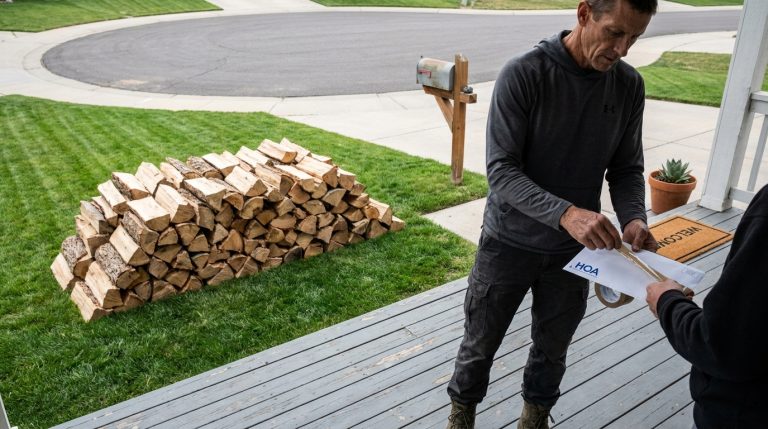
I stood up, my boots making no sound on the hardwood floor, and walked through the dim hallway. Pulling open the heavy oak door revealed no lingering neighbor, only a stark, sterile white envelope resting squarely on the rubber welcome mat. The HOA logo printed in an offensively cheerful blue sat in the corner like a mocking signature.
I picked it up, closed the door, and walked back to the desk. I didn’t tear the envelope open with frantic energy; I slit the top cleanly with a letter opener, sliding out the contents with clinical detachment.
Inside was a formal notice of violation, backdated precisely one week before the destruction of my birdhouses. It was a clumsy, desperate attempt to paper over an illegal act after the fact, citing Section 4, subsection B, and levying a punitive two-hundred-dollar fine. Attached to it was an itemized invoice for one hundred and fifty dollars, payable directly to K&S Landscaping—a firm operated, as my preliminary notes confirmed, by Karen’s own brother-in-law.
They weren’t just doubling down; they were attempting to bill me for the very act of destroying my federally protected research equipment. The sheer audacity of the maneuver was breathtaking, a glaring administrative footprint left out in the open by an opponent who believed her authority was absolute.
I reached for my phone, unlocked the screen, and dialed a direct number. It rang twice before a deep, crisp voice answered on the other end.
“Miller,” Marcus said, his tone brisk and businesslike. “Tell me you’ve got something solid.”
“I have forty-two distinct exhibits of selective enforcement,” I replied, my voice level, steadying against the rising tide of operational friction. “And they just mailed me an invoice for the cleanup of my own destroyed property, payable to a family member’s landscaping business.”
There was a brief pause on the line, followed by the faint rustle of papers. When Marcus spoke again, the professional amusement in his voice had curdled into sharp, predatory focus.
“They’re trying to retroactively cover a criminal act with a civil fine,” Marcus said, his pen scratching against paper on his end. “That crosses the line from petty harassment straight into corporate liability. Send me the envelope, the backdated notice, the invoice, and your photographic database. We’re going to draft a demand letter that pierces their administrative veil.”
“Make sure it includes the explicit threat of federal involvement under the Migratory Bird Treaty Act,” I instructed, my eyes fixed on the shadow box across the room. “Dr. Aris Thorne’s team at Audubon is already prepping the file for the US Fish and Wildlife Service. Let’s see how well their landscaping invoices hold up under federal scrutiny.”
“Consider it done,” Marcus muttered. “Give me forty-eight hours to compile the civil litigation framework. We’ll serve every single board member individually. Let them sign for their own accountability.”
The call disconnected with a sharp click. I set the phone down on the mahogany surface, right beside the backdated violation notice. The paper felt thin, almost fragile against the heavy grain of the wood. Karen thought she was wielding a weapon, but every stroke of her pen, every backdated signature, and every nepotistic invoice was just another coordinate locked into our targeting grid.
I pulled up a blank document on the screen, my fingers resting lightly over the home row. The defensive perimeter was fully established; now, it was time to draft the counter-offensive.
CHAPTER 5: THE FEDERAL AGENTS ARRIVAL
The backdated violation notice remained where I had left it on the mahogany surface, a thin sheet of corporate paper that now felt less like an administrative threat and more like an admission of panic. Karen was overextending her lines, reacting to the pressure of our document trail with crude, retrospective paperwork. But the tactical landscape shifted permanently the following morning when a dark, nondescript Ford sedan turned down the street and parked silently at my curb.
I watched from the study window as the engine cut out, the vehicle absorbing the morning sunlight without a single reflection off its flat, utilitarian paint. A woman in her forties stepped out, wearing a sensible dark blazer and carrying a weather-resistant leather case. She moved with a deliberate, unhurried economy of motion—the posture of someone accustomed to inspecting federal compliance rather than local lawn lengths. Special Agent Riley did not look like a character from a courtroom drama; she looked like a senior investigator who processed facts with absolute neutrality.
The doorbell rang once—a sharp, single chime that cut through the silence of the house. I walked down the short, dim hallway, turned the deadbolt, and pulled the door open.
“Mr. Miller?” she asked, her eyes scanning my face with an analytical precision that missed nothing.
“Agent Riley,” I replied, stepping back to clear the threshold. “Come inside.”
She stepped into the foyer, her gaze briefly catching the shadow box of service medals on the study wall before following me toward the rear of the house. We moved directly into the garage, where I had spent hours preparing the operational zone.
Resting on a large, heavy-duty blue tarp laid out across the concrete floor were the cataloged remnants of Project Bluebird. Every splintered piece of cedar, every bent aluminum bracket, and every crushed micro-camera lens had been organized into neat, numerical rows. Next to them sat a stack of clear evidence bags containing the bent federal tags recovered from the municipal dumpster.
Agent Riley knelt beside the tarp, pulling on a pair of latex gloves. She didn’t speak immediately. She lifted a piece of shattered roof framing, turning it over in her gloved hands to examine the precise angle of the predator guard and the drilled housing unit for the data logger.
“You stated in your initial brief that you observed a female building a nest in this specific housing unit,” she said, her voice dropping into an even, professional register as she gestured toward Unit Seven.
“Confirmed,” I answered, standing a pace back with my hands resting easily at my sides. “I have complete observational logs, automated time-lapse captures from the preceding week, and digital backups stored off-site. The biological window for the first clutch was locked to that exact forty-eight-hour block.”
Riley pulled a small, ruggedized digital notepad from her case, tapping a stylus against the screen to log the timestamp. “And these are the federal tags issued under the Audubon research authorization?”
“Stored in sequence,” I said, pointing to the labeled evidence bags. “Every serial number matches the federal registry filed with the Department of the Interior.”
For nearly an hour, she documented the scene with meticulous rigor, capturing macro shots of the fractured grain and wide-angle frames of the entire tarp layout. She didn’t offer sympathy; federal investigators deal in statutory definitions, not neighborhood grievances. But as I handed her a bound, tabbed copy of our Incident_01 dossier—complete with the photographs, the itemized damage assessment, and Karen’s backdated violation notice—I saw a sharp, crystalline focus lock into her expression.
She paused on the page containing the landscaping invoice billed by Karen’s brother-in-law.
“They billed you for the disposal of the wreckage,” Riley stated, looking up from the pages. It wasn’t a question.
“They assessed a fine and attached a contractor’s fee for removing property they destroyed themselves,” I replied evenly.
Riley closed the binder with a dull, heavy slap that echoed off the concrete walls of the garage. She stood up, stripping off her gloves and dropping them into a disposal pouch.
“Mr. Miller, the Migratory Bird Treaty Act does not distinguish between accidental habitat loss and deliberate, targeted destruction of an active scientific monitoring station,” she said, her tone hardening into a flat, bureaucratic certainty. “When an administrative body overrides federal statutes to enforce local aesthetic covenants, it ceases to be a civil HOA matter. My office is submitting a formal report to the United States Attorney’s General staff this afternoon. The statutory penalties are calculated per nest, per component, and per violation. The exposure for the association is significant.”
She walked back toward her vehicle with the same quiet, measured stride she had arrived with. I stood in the open garage, watching the dark sedan pull away from the curb and glide silently out of the neighborhood. The federal machinery was now engaged. Karen had deployed her local clipboard as an absolute weapon, but she had just stepped directly into the path of an institutional freight train she could neither bully nor outrun.
CHAPTER 6: THE CLUBHOUSE CONFRONTATION
The heavy oak door of the community clubhouse swung open, and the humid evening air rushed inside, carrying the murmur of fifty restless residents packed tightly into the municipal room. The fluorescent overhead panels hummed with a harsh, clinical glare, casting sharp shadows across the long folding tables at the front where Karen sat flanked by her silent, compliant board members. She gripped her wooden gavel with white-knuckled intensity, her expression locked into a defensive mask of supreme authority.
I stepped across the threshold, my boots striking the linoleum floor with measured, deliberate rhythm. I was not alone. Flanking my left shoulder was Marcus, his dark suit jacket unbuttoned as he carried a heavy leather briefcase containing the complete civil litigation file and our selective enforcement exhibits. Behind us moved a quiet, determined column of neighbors—Mrs. Gable holding her head high despite the nervous tremor in her hands, and Mr. Patel with his jaw set tight in silent solidarity.
We moved down the central aisle, the collective chatter of the room dying away into an uneasy, suffocating hush. Karen banged her gavel once, the sharp crack echoing off the drywall like a pistol shot.
“This meeting is called to order,” she announced, her voice tight and trembling with suppressed fury. She launched immediately into a prepared defense, painting the association as an orderly sanctuary under siege from an uncooperative resident who refused to respect shared community standards. She spoke of property values, aesthetic consistency, and the vital necessity of obeying the board’s unyielding oversight.
It was a masterclass in deflection, designed to rally her core supporters before the reality of our legal position could penetrate the room. When she finished, a scattering of hesitant applause rippled from her cronies in the front rows. Then, stepping directly into the trap she had meticulously laid for herself, she turned her gaze toward me.
“Perhaps Mr. Miller would like to step up here and explain to his neighbors why he has chosen to sue the entire community,” she challenged, her voice rising with performative outrage.
I didn’t yell. I didn’t rush. I walked calmly past the empty aisle seats, stepped up to the small podium positioned near the front projection screen, and placed my laptop gently on its surface. I connected the digital interface cable with a quiet click.
“I am not here to sue my neighbors,” I began, my voice amplified evenly through the room’s speakers, cutting cleanly through the tension. “I am here to present the facts.”
With a keystroke, the wall behind the board illuminated. Projected in crisp, high-definition clarity was the official architectural improvement request form I had submitted eight months prior. The room leaned forward as a collective unit.
I clicked to the next slide. The green certified mail receipt appeared on the screen, bearing Karen’s own messy, hurried signature confirming receipt of the packet.
“Under the association’s own covenants, section eight, subsection C, a failure to respond within thirty days constitutes automatic approval,” I stated calmly, letting the administrative rule hang in the air like a heavy anchor.
I advanced the slide again. The harsh light of the projector revealed the raw, brutal image of the splintered birdhouses lying in the municipal dumpster. A sharp intake of breath rippled through the rows of seated residents. The visual was absolute, undeniable, and entirely devastating to the narrative Karen had spent weeks constructing.
“This is what was classified as an unapproved structure,” I said, my eyes fixed squarely on the rigid, pale face of the HOA president. “And this next document is the invoice the board sent me, charging me a contractor’s fee for the removal of property that was operating under federal jurisdiction.”
I clicked once more, bringing up the financial log detailing the landscaping charges billed to K&S Landscaping.
The murmuring in the room erupted into an open wave of disbelief. The other board members began shifting uncomfortably in their chairs, casting nervous, sideways glances at Karen as the illusion of their collective innocence fractured completely.
Mrs. Gable stood up from her seat near the front, her frame small but resolute. In a voice that started softly but gathered unwavering strength with every syllable, she walked to the front of the room and recounted the cruel dismantling of her husband’s memorial rose garden. Mr. Patel followed immediately after, detailing the destruction of his son’s portable basketball hoop and the constant threat of arbitrary fines.
The dam had broken. The quiet fear that had governed Creekwood Commons for years dissolved into a tidal wave of public testimony. Karen stood up behind the table, slamming her gavel down repeatedly, screaming for order, but her voice was completely swallowed by the righteous indignation of the room she thought she owned. The power had shifted irrevocably, leaving the tyrant entirely isolated beneath the harsh glare of the overhead lights.
CHAPTER 7: THE EMERGENCY BOARDROOM FRACTURE
The echoes of the community meeting’s collapse did not fade with the exit of the crowd; they bled directly into the emergency board session called forty-eight hours later behind closed doors. The air inside the glass-walled conference room was dry and brittle, smelling faintly of commercial bleach and strained silence.
Karen sat at the head of the polished oak table, her posture rigid, her hands flat against the wood as if holding down the lid of a sinking vessel. The other three board members did not look at her. They sat scattered down the length of the furniture, their faces pale under the stark, recessed lighting. David Chen, the association treasurer, stared down at a thick ledger of financial records spread open before him.
“We need to authorize an immediate retainer for outside legal counsel,” Karen began, her voice strained, cutting through the silence with a brittle edge. “A fifty-thousand-dollar emergency allocation from the reserve fund. We are facing coordinated outside threats, and the association must defend its governance.”
She spoke with the conditioned reflex of absolute authority, expecting the automatic nods of compliance that had sustained her tenure for years. But the administrative machinery had seized up.
David did not look up from his ledger. His fingers rested lightly on the edge of a paper printout containing the insurance carrier’s preliminary findings.
“I cannot authorize that, Karen,” David said, his voice quiet, steady, and entirely devoid of its former hesitation.
The silence that followed was absolute. Karen’s jaw tightened, the skin around her mouth pulling white. “What did you say?”
“I said no,” David repeated, lifting his gaze to meet hers across the polished expanse. He turned a single sheet of paper toward her. “The insurance carrier’s formal response arrived this morning. Because the destruction of property and the violation of federal statutes were executed through willful, targeted intent, our errors and omissions policy is void. They will defend the corporate entity against the class-action suit, but they will not cover a single dime of any judgment. And they certainly will not touch the one-hundred-thousand-dollar federal penalty from the Fish and Wildlife Service.”
Karen slammed her palm against the table. The sharp crack made the water pitchers rattle. “That is an overreach! We acted in accordance with aesthetic standards to protect property values!”
“No,” David countered, his tone hardening as he slid a second document into view—a printed copy of an email recovered from the digital subpoena logs. “This is what you did.”
He read the words aloud, his voice flat and merciless: “We need to make an example of him before every yahoo in the neighborhood starts putting junk in their yards. Let him put them up, then we’ll take them down and bill him for it.”
The words hung in the air like a physical blow. The remaining board members shrank back into their chairs, the final illusion of a shared mission evaporating into ash. They weren’t protecting the neighborhood anymore; they were co-defendants staring down personal financial ruin because of a single woman’s vindictive vendetta.
“You traded our liability for your ego,” David said, standing up from his chair. “Your tenure as president is terminated under Section 12 for gross breach of fiduciary duty.”
Karen lost all composure. The bulldog-like aggression snapped into unhinged desperation. She stood up, knocking her leather folio to the floor, and lunged across the corner of the table toward the financial ledger. “Give me those records! You have no authority—”
Susan, the board secretary, stepped physically between them, her hands raised defensively as Karen clawed blindly for the binder. It was a clumsy, pathetic scuffle—the final, undignified collapse of a regime built entirely on intimidation. Karen screamed threats of insubordination and multi-million-dollar counter-suits, her voice cracking against the glass walls of the conference room, but the room remained entirely unmoved.
David didn’t flinch. He simply gathered his files into his briefcase, turned his back on her, and walked out the door, followed silently by the rest of the board.
Karen was left standing alone at the head of the empty table, her hands trembling over a stack of meaningless paperwork. The perimeter had collapsed. The fortress was gone.
CHAPTER 8: THE SETTLEMENT THE FINAL NOD AND THE RETURN OF THE BLUEBIRDS
The silence in the conference room didn’t lift when Karen walked out; it simply shifted, settling into the cold, heavy weight of finality. David Chen remained seated at the end of the polished oak table, staring down at the open financial ledgers that had finally unsealed the truth of the association’s books. The missing reserve funds, quietly siphoned off through inflated maintenance invoices and phantom landscape contracts with K&S Landscaping, were laid bare in neat columns of arithmetic. The petty zoning violations and aggressive aesthetic enforcement had never been about property values or community standards. They were a smoke screen—a calculated administrative distraction designed to bankrupt challengers, deter oversight, and hide years of systematic embezzlement behind a clipboard.
Marcus slid his pen into his leather briefcase with a crisp, final click. “The civil class-action settlement is fully ratified,” he said, his voice cutting through the quiet room. “The new board has agreed to cover all legal fees, reimburse the four thousand dollars for your damaged hardware, and fund the community restitution pool. As for Karen’s individual liability, her personal counsel dropped her this morning. To meet the class-action demands and settle the federal fines, she’s putting her house on the market.”
The resolution moved with the inexorable, grinding weight of logistics meeting accountability. Within forty-eight hours, the regional office of the United States Fish and Wildlife Service finalized its assessment. The hundred-thousand-dollar federal penalty for the destruction of registered migratory study habitats was absorbed by the association under its restructured leadership, while the independent financial audit initiated by David revealed the full extent of the drained reserves. Karen’s fortress of rules had crumbled because every single brick of her authority was built on a foundation of theft and intimidation.
Spring arrived over Creekwood Commons not with a whisper of tension, but with the crisp, clean scent of damp earth and renewed purpose. I stood in my backyard beneath the warm afternoon sun, watching the final installation of the expanded Project Bluebird habitats.
We weren’t working alone this time. Mr. Patel stood atop a sturdy aluminum ladder, carefully driving the final mounting screw into a treated cedar post, while his ten-year-old son handed him specialized tools with an air of absolute, professional solemnity.
“A little to the left, Dad,” the boy instructed, squinting through the sunlight at the horizon. “It has to face southeast, exactly like Mr. Miller mapped out.”
Just a few yards away, Mrs. Gable knelt in the rich soil at the edge of the greenbelt. She wasn’t hiding behind envelopes or clutching papers to her chest anymore; her hands were dark with earth as she planted vibrant, defiant pink rose bushes in the newly designated community pollinator plot. The new HOA board had officially recognized her garden, enshrining it as a permanent fixture under David Chen’s transparent administration. She hummed a quiet, steady tune, her shoulders relaxed and free of the burden she had carried for over a decade.
Dr. Aris Thorne had driven down from the university research center to inspect the upgraded solar-powered data loggers and high-definition micro-cameras mounted inside the new boxes. He clapped a hand onto my shoulder, laughing quietly.
“Your documentation methods are becoming legendary at national headquarters, Jack,” Dr. Thorne said, shaking his head with admiration. “We are officially publishing your incident dossier as a standard case study for citizen scientists dealing with hostile local governance. Adversity really does yield the best science.”
As he spoke, a flash of brilliant, unmistakable azure caught my eye from the edge of the treeline. A male Eastern bluebird, confident and unbothered, swept across the yard and landed lightly on the landing perch of the very box Mr. Patel had just secured. The bird dipped its head, peered into the nesting cavity, and hopped up to the roof, puffing out its chest to release a series of clear, warbling notes. A moment later, its mate settled beside it on a blooming branch, watching over the territory we had fought so hard to reclaim.
Later that afternoon, a massive white moving truck rumbled down the asphalt and came to a heavy stop directly in front of Karen’s house.
I was standing on my front porch, holding the newly delivered community newsletter. The front page featured a bright, unvarnished color photograph of Mr. Patel’s son smiling proudly beside the wildlife habitats, accompanied by an official public apology from the board and an invitation for all residents to join the new neighborhood wildlife initiative.
Across the street, the back doors of the moving van swung open with a hollow metallic clang. Karen emerged from the front entrance of her home. She looked diminished, her aggressive posture entirely gone, her shoulders rounded under the crushing weight of total defeat. She directed the two movers in a low, flat monotone, her eyes fixed firmly on the ground, avoiding the gaze of the neighborhood she had once ruled through fear.
She must have felt the quiet intensity of my observation, because she glanced up for a fleeting second. Across the manicured lawn, our eyes locked for a brief, unbroken moment. There was no defiance left in her expression, no lingering malice—only the vast, empty landscape of absolute loss.
I didn’t smile, and I didn’t gloat. I simply offered a slow, deliberate nod. It wasn’t an act of forgiveness, but an acknowledgment of closure—proof that justice, though slow and heavy, had ground its way to the truth.
She looked away instantly, retreating back into the shadowed interior of the house as the movers shut the heavy doors behind her. The truck shifted gears, pulled away from the curb, and rolled quietly out of the neighborhood, taking the last remnants of the old tyranny with it.
I turned back toward the yard. The afternoon light cast a warm, golden glow over the cedar posts, the blooming roses, and the active nesting boxes where new life was taking root. The quiet that settled over Creekwood Commons wasn’t the silence of fear anymore; it was the deep, unshakeable calm of a community that had found its voice, defended its purpose, and reclaimed its home.