The Architecture of Resistance: How a Quiet Marine Weaponized Bureaucracy to Dismantle a Suburban Tyrant
CHAPTER 1: THE WEIGHT OF OAK
The stack did not look like dead trees to me. It looked like geometry, discipline, and four cords of absolute certainty. Each piece of white and red oak had been split to a precise sixteen-inch length, layered with an air gap that allowed the autumn breeze to breathe through the heart of the wood. It was an edifice born from the loss of two ancient giants in the backyard, transformed by a rented hydraulic splitter and a rhythmic, grueling labor that had kept the ghosts of twenty years of deployments quiet in my chest.
Before it stood a woman shaped like a stack of pastel spheres, her pink tracksuit straining against the crisp morning light and her hair shellacked into an unyielding blonde helmet.
“That pile of dead trees is a blight on this community, Mr. Turner,” she said, her voice dripping with the kind of practiced sweetness that sets teeth on edge faster than iron dragged across stone. “It will be gone by Monday, or I’ll have it hauled away and bill you for the privilege.”
My hands, calloused from decades of grip and leverage, did not clench. My breathing remained steady, a slow and measured intake through the nose that I had practiced in gravel-strewn courtyards half a world away. I turned from the stack slowly, letting my eyes drop from her pinched, furious face to the pristine line of the topmost tier. She saw an eyesore. I saw a perimeter.
She mistook the silence for submission, a common error made by those who mistake a low center of gravity for weakness.
“Did you hear me?” she snapped, stepping closer, her small eyes buried deep within puffy flesh as she puffed out her chest. “Monday, or the fines start at one hundred dollars a day. And trust me, they accumulate.”
I let the quiet stretch between us, heavy and weighted with the sort of stillness that always precedes a pressure drop. I did not raise my voice. I did not lean down to meet her height. I simply gave a single, slow nod, a measured dip of the chin that she eagerly devoured as the white flag of surrender.
She huffed, a sharp puff of validation, and turned on her squeaking pastel sneakers, marching back across the asphalt toward her meticulously manicured, yet utterly soulless, property across the cul-de-sac.
I watched her boots vanish into the distance, my mind already stripping away the theater of her threat to examine the mechanics of what she had just done. She had crossed a line, not merely onto my property, but into an equation she was entirely unequipped to solve.
Behind me, the back door clicked open. The sharp, ceramic clink of a coffee mug sounded against the frame, followed by Sarah’s footsteps crossing the threshold, her brow furrowed in a tight line of anxiety as she stared out at the asphalt.
“What was that all about?” Sarah asked, her voice quiet against the distant, droning hum of an early morning lawnmower somewhere down the block.
I turned, keeping my eyes fixed on the empty space where the HOA president had just stood, feeling the cold, clinical calculation settle deep into my bones.
“That was Karen,” I said, my voice dropping an octave as I stared past Sarah into the dark reflection of the kitchen window, where a shadow was already moving behind the glass of the neighboring house. “She wants the wood gone by Monday. But she has no idea what she just invited into her life.”
CHAPTER 2: THE RECONNAISSANCE
The glass of the kitchen window remained cool against my forehead long after Sarah’s footsteps had faded down the hallway toward the quiet hum of the refrigerator. Outside, the cul-de-sac was a masterpiece of manufactured perfection, each lawn cut to an identical, manicured stubble, each driveway barren of anything resembling utility. It was a sterile landscape designed to suppress variance, a suburban grid built on the premise that peace could be legislated into existence through unanimous compliance.
I pulled my head back from the glass, the faint condensation evaporating into the crisp air of the kitchen. The physical stillness of the morning was a lie. Beneath the veneer of birdsong and distant mowers, a quiet friction had just been introduced to the gearwork of Oak Ridge Estates.
“She’s not going to wait until Monday, Jack,” Sarah said, her voice floating back from the doorway as she re-entered with her coffee mug cradled between both hands, her knuckles pale against the ceramic. “People like that don’t issue ultimatums and then second-guess themselves. They double down.”
I walked over to the kitchen island where the thick, spiral-bound booklet of Covenants, Conditions, and Restrictions sat beneath a stack of mail like an unexploded ordnance. I didn’t look up from the cover.
“Let her double down,” I said, my voice flat, stripped of all performative anger. “An escalation is just movement. And movement exposes position.”
I picked up the document, its plastic comb-binding cold and stiff, and carried it down the short hallway into my small home office. It was a compact room, dominated by a heavy oak desk I had salvaged and refinished myself during my final year at Camp Lejeune. The computer monitor sat dark, casting a faint reflection of the window blinds across its matte surface. I pulled out my chair, the metal legs scraping lightly against the hardwood floor with a sharp, protesting edge.
In the military, intelligence preparation of the battlefield was not a luxury; it was the baseline survival mechanism. You never engaged an adversary without knowing the contours of their terrain, the limitations of their supply lines, and, most importantly, the exact rules of engagement they claimed to operate under. Karen wore her title like a general’s star, but she operated on ego, not doctrine. Ego makes mistakes. Ego assumes the enemy will fold at the first display of bureaucratic theater.
I opened the CC&Rs to Chapter 4, the section governing exterior property maintenance, and laid a heavy, calloused thumb down on the page.
The text was dense, a thick weave of legalese designed to protect the developer’s initial investment long after they had packed up their heavy machinery and vanished. I began reading methodically, scanning past the predictable clauses regarding exterior paint palettes—shades of beige and subtle gray—and the strict height restrictions on detached structures.
Article 4, Section 2: Nuisance and Unsightly Materials.
The words jumped out from the page, wrapped in ambiguous velvet. No portion of any lot shall be used for the open storage of any materials whatsoever, except that new building materials may be stored for a reasonable time during active construction. Furthermore, nothing shall be maintained upon any lot which is unsightly or constitutes an annoyance or a nuisance to the neighborhood.
I let out a low, dry breath through my nose. There it was. The weaponized ambiguity. Unsightly and nuisance were not metrics; they were adjectives tailored to fit whoever held the gavel at any given moment. To a woman whose yard was an ecosystem of pastel plastic flamingos and faded resin gnomes, a meticulously stacked, four-cord wall of seasoned red and white oak was an affront to her artificial aesthetic. But the clause explicitly carved out an exception for active construction, and more importantly, it failed to define what constituted a permanent storage violation versus seasonal preparation.
I grabbed a yellow highlighter from the pen cup, the chisel tip hissing softly as I dragged it across the paragraph, turning the gray text into a brilliant, glowing marker of intent.
My phone buzzed against the desktop, a short, sharp vibration that rattled the pen holder. I didn’t look at it immediately. I turned the page, searching for the enforcement mechanism—the penalties, the timeline for appeals, and the threshold required to enact a lien. The bureaucracy was predictable in its architecture. It relied on intimidation through administrative friction, burying the average resident under a mountain of certified mail and vague legal threats until compliance felt cheaper than resistance.
The phone buzzed a second time. This time, I reached out and slid it across the smooth wood surface.
It was a text from an unknown local number, though the prefix matched the neighborhood. Mr. Turner? Saw the run-in with Karen this morning. If you need someone who knows how long she’s been running this little dictatorship, let me know. – G.
I stared at the screen, the pale light illuminating the steady, unblinking focus in my eyes. The perimeter was already shifting. The isolation Karen relied on to maintain her control was a fragile construct, maintained only because no one had ever bothered to push back against the initial pressure.
I tapped out a brief, measured reply. Thank you, G. I might take you up on that.
Locking the phone, I set it face down on the desk and returned to the document. The next phase of the counter-strategy required more than just interpreting her rules; it required documenting the hypocrisy of their application. If the association’s architectural review committee was going to enforce a strict standard of aesthetic purity, I needed to know whether that standard applied universally across the entire half-mile grid of Oak Ridge Estates, or if it was merely a localized tax levied exclusively against new arrivals.
I stood up from the desk, grabbing a small digital camera from the shelf—a compact, durable unit I had carried through three different duty stations—and checked the battery indicator. Full green.
I slipped the camera into the pocket of my hoodie, the metal casing cold against my ribs, and walked back toward the front door. The house was quiet, the heavy oak stack waiting silently in the autumn air across the backyard, holding its moisture, curing slowly in the dark.
Karen wanted a war of attrition. She wanted a paper trail of panic and compliance. Instead, she was about to discover what happened when you picked a fight with someone who viewed a neighborhood dispute through the lens of a protracted, zero-error campaign. I reached out, unlocked the front door, and stepped out into the sharp, gray light of the cul-de-sac.
CHAPTER 3: THE ESCALATION
The threshold of the front door offered no transition, only a sudden, sharp shift in the weight of the air. Outside, the morning sun was cutting long, razor-straight shadows across the manicured lawns of Oak Ridge Estates, illuminating the artificial perfection of a neighborhood built entirely on the suppression of disorder.
I let the front door click shut behind me, the latch seating with a dull, heavy thud that felt entirely too quiet in the pristine stillness of the cul-de-sac.
My boots hit the concrete of the driveway, the soles crunching softly against stray grains of gravel. Across the street, Karen’s house sat behind a barrier of perfectly sculpted boxwood hedges. The windows were blank, reflecting the pale morning sky like smoked glass, yet the architectural layout of the street made it impossible to ignore the invisible perimeter she claimed to command. She operated on the assumption that a title and a laminated clipboard granted absolute jurisdiction over the physical reality of everyone else’s property.
I walked down the length of the driveway, my hands tucked deep into the pockets of my hoodie, fingers brushing against the cold, compact casing of the digital camera.
The strategy required proof, not assumptions. If the architectural review committee was going to weaponize vague clauses about aesthetic nuisances and unapproved storage, I needed to establish whether those rules were structural laws of the community or selective weapons of convenience. I didn’t head toward the backyard to inspect my own stack; instead, I turned outward, toward the sweeping curves of the main neighborhood loop.
The walk was deliberate, timed at a steady, measured pace that drew no attention while missing nothing. Oak Ridge Estates was designed to look organic, but its curves were mathematically calculated to slow traffic and enforce a uniform visual rhythm. Every lawn was a shade of emerald green achieved through chemical intervention; every mailbox stood at an identical height, bolted to matching cedar posts.
Yet, as I moved past the third intersection, the structural hypocrisy began to reveal itself in the margins.
On the corner of Maple and Heritage, a sprawling two-story colonial sported a vibrant, electric-blue bass boat resting on a dual-axle trailer, parked fully exposed in the side yard twenty feet from the street. I stopped for a fraction of a second, pulled the camera from my pocket, and brought the viewfinder to my eye. The digital display blinked green, capturing the rusted brake cable, the peeling registration sticker on the hull, and the explicit prohibition outlined in Article 6, Section 4 of the CC&Rs regarding unregistered recreational vehicles.
A click of the shutter. Silent. Documented. Timestamped.
I lowered the camera, slid it back into my hoodie, and continued walking. Two blocks down, the evidence multiplied. A temporary canvas shed—erected under the guise of seasonal storage two years prior—pushed against a neighbor’s fence line, its fabric sun-bleached and sagging into a permanent, unsightly slouch. Further on, the driveway of the association’s own treasurer featured a faded, rust-streaked basketball standard bolted to a plastic base filled with water and algae, leaning at a distinct, unauthorized five-degree angle.
The pattern was unmistakable. The rules were not a shield protecting the community’s value; they were a moat protecting a hierarchy of power. The closer you were to the board, the wider the perimeter of tolerance.
By the time I looped back toward my own street, the morning sun had climbed higher, burning away the lingering chill of the early hours but leaving behind a dry, metallic taste in the air. As I turned the corner onto my cul-de-sac, a sharp, white flash of paper caught my eye against the dark wood of my front door.
I slowed my pace, my eyes locking onto the object with absolute stillness.
It wasn’t a casual piece of junk mail wedged haphazardly into the handle. It was an official envelope, stark and uncompromising, secured to the center of the wood with a strip of heavy-duty packing tape. Even from twenty feet away, the crisp, institutional blue of the HOA logo printed in the corner was unmistakable.
Karen had not waited for Monday. She hadn’t even waited for the sun to clear the rooflines.
I walked up the driveway, the crunch of the gravel sounding unnaturally loud in the quiet morning. I reached out, my fingers hooking under the edge of the envelope, and peeled it away from the painted wood with a clean, tearing rip.
Inside lay the formal violation notice. The fine was exactly what she had promised during our initial confrontation: one hundred dollars, compounded daily. But it was the accompanying photograph attached to the notice that demonstrated the true clumsiness of her tactical overreach. It was a grainy, sharply angled snapshot of my wood pile taken from the edge of the street, framed to make the neat, geometric rows look like a chaotic heap of urban refuse.
The handwriting at the bottom was scrawled in thick, aggressive red ink, slashing across the printed text with personal animus.
I stood on my own front porch, holding the paper in the cool morning air, and felt the last vestiges of neighborhood diplomacy evaporate entirely. She had moved from a verbal disagreement to a paper trail of documented harassment. She had built the very evidence I needed to dismantle her.
I pushed the front door open, stepped inside into the quiet sanctuary of the hallway, and walked straight toward my office desk. The counteroffensive had just received its first formal brief.
CHAPTER 4: THE COALITION
The kitchen floor felt cool beneath the soles of my boots as I crossed the linoleum, the official HOA envelope clutched in my left hand like a folded charge sheet. Sarah was standing by the sink, staring out into the backyard where the early morning frost was slowly retreating from the top tiers of the oak stack. The ceramic mug in her hand was half-empty, the dark surface of the coffee completely still.
She didn’t turn around as I entered, but the tension in the set of her shoulders telegraphed every word before she spoke them.
“She taped it to the door, didn’t she?” Sarah’s voice was low, carrying a thin edge of fatigue.
“She did,” I said, laying the crisp, blue-cornered notice down flat on the island counter next to the highlighter. “And she doubled down on the timeline. She thinks a paper threat is the same thing as a perimeter breach.”
Sarah set her mug down with a sharp clink that echoed against the granite countertop. She turned to face me, her eyes searching my expression for any sign of hesitation or rising temper. What she found instead was the flat, immovable stillness of a briefing room before an operation.
“Jack, this isn’t a base housing dispute,” she said, stepping closer and resting her palms against the edge of the counter. “If she puts a lien on this house—our forever house—we can’t just ignore it. People lose thousands over these bureaucratic traps. What’s our next move?”
“We stop fighting a lone-wolf action,” I replied, pulling out a chair and sitting down with deliberate slowness. “A tyrant like that doesn’t maintain power because everyone agrees with her. She maintains it because everyone thinks they’re the only one standing alone against her. We need terrain intelligence, and we need witnesses who have already survived the crossfire.”
I didn’t have to look far for the first point of contact. The text message from the morning—the cryptic offer from the retired history professor living three doors down—lingered in my mind like an open coordinate.
Ten minutes later, I walked out the back door, crossed the property line, and took the concrete footpath leading toward George Henderson’s house. The air smelled crisp, carrying the dry, earthy scent of decaying leaves and wood smoke drifting from a distant chimney. George’s property was a study in controlled defiance; his lawn was neat, but unburdened by the manicured, artificial perfection that Karen demanded. A stack of old hardcover books sat visible on the side patio table, and the windows wore a comfortable, lived-in patina.
I stepped up to his front porch and pressed the brass doorbell. A soft chime echoed within, followed immediately by the shuffling of heavy slippers against hardwood.
The door swung open to reveal George, leaning slightly on a carved wooden cane, his pipe unlit but clamped firmly between his teeth. His eyes, bright and shrewd behind wire-rimmed glasses, flicked over my face before dropping briefly to the closed folder tucked under my arm.
“Mr. Turner,” George said, a dry, welcoming smile touching the corners of his mouth. “I figured you’d make it over before the ink on her second warning dried. Come on in, son. The kettle’s already warm.”
The interior of George’s house was a fortress of quiet scholarship. Floor-to-ceiling bookshelves lined the walls, filled with thick volumes on military history, European politics, and local ordinances. The air carried the comforting, rich aroma of pipe tobacco, aged paper, and black tea. We sat across from each other in two worn leather armchairs near a brick fireplace that showed signs of seasonal use.
“I received your text, George,” I said, setting the folder down on the low wooden coffee table between us. “You mentioned you’ve watched her run this neighborhood for a decade.”
George chuckled, a dry, rattling sound, and struck a match against the side of a ceramic box. A blue flame flared, touching the tobacco in his pipe bowl until a thick, sweet cloud of grey smoke drifted toward the ceiling.
“Ten years,” George murmured, taking a slow puff. “Ever since her husband packed his bags and left her with a half-finished mortgage and an empty house. She didn’t find a new life, Jack; she found the homeowners association bylaws. It became her substitute for a family to control. If she couldn’t govern her own home, she decided she was going to govern every blade of grass and garbage can within a half-mile radius.”
He leaned back, the leather creaking under his weight, and ticked off a list of past casualties with clinical precision. He spoke of the young military family hounded out of the neighborhood over the color of their children’s playset, and the elderly widow heavily fined for planting heirloom tomatoes too close to the common utility easement.
“She rules by isolation,” George continued, his tone hardening. “She finds someone new, isolates them with official-looking letters, hits them with fines before they can organize, and counts on them being too embarrassed or exhausted to fight back. People pay up because they think they’re fighting the law. They don’t realize they’re just fighting one bitter woman’s ego.”
“Not this time,” I said quietly. I opened the folder, revealing the meticulous photographic logs I had taken of the neighborhood violations earlier that morning—the peeling paint on the treasurer’s house, the illegal recreational vehicles, the rusted basketball standards left unpunished. “She’s practicing selective enforcement. And she just threatened a lien over a stack of seasoned oak that happens to be worth more than her kitchen appliances.”
George leaned forward, peering over his glasses at the photographs. A slow, appreciative grin spread across his weathered face.
“Well, I’ll be,” he muttered, tracing a finger along the margin of one of the timestamped prints. “You didn’t just bring a shield to a knife fight, did you? You brought an entire ordnance map.”
“I have the documentation,” I said, meeting his gaze squarely. “But a map is only useful if people are willing to read it. I need to reach the others—the ones who are still paying fines out of fear.”
George nodded slowly, pulling the pipe from his teeth and pointing the stem toward the front window. “There’s a young couple down the street—Tim and Jessica Miller. Three doors down from Karen’s direct line of sight. Last summer, she fined them two hundred dollars because their little girls dared to draw hopscotch squares in chalk on their own asphalt driveway. They’re terrified of her, but they’re right on the verge of breaking.”
He stood up, reaching for his walking stick with a steady, determined grip.
“Finish your tea, son,” George said, his eyes glinting with the quiet fire of an old strategist preparing for a final campaign. “Let’s go pay the Millers a visit. It’s time some sunlight got let into this little kingdom.”
CHAPTER 5: THE LEGAL BROADSIDE
The transition from George Henderson’s book-lined study back out to the sunlit pavement of the cul-de-sac offered no relief from the underlying tension. Every mailbox along the route looked like a sentinel; every manicured lawn felt like a monitored perimeter. George walked beside me, his gait steady despite the rhythmic tap of his cane against the concrete.
“The Miller house is just past the bend,” George murmured, keeping his voice low as a neighborhood delivery van hummed past us down the street. “They keep their heads down. You won’t find them eager to step into the line of fire until they know the gun is loaded with something heavier than a warning.”
“We aren’t bringing warnings,” I said, my hands resting in my pockets as my fingers brushed the edge of the photographic evidence folder. “We’re bringing a complete structural analysis of her operational vulnerability.”
When we reached the Millers’ property, the contrast with Karen’s domain was striking. It was a modest split-level house with a tricycle resting near the front steps and a small patch of struggling marigolds by the porch. Tim Miller answered the door before I could raise my hand to knock. He looked tired, the dark circles under his eyes speaking of restless nights and quiet anxieties that came from living under the shadow of arbitrary fines.
When he saw George and me standing on his welcome mat, a flicker of apprehension crossed his features.
“Mr. Turner. Mr. Henderson,” Tim said, his hand lingering on the edge of the wooden door. “Is something wrong?”
“Nothing’s wrong, Tim,” I said, keeping my tone measured, flat, and entirely disarming. “We’re just comparing notes on neighborhood maintenance. Mind if we step inside for a minute?”
Tim hesitated, glancing over his shoulder into the warm, cluttered hallway where the soft murmur of a television played in the background, before pulling the door open. “Yeah. Come on in.”
Inside, sitting across the kitchen table with Jessica Miller while she clutched a mug of tea, we laid out the groundwork. We didn’t ask them to join a crusade; we simply laid out the dossier. I showed them the photos of the selective enforcement—the unpunished boat, the peeling paint, the rusted hoops—and then I showed them the logged timeline of Karen’s notices.
Jessica’s hands trembled slightly as she looked at the violation notice she had received the previous summer for the sidewalk chalk. “She made us feel like criminals,” Jessica whispered, her voice tightening with a mixture of old anger and fresh validation. “We paid the two hundred dollars just so she would leave our kids alone. We thought we were the only ones.”
“You weren’t,” I said. “You were just the ones she tested first.”
That afternoon, armed with their signed affidavit and George’s historical account, I drove down to the local commercial sector and placed a direct call to Dave Rosser. Dave, a former JAG captain who now operated a veteran advocacy and low-cost legal clinic, answered on the second ring with his customary booming cadence.
“Gunny Turner,” Dave barked over the speakerphone, a grin audible in his voice. “Don’t tell me the squirrels in your suburban paradise have declared war.”
“Worse, Dave,” I replied, leaning against my office desk. “An HOA president just threatened to place a lien on my property over a stack of seasoned firewood. And she’s ignoring selective enforcement guidelines.”
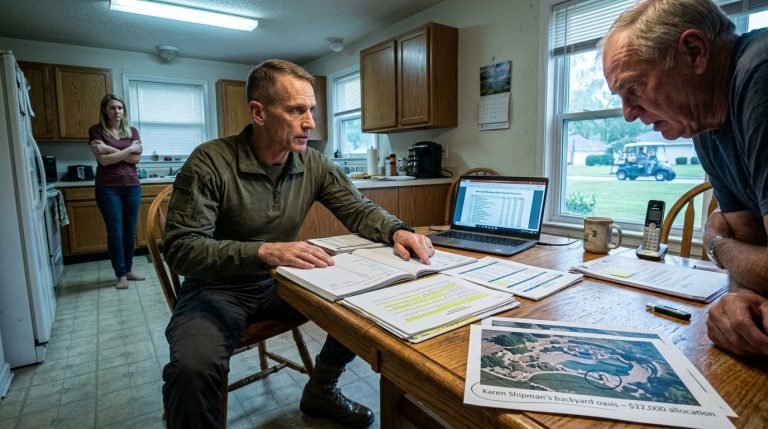
I spent the next twenty minutes uploading the entire dossier: the CC&R excerpts, the timestamped photos of neighborhood violations, the Millers’ affidavit, George’s testimony, and a new piece of intelligence I had secured that morning—a formal, certified appraisal of the four-cord white and red oak stack from a regional specialty lumber mill, pegging the total value of the timber at just over twenty-two thousand dollars.
There was a long, dead silence on the other end of the line. Then Dave let out a slow, razor-sharp whistle.
“Jack,” Dave whispered, his tone shifting instantly from jocular to lethal efficiency. “This isn’t a neighborhood dispute anymore. This is a felony setup waiting to happen. She’s threatening a lien to seize and destroy a private asset worth more than twenty grand based on a vague aesthetic clause? Oh, this is gold-plated ammunition.”
Over the next forty-eight hours, Dave and I worked in tight coordination to draft a legal weapon designed to shatter Karen’s chain of command. It wasn’t just a response letter; it was a formal notice of dispute, a comprehensive injunction, and a multi-party cease-and-desist package addressed not only to Karen in her official capacity, but sent via certified mail to every individual member of the HOA board and the corporate property management firm.
We dismantled her arguments point by point. We cited state fiduciary statutes regarding board member liability, attached the photographic evidence of selective enforcement, enclosed the twenty-two-thousand-dollar timber appraisal, and included an explicit warning: any attempt to tamper with, enter, or remove the wood pile would be treated as criminal trespass and attempted grand theft.
When the green return-receipt cards began trickling back into my mailbox one by one, confirming delivery to every member of the board, I knew the trap was set. Karen’s bureaucratic moat had just been drained. All that remained was to watch how her ego would handle the shockwave.
CHAPTER 6: THE PUBLIC TRIAL
The email notification arrived late on a Tuesday evening, blinking with cold urgency against the dark screen of my office monitor. It was an urgent special notice from the association board, broadcast to every resident in the subdivision under a stark, formal subject line: Review of Ongoing Compliance and Community Standards at Lot 42.
Lot 42 was my address. Karen had chosen to take her grievance off the private correspondence circuit and drag it directly into the open air of a community-wide assembly. She had engineered a public forum, assuming that the theater of a packed clubhouse and the weight of her long-standing authority would cow me into a quiet retraction.
When I brought up the notice on the monitor, Sarah stood beside my desk, her fingers tightly knotting the edge of a kitchen towel.
“Jack, the whole neighborhood will be there,” Sarah said, her voice carrying a tight, anxious tremor. “Her loyalists, the board members who only hear her side—they’ll turn it into a spectacle. What if they vote to uphold the fines?”
I reached out, placing my hand over hers to still the nervous motion of the towel. My touch was steady, grounded in the deliberate calm of a man who had already mapped every sector of the terrain.
“Let them make it a spectacle,” I said quietly. “A public forum cuts both ways. She thinks she’s building a stage to convict me. What she doesn’t realize is that she’s building a stage where everyone else finally gets a microphone.”
The night of the assembly, the community clubhouse was packed to capacity. The air inside was thick with the scent of stale coffee, industrial carpet cleaner, and the nervous body heat of fifty suburbanites packed into folding chairs. At the front of the room, behind a long mahogany-laminated table, sat Karen and the four other board members. Karen wore a severe, dark navy pantsuit that cast a rigid, warden-like silhouette against the white wall behind her. As Sarah and I walked down the center aisle, Karen’s small eyes locked onto mine, burning with a sharp, vindictive triumph.
George Henderson sat two rows back, leaning calmly on his cane and offering a subtle, imperceptible nod as we took our seats in the front row. A few rows behind him, Tim and Jessica Miller sat stiffly, their expressions pale but resolute.
Karen struck her gavel against the wooden block—a sharp, theatrical crack that rattled the water pitchers and hushed the room.
“Good evening, residents,” Karen began, her voice dripping with manufactured solemnity and righteous grievance. “We are here tonight to address a severe breach of community standards. We have a resident who has chosen defiance over cooperation, maintaining an unsightly, hazardous pile of rotting debris that threatens our property values and mocks the rules we all agree to live by.”
She held up the first violation notice like an indictment, detailing a carefully curated, heavily distorted version of events. She spoke of uncooperative attitudes, missed deadlines, and unpermitted clutter, entirely omitting any mention of the diseased oak trees, the selective enforcement logs, or the legal notices her office had received. She played the part of the protective guardian beset by a rogue element, steering the narrative toward a single, inevitable ultimatum.
“The board has prepared a final resolution,” Karen announced, her voice rising with theatrical crescendo as she pointed a finger toward the front row. “If Mr. Turner does not commit tonight to removing the refuse within forty-eight hours at his own expense, we will proceed immediately with a property lien and authorized disposal.”
A heavy, suffocating silence fell over the room. Heads turned toward me, waiting for a outburst, a shouting match, or a retreat.
Instead, I stood up slowly.
I didn’t carry a binder or a stack of crumpled papers. I held a single, small USB drive between my thumb and forefinger. I walked past the front rows, stepped up to the audio-visual console near the projector screen, and plugged the drive directly into the master port.
Karen’s face tightened, her color shifting from pale authority to a blotchy, mottled red. “Mr. Turner, you are out of order. This is an executive board proceeding—”
“It’s an open community meeting, Karen,” Arthur, the board member seated to her left, interrupted sharply. He placed a heavy hand over his microphone, his eyes fixed on her with a sudden, dawning coldness. “He has a right to present his defense.”
The projector hummed to life, casting a brilliant white light across the screen behind the board.
I didn’t yell. I didn’t posture. I clicked the remote, and the first image filled the screen—a crisp, high-definition photograph of the wood stack, showing the clean, uniform sixteen-inch cuts, the meticulous air gaps, and the pristine geometry of seasoned oak glistening under the morning sun.
“This,” I said, my voice carrying an even, conversational resonance that reached every corner of the silent room, “is the hazardous debris in question.”
A low murmur rippled through the rows of folding chairs. I clicked again, bringing up the side-by-side comparison: my wood pile on the left, and Karen’s front yard—choked with faded, chipped plastic gnomes and a cracked, algae-slimed birdbath—on the right.
“The covenants require us to maintain community standards,” I continued, advancing the slide to reveal the photographic evidence of the treasurer’s peeling paint, the unregistered bass boat, and the rusted basketball hoop. “The rules are clear. But my documentation reveals a consistent pattern of selective enforcement. Rules applied rigidly to new residents, while ignored for those close to the board.”
Karen tried to interject, her voice cracking into a high-pitched shriek, but the momentum of the room had already fractured. People were turning in their seats, whispering, nodding in sudden, collective recognition of the hypocrisy on display.
I moved to the final slide. A stark, minimalist white screen bearing a single centered number in bold black type: $22,000.
“This,” I announced, holding up the certified appraisal document, “is the independent market value of the white and red oak timber on my property. It is not trash. It is a private asset. The threat of a lien to haul it away was not neighborhood enforcement—it was an attempted seizure of private property.”
The silence in the clubhouse broke entirely. A collective gasp swept through the rows. Heads whipped back and forth between the screen and Karen, who sat rigid and isolated at the end of the table, her mouth slightly open, stripped of her bureaucratic armor.
Before the board could regain control, George Henderson stood up from his seat, leaning heavily on his cane.
“I’ve lived in this neighborhood for thirty years,” George said, his voice deep and steady. “I remember when Karen forced a widow out over a vegetable garden. I remember when she terrorized a military family over a swing set.”
Tim Miller stood up next, his voice shaking but clear. “She fined us two hundred dollars for sidewalk chalk. We paid it out of fear.”
One by one, hands went up across the room. The dam had burst. Years of quiet intimidation, arbitrary fines, and petty tyranny poured out into the open air. The board members sat frozen, looking at Karen not as their leader, but as a catastrophic legal and financial liability. Arthur slammed his palm down on the table, cutting through the rising tide of testimonies.
“This meeting is adjourned,” Arthur said, his voice trembling with suppressed fury as he glared down at Karen. “The board will hold an immediate executive session. Mr. Turner, all fines and notices against you are permanently suspended.”
I turned away from the projector, stepping back down the aisle as the room erupted into a chaotic murmur of overlapping conversations. The administrative moat had collapsed. Karen sat alone at the front table, staring at a screen that had just exposed every hidden brick of her empire.
CHAPTER 7: THE FINAL TRAP
The quiet that followed the public assembly was not peace; it was the heavy, pressurized calm that precedes a structural collapse. In the days following her humiliation at the clubhouse, Karen did not reach out with letters, calls, or administrative threats. She went entirely underground. But a mind built on absolute control does not accept defeat when stripped of its title; it simply retreats to raw, unstructured impulse.
Anticipating that regression, I had spent the weekend installing two high-definition security cameras—one framing the front approach of the driveway, and the other locked directly onto the geometric face of the oak stack.
It was 5:30 on a cold Friday morning when the first alert chimed silently on my desk monitor.
The screen flickered to life, illuminating the pre-dawn gloom of the cul-de-sac in sharp, high-contrast monochrome. A heavy, battered flatbed truck had just rolled to a halt against the curb in front of my house. A articulated crane arm rose from its bed like a metal insect’s leg, silhouetted against the gray morning sky. A second vehicle pulled in directly behind it—a sleek, dark Lexus.
Karen stepped out of the Lexus wrapped in a heavy trench coat, her face a pale, grim mask of desperate intent. She pointed a gloved finger toward the backyard, shouting instructions to two burly, grease-stained workers who were already unchaining a massive hydraulic grapple claw from the truck bed.
She was bypassing the paperwork entirely. Stripped of her authority and cornered by her own failures, she had chosen direct, criminal execution.
I didn’t hesitate. I didn’t shout for Sarah or wake the house. I moved with the cold, deliberate economy of motion I had practiced a hundred times in tactical staging areas. I pulled on a heavy canvas jacket, checked the cold metal of my phone in my pocket, and walked out the front door into the biting pre-dawn air.
The ground was slick with frost. The flatbed’s headlights cut through the morning mist, casting a harsh, glaring yellow light over my driveway. The two workers were struggling to maneuver the hydraulic claw, their breath pluming into white clouds in the freezing air.
Karen stood near the sidewalk, her arms crossed tight against her chest, her eyes wide and feverish.
I walked down the length of the driveway, my boots crunching rhythmically on the gravel. I stopped twenty feet short of the heavy machinery, placing myself squarely in the lens of the security camera mounted above the garage.
“Morning,” I said, my voice carrying cleanly across the damp asphalt.
The two workers froze, startled by my sudden appearance. Karen spun around on her heel, her face contorting into a violent snarl.
“What are you doing out here?” she shrieked, her voice cracking with manic desperation. “Get back inside your house! This is official association business. We are removing this hazard right now.”
I ignored her entirely, keeping my eyes fixed on the man operating the crane controls. “Gentlemen,” I said, leveling my voice into a calm, authoritative register. “I need you to understand what you’re stepping into. You are currently on private property. The material you are preparing to lift is not debris or waste. It is a private asset with a certified, independent market appraisal value of twenty-two thousand dollars.”
I pulled a laminated copy of Dave Rosser’s legal notice from my jacket pocket and held it up into the glare of the truck’s headlights.
“Your employer has been served with a formal cease-and-desist order,” I continued, every word precise and measured. “If you attach that claw to this property, you aren’t hauling away trash—you are committing felony grand theft. The local police department has already been notified. The moment that grapple touches my wood, I will press charges against your company, and against you personally.”
The two workers exchanged a nervous, wide-eyed glance. The driver dropped his hand from the hydraulic lever, taking a step backward. “Appraisal? Twenty-two grand? Look, lady, you said this was just a standard junk haul,” the driver snapped, turning his glare toward Karen. “We don’t touch felony property.”
“He’s lying!” Karen shrieked, sprinting forward, her composure completely shattered as she abandoned all pretense of bureaucratic decorum. “I am the president! I have the authority! I’ll pay you triple—just crush it!”
She was unraveling in real-time, her voice descending into a frantic, public bribe.
And then, cutting cleanly through the escalating noise, came the sharp, unmistakable strobing of red and blue emergency lights. Two police cruisers turned the corner into the cul-de-sac in tight succession, their tires hissing against the damp asphalt as they boxed in the flatbed truck and cut off Karen’s Lexus from behind.
Car doors slammed shut in unison. Two officers stepped out into the glare, their expressions hard and professional, moving directly toward the center of the confrontation. The trap was fully closed.
CHAPTER 8: THE AFTERMATH AND CATHARSIS
The flashing red and blue strobes painted long, frantic crimson arcs across the frosted metal of the flatbed truck and the hood of Karen’s Lexus. The second officer had already stepped between Karen and the vehicle, his hand resting casually near his duty belt while his eyes scanned the perimeter with steady, unblinking professionalism.
Across the cul-de-sac, front doors were creeping open. Curtains twitched in windows. George Henderson stood silently on his porch, leaning against his cane like an impartial observer at the conclusion of a long campaign, while Tim and Jessica Miller watched from their lawn with phones raised to record the dissolution of an empire.
Karen stood frozen on the asphalt, her chest heaving beneath her heavy trench coat, her mouth working soundlessly as she looked from the police officers to the flatbed driver, and finally, directly at me. The absolute fury that had fueled her pre-dawn raid was rapidly draining away, replaced by something much darker and more fragile: the naked realization of total, public exposure.
“Ma’am,” the first officer said, holding up the certified paperwork and the copy of the cease-and-desist order I had provided moments earlier. “This property is protected under an active legal notice. You directed an unpermitted extraction of high-value private goods. You need to get back in your vehicle and leave the scene immediately, or you will face immediate charges for obstruction and attempted conversion.”
Karen’s lips trembled. For a terrifying, pathetic second, the rigid, shellacked veneer of her authority completely cracked, revealing the raw, hollow core beneath it. The decade of tyrannical control, the weaponized bylaws, and the petty fines had never been about property values or neighborhood standards at all. They were the desperate, defensive mechanics of a woman who had been utterly hollowed out by abandonment—a psychological fortress built to keep the fear of irrelevance at bay by forcing everyone else to bend to her will.
She didn’t scream this time. She didn’t threaten bankruptcy or liens. She simply shrunk into herself, her shoulders caving inward as the weight of her own self-inflicted ruin finally settled over her shoulders. Without a single word, she turned, stumbled slightly on the uneven edge of the curb, and pulled open the door of her Lexus.
The engine roared to life with an aggressive whine, and she backed away in a blind, hasty arc, tires spitting gravel before peeling down the cul-de-sac toward the main thoroughfare.
The flatbed driver wasted no time. At a sharp wave from the second officer, he unhitched his hydraulic controls, scrambled back into the cab, and rumbled away down the street, leaving behind only the smell of diesel exhaust and the quiet, steady hum of the morning wind.
The police officers took my final statement, logged the case numbers into their terminals, and gave a respectful nod before climbing back into their cruisers and pulling away. The immediate threat was gone. The battlefield was clear.
Three months later, the transformation of Oak Ridge Estates was complete. A clean white For Sale sign stood planted in the overgrown grass of Karen’s front lawn, the result of a swift civil settlement negotiated by Dave Rosser that forced her relocation out of the neighborhood under threat of a public discovery trial. With her exile, the atmosphere across the subdivision underwent a profound phase shift. Arthur stepped in as the new association president, formally dismantling the architectural review committee, rewriting the bylaws to eliminate ambiguous nuisance clauses, and replacing the old culture of fear with an open, collaborative community council.
The true catharsis, however, came late that autumn.
The air was crisp and smelled of wood smoke and falling leaves as we built our first large bonfire in the backyard. We didn’t burn the prime white oak; that portion had been sold to a local specialty artisan whose custom furniture commissions more than covered every legal fee Dave had charged, leaving a generous surplus that funded a long-overdue vacation for Sarah and me. Instead, we burned the seasoned remnants, utilizing the warmth of the processed giants to push back the encroaching evening chill.
George Henderson sat comfortably in a folding chair near the fire, puffing slow, steady clouds from his pipe. Tim and Jessica Miller laughed as their young daughters roasted marshmallows on long sticks over the glowing embers. Arthur and several other neighbors had wandered over, joining the circle in an easy, unforced camaraderie that had once seemed impossible.
I stood near the edge of the patio, my hand resting against the smooth, solid grain of the remaining stack of oak—the silent monument that had anchored the entire resistance. I picked up a small hand-planer from the workbench, walking back to a scarred wooden garden bench near the back fence that had suffered from years of weathering and neglect.
With slow, deliberate strokes, I began to shave away the gray, weather-beaten surface of the old bench, exposing the rich, warm timber underneath. Every pass of the blade was smooth and rhythmic, stripping away the decay of the past to reveal something durable and clean.
Sarah walked up behind me, stepping quietly over the grass, and rested her hand gently on my shoulder. She didn’t need to say anything. The fire crackled softly in the background, casting long, dancing shadows across the lawn. The air was quiet, filled with the murmur of laughter and the simple, unbroken peace of a sanctuary successfully defended. The war was over, and the home was finally ours.