The Silent Honor of Highway 13: A Nurse’s Unseen Sacrifice Returned in Full
CHAPTER 1: THE WEIGHT OF AUGUST
The plastic pitcher was cracked near the rim, its yellow handle faded from years of dishwasher heat. Darren Stur held it under the kitchen tap, watching the cold water swirl against four cups of coarse sugar and crushed lemon rinds. Her thumbs were rough around the cuticles, stained faint yellow, and her wrists ached with the dull, persistent stiffness that eleven years of twelve-hour emergency room shifts leave in a body.
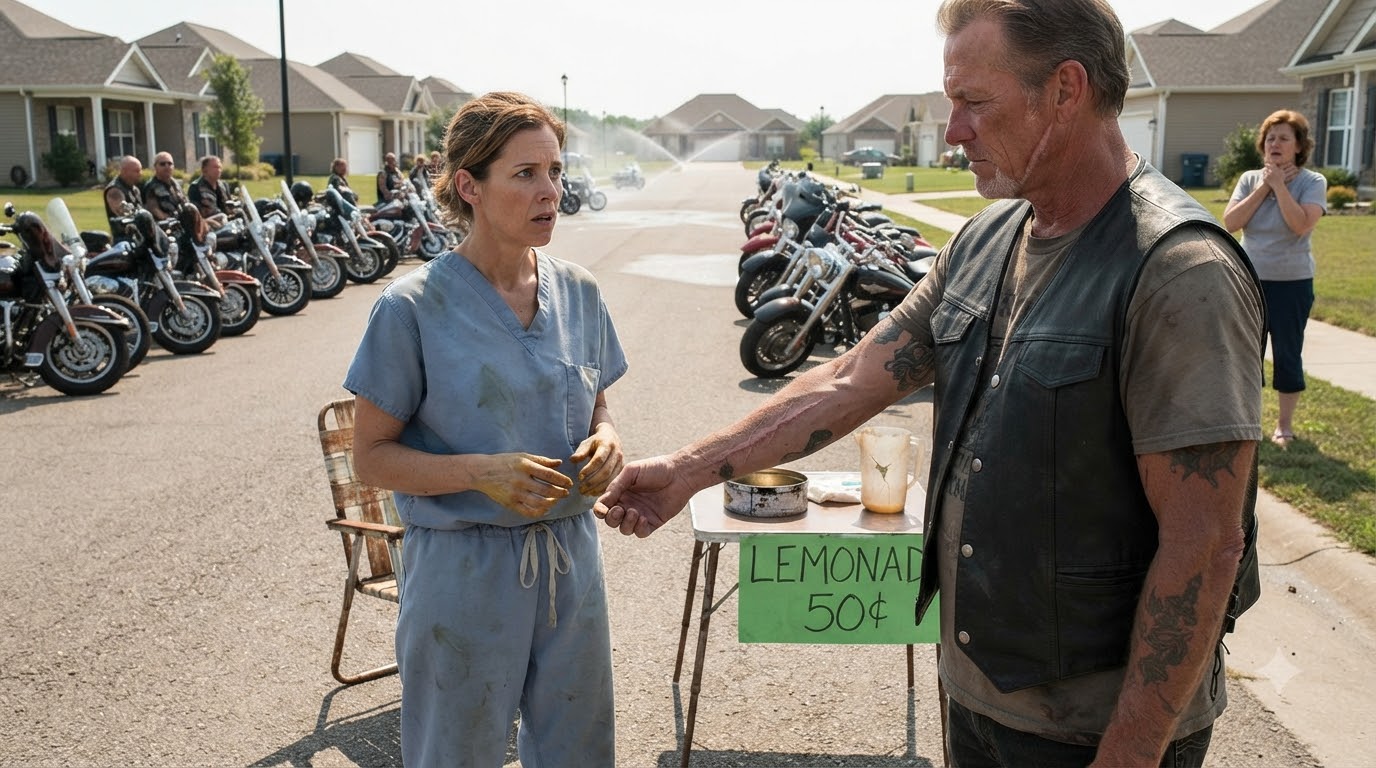
Out on the driveway, eight-year-old Brienne adjusted the card table for the third time. The hand-lettered green sign read LEMONAD 50¢, the letters crowding into each other at the right margin where space had run out. Brienne’s tongue poked from the corner of her mouth as she aligned an empty metal cookie tin in the center of the folding table.
“Mom, is two quarters enough starter money?” Brienne called out, her voice crisp in the humid morning air. “Mrs. Kellerman said real businesses need float.”
“Two quarters is plenty, kiddo,” Darren said, stepping through the screen door. She set the heavy pitcher on the plastic tablecloth, using the cracked measuring cup from the kitchen counter to nudge a loose stone away from the table leg. Her forearm muscles twitched—a tiny, involuntary spasm born of endless chest compressions and dead-weight patient transfers.
She didn’t look at her phone. She didn’t want to see the hospital scheduling app or the pending shift-swap requests. The memory of May was still there, sitting behind her breastbone like cold lead—the young man in Bay 4 whose heart simply refused to restart despite three rounds of epinephrine and forty minutes of flawless, textbook resuscitation. She had washed his blood off her forearms in the scrub sink, walked out to her car, and driven home without saying a word to anyone. The work didn’t ask for tears; it only demanded you show up again at six the next morning.
“First customer at nine,” Brienne announced, checking a plastic watch that clicked loudly with every second.
Darren pulled a rusted lawn chair from beside the garage wall and sat down, resting her hands flat on her knees. The residential street was quiet, suspended in the lazy heat of a Wisconsin late-summer Saturday. A sprinkler clicked rhythmically two houses down. A crow called from the power line overhead.
Then the ground began to vibrate.
It wasn’t a sound at first, but a low-frequency pulse that traveled through the concrete driveway, up the metal legs of the lawn chair, and straight into Darren’s teeth.
Brienne froze, her paper cups held mid-air. “Mom?”
At the corner of the block, the sunlight caught a wall of polished chrome.
CHAPTER 2: THUNDER ON THE PAVEMENT
The thunder didn’t just fill the street; it occupied the air, heavy and thick with the scent of unburned gasoline and road dust.
Darren’s hand tightened around the armrest until her knuckles flared white. She didn’t stand. Eleven years in the trauma bay taught a body how to freeze when a wall of noise came crashing through the doors—you locked your feet, you let the wave hit, and you looked for the anchor.
At the end of the block, the lead bike banked slowly onto her street.
It was a heavy, dark-painted machine, its chrome exhaust pipes gleaming in the harsh August light. Behind it came another. Then two more, riding shoulder-to-shoulder in the disciplined, tight formation of men who had spent thousands of miles reading each other’s rear tires.
“Mom?” Brienne’s voice was small, swallowed completely by the mechanical roar. She had retreated behind the folding card table, her fingers clutching the edge of the plastic tablecloth so tightly the red-and-white checkered pattern puckered.
Thirty Harley-Davidsons filled the quiet suburban street from curb to curb. They moved at a walking pace, an intimidating, deliberate procession that brought Mrs. Kellerman out onto her front porch across the street, her hand clutched to her throat.
One by one, the engines cut out.
The sudden silence was almost louder than the noise—a heavy, metallic stillness broken only by the sharp ping-ping-ping of hot exhaust pipes cooling in the humid air.
Thirty men swung their legs over their saddles. They wore heavy leather vests over faded t-shirts, their forearms thick, scarred, and covered in dark ink. Patches across their backs read MILWAUKEE IONS in arched, embroidered lettering.
They didn’t form a crowd. They didn’t shout.
Without a single word spoken between them, the men stepped onto the concrete driveway and formed a neat, single-file line stretching all the way down to the sidewalk.
The man at the front of the line stepped up to the card table. He was built broad, his face lined by sun and road-grit, with a white scar running along his jawline.
He didn’t look at Darren yet. He looked down at the eight-year-old girl behind the table.
“Fifty cents a cup, little lady?” his voice was a low, gravelly rasp.
Brienne swallowed hard, her small chest rising and falling quickly. She looked at the line of thirty hulking figures waiting patiently on her driveway, then picked up the plastic pitcher with two hands. “Yes, sir. Fresh squeezed.”
The man reached into his leather vest, pulled out a crisp five-dollar bill, and laid it flat beside the cookie tin. “Keep the change.”
He took the small paper cup, took a single sip, and turned toward the garage.
That was when his eyes met Darren’s.
Darren’s breath hitched in her throat. Her eyes dropped involuntarily from his face down to his left arm, where a long, pale, jagged line ran from his wrist all the way to his inner elbow—a scar that had not yet lost its fresh, raised texture.
Pinned near the top flap of his leather vest was a tiny, yellowed strip of faded white surgical tape.
CHAPTER 3: THE SCAR AND THE DEBT
The heat coming off the asphalt was thick, but the space between Darren and the man with the scarred forearm felt colder, suspended in a rigid silence that ignored the hum of the cooling motorcycles.
Darren looked down at his left arm. The pale, thick line running from wrist to inner elbow was unmistakable. She didn’t need a medical chart or a triage tag to recognize the exact contour of that laceration.
“State Road 13,” she whispered, her voice barely carrying over the sound of lemonade pouring into a paper cup.
Ray took a slow, deliberate breath, his broad chest expanding under his leather vest. His left boot hitched slightly as he shifted his weight—a tight, guarded movement of a joint held together by surgical steel.
“All five of us,” Ray said. His voice was flat, devoid of theatrical drama, carrying only the unvarnished weight of a man stating an absolute physical truth. “We made it.”
The cold lead weight behind Darren’s breastbone—the silent, suffocating ghost of the patient she couldn’t save back in May—seemed to crack.
For three hundred and sixty-five days, she had driven home every morning telling herself that what happened after she handed care over to the paramedics was none of her business. She had told herself that an emergency nurse does her job, wipes her hands, and moves to the next bed. But the human mind doesn’t work in clean clinical shifts.
“You don’t have to be standing here,” Darren said, her throat tight. “You don’t owe me a thing.”
“We didn’t ride forty miles across three county lines to pay a debt with words, ma’am,” Ray replied, stepping forward. He opened his broad arms, his leather vest creaking against his shoulders.
Darren didn’t pause. She stepped straight into the embrace.
Her fingers dug into the thick leather of his back. Eleven years of holding composure in chaotic trauma bays, of keeping her face blank while families wept in waiting rooms, dissolved into the coarse fabric of his vest. Her shoulders rose and fell once, hard, releasing a year’s worth of unexpressed exhaustion.
Ray held his ground, solid as an anvil, letting her anchor herself without offering cheap, hollow platitudes.
Behind them, Brienne set down the plastic pitcher with a soft clack. She walked around the card table, wrapped both arms tightly around her mother’s waist, and pressed her face against Darren’s hip, silent and steady.
Down the driveway, twenty-nine other men in leather vests waited in absolute silence, watching the three of them with quiet, unblinking respect.
CHAPTER 4: THE UNSPOKEN CLOSURE
Nobody left. That was the detail that settled over the suburban street like afternoon shade.
The formal transaction was over, the paper cups were empty, and the cookie tin cashbox sat heavy on the plastic tablecloth. But instead of mounting their bikes, thirty members of the Milwaukee Ions scattered across the yard. Denny, the youngest rider, sat cross-legged on the porch step beside Brienne, nodding with complete, serious focus as she explained her exact strategy for buying a purple bicycle with a front basket.
Ray’s wife, Carol, stepped up to the porch, resting a hand gently on Darren’s shoulder.
“He didn’t sleep for two months after they brought him home,” Carol said softly, watching Ray lean against the fender of his bike, his leg stretched out to ease the ache in his rebuilt knee. “He wouldn’t talk about the road. But every time he looked at that scar, he kept saying there was a woman on State Road 13 who held his life together with her bare hands. He needed to find you, Darren. Not to give a speech. Just to show you he was still breathing.”
Darren looked down at her own hands—the same hands that had compressed Ray’s forearm, stabilized a cracked cervical spine, and carried the quiet, suffocating guilt of a lost patient in Bay 4 for an entire year.
The silence in her chest was no longer cold. The unseen weight of that May afternoon didn’t disappear, but it shifted, grounded by the undeniable reality of five men who were standing, walking, and laughing in her front yard.
Brienne marched over, holding out a paper cup covered in scribbled numbers. “Mom! We made one hundred and forty-three dollars and fifty cents! That’s way past forty percent of the bike!”
“Starter capital included?” Darren asked, her voice steady and warm.
“Starter capital counts,” Brienne announced firmly, tucking the cup into her pocket.
Denny stood up from the step, adjusted his leather vest, and gave a sharp nod toward the street. A subtle signal passed down the driveway, completely unspoken, as thirty men simultaneously moved toward their parked machines.
Engines coughed to life one by one, building into a synchronized, compound thunder that vibrated straight through the concrete. Denny shook Darren’s hand, hesitated, and pulled her into a brief, solid hug before swinging his leg over his saddle.
Ray looked across the lawn, met Darren’s eyes, and gave a single, firm nod—a quiet handoff between two people who understood what it meant to survive a hard day.
The long line of chrome and leather pulled away from the curb, moving slowly down the quiet residential street before turning toward the open stretch of Highway 13. The thunder faded gradually into a low rumble, then into memory, leaving the afternoon quiet again.
Brienne picked up the empty pitcher and carried it inside through the screen door.
Darren folded the card table, leaning it flat against the garage wall beside the hand-lettered green sign. She stood at the end of the driveway for a long moment, looking down the empty road toward the horizon.
She had stopped on a Tuesday afternoon because she was a nurse, because someone needed help, and because it was the right thing to do. She hadn’t asked for a name, a check, or a thank you. But a year later, thirty men had ridden forty miles just to buy fifty-cent cups of lemonade and hand her back her peace of mind.
Darren turned around, pulled the screen door open, and stepped inside.