A Desert Ring, A Dirty Cop, and the Biker Who Stood His Ground
CHAPTER 1: COLD DESERT ASPHALT
The neon sign above Rusty’s 24-Hour Diner flickered with a wet, buzzing hum, casting a bloody stain across the oil-slicked asphalt. Two in the morning. The Mojave wind ripped straight through Chloe’s denim jacket, sharp as broken glass, as she crouched behind the dented commercial dumpster. Her knees burned against the frozen gravel. Her stomach had stopped cramping an hour ago, settling into a dull, hollow ache that made her lightheaded.
A glint near the rear tire block of a VIP spot caught the red light.
Chloe crawled forward on her hands and knees, her scraped palms stinging as they scraped over crushed glass. Her fingers, stiff and blue-tinged from the cold, dug into the greasy crevice between the pavement and the concrete curb. When her nails finally hooked around the metal, the sheer weight of it nearly slipped from her grip.
It was a ring. Solid gold, heavy enough to sink a stone in a well. A carved skull wearing a winged helmet stared up at her from the center, flanked by the number 81. Inside the thick band, worn soft by years of sweat and leather, two words were stamped deep into the metal: Filthy Few.
She squeezed her fist around it. Five hundred bucks at a pawn shop at sunrise. Maybe seven if the guy didn’t ask questions about the dirt under her fingernails. That was three weeks of motel rooms, hot soup, and a bus ticket clean to the coast.
Then the ground began to shake.
It started as a low, guttural vibration in the soles of her worn-out canvas shoes, building until the metal dumpster behind her rattled against its concrete pad. Eight heavy V-twin engines swept into the lot, cutting their throttles in sharp, staggered succession. The sudden silence that fell over the lot felt heavier than the roar.
Eight men dismounted. They wore heavy leather cuts, the red-and-white patches stark against the black leather. But there was no laughing, no loud talk. The tallest man in the lead—a broad-shouldered mountain with a graying beard and a jagged scar splitting his left eyebrow—was tearing through his leather saddlebags with frantic, violent jerks.
“It’s not in the leather, Dutch,” the big man growled, his voice like gravel grinding under a boot. “I took the gloves off right here when we pulled up for fuel three hours back.”
“Check the pavement again, Silas,” the second biker said, sweeping a heavy flashlight beam along the gutter. “If you show up at the charter without that ring, the board won’t care that you’ve got twenty years on the road.”
Chloe pressed her back flat against the dumpster’s freezing steel. Her fingers tightened around the gold. Her brain screamed at her to stay put, to let them finish searching and ride out into the dark. But as she watched the massive man drop to his knees in the grease, sifting through cigarette butts with raw, desperate speed, something in her chest tightened. She knew that look. It was the exact same terror she felt every time she looked down at her last dollar bill.
The gravel crunched beneath her shoe before she could stop herself.
Eight flashlight beams instantly snapped toward the dumpster, blinding her in a harsh, white crossfire.
“Who’s back there?” a heavy voice barked. A thick arm reached toward a leather belt sheath.
Chloe held both hands high, her breath coming in fast, ragged puffs. “Don’t shoot. I’m coming out.”
She stepped into the red glare of the neon sign. Her teeth were chattering so hard she could barely keep her jaw steady. Silas stood up slowly, towering over her, his dark eyes narrowed under his scarred brow.
“Get moving, kid,” Silas said, his voice flat with exhaustion. “We aren’t in the mood for beggars tonight.”
Chloe swallowed, her throat dry as sand. She slowly lowered her right hand, reaching into the pocket of her thin jacket. Two of the men stepped forward, their boots striking the pavement with deliberate weight.
“Keep the hand where we can see it,” the lean one named Dutch warned.
“I found it,” Chloe said quietly.
She extended her palm. The gold skull caught the flickering red light of the diner sign.
Silas didn’t move for three long seconds. The silence in the parking lot stretched so thin you could hear the neon tube buzzing fifty feet away. He closed the distance between them in two heavy strides, stopping just inches from her. He didn’t snatch the ring. His massive, calloused fingers reached out with surprising precision, lifting the heavy gold piece from her small, dirt-streaked palm.
He slid it onto his right ring finger. It settled into the worn groove on his knuckle with a faint click.
Silas looked down at her, his scarred face unreadable. He looked at the thin denim jacket, the torn canvas shoes, and the fresh purple grab-bruises dark against her pale wrists.
“You know what a pawn shop would have given you for this?” Silas asked softly.
“A ticket to Los Angeles,” Chloe whispered. “And three hot meals.”
Silas pulled a dented brass Zippo from his vest pocket. He flicked the wheel with a sharp clack, letting the yellow flame dance between them for a second before snapping the lid shut.
“You’re freezing to death, kid,” Silas said, unzipping his heavy leather cut. He draped the thick, oil-scented leather over her shoulders. It weighed almost as much as her backpack, but the trapped heat inside felt like stepping into a warm room. “Get inside. You’re eating.”
CHAPTER 2: GLASS DOOR STANDOFF
“Get inside,” Silas said again, his voice barely louder than the desert wind, but carrying the weight of a iron bar. “Sit in the back booth.”
Chloe didn’t argue. The heavy leather jacket he’d draped over her shoulders smelled of burnt motor oil and stale tobacco, but the warmth trapped inside it was the only thing keeping her legs from collapsing. She stepped past him into the diner.
The place smelled of burnt coffee and fried onions. A lone waitress stood behind the counter, her hands shaking so hard the glass coffee pot she was holding rattled against the burner. In the far corner booth, Dutch was already sliding his lean frame against the vinyl, his sharp eyes scanning the front windows.
The bell above the door jingled.
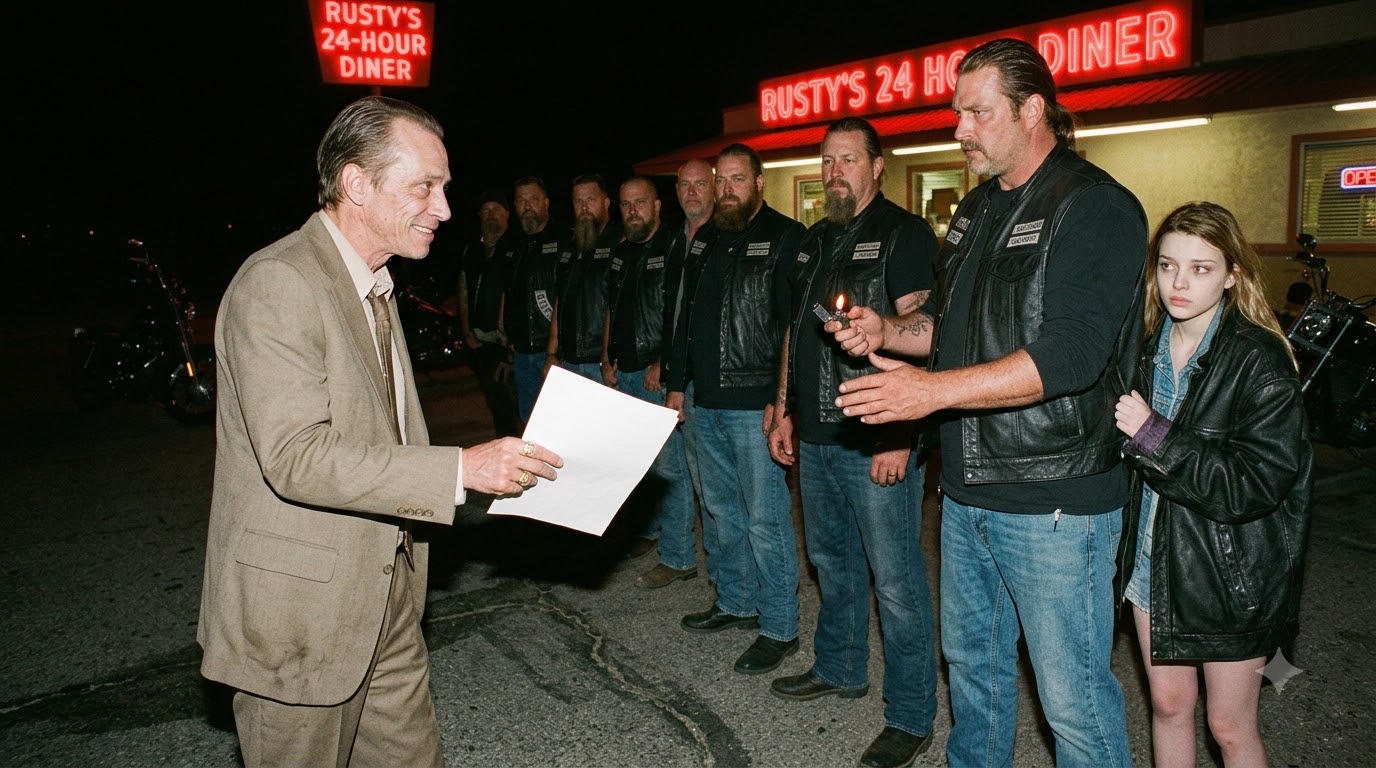
A man in a rumpled tan suit walked in. He didn’t wipe his boots on the mat. His slicked-back hair was thin at the crown, and his pockmarked face carried the easy, practiced smirk of someone who had used a badge as a club for twenty years.
Detective Riggins.
“Look what the desert dragged in,” Riggins said, his eyes locking onto Chloe before she could even slide into the booth. He ignored the eight massive men in leather cuts who filled the space like a brick wall. “Come on, Chloe. Fun’s over. Your foster father’s real worried about you.”
He took three steps toward her, his hand resting casually near his hip.
Silas didn’t reach for a weapon. He didn’t step into a stance. He simply shifted two inches to his left, letting his broad, six-foot-four frame completely erase Riggins’ view of the girl. He pulled his brass Zippo out, flicked it open with a light clack, and held the yellow flame steady between them.
“Diner’s closed, badge,” Silas said smoothly, blowing the flame out with a low exhale. “And you’re blocking the draft.”
Riggins stopped, his smirk tightening into a thin line. He hooked his thumb into his belt, right next to his service weapon, letting his coat pull back just enough to flash the silver shield pinned to his leather holder.
“Back off, Henderson,” Riggins spat. “I’m a sworn officer of the law executing an administrative recovery order for a runaway juvenile. Interfere, and every single patch in this room goes down for obstruction.”
Dutch let out a dry, rustling laugh from the booth. “Administrative recovery? Since when does Reno PD send a homicide detective two hundred miles across state lines for a runaway, Riggins?”
Riggins’ jaw muscles worked, a tiny pulse ticking beneath his pockmarked cheek. He reached into his breast pocket and snapped a folded piece of paper out, slapping it against the air between them. The heavy cream paper caught the neon light—a official state seal stamped crisp and clear at the top, but the space reserved for the regional court routing number was completely blank.
“She’s a fugitive, Henderson,” Riggins said, stepping closer, trying to use his height. “You really want to risk your charter’s federal standing over a stray kid? My backup is two miles down the highway.”
Chloe grabbed the sleeve of Silas’s heavy leather vest from behind him, her fingers digging into the worn denim. “He’s lying,” she whispered, her voice cracking with pure terror. “He works for Richard. He’s the one who brought the papers when Richard took the other two girls away.”
Silas didn’t turn around. He reached back with his left hand, his massive, calloused palm covering her small, trembling fingers for half a second before letting go.
“You got a warrant, officer?” Silas asked softly.
“I don’t need a warrant for a juvenile return,” Riggins snarled, trying to step around Silas’s shoulder.
“Yeah, you do,” Silas said, stepping right back into his line of sight. The gold Filthy Few ring on his right hand caught the sickly fluorescent light of the diner ceiling. “Because she isn’t a runaway anymore. She’s on private property, under my care, and that paper in your hand doesn’t have a judge’s signature on it.”
Riggins stared at the gold ring. A subtle, involuntary flinch twitched through his right shoulder—a biological tell he couldn’t mask as he realized the men standing in front of him weren’t intimidated by the suit or the badge.
“You’re making a massive mistake, Silas,” Riggins said, his voice dropping to a low threat. “Richard isn’t going to let this go. You have no idea what you’re stepping into.”
“Then tell Richard to come get her himself,” Silas said, stepping forward until his chest was inches from the detective’s necktie. “Get out of my doorway.”
Riggins held his ground for two seconds, his eyes darting to the six other bikers quietly closing the space behind Silas, forming an unyielding wall of muscle and leather. He slowly backed toward the glass door, his face pale with cold rage.
“This isn’t over, Henderson,” Riggins muttered, shoving the glass door open. “Not by a long shot.”
CHAPTER 3: THE CRACKED NOTEBOOK
The door swung inward with a heavy thud, sealing the cold desert wind outside. Inside, the room smelled of machine oil, stale coffee, and cold ash.
A tall man with a graying ponytail and a faded leather cut stepped out from the back office. Iron, the charter’s president, didn’t offer a greeting. His pale blue eyes traveled from Silas to the shaking girl wrapped in Silas’s oversized coat, then settled on the worn canvas bag in Silas’s hand.
“Riggins followed you from the diner,” Iron said, his voice flat as a dry lake bed. “He’s sitting at the turnoff in an unmarked cruiser.”
“He came with a blank transport order,” Silas replied, setting the backpack onto the heavy oak table in the center of the room. “No court file number. No county stamp. Just a state seal.”
Dutch pulled a chair out for Chloe, pushing her gently by the shoulder until she sat. Her canvas shoes barely scraped the concrete floor. She looked small against the scarred oak table, her hands tucked deep inside the sleeves of the leather jacket.
“Empty the bag, kid,” Silas said quietly.
Chloe reached over with trembling fingers, unzipping the main pocket. She pulled out a crushed box of stale granola bars, a pair of wool socks, a plastic toothbrush, and a small, cracked leather notebook held shut by a thick rubber band.
Iron reached across the table, his scarred thumb flicking the rubber band off. He flipped the cover back.
The pages weren’t filled with a teenager’s diary. Columns of dates, four-digit numbers, and hand-drawn maps covered the lined paper in a tight, frantic scrawl. Next to every third entry was a set of initials—T.R.—and a dollar amount listed under a column marked County Administrative Transfer.
“This isn’t Richard’s foster care ledger,” Iron said, running his index finger down a list of off-grid shipping routes through Reno and Barstow. “These are highway patrol escort schedules.”
“I thought it was just proof he was stealing the state subsidy money,” Chloe whispered, her jaw tightening as she looked at the paper. “He kept it locked in his desk. Whenever Riggins came to the house late at night, they’d sit at the kitchen table with this book open between them.”
Silas leaned over the table, placing both palms flat on the wood. His brass Zippo sat between his knuckles, cold and silent.
“Look at the dates, Iron,” Silas said, pointing to the last entry written three days before Chloe ran. “That’s not drug drop coordinates. That’s a schedule for transport vans moving through state facilities without inspection stops.”
The realization hit the room like a physical drop in temperature. Layer 1—the idea of a simple corrupt cop protecting a small-time crook—crumbled right there on the oak table. Layer 2 leaked out into the cold air: Riggins wasn’t working a side hustle for a local criminal. He was the logistical anchor for a multi-county trafficking pipeline operating under the cover of state child-welfare transfers.
“He’s not trying to recover a runaway,” Dutch said softly, his fingers hovering over the edge of the notebook. “He’s trying to burn the paper trail.”
Iron slammed the book shut. The sharp slap echoed against the concrete walls.
“If Riggins knows this book is in our building,” Iron said, looking directly at Silas, “he’s not going to call a judge. He’s going to bring every badge on his payroll to this perimeter before sunrise.”
Silas picked up the notebook, sliding it into his vest pocket next to his lighter. He looked down at Chloe, whose eyes were wide with a mix of terror and sudden, cold comprehension.
“He won’t get the book,” Silas said. “And he won’t get her.”
CHAPTER 4: THE GRAVEL PERIMETER
The two patrol cars stopped ten yards from the chain-link barrier. The high beams stayed on, piercing the dust and blinding anyone standing at the gate.
Riggins stepped out of the lead cruiser. He didn’t wear a tactical vest, just his rumpled suit jacket, but his hand stayed resting on the open snap of his leather holster. A younger county deputy stepped out from the second vehicle, his boots shifting nervously on the dry desert dirt as he looked up at the quiet compound.
“Open the gate, Henderson,” Riggins shouted over the idling rumble of the V8 engines. “I’m executing a welfare check under regional juvenile authority.”
Silas didn’t move from the steel beam. He pulled the brass Zippo from his vest, flicking the cap open with a dull clack. He didn’t strike the wheel. He just held the cold metal casing between his fingers, thumbing the edge.
“You brought a junior deputy across county lines for a welfare check, Riggins?” Silas called back, his voice low and steady. “That’s a lot of gas money for a blank transport form.”
Riggins took two steps forward, his boots grinding into the loose gravel. “I don’t need a lecture on jurisdictional boundaries from a man with a felony record. The girl is inside. She’s a flight risk, and she’s carrying stolen property.”
“She’s sitting at a table having a cup of coffee,” Silas said. “And the only thing in her bag was a notebook with your initials stamped next to three off-grid transport routes.”
Riggins froze mid-step. The arrogance on his face didn’t shatter into panic; it hardened into something far nastier. His shoulders squared as he leaned his head toward his shoulder, speaking into his lapel mic.
“Deputy, step up,” Riggins commanded flatly. “We’re cutting the chain.”
The young deputy reached into the back seat of the second cruiser, pulling out a heavy pair of steel bolt cutters. His hands were stiff, his jaw tight with the sweat of a man who knew he was being dragged into something that didn’t smell right.
Iron stepped out from the shadow of the gatehouse. He didn’t carry a rifle. He carried a clipboard clamped with a thick stack of state public-records request filings and a handheld digital recorder, its red recording light glowing steady in the dark.
“Touch that chain, son,” Iron said, addressing the young deputy directly, “and your name goes on a federal civil rights deposition by eight o’clock tomorrow morning. This facility is private commercial property. State police oversight doesn’t cover warrantless entry without a signed judicial order.”
The deputy hesitated, the heavy steel jaws of the tool hovering two inches from the lock. He looked at Riggins. “Detective… you said you had the judge’s signature in the file.”
“Shut up and cut the lock,” Riggins barked, his voice rising in an abrupt, ugly spike of frustration. “I handle the paperwork!”
“He doesn’t have it,” Silas said, stepping right up to the wire mesh of the gate. “Check his breast pocket, kid. The form he showed us at Rusty’s didn’t even have a docket number.”
The young deputy backed up half a step, lowering the bolt cutters. “Sir, if we don’t have a verified warrant on file with the local sheriff—”
“I am the authority here!” Riggins screamed, turning on the deputy, his face flushing dark in the glare of the headlights. “You do what I tell you or I’ll have your badge before you reach the highway!”
Silas snapped his Zippo lid shut with a sharp, final clink.
“You’re out of leverage, Riggins,” Silas said softly. “Drive back to Reno while you still have a car to ride in.”
Riggins stared through the chain-link mesh, his chest heaving, his mouth twisted in absolute, defiant fury. He didn’t order the deputy again. He slowly turned his eyes toward the main building where Chloe was hidden, his jaw working in silence.
“High noon tomorrow, Silas,” Riggins said, his voice dropping to a harsh whisper. “Bring the book to El Mirage. Or I bring forty state badges to tear this fence off its posts.”
CHAPTER 5: THE TRAP AT EL MIRAGE
The patrol car slid to a halt twenty yards away, its engine idling with a wet, heavy knock. The heat rising off the salt flats distorted the horizon, turning the black bumper into a shifting black smudge.
Riggins stepped out alone. He had discarded his suit jacket. His white shirt was soaked through at the armpits, the leather shoulder holster dark with sweat. His face was flushed, his eyes bloodshot and narrow.
“Hand over the envelope, Henderson,” Riggins said, his boots crunching against the salt crust. “You’re thirty miles out of your jurisdiction, standing on federal land.”
Silas didn’t move. He held the manila envelope flat against his chest with his left hand, his right thumb flicking the brass Zippo open and shut. Clack. Clack.
“I’m not holding a notebook, Riggins,” Silas said, his voice flat in the dead quiet of the desert. “I’m holding three certified copies of the transport logs from the Reno regional office. Sent directly to the State Attorney General’s oversight division twenty minutes ago.”
Riggins stopped fifteen feet away, his jaw tightening so hard a muscle twitched near his ear. “You’re bluffing. You don’t have the contacts to move paper that fast.”
“Iron does,” Silas replied smoothly. “And he didn’t use a phone. He walked straight into the county clerk’s office with two state welfare auditors sitting at the desk.”
Riggins’ hand dropped toward his holster, his fingers hooking over the leather strap. “You think some mid-level bureaucrat gives a damn about a runaway kid? I have eighteen years on the job. My word carries weight in every courtroom from here to Carson City.”
“It used to,” Silas said. “Until you signed that blank transfer form in your pocket. The state auditor pulled the serial numbers on your regional transport vouchers. They don’t match any active custody order in the state database.”
A terrible, suffocating silence fell over the salt flats. Riggins’ breath came faster, his chest heaving under his sweat-stained shirt as the institutional shield he’d hidden behind for two decades crumbled under simple, cold arithmetic.
He didn’t pull his gun. He couldn’t. Two unmarked white sedans crested the dirt ridge at the edge of the dry lake, their tires cutting slow, deliberate tracks through the white salt toward them.
Riggins turned his head, his eyes widening as he recognized the state division plates on the leading bumper. His face went from flushed red to a sickly, pale gray.
“You set me up,” Riggins rasped, stepping backward toward his cruiser, his hands trembling as he reached for the car door handle. “You lured me out here.”
“You brought yourself out here,” Silas said, stepping forward until the shadow of his broad frame fell over the hood of Riggins’ car. “You thought because you had a title and a piece of paper, nobody would ever look at the numbers. But the numbers don’t lie, detective.”
Riggins lunged for his open driver’s window, reaching frantically for his radio microphone to call in a false officer-in-distress code.
Silas reached out with one massive hand, slamming the heavy car door shut with a deafening metallic bang that echoed across the empty salt flats, cutting off Riggins’ leverage in a single second.
CHAPTER 6: THE DUSTY QUIET
The late afternoon sun cut through the open bay door, throwing long, warm shadows across the concrete floor. Outside, the desert wind blew through the chain-link fence without kicking up storm dust.
Iron walked into the garage, setting a stack of certified mail receipts on the corner of the bench next to Silas’s brass Zippo.
“Riggins’ state transport license was formally suspended an hour ago,” Iron said, wiping grease off his knuckles with a rag. “The regional district attorney signed the conflict-of-interest transfer. He isn’t coming back down Highway 395, and Richard’s state foster license was revoked by court order before noon.”
Chloe paused, her cloth hovering over the steel handlebar riser. She didn’t jump. She didn’t let out a dramatic breath. She just looked at the paper receipts resting next to the lighter, her small shoulders settling into a quiet, unburdened posture.
Silas laid the pliers down on the bench with a soft metallic click. He reached into his vest pocket, pulled out the thick manila envelope containing her ticket to Los Angeles, and laid it flat on the wood.
“Bus leaves the Barstow depot at seven,” Silas said, looking at the blue printing on the ticket stub. “First class seat. Five hundred cash inside the fold.”
Chloe set her cleaning rag on the workbench. She picked up the envelope, looked at the ticket for two seconds, and then folded it directly in half, tearing the heavy paper right down the center crease with a sharp snap.
She tossed the torn halves into the scrap metal bin beside the workbench.
“Dutch said the parts catalog needs to be indexed by part number before Friday,” Chloe said, grabbing her rag off the wood and rubbing a stubborn spot of road grease off the motorcycle mirror. “And the front shop floor needs sweeping.”
Silas stared at the torn blue paper sitting among the aluminum shavings in the bin. A slow, faint crease formed at the corner of his scarred eye—the closest thing to a smile his face had worn in three weeks.
“Broom’s behind the door, kid,” Silas said, picking up his pliers. “Don’t touch the bench tools until you’ve wiped down the lathe.”