The Weight of the Iron Chain: Engineering Resistance, Subterranean Law, and the Slow Collapse of Suburban Hubris
CHAPTER 1: THE TENSION OF THE LINE
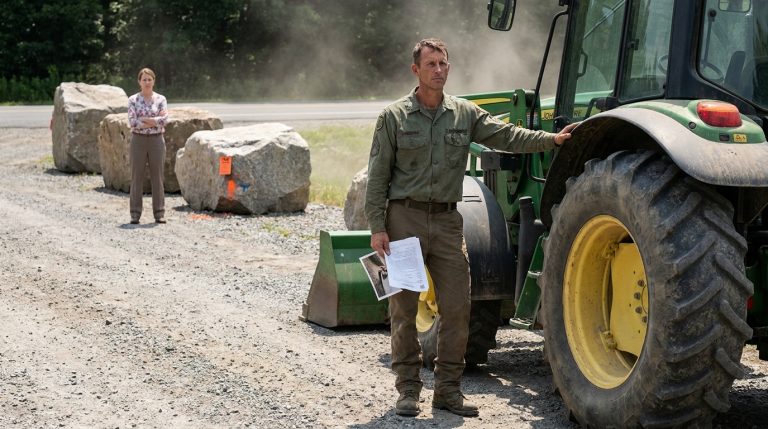
The sun had not yet cleared the high ridge of oaks behind the barn, leaving the northern pasture in a flat, desaturated shadow. John stood with his weight balanced evenly over his boots, hands tucked deep into the pockets of his canvas work jacket. The canvas was stiff with dried mud along the hem—remnants of the drainage ditch he had cut three days ago near the western fence line.
Across the thin yellow string, Karen Miller stood with her boots planted firmly on the manicured sod of Whispering Pines Circle. Her posture was rigid, carved from the same aggressive entitlement that had brought a fleet of heavy-duty tow trucks to his lower gate forty-eight hours prior. Her platinum hair caught the gray morning glare, unmoving in the heavy air.
“You are in direct violation of municipal code seventy-four point two, Mr. Caldwell,” she said, her voice thin and sharp, carrying easily over the dead space between the properties. She tapped a laminated clipboard against her thigh with a rhythmic, mechanical cadence. “The board has ruled. Those bales are an active health hazard. They attract field mice, they retain stagnant moisture, and they destroy the property values of families who invested half a million dollars to live in a controlled environment.”
John let the silence stretch for three slow heartbeats. He watched a single drop of condensation roll off the plastic casing of the security camera mounted to the oak branch above his head. In the military, the loudest voice in the briefing room was invariably the one with the shallowest tactical appreciation. Karen was shouting because she could not see the slope. She could not read the strata beneath her feet.
“Karen,” John said, his voice level, gravelly, and stripped of any conversational padding. “We have been over this twice. That string is three feet inside my deeded parcel. The hay is not stored; it is deployed.”
“It’s rotting garbage!” she snapped, taking a sharp half-step forward as if she might test the nylon string herself. “And as of Friday, the association’s contractors will clear it whether you authorize it or not. You think a retired colonel can just ignore civil bylaws because you own a hundred acres of dirt? This is a modern residential community. We have standards.”
John shifted his weight. The dry earth beneath his right boot gave a faint, satisfying crunch. He looked past her shoulder, down the thirty-degree grade toward the cookie-cutter roofs of Whispering Pines gleaming under their identical architectural shingles. The entire development sat in a natural alluvial basin—a geological pocket that should never have been zoned for slab-on-grade housing without a massive structural retaining wall. The developers had saved three hundred thousand dollars on excavation and drainage, skipped the deep-tier soil stabilization, and left the entire northern tier hanging by a prayer and a sod lawn.
“Standards,” John repeated quietly. He reached down and picked up a clod of dry, gray-brown clay from the edge of his fence line, turning it over in his calloused palm until it crumbled into dust. “You built your foundations on a fifty-year silt deposit, Karen. You spent your money on decorative mailboxes and uniform shutters. But you didn’t check the water table.”
Her face flushed a deep, mottled crimson that clashed violently with her pastel windbreaker. “Don’t lecture me about geology. I have a letter from the county planning commission stating that the site is fully approved.”
“The commission approved what the developer paid them to look at,” John said, dropping the dry dust back to the earth. “The hay stays. And if your husband brings that flatbed up my service road again, I won’t call the sheriff. I’ll let the county surveyor explain to your insurance carrier why your mortgage is currently resting on four inches of uncompacted fill.”
He turned his back on her before she could find the breath for her next shriek, his boots clicking rhythmically against the gravel path leading toward the equipment shed.
Behind him, her voice rose to a frantic, thin pitch, cutting through the morning mist. “You’ll be hearing from our legal counsel before noon, Caldwell! You’re paying for every ton of gravel we have to haul off this hill!”
John didn’t look back. He reached the heavy oak door of the shed, lifted the iron latch, and stepped inside into the dim, cool smell of old machine oil and dry cedar. As the heavy wooden door swung shut behind him, cutting off the last of her shrill cadence, his hand brushed against a small, forgotten leather-bound logbook sitting on the workbench—a record of rainfall levels and soil movement he had kept since the day the developers first cleared the lower timber.
The pages inside were blank for the past week, but tucked neatly between the back cover was a carbon copy of a certified letter he had mailed to the board’s insurance carrier three days ago—a letter whose receipt notification signature had just cleared his digital inbox an hour before dawn.
CHAPTER 2: THE LOGIC OF THE GRADE
The latch clicked home with a dull, heavy thud, sealing out the sharp echo of Karen Miller’s receding voice. Inside the low-timbered shadows of the equipment shed, the air was several degrees cooler than the exposed hillside outside. It smelled of dry cedar shavings, iron filings, and thirty-year-old high-viscosity grease. John did not turn on the overhead fluorescent strip; he let his eyes adjust to the amber light slanting through the high, dust-caked windows on the eastern wall.
He walked past the row of neatly hung mattocks and shovels, his hand trailing lightly over the cold, unyielding handle of a five-foot steel pry bar. The metal was pitted with microscopic traces of rust—maintenance neglected for a morning, but structurally sound.
At the workbench, the leather-bound logbook lay open where he had left it three weeks ago. Beside it sat a stack of heavy manila envelopes containing the photocopies he had pulled from the county planning basement last Tuesday: the original grading permits for Whispering Pines, stamped and approved in a hurry during a municipal commission meeting that had lasted all of twenty minutes.
John pulled out a wooden stool, its legs scraping against the bare concrete floor with a harsh, dry screech, and sat down. He did not open the manila files immediately. Instead, his gaze drifted to a faded black-and-white photograph pinned to the edge of the shelf above the bench. It had been taken during his third deployment in the Balkans—a steep, unstable mountain pass where an entire logistics convoy had nearly slid off a rain-soaked escarpment because the local civil contractor had skimped on sub-base drainage.
The physics of dirt did not change whether the dirt was in the Balkans or sitting on an eighty-acre ridge in the American midwest. Soil had a angle of repose, a saturation point, and a breaking threshold. When water moved through clay and silt, it did not negotiate. It followed gravity with the mindless persistence of a hydraulic press.
He reached out and flipped open the county grading permit, his thumb sliding down the column of numerical data until it hit the civil engineer’s certification signature at the bottom: Prestige Homes LLC, certified by R. Vance, PE.
John reached into his shirt pocket, pulled out a short red grease pencil, and tapped the tip against the figures printed under the soil compaction subsection. The developer had calculated the site’s runoff coefficient using a standard ten-year storm model for flatland clay-loam. They had completely omitted the northern ridge’s thirty-degree slope gradient, treating the hill as a horizontal plane rather than an elevated, water-gathering trough.
A sharp, metallic ping echoed from the far corner of the shed—the cooling metal of the old John Deere tractor ticking as the engine block lost its heat.
The silence that followed was heavy, broken only by the faint scratching of a field mouse behind the wainscoting. John pulled a yellow legal pad toward him and uncapped a black ballpoint pen. He did not write prose. He wrote equations, vectors, and stress loads.
If the northern ridge received more than four inches of sustained rainfall over a twelve-hour period—the kind of atmospheric river system that rolled up from the Gulf every three or four years—the uncompacted fill behind the Whispering Pines backyards would begin to liquefy. Without deep-rooted vegetation or structural retaining walls, the top six feet of earth would lose its shear strength entirely. It wouldn’t wash away in a clean sheet; it would shear off in a massive, cohesive mudslide that would drop four hundred tons of wet clay directly into the rear setbacks of the lower homes.
And Karen Miller was standing at the bottom of that slope with a pair of survey stakes and a yellow string, demanding that he remove the only permeable, friction-based check dams holding the upper pasture in place.
His hand paused over the paper. The office phone in the house—linked to the shed via a heavy underground line—began to ring. A single, sharp electronic trill that cut through the quiet.
John didn’t look up. He knew who it was. The notification email from the insurance carrier had only been the opening bell.
The phone rang a second time, then a third, echoing off the empty galvanized water troughs stacked against the back wall. He let it ring, watching the slow, rhythmic drop of dust motes dancing in the amber shaft of sunlight. In any campaign, the first move of an untrained adversary was to call for reinforcements when they realized the terrain didn’t obey their rules. Karen was about to learn that paper bylaws were completely transparent to water, and that a thirty-degree slope cared nothing for the president of a home-owners association.
He set the grease pencil down, stood up from the stool, and walked to the small refrigerator in the corner to pull out a bottle of cold well water. As he twisted the cap, his eyes locked on the heavy iron chain hanging from a peg by the side door—the spare security chain he kept ready for the moment the property line was tested again.
CHAPTER 3: THE FIRST PAPER TRAIL
The plastic cap clicked shut with a sharp, dry snap. John set the water bottle down on the edge of the workbench, right beside the red grease pencil. The telephone had stopped its shrill pulsing three notes into its fourth ring, leaving behind an exaggerated vacuum of silence inside the timbered shed.
He didn’t return to the house. Instead, he pulled the heavy manila envelope containing the certified mail delivery receipts toward him. The tracking number stamped across the top belonged to the initial warning letter sent to Karen Miller and the four other members of the Whispering Pines board of directors. According to the digital portal on his tablet, the envelope addressed to Karen had been signed for at 10:14 a.m. two days ago by a resident named Miller—presumably Karen herself, or her husband Bill.
John slid a calloused thumb under the metal clasp of the second envelope, breaking the seal with a faint tearing sound of dry paper. Inside lay a copy of the formal notice he had drafted himself, accompanied by the preliminary two-page assessment Mark Peterson had run through his private engineering software.
The prose of an engineer was stark, unembarked by emotion or rhetorical flourish. It spoke in vectors, pounds per square foot, and plasticity indices. Yet to anyone who understood civil mechanics, it was a death warrant for the developer’s financial liability. The report explicitly detailed how the northern slope’s thirty-degree gradient depended entirely on the upper pasture’s root structure and permeable barriers to prevent soil creep from accelerating into a mass-wasting event.
A thin layer of fine dust drifted down from the exposed rafters as a heavy delivery van rumbled past on the county road outside, its tires humming against the asphalt. John listened to the fade of the engine, his mind calculating the distance between the road and his perimeter fence. Karen’s next move wouldn’t be legal; people who relied on laminated clipboards and floral mumu dresses rarely understood the mechanics of litigation until they were already drowning in it. They operated on escalation. If the certified letters and the formal warnings didn’t break his resolve, they would attempt to force compliance through administrative harassment—fines, code enforcement complaints, and petty municipal citations designed to bleed a landowner through paper cuts.
He reached into his jacket pocket and pulled out a folded slip of pink paper—the first municipal fine notice that had arrived in his mailbox three days prior. One hundred dollars for failure to maintain aesthetic standards, accompanied by a grainy, zoomed-in photograph of his hay bales taken from the public shoulder.
John picked up a black marker, drew a clean, heavy diagonal line across the fine amount, and wrote a single sentence across the bottom margin in precise, all-caps lettering: Not subject to HOA jurisdiction per deed recorded August 14, 1994.
He slipped the marked notice into a clean envelope, sealed it, and dropped it into the outgoing mail tray by the door. It was a minor gesture, a routine tactical maneuver in a campaign that was only just clearing its initial skirmish phase. But as he turned back to the workbench, his gaze fell upon the faded aerial photograph of the northern ridge pinned beneath the edge of the tool rack.
The developer’s site plan showed a neat, symmetrical layout of thirty single-family homes, each with its own postage-stamp lawn and pristine concrete driveway. What the plan omitted—what the county commissioners had glossed over during their hurried twenty-minute approval session—was the old drainage swale that had run directly through the middle of the tract before the bulldozers arrived. The developers had filled the swale with uncompacted overburden, graded it flat, and built right over the top of an ancient subsurface spring line.
The hay bales weren’t just stopping surface erosion; they were acting as a slow-release permeable buffer for an entire hydrological system that the builders had tried to pave over.
John reached out, his fingers wrapping around the cold iron link of the security chain hanging by the door. He gave it a firm, downward tug, testing the strength of the anchor bolt sunk deep into the oak framing. The chain didn’t budge.
Outside, the sun slipped lower behind the western hills, casting long, bruised shadows across the dry pasture grass. The air grew perceptibly colder, carrying the dry, metallic scent of an approaching weather front from the southwest. Karen was still calculating her moves based on the assumption that he was a stubborn old farmer with a pile of decaying grass in his yard. She had no idea she was trying to evict a force of nature with a yellow piece of string.
CHAPTER 4: THE ARCHIVE BASEMENT
The drive down to the county seat took twenty-two minutes along the winding asphalt ribbon of Route 9, the old Ford’s suspension groaning over frost heaves that the state highway department patched with cold-mix asphalt every autumn. John kept his hands steady on the cracked vinyl steering wheel, his eyes scanning the rear-view mirror. No tail. No corporate sedan from Prestige Homes, and no floral-patterned golf cart. Just the gray, overcast sky pressing down on the ridge tops like a wet wool blanket.
When he pulled into the gravel lot behind the county administration building, the air smelled of wet asphalt and coal smoke from the municipal heating plant down the block.
The basement archive of the planning department was housed behind a heavy, fire-rated steel door that always stuck slightly at the bottom left corner, requiring a sharp upward lift of the brass handle to clear the concrete threshold. John caught the handle, heaved it upward with a familiar snap of his wrist, and stepped into the chilled, dry air of the records vault.
Brenda, the head clerk, looked up from behind a towering stack of green-bar computer printouts, her bifocals sliding down the bridge of her nose. “Back again, Colonel? You’re going to wear out the floorboards in aisle four before the tax assessment rolls even update.”
“Just checking the sub-grade specifications on the Whispering Pines tract, Brenda,” John said, his voice dropping into the quiet acoustics of the room. “The original drainage annex from ninety-six.”
“Aisle four, shelf three, bottom bin,” she muttered, sliding a yellow requisition slip across the counter without waiting for him to write his name. “Though I don’t know what else you expect to find down there. That project was pushed through the commission faster than a grease-fire through a straw barn.”
John took the slip, nodded his thanks, and walked down the narrow, fluorescent-lit aisle. The air here was dead and chemical, preserved by industrial dehumidifiers that hummed a relentless, low-frequency drone. He pulled down the heavy canvas-bound binder labeled Whispering Pines Phase 1: Geotechnical and Drainage Certification, carrying it over to the scarred oak consultation table under the flickering overhead tubes.
He didn’t start with the final approvals. He skipped straight to the preliminary soil-boring logs completed by the contractor’s geotechnical firm twenty-five years ago.
His forefinger traced the printed data columns, moving past the standardized moisture content percentages until it hit the plasticity index ratings for the core strata underlying the northern boundary line. His jaw tightened. The numbers were technically within legal minimum thresholds for light residential construction, but they had been calculated using dry-season core samples taken during a severe multi-year drought. They had completely disregarded the historical water table data from the spring melt seasons.
A faint scratching sound echoed from the far end of the archive room—another clerk shifting boxes behind the partition.
John pulled out a small pocket notebook and transcribed three specific engineering codes onto the crisp paper. The developer hadn’t just been optimistic; they had intentionally utilized a ten-year storm absorption model for a geographic pocket that required a hundred-year standard under the county’s own municipal ordinances. When the original engineering firm submitted the report, someone—probably a project manager looking to trim thirty thousand dollars off the site-prep budget—had crossed out the recommendation for a deep-tier gabion retaining wall along the upper tree line and replaced it with a simple note: Natural vegetation buffer sufficient.
Natural vegetation buffer. That was civil-service shorthand for let the farmer up the hill deal with the mud so we can sell the houses and clear our escrow accounts.
He closed the binder with a dull, heavy slap that echoed off the concrete walls. The decoy secret—the aesthetic code violations and the petty bureaucratic fines Karen was hurling at his front gate—was nothing more than smoke thrown up to cover the structural vulnerability of the development below. She wasn’t just fighting an old soldier over a pile of hay; she was desperately trying to force him to maintain the unstable anchor holding her entire neighborhood’s foundation in place, all while pretending the physics didn’t exist.
John stood up, tucked the notes into his inner pocket, and slid the heavy binder back into its slot on shelf three. The physical evidence was locked down, documented, and cross-referenced with three separate federal engineering standards.
When he pushed open the heavy steel archive door and stepped back out into the gray afternoon light, the wind had picked up from the southwest, carrying the sharp, metallic tang of ozone and wet earth. The storm wasn’t three days away anymore; it was gathering its weight over the high passes, and the friction between paper law and raw gravity was about to snap.
CHAPTER 5: THE MIDNIGHT BREACH
The wind had shifted by midnight, coming hard out of the southwest and driving a fine, abrasive grit against the windshield of the Ford as John turned off the county blacktop onto his own gravel drive. The dash clock glowed a sharp green: 04:47 a.m.
Inside the darkened house, the low-light tablet resting on the nightstand flickered with a silent, rhythmic green luminescence. John did not turn on the overhead lights. He unzipped his canvas work jacket, letting it drop onto the wooden bench by the mudroom door, and leaned over the tablet screen.
The security feed from the secondary gate camera was active.
A pair of high-beam headlights cut through the pre-dawn murk at the far western boundary line, washing the dry oak trunks in a harsh, glare-white flash before winking out completely. No engine noise reached the house over the rising whistle of the wind, but the thermal signature on the perimeter monitor registered a heavy diesel block cooling against the damp air.
John did not flinch, nor did he rush. In thirty years of engineering logistics, he had learned that an adversary acting out of frustrated hubris always committed their tactical errors in the dark.
On the screen, a dark-jacketed figure stepped out from the passenger side of an F-250 pickup parked squarely across the service lane. Behind the truck, a dual-axle flatbed trailer idled, carrying a compact utility tractor equipped with a front-end loader bucket. Even through the grainy, low-light infrared filter, the silhouette was unmistakable: Karen Miller’s husband, Bill, accompanied by two heavy-set figures wearing high-visibility vests. And stepping out from behind the truck’s tailgate, pulling a dark windbreaker tight against the chill, was Karen herself.
They weren’t waiting for daylight, and they weren’t waiting for a court order. The humiliation of the homeowners meeting and the unyielding wall of certified letters had pushed her past the boundary of administrative posturing. She had decided to settle the matter herself, under the cover of a midnight raid, operating on the delusional premise that removing the hay bales before the incoming storm would erase the evidence of her failure and prove her right all along.
John’s thumb hovered over the screen, sliding down to unlock the encrypted interface. He did not grab a flashlight or a heavy tool. Instead, his fingers moved with measured, deliberate calm.
On the monitor, Bill Miller dropped to one knee beside the gate post, a pair of heavy red-handled bolt cutters braced against the iron link chain. With a sharp, metallic snap that even the wind could not entirely swallow, the links parted. The heavy gate swung wide into the dry buffalo grass.
They were on his land now. The boundary line had been crossed, the lock compromised, and the intent to commit felony vandalism and theft was being executed in real-time under the unblinking gaze of three independent security cameras and two cloud-synced hard drives.
John picked up his phone from the nightstand. He didn’t dial the emergency number immediately. He watched on the tablet as Bill climbed into the seat of the compact tractor, the diesel engine coughing to life with a dark plume of exhaust, and trundled up the slope toward the upper terrace where the first massive round hay bale sat like a silent sentinel against the ridge.
The tractor’s loader tines bit deep into the compressed forage with a dull, tearing sound. Bill jerked the hydraulic control lever, lifting the thousand-pound bale off the earth, turning the machine around in a clumsy, skidding arc, and heading back down toward the flatbed trailer where Karen stood directing them with frantic, stabbing gestures in the dark.
It was time.
John tapped the pre-saved speed dial for the county sheriff’s non-emergency dispatch, his voice steady and low as the dispatcher picked up on the second ring. “This is John Caldwell at 1580 Old Mill Road. I am witnessing an active break-in and felony vandalism on my property. Send a unit.”
He hung up without waiting for the acknowledgment, slipped his phone into his pocket, and walked out the back door into the freezing, wind-whipped dark. The war for the hill had moved from the paper trail to the mud.
CHAPTER 6: THE BLUEANDRED LIGHT
The wind caught the screen door of the mudroom, slamming it back against the weathered cedar siding with a dry, splintering crack. John did not break his stride. He stepped off the back porch and onto the gravel path, his boots crunching rhythmically against the stone as he descended toward the western service gate.
The air was raw, smelling sharply of wet iron and crushed weeds. Ahead, the headlights of the Ford F-250 carved harsh, yellow beams through the blowing dust, illuminating the spinning amber strobe of the utility tractor and the frantic motion of figures scrambling around the flatbed trailer. Bill Miller was in the driver’s seat of the tractor, his face bathed in the sickly orange glow of the dashboard instrument cluster. He had already dropped the front-end loader into a third round hay bale, the steel tines biting into the compressed orchard grass with a dull, heavy groan.
Beside the trailer, Karen Miller stood with her dark windbreaker zipped tight to her throat, her platinum hair whipping across her face in chaotic strands. Her voice carried over the diesel engine’s roar, thin and hysterical. “Hurry up, Bill! Get it on the flatbed before the deputies decide to answer that call. He’s bluffing—he’s just an old man with too much dirt!”
John kept his pace deliberate, unhurried, measuring each step with the cold precision of a field commander observing an enemy unit outmaneuvering itself. He didn’t need to shout. The terrain was doing the work for him. Every pound of hay they loaded stripped away another fraction of the slope’s permeable friction defense, bringing the entire underlying geologic tension closer to its breaking point.
Then, from down on the asphalt of Whispering Pines Circle, the dark silhouette cut through the gloom.
Two twin shafts of brilliant white light swept across the lower fence line, instantly followed by the blinding, rhythmic strobe of crimson and blue. A county patrol cruiser rounded the corner, its heavy V-8 engine growling as it slewed across the damp shoulder and blocked the service lane entirely. A second cruiser pulled up right behind it, cutting off any exit route for the flatbed trailer.
The flashing lights painted the cedar fence posts and the dust-choked air in alternating strokes of violent red and deep, electric blue.
Bill killed the tractor engine instantly. The sudden silence was absolute, save for the whining whistle of the wind through the oak branches.
The lead cruiser’s door swung open with a heavy metallic click. Deputy Harris, a thick-set man with a weathered face and a crease-pressed uniform, stepped out onto the gravel. His right hand rested casually, deliberately, on the holster at his hip. He didn’t draw his weapon, but his eyes swept the scene with an experienced, dangerous calm—taking in the snapped iron chain on the gate post, the tractor idling on private land, and the three heavy hay bales already stacked haphazardly on the flatbed trailer.
“All right,” Harris called out, his voice cutting through the wind like a saw blade. “Everybody step away from the equipment right now. Hands where I can see them.”
Karen spun around, her face flushed a blotchy, frantic white that contrasted sharply with her dark jacket. She marched straight toward the deputy, her hand thrusting a laminated clipboard forward like a shield. “Officer, thank goodness you’re here. We are the HOA board of directors. This man—this trespasser—has been threatening our community, and we are legally abating a public nuisance under association guidelines.”
Deputy Harris didn’t take the clipboard. He let his flashlight beam drop to the jagged, freshly broken links of the iron chain lying in the mud, then raised the beam straight into Karen’s face.
“Ma’am,” Harris said, his tone flat and heavily weighted with institutional authority. “Whose property number is on this gate post?”
Karen blinked against the blinding glare of the flashlight. “That’s irrelevant. The community bylaws state—”
“Ma’am, I asked you a simple question,” Harris interrupted, his voice dropping an octave. “Does this land belong to Whispering Pines, or does it belong to John Caldwell?”
From the shadows near the oak tree, John stepped into the fringe of the cruiser’s headlights, his hands tucked quietly into the pockets of his canvas jacket. “It belongs to me, Deputy. And none of the individuals standing on this trailer have authorization to be past that fence line.”
Karen’s head snapped toward him, her mouth opening and closing like a fish pulled dry onto a dock. “He’s lying! He’s holding our entire neighborhood hostage with a pile of rotting weeds!”
Harris looked past her at Bill Miller, who was still sitting frozen in the tractor seat with his hands planted flat on the steering wheel. The deputy’s gaze flicked back to Karen, then to the flatbed trailer loaded with over six thousand pounds of stolen agricultural property.
“Cutting a lock on private land at five o’clock in the morning isn’t an aesthetic dispute, Mrs. Miller,” Harris said, unhooking the metal cuffs from his tactical belt. “That’s breaking and entering, criminal trespass, and felony grand larceny. Turn around and put your hands behind your back.”
The metallic click of the steel cuffs locking around Karen’s wrists sounded loud and sharp against the howling wind. As the second deputy led her toward the back of the cruiser, her protests dissolved into a choked, sputtering breath of pure, unadulterated disbelief. She had spent a year believing her bylaws were absolute law, entirely blind to the fact that civil reality has no patience for paper tyrants.
John watched them load her into the cruiser, his expression unreadable. The trap was sprung, the arrests were logged, and the legal case was ironclad. But as he looked up toward the upper crest of the hill, where the dark, swelling clouds of the atmospheric river began to crown the ridge, he knew the real adversary hadn’t even arrived yet.
CHAPTER 7: THE ATMOSPHERIC RIVER
The red and blue strobe lights faded into the blowing dust down on the asphalt loop, leaving behind a profound, damp silence broken only by the steady, gathering hiss of moisture hitting the dry earth. John stood by the broken gate post for a long moment, watching the mist thicken into a dense, vertical wall of rain.
The atmospheric river had arrived right on schedule.
He didn’t linger outside. He walked back up the gravel path, his canvas jacket already darkening with heavy drops, and returned to the quiet warmth of the house. Inside, the digital barometer on the hallway wall showed a sharp, plummeting drop in atmospheric pressure. Outside the double-paned kitchen window, the rolling expanse of his northern pasture vanished behind a gray curtain of continuous, driving water.
For thirty-six hours, the sky emptied itself over the ridge.
John sat at the kitchen table with a cup of black coffee, watching the landscape through the streaming glass. On the upper two-thirds of the hill—where the remaining rows of dense, compacted round hay bales still formed an unbroken, permeable barrier—the system performed precisely as civil physics demanded. The water hit the contoured slope, slowed its velocity against the compressed straw, and sheeted gently downward, soaking deep into the clay matrix rather than cutting destructive channels. The ground held.
But down on the western edge of the property, where Bill Miller’s tractor tires had churned up the turf and stripped away the baseline cover during the pre-dawn raid, the narrative changed.
The rain did not absorb; it accumulated. By the second afternoon, tiny runnels of gray-brown slurry began to pool along the boundary line where Karen’s floral-printed string had been staked two weeks prior. The rivulets merged, swelling into a thick, viscous stream of liquefied topsoil and clay. Without root structures or check dams to check its momentum, gravity took over with absolute, unfeeling authority.
A dull, low-frequency thud echoed from the direction of Whispering Pines Circle—a sound like a heavy timber snapping under immense structural load.
John stood up from the table, walked to the window, and raised the sash an inch to catch the soundscape outside. Through the roar of the downpour came the distant, frantic shriek of car alarms and the metallic groan of bending concrete.
The western third of the Whispering Pines development was sliding.
The cosmetic French drains installed by Prestige Homes—designed to handle light lawn runoff during a normal spring shower—choked within minutes on the thick, churning sludge pouring down from the unreinforced grade. The mud slammed directly into the rear setbacks of the lower properties, burying patio furniture, smashing through decorative lattice fences, and rising over the concrete foundation slabs.
On the rear patio of the house directly across from his gate—the property owned by the HOA vice president, Tom Chen—a deep, jagged fracture split the reinforced concrete from corner to corner. The earth beneath the back wall was literally liquefying, sliding away like wet mortar and leaving the rear corner of the house hanging suspended over a freshly carved mud pit.
The structural failure was total, absolute, and entirely self-inflicted. The developer’s twenty-five-year-old shortcut, combined with Karen’s frantic midnight attempt to eliminate the only natural barrier protecting them, had triggered the exact geological event John had mapped out in the county archives.
He pulled the window shut, the glass rattling slightly against the frame as a fresh gust of wind drove the rain sideways across the porch. There was no triumph in the devastation, only the cold, unyielding verification of physical law. Water does not care about bylaws, and gravity does not negotiate with the president of an homeowners association.
CHAPTER 8: THE RUSTED WALL
The rain stopped three days after the ridge gave way, leaving behind a heavy, moisture-laden silence that smelled of wet limestone and rotting sod. John stood on the upper crest of the hill, his boots planted firmly in the damp earth where the last of the rounded hay bales had finally been broken down and tilled back into the topsoil.
Below him, the jagged scars of the slide had been stripped of their mystery. The legal discovery process had unsealed the developer’s original geotechnical files, laying bare the truth that Karen Miller’s frantic administrative tyranny had been designed to mask: Prestige Homes LLC had deliberately falsified soil saturation metrics twenty-five years prior, avoiding the expense of a reinforced retaining wall by shifting structural dependency entirely onto the natural grade of the upper pasture. When the insurance carriers denied coverage due to gross negligence and willful disregard of certified warnings, the neighborhood’s collective illusion evaporated.
A heavy diesel excavator rumbled down on the lower shelf of the slope, its steel bucket scooping out the last of the unstable silt behind Tom Chen’s fractured foundation. A professional engineering crew—operating under the direct consultation of Mark Peterson’s firm—was driving deep I-beams into the bedrock to anchor a permanent, steel-reinforced retaining wall.
Footsteps crunched softly on the gravel path behind him. John didn’t turn until he heard the familiar, hesitant rasp of boots stopping just short of the property line.
Tom Chen stood there, his shoulders hunched under a canvas jacket, holding a set of blue-backed architectural blueprints rolled tight in his hand. His face was gray with the lingering exhaustion of months of insurance depositions and civil litigation.
“Colonel,” Tom said, his voice quiet, stripped of the defensive corporate polish he used to wear like armor. “The county approved the final permits this morning. The contractor starts pouring the footer for the new retaining wall on Monday.”
John turned slowly, resting his hands in the pockets of his canvas work jacket. He looked past Tom down toward the construction zone where the massive steel pilings were being driven into the earth. “It’s the right engineering choice, Tom. Should have been put in twenty-five years ago before a single foundation was poured.”
Tom nodded, unrolling the top edge of the blueprints just enough to reveal the stamped civil seal. “We’re assessing the remaining homeowners to cover the capital costs. The developer liquidated what was left of their escrow accounts months ago, and Karen… Karen’s house sold at a sheriff’s auction last week just to satisfy a fraction of the civil judgments against her.” He paused, swallowing hard. “We wanted to ask—if you’re willing—to oversee the final grade inspection once the concrete cures.”
John looked at the blueprints, then back up at the open, unobstructed horizon of the northern ridge. The threat was neutralized, the fraudulent foundation exposed and corrected, and the community below had finally been forced to accept the unyielding laws of physics and truth.
“I’ll inspect it,” John said evenly. “Not for a fee, and not for the association. But because a structure built on this hill needs to stand square, and it needs to be done right.”
A profound, visible tension drained out of Tom’s posture. He rolled the plans back up, gave a respectful nod, and turned back down the slope toward the construction site without another word.
John waited until the sound of Tom’s boots had faded entirely down the gravel path. The silence returned to the hill, heavy and restorative. He walked over to the edge of the tool shed, his hand reaching out to touch the heavy iron chain hanging on its peg by the side door. The metal was cool and steady beneath his palm—unbent, unrusted, and secure. He lifted the spare link, tested its weight against his fingers, and then let it drop back against the oak framing with a solid, reassuring clink.
The boundary was intact. The earth had settled into its natural repose. And the long, grueling campaign to force reality through the facade of suburban hubris was finally, completely over.