The Architect of Oak Creek: How a Quiet Suburban Lawn Became the Battlefield for Absolute Control
CHAPTER 1: THE WEIGHT OF COLD CERAMIC
The coffee in the mug had stopped steaming three minutes ago, leaving a flat, dark skin across the surface that mirrored the gray asphalt of the driveway. Mark Thorne did not drink it. He held the ceramic cylinder with both hands, his thumbs tracking the micro-fractures in the glaze while Karen Shipman’s voice scraped against the crisp Saturday air like a trowel over dry gravel.
“Forty-eight hours, Mr. Thorne.”
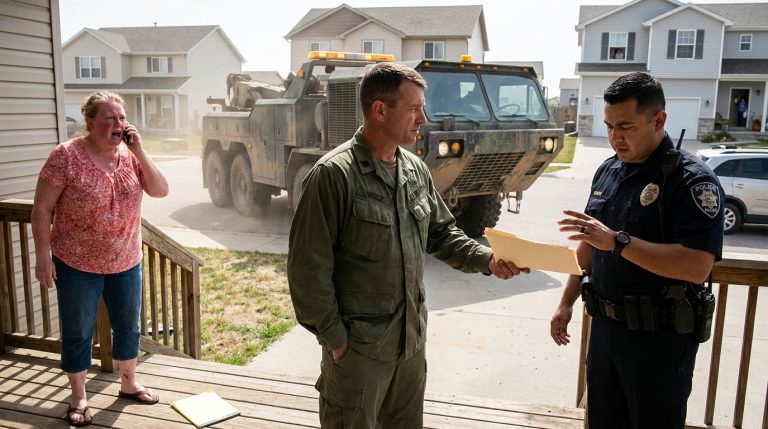
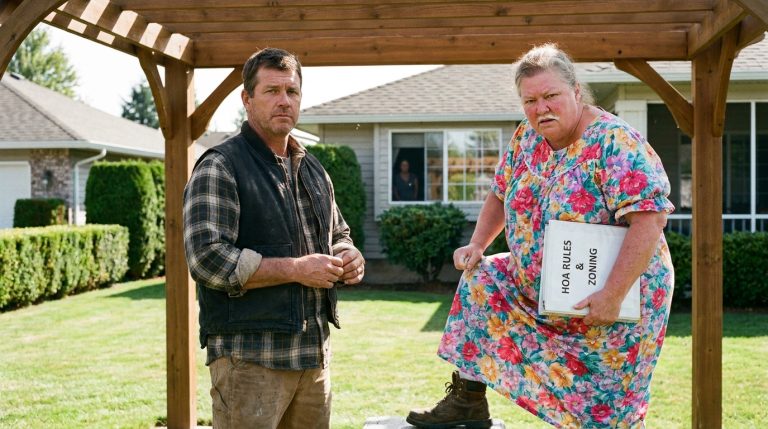
Her floral-print muumuu billowed slightly in the damp morning breeze, a garish smear of synthetic violet against the sterile, hyper-manicured green of Oak Creek Meadows. Behind her, leaning against the side of a rusted Ford, the contractor named Jim rolled a heavy wooden-handled sledgehammer between thick, grease-stained palms. He didn’t look at Mark. He looked at the bespoke cedar structure sitting three feet past the edge of the Kentucky bluegrass—the five-foot-tall solitary bee habitat with its precisely drilled, clean-bored nesting tubes and hand-hammered copper flashing.
Mark’s weight shifted subtly onto his back foot. It was an old combat engineer’s adjustment, a quiet recalculation of balance when terrain and hostile force converged in a restricted zone. He did not blink. His breathing remained shallow and measured, paced at fourteen cycles a minute.
“You’re running an illegal vector for biological hazard,” Karen barked, lifting her clipboard like a magistrate swearing an oath on corrupted Scripture. Her small, bead-like eyes darted over the clean lines of the cedar frame, searching for a splinter, a code violation, a loose screw—anything to justify the ten-thousand-dollar non-compliance fine printed in bold red ink on the top sheet. “Section 7, paragraph B. Unapproved outbuildings. You think because you spent twenty years building bridges overseas that you’re exempt from the bylaws of a civilized community?”
Mark didn’t answer immediately. He let the silence stretch, tightening the space between them until the contractor shifted his weight, the metal head of the sledgehammer clinking softly against the truck bed’s corrugated floor.
The silence wasn’t a retreat; it was an assessment. In the Corps, you never acknowledged a trap until you had mapped its perimeter, measured its load-bearing points, and located the fault line in the concrete. Karen thought she was holding the high ground because she had a clipboard and an idle muscle-bound thug with a demolition tool. But her eyes were tight at the corners. Her knuckles, clamped over the edges of the plastic board, were stark white. She wasn’t calm. She was hunting. And hunters who are too eager always leave their flank exposed.
“It’s not an outbuilding, Karen,” Mark said finally. His voice was low, flat, stripped of all inflection. “It’s a scientific research installation registered with Northwood University’s entomology department. The documentation was filed three weeks ago via certified mail.”
“Lost in transit,” she snapped instantly, a fraction of a second too fast, as if she had rehearsed the denial before the words even left his throat. “The architectural committee has no record. Which means it doesn’t exist. Just like your right to keep unmonitored pests fifty feet from a residential cul-de-sac.”
She turned sharply on her heel, her orthopedic sandals crunching on the pristine gravel of the path, and marched back toward her electric golf cart humming softly at the curb. Jim pushed off the truck, hoisting the sledgehammer to his shoulder with casual menace, and followed her without a word.
Mark watched them go, his gaze tracking the precise arc of Karen’s right elbow as she climbed into the driver’s seat. The cart surged forward, its electric motor whining like a low-frequency drone.
He lowered the coffee mug to the porch railing. The ceramic made a sharp clack against the wood.
He turned and walked back into the dim, cool shelter of the garage, leaving the front door half-open. The workbench was quiet, smelling of raw cedar dust, gun oil, and dried linseed. On the pegboard above the table, neatly organized by size, hung a row of titanium-coated drill bits and precision calipers. He reached out, his fingers brushing past the tools until they stopped at a locked steel filing cabinet tucked beneath the lower shelf.
He didn’t open the main drawer. Instead, he reached behind the heavy metal casing, his fingers finding the small, cold edge of a thumb-drive taped discreetly to the back panel—a digital backup containing every public financial disclosure document the Oak Creek Meadows HOA had published over the last twenty-four months.
As his thumb caught the rough plastic of the drive, the kitchen phone began to ring inside the house—a sharp, single-toned digital chime that cut through the silence of the workshop.
Mark pulled his hand back slowly, his eyes fixing on the doorway leading into the kitchen where Sarah was standing by the counter, holding the cordless receiver against her chest, her face pale.
“Mark,” she said, her voice dropping to a tight whisper as he stepped across the threshold. “It’s not the HOA office. It’s the county tax assessor’s automated line. They just flagged a secondary property transfer under Karen Shipman’s maiden name—and the address listed on the permit isn’t hers.”
CHAPTER 2: THE AUDIT AT THE KITCHEN TABLE
The cordless receiver remained pressed against Sarah’s collarbone for three seconds before Mark crossed the linoleum, his boots making a dull, heavy thud against the floorboards. The digital hum of the refrigerator seemed to sharpen, vibrating in the narrow space between them.
“Repeat that address,” Mark said, his voice dropping into the registers he used when briefing a combat engineer platoon under a fading radio signal.
Sarah’s eyes flicked from the glowing liquid-crystal display of the phone to the stack of unorganized paper files spread across the oak dining table. “It’s off County Road 9. A commercial subdivision project zoned under a holding company called ‘Oak Ridge LLC.’ The primary signatory listed on the deed transfer from four months ago isn’t a corporate entity. It’s a personal trust. And the legal contact is registered to a post office box in downtown Raleigh under Karen Shipman’s maiden name.”
Mark reached out, taking the phone from her hand. The plastic was warm from her palm. He didn’t dial back; instead, he stepped toward the table, pulled out the heavy oak chair, and sat down. The wood groaned under his weight, a familiar, solid sound that grounded him.
“She’s not just a petty tyrant,” Mark murmured, his gaze falling upon the two-year span of Oak Creek Meadows HOA budget reports stacked neatly beside his coffee mug. “A petty tyrant steals control. A professional embezzler buys real estate.”
In the quiet of the house, the transition from defense to offense was not marked by a shout or a slammed fist, but by the dry, rasping sound of a yellow highlighter tearing across a line of administrative expense totals. In the Marine Corps, Mark had spent two decades auditing supply inventories where fuel, concrete, and munitions mysteriously vanished between the port and the forward operating base. The mechanics of theft were always the same: they relied on boredom, complexity, and the assumption that nobody would bother to check the math on page fourteen of a routine public filing.
He pulled the 24-month ledger closer. His thumb traced the column labeled Community Infrastructure & Grounds Maintenance. For twenty-two months, the figures were flat—predictable, boring numbers representing lawn mowing, sprinkler repairs, and seasonal mulching. Then, eight months ago, a sharp spike occurred: a single lump sum allocation of twenty-two thousand dollars approved under the dry, administrative heading of Special Project: Retaining Wall and Water Feature Installation.
“Look at the vendor,” Mark said, sliding the document across the grain of the oak table toward Sarah.
She leaned over his shoulder, her finger tracking the line item. “Green Pastures Landscaping. That’s the same crew Jim works for.”
“Right. But look at the date of the wire transfer.” Mark pointed a calloused index finger at the margin note. “It cleared forty-eight hours before Karen sent me violation notice number 00437. She didn’t target my bee hotel because of the HOA bylaws. She targeted me because I was building something visible in my front yard—something that drew foot traffic, something that forced people to look at my property while her contractors were hauling slate and stone across county lines to build her private patio.”
The psychological weight of the realization settled over the room like fine dust. Karen hadn’t been reacting to a code violation; she had been preemptively striking against any neighbor who maintained too much visibility, too much pride in their own space, for fear someone might look too closely at the books. It was a classic predator-prey mechanism: control the perimeter so nobody checks the den.
Mark opened the laptop resting beside the ledger, waking the screen with a sharp tap of the spacebar. The blue light washed across his weathered face, highlighting the tight lines around his eyes. He didn’t open a browser or a financial app; he opened a clean, encrypted database document he had quietly initialized the moment the first certified warning letter arrived in his mailbox.
“We need more than a county tax record,” Mark said softly, his fingers moving across the keyboard with rhythmic, mechanical precision. “A property transfer under a maiden name is circumstantial. It proves she owns land; it doesn’t prove she stole the neighborhood’s asphalt and fountain funds to build it.”
“So how do we get the proof?” Sarah asked, pulling her arms tightly around herself as she stood by the window, watching the morning mist slowly burn off the manicured lawns across the street. Across the asphalt, an electric golf cart hummed past—not Karen’s, but a neighbor’s, moving at a slow, funereal pace.
“We don’t go looking for a smoking gun,” Mark said, his eyes fixed on the scrolling rows of PDF data sets he had downloaded from the HOA portal. “We look for the sloppy arithmetic. People like Karen build an empire out of rules, but they maintain it through laziness. She hasn’t updated her contractor sign-off sheets since the fiscal year rolled over in March. She’s relying on Gerald to rubber-stamp the physical invoices without cross-referencing the physical site.”
He paused, his cursor hovering over a compressed PDF file titled Q3_Board_Minutes_Signed.
“What’s in there?” Sarah asked, stepping closer.
“The meeting minutes where the twenty-two-thousand-dollar water feature was supposedly voted on and approved by the quorum,” Mark said, a cold, flat edge creeping into his tone. “If Gerald signed off on a community fountain at the north entrance, but the north entrance only has dry dirt and old oak roots…” He clicked the mouse. “…then we have our paper trail.”
The file opened, displaying a scanned, handwritten signature block at the bottom of a formal resolution. But as Mark zoomed in on the document, the light in the room seemed to shift. The signature was there—Gerald’s shaky, compliant scrawl—but directly above it, in the margins where the digital metadata was embedded, was a small, overlooked revision history timestamp dated three days after the community vote had officially closed.
The document had been altered after the fact.
Before Mark could trace the digital footprint further, a sharp, metallic rap echoed against the front door—not the heavy, deliberate thud of a postal delivery, but two quick, aggressive raps knuckles against oak.
Mark didn’t flinch. He closed the laptop lid with a soft, decisive click, stood up from the table, and walked down the short hallway without making a sound, leaving Sarah standing silently beside the glowing screen.
CHAPTER 3: THE QUIET INSURGENCY
The second knock was heavier, striking the oak frame with enough force to rattle the brass kick-plate at the base of the threshold. Mark did not rush. He moved with the measured, economical stride of a man who understood that whoever stood on the other side of the timber was operating on a timeline dictated by impatience, while his own rhythm was governed by absolute tactical control.
His hand closed around the cold, brushed-steel handle of the front door. He turned it smoothly, pulling the heavy panel inward without a sound.
It wasn’t Karen.
Standing on the brushed concrete porch was Dave, the retired accountant from two doors down, whose face looked like a topographic map of long-suppressed anxiety. In his right hand, Dave clutched a crumpled manila envelope, his knuckles grey against the paper. Behind him, the morning sunlight caught the sharp edge of the street curb, casting long, lean shadows across the manicured turf.
“Mark,” Dave breathed out, his voice a low, raspy flutter. He didn’t wait for an invitation; he stepped past Mark into the cool dimness of the entryway, his eyes darting toward the living room archway before settling back on Mark’s face. “I saw Karen’s golf cart heading toward the north cul-de-sac ten minutes ago. She’s carrying a stack of yellow notices. The emergency meeting flyers. She’s dropping them off at every house where she thinks people might be softening.”
Mark closed the door behind him, the latch clicking home with a solid, reassuring thud. He didn’t offer a seat or exchange pleasantries. “Let her drop them,” Mark said quietly, his voice maintaining its flat, level register. “Paper is cheap, Dave. But people are starting to read the fine print.”
Dave swallowed hard, his hand trembling slightly as he lifted the manila envelope. “They’re reading it, yeah, but they’re scared. You don’t live in Oak Creek Meadows for twenty years without learning what happens to people who get crosswise with the architectural committee. Look at my Japanese maple—she made me dig it up by the roots because it was two feet out of alignment. She treats the bylaws like a loaded gun.”
Mark took the envelope from Dave’s grip. The paper was cold. Inside were three photocopied pages of neighborhood gossip sheets, interspersed with aggressive warnings about property devaluation and biological liabilities. It was amateur propaganda, but it carried the weight of institutional intimidation.
“A gun only works if you’re afraid to get scratched by the hammer,” Mark said. He walked back toward the kitchen threshold, signaling Dave to follow.
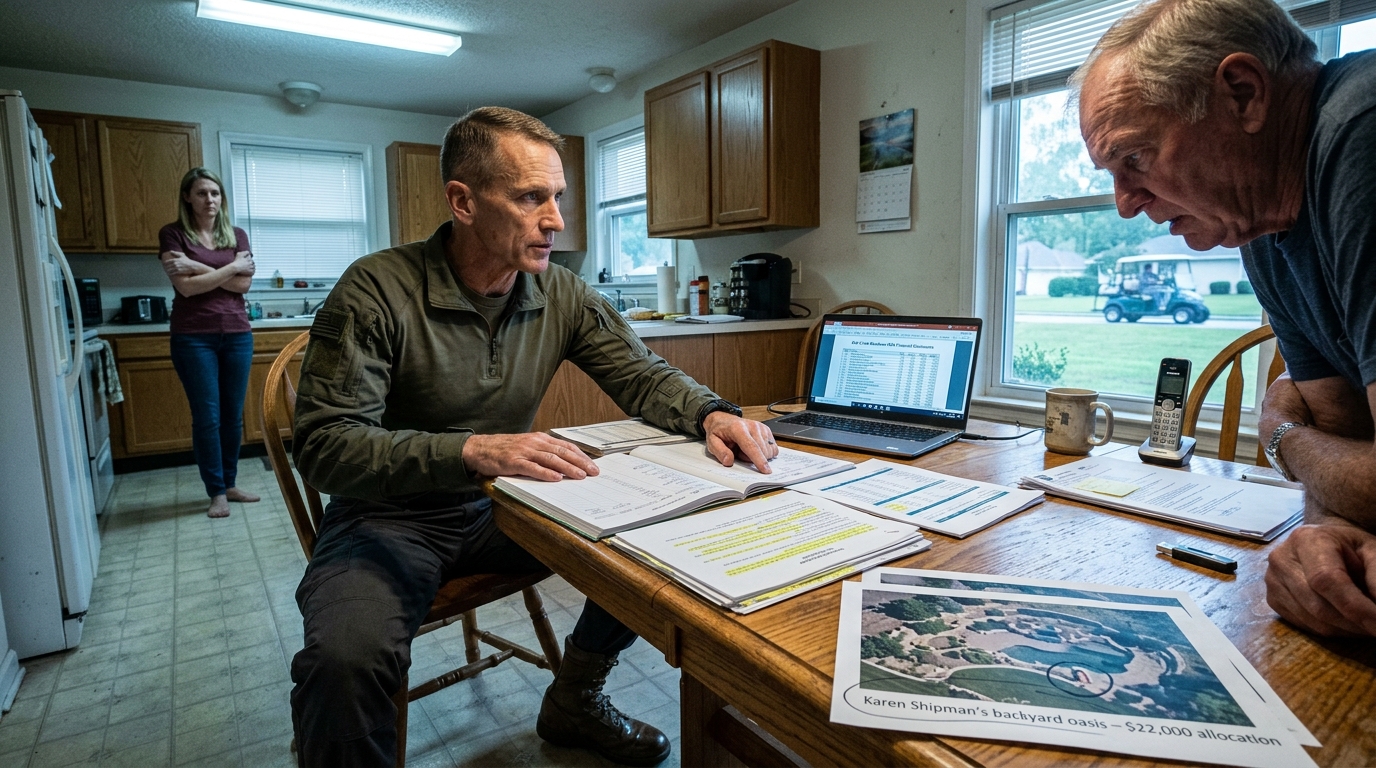
As Dave stepped into the kitchen, his eyes caught the sprawling layout of printed spreadsheets, highlighted budget ledgers, and satellite property views spread across the oak dining table. Sarah stood by the counter, her posture rigid, her hands resting flat against the laminate surface. She gave Dave a tight, empathetic nod.
“What is all this?” Dave whispered, stopping short as his accountant’s eye immediately locked onto the columns of financial data. He stepped closer, peering down at the twenty-two-thousand-dollar line item under Special Project: Retaining Wall and Water Feature Installation. His breath caught. “Wait a minute. I signed off on the quarterly infrastructure review in February. This line item wasn’t in the summary packet distributed at the general assembly.”
“No,” Mark said, pulling out a chair and leaning against the backrest. “It wasn’t. It was buried in the supplemental maintenance addendum under a generic vendor code for Green Pastures Landscaping. Gerald signed the authorization, but the physical work was never done at the north entrance.”
Dave reached out, his finger touching the satellite photograph of Karen’s backyard oasis—the multi-tiered stone retaining wall, the slate patio, and the gurgling stone fountain captured cleanly from orbit. The silence in the kitchen grew heavy, thick with the realization of systemic betrayal. Dave’s jaw tightened, the slack lines of fear on his face hardening into something sharp and unforgiving.
“She’s been bleeding the association dry,” Dave muttered, his voice dropping an octave. “For four years, every time we asked why our quarterly dues went up eight percent, she blamed inflation and municipal water taxes. It wasn’t taxes. It was her landscaping.”
“That’s why she’s panicking,” Sarah said quietly, stepping forward with a fresh mug of coffee and placing it gently beside Dave’s hand. “The bee hotel isn’t a zoning infraction. It’s a spotlight. My husband built something clean, public, and permanent right where everyone could see it. It drew eyes to the front yard. And people who look at yards eventually start looking at ledgers.”
Dave picked up the ceramic mug, wrapping his cold fingers around the warm clay, but he didn’t drink. He looked from Sarah to Mark, his eyes clearing of the lingering fog of suburban submission.
“She’s calling an emergency assembly for next Friday,” Dave said, his tone turning transactional and sharp. “She wants a binding community vote to authorize immediate physical demolition of your bee habitat using an outside contractor, billed directly to your property tax lien. She thinks she can railroad the vote before anyone has time to ask questions.”
Mark’s gaze narrowed slightly. A cold, steady clarity settled behind his eyes. In tactical planning, when an adversary attempts to force a quick, decisive engagement on unfavorable terrain, you do not retreat; you draw them into an ambush of their own making.
“Let her schedule the meeting,” Mark said softly, his fingers tapping once against the oak backrest. “Let her book the clubhouse, print her yellow flyers, and line the front row with her loyalists.”
Dave frowned, a flicker of doubt crossing his features. “Mark, if she holds a formal vote and the majority of the room gets spooked by her killer bee narrative, the board passes the demolition order legally. Once it’s an official HOA resolution, even university lawyers have to wade through months of civil injunctions to stop them from tearing your work down.”
“She won’t reach the vote,” Mark replied, his voice devoid of arrogance, carrying only the weight of a calculated certainty. “Because by next Friday, the agenda won’t be about my bees. We are going to hand her a microphone, project her private patio onto the community clubhouse screen, and let her explain to eighty angry homeowners why their association fees built her stone fountain.”
Dave stared at Mark for a long, unbroken moment. Slowly, the corners of the older man’s mouth twitched upward into a grim, humorless smile. He set the coffee mug down, the ceramic clicking softly against the wood, and reached out to tap the edge of the financial ledger.
“I still have my old ledger sheets from when I served on the fiscal oversight committee three years ago,” Dave said quietly. “If you want to prove she altered the digital metadata on those authorization stamps, I can show you how Gerald’s signature was digitally cloned from an old maintenance release form.”
Mark nodded once, a sharp, decisive motion. “Bring them tonight. We have six days to build the dossier. And Dave?”
Dave paused at the kitchen threshold, looking back over his shoulder.
“Keep your head down until then,” Mark said. “Don’t let her see you smiling.”
CHAPTER 4: THE CLUBHOUSE AMBUSH
The screen of the laptop remained dark as Mark slid it into the padded compartment of his canvas tool bag, the zipper teeth hissing softly against the fabric. Outside the kitchen window, the autumn dusk was bleeding a bruised purple across the tops of the mature oak trees lining Arbor Lane. Across the street, the windowpanes of Mrs. Henderson’s house reflected the amber glow of a single porch light—steady, unblinking, and entirely devoid of the curtains-drawn isolation that had characterized the block forty-eight hours prior.
Mark zipped the bag, hoisted it by its reinforced nylon handles, and walked out to the front porch. The cool evening air carried the dry, metallic scent of falling leaves and asphalt cooling down after a warm afternoon.
He didn’t stay hidden. He walked straight down the aggregate concrete path, his boots striking a rhythmic, measured cadence against the pavement, heading toward the north cul-de-sac where the community clubhouse sat like a low-slung concrete bunker surrounded by a perimeter of dwarf boxwoods.
He needed to check the venue layout before Friday night. In any operation, knowing the architecture of the engagement zone was half the tactical victory.
The clubhouse parking lot was empty save for a single white utility van parked near the side service entrance. Mark kept to the deep shadows cast by the overhanging branches of a weeping willow, his eyes tracking the perimeter lights, the position of the emergency exits, and the primary electrical conduit box on the exterior brick wall. Everything was standard municipal build—cheap commercial locks, drop-ceiling panels, and a wall-mounted projector screen pulled down over a corkboard lined with outdated community pool schedules.
As he reached the rear service corridor, a low murmur of voices drifted through the heavy metal fire door.
“…she’s got the flyers out on every porch between here and the creek,” a woman’s sharp voice snapped, cutting through the muffled interior hum of the building’s HVAC unit. “If the board passes the demolition order on Friday, Thorne’s structure comes down whether he likes it or not. Karen has the proxies lined up.”
“I don’t know, Brenda,” a second, more hesitant voice replied—Gerald’s reedy, nervous cadence. “The university lawyer sent three pages of single-spaced federal grant citations to the corporate office. If we touch that bee habitat and it turns out to be federally protected ecosystem research… well, liability doesn’t just stop at the HOA ledger. It rolls downhill straight onto the executive committee.”
“Karen says the grant is a bluff!” the first voice retorted, the sound of a fist slapping hard against a wooden clipboard ringing sharply through the steel door. “She’s been running this neighborhood for four years. Nobody crosses her and stays. We just need the quorum vote, and Jim’s crew will take care of the rest with the sledgehammers before Saturday morning.”
Mark stood motionless in the shadow of the brick pillar, his breathing slow and shallow. He didn’t blink. The information was exact, clean, and entirely predictable. They weren’t waiting for a debate; they were engineering a fast-tracked, pre-vote demolition to eliminate the physical evidence before the legal department could serve an injunction.
He didn’t step forward. He didn’t bang on the door or give away his position. He simply backed away two paces, his boots sliding silently over the damp concrete, and traced his route back along the edge of the shadow line toward Arbor Lane.
The perimeter was porous. The enemy was relying on institutional momentum and raw intimidation to carry a rigged vote. But momentum, Mark knew from years of engineering combat logistics, was a fragile thing if you knew where to wedge the crowbar.
When he reached his own driveway, the amber porch light was on, casting a long, sharp beam across the base of the solitary bee habitat. The copper flashing caught the light, gleaming like a thin line of fire against the dark cedar grain. A single, heavy-bodied mason bee crawled slowly along the rim of a nesting tube, its wings twitching once before disappearing into the warm, dry interior of the wood.
Mark stepped onto the porch, set his tool bag down beside the front door, and reached into his jacket pocket. His fingers found the small, folded printout of the twenty-two-thousand-dollar landscaping invoice—the one tied to the private slate patio and gurgling stone fountain sitting quietly behind Karen’s kitchen window three streets over.
The trap was fully baited. On Friday night, the clubhouse doors would open, the projector would drop, and the ledger would speak.
CHAPTER 5: THE FALL OF THE LEDGER
The air inside the Oak Creek Meadows clubhouse was thick with the chemical tang of cheap lavender air freshener and the heavy, collective respiration of ninety residents packed into folding metal chairs. The room hummed with a low, anxious frequency—a nervous friction born of yellow information flyers, whispered warnings of aggressive insect swarms, and the heavy institutional authority radiating from the front of the hall.
Mark did not take a seat in the rows of folding chairs. He stood quietly near the rear exit panel, his weight balanced evenly over his boots, his canvas tool bag resting against the base of the concrete wall. Beside him, Alan Davies adjusted the strap of a slim leather portfolio with unhurried precision, while Dave stood near the side emergency exit, his eyes fixed on the front lectern.
At the podium stood Karen Shipman. She wore her vibrant purple pantsuit like armor, her fingers resting lightly on the polished mahogany edges of the speaker’s stand. Beside her, Gerald hovered like a pale shadow, clutching a thick stack of printed proxy ballots against his chest.
“This emergency assembly of the Oak Creek Meadows Homeowners Association is now in session,” Karen’s voice boomed through the clip-on microphone, sharp and practiced. Her gaze swept over the crowd, landing briefly on the back row before she launched into her opening address. She painted a vivid, calculated picture of impending disaster—invoking liability, community standards, and the urgent necessity of authorizing an immediate, binding vote to remove the unauthorized biological hazard located at 112 Arbor Lane.
She spoke with fluid, rehearsed rhythm, never once mentioning Mark by name, reducing him to a mere case number and a threat to property values. A low murmur of agreement rippled through the front rows, reinforced by the quiet nods of her loyalist committee members.
When she finished her fifteen-minute diatribe, a synthetic smile touched the corners of her mouth. “The floor is now open for a motion to approve the expedited demolition order,” she announced, lifting her gavel with theatrical flair. “Is there a second?”
“I call point of order,” a steady, low voice cut through the murmurs before anyone in the front row could move.
The room went dead silent.
Mark didn’t raise his voice. He simply stepped out from the deep shadow of the rear exit corridor into the harsh amber glare of the overhead fluorescent lights. Every head in the room whipped around. Karen’s hand froze mid-air above the gavel, her small eyes narrowing into hard, bright beads as she recognized the man standing at the back of her domain.
“The resident at 112 Arbor Lane has been allocated five minutes for public comment,” Karen snapped, recovering her composure with a sharp twitch of her chin. “Your time will come during the formal vote processing, Mr. Thorne. Right now, the board is entertaining a motion for—”
“The agenda has changed, Miss Shipman,” Alan Davies interrupted smoothly. The university lawyer stepped past Mark, walking deliberately down the center aisle toward the front of the room, carrying his laptop like a case file. “Before the board votes on architectural enforcement, the association has a legal obligation to review a matter concerning material discrepancies in the community’s public financial disclosures.”
Karen’s face lost two shades of color in a single heartbeat. “You have no jurisdiction here,” she spat, her voice rising an octave, losing its polished edge. “This is a private property governance meeting. Gerald, call for the vote—”
“Gerald signed the authorization addendum under duress of a cloned digital stamp,” Davies said, his voice cutting through the rising panic like a scalpel. He reached the front table, flipped open his laptop, and connected the display cable to the clubhouse’s main ceiling projector.
The screen behind Karen flickered violently, white light splashing across the corkboard before resolving into a crisp, high-resolution digital image of a financial ledger.
The room erupted into an immediate wave of cross-talk and shifting chairs.
“Look at the line item,” Dave called out from the side aisle, his voice carrying the calm authority of an experienced accountant. “Twenty-two thousand dollars allocated for a north entrance water feature that was never built.”
Davies clicked the trackpad. The screen shifted again. This time, a satellite photograph of a sprawling, multi-tiered stone retaining wall, slate patio, and gurgling three-tiered fountain appeared in bright, undeniable detail, circled in bold red ink.
“And here,” Davies said quietly, “is where that community water feature was ultimately installed. Directly behind Miss Shipman’s private residence.”
The silence that followed was absolute, heavy, and suffocating. Ninety pairs of eyes shifted from the glowing projection screen back to the podium. Karen stood frozen, her mouth slightly open, the purple pantsuit suddenly looking less like armor and more like a costume.
“That’s a lie,” she choked out, her voice cracking as she pointed a trembling finger at the screen. “That was a prototype! A design test for association use—”
“A prototype funded by twenty-two thousand dollars in unauthorized association wire transfers,” Mark said, stepping forward until he stood halfway down the center aisle, his voice steady, low, and stripped of all anger. “You didn’t target my research installation because of the bylaws, Karen. You targeted it because I built something visible. You couldn’t risk anyone looking too closely at a neighborhood where you were writing the rules with one hand and emptying the treasury with the other.”
The facade collapsed. Gerald dropped his stack of proxy ballots—the white papers fluttering down like broken wings across the linoleum floor.
Bill, the retired Army sergeant sitting three rows from the front, stood up slowly. His heavy boots creaked against the floor. He looked back at Mark, gave a single, microscopic nod, and then turned his gaze toward the silent assembly.
“I move for a vote of no confidence in the executive board,” Bill said, his gravelly voice filling the entire hall. “Effective immediately.”
CHAPTER 6: THE COPPER FLASH AT SUNSET
The heavy metal exit door of the clubhouse swung shut behind Karen Shipman with a dull, flat thud, cutting off the trailing murmur of the assembly. Inside the hall, the silence held for three full heartbeats before breaking into a ragged, collective exhale. Gerald, the mousy treasurer, remained hunched over the scattered white proxy ballots littering the linoleum, his hands trembling as he stared at the floor. He didn’t look up when Bill stepped past him toward the podium.
Mark stood motionless near the back row, his canvas tool bag still resting against his knee. He did not cheer, nor did he join in the sudden, sharp wave of chatter that rose from the middle rows where Dave and Mrs. Henderson were already speaking in low, animated tones. In engineering, a structural collapse required a precise sequence of stress releases; only when the final load-bearing timber settled did you verify the integrity of the foundation.
“The motion carries,” Bill announced, his gravelly voice steady as he gripped the edges of the mahogany lectern. “Eighty-seven to four. The executive board is dissolved. Interim governance takes effect immediately.”
The transition was neither graceful nor prolonged. Within twenty minutes, the clubhouse had emptied into the cool autumn night. The forensic audit initiated by the new interim board under Dave’s supervision would ultimately uncover nearly seventy thousand dollars in misappropriated funds over Karen’s four-year tenure—a systemic exploitation of bureaucratic opacity disguised as neighborhood protection. But on that night, the immediate victory belonged to the quiet reclamation of order.
Mark walked home alone under the pale amber glow of the streetlights, his boots crunching softly over the dry maple leaves scattered along Arbor Lane.
When he reached his driveway, the evening air was dead still. There was no electric golf cart humming at the curb, no threatening yellow flyers taped to the post, and no sledgehammer leaning against a rusted tailgate. There was only the quiet, steady hum of the solitary bee habitat standing tall beside Sarah’s prize-winning rose garden.
The copper flashing caught the last fading rays of the western sun, glowing with a sharp, warm line of light against the dark, untreated cedar grain.
Inside the house, the hallway was dark, but a warm streak of yellow light spilled from the kitchen threshold where Sarah stood by the counter, holding two mugs of coffee. Mark stepped across the threshold, pulled off his canvas tool bag, and set it down against the base of the workbench in the garage before walking back to join her.
He didn’t speak of the clubhouse vote, nor did he replay the exact moment Karen’s face went pale beneath the projector light. Those logistics were closed files. Instead, he took the ceramic mug from Sarah’s hand, his fingers brushing against hers—a brief, grounded contact that steadied the long weeks of tension.
“The audit team from the county prosecutor’s office called while you were walking back,” Sarah said quietly, her voice soft against the low hum of the refrigerator. “They have the invoices, the digital metadata logs, and the satellite property transfers. Her lawyer didn’t even file an injunction.”
Mark nodded once, taking a slow sip of the coffee. The liquid was dark, hot, and clean. “She built an architecture out of fear,” he said, his voice level. “And fear doesn’t hold up when the math changes.”
“And the bees?” Sarah asked, a faint, tired smile touching the corners of her mouth.
“They’re settled in for the night,” Mark replied.
Two days later, the formal public apology from the new HOA board was published on the community portal, replacing the old bulletins with clean, transparent governance. The fines against 112 Arbor Lane were permanently voided, and the architectural review guidelines were rewritten from the ground up to favor community initiative over punitive control. Down the street, Sergeant Major Bill’s twenty-five-foot flagpole stood tall against the clear blue sky, flying the garrison flag with absolute, unhindered pride.
On a quiet Sunday afternoon three weeks after the vote, Mark stood in his side yard with a fine-grit sanding block in his hand. He knelt beside the base of the bee hotel where a stray moisture scuff had dulled the edge of the cedar post during the autumn rains.
The wood was sound. The grain was tight.
He moved his hand in a slow, rhythmic circle, smoothing the surface until the raw timber felt clean and seamless beneath his palm. Above him, a small, metallic-blue mason bee slipped out from one of the precision-drilled nesting tubes, caught the afternoon light, and darted upward toward the open sky.
Mark sat back on his heels, resting the sanding block on the grass. The yard was quiet. The war was over, the ledger was balanced, and the patch of green was finally, permanently at peace.