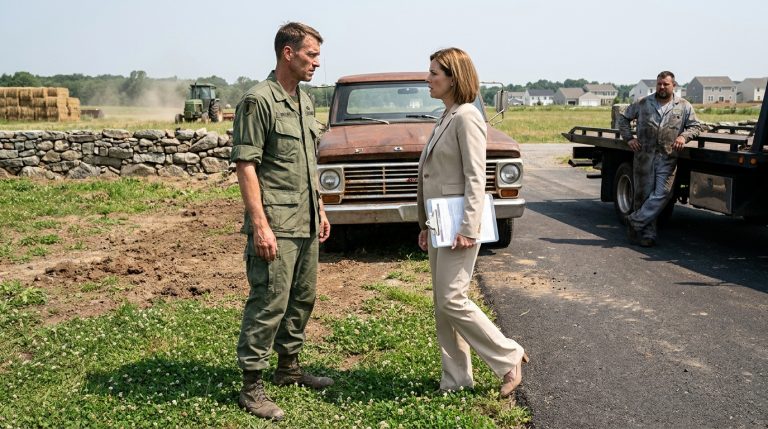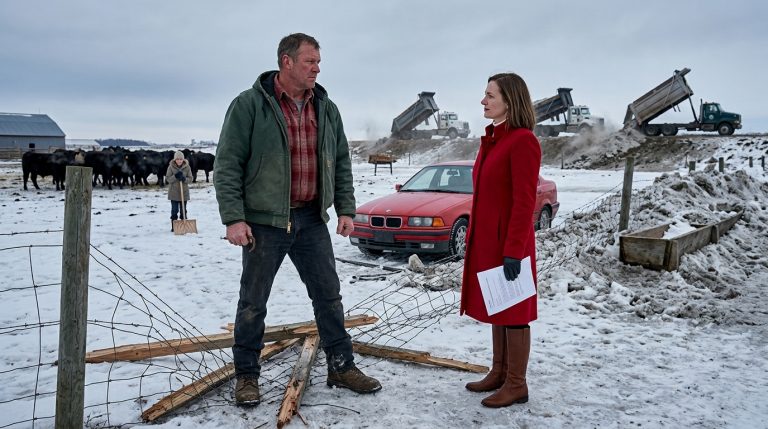
The Iron Anchor: How a Mountain Tow Driver Broke the HOA Dictator of Frostline Terrace
CHAPTER 1: THE SWITCHBACK EDGE
The spring-latch on the heavy steel winch shackle went clack against the bumper plate. Cold iron. Grease thick enough to trap road grit. I wiped a streak of gray sludge off the locking pin with my work glove, test-snapping the gate twice until the tension felt right.
Then the headlights hit me.
A white luxury SUV skidded sideways across the ice-packed apron of the staging lot. Rubber whined against frozen asphalt. The bumper stopped four inches from my tow ramp.
Marin Holt didn’t wait for her engine to die. She hit the ground in three-inch leather boots, heels clicking sharply on the glaze. She slammed her palm onto the lower steel deck of my rig. Hard enough to leave a ring mark in the frost.
“Tow my vehicle first,” she said. No greeting. No breath wasted. “Mine. Right now.”
The wind whipped sideways off the ridge, carrying smell of pine needles and burnt diesel. I didn’t drop the winch controller. “I’m on county emergency rotation, Mrs. Holt. Driveway pullouts wait.”
She reached into her coat, pulled out a laminated card on a lanyard, and slapped it flush against my driver-side window. “HOA Emergency Priority. I signed the authorization an hour ago. My driveway is slicked over. You haul my SUV out before you move this truck another yard.”
My belt radio burst into static. High-gain emergency frequency.
—All units, rollover on Mile 9 switchback. Vehicle off the ledge. Multiple occupants trapped. EMS requesting immediate heavy winch clearance—
My chest went tight. Mile 9 had no guardrails. Just a three-hundred-foot drop straight into the pine canopy.
“You hear that?” I said, thumbing the winch gear into neutral. “People are down the embankment.”
Marin stepped closer. Her expensive perfume cut through the raw reek of exhaust and freezing air. Her smile went paper-thin.
“You ignore my vehicle,” she whispered, “and I hit your business with a twelve-thousand-dollar non-compliance fine before breakfast. Then I pull your access code for Frostline Terrace. You’ll be invisible by sunrise.”
I looked down at her hands. She wasn’t shaking from the cold. She was tapping a manicured nail against the corner of a brass keyring—a heavy key marked with a custom stencil: Tanker-7.
Why was the HOA president carrying a fleet key for a commercial liquid-hauler?
I didn’t ask. I reached up, grabbed the cab door handle, and pulled myself into the driver’s seat.
“Get your vehicle off my apron,” I said. “Or I’ll drag it off with the hook.”
Her jaw locked. “You just picked your side.”
I dropped the transmission into low gear. The diesel roared, tires biting into the packed powder as I pulled out toward the switchback, leaving her standing alone in the blizzard.
CHAPTER 2: PAPER WEAPONS
The wipers slapped heavy slush across the glass, every stroke leaving a greasy film that caught the glare of the oncoming snow. I kept my left hand hooked over the bottom of the wheel, feeling the chatter of the front axle through the column as the flatbed climbed into the whiteout toward Mile 9.
In the passenger seat, my belt radio hissed, the county dispatcher’s voice breaking through the static in sharp, clipped bursts.
—Rescue 4, County Dispatch. EMS is on scene at Mile 9. The vehicle is pinned against a pine stand twenty feet below the shoulder. Ropes are deployed, but they need the winch line set before the bank gives way—
“Copy, Dispatch,” I said, thumbing the mic. “I’m three minutes out. Setting heavy anchors on the upper curve.”
I dropped the mic back into its bracket. On the floor mat beside the gear shift, the slurry kicked up by the front tires wasn’t melting white. It was pooling in the rubber ridges with an oily, iridescent sheen—a sickly yellowish-gray film that didn’t smell like road salt or engine coolant. It smelled like industrial solvent.
I cut the wheel hard into the first switchback, the dual tires biting into the packed powder.
By the time I crested the ridge at Mile 9, the scene was bathed in the strobe of red and amber lightbars. Highgate County Sheriff’s cruisers blocked the uphill lane, their tailpipes blowing thick white clouds into the freezing air. A deputy in an insulated parka waved his flashlight, directing me onto the narrow shoulder where the asphalt dropped into darkness.
I backed the rig into position, setting the air brakes with a loud hiss-shuck that echoed through the trees. I stepped out into the knee-deep drift, the cold slapping my face like a wet towel.
“Glad you made it,” Deputy Vane said, stepping up to the driver’s side door. He had a radio clipped to his collar and snow caked in his eyebrows. “HOA tried to redirect us ten minutes ago. Said they had a private operator coming up from the lower gate.”
I grabbed my heavy leather work gloves off the dash and pulled them on, cinching the wrists tight. “They don’t have a rig on this side of the mountain heavy enough to hold a two-ton SUV on a steep grade.”
“Tell that to Holt,” Vane muttered. “She called the sheriff’s desk directly. Claimed you were operating outside your designated zone.”
I didn’t answer. I walked around to the tail of the truck, unhooked the main winch cable, and pulled the free-spool lever. The steel line sang out, cold and stiff, as I dragged it through the snow toward the edge of the drop-off.
Twenty feet down, half-buried in splintered pine branches, sat a blue sedan resting on its side. Two firefighters were bracing the lower frame with hydraulic jacks, their boots slipping on the slick shale beneath the snowpack. A paramedic was leaning through the shattered rear window, supporting the neck of a terrified woman while a child sobbed into a thermal blanket beside her.
“Hold the line!” the lead paramedic shouted, looking up toward the road. “The ground’s sliding!”
I didn’t waste time talking. I wrapped the lead chain around the trunk of a massive Douglas fir at the lip of the ledge, slotted the heavy steel hook into the main eyelet, and slammed the locking pin home. Clack.
I scrambled back to the rig, grabbed the remote box, and engaged the hydraulic power take-off. The engine RPMs bumped up automatically, the deep rumble of the diesel drowning out the howl of the wind. I leaned over the rail, watching the cable draw taut, the steel strands groaning under the sudden transfer of ten thousand pounds of dead weight.
“Line is locked!” I yelled down the bank. “You’re anchor-safe! Get ’em out!”
For twenty minutes, nobody spoke except to call out rope tensions and footings. We worked by the beam of the truck’s overhead halogen work lights, the cold biting through my insulated overalls until my fingers felt like wooden pegs inside my gloves. We pulled the driver out first, then the kid, hoisting them up the bank on a plastic rescue sled attached to my secondary snatch block.
When the last paramedic reached the road, the lead medic walked over to my cab, wiping sweat and snow off his forehead with a dirty sleeve.
“Good hookup,” he said, breathing heavy. “Five more minutes without that line and that car would’ve slid right into the creek bed at the bottom.”
“Just doing the job,” I said, coiling the winch lead back onto the drum.
“Yeah, well,” the medic said, looking down the road where a secondary tow truck—a battered black flatbed with no municipal markings—was idling near the lower turnoff. “Someone else was trying to intercept the call. They were parked at the bottom of the switchback waiting for us to fail.”
I looked down the road. On the door of the black flatbed, barely visible through the swirling snow, was a freshly painted stencil: Tanker-7 Fleet Services.
The driver inside didn’t get out. As soon as my cable cleared the tree, the black truck reversed down the grade, its tires spinning wildly before catch-gripping the ice and disappearing into the dark.
By five in the morning, the storm had tapered off into a fine, needle-sharp sleet. I drove the rig back down into Frostline Terrace, the cab smelling of wet wool, hot hydraulic fluid, and cold coffee.
When I pulled up to my driveway, the garage door was plastered with neon-yellow paper.
Three separate violation notices were taped dead-center across the aluminum panels. I killed the engine, stepped out into the freezing slush, and ripped the top sheet off the metal.
COMMERCIAL NUISANCE – UNAUTHORIZED HEAVY VEHICLE STAGING.
PENALTY: $4,000 PER INCIDENT.
TOTAL DUE: $12,000.
At the bottom of the sheet, where the HOA inspector’s signature was supposed to be, there was only a sharp, hand-drawn set of initials: M.H.
Tacked underneath the penalty notice was a formal summons printed on crisp, high-gloss letterhead.
MANDATORY BOARD HEARING – FROSTLINE TERRACE COMMUNITY CENTER.
AGENDA: EMERGENCY BOND REQUIREMENTS & COMMERCIAL REVOCATION.
TIME: 08:00 AM.
My phone buzzed in my pocket. A text message from an unknown, unlisted number slid across the screen:
Check your local mail kiosk. She isn’t just fining you. She’s clearing the route for Siphon Line 4.
I stared at the screen until the display timed out into darkness. The sleet ticked rhythmically against the aluminum notices in my hand. I folded the yellow sheets in half, shoved them into my heavy coat pocket, and turned my eyes back toward the main road leading up toward the high ridge of Blackwood Basin.
CHAPTER 3: THE LEAK IN BLACKWOOD
The screen went dark, but the letters remained burned onto my eyes. Siphon Line 4.
I shoved the phone into my coat pocket next to the folded yellow paper, the stiff edges biting into my knuckles through my glove. Sleet rattled off the flatbed’s hood like thrown gravel. I didn’t turn toward my front porch. I turned back to the cab door, my boots cutting through the slush to the driver-side step.
If Marin Holt wanted a war over municipal authority, she wouldn’t leave paper trails in an HOA board office. She’d leave them where the trucks parked.
I hit the ignition. The diesel roared back to life, vibrating through the steel floorboards and into the soles of my work boots. Instead of backing into the garage, I pulled out onto the main arterial road, turning uphill toward the high perimeter fence that separated Frostline Terrace from the county watershed district.
Ten minutes up the access route, the high-density suburban homes gave way to pine stands and gravel pullouts. The road dead-ended at a padlocked chain-link gate marked with a faded aluminum sign: PROPERTY OF HIGHGATE COUNTY WATER RESOURCES — BLACKWOOD BASIN RESERVOIR.
I cut my headlights, letting the truck idle in the darkness.
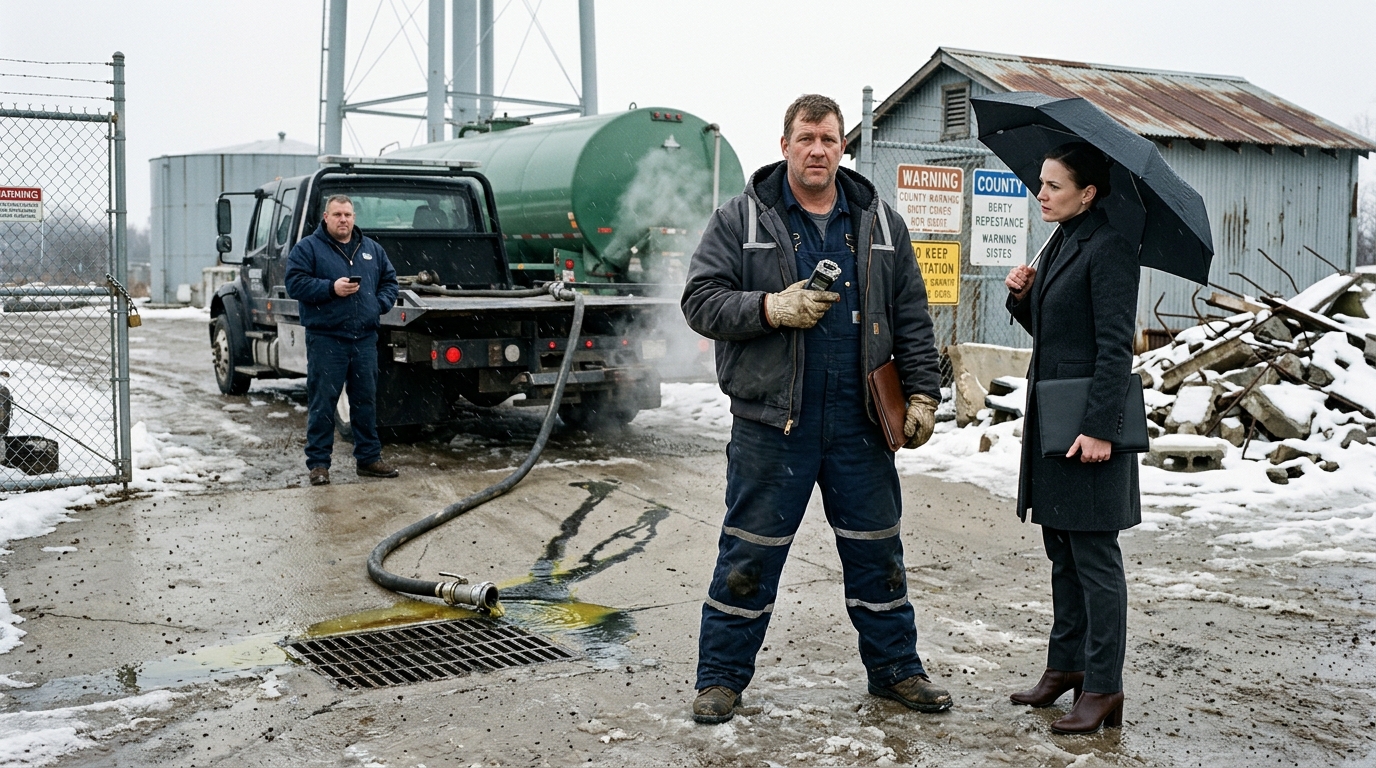
Fifty yards beyond the gate, idling in the clearing beneath the towering water holding tanks, sat the black flatbed from Mile 9. Beside it stood a massive steel tank trailer painted faded industrial green. Stenciled in chipped white enamel across the side tank frame was the identifier: Tanker-7.
A thick rubber hose ran from the belly valve of the tanker trailer directly toward a storm grate set into the concrete apron.
I pulled a pair of heavy brass binoculars from the glove compartment, resting my elbows against the steering wheel to steady the view through the sleet-streaked windshield.
A man in a navy insulated jacket was kneeling over the storm drain, his hands working a heavy wrench against a bronze coupling labeled Siphon Line 4. Every few turns of the valve, a dark, viscous liquid sputtered from the secondary pressure relief port, splashing over the concrete before vanishing down the grate.
The runoff didn’t look like melted snow. It had the same yellowish, iridescent sheen I’d seen pooling in my wheel wells an hour ago on Mile 9.
My thumbs tightened over the rubber casing of the binoculars. The preferred tow company wasn’t just taking kickbacks for priority calls. They were using their municipal clearing access—the unrestricted clearance Marin Holt was trying to grant them through her fake emergency rule—to haul toxic industrial chemical waste up the mountain under the cover of blizzard operations and dump it straight into the county drainage network.
Dumping waste during a storm meant the mountain runoff would flush the chemical trace down the valley before the county environmental inspectors could take water samples at dawn.
The driver stood up, wiping his hands on a grease rag. He reached into his pocket and pulled out a cell phone, illumination washing over his face. He held it to his ear, nodded twice, and spoke into the wind. Even without audio, the body language was clear—he was taking orders, confirming the dump was halfway clear.
A light flickered behind me.
I looked in the side mirror. A white SUV was crawling up the access grade, its fog lights cutting low through the falling sleet. It didn’t have emergency strobes on, but I knew the silhouette before it cleared the final bend.
Marin Holt.
She pulled up thirty feet behind my flatbed, blocking the narrow access route. Her high beams flashed twice—a signal to the gate crew.
I dropped the binoculars onto the passenger seat and pulled out my phone, opening the camera app. I stepped out of the cab into the freezing dark, keeping the flatbed’s wide body between me and her high beams.
“You’re trespassing on restricted water district property,” Marin’s voice cut through the wind before her door even swung shut. She stepped around her front bumper, umbrella held low against the sleet. She wasn’t wearing her HOA badge now. She was carrying a leather document folio tucked under her arm.
“The gate’s locked, Mrs. Holt,” I said, my voice steady as I stepped into the open gap between our trucks. “And your boyfriend’s dumping industrial solvent into the Blackwood Basin drain.”
Her expression didn’t shatter. It hardened into something cold and sharp as glass.
“That’s commercial clearing runoff,” she said, her tone devoid of emotion. “Approved under the community emergency infrastructure protocol. You don’t have the technical background to evaluate environmental permits.”
“I have eyes,” I said. “And I have dashcam logs from Mile 9 showing that truck trying to block county EMS while his tank was full.”
She took one step closer, the tip of her umbrella digging into the frozen mud. “You have twelve thousand dollars in unpaid municipal fines and an emergency board hearing in two hours. By nine this morning, your commercial operating license in Highgate County will be suspended pending administrative review.”
She leaned in, her voice dropping into a razor whisper. “You think a county judge is going to take the word of an uninsured, non-compliant tow operator over a sworn HOA president? You’re out of your depth.”
“Maybe,” I said. I reached into my coat, pulled out the small digital audio recorder I used for logging county dispatch calls, and held it up between us. The tiny red recording light was solid.
“I don’t need a judge to believe my word,” I told her, my fingers cold against the plastic casing. “I just need the county health department to test the water coming out of Siphon Line 4 before the storm breaks.”
Her eyes tracked down to the red light. For the first time all night, her fingers twitched—a micro-spasm in her hand that made the umbrella tilt three inches to the left.
CHAPTER 4: THE DIGITAL TRAP
The red light on the digital recorder glowed like a single coal in the dark between us.
Marin Holt didn’t reach for it. She didn’t shout. Her fingers simply tightened around the shaft of her umbrella until the black fabric stretched taut against the ribs.
“Recording without consent in an administrative meeting zone,” she said, her voice dropping an octave into a low, metallic hum. “You really think that holds up?”
“This isn’t a board meeting, Marin,” I said, thumbing the side lock on the casing to save the file stem. “This is a restricted water access lane. And you’re standing five feet from a commercial liquid-hauler dumping chemical solvent into Siphon Line 4.”
Beyond her shoulder, a heavy pneumatic hiss echoed from the clearing. Pshhhhh-clack.
The green tank trailer attached to Tanker-7 shuddered on its leaf springs. A cloud of thick, sweet-smelling chemical vapor vented from the upper relief cap, drifting through the chain-link fence and settling across the snow pack like a gray blanket. The driver turned sharply, his flashlight beam swinging toward us through the sleet.
Marin didn’t look back at her boyfriend’s truck. Her eyes remained locked on mine, calculations running behind her cold, precise expression.
“You think you’re building a case,” she said quietly. “You’re actually writing your own foreclosure.”
She turned on her heel, her leather boots cutting clean arcs into the slush, and stepped into her SUV. The door slammed with a heavy thud. The engine roared, her tires throwing up a spray of yellow-tinged slush as she reversed down the narrow access road, her taillights disappearing into the whiteout.
I didn’t waste seconds watching her go. I turned back to my flatbed, opened the cab door, and grabbed the heavy brass sample bottle I kept in my roadside emergency kit for radiator fluid analysis.
I stepped through the broken gap in the water district gate. My boots crunched over the gravel as I approached the storm drain beneath Tanker-7. The driver saw me coming, slammed the secondary valve lever shut with a iron prybar—clang—and jumped into his cab, grinding the gears as he tore toward the far service exit leading out toward Blackwood Basin.
The runoff was still swirling down the cast-iron grate.
I knelt in the freezing slush, my knee pressing through my work pants until the cold bit into the bone. I dipped the glass sample bottle directly into the stream where the liquid entered the grate beneath Siphon Line 4. The glass went cloudy instantly. A thick, greasy ring formed around the neck of the bottle, smelling overpoweringly of industrial degreaser and benzene.
I capped the bottle tight, wiped the outer glass clean with a rag, and sealed it in an airtight plastic evidence bag.
By six-thirty AM, the sky over Highgate County was the color of lead. The sleet had turned into a steady, freezing drizzle that glazed every surface in quarter-inch ice.
I sat in the cab of my truck parked in the quiet staging bay behind the municipal maintenance building. The dashcam’s memory card was slid into my ruggedized laptop on the passenger seat. Beside it lay the digital recorder, three audio files timestamped from Mile 9 to the Blackwood gate, and the high-resolution photographs I’d pulled from the dashcam showing Tanker-7 idling over the drain.
My fingers were stiff from the cold as I built the packet.
I didn’t upload it to social media. I didn’t send it to the HOA board group chat. That was where Marin operated—in the muddy water of local politics, personal feuds, and manipulated panic.
I opened an encrypted transmission portal directly to three specific inbox nodes: Captain Elias Mercer at Highgate Fire and EMS, the Chief Investigator for the State Department of Environmental Protection, and the Highgate County Sheriff’s Department Civil Fraud Division.
I attached the files one by one:
Audio_Log_01_Mile9_Interference.mp3
Dashcam_Tanker7_Blackwood_Gate.mp4
HOA_Fake_Bond_Notice_Extortion.pdf
Water_Sample_ChainOfCustody_SiphonLine4.jpg
I typed a single sentence in the cover note:
The HOA priority scheme is a physical shield for illegal commercial chemical dumping into the Blackwood Basin watershed during active storm events.
I hit send.
The progress bar hit one hundred percent with a quiet chime. On the passenger seat, the glass sample bottle sat in its sealed plastic pouch, the dark, yellowed liquid resting at the bottom like settled poison.
My phone screen lit up on the console. An incoming call from an unlisted county line.
I picked it up on the first ring.
“This is Mercer,” the voice came through, crisp and stripped of sleep. “Where are you right now?”
“County maintenance yard,” I replied. “You get the packet?”
A pause on the line, punctuated by the sound of paper shuffling and a radio receiver clicking in the background.
“I got it,” Mercer said, his voice lowering. “Stay in your rig. Don’t go to the community center alone. Sheriff’s deputies and State Environmental are en route to the site now. We’re locking the perimeter at Blackwood Basin.”
“The HOA emergency meeting starts in twenty minutes,” I said, looking at the clock on the dashboard. “She’s going to attempt a formal vote to revoke my operating access before the board knows what’s on that hill.”
“Let her start the meeting,” Mercer said flatly. “We’re five minutes behind you.”
CHAPTER 5: THE AMBUSH AT THE HALL
“Five minutes behind you,” Mercer’s voice dropped off as the line went dead.
I slid the phone into my front pocket, grabbed the sealed evidence bag containing the glass sample bottle, and stepped out into the freezing slush. The air inside the Frostline Terrace Community Center was thick with dry radiator heat, foggy windows, and the low, agitated murmur of forty property owners packed into metal folding chairs.
Marin Holt stood at the head of the oak dais. She wore a tailored charcoal blazer, her hair pinned tight, a stack of high-gloss enforcement folders spread neatly in front of her. She was already speaking, her voice amplified through the hall’s wall-mounted speakers.
“—failure to maintain municipal coordination during a severe weather event,” Marin was saying, her pen tapping rhythmically against the rim of her glass. “The operator in question chose private discretion over community directive. As HOA president, I am invoking Rule 14-B to issue an immediate commercial exclusion order—”
I didn’t take a seat. I walked down the center aisle, my heavy work boots squeaking against the polished linoleum.
Marin didn’t stop her speech, but her eyes locked onto mine the moment I crossed the threshold. She raised her hand, signaling the two board members seated to her left. “The public comment period is closed. Mr. Vance, you are out of order.”
“I’m not here for public comment,” I said, my voice carrying clearly over the low hum of the heating vents. I pulled the sealed plastic pouch from my coat and set it squarely on the front edge of her table. The cloudy, yellowed liquid inside sloshed against the glass, casting a pale shadow across her printed motion sheets.
A whisper rippled through the front two rows.
“What is that?” asked the gray-haired board treasurer sitting to Marin’s right, squinting through his bifocals at the oily ring floating at the top of the jar.
“That’s runoff taken two hours ago from Siphon Line 4 at the Blackwood Basin gate,” I said. “Sampled directly beneath the belly valve of Tanker-7 while it was discharging chemical solvent into the county storm drain.”
Marin’s expression didn’t falter. She reached out with her pen, using the plastic cap to nudge the bag two inches to the side as if it were a dirty napkin. “This meeting is regarding commercial vehicle compliance, not unverified water claims. Board members, if you’ll look at page three—”
“The vehicle doing the dumping was the same flatbed you authorized for priority access on Mile 9,” I interrupted. “The company registered to your boyfriend’s fleet.”
“You’re making slanderous allegations to cover a twelve-thousand-dollar fine,” Marin snapped, her voice sharpening into a cold, lethal blade. She picked up her wooden gavel. “Secretary, record that the operator refused to address the compliance violations. Motion to vote on immediate revocation—”
The heavy double doors at the back of the hall slammed open against the drywall.
The cold mountain air rushed in first, sweeping through the warm room and sending loose papers fluttering off the front tables.
Captain Elias Mercer stepped into the center aisle. He wore his full turnout coat, dark blue and lined with reflective trim, wet snow melting off his shoulders. Behind him stood two Highgate County Sheriff’s deputies in brown tactical parkas, followed by a state officer wearing the badge of the Environmental Protection Division.
The room went dead silent.
Marin’s gavel remained hovering two inches above the sound block. Her knuckles went white against the wood.
“Captain Mercer,” Marin said, her voice recovering its smooth, managerial cadence within a heartbeat. “This is an internal community governance proceeding. If you have an emergency access inquiry, our legal counsel—”
“I’m not here for an inquiry, Mrs. Holt,” Mercer said. He didn’t rush. He walked down the aisle with a steady, unhurried stride, his boots clicking against the floor until he stopped right beside my shoulder. He set a heavy leather binder on the table, right next to the glass sample bottle.
“State Environmental just sealed the perimeter at Siphon Line 4,” Mercer said flatly. “They caught Tanker-7 halfway through a four-thousand-gallon discharge into the Blackwood reservoir intake.”
A sharp gasp went through the crowd. The treasurer pulled his hands back from the table as if the oak surface itself had gone hot.
“That contractor operated independently,” Marin said instantly, her eyes shifting to the two deputies behind Mercer. Her tone stayed clipped, analytical, detached. “If a vendor violated environmental statutes on county land, the HOA bears zero administrative liability. Our emergency priority rule was drafted solely for resident safety.”
“The emergency rule wasn’t filed with the county,” the state environmental officer stepped forward, pulling a folded legal document from his jacket. “And the priority contract you signed funneled a thirty-percent surcharge directly into an unlisted corporate account tied to Tanker-7 Fleet Services.”
The officer set a second sheet on top of her folder.
“We have the dispatch logs, the dashcam telemetry from Mile 9, and the physical water analysis,” Mercer added, his eyes locked on Marin. “You didn’t just delay a county rescue operation to clear your driveway, Mrs. Holt. You used municipal emergency declarations as a cover to move hazardous industrial waste through restricted watershed roads.”
Marin stared at the paper lying on her folder. Her lips parted, but no sound came out. The manicured composure she had worn like armor all winter finally cracked—her chin gave a single, involuntary twitch, her hand dropping the gavel onto the felt pad with a dull, hollow thud.
The treasurer stood up from his chair, backing away from the dais. “The board had no knowledge of this contract. None.”
“The board can explain that to the grand jury,” the lead deputy said, stepping around the table and pulling a pair of steel cuffs from his belt. “Marin Holt, you are under arrest for felony environmental contamination, fraud, and criminal obstruction of emergency services.”
She didn’t fight. She didn’t scream or make a scene. She simply held her wrists together as the steel clicked shut, her eyes remaining fixed on the cloudy glass bottle resting on the table before her. The crowd parted in absolute silence as the deputies escorted her down the center aisle and out into the freezing drizzle.
CHAPTER 6: CLEAR ROADS
The heavy oak doors clicked shut behind the deputies, cutting off the flash of cruiser strobes outside. Inside the hall, forty people sat in absolute silence, staring at the empty front table. The glass sample bottle remained on the wood, its cloudy yellow fluid settling under the cold glow of the overhead fluorescent lights.
Nobody picked up a gavel. Nobody called for the next agenda item.
Captain Mercer reached out, scooped up his leather binder, and nodded toward the side exit. “Come on. The sheriff’s impounding Tanker-7 at the basin gate. We need your rig to clear the staging pad.”
I turned without a word, my work boots leaving wet, dark prints on the linoleum as I followed him out into the cold air.
The freezing drizzle had stopped. Above the high pine ridge of Blackwood Basin, the storm clouds were tearing apart, revealing strips of pale winter sky. The air no longer smelled of raw industrial solvent or sweet chemical vapor. It smelled clean—cold granite, wet bark, and pine sap.
We walked down the concrete steps toward my flatbed. The rig sat idling in the staging bay, its diesel exhaust rising in a thin, steady plume against the snowdrifts.
“State Environmental’s pulling the full site logs,” Mercer said, stopping beside my driver-side door. He rested one gloved hand on the lower mirror bracket. “It wasn’t just a local operation. Tanker-7 was running chemical clearing loads up from the valley plants every time a blizzard hit. They used the HOA emergency priority access to bypass county weigh stations and watershed checkpoints.”
“And Siphon Line 4?” I asked, pulling my work gloves from my coat pocket.
“Capped,” Mercer said flatly. “State hazmat crews are setting containment booms at the drainage exit. Because you took that sample at six AM, we caught the plume before it hit the main municipal reservoir intake.”
He extended a thick, calloused hand. I took it, our grip firm through the heavy leather work gloves.
“You held the line when it mattered,” Mercer said. “County dispatch is logging your rig as primary heavy-winch response for the rest of the season. No HOA overrides. No commercial interferences.”
“Copy that, Captain,” I said.
He nodded once, turned, and walked back toward his command cruiser, his boots crunching steadily through the freezing slush.
I climbed up into the cab. The heater was blowing warm air against my knees. I reached down to the passenger floorboard, picked up my heavy brass grease gun and a clean rag, and set them on my lap.
My hands were still stiff from the cold, raw around the knuckles where the wind had whipped under my sleeves on Mile 9. I systematically wiped down the brass fittings, working the lever until fresh red lithium grease pushed out through the nozzle, purging the road grit and ice from the joints.
I picked up the heavy steel winch shackle—the one that had held ten thousand pounds of dead weight on the switchback ledge—and checked the locking pin. I wiped away a streak of gray sludge from the gate, tested the spring-latch three times, and listened to the sharp, clean metal snap against the frame. Clack. Clack. Clack.
No rust. No play in the pin. The steel was solid.
I set the tool back in the driver-side door pocket, dropped the transmission into low gear, and released the air brakes with a long, satisfying pshhhh-hiss.
The flatbed pulled out of the community center lot, its tire chains clicking rhythmically against the ice-crusted asphalt. As I passed the entrance to Frostline Terrace, I saw Marin Holt’s white luxury SUV sitting parked in her driveway, half-buried under fresh snowdrifts, its windows frosted over and dark.
I turned the rig uphill, taking the long, sweeping curve toward the switchback on Mile 9.
The belt radio on my console chirped softly, breaking through the low rumble of the engine.
—All units, County Dispatch. Storm warnings are lifted across Highgate County. Roads are clearing. Patrols report all mountain passes open and stable—
I reached down, thumbed the mic, and answered without hesitation.
“Flatbed 1, clear and rolling.”
I hung up the mic, adjusted my mirror, and drove on up the mountain under a clear, open sky.