The Weight of Iron and Paper: How a Petty Suburban Tyrant Unwittingly Engineered Her Own Legal Annihilation
CHAPTER 1: THE FIRST LOCK
The heavy wrought iron gate had stood for thirty years, a quiet sentinel bolted into granite posts that my father had helped set with his own calloused hands. Now, it wore a crown of industrial-grade steel and a thick, rust-colored chain that caught the low glare of the afternoon sun like a fresh scar.
My key—a simple piece of brass worn smooth by decades of pocket friction—slid into the housing and met a dead, unyielding stop.
“This gate is now for residents of the Harmony Creek Homeowners Association only,” she said.
Karen. Her name had been floating through county property records for a week, but seeing her was entirely different. She stood planted squarely in the center of the asphalt access road, a plus-size monolith of administrative entitlement stuffed into a pastel pink tracksuit that seemed to strain against the pressure of her self-importance. Her face was a masterclass in smug certainty, framed by lips pressed into a tight, triumphant smirk.
Behind me, the diesel engine of my F250 idled with a low, rumbling vibration that rattled the floorboards. In the passenger seat, Sarah sat in silence, her mouth slightly parted as she stared past the windshield at the barricade.
I didn’t reach for the horn. I didn’t shout. Twenty years in the Army Corps of Engineers taught me a very specific pathology: when a structure is subjected to sudden, unauthorized structural stress, you do not panic. You assess the load limits. You look for the fracture lines.
“Karen,” I said, my voice dropping into that flat, measured cadence I used when inspecting a compromised foundation in Baghdad. “You know perfectly well there is no other way. This is the sole access easement to my land.”
She gave a dismissive little twitch of her shoulder, a gesture that sent ripples through her synthetic fabric. “That sounds like a personal problem, not an HOA problem. We voted to secure our community. Unaffiliated properties represent an unacceptable security risk.”
The audacity wasn’t just staggering; it was mathematically absurd. Our ten-acre parcel had been in the family for sixty years, anchoring the landscape long before the developer ever paved over the surrounding pasture to build these overpriced particle-board palaces. The deeded easement was hardwired into county records and written directly into the title covenants of every single home in her subdivision.
I held up the useless brass key between my thumb and forefinger, letting the sunlight hit the polished metal. “So you decided to alter a shared access asset without notifying a legal co-owner?”
“I am notifying you now,” she countered, stepping forward an inch as if trying to physically outmass the law. “You are no longer considered a party to the gate’s operation. If you have an issue, take it up with the board at our next scheduled meeting. In three months.”
Three months. She expected me to park my truck at the perimeter and hike two miles through dense timber to reach my own workshop, right on the eve of a major black walnut timber and custom woodworking delivery that would breach my commercial contracts if missed.
My fuse was long, but when it burned down to the primer, it took the whole installation with it. I killed the engine. The sudden silence of the cab amplified the sharp, metallic ticking of the cooling exhaust manifold and the heavy thumping of blood behind my temples.
I reached for my phone, sliding my thumb across the screen while keeping my eyes locked on the pastel pink fabric of her tracksuit.
“What are you doing, Mark?” Sarah asked, her voice a tense, brittle whisper from the passenger seat.
“I’m calling a commercial locksmith,” I said, my gaze never breaking away from Karen’s self-satisfied grin. “A twenty-four-hour emergency unit. And then I’m calling counsel. Every single cent this costs me, Karen—every invoice, every hour of lost business, and every dollar of legal overhead—is going to land directly on a personal invoice addressed to you.”
The smugness flickered for a fraction of a second, replaced by the faint, irritable twitch of a woman whose script had just been interrupted by an illiterate extra.
“You can’t do that,” she scoffed, waving a hand dismissively toward the horizon. “This is HOA property.”
I let out a cold, single breath that didn’t reach my eyes. It was the exact expression I’d worn when staring down a corrupt local contractor trying to pour unreinforced concrete. “You aren’t a magistrate, Karen. You’re a homeowner with a plastic badge. And that chain you just wrapped around our property isn’t security. It’s an act of criminal trespass on a shared asset.”
I dropped my phone back onto the console, but as I reached for the door handle, a glint of dull, unpolished metal tucked into the links of the new chain caught my eye—a specific stamp on the padlock’s shackle that didn’t match standard commercial hardware, hinting at a hidden supplier code I hadn’t expected to see so soon.
CHAPTER 2: THE SECOND ESCALATION
The high-pitched whine of the heavy-duty angle grinder tore into the cooling twilight, sending a brilliant, sputtering arc of orange sparks cascading against the cold iron of the gate.
Gus, the commercial locksmith, didn’t look up from his work. His knuckles were mapped with old grease-stained tattoos that flexed with every wrench of his shoulder, his body leaning into the tool as it bit into the hardened shackle Karen had installed less than an hour ago. He was a man who measured his life in minutes and billable hours, indifferent to suburban politics, focused entirely on the physics of shearing metal under tension.
I stood three paces back, my hands tucked deep into the pockets of my canvas jacket, watching the sparks die out against the dry roadside grass.
In the passenger seat of my truck, Sarah’s silhouette was unmoving, her face turned slightly toward the passenger window. She didn’t need to say anything; her silence carried the weight of a shared, bitter history. Every yard of gravel beneath our tires, every timber in the workshop up the hill, every post my father had set by hand—it was all being measured against the petty ambitions of a woman in a pastel tracksuit who viewed a sixty-year-old deed as an administrative inconvenience.
The scent of hot ozone and burning iron hung heavy in the humid air, suddenly dragging a sharp, unbidden memory across my thoughts: the summer of nineteen-eighty-four, standing beside my father in the blazing sun as he leveled the concrete footer for this very easement, telling me that a man’s word is only as good as the paper it’s stamped on, and the law is the fence that keeps the wolves from the door.
My father didn’t build this road for a committee. He built it so we could live without begging for permission.
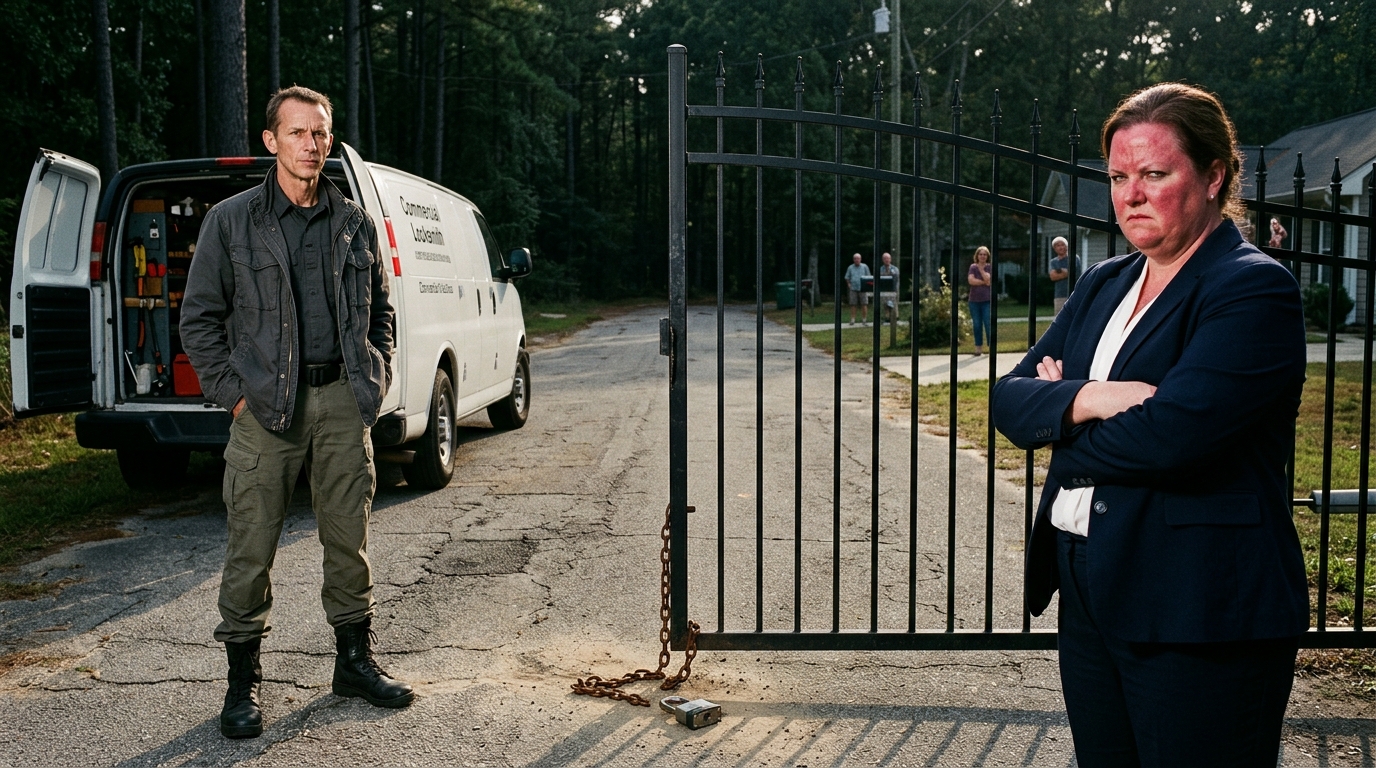
With a final, violent shriek of twisting steel, the padlock’s shackle gave way. The lock dropped into the dust with a dull, heavy thud, followed immediately by the rattling collapse of the thick, rust-colored chain.
Gus clicked off the grinder, the sudden silence rushing back to fill the empty space like water surging into a breached coffer. He wiped his forearm across his forehead, leaving a smudge of black carbon against his skin, and kicked the severed chain aside with the toe of his steel-toed boot.
“There’s your souvenir, Captain,” Gus grunted, bending down to scoop up the ruined hardware and handing it to me. The metal was still radiating heat, warm enough to sting through the heavy canvas of my glove. “That’s grade-ten security alloy. Someone really didn’t want you turning your own ignition past this point. That’s going to run you four hundred and eighty-five dollars for the emergency callout, parts, and labor.”
“Write the itemized invoice, Gus,” I said, my voice flat, devoid of the adrenaline spike that had set my teeth on edge moments earlier. “Make sure every detail of the hardware is specified. We’re going to need it for the file.”
While Gus scratched out the receipt against the tailgate of his van, Karen emerged from the shadowed porch of the house closest to the entrance. She didn’t walk; she marched, her bulk moving with a determined, rhythmic heft that telegraphed absolute unyielding arrogance. She had changed out of the pastel pink tracksuit into a sharp, uncompromising navy blazer, as if a change of synthetic fibers could elevate a neighborhood dispute into a judicial decree.
“You’re destroying private property,” she announced, her voice pitched high enough to carry across the empty asphalt. She stopped five feet short of the open gate, crossing her arms over her chest with a self-righteous snap. “I have recorded this entire interaction. You are looking at criminal mischief charges, Mr. Rivera. I’m calling the county sheriff right now.”
I didn’t step forward. I didn’t engage in the theatrical shouting match she was clearly baiting me to perform. Instead, I pulled the crisp, folded paper receipt from Gus’s hand, checked the figures, and slid it neatly into my inner breast pocket beside my tactical notepad.
“Call whoever you want, Karen,” I said, stepping past Gus toward the driver’s side of the F250. My movements were deliberate, slow, calculated to deny her the emotional payoff of a reaction. “You’ve just vandalized a shared access asset protected by a county-recorded easement dating back to nineteen-fifty-four. That locksmith invoice? That’s exhibit A. Every time you lock this gate, I will cut it open. And every single cent of the labor, plus damages for commercial interference, will be itemized and billed directly to your personal address.”
Her face flushed a deep, mottled crimson, the skin around her eyes tightening into angry slits. “You don’t understand how things work here! The board dictates community standards! Your little papers don’t mean a damn thing against our bylaws!”
“Bylaws don’t supersede the United States Constitution, and they certainly don’t rewrite real estate law,” I said, pulling open the heavy truck door. I paused with my hand on the steering wheel, turning my head just enough to meet her furious gaze with absolute, chilling emptiness. “Keep locking it, Karen. Build a fortress out of padlocks if it makes you feel tall. But understand this: you aren’t protecting a community. You’re building your own financial tombstone.”
I climbed into the cab, the heavy steel door thudding shut with a solid, reassuring seal that locked out her sputtering indignation. Sarah reached across the console, her fingers brushing against my wrist, cool and steady.
I fired the diesel engine, letting the deep-throated rumble fill the cab once more, and slipped the transmission into gear. As the truck rolled forward through the gap where the chain had hung, I caught her reflection in the side mirror—standing alone on the asphalt, her mouth open in silent fury, watching the dust rise behind my tires as I climbed the long, steady grade toward home.
The gate was open tonight, but I knew, with the cold certainty of an engineer reading a stress-fracture report, that she wouldn’t stop here. The escalation was inevitable. And when she struck next, the trap would already be waiting.
CHAPTER 3: THE DISCOVERY PHASE
The desk lamp cast a harsh, circular pool of yellow light over the yellowed, brittle edges of the county registry papers. Outside, the crickets kept up their steady, metallic rhythm against the deep velvet black of the timberline, but inside the room, the only sound was the deliberate scratch of my pen against a legal pad as I logged the metrics of the afternoon’s confrontation.
Two hundred and ninety minutes from the first lockout to the final invoice generation. Four hundred and eighty-five dollars logged to Gus. One official police record initiated by Deputy Miller, who had noted the civil obstruction without crossing the line into jurisdiction he couldn’t touch.
It was an architecture of accountability. In the Corps, you didn’t launch an offensive without mapping every supply line and bottleneck; you didn’t push forward until the reconnaissance was absolute. Karen thought she was playing a game of neighborhood politics, swinging a plastic badge like a broadsword. She didn’t realize that civil procedure is a game of attrition, and attrition belongs to the side that measures its grievances in notarized stamps and certified mail receipts.
I pulled the original shared maintenance agreement closer—the one bearing my father’s steady, looping signature alongside the developer’s corporate seal from nineteen-eighty-four. The paper was thin, smelling faintly of dry storage and old lignin, but the language was forged in steel. Said easement shall provide ingress and egress in perpetuity for the parcel listed under ID four-zero-two. There was no expiration date. There was no escape clause tied to the shifting moods of an elected homeowners association president wearing a pastel tracksuit.
My phone chimed softly on the blotter, a bright, intrusive pulse of light cutting through the lamplight. An email from Alan Shoreline.
I opened it. His response was characteristically lean, stripped of pleasantries. Demand letter went out certified this morning. Tracking numbers confirm delivery to both her personal residence and the HOA administrative box. We’ve given them ten business days to tender the four-eighty-five plus fifty dollars for drafting overhead. Keep logging everything. If she escalates again before the deadline, don’t call the locksmith immediately—let the tension compound. Build the paper trail.
I stared at the screen, letting the words settle. Alan understood the tempo. You didn’t choke a snake by pulling on its tail; you let it coil tighter around its own friction until the pressure did the work for you.
Yet, as I leaned back in the creaking leather chair, rubbing a hand over the stubble along my jaw, a cold unease flickered beneath the tactical logic. Karen wasn’t just acting out of ordinary bureaucratic stubbornness. The sheer speed with which she had deployed industrial-grade hardware, the absolute conviction in her voice when she declared our land an “unacceptable security risk,” pointed to something more systemic. People don’t order case-hardened chains on a whim unless they are operating under a shared delusion—or a coordinated directive.
I opened a fresh browser window on the desktop, navigating to the county’s public records portal. The screen flickered, casting a pale, clinical blue wash across my face.
If Harmony Creek was operating under a consolidated board, those votes had to be logged somewhere in public filings. I punched in the corporate incorporation data for the association, filtering backward through historical amendments. Most HOA filings are dry, administrative boilerplate—roof shingles, fence heights, pet restrictions. But as I scrolled through the digital ledgers from five years prior, a familiar surname caught in the digital mesh.
Karen Smith.
Not here. In a neighboring county jurisdiction, twenty miles to the west.
I opened a separate tab, digging into the municipal newspaper archives of that neighboring district. The search engine ground for a moment before spitting out a digitized local rag from November of two thousand twenty-one. A tiny, buried blurb near the back pages: Board Treasurer Resigns Amidst Sudden Budget Shortfall Controversy.
I zoomed in, the pixelated text sharpening under the cursor. The article was frustratingly vague—corporate diplomacy at its finest—mentioning an unexpected fifty-thousand-dollar deficit in community maintenance funds, a hastily called special assessment, and the abrupt, unceremonious resignation of the board treasurer, one Karen Smith, citing “personal relocation.”
No criminal charges. No public trial. Just a clean, scrubbed departure before the auditors could finish unspooling the thread.
I leaned closer to the monitor, the sharp edges of the text bringing the puzzle pieces into sudden, hard alignment. This wasn’t about neighborhood safety. It was about financial control and the desperate need to obscure an administrative track record. If she had mismanaged funds in her previous district, leaving a trail of emergency assessments in her wake, she needed a new kingdom to validate her authority—and a scapegoat to distract from her vulnerabilities.
A ten-acre unincorporated property sitting directly adjacent to her subdivision, immune to her bylaws yet dependent on their access road, wasn’t just an annoyance. It was an ideological threat to her absolute control. And if she could bully, fine, or legislate us into submission, she could position the HOA to acquire our parcel at a fraction of its market value, burying any institutional memory of what stood here before her subdivision was ever drawn on a napkin.
The desk lamp hummed softly, vibrating against the wooden grain. The legal pad beside my keyboard held the rows of numbers, the mounting tally of locksmith invoices, the dates, the times, the names.
My phone buzzed again—a quiet, single vibration. This time, it wasn’t an email from counsel. It was a text message from an unknown local number, displaying only a short, cryptic string of text: Check your mailbox at the foot of the drive tomorrow morning. You aren’t the only one she’s tried to bury.
I stared at the glowing screen as the digital clock in the corner ticked silently toward midnight. The perimeter was quiet, the heavy timber of the workshop standing dark against the starlight, but the board had just made its first tactical error. They thought they were building a wall. They had only provided us with a foundation to tear it down.
CHAPTER 4: THE DEPOSITION AND THE UNRAVELING
The morning mist clung to the lower timberline like wet cotton, dampening the gravel path as I walked down toward the road. The envelope in my hand was heavy, stuffed with cheap copier paper and bearing no return address—just my name scrawled in a shaky, hurried cursive.
Back in the quiet kitchen, with Sarah pouring black coffee into a heavy ceramic mug, I pulled the contents free. It wasn’t an anonymous threat. It was a stack of photocopied architectural blueprints from nineteen-eighty-eight, annotated with handwritten margins detailing the proposed zoning boundaries of Harmony Creek—and right there, scrawled in red ink across our ten-acre parcel, was a notation: Future municipal green space / acquisition target post-easement dissolution.
The decoy secret was no longer a theory; it was mapped out on paper. Karen wasn’t just trying to lock a gate; she was executing a phased land grab designed to choke our access until the property value collapsed beneath the weight of accumulated legal fees and logistic isolation.
My phone vibrated against the wooden table. Alan Shoreline’s number flashed on the screen.
“Mark,” Alan’s gravelly voice cut through the hum of the refrigerator without preamble. “We’ve scheduled the preliminary deposition for Thursday morning at a neutral law firm conference room downtown. Her counsel thinks they’re walking into a standard civil mediation. They have no idea we’ve already secured the incorporation records from her old district.”
“Is she going to show?” I asked, taking a slow sip of the dark roast.
“She’ll show,” Alan rumbled with a dry, humorless chuckle. “Karen can’t resist a stage where she thinks she’s holding the gavel. Be there at nine sharp. Wear a clean shirt. We’re going to hand her a rope and let her tie the knots herself.”
By Thursday morning, the sterile, windowless conference room smelled of industrial carpet cleaner and cold paper. The table was polished mahogany, reflecting the harsh glare of overhead fluorescent tubes that cast sharp shadows beneath the jawlines of everyone present.
Karen sat across the aisle, flanked by her attorney—a slick, low-tier litigator whose nervous fingers kept tapping against a plastic barrel pen. She wore a rigid navy blue blazer that looked two sizes too tight across her shoulders, adorned with a cheap string of faux pearls. Her chin was lifted high, her expression radiating the unyielding, defensive arrogance of someone who had never been forced to look at an audit ledger of her own making.
I sat quietly beside Alan, my hands resting flat on the table, my posture loose but disciplined.
The court reporter swore her in with a swift, rhythmic drone. Karen’s voice was crisp, dripping with condescension as she stated her name and her official title as president of the Harmony Creek Homeowners Association.
Alan didn’t attack. He never raised his voice. He approached the witness like an engineer inspecting a stress-fractured load-bearing column—slowly, methodically, tapping on the weak spots to see where the mortar would crumble.
“Ms. Smith,” Alan began, his tone almost conversational as he paced a slow circle near the end of the table. “Directing your attention to August first of this current year. Was it your personal directive to install an industrial chain and padlock across the main access easement?”
Karen’s attorney shifted uncomfortably, clearing his throat, but Karen waved him down with a dismissive flick of her wrist.
“It was a unanimous board decision,” she said, her voice bright with rehearsed certainty. “Executed for the safety and security of our community residents.”
“And at the time you ordered that hardware installed,” Alan continued, pausing beside his briefcase, “were you formally aware that Mr. Rivera’s parcel held a county-recorded, permanent deeded easement granting unrestricted ingress and egress?”
A micro-second of hesitation flickered across her eyes—just a fraction of a beat where the calculation happened behind her pupils. But arrogance outweighed caution.
“I was aware that he possessed some antiquated paper,” she scoffed, leaning back in her leather chair. “However, our board’s legal review established explicitly that community safety bylaws supersede any historical claims.”
Lie number one. Alan didn’t flinch. He simply pulled a clean sheet of paper from his file. “Ah. Your board’s legal review. Would it surprise you to learn, Ms. Smith, that according to the discovery disclosures provided by your own association yesterday, no such legal review was ever requested, documented, or billed prior to August first?”
The color in her cheeks tightened, flushing a dull, mottled red beneath the heavy fluorescent glare. Her attorney leaned in, whispering sharply in her ear, but she shrugged him off, her jaw hardening.
“Our internal communications are confidential,” she snapped.
“Under oath, Ms. Smith, perjury is not confidential,” Alan replied smoothly, his voice dropping an octave into a cold, metallic register. He walked closer, laying a single document down on the polished wood before her—a certified transcript of her past municipal board departure from five years prior. “Let’s talk about your previous tenure as treasurer in Westmoreland County. Did you leave that position voluntarily, or was it preceded by an unrecorded fifty-thousand-dollar maintenance deficit?”
The silence in the room dropped like a lead weight. The fluorescent hum overhead suddenly sounded deafening. Karen stared down at the paper, her fingers clutching the edge of the mahogany table so tightly that the skin across her knuckles turned bone-white.
The trap was fully sprung, and the walls were closing in, exactly as calculated.
CHAPTER 5: THE CLUBHOUSE RECKONING
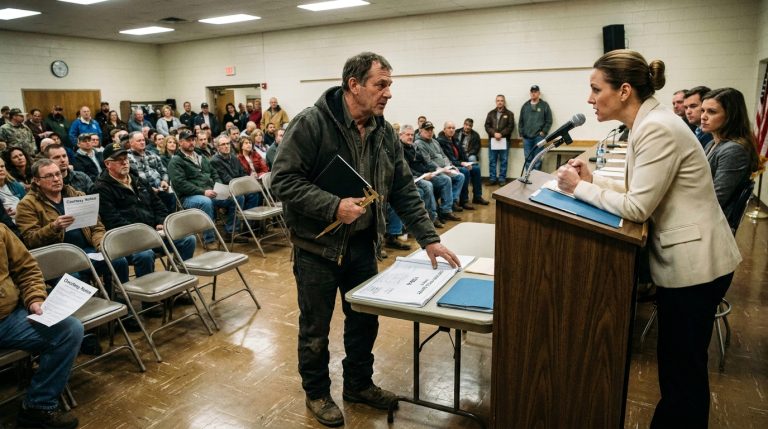
The fluorescent lights of the Harmony Creek community clubhouse hummed with a harsh, unyielding vibration that matched the collective pulse of the room. Every folding chair was occupied, the metal legs scraping against the linoleum floor in a restless symphony of anxiety. Homeowners sat shoulder to shoulder, their faces tight with the sudden, jarring realization that the administrative theater they had ignored for months was about to collapse inward.
At the front folding table, flanked by a visibly sweating Frank and a pale, silent Brenda, sat Karen.
She wore the same tight navy blazer from the deposition, but the armor of absolute authority had begun to crack around the edges. Her fingers gripped a plastic microphone with white-knuckled intensity, though she hadn’t spoken a word since we walked through the double doors.
Sarah and I stayed near the back, flanked quietly by Carol and George, whose presence gave our small contingent the weight of institutional memory. We didn’t shout. We didn’t make theatrical entrances. We simply occupied space with the calm, immovable gravity of a load-bearing column under load.
“This is a private meeting for association members only!” Karen shrieked suddenly, her voice cracking slightly as she spotted me near the back row. She banged her palm against the folding table, the hollow thud rattling the water pitcher. “Mr. Rivera has no standing here! Someone escort him off the property before I call the sheriff!”
Before the silence could curdle, Carol stepped forward into the center aisle, her posture rigid, her voice carrying clear and steady across the room without amplification.
“He is an invited guest, Karen,” Carol said, her tone devoid of malice, carrying only the absolute weight of fact. “I invited him, pursuant to my rights as a property owner and founding resident of this community.”
Karen’s face mottled into a dark, violent shade of purple, the skin tightening around her jaw. “That’s out of order! We have a strict agenda to follow regarding community beautification and budget allocations—”
“Your budget allocations are finished, Karen,” a deep, authoritative voice resonated from the middle rows.
Arthur, a retired municipal judge who lived three doors down and had kept his distance until the paperwork made it impossible to look away, stood up slowly. He adjusted his glasses, looking down at the former board president not as a neighbor, but as a magistrate reviewing an incompetent docket.
I stepped forward into the open aisle, pulling a single, folded set of papers from my inner pocket—the exact deposition excerpts Alan had finalized less than twenty-four hours prior.
“You aren’t discussing beautification tonight,” I said, my voice dropping into that flat, measured register that required no shouting to command the room. “You’re discussing why your former board president committed perjury under oath last Thursday, and why your insurance carrier has already issued a formal reservation of rights regarding your collective liability.”
A sharp wave of murmurs rippled through the rows, heads turning back and forth like spectators at a courtroom gallery.
I didn’t rush the narrative. I laid out the structural failures step by step: the thirty-year deeded easement, the illegal industrial chains cut by Gus, the fabricated gravel violations designed to bleed us through administrative fines, and finally, the certified transcripts proving that Karen had lied under oath about the board’s nonexistent legal review.
“She didn’t secure this community,” I said, letting my gaze sweep over the anxious faces of the homeowners. “She exposed every single household in this association to catastrophic financial exposure. Not because of safety, but to facilitate an unrecorded land acquisition scheme.”
Karen leaped to her feet, her chair screeching backward against the floorboards. “Lies! He’s a litigious outsider trying to destroy our property values! Don’t listen to him—”
“Sit down, Karen,” Arthur commanded, his voice cutting through her panic like a steel blade. He turned his attention directly to the assembly. “I’ve reviewed the preliminary filings and the certified transcripts delivered to my home this afternoon. The liability is real. The bad faith is documented. If we do not act right now to dissociate this community from her actions, we will all share the financial execution.”
Frank, the timid board member seated to her left, swallowed hard, his hands trembling as he pushed his glasses up his nose. Slowly, deliberately, Frank raised his hand.
“I… I move for an immediate vote of no confidence,” Frank stammered, his voice shaking before finding its footing. “And a motion for the immediate removal of Karen Smith from the board of directors, effective right now.”
“Second!” shouted a dozen voices simultaneously from across the room.
Karen stood frozen behind the folding table, her mouth opening and closing in a silent gasp of disbelief as the hands shot up across the room in an unbroken, condemning wave of civic survival. Even Brenda, her most loyal crony, dropped her gaze to the linoleum and kept her hands flat on the table, offering neither defense nor dissent.
Arthur didn’t wait for a formal ballot count. The mathematics of the room were absolute.
“The motion carries unanimously,” Arthur declared, the gavel of collective reality coming down hard. “Karen, you are stripped of your office. Gather your personal items and leave the premises.”
For three long seconds, the room held its breath. Karen looked out across the sea of faces—faces that had nodded to her in the hallways just weeks ago, now turned entirely away. The pastel tracksuit of simulated power had long since been traded for a professional blazer that couldn’t hide the hollow core beneath.
With a single, choked sound that died in her throat, she snatched her handbag from the folding chair, turned on her heel, and marched blindly toward the exit, the heavy metal doors swinging shut behind her with a definitive, echoing snap.
The tyrant had been unseated by her own logistics. But the final ledger had not yet been settled.