The Quiet Legacy of Jesse Malone and the Unbreakable Vow of the Iron Vow
CHAPTER 1: THE COLD FRONT DESK
The intake clerk didn’t look up from her clipboard. Her fingernails, chipped and stained with blue ink, tapped a sharp, mechanical rhythm against the form laminate counter.
“Full for the night,” she said, her voice flat and completely stripped of resonance. “Try back tomorrow at eight.”
I shifted the plastic grocery bag to my left hand. The thin handles dug deep into my calloused fingers, the plastic stretching under the weight of two spare pairs of socks and a half-empty bottle of rubbing alcohol. My right knee gave a sharp, grinding pop as I tried to shift my weight off the heel.
“I walked four miles from the south terminal,” I said. My breath barely fogged the plexiglass divider separating us. “Just a chair for the radiator. That’s all.”
The clerk flipped a yellow carbon page over without looking at me. “Regulations say forty beds max. Fire marshal set the limit. I’m not risking my shift for a chair.” She slid a printed sheet across the counter—a list of city soup kitchens three districts over. “Take the paper.”
I didn’t reach for it. My hand stayed in my coat pocket, fingers tightening around the dog-eared index card where I’d written five other addresses that had already turned me away. The paper inside was soft, almost cotton-like from being folded and unfolded a hundred times over eight months.
The heavy steel door slammed shut behind me, pushing a wall of damp, thirty-degree air straight through my worn woolen coat. The street was quiet, save for the low hum of the elevated train four blocks west.
My knees burned with every step on the uneven pavement. I didn’t head south. There was nothing south except empty loading docks and locked alley gates. Instead, I let my feet drag along the brick wall of an old warehouse on 14th Street, using the rough mortar to keep my balance as the wind cut through my stockings.
Up ahead, a small round sign buzzed in the dusk—a faded circle of neon casting amber light onto the slushy sidewalk. Beneath it stood a heavy oak door with a brass handle shaped like a motorcycle chain.
I stopped against the exterior wall, three feet short of the entrance. My chest felt tight, the kind of heavy, silent ache that sits right behind the sternum when the body stops fighting the cold and just starts shutting down.
I closed my eyes for five seconds, listening to the muffled thrum of a bass guitar vibrating through the brickwork. When I opened them, my gaze drifted to the narrow window beside the door.
Inside, past the amber glow of the hanging lamps and the dark wood of the bar, the far wall was covered in rows of framed black-and-white photos. My eyes tracked across them aimlessly, seeking nothing, until they locked onto a small square frame right in the center.
The plastic bag slipped two inches down my wrist.
The face in the frame had the same slight asymmetry in the jawline, the same faint crease between the eyebrows that appeared whenever he was listening hard to a problem. Underneath the glass, written in thick, permanent marker, were ten letters and a date I knew better than my own name.
Jesse Malone.
I reached out, my fingers pressing flat against the cold, exterior glass right over his cheekbone, unable to feel anything except the ice on the surface.
CHAPTER 2: THE PORTRAIT ON THE WALL
The heavy door didn’t yield easily, its rusted iron hinges groaning against the draft. Warm air, thick with the smell of motor oil, stale lager, and wet denim, rushed out to hit my face.
Inside, the chatter died instantly.
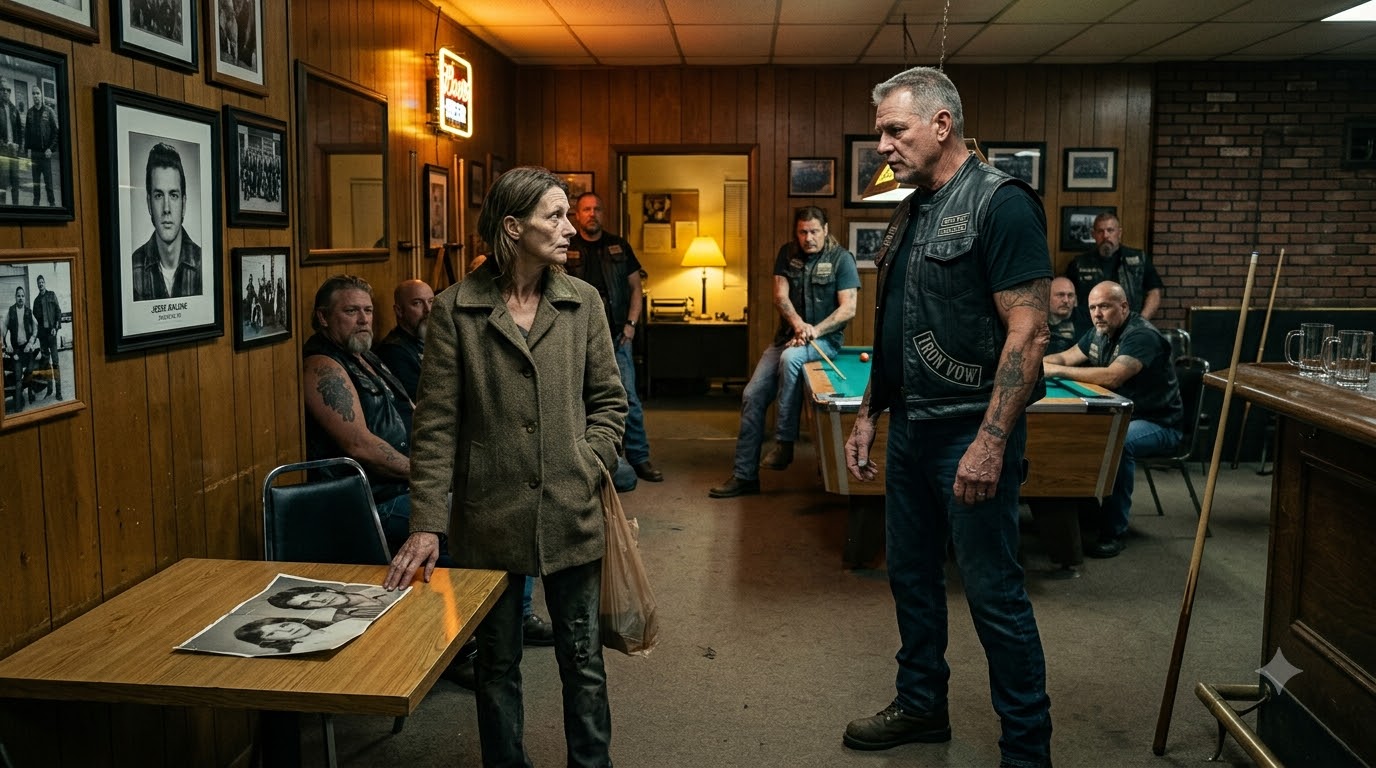
It wasn’t a sudden drop like a light switch flipping off, but a rolling wave of silence that washed across the room, table by table. A dozen pairs of eyes locked onto me. Men with broad shoulders, worn leather cuts bearing the Iron Vow emblem, and forearm tattoos faded by years of road road-dust sat frozen over their glass mugs.
I didn’t step back. When you’ve spent eight months learning how to be invisible on cold sidewalks, a room full of staring strangers doesn’t scare you as much as an empty alley at two in the morning.
My boots made a slow, wet dragging sound across the linoleum floor. The plastic grocery bag in my right hand rustled against my hip, the sound ridiculously loud in the sudden quiet. Nobody moved to stop me. A man near the pool table quietly pulled his boots back off the main walkway, giving me an extra foot of clearance without saying a word.
I stopped right in front of the framed photograph. Up close, the glass was spotless.
My fingers came out of my coat pocket, raw and red from the wind. I placed two fingertips on the bottom edge of the thin wooden frame, just touching the faded border.
“Why is my son’s photo on that wall?”
My voice was barely louder than the hum of the neon beer sign behind the counter, but in that room, it hit like a iron mallet on a rail.
A chair scraped harshly against the floorboards in the back corner.
A man pushed himself up from a low booth. He was tall—six-foot-three at least—with graying hair trimmed short and forearms like cured timber, crisscrossed with dark ink and old road scars. The leather cut across his chest looked heavy enough to turn a knife.
He walked toward me without rushing, his heavy work boots thudding against the floor in a measured, deliberate rhythm. He stopped two feet away, his shadow completely blotting out the draft from the front entrance.
He looked down at my face, then at the index card sticking an inch out of my coat pocket, then up at the photograph. He didn’t look at me like the shelter clerk had—like I was a metric on a state form. His eyes were dark, sharp, and focused, taking in the line of my jaw and the worn-out knuckles resting against the frame.
“Are you Jesse’s mom?” he asked. His voice was surprisingly low, carrying the gravelly texture of a man who didn’t waste breath on useless words.
“I am,” I said. “Dot Malone.”
The big man took a slow, deep breath, his chest expanding under the heavy leather. He turned his head toward the rest of the room. Every eye was still on us, waiting.
“Thomas Greer,” he said quietly, turning back to me. “Most folks here call me Mack.”
He reached out, his thick, calloused hand hovering near the back of an oak chair at the nearest table. He pulled it out three inches, setting the legs down without making a sound.
“Come sit down, Dot,” Mack said. “Please.”
CHAPTER 3: THE CREASED PHOTOGRAPH
The chair frame groaned under my weight, but the wood held solid. Across the laminate table, Mack sat down, his broad shoulders casting a shadow across the ring of water left by an old beer mug.
Nobody spoke for a full minute. A younger man with tattooed knuckles walked over from the bar, set a heavy glass of tap water beside my elbow, and backed away without making eye contact.
I didn’t drink. My fingers stayed wrapped around the index card in my pocket, the creased paper feeling thinner by the second.
“He came through that door seven years ago,” Mack said. He rested his thick forearms on the table, his knuckles rough and scarred. “Twenty-six years old. Kept his mouth shut and his eyes open. Half the guys thought he was arrogant. Truth was, he just didn’t speak unless he had something worth saying.”
I looked down at the tabletop. “Jesse always listened twice before he spoke once. Even as a boy.”
“He talked about you,” Mack said softly. “More than he let on to the rest of the crew.”
He reached into the heavy inner pocket of his leather cut. His large fingers moved with deliberate care, pulling out a small rectangle wrapped in a clear plastic sleeve. He slid it across the table toward my hands.
I took it out of the sleeve. It was a photograph, worn soft at the edges and split down the center by a deep, permanent crease from years of being folded flat inside a wallet or a pocket.
It was a picture of me and Jesse.
He was fifteen, his arm thrown clumsy over my shoulder while I was laughing at something off to the left—a burnt roast on the backyard grill, most likely. I looked so young my own face felt like a stranger’s.
“He carried that every mile he rode,” Mack said. His thumb brushed a speck of dust off his own leather sleeve. “Told me three weeks before the accident he was fixing to bring you down here. Said he wanted you to meet the people who had his back when the road got dark.”
“He never called to tell me,” I whispered, my thumb tracing the white fracture line down the middle of Jesse’s face.
“He was waiting for the right time,” Mack said. His voice dropped lower, flat with the heavy weight of an unavoidable truth. “He kept waiting for things to be settled. But the road doesn’t wait for a man to finish his plans.”
On the desk in the back office behind Mack, through the half-open door, a small silver key attached to an unlabelled brass tag sat untouched under the desk lamp, catching the yellow light.
I held the worn picture in both hands, feeling the thin, fragile paper beneath my skin, knowing for the first time in two years that I hadn’t been forgotten on that long, cold road.
CHAPTER 4: THE SHARED TABLE
The floorboards groaned under the weight of heavy work boots as the men settled into a tight circle around our table. None of them made grand gestures or offered loud condolences. They just sat, elbows resting on knees, giving the silence space to sit between us.
A burly man with graying stubble and a oil-stained mechanic’s shirt leaned forward. “Three years ago, my pump blew out on Interstate 90 during a thunderstorm,” he said, his voice raspy from decades of shop dust. “Jesse drove two hours with a replacement part in his trunk. Didn’t ask for gas money. Didn’t even take a beer. Just fixed the line, handed me a dry towel, and rode off.”
Mack nodded slowly, his broad hand flat on the table near the creased photo. “That was Jess. Never made a speech when a job needed doing.”
“When old Miller lost his roof in the spring hail,” another rider added from the edge of the circle, “Jesse spent three full weekends on that ladder. Didn’t say a word to anyone at the clubhouse. We only found out because Miller brought a crate of peaches down here looking for the kid who patched his rafters.”
I listened, my thumb tracing the worn edge of the photo. Each story felt like a stone being placed into a solid wall, building a picture of my son I had never seen from my kitchen window.
“We tried to find you after the funeral,” Mack said quietly, his eyes fixing on mine with steady weight. “We hit dead ends everywhere. Address on file was five years old. Phone was out.”
“I lost the apartment eight months back,” I said. The admission didn’t carry the sharp sting it usually did. It was just a fact, plain and stripped of shame.
Mack didn’t flinch. He didn’t look away, and he didn’t offer pity. Instead, his gaze drifted toward the half-open office door where the silver key sat under the desk lamp.
“Jess built something here,” Mack said, turning his attention back to me. “He made sure that if any of us took a bad spill, the people left behind weren’t left alone. That wasn’t just for the guys in leather, Dot. That was for you.”
He pushed back his chair and stood up, his heavy boots making a firm, solid sound against the linoleum.
“Give us one day,” Mack said. “Come back tomorrow afternoon.”
CHAPTER 5: THE UNSPOKEN SHELTER
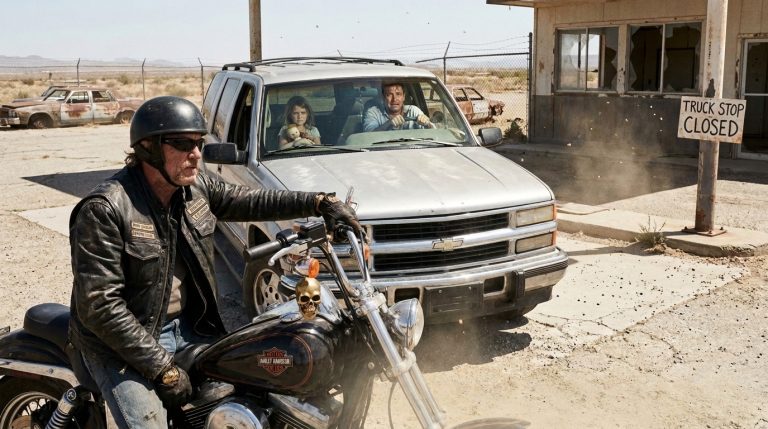
He didn’t lead me to the bar or the back booth. Mack reached into his vest pocket, pulled out a brass key attached to a heavy silver ring, and placed it firmly into my right palm.
“Two miles east,” Mack said, his voice quiet over the low hum of the idling motorcycles outside. “Third floor corner apartment. Building’s owned by a brother who served with Jess.”
I looked down at the brass key, the cool metal pressing into my calloused skin. “Mack, I can’t pay rent. I don’t have—”
“—First three months are covered,” Mack interrupted smoothly, folding my fingers over the metal ring. “No lease forms. No front-desk intake forms. No municipal audit. Just a deadbolt and a warm radiator.”
He didn’t wait for my hands to stop trembling. He led me straight down 14th Street in his pickup truck, carrying my single plastic grocery bag up three flights of narrow wooden stairs.
When he unlocked the door, the heat hit my face first—steady, dry, and smelling faintly of clean radiator paint.
Inside sat a twin bed with fresh flannel sheets, a small oak table with two chairs, and a window overlooking a quiet tree-lined alley. On the laminate counter rested a box of non-perishable groceries, a prepaid mobile phone with Mack’s number saved on speed dial, and a simple wooden frame.
Inside the frame was the creased, twenty-year-old photograph of me and Jesse laughing on the lawn.
“Jesse set up a emergency reserve fund with the club four years ago,” Mack said, standing in the doorway with his hands tucked into his leather cut. “He made sure that if anything ever happened to him, his mother had a roof that no shelter clerk could take away.”
I picked up the framed picture with both hands, my thumb resting over the faint crease in the middle, feeling the solid floor beneath my boots remain completely still.
CHAPTER 6: TOMATOES ON THE WINDOW SILL
The steam rose in a faint, straight line from the black coffee, dissolving into the warm air of the room. Down below in the quiet alley, a delivery truck rattled past, its tires making a steady, rhythmic wet sound against the pavement.
I didn’t turn around to check the lock on the front door. The deadbolt was shot home, solid and heavy in its frame.
Beside my elbow, the small clay pot held three inches of damp potting soil. Two tiny green shoots had broken through the dark earth over the weekend, leaning toward the sunlight pouring through the clean glass pane. They were small, frail things, but their roots were locked tight into the dirt.
I reached out with my thumb and gently pressed the soil around the base of the nearest stem, anchoring it deep into the pot.
On the corner of the small oak table behind me, the wooden frame sat flat in the warm light. In the photograph, Jesse’s laughter was caught forever, untouched by time, cold winds, or forgotten promises.
He hadn’t left me alone on that long road. He had simply built a bridge out of the quiet, solid men he trusted, making sure that when my own strength gave out, there would be a solid floor beneath my feet and a roof that belonged to me.
I took a slow sip of the hot coffee, set the mug down on the wooden sill, and watched the street wake up below.