The Ten-Foot Creep: How a Quiet Property Line Dispute Restored Law and Order to a Franklin Subdivision
CHAPTER 1: THE MONDAY TRASH HAUL
The grey plastic wheels screeched against the curb, vibrating straight up through my wrists. I paused, wiping my palms on the thighs of my work jeans, and looked past the driveway.
A six-foot cedar fence cut straight across the back of the property. The wood was raw, pale, and smelled faintly of fresh resin.
It hadn’t been there on Friday when I loaded up the sedan to visit my sister in Tulsa.
I stood there by the open bin lid, letting the cool morning air hit my face. Subdivision fences pop up all the time, usually put up by people who value their privacy over an open view.
It looked clean enough, straight lines, professional posts sunk deep into the clay. But something about the distance between the back of my back porch and those new cedar pickets felt wrong.
My boots crunched on the gravel as I walked back up the drive. The house behind mine had changed hands the previous year, bought by a guy named Brent Hollis.
He drove a lifted truck that scraped the top of the garage door frame every time he came home from his commercial real estate office. He wore polished loafers in a neighborhood where most people wore muddy boots or sneakers.
He wasn’t loud, just smooth in a way that made you keep your hand on your wallet.
Miguel’s truck was already idling at the curb by ten o’clock, the exhaust chugging a steady rhythm. I walked out to hand him the gate key, and he shut off the mower, wiping grease off his thumb with a rag.
“You know your yard goes past that fence, right?” Miguel asked, pointing a wrench toward the cedar planks.
I gave a dry laugh, leaning against the bed of his trailer. “Pretty sure it ends near those old oak stumps.”
Miguel didn’t smile. He kicked the tire of his trailer, his eyes steady on the grass line. “I’ve mowed this lot for five years. That grass behind the fence is yours. Something’s shifted.”
I didn’t answer right away. I just nodded, thanked him, and watched his truck rumble down the asphalt until the engine noise faded into the quiet hum of the subdivision.
CHAPTER 2: THE CLOSING FOLDER
I dragged my thumb across the metal handle, pulling out the manila envelope marked with the title company’s faded ink.
The kitchen table was bare except for a mug of black coffee that had gone cold hours ago.
I dumped the contents onto the wood grain, scattering thick packets of paperwork, warranty deeds, and folded blue-line plot prints that hadn’t seen the light of day since the day I signed the mortgage.
My fingers sifted through the tax assessments until I pulled out the original site map stamped by the county recorder.
I laid the heavy parchment flat, pinning the corners down with the salt shaker and a heavy coffee mug.
The pen lines were precise, drawn by a county draftsman long before Brent Hollis ever drove his lifted truck into the subdivision.
According to the scale, my northern boundary line didn’t hug the edge of those old oak stumps.
It extended a full ten feet past them, deep into the fresh cedar clearing where Brent’s new fence now stood.
I didn’t feel a surge of anger or a rush of adrenaline; just a dull, grinding weight settling into my lower back.
It wasn’t a mistake of two inches or a fuzzy yard-stake error.
Ten feet of cleared ground was a deliberate chunk of dirt, taken because somebody figured a quiet neighbor wouldn’t look twice at a line of fresh wood.
I folded the original plot map along its crease, sliding it carefully back into the sleeve.
The kitchen window looked out toward the dark yard where the new cedar pickets caught the streetlamp’s pale glow.
I picked up the heavy metal ruler from the counter, tapping its flat edge against my palm in a slow, rhythmic beat.
If the paperwork said one thing and the fence said another, there was only one way to settle it before the week was out.
The next evening, I walked across the dew-soaked lawn with the folded map tucked securely under my arm.
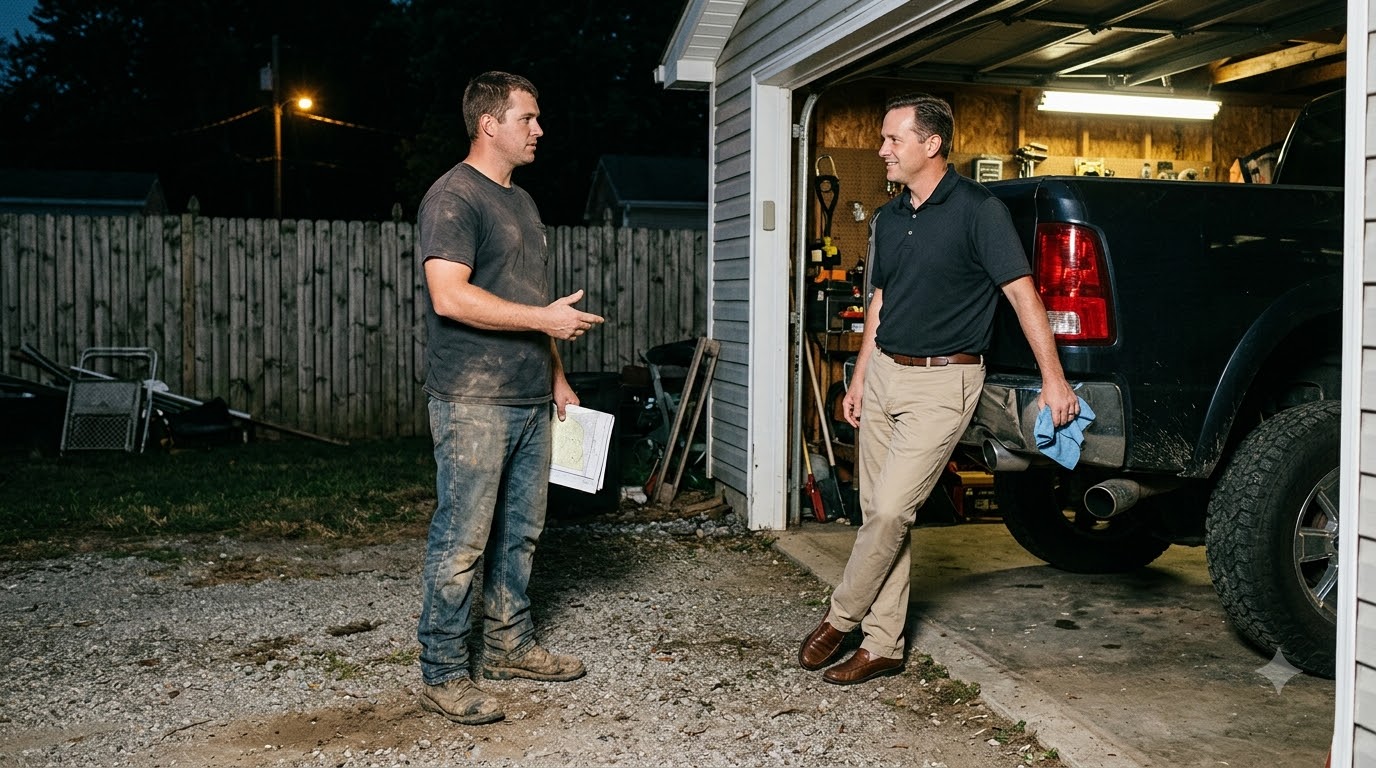
Brent’s garage door was wide open, casting a bright strip of fluorescent light across his clean concrete driveway.
He was standing by the rear bumper of his truck, wiping down the chrome tailpipe with a microfiber cloth.
He didn’t look up until my work boots crunched against the edge of his driveway gravel.
“Evening,” Brent said, his smile sliding into place with the practiced ease of a salesman closing a routine ledger.
“Evening, Brent,” I replied, keeping my voice flat and even as I stopped five feet short of his bumper. “We need to talk about the line behind the garage.”
CHAPTER 3: THE DRIVEWAY CONVERSATION
Brent didn’t look up from his microfiber cloth immediately. He dragged the blue rag across the chrome tailpipe one last time before turning his head with a practiced, smooth smile.
“Evening,” Brent said, his voice carrying that easy cadence of someone who assumed every negotiation ended on his terms.
“Evening, Brent,” I replied, keeping my boots planted firmly on the edge of his driveway gravel. “We need to talk about the line behind the garage.”
Brent tossed the cloth into an open plastic bucket by his rear tire. “Looks clean, right? The fence frames the whole back corner nicely.”
“It does,” I said, sliding my hand inside my jacket pocket to grip the folded edge of the county plot map. “Except it’s built eight feet past where my property ends and yours begins.”
The smile on Brent’s face didn’t shatter; it just thinned out at the edges. He crossed his arms over his chest, leaning his hip against the tail-light housing of his lifted truck.
“Look, the previous owner told me the boundary ran right near those old oak stumps,” Brent said, his tone dripping with patronizing patience. “People get those old lines mixed up all the time.”
“I pulled the original site maps from the county recorder yesterday,” I said, pulling the folded paper out and letting it hang loose at my side. “The stakes were placed forty years ago. That cedar line sits deep in my grass.”
Brent let out a soft, dismissive chuckle, shaking his head as if dealing with a child. “Maps can be old, man. Things shift. But we’re reasonable people; we can figure something out without making a big deal over a strip of dirt.”
“Working it out means moving the fence back where it belongs,” I said, my voice dropping an octave as I locked my eyes onto his.
Brent’s jaw tightened for a fraction of a second, the polished commercial real estate demeanor slipping just enough to show the calculation underneath. “Sure, whatever you need,” he muttered, turning back toward his truck without another word.
He didn’t offer to check the deeds. He didn’t ask to see the map. He just walked into his garage, leaving me standing alone on the cold asphalt with the paper in my hand.
CHAPTER 4: THE FIRE PIT ESCALATION
Two grey Adirondack chairs sat squarely in the middle of the disputed green space, angled toward a stone ring filled with glowing embers.
A couple of plastic cups rested on the arms of the chairs, sitting comfortably on what the county records proved was ten feet inside my northern boundary.
I stood at the edge of my back lawn, my hands shoved deep into my jacket pockets as the evening breeze carried the sound of muffled laughter from down the block.
It wasn’t just a fence anymore. It was an occupation disguised as outdoor remodeling.
Brent had deliberately moved his patio layout across the imaginary line, daring me to say something while he entertained guests on dirt he didn’t own.
I walked out past the old oak stumps, my heels sinking slightly into the damp turf.
Beneath the tall grass near where the cedar corner post stood, my boot heel struck something hard and flat.
I crouched down, brushing away the damp soil with my bare fingers until a circle of rusted iron broke through the mud.
It was an old property marker pin, driven deep into the clay decades before either of our houses were framed.
The distance between that iron pin and Brent’s fire ring wasn’t a matter of inches; it was a solid, undeniable ten feet of stolen ground.
My jaw tightened as I stood back up, wiping the dark soil off my palm onto my trousers.
Footsteps crunched on gravel near the side gate, and Brent stepped out carrying a fresh bag of firewood under his arm.
He stopped dead in his tracks when he saw me standing by the iron pin, holding an empty plastic cup he had left behind.
“Enjoying the view?” Brent asked, his voice sharp and defensive as he dropped the wood bag onto the grass with a heavy thud.
“This pin has been here since nineteen-eighty,” I said, pointing straight down at the rusted iron circle in the dirt. “Your fire ring sits four feet past it.”
Brent stepped across the invisible line, his face hardening as he squared his shoulders. “People use what’s open, man—everyone knows that around here.”
“Owning property means knowing where it ends,” I replied, holding my ground without taking a step back.
“You can keep staring at your dirt all you want,” Brent snapped, turning on his heel and heading back toward his patio without another word.
CHAPTER 5: THE ZONING NOTICE
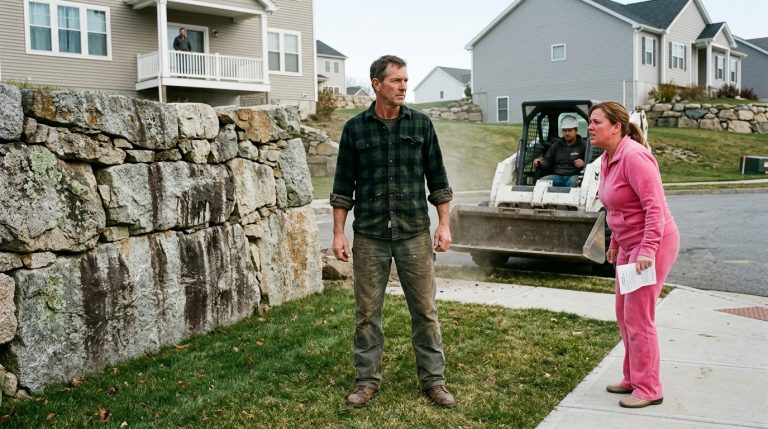
A flatbed truck sat idling right across the gravel turnaround, its diesel engine rattling the windowpanes of my back porch.
Two men in high-visibility vests were unlatching a stack of dark gray siding panels meant for the unauthorized shed sitting four feet past the rusted iron survey pin.
I walked out the back door with the original county plot maps rolled tight in my hand, my boots crunching hard on the frozen ruts.
Brent was leaning against the tailgate of his lifted truck, pointing toward the disputed patch of grass with a roll of blueprints tucked under his arm.
“Drop the corner posts right along that cedar line,” Brent instructed the lead contractor, ignoring the heavy parchment map I held out as I stepped into his path.
“You’re building on recorded county right-of-way,” I said, my voice cutting through the clatter of the diesel motor.
Brent didn’t flinch; instead, his mouth twisted into an ugly, theatrical sneer designed to draw the attention of neighbors peering through their blinds.
“Here he comes again with his imaginary lines,” Brent shouted loud enough for half the street to hear, turning his palms up in fake exasperation. “The county doesn’t care about a couple of old rusty pins from the nineteen-eighties!”
“The county records division stamped these deeds forty years ago,” I replied, snapping the wooden ruler against my palm with a dry crack. “Move the truck off my grass before I call the local magistrate.”
Brent’s face flushed a deep, mottled red as he realized the crowd across the street was watching his performance unravel.
“You’re harassing me over a strip of weeds,” Brent barked, slamming his hand down on the tailgate with a loud metallic bang. “I’ve got commercial permits coming in next week, and you can’t touch what’s already built!”
“Try building it without legal clearance,” I said, holding my ground against the hood of his truck without taking a single step back.
CHAPTER 6: THE QUIET BOUNDARY
The contractor looked from Brent’s flushed face down to the faded parchment map clutched in my hand, then slowly shut the tailgate of his flatbed.
“We don’t pull permits over disputed property lines,” the driver muttered, shifting his gear lever into reverse with a loud metallic clank.
Brent lunged forward, his hands clawing at the air as his commercial leverage dissolved into thin air. “Wait, we have an agreement with the subdivision association—don’t listen to him!”
The truck rolled backward down the driveway, its tires spitting gravel across the asphalt.
Brent stood alone on the disputed grass, his chest heaving under his golf polo as he stared down at the rusted iron survey pin protruding from the dirt.
“You can’t do this over a few feet of grass,” Brent snarled, his voice cracking with sudden, panicked desperation.
“It’s not a few feet, and it never belonged to you,” I said, my voice steady and quiet against his shouting.
Within a week, the cedar pickets came down piece by piece, stripped away by the same men who had erected them under false pretenses.
The prefab shed followed soon after, loaded onto a flatbed and hauled away before the month was out.
I stood by the old oak stumps on a quiet Saturday morning, looking out over an open, unobstructed stretch of green grass.
The heavy pressure that had sat on my chest for months was gone, replaced by the simple, clean smell of freshly cut clover.
Martin walked past along the sidewalk, nodding his head toward the open boundary line with a slow, approving smile.
“Heard about the property line,” Martin said, pausing briefly by the mailbox. “You did the right thing holding your ground.”
I wiped a speck of dust off my fence post, listening to the quiet rustle of the wind through the trees.
Property lines aren’t suggestions, and common sense doesn’t need a crowd to win.
I turned back toward the house, stepping across the grass on ground that was finally, unequivocally mine.