The Iron Anchor: How a Suburban Siege Broken by a Fifty-Ton Titan Exposed a Million-Dollar Fraud
CHAPTER 1: THE SNAPPING CHAIN
Steel shrieked.
The heavy tow chain went bowstring-tight, binding hard against the differential casing of the five-ton truck. Concrete groaned under my driveway, spiderwebbing where the rear tires locked up against three thousand pounds of winching force.
“Keep pulling! Drag it into the street!”
Beverly Caldwell didn’t look at me. She stood three paces past the property line, clutching her black clip-board against her chest like a riot shield. Her acrylic nails tapped a frantic rhythm against the aluminum backing.
A chunk of red clay brick sheared off my garden border. The truck lurched six inches backward, its leaf springs screaming under the sudden shear load.
“Visibility hazard,” Beverly barked toward the tow driver. “Section Four, Paragraph B. Emergency removal authorized.”
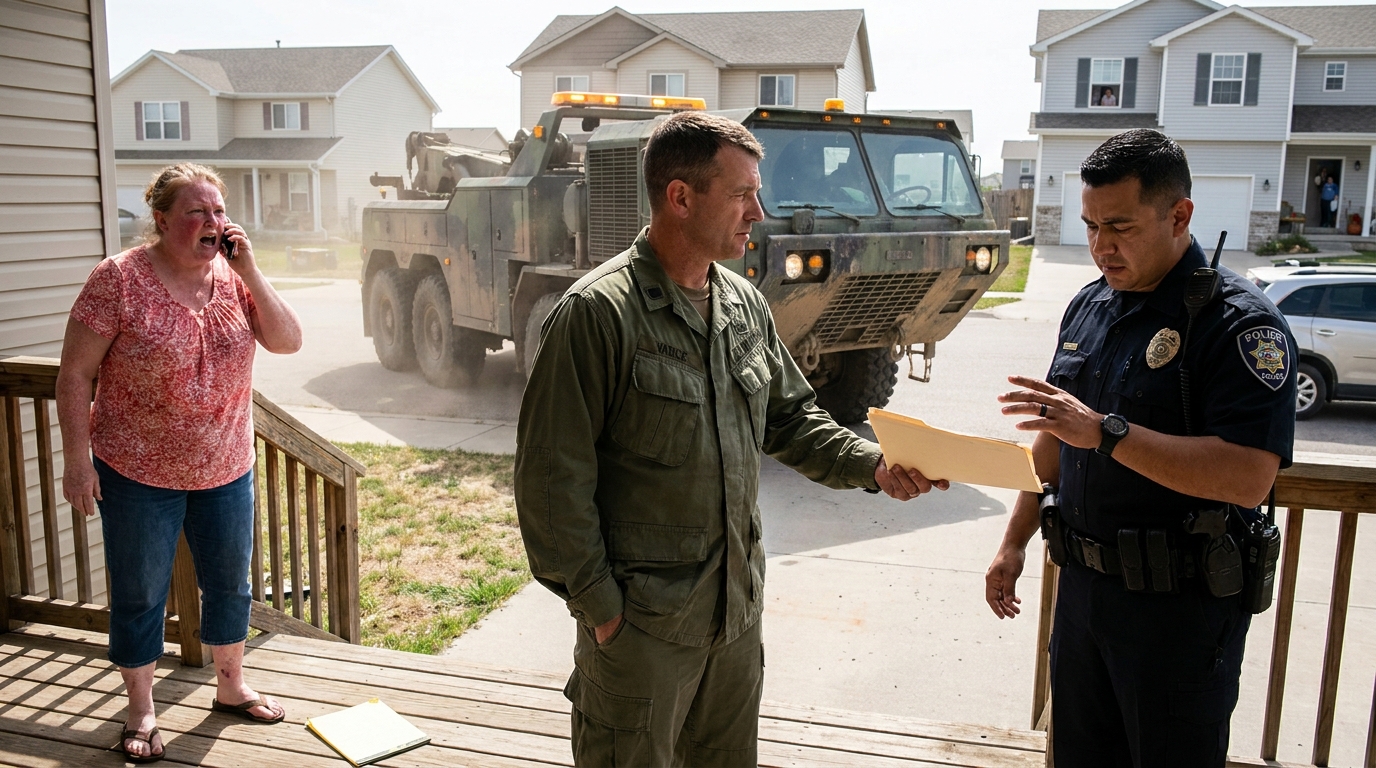
“You didn’t post a twenty-four-hour cure notice, Beverly,” I said. My voice barely carried over the diesel chug of the flatbed. I didn’t step toward her. I didn’t raise my hands. I stayed three feet inside my doorframe, my thumb pressing hard into a cold, flat brass washer in my pocket—the spare lock-nut from the truck’s rear pintle hitch.
“Community safety overrides private storage, Sergeant,” she snapped, her eyes tracking the tow operator’s hydraulic controls. “Military surplus doesn’t belong in Ridgerest Mesa. It drags down the neighborhood aggregate valuation. People live here to forget the sand.”
The driver hit the secondary winch lever. The truck jumped again.
A sharp, metallic clink rang out against the asphalt.
The brass memorial plate mounted below the front grille—stamped with four names and a grid coordinate from the Korengal Valley—snapped its rusted mounting bracket. It dropped into the gutter dirt, face-down beside the tow truck’s rear duals.
Beverly stepped over it. Her heel left a black smudge across the stamped serial numbers.
“Toss the debris,” she told the driver, pointing her pen at the gutter. “Clean the curb before you haul out.”
My thumb stopped moving over the brass washer. My heart rate dropped five beats a minute, settling into a flat, icy baseline.
“You’re operating outside the board’s quorum,” I said, my voice leveled like a sightline.
“I am the board,” she replied, her chin snapping up. She pulled a pre-printed fluorescent orange warning sticker from her binder and slapped it across my mailbox. No citation number. No county stamp. Just her initials in blue gel ink: B.C.
Across the street, two blinds twitched in Tom’s front window. A cell phone screen glinted behind a parked sedan. Nobody stepped out.
The tow truck’s engine surged, its exhaust blowing black soot over my garage door as the five-ton cleared the apron and settled into the center of the cul-de-sac.
I didn’t try to stop the truck. I pulled my phone from my hip, tapped the screen three times, and brought up an encrypted direct line.
“Dispatch,” a rasping voice answered on the first ring.
“This is Vance,” I said, watching Beverly scribble a line item onto her clipboard. “Unlawful seizure on private residential land. Five-ton unit. Urban access restricted.”
“Status?”
“They’re moving it to the county impound lot on Fifth.” I looked down at the curb where the brass plate lay half-buried in dry grass. “Send the heavy unit. Fifty-ton class.”
“Permits?”
“Route it through DOT emergency clearance,” I said softly. “She called it a public safety hazard. Let’s make sure it gets cleared properly.”
“Copy. Heavy unit rolling in three.”
Beverly turned around, a sharp, triumphant smile fixing on her face as the tow truck pulled away, dragging two black rubber streaks across my concrete. She held out a carbon-copy paper slip toward my chest.
“Daily storage fine starts tonight,” she said, her breath smelling of cold mint and stale coffee. “Plus the emergency dispatch surcharge.”
I didn’t take the paper. I looked past her shoulder, watching the dust settle where my truck had sat for three years.
“You should have left the plate, Beverly,” I said quietly.
She sneered, tucking the paper into my screen door frame. “You think that uniform makes you untouchable here, Vance? This isn’t a military installation. You don’t command anything on this street.”
She turned her back and walked down the driveway, her heels clicking a steady, arrogant cadence on my cracked apron.
I waited until her front door slammed shut down the block.
Then I walked to the gutter, picked up the cold brass plate, and wiped the rubber smudge off the names with the corner of my sleeve.
CHAPTER 2: PAPER WARFARE
The brass plate was cold enough to draw the moisture straight out of my thumb. I held it by its bent mounting flange, feeling the grit of gutter dirt ground into the stamped lettering of the grid coordinate.
The dual tires of the tow truck had left two parallel ribbons of raw, black rubber across my apron, tearing up a three-foot strip of bluegrass where the chassis swung wide into the turn. The scent of burnt petroleum hung heavy in the humid air, trapped low beneath the suburban canopy. Down the block, Beverly’s porch light clicked on, casting a sharp yellow rectangle across her immaculate lawn.
I walked back up the drive, my boots crunching over the loose gravel and chipped concrete. I didn’t go inside. I sat on the top cinder-block step of the porch, placed the brass plate across my knee, and pulled out my phone.
The fluorescent warning sticker on the screen door reflected off the glass. No citation number. No county seal. Just her blue ink.
I tapped into the county land registry portal, bypassed the public portal interface, and opened the GIS parcel overlay for Ridgerest Mesa, Block 4, Lot 12. My lot.
The standard property boundary was clear: fifty feet from the street centerline, ending three feet short of the concrete apron. Clean. Established in 1994.
Then I pulled the recent municipal filings layer.
A secondary line cut through my lot. A shaded, diagonal swath fifteen feet wide, slicing straight across my driveway, cutting off the exact corner where the five-ton had sat parked for three years. The system tagged it as a pending utility and sightline easement.
I zoomed in on the metadata block at the bottom right corner of the document scan.
Filing ID: EASE-2026-088. A faint stamp in red margin ink read Redline File 88.
Submitted fourteen days ago. Not approved by a municipal judge. Not recorded in the HOA quarterly minutes. Not voted on by a single resident on this street. Just submitted directly to the county recorder’s office with a temporary administrative hold flag.
My thumb dragged across the cold brass plate on my knee, tracing the corner where the metal was torn.
Beverly hadn’t towed the truck because it was a sightline hazard. She needed the physical space empty because a county surveyor couldn’t sign off on a clear easement verification with seven thousand pounds of military axle sitting on top of the proposed line.
I opened a second window and pulled the public records index for the city’s upcoming infrastructure development board meeting.
Agenda Item 4-B: Ridgerest Entrance & Corridor Traffic Optimization Project.
Approved budget: $1.88 million.
Primary Contractor: Mesa-Apex Infrastructure LLC.
I clicked the entity filing for Mesa-Apex. Registered six months ago out of a mail-drop office on Commerce Way. Principal officer listed: Marcus Caldwell.
Beverly’s younger brother.
A cold, methodical stillness settled over me. It wasn’t anger. Anger was loud and messy; it made men drop their guards and swing wide. This was targeted, structural friction. She wasn’t just enforcing neighborhood codes. She was clearing the field for a million-dollar shell-company payout, using her position as HOA president to forge municipal access rights across private deeds.
My phone vibrated in my palm. An incoming text from the dispatch coordinator.
HEAVY UNIT 01 CLEARED. OVERSIZE PERMIT #4092 ACTIVE. ETA CUL-DE-SAC: 1100 HOURS.
I looked down at the paper notice stuck to my screen door. The ink was still fresh enough to smear under a thumb.
She thought she was playing an HOA game—fines, daily surcharges, towing liens designed to bleed a resident until they gave up the land or paid out of exhaustion. She didn’t realize that by invoking an emergency public safety clause to seize property, she’d bypassed civil HOA jurisdiction entirely and dragged state transit laws onto her own lawn.
I took a photograph of the physical notice on the door, capturing the missing citation field. I uploaded the image directly into the state attorney general’s consumer fraud portal alongside the raw GIS parcel overlay showing Redline File 88.
Across the street, the blinds in Tom’s living room pulled back an inch. His porch light flickered on, and he stepped out in his slippers, keeping to the shadows of his garage.
He crossed the street with quick, quiet steps, his hands shoved deep into his cardigan pockets.
“Vance,” he whispered, stopping at the edge of the rubber marks on my driveway. “She’s out of control. She had the board sign off on an emergency assessment three days ago. Said we needed a legal war chest because ‘certain elements’ were threatening property values.”
“Did you sign it, Tom?” I asked, not looking up from the screen.
“No,” Tom said, his voice trembling slightly. “I asked to see the line items. She told me the details were confidential until the audit cleared. Vance… she threatened to place a maintenance lien on my house if I missed the vote.”
I stood up, slipping the brass plate under my arm.
“Go back inside, Tom,” I said softly. “Don’t sign anything. Don’t go to the mailbox tomorrow morning.”
“What are you going to do?” he asked, looking down at the scarred concrete where the truck had been dragged. “That rig is at the impound lot. The fees are going to be three hundred dollars a day.”
“The rig isn’t at the impound lot,” I said. “It’s in transit.”
Tom blinked, confused. “In transit where?”
“Back here,” I replied. “With escort.”
He stared at me for a second, sensing the shift in the air, then nodded once and retreated back across the asphalt, his slippers slapping softly against the dry street.
I walked inside, set the brass plate on the kitchen table beside a clean screwdriver and a bottle of thread-locker, and opened my laptop to draft the formal notice of administrative conflict.
By 0200 hours, the document was filed with the county clerk, the state transportation authority, and the regional sheriff’s dispatch.
Beverly wanted a safety hazard. I was going to give her a fifty-ton lesson in regulatory compliance.
CHAPTER 3: GROUND TREMORS
The downshift was a low, sub-audible pulse that rattled the glass in the single-hung window behind my kitchen table.
I picked up the small blue bottle of thread-locker, capped it, and set the screwdriver beside the bent brass memorial plate. The monitor’s pale light reflected off the brass keyhole hanging from my spare ring on the counter—a heavy, brass-paddled key to the truck’s rear utility locker that hadn’t moved in three hours.
Across the cul-de-sac, a white-and-blue patrol cruiser turned off Commerce Avenue, its headlights sweeping low across my scraped driveway. The overhead light bar stayed dark, but the driver’s side spotlight flickered twice, illuminating the orange warning notice Beverly had slapped against my screen door.
I walked out onto the porch, letting the door click shut behind me. The cool night air carried the sharp, familiar tang of diesel soot and unburnt fuel.
The cruiser pulled up to the curb, its tires grinding against the loose gravel left behind by the tow truck. Officer Alvarez—a five-year veteran with a flat, tired face—rolled down his window, leaning his arm over the frame.
“Vance,” Alvarez said, nodding toward the driveway. “Got a call about a commercial obstruction blocking emergency ingress.”
“Beverly called it in,” I said, stepping down to the second cinder-block stair.
“She called dispatch three times,” Alvarez said, tapping the computer screen mounted beside his steering wheel. “Said you were threatening to bring uncertified heavy equipment into a residential zone. What’s rolling down Commerce right now, Miller?”
Before I could answer, a second patrol car turned the corner, parking fifty feet back to block the entry to the cul-de-sac. Behind them, Beverly’s front door flew open.
She marched down her concrete walkway, her heels clicking like a telegraph operator in the dead silence. She had a thick yellow legal pad tucked under her left arm and her phone clamped to her ear, her voice cutting sharp through the humid air.
“He’s disobeying an administrative code enforcement directive!” she shouted to Alvarez before she even reached the lawn. “Officer, I instructed your department to secure this perimeter. That vehicle was removed under emergency authorization!”
Alvarez stepped out of his cruiser, adjusting his duty belt. He didn’t look at her; his eyes stayed on the end of the street where the streetlights were beginning to hum.
“Mrs. Caldwell,” Alvarez said, his tone flat and practiced. “The town code doesn’t cover private property seizures without a magistrate’s order or a recorded board quorum.”
“It’s a sightline violation!” Beverly snapped, waving her hand toward the scraped concrete. “Look at the corner lot! It cuts directly into the proposed traffic safety zone! I filed Redline File 88 two weeks ago—it’s a public record!”
My hand stayed loose in my pocket, my fingers resting against the spare brass keyhole ring.
“You filed a draft easement, Beverly,” I said softly. “Unvoted. Unsigned by the county surveyor.”
“It’s an active municipal project!” she shrieked, turning her back on me to press closer to Alvarez. “I am the president of this association! I have full fiduciary authority to protect our property values!”
Then the street began to vibrate.
It didn’t start with a sound. It started in the soles of Alvarez’s boots, a deep, rhythmic tremor that shook the loose gravel on the road shoulder. The glass in Beverly’s hand trembled, her phone slipping an inch before she caught it.
Down at the entrance to the cul-de-sac, amber beacons crested the hill, sweeping long yellow beams across the manicured lawns and vinyl siding.
The machine turned onto the street, filling the lane from curb to curb.
It was a 50-ton M984 heavy recovery wrecker, its eight massive tires chewing through the quiet neighborhood air with a low, hydraulic thrum. The steel boom assemblies folded over the rear chassis looked like folded iron wings, painted in dark, non-reflective olive drab.
A oversized transport permit banner hung across the front bumper, flanked by two flashing yellow escort lights.
Beverly took three steps backward, her legal pad dropping against her knee. “What is that?” she whispered, her voice cracking. “What is that thing doing here?”
The heavy wrecker ground to a halt ten feet from my driveway, its air brakes releasing with a sharp, deafening hiss that echoed off the houses.
The cab door opened, and a driver in high-visibility tactical coveralls stepped down, carrying a heavy metal clipboard and a sealed manila envelope. He walked past Beverly without a word, stopping directly in front of Officer Alvarez.
“State DOT Heavy Recovery Permit Number 4092,” the driver said, his voice gravelly and calm. “Escort clearance authorized by the Regional Transit Authority. We are here to execute a lawful property recovery and return to site.”
Beverly’s face went white, then mottled red. “You can’t bring a tank into this neighborhood! This is a private community!”
She pulled her phone up to her face, her thumb stabbing frantically at the screen.
“I am calling 911!” she screamed, her voice echoing off Tom’s dark windows across the street. “I am reporting an armed military invasion of a civilian residential area! There are weapons on that truck! I demand immediate state police intervention!”
Alvarez froze, his hand dropping toward his radio. “Mrs. Caldwell, do not make that call.”
“I am making it right now!” she roared into the receiver. “Dispatch! Send everyone! There is a heavy military vehicle blocking my street and threatening residents!”
Across the cul-de-sac, three more porch lights clicked on. Doors opened. Heads peered out into the flashing amber light.
I didn’t move. I pulled the small manila folder out from under my arm—the printed GIS parcel map, the unvoted easement filings, and the corporate registry page for Mesa-Apex Infrastructure LLC—and handed it directly to Alvarez.
“Check the filing date on that easement, Officer,” I said quietly as Beverly continued shouting false reports into her phone. “And check who owns the contractor listed on the municipal budget.”
Alvarez opened the folder under his flashlight beam. As his eyes scanned the first page, a third vehicle turned onto the street—a dark gray county SUV with a gold law enforcement seal stamped across the door.
CHAPTER 4: PAPER TRAIL COLLAPSE
The gray SUV’s door clicked open, the interior dome light casting a cool circle over the wet curb.
An investigator stepped out into the pulsing amber glare of the wrecker’s beacons. She wore a dark county windbreaker with a silver investigator badge pinned to the breast pocket, a thick accordion file gripped in her left hand.
Beverly’s voice hitched mid-sentence as she lowered her phone an inch. “Who are you? This is a private residential area. I am handling an administrative emergency!”
“Investigator Miller, County Special Audits,” the woman said. Her tone was completely dry, devoid of heat or urgency. She didn’t look at Beverly first. She looked at Officer Alvarez, then glanced down at the manila folder Alvarez was holding.
“Alvarez,” Miller said. “What’s the status on the emergency dispatch call?”
Alvarez clicked his flashlight off. “Caller reported an armed military obstruction on private property, Investigator. But the recovery team brought state DOT transit permits, and the homeowner just handed me these GIS filings.”
“Let me see them,” Miller said. She held out her hand, taking the folder.
Beverly stepped off the curb, her heels striking the asphalt with violent, irregular clicks. Her fingers twitched around her phone, her knuckles stark white under the amber lights.
“This is ridiculous!” Beverly yelled, her voice straining against the low rumble of the 50-ton engine idling behind us. “I am the elected president of the Ridgerest Mesa Homeowners Association! He stored an unauthorized military vehicle on a public sightline! I executed an emergency abatement order under Section Four!”
Investigator Miller didn’t look up from the folder. Her thumb flipped past the GIS parcel map, stopping directly on the red ink margin stamp: Redline File 88.
“Section Four requires a minimum forty-eight-hour written notice posted to the primary dwelling, Mrs. Caldwell,” Miller said softly. “It also requires a recorded board vote with three trustee signatures attached.”
“We had an emergency consensus!” Beverly snapped. She pulled a printed paper sheet from her yellow legal pad and thrust it toward Miller’s face. “The board authorized emergency legal action on Tuesday!”
Miller took the sheet, held it up into the amber beam of the wrecker’s strobe, and read the single paragraph.
“This is an assessment authorization for a legal retainer,” Miller said. Her eyes locked onto Beverly’s. “It has one signature. Yours. And it’s dated three weeks ago—ten days before you submitted Redline File 88 to the county clerk.”
Across the street, Tom stepped off his lawn and walked halfway across the asphalt, his slippers silent against the street. Two other neighbors—a couple from Lot 14—crossed their driveway, standing near the rear duals of Alvarez’s cruiser with their arms crossed over their chests.
“Look at the vendor code on that legal retainer, Investigator,” I said from the foot of my driveway.
Miller flipped her accordion file open, pulled a stapled municipal bank statement out, and laid the two documents side-by-side on the hood of Alvarez’s cruiser.
The yellow beam of the strobe swept over the numbers.
“Account line 402,” Miller read aloud, her voice carrying clearly across the quiet cul-de-sac. “A single wire transfer for $120,000, designated as ‘Pre-Development Site Assessment.’ Paid to Mesa-Apex Infrastructure LLC.”
A sharp murmur broke out near the curb. The husband from Lot 14 took two steps forward, his face twisting in sudden recognition. “Wait… $120,000? We were told our quarterly dues went up twenty percent to cover asphalt sealcoating!”
Beverly’s head snapped toward him. “Stay out of this, Greg! You don’t understand how municipal infrastructure development works!”
“I understand Marcus Caldwell’s name is listed as the registered agent on the corporate charter for Mesa-Apex,” Miller interrupted, tapping a printed state registry sheet against the cruiser hood. “Your brother, correct?”
Beverly’s mouth opened, but no sound came out. Her chest rose and fell in short, shallow hitches. She glanced at the two officers, then at the driver of the 50-ton wrecker, who sat quietly on his running board with a stopwatch in his hand.
“That… that was an advance for environmental testing,” Beverly stammered, her voice dropping an octave, losing its sharp edge. “The county proposed the traffic modification project! We had to secure the easement before the municipal grant expired!”
“The county didn’t propose the project, Mrs. Caldwell,” Miller said, pulling out a final sheet stamped with the County Clerk’s official seal. “The project was submitted as a private developer initiative by Mesa-Apex. Using an unapproved easement drawn straight through Sergeant Miller’s private deeded property.”
Miller looked up, her eyes cold and precise as she looked directly at Alvarez.
“Officer Alvarez, please secure all association financial records currently held in the administrative office at the clubhouse,” Miller instructed. “We are executing an immediate hold on the HOA operating account under County Fraud Protocol 12.”
Beverly’s legal pad slipped from her grip, hitting the asphalt edge-first and spilling loose yellow lined pages into the gutter dirt right beside my scraped concrete.
CHAPTER 5: THE CURB VOTE
A gust of wind carried two loose yellow sheets into the ditch, pinning them against the culvert intake.
Beverly didn’t reach down for them. Her chin stayed locked high, but her right hand twitched against her seam, her thumb digging ruthlessly into the side of her palm. Her eyes darted from Investigator Miller’s badge to the two men walking up the sidewalk.
“David. Paul,” Beverly rasped, her voice paper-thin. “Get back in your house. The board hasn’t called a special session.”
David—the vice president, a retired civil engineer with a heavy frame—didn’t stop. He stepped directly over a scattered page of the legal pad, stopping two feet from Investigator Miller.
“We heard the sirens,” David said. His voice was gravelly, his eyes fixed on the printed audit sheet resting on Alvarez’s cruiser. “And I got the automatic county court filing alert on my phone ten minutes ago. Investigator, is it true?”
Miller lifted the printout. “Your president filed an unvoted easement—Redline File 88—slicing across private deeded lots to justify a $1.88 million infrastructure contract. The recipient of the $120,000 initial retainer was Mesa-Apex Infrastructure LLC, registered directly to Marcus Caldwell.”
David’s jaw tightened. He turned slowly toward Beverly, his eyes hard as flint. “You told us that money went into a escrow hold for suburban drainage repair. You made us sign the emergency assessment waiver under threat of a fiduciary default.”
“It was an escrow hold!” Beverly hissed, stepping toward him, her hands clawing the air in desperate, violent gestures. “The traffic modification project would have raised lot valuations across this entire corridor by fifteen percent! Marcus was handling the preliminary land surveys at cost! If we didn’t clear the corner lot, the state grant would have lapsed to the east township!”
“You used my driveway as a bargaining chip for your brother’s dummy company, Beverly,” I said, taking one deliberate step forward into the strobe light. “And you used an emergency abatement clause to steal a military vehicle because it was sitting on your paper road.”
“It was in the way!” she screamed, spinning on me, her eyes wild, bloodshot under the yellow light. “You think you can park seven tons of iron on a residential corner and pretend you own the ground? You don’t own anything here! This community has rules!”
“The rules require a quorum, Mrs. Caldwell,” Miller cut in, her voice flat and cold. “And under County Administrative Statute 40, any officer engaging in fraudulent filings using association assets is subject to immediate emergency removal by two-thirds of present board officers.”
Beverly’s posture snapped straight. “You can’t do that here! You need a two-week formal notice! You need a written proxy!”
David looked at Paul, the board secretary, who stood shivering slightly in his jacket near the curb.
“Paul,” David said clearly. “I motion to suspend Beverly Caldwell immediately from all HOA board duties, pending the county audit.”
Paul swallowed hard, looking at the scattered papers in the gutter, then at the massive 50-ton wrecker idling patiently behind us. He raised his right hand. “Second.”
“You can’t second it!” Beverly shrieked, taking a frantic step toward Paul. “I hold the proxy for Lot 9! You don’t have the vote!”
“Lot 9 was sold last Thursday, Beverly,” Paul said quietly. “The transfer cleared escrow yesterday. You don’t hold the proxy anymore.”
Miller pulled a formal county notice from her file, slapped it against a clipboard, and held out a pen. David signed his name across the bottom line with three sharp, heavy strokes, then handed the pen to Paul, who signed beneath him.
“Motion carried,” Miller declared, taking the board document back. “Mrs. Caldwell, you are officially stripped of administrative authority over this community. Officer Alvarez will escort you to your residence to ensure no association files or digital drives are removed before the audit team arrives at dawn.”
Beverly stared at the signature line on the clipboard. Her lips moved silently, trying to find a clause, a rule, a line item to hide behind. The legal leverage she had wielded like a hammer for ten years had evaporated into the humid night air in less than six minutes.
“This is my neighborhood,” she whispered, her voice cracking into a ragged rasp. “I built this place…”
Alvarez touched her elbow gently. “Let’s walk back to your house, Mrs. Caldwell.”
She didn’t fight him. She turned slowly, her heels dragging against the asphalt, leaving her scattered yellow pages blowing loose in the street behind her.
Behind us, the driver of the 50-ton wrecker climbed back into his cab, hit a toggle switch, and engaged the secondary hydraulics.
Metal clanked against metal. The heavy steel booms swung out over my driveway with a deep, mechanical hum, lowering the heavy steel lines into place.
CHAPTER 6: IRON AND ASHES
The steel rigging lines clattered as they met the concrete apron.
The wrecker operator swung his heavy boots over the running board, stepped into the space where the tow truck had dragged my axle six hours earlier, and motioned toward the street. The convoy escort—a flatbed transport carrying my five-ton truck back from the municipal holding lot—eased down the cul-de-sac, its air brakes letting out a soft, final sigh.
David stood beside me, his hands thrust deep into his jacket pockets. He didn’t look down at the scattered paper sheets lingering in the ditch. He kept his eyes on the five-ton as the operator backed it into position, lining the rear tires up with the scraped ribbons left on my concrete.
“The county auditor’s office called my cell while Alvarez was walking her inside,” David said softly. His thumb twitched against his pocket hem, a nervous, unconscious rhythm. “They’re freezing the HOA master account at 0800. Every check written to Mesa-Apex Infrastructure LLC under Redline File 88 is being flagged for criminal review.”
“It wasn’t just Marcus Caldwell,” I said, my voice barely raised above the idling diesel engine.
David glanced at me sideways. “What do you mean?”
“Check the entity charter for Mesa-Apex,” I replied, pulling the spare brass keyhole ring from my pocket and letting it rest across my palm. “Marcus is the registered agent. But the secondary officer listed on the franchise tax board filing is Beverly’s husband. They’ve been routing the pre-development grants through three separate shell accounts since last autumn. The sightline complaint wasn’t about a neighborhood hazard. It was the physical anchor for a $1.88 million municipal line item.”
David swallowed, a slow, heavy movement of his throat. He looked across the street toward Beverly’s dark porch light. “She convinced us we were broke. Told us the drainage system was collapsing and that we needed emergency legal waivers to avoid state fines. We trusted her because she had the files.”
“She had the paper,” I said. “Paper doesn’t hold weight.”
The heavy winch groaned as the driver set the five-ton’s parking brake, killed the auxiliary transport engine, and disconnected the tow bridle. The five-ton settled onto its leaf springs with a heavy, familiar metallic thunk, its dark tires resting precisely inside the concrete boundaries of my deeded lot, two inches short of her imaginary easement line.
Investigator Miller walked over from Alvarez’s cruiser, holding a copy of the formal property release form. She handed me a pen.
“The impound fees are waived, Sergeant,” Miller said, her flashlight beam angling down to illuminate the signature box. “The county has officially struck Redline File 88 from the parcel registry. Your deed is clean. The HOA board will receive a formal injunction preventing any further enforcement actions without a court-appointed administrator present.”
I signed my name across the bottom line, handed the pen back, and looked down at my driveway.
The orange warning sticker on my screen door was gone, peeled away by the wind, leaving only a faint square of sticky residue on the frame.
Miller nodded once, stepped into her gray county SUV, and pulled out of the cul-de-sac. Officer Alvarez followed two minutes later, his cruiser’s red and blue lights fading into the tree line at the entrance of the subdivision.
Paul and David lingered at the curb for a moment. Paul looked at the five-ton truck, then at me, shifting his weight from foot to foot.
“Vance,” Paul said, his voice hesitant. “We’re going to hold an emergency open meeting on Saturday. To explain the audit to the street. If you want to speak…”
“I don’t need to speak, Paul,” I said. “Just make sure the books stay open.”
David nodded slowly, touched Paul’s shoulder, and the two of them walked back down the sidewalk toward their homes, their shadows stretching long under the quiet yellow streetlights.
I walked to the kitchen table, picked up the bent brass memorial plate and the small bottle of thread-locker, and walked back out to the front of the truck.
The mounting bracket on the lower grille was bent back three degrees where the tow hook had clipped it. I set my boots against the steel bumper, pulled a small pry tool from my pocket, and slowly, methodically levered the bracket back into alignment. The metal groaned, yielding to steady leverage until the screw holes lined up flush.
I applied two drops of thread-locker to the original brass bolts, set the memorial plate against the steel bracket, and drove the screws home until they locked solid against the frame.
I ran my thumb over the four stamped names and the grid coordinate. The rubber smudge was gone. The metal was clean, cold, and anchored to seven tons of hardened steel.
Across the cul-de-sac, a single curtain twitched in Beverly’s front window, then fell still. No lights turned on. No doors opened.
The street was quiet again. Not the tense, breathless silence of a neighborhood waiting for an explosion, but the deep, steady quiet of a place where the foundation had settled back onto solid ground.
I closed the driver’s side cab door, heard the heavy latch catch with a clean, solid click, and walked back up my porch steps.