The Architecture of Receding Tides: How Precision, Patience, and Two Decades of Silence Dismantled a Public Illusion
CHAPTER 1: THE BRASS AND THE MORNING FROST
The frost on the iron housing of the intake valve was thin enough to scrape off with a thumbnail, but I used the edge of an old brass key instead. Metal against metal carries a clean, flat ring across still water, and at six in the morning, sound behaves differently. It travels low, hugging the surface of Harrow Lake like a damp blanket before losing itself in the reeds.
I did not rush the turn. Two full rotations clockwise, a brief hesitation to feel the cold grab at the grease in the joint, and then a steady, grinding counter-rotation until the internal leather seal broke suction.
Down at the water’s edge, three hundred yards away, the first gray ripple started not with a splash, but with a withdrawal. A tiny, circular depression formed around the concrete intake grid, sucking a skim of fallen oak leaves down into the dark.
From the porch, the view through the binoculars was sharp enough to count the white pine needles on the opposite bank. My thumb rested against the rubberized focus dial, feeling the precise grit of dust caught in the threads. Two years of waiting had narrowed down to this exact minute: six o’clock, seven minutes past. At ten o’clock, Vivian Marsh would step up onto the newly poured cedar platform by the southern cove, scissors in hand, flanked by local politicians who had never bothered to check a county plat map from the Bush administration.
They had mapped a park over a graveyard of property rights, and they had done it with smiles broadcast across three municipal social media pages.
A movement on the eastern ridge caught the corner of my eye—a solitary crow lifting off a dead birch limb, shaking loose a spray of diamond-frost. Nothing else moved. The world was cold, sharp-edged, and entirely predictable.
I lowered the binoculars, letting the leather strap settle against the worn wool of my jacket. On the kitchen table behind me sat the file folder from Leonard K, forty-seven pages of certified copies, easements, and water-rights precedents bound with a brass clasp that had begun to tarnish at the corners. It didn’t need to be opened today. Every word of it was burned into the lining of my skull.
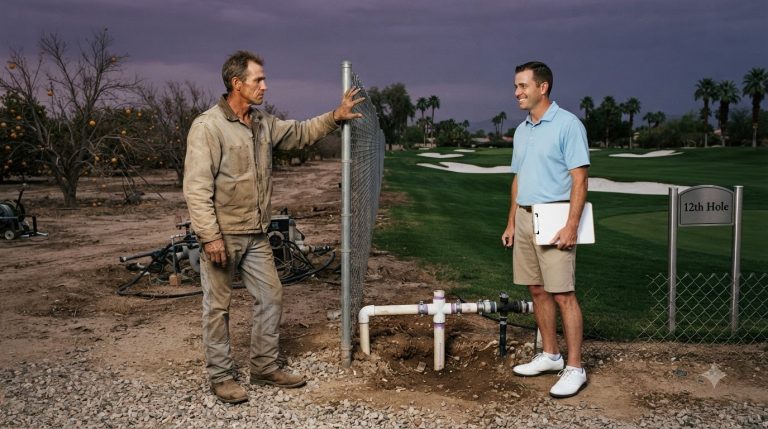
The water at the intake pipe dropped another half-inch, invisible to anyone standing on the shore, but glaringly obvious to the intake float resting against my bulkhead. The gate was open. The math had begun.
I picked up a cold ceramic mug of black coffee, took one bitter sip, and watched the fog thin over the middle of the lake, waiting for the ribbon to be tied.
CHAPTER 2: THE VIEW FROM THE PORCH
The binoculars remained pressed against the bridge of my nose, the rubber eyecups cold from the morning air. Across the valley, the blue expanse of Harrow Lake stretched flat and undisturbed under the rising sun, mirroring the bruised purple clouds clinging to the eastern hills.
From this elevation, three hundred yards up the limestone ridge, the southern cove looked like a stage set built overnight. A sprawling banner of royal blue fabric stretched taut between two newly planted cedar posts, fluttering gently in the breeze. Beneath it, a knot of folding chairs arranged in neat semicircles stood empty, waiting for the crowd that was already beginning to trickle down the access road in tight clusters of pastel windbreakers and sensible walking shoes.
Vivian Marsh stood near the center of the platform. Even at this distance, her posture was unmistakable—rigid, purposeful, the stance of a woman accustomed to having her schedules met down to the second. She wore a cream-colored wool coat that caught the morning light, her hand occasionally reaching out to smooth the edge of the ceremonial ribbon or gesture sharply to a county maintenance worker struggling with a tangled microphone cord.
“They’re early,” I murmured, the words lost to the hollow quiet of the porch.
The municipal parking lot behind the cove was already half full. Silver sedans and compact SUVs nosed into fresh gravel spaces that had been laid down less than forty-eight hours ago over what used to be a natural stand of wild cattails and reed grass. The county commissioners had arrived in a single black town car, stepping out with the practiced ease of men who expected their photographs to make the evening papers.
They thought they were dedicating a public park. They thought they were cutting a ribbon on a legacy of community expansion, funded by a neat stack of state tourism grants and backed by a municipal easement drafted three decades ago when the world was simpler and property lines were written in pencil rather than digitized laser grids.
My thumb shifted the focus ring slightly, sharpening the image of the shoreline where the concrete boat launch met the water. The edge of the ramp dipped precisely four inches beneath the surface, exactly where the spring runoff grade dictated it should. To anyone standing down there right now, it looked like a minor engineering oversight—a slightly ambitious design choice by a landscape crew that didn’t quite understand the seasonal drawdowns of a private basin.
They would realize it wasn’t an oversight by eleven o’clock.
The wind shifted, carrying the faint, tinny echo of a PA system testing its gain. A high-pitched squeal bounced off the limestone ridge, followed by Vivian’s voice, smoothed and flattened by distance, welcoming early arrivals.
I set the binoculars down on the bare wooden planks of the porch. The lenses clicked softly against the grain. My fingers felt stiff, not from the cold, but from the quiet concentration of holding a steady gaze for twenty minutes.
Inside the house, the grandfather clock in the hallway struck seven times, its deep, resonant gongs vibrating through the floorboards. Seven o’clock. Four hours until the ribbon fell. Four hours until the water level, dropping by fractions of an inch at the intake gate, hit the threshold where the gravity-fed supply lines to the park’s decorative fountains would sputter and run dry.
Leonard K had been specific when we spoke on the phone last Tuesday. Don’t send a letter, he had said, his voice crackling over the landline with the dry rasp of an old archivist. If you warn them, they’ll halt construction under an emergency injunction review and claim administrative confusion. You let them pour the concrete. You let them pave the access road. You let them invite the state senator. Make the footprint as large and public as humanly possible, so that when the ground pulls away from under them, there’s nowhere left for the county to hide.
I walked back inside, the chill of the kitchen greeting me like an old friend. The coffee in the mug was lukewarm now, tasting of chicory and iron.
On the kitchen counter, next to the heavy brass key for the intake house, sat a small stack of yellowed legal notices dating back to 1999—the year the county first tried to widen the north road without acquiring the right-of-way. They had backed down then because I had a sheriff’s deputy standing on their survey stakes before the graders could drop a blade.
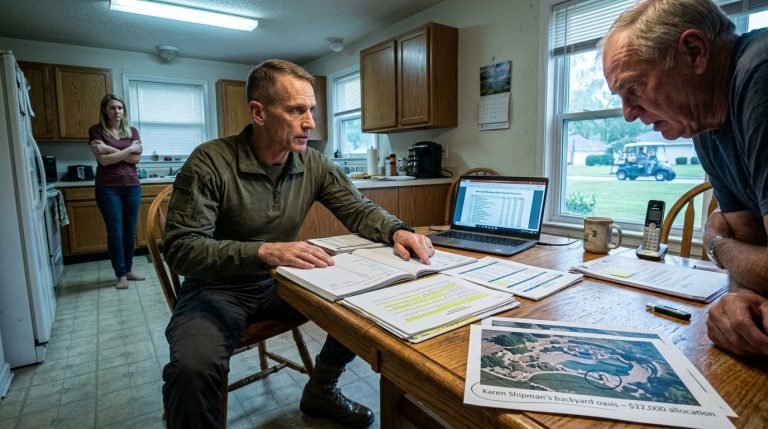
This time, I hadn’t called the sheriff. I hadn’t put up a single ‘No Trespassing’ sign along the southern cove. I had let the weeds grow tall over the property markers, let the boundary posts rust into the brush, and watched as Vivian Marsh and the Ridge Rest HOA poured three hundred and forty thousand dollars into concrete, timber, and public relations.
A sharp rapping sound echoed from the front of the house.
I stopped midway across the linoleum floor. Nobody came up the ridge road at seven-ten in the morning. Not the mail carrier, not the county meter reader, and certainly not the neighbors, who had learned years ago that my gate was permanently latched from the inside.
The knock came again—three firm, measured raps against the heavy oak of the front door. Not a delivery drop. A summons.
I didn’t reach for a weapon, because there was no need for one. I simply walked down the narrow hallway, my boots striking the braided rug with muffled thuds, and rested my hand on the cold iron latch.
CHAPTER 3: THE RIBBON CUTTING AND THE FIRST DRY PATCH OF EARTH
The hand did not linger on the latch. I pulled the heavy oak door inward, letting the dry draft of the hallway mix with the sharp, pine-scented air off the ridge.
There was no one on the porch.
Only a square manila envelope resting squarely on the Welcome mat, held down against the mountain draft by a smooth, grey river stone. The paper was crisp, unmarked by postage, and smelled faintly of fresh copier toner. I did not reach for it immediately. Instead, my eyes tracked the treeline down toward the lower service road where a red pickup truck was just shifting into reverse, its brake lights flaring twice before it bounced down the gravel track toward the valley.
I recognized the truck. It belonged to Miller, the county’s third-district maintenance sub-contractor, a man who had spent twenty years pretending he didn’t see where my property pins crossed the municipal drainage ditch.
With the toe of my boot, I nudged the river stone aside and lifted the envelope. It was light—too light for a legal injunction, too heavy for a standard municipal notice.
Back inside the kitchen, standing under the amber glow of the pendant light, I slit the flap with the edge of the brass key. Inside lay a single sheet of heavy stock paper: a preliminary site map of the Ridge Rest park facility, annotated in red grease pencil by an unsteady hand. Across the margin, someone had scrawled a crude warning in all capital letters: THEY FILED THE AMENDMENT YESTERDAY. THE WEST PLATS ARE CLEAR.
A faint, cold smile touched the corners of my mouth. They thought they had secured an eleventh-hour amendment to shield the project from private encumbrances. They believed a quick stamp from a sympathetic planning commissioner on a rainy Thursday afternoon could rewrite nineteen years of water registry data.
They didn’t understand the geography of paper. A stamp only holds weight if the land beneath it actually belongs to the hand that presses it.
I folded the note, tucked it into the pocket of my wool jacket, and walked back to the window overlooking the lake. The clock on the wall ticked past eight-thirty. Down at the southern cove, the crowd had swelled. The pastel windbreakers had multiplied into a dense, colorful crescent pressing against the temporary snow fencing the county had erected to keep onlookers off the freshly seeded turf.
Through the binoculars, Vivian Marsh was moving with practiced grace among the group. She wore her administrative confidence like tailored armor, leaning in to laugh at a joke made by the district commissioner, her silver-framed glasses catching the bright morning glare. Beside her, a young man in a crisp blue suit carried a mahogany presentation box holding the ceremonial golden scissors.
The machinery of public validation was spinning at peak velocity. Press photographers from the county gazette were squatting near the water’s edge, framing their shots to catch the sunlight glinting off the newly poured concrete boat launch and the pristine cedar platform. They were capturing the birth of a community landmark.
They were also capturing the exact evidence we needed.
A sudden, sharp memory flickered unbidden—the autumn of 1999, when Miller’s father had stood on this very porch trying to convince my grandfather to sign away a ten-foot drainage right-of-way for a drainage ditch that never came. My grandfather had listened in total silence, whittling a piece of cedar down to a smooth, featureless wedge, before handing him a single surveyor’s report from 1954 and telling him to walk back down the hill the way he came. Some things didn’t change. Men like Miller traded in shortcuts; men like Vivian Marsh traded in volume; and I traded in the slow, grinding accumulation of time.
Down at the cove, the time was moving faster than they realized.
At ten o’clock sharp, the applause began. It rippled through the crowd of three hundred and fourteen people like a sudden gust through high grass. Through the lenses, I watched Vivian step up to the wooden podium, her mouth opening in a practiced, soundless cadence of civic triumph. Her hands swept outward in a grand gesture meant to encompass the water, the trees, the sky—everything she had convinced herself and the county board belonged to the public domain.
The golden scissors flashed in the sunlight as she snipped the center of the blue ribbon.
The crowd surged forward, cheering, children breaking away from their parents to sprint toward the water’s edge, folding chairs clattering open against the gravel.
It was ten o’seven.
And right on schedule, the first woman to reach the shore stopped dead in her tracks, her sneaker sinking not into wet mud, but sliding across a cracked, pale crust of sun-baked silt where two feet of water should have been waiting.
CHAPTER 4: THE SINKING BOAT LAUNCH AND THE SIGHTING OF THE PROCESS SERVER
The first crackle of confusion over the loudspeaker didn’t sound like panic; it sounded like an audio feedback loop trying to adjust to an unexpected resistance.
From three hundred yards up the limestone ridge, through the cold glass of the binocular lenses, I watched the tight knot of dignitaries on the cedar platform shift their weight. Vivian Marsh had her hand extended, palm out toward the water, offering a bright, rehearsed smile to the cheering families who had rushed the shoreline. But her fingers stopped moving mid-gesture.
A murmur rippled outward from the water’s edge, traveling backward through the folded chairs and the rows of municipal officials like a wave hitting a concrete pier. The woman in the pastel windbreaker who had first stepped onto the exposed lake bed did not step back; she crouched, her fingers reaching down to touch the gray, flaking mud where water should have been lapping at her ankles.
“What’s happening?” a man’s voice carried faintly across the valley, thin and distorted by the wind.
Vivian turned sharply toward the shore engineer, her cream-colored coat swishing against the stained wood of the podium. The engineer, a burly man in a high-visibility yellow vest, was already staring down at the boat launch ramp twenty feet to their left. The concrete edge, engineered to meet the summer pool grade with an exact four-inch submergence, now hung suspended in the open air, eighteen inches above a receding margin of dark, glistening silt.
The water wasn’t just low; it was running backward, pulling away from the new picnic tables and the freshly sodded banks as if the basin itself were holding its breath.
I adjusted the focus wheel, turning it a fraction of a millimeter until the texture of the mud leaped into sharp relief. Tiny gas bubbles were popping through the silt where the hydrostatic pressure of the basin was rebalancing against the open intake valve. Nature was doing what nature always does when left to its own physics—exposing what had been buried beneath an artificial level.
And then, moving steadily through the cluster of bewildered children and folding chairs, came a tall, spare figure in a charcoal overcoat.
He didn’t run. He walked with the measured, unhurried cadence of a man who had appointments scheduled down to the minute. In his right hand, he carried a heavy, expandable leather portfolio secured with a brass buckle. It was Leonard K’s senior clerk, a man named Henderson, who had spent thirty years serving papers to corporate developers and county commissioners who thought their stationery could override a land title filed during the Truman administration.
Through the binoculars, I watched Henderson thread his way past a row of bewildered township supervisors. A local photographer, framing a shot of the receding water line, swung his camera lens around, capturing the clerk’s approach in a rapid sequence of shutter clicks.
Vivian Marsh saw him when he was less than ten feet away.
Her expression shifted instantly—the civic warmth evaporating, replaced by the tight, defensive squint of someone realizing an unbudgeted variable had entered the room. She dropped the golden ceremonial scissors onto the podium. They landed with a dull, heavy clatter against the cedar planks.
“You can’t be here,” she said, her voice sharp enough to cut through the hum of the crowd. “This is a private municipal event. Authorized access only.”
Henderson didn’t argue. He didn’t raise his voice to compete with the murmuring spectators. He simply reached into the leather portfolio, pulled out a thick, tightly bound sheaf of paper bearing the embossed seal of the district court, and extended it toward her chest.
“Vivian Marsh?” he asked, his tone flat, bureaucratic, and entirely devoid of malice. “You’ve been served.”
The wind gusted down the ravine, carrying the sharp scent of damp earth and rust across the ridge. I lowered the binoculars, letting them rest against my chest, and reached into my pocket to touch the cold, smooth metal of the brass key. The first phase was complete. The ground had opened up beneath them, but the deeper architecture of the title—the nineteen years of quiet documentation sitting in the folder on my kitchen table—was still locked away, waiting for the legal tide to hit high mark.
CHAPTER 5: THE DELIVERY OF THE COMPLAINT AND THE UNRAVELING
The envelope did not fall; it met resistance. Vivian Marsh’s fingers remained clamped at her sides, curled tight into the fabric of her cream-colored coat as Henderson held the forty-seven-page complaint steady against the wind.
Around them, the celebratory murmur of the crowd fractured into sharp, jagged questions. A local reporter from the county gazette dropped his telephoto lens lower, the metal barrel clicking against his jacket as he reframed the shot to catch the embossed seal of the district court shining against the grey wool of the clerk’s sleeve.
“This is a mistake,” Vivian said, her voice rising just enough to carry over the murmur of the onlookers, though the practiced resonance of her public speaking voice had thinned into something hard and brittle. “There is an active municipal easement. The county board certified these parcels eighteen months ago.”
Henderson did not blink. His eyes remained fixed on her with the dull, absolute indifference of a man who had delivered thousands of legal notices to people who believed their own press releases. “Section four, subsection two of the original 1991 deed covenant,” Henderson replied, his tone level and unhurried. “The easement grants pedestrian access for fishing during daylight hours. It explicitly prohibits commercial structural development, earthmoving, and concrete pouring. You’re standing on private property, Ms. Marsh. And the water you invited three hundred people to look at belongs to the parcel registered under title deed four-zero-eight.”
The silence that followed was heavier than the wind.
Through the lenses of my binoculars back on the ridge, I watched the district commissioner step forward, his smooth, practiced smile slipping sideways as he glanced down at the receding waterline twenty feet away. The silt was drying rapidly in the morning sun, cracking into pale geometric patterns where the dock pilings now hung like broken teeth over empty air.
Vivian reached out then—not to push the document away, but to snatch the top edge of the manila backing. Her fingers trembled slightly, a microscopic failure of composure that only someone watching through high-magnification glass could catch. Her eyes scanned the first paragraph, tracking the bold legal citations that Leonard K had spent three weeks formatting with surgical precision.
The decoy secret—the assumption that the county’s administrative approval of the state tourism grant could somehow sanitize a flawed land transfer—dissolved right there in the cold morning air. They had built their entire public narrative on the belief that a rubber-stamped zoning variance could override a private metes-and-bounds survey.
“Call the county attorney,” Vivian whispered, not to Henderson, but to the young man in the blue suit who still held the mahogany box containing the golden scissors.
The young man didn’t move. He was staring down at his smartphone, where notifications were already beginning to pile up in a silent, flashing cascade. Word travels fast when a public ribbon-cutting turns into a title dispute recorded by thirty smartphone cameras and a local news crew.
I lowered the binoculars, resting them against my chest once more. The air on the porch was growing sharper as the sun climbed higher, burning off the last thin skin of frost from the railing. Down below, the crowd was beginning to drift backward, away from the sinking dock and toward the parking lot, instinctively distancing themselves from a sinking ship of municipal liability.
The first phase of the escalation was holding true to the math. Every phone call made, every hurried consultation between the commissioner and his aides, and every desperate glance toward the empty lake bed was a turn of the screw. They thought they could absorb the blow with a quick administrative hearing on Monday morning. They still didn’t understand that the forty-seven-page complaint was only the introductory brief.
I turned away from the railing and walked back into the dim quiet of the house, leaving the front door cracked an inch to let the mountain air sweep through the hallway. The folder on the kitchen table awaited its next entry.
CHAPTER 6: THE EVENING NEWS BROADCAST AND THE DIGITAL FALLOUT
By six o’clock that evening, the blue light of the television screen in the corner of my kitchen was the only illumination in the room. The local affiliate out of the county seat had bumped its usual evening lineup, replacing the standard weather and sports desk update with a live feed captured from the southern cove of Harrow Lake.
The anchorwoman, a woman with hair lacquered into an unmovable helmet of professional composure, stood before a split-screen graphic. On the left side played a looping, high-definition drone shot of the ribbon-cutting ceremony from that morning—the bright blue banner, the smiling crowd of three hundred and fourteen people, and Vivian Marsh raising her hands in triumph. On the right side was the brutal, unvarnished reality of the afternoon: the cracked, grey silt basin, the boat launch hanging eighteen inches above dry earth, and the stark white lettering of a hastily erected private property sign planted directly in the middle of the newly sodded turf.
“What was billed as a thirty-thousand-square-foot community recreation area funded by state tourism grants has turned into a major administrative and legal embarrassment for the Ridge Rest HOA,” the anchor said, her voice pitched to a smooth, neutral cadence that masked the sharp teeth of the scoop. “Legal representatives for private stakeholders confirmed this afternoon that the basin sits entirely within an unceded historical water tract. Construction permits issued by the county commissioners last November failed to account for a binding 1991 baseline covenant.”
The camera cut abruptly to a shaky smartphone video recorded by an attendee in the crowd—the exact moment Henderson handed the forty-seven-page complaint to Vivian Marsh.
The frame caught Vivian’s face in stark, unflattering light: the sudden drop of her jaw, the rigid tightening of her posture, and the desperate, instantaneous look she threw toward the district commissioner before the footage cut out.
My thumb tapped a slow, rhythmic beat against the scarred wooden surface of the kitchen table. Across the room, the small digital counter on the local news station’s website tracker ticked upward in real-time. Three hundred and forty thousand views. Four hundred thousand. The digital ecosystem was doing what it did best—feeding on the spectacle of bureaucratic hubris collapsing under its own weight.
There was no need for me to call Leonard K. There was no need to check the intake valve down at the dam; the water level had stabilized exactly where the natural basin floor dictated it should, leaving the park’s decorative concrete dry and cracked in the evening breeze.
The phone on the wall beside the pantry did not ring—it rattled with a sharp, electronic urgency. Three short bursts, a brief pause, and then another sustained trill. It was likely a reporter from the county gazette looking for a statement, or perhaps Miller testing the waters to see if a back-channel compromise could be struck before the Monday morning injunction hearings.
I didn’t answer it. I let the signal loop through its programmed cycle until the line went dead, leaving behind only the low, steady hum of the refrigerator compressor and the muted drone of the television anchor moving on to the evening’s next scandal.
The trap had been laid two years ago with a single, innocuous letter from an HOA board that thought they could redraw the world with a press release. They had built their entire illusion on the assumption that power belongs to whoever shouts the loudest. But power, much like water, always finds the lowest point—settling quietly into the cracks until the weight of its own lie brings the whole structure down.
I stood up from the table, walked over to the small kitchen window, and looked out toward the dark, motionless surface of the lake. The digital age moved fast, but the ground underneath it was still anchored to old paper and cold iron.
CHAPTER 7: THE EMERGENCY HOA SCRAMBLE AND THE ATTORNEY GENERALS INQUIRY
The Monday morning frost was thicker than it had been the week before, crusting over the porch rails in brittle white needles that snapped cleanly under the edge of a scraper.
Down in the valley, the Ridge Rest HOA administrative office looked less like a community hub and more like a besieged outpost. Through the high-powered lenses of the binoculars, three black sedans belonging to the county legal department were parked haphazardly across the freshly paved gravel turnaround. A pair of men in dark overcoats stood near the trunk of the lead vehicle, trading manila folders back and forth under the grey morning light while a local towing service van winched away the promotional sign that had marked the southern cove entrance.
Vivian Marsh was not on the porch this time.
According to the brief update running on the early morning radio ticker through the kitchen radio, she had spent the previous evening locked in emergency session with her criminal defense counsel and two junior partners from the state’s municipal litigation pool. The grant money—the $45,000 disbursement issued under emergency tourism improvement provisions—had been frozen by order of the state auditor’s office before the electronic transfer could even clear the municipal clearinghouse.
My thumb rested against the cold rubber of the binocular focus ring. The system was performing exactly as Leonard K had mapped it out two years ago. When you let a bureaucracy build its own monument on sand, you don’t need to swing a hammer at the walls. You simply pull the wedge at the base and let the sheer weight of their own paperwork crush them into the mud.
A sharp rap on the front door broke the quiet hum of the kitchen.
It wasn’t Miller, and it wasn’t the delivery drop from the weekend. I walked down the narrow hallway, my boots striking the braided rug with deliberate, even steps, and pulled the heavy oak latch inward.
A young man in a slate-grey suit stood on the porch, his breath pluming white in the freezing air. He had the pinched, anxious look of someone who had been handed a brief he didn’t want to argue, clutching a manila envelope sealed with red wax tape.
“Mr. Vance?” he asked, his voice tight with professional nervousness.
“You’re standing on the wrong side of the property marker,” I said, my voice flat, cold, and entirely level.
The young man blinked, glanced down at the frosted edge of the welcome mat where a rusted iron spike marked the true boundary line, and took a half-step backward onto the gravel access path. He didn’t try to hand me the envelope. He simply laid it down on the top of the porch railing, right beside the brass key for the intake house.
“The district court has issued an order for a joint title deposition,” he said quickly, keeping his hands visible in his coat pockets. “Ms. Marsh’s counsel is requesting an immediate stay on the water level restoration pending an emergency administrative review.”
“Tell them the valve is locked,” I said, and closed the door.
The latch clicked home with a solid, heavy thud that resonated through the timber frame of the house. There would be no stay, and there would be no administrative shortcut. The water had done its work, exposing the structural rot beneath the ribbon-cutting ceremony, and the final turn of the screw was already waiting.
CHAPTER 8: THE RESIGNATION AND THE RETURN OF THE STILL WATER
The silence in the hallway did not last. By noon on Tuesday, the black sedans parked along the lower access road had turned around one by one, their tires crunching backward over the fresh gravel as the county legal team abandoned the perimeter.
Through the binoculars, the southern cove looked desolate. The promotional banners had been stripped from the cedar posts, leaving behind raw, unpainted wood grain exposed to the mountain air. The local news crews were gone, having packed up their satellite trucks and high-definition lenses to chase a newer scandal across the state capital.
Vivian Marsh’s resignation was delivered to the Ridge Rest HOA board via a brief, unsigned PDF transmitted through her defense counsel just before midday. There were no press conferences, no defensive statements, and no final declarations of community stewardship. The $45,000 tourism grant had been formally rescinded by the state auditor, and the municipal planning commission was already facing a broad, sweeping inquiry into nineteen years of unverified property transfers.
I picked up the brass key from the porch railing where the young clerk had left it, turning its cold, serrated edge over in my palm.
There was no sense of triumph—only the quiet, settling weight of order being restored. A landscape cannot hold an untruth indefinitely; sooner or later, the water finds its true level, and the boundary markers reassert themselves through the mud.
I walked back down the hallway to the kitchen, opening the heavy metal filing cabinet that had sat in the corner for nearly two decades. Inside, neatly stacked beneath decades of water-level ledgers and certified tax assessments, lay the original 1954 plat map. I pulled it out, smoothed the heavy vellum against the wooden tabletop, and took a small brass screw from my pocket—the one that had worked itself loose from the intake housing two summers ago during the initial planning phase.
With a small flathead screwdriver, I sat down at the table and began to tighten the screw back into its housing, listening to the clean, sharp bite of steel threading into brass. The repair was small, functional, and completely invisible to anyone passing by on the road, but it restored the intake gate to absolute mechanical perfection.
When the tool clicked against the metal, I set it down and walked back to the front window.
The sun had broken through the grey winter clouds, casting a long, sharp line of light across the surface of Harrow Lake. The water had stopped receding, holding steady at its natural winter basin line, quiet and deep against the limestone banks. The park was gone, the concrete boat launch stood abandoned above the dry silt, and the world outside had returned to the exact shape the law always intended it to have.
I reached out, pulled the window latch shut against the mountain wind, and sat down to watch the afternoon shadows lengthen across the water.