The Dust and the Deed: How a Retired Engineer Outmaneuvered a Suburban Tyrant Using Cold Logic and Gravel
CHAPTER 1: THE LINE IN THE DUST
The pink tracksuit looked radioactive against the dull gray of the Douglas firs.
It was an impossible color for a logging trail—brilliant, synthetic, and violently out of step with the damp duff and the heavy scent of rotting bark. She stood squarely in the center of the skidder tracks, her arms locked across her chest in a knot of defensive tension, planting her sensible white sneakers into the dirt as if she were staking a claim for a foreign crown.
“That forest belongs to the viewscape of this community,” she said, her voice cutting through the steady idle of the heavy machinery with a practiced, venomous entitlement. “And I’ll see you in jail before I let you touch one more tree.”
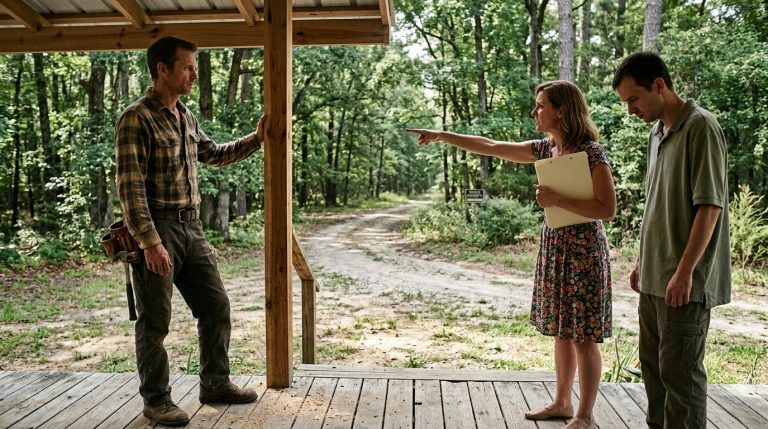
I kept my hand resting on the warm iron of the skidder’s door, feeling the low, rhythmic thrum of the diesel engine vibrating through my palm. My fingers brushed the grit of dried mud caked along the latch. Twenty-two years in the Army Corps of Engineers taught me one immutable law of terrain: you never react to the noise your adversary is making; you look at the ground they are standing on. And right now, she was standing squarely on my property, roughly four hundred yards inside the iron boundary pin I had driven into the granite myself a decade and a half ago.
She was in her late fifties, her face pulled taut into a mask of pure, unadulterated indignation. Behind her, a brand-new Lexus SUV idled haphazardly on the gravel shoulder of the access track, its tires chewing up the edge of the ditch I had spent two solid weekends clearing and draining.
“Ma’am,” I said, keeping my voice flat, measured, and stripped of any heat. “You’re on private property. And every permit for this harvest has been pulled, filed, and cleared through the state forestry department.”
Her laugh was short, sharp, and ugly—the sound of breaking glass. “Your rights end where my community’s property values begin, Mr. Coleman. We have covenants. Aesthetic harmony. That devastation”—she jabbed a manicured finger toward a single, cleanly felled pine lying across the fern beds—”is a direct violation of Aspen Ridge.”
Down the line, my crew chief, Gus, killed his chainsaw. The abrupt silence that rushed in to fill the void was heavier than the noise had been. Gus didn’t look at her; he looked at me, his weathered face expressionless beneath the brim of a faded canvas hat. He had seen enough land disputes over thirty years of logging to know when a fool was stepping into a crossfire without a compass.
I didn’t argue the covenants with her. Arguing with someone who believed they owned the horizon was like trying to patch a breach with wet sand. Instead, my gaze flicked past her shoulder, tracking the faint, secondary wheel ruts winding up the slope toward the cookie-cutter ridge of McMansions looming just beyond the tree line. Something didn’t fit. The developer’s original plat map, the one I had memorized when I bought these hundred acres for my retirement, showed a dead-end loop on their side of the ridge, tight against the property drop-off.
Yet her tires were dusted with a very specific gray shale found only on the lower maintenance track—a track that crossed my eastern corner by virtue of an old, half-forgotten utility easement.
She was glaring at me now, her breathing shallow and fast, waiting for me to yell back so she could lock down her sense of martyrdom. She wanted a fight. What she didn’t realize was that a good engineer never fights a fortified position head-on; you simply check the load-bearing calculations of their foundation and wait for the weight to do the work.
“You’ll be hearing from the county sheriff, and you’ll be hearing from our lawyers,” she snapped, turning on her heel with a sharp rustle of synthetic fabric. She marched back toward the Lexus, spraying gravel with a petty fury that left a thin white dust settling over my boots.
I watched her pull away, the red tail-lights vanishing into the dense wall of pine. Gus walked over, wiping grease from his thumb with a rag.
“Well,” Gus muttered, spitting a strand of rye grass into the dirt. “That’s going to cost us a few hours of daylight.”
“No, Gus,” I said quietly, staring up the slope where the roofs of Aspen Ridge gleamed in the pale morning light. “That’s just the reconnaissance phase. Let’s pack it in for today. The ground’s about to get a lot more interesting.”
CHAPTER 2: THE BLUEPRINT OF LEVERAGE
The linoleum inside the county recorder’s office smelled of stale floor wax and damp wool. It was a flat, unyielding smell that belonged to rooms where people went to find out how much of their lives were legally owned by someone else.
I set the thick cardboard box down on the counter with a dull thud. The clerk, a man with graying temples and glasses dangling from a faded neck strap, didn’t look up immediately. He was halfway through stamping a stack of subdivision variances, his wrist moving with the metronomic rhythm of a pendulum.
“Help you find a plat map, Mr. Coleman?” he asked without breaking cadence. The county was small enough that a logging truck with an engineer’s decal on the door left a footprint in local memory.
“I need the complete historical file on parcel 73-4A, and the corresponding engineering right-of-way filings for Aspen Ridge Estates, Phase One,” I said.
The clerk paused, his stamp hovering an inch above a blue ink pad. He looked up, his eyes narrowing slightly behind thick lenses. “Phase One? That’s the luxury development up on the ridge. Lots going for half a million a pop. You running into a boundary issue up there?”
“Just checking the load-bearing capacity of a few legal assumptions,” I replied.
He grunted, pulled his keyboard toward him, and began clacking away with two fingers. The monitor cast a pale green glare across his cheeks. Behind me, the glass doors of the municipal building rattled as a gust of October wind drove a handful of dry oak leaves across the concrete stoop. The weather was turning; the air outside had that thin, metallic bite that precedes a hard freeze, the kind of cold that forces people down from the hills and makes them very conscious of whether their driveway is clear.
Ten minutes later, he handed me a heavy, accordion-fold Manila folder stuffed with onion-skin copies, blue-line prints, and stapled amendments. I carried it over to one of the scarred oak writing tables near the tall, drafty windows, sitting down so my back was to the room, keeping my field of view clear.
The documents weren’t glamorous. They were standard bureaucratic paperwork, but to an engineer, they were a structural stress analysis. I unrolled the developer’s original primary plat map from five years ago. My hundred acres sat on the left edge like a solid granite anchor, marked with old survey pins and natural contour lines. Adjoining it was the checkerboard layout of Aspen Ridge.
I traced the main access road with the tip of my thumb. It curved up from County Highway 12, slicing through a sixty-foot grade cut before leveling out at the ridge top. According to the engineering notes clipped to the back of the variance request, the grade on the second switchback sat at fourteen percent—just one percentage point shy of the maximum safety limit allowed under rural zoning codes.
There was a marginalia note scrawled in red pen by a county inspector who had long since retired or moved on: Conditional approval granted subject to standard turnaround compliance at terminus.
I flipped to the next page. The architectural layout for the final phase of the cul-de-sac. The space where a standard fire truck or a municipal snowplow was supposed to complete a three-point turnaround was conspicuously blank, replaced later by a pencil-drawn amendment that squeezed in two extra residential lots to maximize the developer’s profit margin. To compensate for the missing turnaround, the developer had quietly looped an emergency utility easement through the northeast corner of my timber tract, tying their dead-end ridge directly onto my old logging road.
It was a classic shortcut. A paper engineering fix designed to pass muster with a lazy planning commission while quietly shifting the burden of physical space onto someone else’s property line. They had assumed the woods were empty, that the old timber tract was a passive neighbor who wouldn’t look too closely at the fine print.
My phone buzzed against the wood of the table—a short, sharp vibration. I pulled it out. A text from Dave, the JAG officer who handled my legal work: Heard about the roadside circus. Lockwood Finch sent over a formal notice of intent to file for a temporary restraining order. Hearing is set for two weeks out before Judge Albright. Stay off the property line, keep your paperwork dry, and let’s meet tonight.
I looked back down at the blue-line print, letting my thumb trace the dotted line of the easement where it crossed my eastern boundary. Karen and her high-priced downtown lawyers thought they were bringing an overwhelming force to bear against a lone logger cutting a pine tree. They were treating the dispute like a turf war, screaming about aesthetic harmony and property values while waving injunctions like banners.
They didn’t understand the terrain they were operating on. They didn’t realize that every legal document they filed was just another load-bearing pillar resting entirely on an infrastructure they didn’t own.
I packed the maps back into the folder, the crisp crackle of the heavy paper sounding loud in the quiet room. The clerk looked up as I walked past his desk to drop the file off for copying.
“Everything clear, Mr. Coleman?” he asked.
“Crystal,” I said, zipping my canvas jacket against the draft. “The foundations are right where I left them.”
I stepped out of the municipal building and into the cold gray afternoon. The wind caught the collar of my jacket, smelling faintly of woodsmoke and coming rain. The first legal salvo had been fired, and the clock was ticking down the days to the courthouse hearing. But as I climbed back into the truck and turned the key, the engine catching with a deep, familiar rumble, I wasn’t thinking about lawyers or judges. I was thinking about drainage ditches, heavy granite boulders, and the physics of what happens when a community builds its entire winter survival on a road that didn’t belong to them.
CHAPTER 3: THE INFRASTRUCTURE TRAP ON THE LOGGING ROAD
The small crawler tractor idled with a deep, rhythmic cough that sent faint puffs of blue exhaust into the damp autumn air. Chet, an old-timer who had graded half the county roads back when logging was done with mules instead of skidders, spat a stream of dark tobacco juice into the ferns and cut the throttle.
“You want these boulders right on the shoulder, Jack, or sitting dead center?” Chet asked, leaning an elbow against the rusted iron cowl of the dozer. His fingers were dark with grease, permanently stained by decades of wrenching on iron and steel.
I stepped off the lowboy trailer, my boots sinking an inch into the wet duff of the logging road’s border. I pulled the survey print from my back pocket, letting the crisp October wind snap the edges flat.
“Neither, Chet,” I said, pointing toward the wide, horseshoe-shaped clearing roughly forty yards before the property line met the old utility easement. “We position them to mimic a natural slide. Three heavy blocks right across that flat turnaround pocket the snowplows use, and we narrow the shoulders on the approach down to ten feet flat. Just wide enough for a pickup with clearance. Nothing wider.”
Chet squinted up the slope toward the distant, gray-shingled rooftops of Aspen Ridge peering over the ridge line. A slow, knowing grin cracked the leather of his weathered cheeks.
“Narrowing the neck and removing the turning basin,” Chet muttered, rubbing his chin. “That ain’t just erosion control. That’s a choke point.”
“It’s maintenance,” I replied evenly, tapping the survey map. “Water runoff has been cutting deep ruts into the clay on these grades for ten years. The drainage ditches need profiling, and those boulders stabilize the embankment against a freeze-thaw cycle.”
“Right. Freeze-thaw,” Chet chuckled, climbing back into the iron seat and engaging the tracks with a sharp metallic clatter. “Nature’s toughest lawyer.”
For the next three hours, the woods echoed with the low roar of diesel and the screech of granite scraping against granite. We didn’t block the road entirely—doing that would have given Karen and her lawyers a legitimate leg to stand on regarding the emergency access easement. Instead, we worked with the precision of combat engineers reshaping a defensive perimeter. We deepened the drainage ditches on either side so that any vehicle drifting six inches off the centerline would drop its front axle straight into a three-foot trench of wet red clay.
We placed three massive, multi-ton boulders—each hauled up from the dry creek bed on the lower forty—right in the middle of the wide gravel clearing where the commercial snowplow operators traditionally swung their rigs around during winter storms. To the casual eye, it looked like a prehistoric rockfall or a rough land-reclamation project. To anyone trying to maneuver a ten-ton rig, it was an absolute wall.
By noon, the job was done. I paid Chet in cash, watched him load his crawler onto the flatbed, and listened as the transport truck rattled down toward the county highway, leaving behind a silence broken only by the caw of a blue jay and the drip of condensation from the fir boughs.
I walked the length of the newly configured road alone, checking the clearances with a six-foot folding rule. The track was solid, graveled, and completely legal under my state forestry permit. At the lower entrance, I anchored two new metal signs to treated cedar posts: Private Property. Coleman Timberlands. Road Under Construction. Travel at Your Own Risk. No Trespassing.
The trap was set. It didn’t rely on threats, yelling, or courtrooms. It relied entirely on topography, local weather patterns, and the stubborn unwillingness of heavy machinery to negotiate a space that no longer accommodated its turning radius. All we had to do now was wait for the first hard drop in the barometer.
I walked back to my cabin just as the afternoon sun dipped below the jagged western ridge, casting long, sharp shadows across the stacked firewood on the porch. Sarah had coffee waiting on the stove, the steam curling against the clean glass of the kitchen window.
“Done with the landscaping?” she asked quietly, handing me a heavy mug without needing to look up from her ledger.
“Drainage is fixed,” I said, taking a sip of the dark, bitter roast. “The road’s ready for winter.”
She looked at me, a faint, knowing smile touching the corners of her mouth. “And the HOA?”
“They’re still fighting a battle they think is about aesthetic harmony,” I said, setting the mug down on the wooden counter. “They don’t realize yet that the ground beneath them has already shifted.”
CHAPTER 4: THE BLIZZARD THE BLOCKED PLOW AND THE FIRST PHONE CALL
The storm arrived just after midnight, sliding down from the high northern passes with a silent, suffocating efficiency. By seven in the morning, thirty-two inches of heavy, wet Pacific powder blanketed the timberland, bending the young fir boughs to the breaking point and wrapping the world in a muffled, blinding white stillness.
I stood by the second-floor window of the cabin, wiping a clear circle in the frost-fogged glass. Down on the county highway, the orange beacon of a state plow swept back and forth, cutting a black stripe through the drift. But up on the upper logging track, the real test of the terrain was unfolding in real-time.
A heavy-duty commercial plow truck, painted bright highway orange and fitted with an eight-foot steel blade, came grinding up the main Aspen Ridge approach. Its diesel exhaust billowed white against the gray sky, thick and straining under the load of the steep incline. The driver pushed past the subdivision’s dead-end perimeter and nosed right up to the narrow gap where the old utility easement met my property line.
Then the engine note dropped from a high whine to an idle rumble.
Through my binoculars, I watched the driver kill the lights, open the cab door, and step out into knee-deep drifts. He was wearing an orange high-visibility parka and a fur-lined cap. He stood at the boundary edge, staring down my newly modified road.
He looked past the fresh metal signpost—Private Property, Coleman Timberlands, Road Under Construction—and scanned the narrowed shoulders where Chet had deepened the clay ditches. Finally, his gaze locked on the triangular cluster of granite boulders sitting squarely in the middle of the wide clearing where he usually swung his heavy rig around.
The driver shook his head slowly, pulled a radio mic from his shoulder, and spoke into it for a full thirty seconds. Then he climbed back inside, reversed the multi-ton machine down the narrow approach with agonizing, wheel-slipping care, and parked it directly across the upper third of the subdivision’s exit lane, effectively killing any attempt to move commercial traffic down the hill. He wasn’t risking his rig in a drainage trap without a turnaround.
Ten minutes later, my cell phone buzzed on the wooden table downstairs. I let it ring twice, watching the caller ID flash blank before I picked it up and hit speaker.
“Coleman!”
The shriek tore through the speaker with enough force to rattle the glass on the sideboard. Karen’s voice was high, frantic, and stripped of any suburban polish.
“Good morning, Karen,” I said, keeping my tone flat and even. “It’s snowing quite a bit up here, isn’t it?”
“What have you done to that road?” she screamed, her breath catching in a dry sob of pure rage. “Our snowplow contractor just called dispatch and refused to come up! He says the road is impassable! There are boulders everywhere, and the shoulders are all torn up! We’re trapped!”
“I haven’t blocked anything,” I replied, taking a slow sip of black coffee. “I’ve been conducting necessary infrastructure improvements. Drainage work and erosion control. As a property owner, I have a responsibility to manage runoff before the spring thaw washes the hillside out.”
“Improvements? You’ve turned our emergency route into a damn obstacle course!” she yelled, her voice cracking. “The driver says he can’t turn his truck around! He’s parked right across the exit! You did this on purpose!”
“My land, my road, my permits,” I said quietly. “And the signs are entirely clear. It’s private property under active construction. Your plow contractor exercised good professional judgment by not risking his equipment on an unapproved surface.”
“I’ll sue you!” she shrieked, the panic bleeding visibly through her anger now. “I’ll get an emergency injunction! I’ll have the sheriff drag you out in handcuffs!”
“You’re welcome to try,” I answered, the memory of Judge Albright’s dry courtroom voice resting steady in my mind. “Though your last legal venture cost your association quite a bit of time and money for a case that was dismissed with prejudice. As for the easement, it guarantees emergency access for light rescue vehicles—ATVs, snowmobiles, medical foot-patrols. It says nothing about guaranteeing a turning radius for a ten-ton commercial snowplow. Have you actually read the easement text, Karen?”
The silence on the other end was absolute. There was no sputtering, no legal posturing—just the heavy, ragged breathing of a woman who had just realized she was standing at the edge of a cliff she had built herself.
“What do you want, Coleman?” she whispered, her voice finally hollow.
“For now, I want you to enjoy the weather,” I said.
I cut the connection, laid the phone down on the counter, and turned back to watch the snow continue to pile silently against the glass. The first major pressure point had collapsed. The storm had done its work, and the foundation was cracking wide open.
CHAPTER 5: THE CLUBHOUSE REVOLUTION AND THE DEPOSITION OF THE PRESIDENT
The air inside the Aspen Ridge community clubhouse tasted of wet wool, stale coffee, and collective panic.
Outside, the thirty-two-inch snowpack drifted against the glass walls, sealing the building in a white, sound-dampening tomb. Inside, fifty residents stood packed shoulder-to-shoulder, their breath pluming in pale, ghost-like wisps because the automated heating system, starved of maintenance funds redirected elsewhere, was struggling against the sub-zero draft.
At the front of the room stood a flimsy plastic utility table serving as an improvised podium. Karen stood behind it, her face drained of its manic energy, clutching a portable staple gun like a weapon.
“This meeting is illegal!” she shouted, her voice echoing off the paneled walls with a shrill edge. “None of you have the authority to call an assembly! I am the president of this association, and I declare this gathering adjourned!”
Tom Gable didn’t shout back. He stood near the front row, his tall frame unyielding, hands deep inside the pockets of a heavy fleece jacket. When he spoke, his voice cut through the noise with the flat, calm authority of a man who had spent decades coordinating flight paths through severe turbulence.
“You don’t get to adjourn a community that’s freezing in its own driveways, Karen,” Tom said, stepping forward. “Not after spending forty thousand dollars of our reserve funds on a lawsuit you never told us about, and losing so badly the judge threw it out before lunch.”
A low rumble of agreement rolled through the crowd, heavy and dangerous.
The double doors at the back of the room creaked open, letting in a swirl of fine snow and a sharp bite of mountain air. I stepped inside, shaking the white powder from the brim of my cap, holding a thin cardboard folder under my arm. The crowd parted instinctively, eyes turning toward me not with the hot, misdirected fury of a week ago, but with a cold, investigative curiosity. I didn’t say a word; I walked straight down the center aisle, stopped ten feet from the front table, and laid the folder open on the wood.
Tom reached down, flipping open the top document—the official court dismissal signed by Judge Albright, followed by the itemized legal bill from Lockwood Finch, and finally the county subdivision plat map highlighting the missing turnaround easement.
“Look at the signatures,” Tom told the room, lifting the survey map so the nearest homeowners could see the red ink annotations. “Look at what we’ve been paying for.”
The reaction was immediate. A woman near the front gasped, covering her mouth with a mittened hand. A retired contractor two rows back let out a harsh, bitter laugh. The illusion of the pristine, self-governing mountain paradise was stripping away like dry paint under a blowtorch.
Karen’s hands began to shake against the edge of the plastic table. Her eyes darted wildly across the crowd, looking for the familiar nods of compliant neighbors, finding only cold, stony glares.
“I protected your property values,” she stammered, her voice cracking for the first time. “That logger… he was going to destroy the viewscape…”
“It’s his land, Karen,” a sharp voice cut from the center of the room. It was the resident lawyer who lived on the western ridge, stepping forward with a copy of the association bylaws clutched in her fist. “According to Article Seven, Section Two, a president can be stripped of executive authority immediately by a two-thirds majority vote of members present at a quorum assembly. We have over half the community in this room right now.”
She turned to face the crowd, raising her voice. “I move for the immediate removal of Karen as president of the Aspen Ridge Homeowners Association, effective this second.”
“Seconded,” Tom said instantly.
The voice vote didn’t even need a count. It rolled through the room like an avalanche—a unified wall of dissent that slammed against the walls and left no room for debate.
Karen stood frozen behind the plastic table for three long seconds. Her mouth worked silently, trying to find words that no longer held any legal or social weight. Then, realizing the ground beneath her feet had entirely given way, she snatched her leather handbag off the chair, shoved her way violently through the tight ring of neighbors who stepped aside in absolute silence, and pushed out into the freezing night.
The heavy oak doors slammed shut behind her, sealing out the wind.
For a moment, nobody spoke. The silence in the clubhouse was heavy, defined only by the faint hum of the failing heater. Then Tom let out a long, slow breath, turned to me, and gave a single, respectful nod.
“Well, Jack,” Tom said quietly, the tension in his shoulders dropping an inch. “Looks like we have some cleaning up to do.”
CHAPTER 6: THE SETTLED DUST AND THE RESUMED HARVEST
The transition from winter’s hard frost to the soft, mud-slicked days of late April was measured not by the calendar, but by the steady drop of water leaking from the melting snowpacks along the upper ridge.
I stood on the front deck of the cabin, the morning sun cutting sharp, warm angles across the freshly swept planks. In my left hand, I held a cold bottle of beer; in my right, I ran my thumb over the edge of the newly minted access and maintenance agreement resting on the cedar table. The document was signed, notarized, and legally binding—a quiet, enduring piece of engineering built on ironclad boundaries and shared accountability.
Down the gravel track, the deep, rhythmic rumble of heavy diesel engines broke the mountain silence.
The logging trucks were back. Gus and his crew had rolled in right at dawn, their high-clearance flatbeds and timber harvesters moving with the slow, deliberate motion of heavy machinery returning to a secure post. There were no flashing blue lights, no pink tracksuits, and no frantic threats of citizen’s arrests. Just the clean, honest work of a selective timber harvest operating under valid state permits and mutual respect.
A week prior, a large, dusty U-Haul truck had idled for two hours in front of Karen’s sprawling house on the ridge before grinding its gears and heading down the mountain for good. She had sold her property at a steep loss, unable to face the neighborhood after the facade of her manufactured authority had cracked wide open. Beneath her tyrannical bluster and obsessive gatekeeping lay a deeper, more fragile terror: the desperate need to control an environment she knew was slipping from her grasp, masking her own profound overextension behind a wall of petty rules. Now, the house stood empty, its manicured lawn already surrendering to the natural spread of mountain clover.
My phone buzzed against the wood. It was Tom Gable.
I swiped the screen and brought it to my ear. “Morning, Tom.”
“Morning, Jack,” Tom’s voice came through, clear and relaxed, unburdened by crisis. “Just calling to touch base. The board voted unanimously last night to approve the new flower bed design by the entrance. No three-hour debates on petal colors this time.”
“Sounds like a functional government,” I chuckled, taking a slow sip of the cold brew.
“It is, thanks to you,” Tom said, his tone turning reflective. “You didn’t just protect your land, Jack. You handed us back our community. I’ve got a few of the committee members coming over this afternoon. We wanted to see if you’d be open to walking the timber line with us. We want to understand how you manage the selective thinning. A few of the neighbors were worried about the canopy, and I told them you’d show them what actual stewardship looks like.”
“Tell them to be here at two,” I replied. “Wear boots. The clay up on the upper shelf is still holding water.”
“We’ll be there,” Tom said. “Enjoy the quiet until then.”
We clicked off. I lowered the phone and set it beside the legal papers.
The view from the deck had changed subtly over the months. The timber was thinner, letting shafts of golden sunlight strike deep into the fern beds where the underbrush had long lived in shadow. But the forest wasn’t destroyed; it was healthier, lighter, and safer against the summer fire risks that haunted the dry ridges.
I walked over to the wooden railing where a small section had taken a glancing blow from a falling frost-heavy limb back in November. Using a mallet and a handful of galvanized timber screws from my workshop belt, I hammered the loose slat back into place, driving the steel home until the grain of the cedar sat flush and solid once more.
The repair was small, unglamorous, and entirely necessary. I stood back, wiped a smear of pine resin from my knuckle onto my jeans, and looked out over the unbroken expanse of green rolling up toward the high peaks. The boundary was marked, the road was clear, and the ground beneath my feet was entirely my own.