The Gentle Roots and the Warm Hearth: How Quiet Resilience and Shared Compassion Disarmed a Neighborhood Tyrant
CHAPTER 1: THE FIRST BREATH
“That illegal sinkhole you call a root cellar will be filled with concrete by Friday at your expense, Mr. Henderson,” Karen said, her voice carrying the faint, tired wheeze of someone straining to hold up an invisible weight. “This is a covenanted community, not a place for hidden things.”
Her face was pinched, her eyes holding a frantic, defensive spark as she stared past me toward the gentle rise of our backyard. Beneath the heavy exterior of entitlement, there was something else—a deep, rigid exhaustion. It was the look of a person who believed that if she stopped policing the borders of her life for a single second, everything she cared about would simply crumble away.
That root cellar had been a labor of love, built over three months to honor my grandfather and to give Laura a sanctuary for the abundance of her garden. To Karen, it looked like a threat; to us, it was life rooted in the earth. The sharp words hung in the humid afternoon air, heavy and misdirected, but instead of the hot spike of anger I might have felt years ago, a quiet, steady resolve settled into my bones.
You don’t meet a closed fist with another fist. You meet it by standing your ground with unshakeable calm, letting the noise wash over you while you look for the human being hiding beneath the armor. What Karen didn’t know yet was that this small patch of earth wasn’t a battleground of enemies, but a mirror reflecting how deeply we all long to protect the things we love.
She turned and marched away down the sidewalk, her footsteps heavy against the pavement, leaving behind the rustle of lilac leaves and the silent, patient weight of the soil waiting quietly beneath our feet.
CHAPTER 2: ROOTS AND RUSTED NAILS
The silence left behind after Karen retreated down the sidewalk was not empty; it was heavy, filled with the faint, persistent rustle of dry leaves scraping across concrete and the steady, grounding rhythm of Laura’s breathing beside me.
Laura stood on the back porch, her hands wrapped tightly around a ceramic mug that had lost its glaze along the rim years ago—a faded, familiar texture that felt like safety. She looked toward the gentle rise of earth where the root cellar lay hidden beneath a blanket of fresh sod and twin lilac bushes. Her shoulders were tense, the line of her back rigid under the weight of an uninvited conflict.
“She won’t stop at a warning, Mark,” Laura said softly, her gaze fixed on the spot where the cedar door sat flush against the slope. “People like that don’t just fold because you quote a bylaw back at them. They look for the cracks in everything else.”
“Let her look,” I said, stepping closer and resting a hand on the wooden porch railing, feeling the rough grain of old pine beneath my palm. “A structure built on fear doesn’t hold up when the ground shifts. We followed the rules. We did the work.”
The memory of the last three months was still fresh in the grain of my hands—the deep calluses, the smell of damp soil and wet mortar, and the quiet satisfaction of shaping concrete blocks into a subterranean vault of preservation. It wasn’t just a project; it was a promise to the land and to the life we were trying to grow here. Every tomato plant, every jar of preserved summer squash, and every root vegetable buried in straw represented hours of patient, unglamorous labor.
Yet, as I looked out over the neighborhood, I could see how fragile the polished surface of Oak Ridge really was. Behind every manicured lawn and identical mailbox lay an invisible ecosystem of quiet compromises and suppressed resentments. Karen was simply the loudest keeper of a system built on keeping people small, using the illusion of perfection to mask a deep, systemic brittleness.
“We need to check the boundaries again,” I murmured, turning away from the railing. “Not just our property lines, but the history of how these covenants were written. If she’s going to weaponize the rules, we need to know every single rusted nail in the foundation of this community.”
Laura set her mug down on the weathered patio table, the ceramic clinking softly against the wood. A sudden gust of wind swept across the yard, carrying the dry, mineral scent of dust and the distant, metallic hum of a lawnmower two streets over. The afternoon light was beginning to soften, casting long, bruised shadows across the manicured lawns, turning the vibrant green into muted shades of gray and slate.
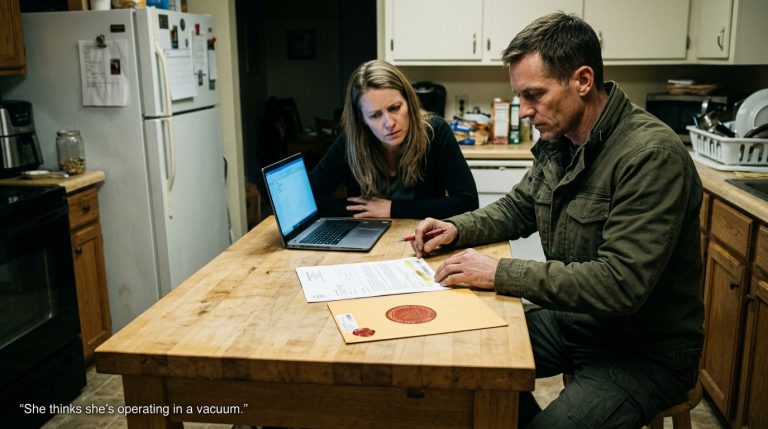
Without another word, I walked back inside to the command center we had set up on the dining room table. The binders were stacked neatly—permits, architectural sketches, county codes, and the thick, convoluted packet of HOA bylaws that Karen had cited with such misplaced confidence.
I opened the binder to the section covering architectural controls, tracing my finger down the dense legal text until I found the clause she had referenced. Section 14.7. Above-ground structures. The words were plain, clear, and unambiguous to anyone willing to read them without an agenda. But reading was never the point for someone like Karen; control was.
As I sat there in the fading afternoon light, flipping through the pages of municipal codes, a quiet thought settled into my mind. The root cellar was secure, locked away beneath two feet of earth and concrete, impervious to her immediate threats. But the real vulnerability in Oak Ridge wasn’t my backyard. It was the vast, uninspected expanse of public projects and community committees that operated entirely on rubber-stamped approvals and blind trust.
If she wanted a war of paperwork and precedents, I wouldn’t just defend my perimeter. I would trace the lines outward, following the rust wherever it led, until the entire artificial structure of her authority began to show its true, fraying edges.
CHAPTER 3: THE WEIGHT OF PAPER
The light from the desk lamp carved harsh shadows across the pages of the municipal code binder, illuminating the precise paragraph Karen had weaponized in her first official letter. Section 14.7. The words stared back at me, crisp and stark against the faded paper. Above-ground structures.
I set the pen down, the plastic barrel cool beneath my fingers, and leaned back into the worn leather of my office chair. The house was entirely quiet, save for the faint hum of the refrigerator down the hall and the steady, rhythmic ticking of the wall clock in the kitchen. Laura was asleep upstairs, her exhaustion finally claiming her after days of quiet tension, but my mind remained keyed to a high, defensive pitch.
Karen’s mistake hadn’t been a simple misunderstanding of the rules; it was an act of deliberate translation. She had taken a clause meant for lawn sheds and garden gnomes and stretched it over a subterranean fortress of concrete and earth, hoping the sheer intimidation of a formal penalty would force compliance before anyone bothered to check the definitions.
A faint, greasy smudge of printer ink marred the corner of the municipal copy, a small physical imperfection that stood out against the otherwise sterile bureaucracy. It mirrored the way her enforcement relied on blurry boundaries and unverified assumptions. If she wanted to govern through paper, I would give her paper back—so dense, so impeccably indexed, and so legally airtight that not even a self-appointed president could slice through it.
I pulled a fresh sheet of heavy bond paper toward me, feeling its smooth, heavy texture beneath my hand. The response needed to be a masterclass in calm, unyielding precision. No emotional venting, no retaliatory barbs—just cold, structural facts mapped directly against the community covenants and the county-issued permits stamped by Dave down at the municipal building.
I began to write, my hand moving in a steady, practiced rhythm. I quoted her citation right back to the margins, highlighting the critical preposition that anchored the entire legal definition: above. A root cellar, by its very engineering, occupies the space below the natural grade of the earth. It is an excavation, a cellar in the truest historical sense, bounded by soil and physics rather than airspace and neighborhood aesthetics.
As the paragraphs accumulated, stacking into a logical wall of defense, I realized the limitations of merely protecting my own perimeter. Karen’s authority was not sustained by my yard alone; it drew its strength from the passive compliance of the rest of the street. Every neighbor who nodded along with her morning warnings, every homeowner who kept their trash cans tucked away two minutes faster out of quiet dread, fed into the illusion of her absolute rule.
To shift the dynamic, I couldn’t just sit behind a barricade of certified mail receipts. I needed to understand how deep this pattern went. George Gable’s face flickered in my memory—the retired accountant who had faced the exact same administrative hostility three years prior over a decorative stone border. There were others, too, hidden behind identical manicured hedges and quiet front doors.
I folded the completed response, slid it into a crisp white envelope, and pressed the adhesive strip down with my thumb. The seal was tight, secure. Tomorrow morning, I would walk it down to the post office and pay the extra fee for certified mail with a return receipt requested—that little green card my father had taught me was worth its weight in gold.
The house shifted around me as the night air cooled the siding outside, a faint creak of timber settling into the frame. I looked out the dark window toward the backyard, where the gentle slope of earth rested quietly under the starlight. The root cellar was safe for tonight, but the wider battle lines were only beginning to draw themselves across the quiet asphalt of Oak Ridge.
CHAPTER 4: THE UNFOLDING FABRIC
The sealed envelope rested on the center of the dining room table, its white surface catching the low amber glow of the desk lamp like a small, flat marker of intent. My thumb lingered for a second over the crisp edge where the adhesive strip was pressed down tight. It was ready for the post office, armed with the certified tracking number that my father had taught me never to neglect. But sending paper back and forth across town was only half the equation; Karen’s true leverage didn’t lie in her letters alone, but in the quiet, uneasy silence she cultivated among the people living right next door.
The next morning arrived with a thin, pale mist clinging to the grass blades, turning the lawns into muted shades of gray and faded green. I was out on the front steps, securing the garden hose around its iron bracket, when I noticed Brenda next door stepping out to retrieve her morning paper. Her movements were hesitant, her eyes darting instinctively toward Karen’s immaculate driveway down the block before she even bent down to pick up the delivery.
It was a small, telling gesture—the physical posture of someone constantly checking for weather that hadn’t arrived yet. Karen’s power over the street was maintained entirely through that baseline of low-level apprehension, a steady drip of small warnings and public critiques that made neighbors feel safer looking away than standing firm.
“Morning, Brenda,” I said, keeping my voice even and low enough not to carry across the dew-drenched lawns.
She paused, clutching the rolled-up newspaper against her coat like a shield, before offering a cautious, tight-lipped smile. “Morning, Mark. Nice weather we’re having.”
“It’s holding up,” I replied, walking slowly toward the low wooden divider separating our properties. I didn’t press her about the HOA or the whispered rumors Karen had been spreading during her morning power walks. Pushing too hard on someone wrapped in caution only makes them pull tighter into themselves. Instead, I pointed toward the flower beds flanking her porch, where early shoots of purple coneflowers were pushing through the mulch. “The coneflowers are coming up strong this year. Laura was saying yours always seem to catch the morning sun just right.”
Brenda’s shoulders dropped an inch, the rigid angle of her posture softening against the faded textures of her quilted jacket. “Oh, those? I almost didn’t plant them this spring. The architectural committee sent a note last year about plant heights near the property line, and I wasn’t sure if they’d object again.”
“Section 14.7?” I asked quietly, letting a faint, knowing note enter my voice without a trace of mockery.
Brenda’s eyes widened slightly, a flicker of validation crossing her face. “You got one too? Karen stopped by my porch last week. She said your root cellar was going to cause a sinkhole that would drag my foundation down with it.”
“It’s built two feet below grade with reinforced concrete block and waterproofed footers,” I said, keeping my tone steady and conversational, anchoring every claim in physical reality rather than argument. “The county inspector signed off on the engineering specs before a single shovel touched the dirt. It’s quieter and sturdier than my garage.”
Brenda looked past me toward the gentle rise in our backyard, where the twin lilac bushes framed the discreet cedar door. For a second, the cautious barrier in her expression dissolved entirely, replaced by the universal curiosity of someone who simply wanted things to make sense. “She made it sound like… well, like you’d just dug an open trench and thrown some plywood over it.”
“People see what they’re primed to see when someone tells them to look through a cracked lens,” I murmured, resting my hands on the top rail of the divider. “If you ever want to see what’s actually down there—or talk about how municipal bylaws are supposed to work—our back gate is always open.”
She nodded slowly, the tension in her hands easing as she unrolled the newspaper a fraction. It wasn’t an alliance forged in a single conversation, but it was the first crack in the monolith. Karen relied on isolation to keep her rules absolute; the moment neighbors began sharing actual facts instead of whispered warnings, the foundation of her manufactured authority started to weather away.
Later that afternoon, after mailing the certified letter, I walked back along the perimeter of our property, checking the drainage slope around the cellar. The earth was settling naturally, the grass seed we’d laid taking root in the damp spring soil. The work was honest, grounded in physical labor and patient engineering. But as I stood there looking across the neighborhood toward the community pond where Karen’s prized gazebo stood near the water’s edge, I knew that defending my own yard was only the preliminary phase.
The real test would come when the discrepancies in public projects—those rubber-stamped structures built in a hurry and protected by closed meetings—finally collided with the daylight. And for that, I needed more than just a well-argued letter. I needed to know how deep the silence went across the rest of the street.
CHAPTER 5: THE MANILA ARCHIVES
The evening air was cooling rapidly, dropping a fine layer of condensation across the windshield of my truck as I pulled into the quiet cul-de-sac three streets over. George Gable’s house stood amidst a perimeter of immaculate, disciplined rose bushes—a local legend of careful pruning and quiet patience. But tonight, the warm light glowing behind his front window held an urgency that didn’t match the calm exterior of the garden.
I stepped out onto the concrete walkway, the gravel crunching softly beneath my boots, and raised my hand to strike the brass knocker. Before I could let it fall, the front door swung inward on well-oiled hinges. George stood there, a tall, gaunt man with silver hair combed back and the unmistakable posture of a retired accountant who had spent decades balancing ledgers down to the final decimal point. In his hand, he held a thick, bulging manila folder held together by a frayed elastic band.
“Mark,” George said, his voice a low, raspy baritone that carried the weight of history. “I saw your truck turn the corner. Come in. The coffee’s still hot.”
I crossed the threshold into the entryway, stepping onto a woven rug that smelled faintly of old paper and dried lavender—faded textures of a life lived deliberately out of the spotlight. George led me back toward his study, a small room lined from floor to ceiling with dark wood bookshelves and heavy metal filing cabinets that looked as though they had been salvaged from an old municipal building.
“I got your note about the certified letter you sent the board,” George said, setting the thick manila folder down on his mahogany desk with a dull, heavy thud. He pulled out a worn ceramic mug and poured a dark, steaming stream of coffee from a silver thermos. “You handled Karen’s first salvo by the book. But you need to understand something about how she operates. She doesn’t back down when she’s legally cornered. She doubles down on the narrative.”
I took the mug, feeling its comforting warmth against my palms, and sat down in the upholstered armchair opposite his desk. “She’s banking on the rest of the board backing her play out of habit. But Brenda and a few others on our street are starting to see through the threats.”
“That’s a start,” George replied, pulling off the elastic band and opening the folder. He began spreading papers across the desk surface—photographs, faded HOA notices, and handwritten timelines of events that stretched back over three years. “Look at this. This was my file when she tried to fine me out of the neighborhood over a four-inch stone border around my roses. She called it an unapproved fortification. She tried to levy daily penalties, exactly like she’s doing to you.”
I leaned forward, scanning the documents under the amber light of his desk lamp. The pattern was identical. The same inflammatory language, the same deliberate misinterpretation of the covenants, and the same quiet coercion designed to exhaust a homeowner into compliance. But as I flipped through George’s meticulous records, I noticed something else tucked into the back flap—a collection of architectural receipts and community maintenance logs bearing the logo of the Oak Ridge Homeowners Association.
“What are these?” I asked, tapping a finger against a faded contractor invoice dated from the previous spring.
George let out a dry, tired sigh, adjusting his glasses on the bridge of his nose. “Those are public records from when the association approved the construction of the community gazebo down by the pond. Karen made that project her personal crown jewel. She pushed the board to bypass the usual secondary committee reviews so she could rush it to completion before the summer barbecue season.”
A cold, methodical intuition began to snap into place in the back of my mind. An expedited municipal or community project rushed through committee without proper architectural oversight almost invariably left structural gaps behind.
“Did anyone pull the inspection sign-offs for that gazebo?” I asked, my voice dropping into a quiet, steady register.
George looked up sharply, meeting my gaze with a sudden, piercing intensity. “The board was told the permits were handled. Nobody asked questions because questioning Karen meant becoming her next target. But if you’re asking whether a proper geotechnical survey was done on those support piers near the wet clay of the pond… I wouldn’t bet a plugged nickel on it.”
The silence in the study grew heavy, filled only by the rhythmic ticking of a grandfather clock down the hall. The conflict was no longer a localized dispute over a backyard root cellar. It had expanded into a structural fault line running right underneath the polished surface of the entire community. Karen had built her entire reign on an illusion of flawless compliance, while the public assets under her direct oversight sat on foundations far more fragile than any dirt excavation on my property.
I set my coffee mug down on the edge of the desk, the ceramic clinking softly against the wood. The strategy shifted in that exact microsecond. Defense was no longer enough. To dismantle a tyrant who weaponized the rules, you had to look at the very structures she claimed to protect.
CHAPTER 6: THE BLUEPRINT OF HYPOCRISY
The fluorescent lights of the county records office hummed with a flat, sterile vibration, casting a cold glare across the heavy oak table where Dave, the municipal clerk, slid a large, cardboard banker’s box. The cardboard was worn at the edges, carrying the faint, dry scent of stored dust and old paper—faded textures that spoke of long-forgotten filings and bureaucratic oversight.
“The gazebo project records,” Dave said, resting his palms on the edge of the counter and offering a knowing, tired smirk. “You sure you want to dig into this one, Mark? That file moved through the committee faster than a brushfire last spring. People tend not to look too closely at things built in a hurry.”
“That’s usually when the details get left behind,” I replied, pulling the box closer and lifting the lid.
Inside lay a dense, tangled collection of architectural drawings, contractor bids, material invoices, and initial inspection sign-offs for the Oak Ridge community gazebo. Karen’s pet project. The crown jewel of her tenure as HOA president. For the next two hours, I sat under the sterile hum of the office lights, cross-referencing every line item against standard engineering practices.
At first glance, the paperwork looked clean enough. The permits were filed; the primary contractor was licensed. But as my engineer’s eye combed through the material lists and compared them against the structural blueprints, the discrepancies began to surface with quiet, unsettling clarity.
The blueprints specified four concrete support piers sunk a full four feet deep into the earth to clear the local frost line and anchor against the shifting clay near the community pond. Yet when I cross-referenced the concrete delivery receipts in the file, the yardage ordered was mathematically insufficient for four four-foot depths. It barely accounted for half that. A corner cut to trim costs and accelerate timelines, leaving the entire open-air structure vulnerable to seasonal frost heave.
Then I turned to the electrical specifications. The plans called for underground-rated conduit to safely channel power from the main line out to the gazebo’s overhead lighting fixture. But as I flipped through the itemized invoices from the electrical supplier, the conduit entries were completely blank. In their place was a charge for standard, interior-grade Romex wiring—insulation designed for dry indoor drywall, utterly unsuited for direct burial in damp, shifting soil.
A cold, heavy certainty settled in my chest. Interior-grade wiring buried directly in the earth without conduit would inevitably degrade under moisture and pressure, turning the surrounding soil and the metal frame of the gazebo into an active electrical hazard.
I turned to the final page of the file, my thumb brushing against the smooth paper. The space designated for the final electrical inspection sign-off was entirely blank. There was a request form tucked into the pocket, but no corresponding approval report. It had never been inspected. It had never been passed.
Karen had rushed her legacy project to completion, cutting corners on the foundations and installing a hidden hazard to save time and budget, all while terrorizing homeowners over minor aesthetic infractions and subterranean vegetable storage. The hypocrisy wasn’t just administrative; it was dangerous.
I carefully closed the banker’s box, the cardboard flaps sliding together with a soft snap. I had the physical evidence now—not just arguments about bylaws, but hard, verifiable proof of structural negligence on public property. The pincer movement was complete. All that remained was to let the system meet the reality it had tried so hard to ignore.
CHAPTER 7: THE CLUBHOUSE RECKONING
The air inside the community clubhouse was thick with stale air freshener and the nervous, shifting energy of fifty residents packed into rows of narrow metal folding chairs. At the front of the room, Karen stood behind a raised podium wrapped in a vibrant purple caftan, her expression a mix of grand triumph and rehearsed grievance. She was presiding over an emergency session she had engineered to publicly condemn my property, flanked by board members who looked like men waiting for a verdict they knew they couldn’t appeal.
As I walked down the center aisle with Laura beside me, carrying the slim leather portfolio containing my counter-report, the low murmur of the room died down into a tense, expectant hush. George and Tom sat near the back, offering steady, reassuring nods.
Karen raised a hand, her voice dripping with artificial gravity as she addressed the crowd. “We are here tonight to address a severe lapse in community standards and an imminent safety hazard,” she announced, gesturing toward the back door as if expecting county authorities to storm the room at her command. “Mr. David Evans, a senior inspector from the county building department, is joining us to provide an expert assessment of the unapproved bunker built at 112 Oak Drive.”
A man in a county-logo polo shirt stepped out from the side doorway, holding a clipboard and a heavy-duty flashlight. It was Inspector Evans, caught in the web of Karen’s manufactured certainty. She had brought him here expecting public vindication, a final televised strike to force compliance and humiliate me in front of my neighbors.
Before Karen could invite the crowd on her planned field trip to my backyard, I stood up from my seat in the middle row, my voice cutting cleanly through the beige room.
“That won’t be necessary just yet, Karen,” I said, using her first name to deliberately strip away the administrative armor she wore like a uniform. “Before we organize a tour, I think Mr. Evans and everyone sitting in this room deserve a chance to review the actual documents.”
Karen’s face tightened instantly, a flash of red cutting across her cheeks. “Mr. Henderson, this is an official meeting of the Oak Ridge board—”
“With all due respect to the board,” I interrupted, stepping forward and placing the portfolio directly onto the podium beside her notes, “you’ve made some very public accusations regarding structural safety and permits. Here are the blueprints, the official county building permit stamped by municipal authorities, and the engineering calculations proving that my root cellar exceeds every regional code for subterranean stability.”
Inspector Evans stepped closer, drawn by professional instinct. He opened the portfolio, his eyes scanning the precise stamps and structural diagrams. The silence in the room stretched thin and taut. After a long moment, Evans looked up, his tone professional and absolute. “These plans are thorough, and this permit is entirely valid. On paper, this is one of the most rigorously documented projects I’ve reviewed.”
A collective murmur rippled through the folding chairs. Karen sputtered, her hands gripping the edges of the podium. “But the construction—he could have cut corners! It has to be inspected!”
“I agree,” I said, turning to Evans. “Let’s inspect it right now.”
The entire room migrated in a restless, quiet mass from the clubhouse down the sidewalk to my backyard. When we reached the gentle rise of earth behind the house, I opened the cedar door and stepped aside. Inspector Evans descended into the cool, white-painted interior with his heavy flashlight. Ten minutes later, he climbed back up the wooden steps, his face grave and decisive.
“The block work is exemplary,” Evans announced to the assembled neighbors. “The waterproofing is professional, and the ventilation is fully compliant. This root cellar isn’t just safe; it’s over-engineered. There is nothing wrong with it.”
Karen stood frozen, her authority cracking at the seams. But before she could rally a defense, I turned back toward the county inspector, my gaze shifting across the manicured lawn toward the community pond where the gazebo stood against the twilight sky.
“While you are here in your official capacity, Mr. Evans,” I said clearly, “there is another public structure in this neighborhood that several homeowners have serious safety concerns about.”
Karen’s head whipped around, her eyes widening in sudden, dawning terror. I opened the second section of my portfolio, holding out the public records I had pulled from the county office. “The community gazebo completed this spring. I have reviewed the filings. The foundation support piers were not sunk to the required four-foot frost line, standard underground conduit was omitted, and interior-grade Romex wiring was buried directly in the wet clay without protection. Furthermore, there is no record of a final electrical inspection ever being passed.”
The word electrocution hung unspoken in the heavy evening air, but the implication struck every parent in the crowd like a physical blow. Inspector Evans took the report, his professional expression hardening into ice. Without a word to Karen, he strode past the gathering toward the gazebo, pulling a heavy pry bar and a flashlight from his belt.
He kicked away the mulch at the base of the primary support post, scraped the soil, and exposed shallow concrete. He dug into the damp earth near the electrical box and pulled up a length of orange plastic-sheathed wire. The evidence was undeniable.
Evans reached into his vest, pulled out a large, bright red tag bearing the word CONDEMNED in massive black letters, and lashed it securely to the center post of the gazebo.
“This structure is an imminent public safety hazard,” Evans declared, his voice ringing out across the silent neighborhood. “Power must be cut immediately. It is unsafe, uninspected, and must be demolished.”
Karen stood staring at the red tag, her face a canvas of absolute ruin. The weapon she had brought to destroy me had been dismantled and turned completely against her, exposing the fragile, reckless hypocrisy at the heart of her reign.
CHAPTER 8: ROOTS AND RENEWAL
The heavy, metallic whine of saws and the dry, splintering crunch of structural timber echoed across the pond, carrying clearly through the open kitchen window. I stood at the sink, rinsing a final batch of fresh garden peaches under a steady stream of cool water, the fruit smooth and heavy against my palms.
The demolition crew was dismantling the condemned gazebo board by board, systematically erasing the physical monument to Karen’s administrative overreach. It was not a violent collapse, but a slow, calculated unbuilding—a return of the ground to its natural state. The financial fallout had been swift and unforgiving; the cost of tearing down the hazard and dealing with the community reserve shortfall forced an immediate, emergency review of the HOA’s bylaws. Karen had put her house on the market within days, unable to face a neighborhood where her authority had dissolved into quiet, collective disdain. She had ruled through the fear of a fragile order, only to discover that true stability cannot be legislated from a pedestal of intimidation.
A soft clink of ceramic interrupted my thoughts. Laura stepped into the kitchen, carrying a fresh crate of Mason jars from the porch, her face relaxed and lines of tension completely gone from around her eyes.
“The delivery truck brought the new shelving brackets,” she said softly, offering a warm, quiet smile that reached all the way to her eyes. “George and Tom are already helping clear the lower racks down below.”
“I’ll be right down to help secure them,” I replied, drying my hands on a clean kitchen towel.
We walked out the back door together, stepping onto the soft grass of the lawn. The afternoon sun was warm, casting a golden light across the gentle rise of earth where our root cellar sat integrated seamlessly into the landscape. The cedar door stood slightly ajar, venting the cool, earthy scent of damp stone and ripening fruit into the open air.
Down inside the subterranean vault, the concrete walls were bright and dry, lined with neat wooden shelves packed with jewel-toned jams, pickled vegetables, and rows of preserved peaches. George and Tom were down there adjusting a loose bracket, their voices carrying up in easy, unhurried conversation. They weren’t whispering or glancing over their shoulders; they were simply neighbors sharing labor, anchored in a community that was finally learning to breathe again.
I descended the concrete steps into the cool sanctuary, taking a heavy brass screwdriver from my pocket to tighten the final screw on the lower oak shelf we had built together months ago. The metal bit held firm against the wood, a small, durable repair that symbolized everything we had fought to protect.
The war of paperwork, permits, and petty tyranny was over. What remained was the quiet, enduring rhythm of the land—the steady rotation of seasons, the bounty of the earth, and the profound peace of a home built on a foundation that no arbitrary rule could ever touch.