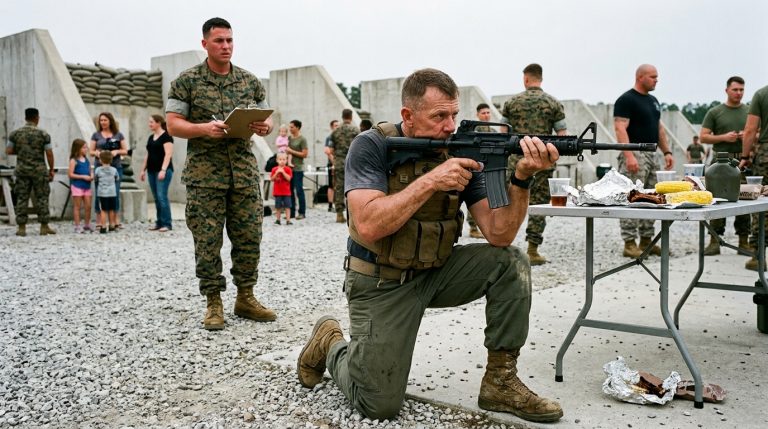
The Granite Bulwark: A Veteran Engineer’s Calculated War Against Suburban Tyranny
CHAPTER 1: The First Line
The clippers felt heavy in his palm, cold metal biting against a calloused thumb. Beyond the boundary line, the air vibrated with a low, greasy purr—the distinct, aggressive idle of a skid steer loader warming its hydraulics against the morning frost.
Jack didn’t rush. Twenty years of laying bridging equipment across swollen rivers under mortar fire had beaten any capacity for panic out of his marrow. You didn’t react to the noise; you evaluated the vector.
Karen stood four feet out on the public concrete, her chest puffed inside that synthetic pink shell like an overinflated floatie. Her mouth was moving, but the words were drowned out by the machine’s exhaust stuttering against the curb. He noticed a detail he’d missed in the initial glare: the signature block on the violation notice tucked under his windshield wiper yesterday didn’t carry the official municipal stamp of the county clerk. It was stamped with a private notary seal from three towns over—an administrative shortcut that smelled faintly of desperation or forged compliance.
“Mr. Caldwell!” Her voice finally sliced through, thin and grating as a rusted saw blade. “The thirty days expired at midnight. The board has authorized immediate abatement.”
The operator in the hard hat killed the throttle for a second, letting the diesel cough and settle. He looked bored, a man collecting an hourly wage to break someone else’s heart.
Jack set the garden clippers down inside his bucket, the plastic clacking against a trowel. He wiped his hands on his thighs, feeling the stiff denim give against his muscles. The old stone wall at his back felt solid, a hundred years of gravity pulling granite against granite without a single drop of mortar. It didn’t belong to the twentieth century, and it certainly didn’t belong to her.
“Karen,” he said, keeping his voice flat, pitched just loud enough to carry across the damp grass. “You’re standing on a grade that hasn’t been properly stabilized since the utility lines were punched through in seventy-eight. If that bucket touches the corner stone, you aren’t removing an eyesore. You’re pulling the pin.”
Her smile didn’t reach her eyes; it was a tight, cruel seam stitched across a powdered face. “Save the dramatics for the appeals board. Drop the blade, Frank.”
The operator reached for the control lever, his hand hovering over the cold steel, while across the street, a living room curtain twitched back just an inch, exposing the pale, terrified eye of a neighbor watching the executioner arrive.
CHAPTER 2: The Anatomy of a Battlefield
The operator’s knuckles remained white against the rubber grip of the joystick. A thin plume of blue diesel exhaust curled up past the hydraulic arm, smelling sharply of unburnt fuel and scorched oil in the crisp morning chill. Across the asphalt, the pale blue curtain twitched again—not closing this time, but parting wider. Someone was watching every heartbeat of this standoff through the glass.
Jack didn’t blink. Twenty years ago, in the choking gray dust of the Arghandab valley, he had learned that the most dangerous man in any engagement wasn’t the one shouting orders from behind a protective berm. It was the one holding the trigger who didn’t understand the physics of what they were trying to blow up. Karen was shouting something now, her voice pitching into a shrill, metallic frequency that scraped against his ear canal, but he filtered her out entirely. He focused instead on the micro-fractures in the concrete sidewalk where her pink running shoes met the municipal right-of-way.
A sudden, sharp fragment of memory cut through the cold air—the smell of crushed shale and hot generator grease outside a command tent in Kandahar, the exact pitch of a diesel engine revving before a clearance sweep. The phantom weight of a flak vest pressed down on his collarbones, heavy and real, reminding him how quickly structural integrity could fail when someone misjudged the load-bearing parameters.
“I said drop the blade, Frank!” Karen shrieked, her hand darting out to slap the side of the skid steer’s yellow metal housing. “We have a signed municipal nuisance warrant. The district court isn’t going to bail him out.”
The operator—Frank—didn’t move. He looked down at the paper notice taped to his cab dashboard, then across the lawn at the massive, weather-beaten face of the dry-stacked granite wall. The stones were giants, locked together by centuries of gravity and friction, grey-green with old lichen and iron-stained streaks of mineral runoff. They didn’t look like a residential fence. They looked like the hull of a beached warship.
“Lady,” Frank muttered, his voice gravelly and low enough that it barely reached the sidewalk. “That ain’t cedar plank. Look at the batter on that face. That’s a gravity wall.”
“It’s an unapproved structure!” Karen stepped closer, her breath pluming in the 40-degree air. “If you don’t drop that bucket right now, I’m calling your dispatcher and pulling your corporate bond before noon.”
Jack shifted his weight, his boots grinding slightly into the frost-rimed grass of his own lawn. He kept his hands loose at his sides, fingers curled just enough to feel the cold air hitting his palms. He didn’t need to shout. He didn’t need to wave documents at her yet. The psychological pressure was doing the heavy lifting. Every second the machine sat there idling was a second her public theater dissolved into an embarrassing public spectacle for the entire neighborhood to witness from behind their closed blinds.
“Frank,” Jack said, his voice cutting through her tirade with the flat, uninflected authority of an NCO giving a final safety check. “Look thirty feet uphill toward the Garcia residence. Notice the angle of their foundation line relative to the drainage grate.”
Frank’s head snapped up. He tracked the line of the slope, his eyes narrowing as he calculated the grade. Sterling Ridge wasn’t built on level earth; it was a carved-out hillside held back by terraces, and this particular lot sat at the absolute bottom of the drainage funnel.
“Son of a bitch,” Frank breathed, his grip relaxing slightly on the hydraulic controls.
“Don’t listen to him!” Karen’s face mottled into a patchy, furious red, her fingers clawing at the sleeve of her pink tracksuit. “He’s stalling! He’s just trying to protect his illegal property!”
“Karen,” Jack said softly, stepping one slow, deliberate inch closer to the property line, his eyes locking onto hers with a cold, unrelenting weight. “You brought the machine. But you haven’t asked to see the historical survey records filed with the county clerk in nineteen-fifty-eight. Have you?”
The silence that followed was absolute, save for the low, rhythmic thrum of the diesel engine settling back into an idle. Karen’s mouth opened, but no words came out; the smug certainty in her eyes flickered, replaced for a fraction of a second by a cold, darting panic as she realized she had pushed past the edge of the map without checking what was waiting in the dark below.
CHAPTER 3: Mapping the Terrain of Power
Karen’s face twisted through three distinct shades of pale before settling into a mottled, dangerous crimson. She took half a step forward, her pink-clad shoulders hunching as if she were preparing to lunge across the invisible boundary line separating public concrete from private turf. But the physical weight of Frank’s inaction held her back; the operator had already cut the throttle down to a low, disgruntled grumble, his hands resting heavily on his knees inside the cab.
A sharp gust of wind swept down the Sterling Ridge corridor, carrying the dry, rattling scrape of dead oak leaves across the asphalt. The sudden drop in temperature bit through the fabric of Jack’s shirt, sharpening his senses. He didn’t blink, maintaining the steady, unreadable gaze of a man who had spent decades reading hostile terrain.
“You’re quoting ghost laws, Mr. Caldwell,” Karen hissed, her voice vibrating with a brittle, defensive fury that lacked its initial theatrical punch. “The architectural committee has absolute jurisdiction over every linear foot of visible frontage within this subdivision. The board reviewed your dossier three times.”
“Which dossier, Karen?” Jack’s voice remained level, quiet, sliding beneath her high-pitched frequency like a cold blade entering water. “The one filed with the county clerk under the original ninety-fifty-eight plat survey, or the summary report your committee synthesized internally without a quorum vote present?”
The subtle twitch near her left eye gave her away. It was a micro-expression of absolute, unadulterated shock—the look of an operator who suddenly realized her own ledger had been audited by someone who knew where the false bottoms were hidden. She hadn’t expected him to know about the quorum requirement. In her world of cookie-cutter houses and automated fine notices, compliance was a rubber stamp, not a matter of municipal legal record.
Across the street, a window sash rattled shut with a sharp clack. The invisible audience behind the lace curtains was shrinking back, realizing that the queen’s spectacle was turning into an exposure of institutional negligence. Carlos Garcia, standing rigidly on his upper-tier porch twenty yards away, stepped closer to his railing, his eyes darting from Karen’s rigid posture down to the massive stone blocks anchoring the base of Jack’s yard.
“You’re bluffing,” Karen spat out, though the conviction had entirely drained out of her delivery, leaving only a hollow, echoing shell. “If you had anything official, you would have filed an injunction with the district magistrate instead of standing here playing gardener.”
“An injunction is a defensive tool,” Jack replied, his hand resting lightly on the rim of his plastic bucket. “It waits for the other guy to swing first. What I did this morning wasn’t defensive, Karen. It was a courtesy notification to your contractor so he wouldn’t commit an actionable tort on private infrastructure.”
Frank poked his head out of the skid steer window, his expression hardened into a professional mask of absolute self-preservation. “She’s right about the work order, mister, but my insurance carrier doesn’t cover willful structural damage when there’s an active land-use discrepancy flagged on the county plat. I’m loading my machine back onto the flatbed. You two can sort out your municipal tea party in court.”
Before Karen could shriek a counter-command, the operator threw the hydraulic levers into reverse. The heavy rubber tracks groaned against the asphalt, pivoting the yellow machine around in a tight, acrid-smelling arc of diesel smoke. The confrontation had collapsed not because of a shouting match, but because the cold, hard physics of liability had dismantled her authority in less than three minutes.
Karen stood alone on the public sidewalk, her pink tracksuit looking absurdly bright against the dull, desaturated gray of the November morning. She opened her mouth to speak, but no sound came out—only a sharp, ragged intake of cold air. Without a word, she spun on her heel, her running shoes slapping angrily against the concrete as she marched toward her parked SUV, yanked the door open with a vicious metal snap, and threw the vehicle into reverse.
Jack watched her taillights flare red as she backed too fast out of the driveway, clipping the edge of a neighbor’s manicured lawn before tearing down the hill toward the subdivision’s main gates.
The street fell into a profound, heavy silence. The wind died down, leaving only the distant, steady hum of traffic from the valley below. Jack picked up his pruning clippers, the metal cold and biting against his palm, and walked slowly back to the base of the hundred-year-old stone wall. He ran a calloused thumb along the moss-covered edge of the bottom cornerstone, feeling the solid, unyielding density of the granite. The first skirmish was over, but the paper trail in his kitchen drawer—and the missing signatures on the HOA’s financial disclosures—remained untouched, waiting for the next phase of the push.
CHAPTER 4: The First Salvo on Paper
The kitchen was warm, smelling faintly of roasted chicory and the metallic tang of damp wool where Jack had hung his jacket over the back of a wooden chair. Sarah stood by the counter, her hands wrapped tightly around a ceramic mug as if trying to absorb its heat. She didn’t turn around immediately when the back door clicked shut, but the rigid set of her shoulders told him she had watched every second of the confrontation from the window.
“She’s not going to let this drop,” Sarah said softly, her voice barely rising above the hum of the refrigerator. “Karen doesn’t know how to step back. To her, losing a face-saving argument in public is an act of war.”
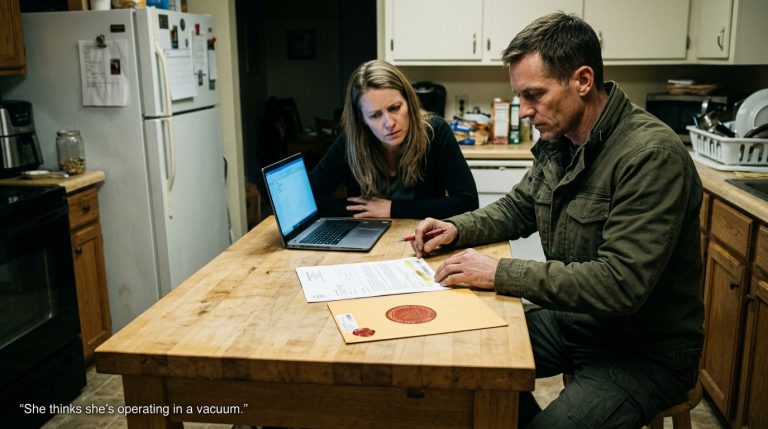
“Let her make it a war on paper,” Jack replied, pulling out a heavy metal-framed chair and sitting down. He dragged his project binder across the laminate table, flipping past the certified mail receipts and the original survey maps until he hit the administrative logs he had pulled from the county records office three days prior.
The physical texture of the documents mattered. These weren’t clean, modern printouts; they were high-resolution scans of microfilmed ledgers from the late seventies, yellowed at the margins and stamped with fading purple ink from county auditors long since retired or passed away. But beneath the routine bureaucratic clutter of zoning approvals and grading bonds, something else had caught his eye during the late-night hours under the desk lamp.
He slid a specific page across the table toward Sarah. It was an itemized ledger of escrow deposits and maintenance assessments from the Sterling Ridge development association’s founding era, cross-referenced with a more recent audit summary printed off the community’s public web portal six months ago.
Sarah leaned over, her eyes scanning the columns. “What am I looking at?”
“Look at the discrepancy between the reserve fund allocations for fiscal year twenty-two and twenty-three,” Jack pointed a calloused finger at a highlighted line item. “The landscaping maintenance line item dropped by nearly forty percent, while emergency architectural remediation fees spiked by an equivalent amount. But there’s no record of any major common-area repairs during that window.”
“Money moving sideways,” Sarah murmured, her brow furrowing as she traced the numbers. “That doesn’t fit an aesthetic dispute over mailboxes and walls.”
“Aesthetic violations are low-cost, high-yield revenue generators,” Jack said, his mind tracking the tactical layout like a combat map. “Every time the board levies a five-hundred-dollar fine for non-compliant materials, that cash flows into an unmonitored discretionary account managed directly by the president’s office without requiring a full neighborhood vote. If she forces a contractor to tear down my wall under a ‘code remediation’ order, she also controls the payout for the clearing contract.”
The realization didn’t come with a dramatic flash of light; it settled in with the heavy, unyielding friction of a machine gear grinding against grit. Karen wasn’t just a power-tripping suburban tyrant obsessed with uniform vinyl siding and black mailboxes. The rigid enforcement notices were a smoke screen—a systemic method of masking a persistent drainage of community reserve funds through inflated, self-approved remediation contracts.
Yet, as concrete as the financial footprints looked on paper, they were still circumstantial shadows. If he took these ledger sheets to the municipal court right now, a defense attorney for the HOA would dismiss them as a homeowner’s misinterpretation of routine accounting adjustments. He needed a direct line of sight to the physical ledger in the association’s central office before he could blow her administrative structure wide open.
Jack closed the binder with a dull, flat snap that echoed in the quiet kitchen. “She thinks this is about a fence. She thinks she can starve me out with certified letters and board votes. But she’s exposed her flank by rushing the demolition order before the county auditors cleared the quarter.”
“What do you need?” Sarah asked, her gaze steadying as she looked down at him, the initial anxiety giving way to a cold, shared resolve.
“I need to look at the physical record book locked in the clubhouse administrative closet,” Jack said, standing up and reaching for his jacket. “And to do that legally, Marcus has to serve them with a formal production request before tomorrow morning’s business hours, forcing their hand while she’s still scrambling to explain the city engineer’s stop-work order to the rest of the board.”
The air outside had grown colder, the afternoon shadows lengthening across the asphalt as the sun dipped behind the steep ridge of the upper tier. Jack stepped back onto the front porch, casting a long, sharp look up toward the Garcia house where the upper windows remained dark and watchful. The board was fractured, Karen was isolated, but the core machinery of her control was still humming behind closed doors.
CHAPTER 5: The Kangaroo Court Convenes
The fluorescent lights of the Sterling Ridge community clubhouse hummed with an irritating, high-pitched whine that bounced off the polished linoleum floor. It was an institutional space designed to project civic harmony, but tonight the room felt less like a meeting hall and more like a tactical briefing room before an advance.
Jack sat near the back row, his coat unbuttoned, hands resting flat on the thighs of his dark jeans. Beside him, the heavy manila folder containing Dr. Albright’s certified structural report and the microfilmed blueprints rested like unexploded ordnance. Up front, behind the long mahogany-veneered table, Karen sat flanked by her two board cronies. Her face was tightly controlled, powdered smooth to mask the exhaustion of a week spent dodging phone calls from the municipal planning office and the association’s corporate insurance carriers.
“We will now call to order the special executive session of the Sterling Ridge Architectural and Governance Committee,” Karen announced, her voice lacking its usual theatrical resonance. It had a dry, brittle edge, like paper left too long in the sun.
The room was packed. Homeowners sat shoulder-to-shoulder on folding metal chairs, murmuring among themselves, their collective gaze shifting back and forth between the front table and the silent figure sitting near the exit. The stop-work order issued by the city engineer had leaked through the neighborhood group chats within hours of the incident, turning what was supposed to be a routine disciplinary hearing into a public referendum on the board’s survival.
Jack didn’t wait for her to call the floor open for public commentary. He stood up slowly, the legs of his metal chair scraping sharply against the linoleum, cutting through the low murmur of the room.
“Point of order, Madam President,” Jack said, his voice level, carrying effortlessly across the hollow space without a hint of rising inflection.
Karen’s hands tightened on the edges of her briefing papers, her knuckles turning a stark, bloodless white. “Mr. Caldwell, public comments are strictly restricted to the final twenty minutes of the agenda, and only after—”
“This isn’t a public comment,” Jack interrupted, taking two measured steps down the central aisle, his boots striking the floor with rhythmic authority. “This is a formal motion under Section 4, Paragraph B of the master bylaws concerning unannounced executive expenditures and the improper classification of pre-existing infrastructure.”
A sharp murmur rippled through the middle rows of seated neighbors. Carlos Garcia, sitting two rows ahead, turned his head slightly, his eyes narrowing in focused attention.
Karen flushed a mottled, dangerous crimson, her mouth parting as she searched for a parliamentary shield that didn’t exist in their amateur playbook. “The board has already evaluated your property status. The matter of the boundary wall was settled under the aesthetic violation code—”
“The wall isn’t a fence, Karen,” Jack said, his tone dropping into that flat, unyielding register he used when running engineering checks on compromised terrain. He reached into his folder, pulling out a single, stark document stamped with the municipal seal. “And the financial ledger supporting your emergency remediation contracts doesn’t match the county auditor’s disbursement records for the last fiscal year.”
The silence that fell over the room was absolute. The fluorescent hum overhead seemed to double in volume.
Jack didn’t drop the bombshell all at once. He walked forward, stopping just four feet short of the mahogany table, holding the papers where the other board members could see the stark, unvarnished headings. He noticed a small, telling detail on the administration sign-off sheet clipped to the corner of Karen’s binder: the physical access log for the clubhouse administrative closet lacked the mandatory secondary signature required whenever discretionary reserve funds were reallocated. The system wasn’t just corrupt; it was sloppy, built on the assumption that no one would ever pull the microfilms to check the math.
“I have here the certified copies of the nineteen-fifty-eight plat survey,” Jack continued, his eyes locking onto Karen’s trapped, darting gaze, “alongside the independent structural assessment filed with the city engineer this morning. Furthermore, I have the itemized accounting logs showing where forty percent of the community’s landscaping reserve vanished during the exact quarter your committee pushed through three separate punitive fine structures.”
One of the board members to Karen’s left—a mild-mannered accountant named Miller who looked like he wanted to dissolve into the upholstery—suddenly turned his head, staring directly at Karen with wide, betrayed eyes. “What ledger is he talking about, Karen? What emergency remediation?”
Karen slammed her palm against the table, the sharp thwack making several people jump. “He’s fabricating documents! This is a coordinated smear campaign by a disgruntled homeowner trying to avoid paying his code fines!”
“Is it?” Jack asked softly, laying the papers flat on the edge of the mahogany table, right beneath Miller’s trembling hands. “Then you won’t mind opening the administrative logbook right now and letting the board verify the secondary signatures on the Q-three disbursement vouchers, will you?”
The trap was sprung. There was no escape hatch left in the room; the paperwork was real, the physical physics of the hillside were undeniable, and the collective weight of an entire neighborhood’s broken trust was pressing down on the front table with the force of a collapsing foundation.
CHAPTER 6: Digging into the Past
Miller’s fingers hovered over the financial documents like they were charged wires. He didn’t look up at Karen; his eyes remained glued to the quarterly disbursement logs, tracking the jagged downward spiral of the landscaping reserve funds against the inflated, unverified invoices for architectural code enforcement.
“Karen,” Miller said, his voice cracking slightly on the second syllable, stripped of its usual mild compliance. “What are these line items for Q-three? The emergency remediation fund… it accounts for nearly twelve thousand dollars paid out directly to a shell consulting firm registered in an out-of-state zip code.”
The fluorescent hum overhead seemed to sharpen, driving a wedge of raw tension into the center of the room. Karen opened her mouth, her face twitching as she struggled to pull back the curtain of authority that had sustained her little empire for years. But the institutional machinery had seized up. Without the rubber stamp of board consensus, her administrative defense was nothing more than hollow air.
Jack didn’t rush in to fill the silence. He remained standing four feet from the table, his arms loose at his sides, watching the pressure fracture the board’s fragile alignment from the inside out. In combat engineering, you didn’t need to detonate the main charge if the enemy’s own structural stress lines were already pulling the bunker apart. You just stood back and let gravity do the work.
A phantom memory flared behind his eyes—the damp, choking smell of a shored-up trench wall groaning under the concussive thump of heavy artillery miles away, the terrifying realization that when the internal braces gave way, everything built above them slid into the void. Sterling Ridge was built on that exact kind of artificial grade, and Karen had spent two years weakening its foundation for a handful of petty municipal fines.
“I move to table all pending architectural enforcement actions,” Miller said abruptly, pulling his hands back as if the papers were burning him. He looked across the table at the third board member, a quiet woman named Vance who was already nodding in grim agreement. “And I move for an immediate, independent forensic audit of the association’s discretionary accounts, effective tonight.”
“You don’t have the authority!” Karen shrieked, half-rising from her leather-backed chair, her professional veneer finally shattering completely into raw, defensive panic. “The president retains sole administrative oversight over—”
“Not when there’s an active municipal stop-work order and a formal notice of critical infrastructure liability tied to an unvetted demolition contract,” a deep voice cut through the shouting from the middle rows.
Carlos Garcia stood up from his folding chair, his posture rigid, his face carved into a mask of cold fury. He didn’t look like a passive neighbor anymore; he looked like a homeowner whose foundation had just been mapped out over an active sinkhole. “We’ve all seen the emails, Karen. We’ve all received the threat letters about our mailboxes, our trim colors, our fence materials. And now we find out you were channeling community reserves into ghost accounts while trying to tear down the very retaining wall holding up the north tier.”
The room erupted. The murmurs turned into a wall of overlapping voices, angry and unified, surging forward against the front table. Karen shrank back into her seat, the color completely drained from her face, leaving her looking suddenly old, small, and entirely cornered by the wreckage of her own design.
Jack turned away from the shouting match. He didn’t need to watch the final collapse of the kangaroo court. The paperwork was in motion, the board was fracturing, and the paper trail was exposed to the light. He walked slowly down the center aisle, pushing open the heavy glass exit doors and stepping out into the crisp, biting night air of Sterling Ridge. The stars were sharp points of cold silver overhead, and down the hill, half a mile away, the dark, solid mass of the old stone wall stood silent and immovable against the slope, holding the earth together in the dark.
CHAPTER 7: The Blueprint of Leverage
The asphalt of the parking lot was slick with a sudden, unannounced sheen of cold mist as the temperature dropped past freezing. Jack didn’t head straight for his truck. Instead, he pulled the collar of his jacket up against the damp bite of the wind, his boots crunching lightly over loose gravel near the edge of the property line. The exposure of the financial discrepancies at the board meeting had cracked Karen’s perimeter, but a cornered animal didn’t surrender; it lashed out blindly at whatever was closest.
He needed to transition from defense to absolute structural containment before morning business hours.
The truck door clicked open with a heavy, mechanical resistance as he climbed inside, the cab smelling faintly of damp canvas and cold metal. He didn’t turn the key immediately. Sitting in the dark, he pulled out his phone and dialed a secure, direct number—Marcus’s private line. The phone rang twice before a sharp, awake voice cut through the static.
“Talk to me, Jack,” Marcus said without preamble, the background sound of rustling paper suggesting his firm was still burning midnight oil.
“The executive session fractured,” Jack said, keeping his voice low, measured against the rhythmic ticking of the cooling engine block. “Miller and Vance pushed through a motion to table all enforcement actions pending an independent forensic audit. Karen lost control of the floor.”
A low whistle came over the line. “That’s faster than expected. The financial irregularities must have hit them harder than the structural warnings.”
“They’re connected,” Jack replied, his eyes tracking the shadows moving across the upper ridge through the windshield. “The aesthetic fines were never about mailboxes or cedar planks. They were a localized revenue stream designed to patch holes in a discretionary account she was siphoning through out-of-state consulting shells. But the paper trail in the clubhouse ledger is only half the puzzle.”
“What’s the other half?” Marcus asked, his tone sharpening instantly into professional sharpness.
“The structural audit Dr. Albright ran this morning confirmed the nineteen-seventy-eight engineering notes,” Jack said, gripping the steering wheel until his knuckles whitened. “If the board tries to retaliate by filing an emergency municipal lien or attempting another back-channel bypass through a compromised county inspector, they aren’t just violating a zoning code. They’re triggering a direct liability trap that their insurance carrier has already flagged as willful misconduct.”
“Then we don’t wait for them to make a move,” Marcus said, the scratching of a pen audible over the receiver. “I’ll draft a formal notice of preservation and deliver copies directly to the municipal clerk’s office and the corporate carrier’s regional adjuster before eight a.m. We lock down their administrative privileges permanently.”
“Do it,” Jack said. “And make sure the carrier understands that any further harassment from Karen’s office constitutes active endangerment of public infrastructure.”
He ended the call, cutting the connection with a sharp tap on the screen. The cab plunged back into absolute silence, save for the faint sound of mist tapping against the glass. He stared out through the windshield at the dark, looming shapes of the houses up on the hill, knowing that tomorrow’s light would bring the true test of whether the foundation could hold when the final weight came down.
CHAPTER 8: The Independent Assessment
The engine block of the truck ticked as it cooled, a metallic contraction rhythmically breaking the damp silence of the unlit parking lot. Jack didn’t turn the key. His eyes remained fixed on the glowing amber digits of the dashboard clock, tracking the slow, unyielding crawl toward dawn. Down in the valley, the distant sodium-vapor lights of the municipality cast a sickly, orange haze over the lower treeline, but up here on the ridge, the night remained heavy, dense, and unlit.
Karen wouldn’t take the board’s fracturing as a final defeat. A tactical commander whose flank had been turned didn’t lay down arms; they consolidated whatever ragged units remained and launched a desperate, uncalculated counter-offensive before the audit could formally lock down the accounts.
He shifted his weight in the driver’s seat, the worn leather groaning under his jacket. His phone vibrated against his thigh—a short, silent text notification from Marcus confirming that the preservation notices had been successfully transmitted to the municipal clerk’s office and the corporate carrier’s regional desk before the morning shift change. The legal containment field was anchored. But legal paperwork didn’t stop a desperate individual from attempting a reckless physical end-run while the administrative gears were still grinding into place.
Jack started the engine, the diesel coughing once before settling into a deep, vibration-heavy purr. He didn’t head back down toward the main highway; instead, he steered the truck slowly up the winding asphalt of Sterling Ridge, keeping his headlights on low beam to avoid flashing across the front windows of the houses nestled along the slope.
When he turned onto his own street, the beam cut across the base of his front yard, illuminating the massive, dark silhouette of the dry-stacked stone wall. It stood unshaken, the wet granite glistening under the cold mist, looking every bit like the ancient bulwark it was. But something else caught the edge of the high-beam sweep—a low-slung, unmarked silver sedan idling quietly by the curb twenty yards past his driveway, its lights completely extinguished.
Jack killed his own headlights instantly, letting the truck roll silently to a halt fifty feet back.
He didn’t reach for a weapon; he reached for tactical observation. In the dim amber glow of the dashboard, he watched the silhouette in the parked sedan. The driver’s window rolled down an inch, letting a thin, curling tendril of cigarette smoke drift out into the freezing night air. It wasn’t Frank, and it wasn’t a municipal worker. The posture was rigid, tense—the unmistakable silhouette of someone waiting for a specific gate to open, or a specific set of lights to go dark.
The escalation had moved past the boardroom table. Karen was attempting to re-establish control through intimidation or private surveillance, trying to find a physical wedge where the legal paperwork had locked her out.
Jack cut the engine entirely, plunging the cab into total darkness and absolute silence. He sat there, his fingers resting lightly on the door handle, watching the smoke drift out into the cold night air, calculating the vectors of approach. The wall at his back held the entire hillside together, and he wasn’t going to blink first.
CHAPTER 9: The Silence Before the Storm
The unmarked silver sedan remained motionless for three full minutes, its low-slung body blending into the asphalt shadows beneath the overhanging oak branches. Jack did not move a muscle, letting the chill of the unheated truck cabin settle into his joints. In reconnaissance, patience was the primary weapon; whoever sat behind that darkened windshield was burning through their own psychological stamina by waiting in the open.
Slowly, without a sound, the sedan’s brake lights flickered once—a dull, ruby flash cutting through the mist—before the engine engaged with a muffled purr. The vehicle pulled away from the curb, accelerating without its headlights until it rounded the upper curve of the ridge and vanished into the gray predawn gloom.
Jack waited another sixty seconds, letting the distance widen before he twisted the key in the ignition. The diesel caught immediately, its low rumble vibrating through the steering wheel. He eased the truck forward, parking it in the gravel apron beside his driveway. As he stepped out into the damp morning air, his eyes immediately caught a fresh micro-discrepancy: a sharp, clean scratch marning the dark green paint of his side gate latch—metal scraped against metal within the last few hours. Someone had tested the perimeter while he was still out.
The escalation was no longer abstract. Karen’s faction was attempting to probe for physical vulnerabilities now that the legal channels had locked down.
He didn’t hesitate. Instead of heading straight inside, Jack walked the perimeter of his property, his boots crunching on the frost-hardened turf. He checked the stability of the lower cornerstones of the dry-stacked wall, running his gloved fingers along the wet granite joints. Everything remained locked in tension, holding the massive weight of the hillside steady against the damp earth. The physical structure was sound, but the human element around it was growing volatile.
By 7:00 a.m., the gray light of morning had fully bleached the mist into a flat, cold daylight. Jack stood in his kitchen, pouring black coffee into a heavy ceramic mug, when his phone buzzed violently against the counter. It was Marcus.
“Morning, Jack,” the lawyer’s voice came through crisp and energetic, completely bypassing pleasantries. “The corporate insurance carrier’s regional desk just called my office. They pulled the independent engineering report alongside the municipal stop-work order we filed last night.”
“And?” Jack asked, taking a slow sip of the bitter coffee.
“They’re pulling their coverage of the HOA’s executive liability shield effective immediately,” Marcus said with a sharp, humorless chuckle. “Karen tried to submit an emergency rider at 5:00 a.m. to cover a retroactive demolition contractor fee, and the carrier’s automated fraud flag caught the discrepancy with the Q-three reserve accounts. They aren’t just cutting her loose; they’re launching a formal internal investigation into structural endangerment.”
The trap was closing from all sides. Karen had attempted a pre-dawn maneuver, only to run headfirst into a corporate compliance wall that she could neither bully nor bribe. But desperation made figures like her unpredictable. The real battle wasn’t going to be fought with paperwork anymore; it was coming to a head right here on the ridge.
CHAPTER 10: The Second Morning Execution
The coffee in Jack’s mug had gone stone cold, but he didn’t pour it out. He set it down on the counter with a quiet, deliberate click, his eyes fixed on the live-feed monitor displaying the wide-angle sweep of his front yard. The gray morning light was breaking hard across the ridge, throwing long, jagged shadows from the oak trees over the damp asphalt.
The security monitor flickered. A second vehicle had just turned onto the street—not an unmarked sedan this time, but a heavy commercial flatbed pulling up directly opposite his property line.
Jack didn’t wait. He moved toward the front door with the practiced, economic motion of an operator stepping out of a staging tent. The air outside bit through his shirt the second he crossed the threshold, sharp as a whetstone. By the time he reached the edge of his lawn, Karen’s white SUV was already swinging hard against the curb, its tires crunching aggressively over the loose gravel.
She didn’t wait for an engine to settle. She flung her door open and stepped out, her face a mask of mottled, desperate fury, her pink tracksuit looking like a crude battle standard in the pale daylight. Behind her, the flatbed’s driver remained in his seat, staring straight ahead with the wary, reluctant posture of a man who knew he had been dragged into a collapsing operation under false pretenses.
“You think you’ve won, Caldwell?” Karen shrieked, her voice cracking as she marched straight toward the property line, her fingers clawing at the air between them. “The board is a pack of cowards! I have emergency executive jurisdiction, and this wall comes down today, court order or no court order!”
Jack did not flinch. He stopped precisely at the boundary line, his boots planted firmly on the frost-rimed grass. A ghost of a memory brushed against his consciousness—the rigid, high-stress discipline of holding a defensive perimeter when the outer berm was compromised, where every second spent listening to a frantic adversary was a second spent calculating their next fatal mistake. He kept his breath even, his posture entirely unyielding.
“Karen,” Jack said, his voice dropping into that flat, gravelly register that cut through her screeching like an iron wedge. “Your corporate insurance carrier pulled your liability shield at five a.m. If that flatbed unloads a single tool onto this property, you aren’t executing an HOA aesthetic violation. You’re committing an act of criminal negligence against a designated structural support.”
She stopped dead three feet away, her chest heaving, her eyes wild with a sudden, dawning terror that she tried to mask beneath sheer volume. “Lies! You forged those documents! You and your ambulance-chasing lawyer manufactured the whole thing!”
“Ask the driver,” Jack said, nodding slightly toward the flatbed. “Ask him if his commercial bond covers intentional slope destabilization after a municipal stop-work order has been logged with the county clerk.”
Karen whipped around, pointing a shaking finger at the driver’s window. “Do your job! The association indemnifies you! Tear it down!”
The driver slowly rolled his window down two inches, his face hardened into an impenetrable wall of professional self-preservation. He looked from Karen’s manic expression down to the massive, weather-beaten granite stones of the retaining wall, then back at Karen.
“Lady,” the driver said flatly, his voice carrying the finality of a slammed steel door. “My dispatcher called me five minutes ago. My company bond is frozen as of sunrise. I’m not touching this property, and I suggest you step away from the truck before I call the county sheriff myself.”
The silence that rushed in to fill the space was absolute. Karen stood frozen on the public concrete, her mouth working silently as the last pillar of her authority dissolved into thin air. She looked around, searching the upper windows of the neighboring houses for a single friendly face, but every curtain remained drawn tight, the entire ridge locking her out in the cold.
CHAPTER 11: The Collapse of the Empire
The flatbed’s tires crunched against the asphalt as the driver executed a wide, careful K-turn, avoiding the edge of the drainage ditch before accelerating down the hill. The sound of the diesel engine faded rapidly into the cold morning air, leaving behind an absolute, heavy vacuum.
Karen stood alone on the public concrete, her breath pluming in the 35-degree frost. The pink tracksuit, once a symbol of untouchable authority, now looked frayed and pathetic against the drab gray background of the suburban street. She turned slowly, her eyes darting toward the front windows of the neighboring houses. Every blind remained shut, every curtain pulled tight. The community she had ruled through fear and minor administrative terror had completely evacuated her sphere of influence.
“You can’t do this,” Karen whispered, her voice cracking as she took a stumbling step forward toward the property line. The brittle, artificial confidence had vanished entirely, replaced by the raw, exposed panic of someone whose manufactured reality had just collided with physical laws. “I’m the president of the board. The association has absolute oversight over every linear foot of front-yard frontage.”
“The association doesn’t exist anymore, Karen,” Jack said, his voice flat, steady, and devoid of triumph. He did not raise his tone; he simply let the weight of the facts land where they stood. “The insurance carrier pulled your liability shield at dawn. The municipal clerk has logged the engineering reports confirming that this wall isn’t a decorative fence—it’s the primary basal retaining structure holding up thirty homes on the upper tier, including yours.”
She stopped, her hands twitching at her sides. “That’s… that’s an exaggeration. It’s just a stone barrier.”
“Ask Carlos Garcia,” Jack replied, nodding toward the upper tier where the front door of the Garcia residence clicked open.
Carlos walked down the sloping asphalt driveway, his boots hitting the ground with measured, deliberate force. He didn’t look at Karen; his eyes were fixed on the massive, weather-beaten granite stones of the retaining wall at the base of Jack’s yard. When he reached the sidewalk, he stopped, breathing out a long cloud of frosty air.
“My kids sleep in the back bedroom right over that slope, Karen,” Carlos said, his voice dangerously low, stripped of all neighborly pretense. “You tried to send heavy machinery in here to tear down the only thing keeping our foundation from sliding down into the ravine. Not because of a violation. Because you wanted to bury a paper trail on the clubhouse reserve funds.”
“That’s a lie,” Karen stammered, backing up a step as old Mr. Miller and two other residents rounded the corner from the next street, their faces set in cold, unyielding lines. “The audit… the accounts were balanced under committee review—”
“The audit is finished,” a new voice cut through the morning chill.
A municipal sedan pulled up quietly behind Karen’s abandoned SUV, and Mr. Davies, the city engineer, stepped out onto the pavement holding a thick, bright yellow folder stamped with official county seals. He walked directly past Karen without breaking his stride, stopping beside Jack at the property line.
“Good morning, Mr. Caldwell,” Davies said, before turning his gaze toward the former HOA president. “Mrs. Henderson, the city prosecutor’s office has formally accepted the structural endangerment filings, alongside the state auditor’s preliminary findings on the missing Q-three reserve funds. Effective immediately, your administrative credentials are revoked, and an injunction has been issued freezing all association assets pending receivership.”
Karen swayed slightly on her feet, her hands reaching out to catch herself on the hood of her own SUV as the final layer of her defense completely disintegrated. The financial embezzlement hidden beneath years of petty aesthetic citations was out in the open, anchored by the immutable physics of the stone wall she had tried to destroy.
“You’re ruined,” she muttered, staring down at the frost-covered concrete between her running shoes.
“No, Karen,” Jack said quietly, resting his hand on the cold, weathered granite of the nearest cornerstone. “We’re just safe. And you’re done.”
Davies tapped the yellow folder against his thigh, gesturing toward the municipal sedan. “I’ll need you to accompany me down to the county offices to sign the receivership transfer paperwork, Mrs. Henderson. Now.”
Karen did not look up. With slow, mechanical reluctance, she pushed herself off the hood of her vehicle, turned away from the crowd of neighbors watching in absolute silence, and walked toward the city car. She pulled the door open, slid into the passenger seat, and stared straight ahead through the windshield as the vehicle pulled away from the curb, carrying the last remnant of tyranny down the hill and out of Sterling Ridge forever.
CHAPTER 12: The Standing Stone
The cold morning mist slowly burned off the asphalt, leaving the street damp and smelling of wet earth and crushed limestone. Jack did not immediately turn back toward the house. He stood at the edge of his property line, his boots planted on the firm turf, looking down at the massive, weather-beaten granite blocks of the dry-stacked wall. Without a drop of mortar, without a single modern steel tie-back, the structure held its ground, a monument to a century of unyielding physics and old-world craftsmanship.
Across the street, Carlos Garcia stepped out onto his front porch, holding a steaming mug of coffee. He caught Jack’s eye across the asphalt, raised the ceramic mug in a quiet, respectful salute, and nodded. It was a gesture born not of neighborly convenience, but of shared survival. The invisible walls of suspicion that had choked Sterling Ridge for years had been cleared away, leaving a community that finally understood what lay beneath their feet.
Jack walked slowly back to the base of the wall, kneeling in the damp grass. A small patch of moss near the lower corner had been slightly scuffed during the morning’s confrontation. He reached into his garden bucket, pulled out a small trowel, and carefully patted the loose soil back into place around the foundation stone, smoothing the earth until it settled back into its natural, organic contours.
The front door of the house clicked open behind him. Sarah stepped out onto the porch, her footsteps light against the wooden planks. She walked down the steps and stopped beside him, the morning sun finally cutting through the ridge overhead, casting a warm, golden light across the front yard. She didn’t say anything at first; she simply rested her hand gently on his shoulder, feeling the solid, steady posture of a man who had completed his tour.
“She’s gone, isn’t she?” Sarah asked softly, her gaze following the line of the old stone wall as it stretched the full length of the property.
“The house is already listed on the market at a loss,” Jack said, his voice level and quiet. “The new board is auditing the remaining accounts, and the receivership is handling the rest. Karen won’t be coming back.”
“And the wall?”
Jack stood up, wiping a trace of dark earth from his palms onto the fabric of his jeans. He looked down the length of the granite bulwark, watching how the sunlight caught the rough, crystalline faces of the stones, making them look as permanent and enduring as the earth itself. It had been built to hold back more than just dirt; it had held back the erosion of an entire community’s integrity.
“The new architectural guidelines passed unanimously an hour ago,” Jack said, a faint, rare smile touching the corners of his mouth. “The wall is officially classified as critical community infrastructure. The HOA is legally bound to fund its maintenance from here on out.”
Sarah leaned her head gently against his shoulder, letting out a long, slow breath that carried away the last lingering tension of the conflict. “Then I suppose we finally have some peace.”
“Yeah,” Jack said, wrapping his arm around her waist as they stood together in the crisp autumn air, watching the children down the street begin to drift back toward the lawn for a Saturday afternoon of laughter and ordinary life. “We’re home.”
The stone wall stood tall and eternal behind them, absorbing the quiet of the morning, its ancient joints locked in perfect, unyielding balance against the weight of the world.