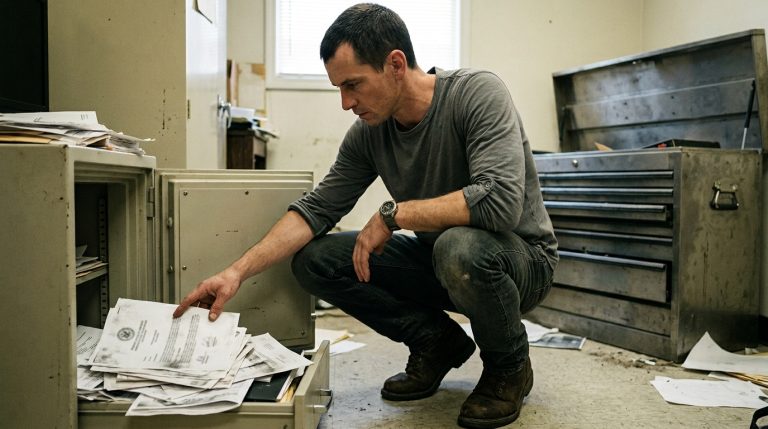
The Concrete Foundation of Retribution: How One Veteran’s Stargazing Tower Dismantled a Suburban Tyranny
CHAPTER 1: THE FIRST NOTICE AND THE THREAT AT SUNSET
The sound of the rusted metal voice still hung in the heavy afternoon air, vibrating against the newly galvanized steel of the lattice structure. Jack did not blink. He kept his weight balanced on the balls of his feet, his gaze locked onto the floral-print muumuu billowing against the manicured perimeter of the Oak Ridge development. Karen’s clipboard served as an extension of her grip, its aluminum edge biting into her thumb as she tapped her right loafer against the sod.
“Forty-eight hours, Mr. Rider,” she said, her voice dropping an octave into a gravelly rasp that signaled the end of her preliminary warning. “The county inspector is booked for Friday morning, and I’ll have the sheriff’s deputies escorting the towing crew right behind him.”
Jack turned his head two inches to the left, registering the precise angle of the sun as it dipped below the crown of the western ridge. The shadows were lengthening across his five acres, stretching long and dark toward the property line where the manicured lawns of Summit Creek ended and his wild, ungreened earth began. He noted the sweat beading along the bridge of her thick, wire-rimmed glasses—a sign of thermal stress masked by absolute bureaucratic certainty.
“The structure is anchored in ten tons of reinforced concrete, Karen,” Jack said, his voice flat, stripped of all inflection. “It sits entirely within my boundary lines. You’ll need more than a clipboard to move it.”
“We’ll see how anchored it is when the demolition claw hits the base,” she snapped, pivoting sharply on her heel with the practiced drill of an HOA president accustomed to unresisting subjects. She marched back toward the sterile sea of identical beige roofs, her clipboard held like a shield against the fading light.
Jack waited until the slap of her sneakers against the asphalt faded entirely before he exhaled. He reached down and ran a calloused thumb along a micro-abrasion on the tower’s base leg—a minor flaw from the assembly process that required a dab of cold-galvanizing compound. His fingers were steady. The adrenaline spike had already peaked and receded, leaving behind the cold, methodical focus he had relied on during midnight equipment checks on desolate mountaintops half a world away.
He walked past the towering steel frame, its triangular geometry slicing the indigo sky, and stepped onto the back porch. The screen door clicked shut behind him with a dull, familiar pop.
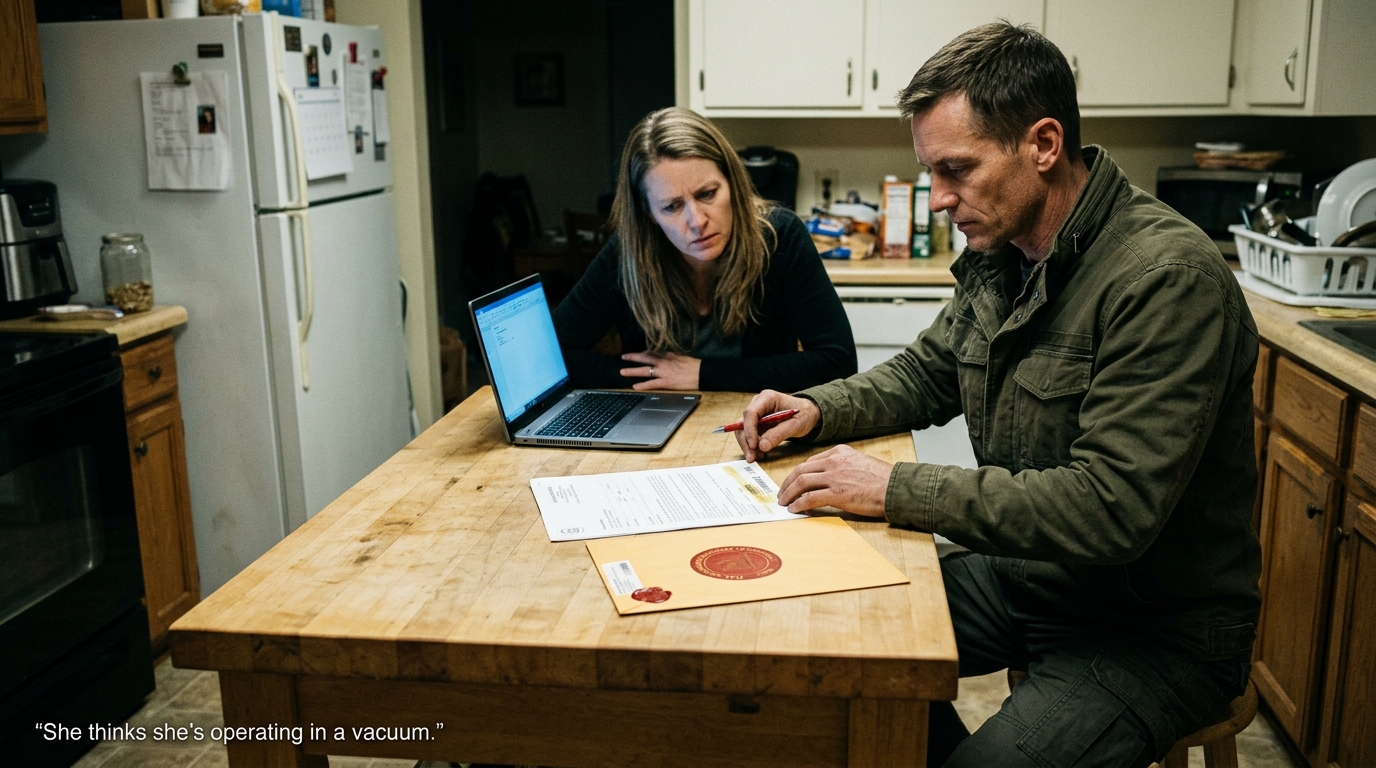
Inside the kitchen, Sarah stood by the counter, her hands wrapped tightly around a ceramic mug that had long since gone cold. Her eyes flicked from his face to the certified letter sitting squarely in the middle of the butcher-block table. The red wax seal of the Oak Ridge Homeowners Association was stamped across the flap, heavy and official.
“She wasn’t bluffing, Jack,” Sarah said, her voice dropping into that quiet register she used whenever the past threatened to bleed into the present. “I saw her talking to the district code officer by the mailboxes this morning. They’re treating this like a zoning violation.”
Jack pulled out a wooden chair and sat down, dragging the heavy binder of bylaws toward him. He didn’t open it yet. Instead, his eyes drifted to a small discrepancy on the outer edge of the envelope—a postal barcode printed on a separate white sticker, pasted directly over the original meter mark. It was a detail most people would miss, a clumsy administrative patch job.
“She thinks she’s operating in a vacuum,” Jack said softly, his fingers tracing the edge of the sticker. “She thinks the rules are a weapon she owns.”
He flipped the envelope over, sliding his thumb beneath the flap, and pulled out the three-page summons. The text was dense, blocky, and aggressively formatted, designed to induce panic before the reader could reach the third paragraph. But as his eyes scanned the block letters of the second page, something caught his attention—a stray reference to an annexed land parcel code that didn’t match the county plat map he had verified before purchasing the land.
He reached for his red pen, his expression hardening as he realized the document in his hands contained a fatal administrative error that Karen didn’t even know she had made.
CHAPTER 2: THE KITCHEN TABLE ANALYSIS AND CLAUSE 174b
The kitchen was quiet, save for the low, rhythmic hum of the refrigerator compressor and the scratching sound of the red ink pen against the thick, cream-colored paper of the summons. Jack kept his eyes fixed on the parcel code pasted over the original meter mark. The adhesive beneath the white sticker had bled through slightly, leaving a yellowish halo that smeared the barcode numbers underneath. It was a sloppy patch job—the kind performed by someone rushed and anxious, terrified that an official routing audit might expose an administrative shortcut.
He didn’t look up when Sarah set her cold mug down on the counter with a faint clink. He knew the precise rhythm of her breathing, the subtle hitch in her chest whenever the weight of the outside world pressed too close to their walls.
“She used a bulk-rate postal permit meant for commercial mass mailings,” Jack said, his voice a low, steady rumble that cut through the silence. He didn’t raise his eyes from the paper. “Not a standard municipal certified notice. That means this didn’t go through the county clerk’s automated docket system. She bypassed the standard municipal pipeline to save three days on the turnaround.”
Sarah crossed the linoleum floor, her bare feet making no sound, and pulled out the chair directly across from him. The wood scraped slightly against the grain. She leaned forward, resting her elbows on the edge of the table, her gaze dropping to the highlighted paragraphs of the HOA bylaws binder.
“If she bypassed the clerk, does that mean the notice is invalid?” she asked, her brow furrowed as she studied the margins where Jack had scribbled cross-references in his sharp, military hand.
“It means it’s a private civil threat masquerading as a legal mandate,” Jack replied, tapping the tip of his red pen against the corner of the envelope. “She’s leveraging the stationary and the letterhead to make people panic before they check the municipal registry. Ninety percent of the residents on our side of the ridge don’t know the difference between a county zoning ordinance and a private homeowners covenant. They see a ten-thousand-dollar fine in bold print, and their hands start shaking.”
A sudden, sharp sound outside made both of them freeze. A distant car engine down on the paved perimeter road revved twice, the exhaust note sharp and metallic, before shifting gears and fading into the humid evening air. For a fraction of a second, the harsh glare of headlights swept across the upper windowpanes, casting long, angular shadows of the kitchen window frames across the ceiling—sharp edges of light stretching and distorting before snapping back into darkness.
Jack’s left shoulder twitched—a faint, involuntary muscle memory from long nights spent in cold command tents where every unexpected headlight meant a perimeter check. He suppressed it instantly, keeping his posture loose, his eyes returning to the papers.
“We need to look at the annexation records from two years ago,” Jack said, sliding a second binder across the butcher block. “The town council vote that supposedly dragged our five acres into their jurisdiction. If her administrative shortcuts are this sloppy on a simple notice of violation, her foundational paperwork for the boundary expansion is going to be riddled with structural gaps.”
“You think she forged the jurisdictional footprint?” Sarah asked, her voice dropping to a whisper as she reached out, her fingers brushing the edge of the open binder.
“I don’t think she forged it,” Jack said, his gaze narrowing as he recalled the precise wording of clause 17.4b buried deep in Appendix C. “I think she assumed nobody would ever look past page four. People who build empires out of beige paint chips and lawn-height regulations don’t expect someone to treat their bylaws like an intelligence briefing.”
He reached for a yellow legal pad, pulling it into the center of the table. He didn’t feel anger; that spike of adrenaline from the afternoon had completely burned away, leaving behind the cold, hyper-focused clarity he used to map out communication grids over hostile terrain. Every variable had a parameter. Every signal path had a vulnerability. Karen had drawn a hard line at his property boundary, believing she held Summit Creek in the palm of her hand. She had no idea she had just handed him the exact schematics needed to dismantle her entire operation.
“Get me the tax assessor’s plat map from the county archive website,” Jack said, looking up to meet Sarah’s eyes. “Let’s see who actually signed off on the northern corridor expansion.”
Sarah nodded, her jaw setting into a firm, resolute line as she reached for her laptop. The screen flickered to life, casting a pale, cold blue glow across her face. Outside, the wind picked up slightly, rustling the high branches of the oak grove and tapping a dry, rhythmic branch against the side of the house. The perimeter was quiet, but the first tactical move had been logged, and the blueprint for the counter-offensive was already taking shape beneath the kitchen light.
CHAPTER 3: THE RECONNAISSANCE WALK AND GEORGES WARNING
The blue glow of the laptop display cast stark, angular highlights across Sarah’s cheekbones as she scrolled through the county archive document. Jack stood directly behind her, his weight balanced evenly over his boots, watching the digital plat lines map themselves across the screen. The northern boundary of the Oak Ridge subdivision bled into the jagged contours of their five-acre ridge, but the digital borders did not align with the physical iron survey pins Jack had driven into the earth himself two years prior.
“Look at the timestamp on the annexation filing,” Sarah said, her voice tight, pointing a slender finger at a small metadata block in the corner of the PDF. “It was processed three days after the town council’s summer recess began—when quorum requirements drop from nine members to four.”
“Standard administrative padding,” Jack murmured, leaning closer, his breath stirring a stray lock of hair at the nape of her neck. “They pushed it through while the civil engineers were off-site. No public notice, no certified mail delivery to outlying parcels.”
He straightened up, the linoleum creaking softly beneath his soles. The digital proof was useful, but a court filing wouldn’t stop Karen from sending her demolition crew on Friday morning. Bureaucracy moved at the speed of ink on paper; bulldozers moved at the speed of diesel fuel. To dismantle a trap, you had to inspect its tripwire from the inside.
Jack reached for his canvas utility jacket hanging from the peg by the back door, slipping his arms through the stiff sleeves. The fabric smelled faintly of machine oil and dry cedar.
“Where are you going?” Sarah asked, her fingers pausing on the trackpad.
“To look at the terrain,” Jack said, his hand resting on the latch of the back screen door. “Karen didn’t pull those annexation boundaries out of thin air. She had help from someone inside the county zoning office who knew how to skirt the parcel codes. I’m going to walk the lower perimeter before the light dies completely.”
“Be careful, Jack,” she said, her eyes reflecting the pale light of the monitor. “She’s watching every vehicle that comes up this ridge.”
“Let her watch,” Jack replied, a faint, humorless curve touching the corner of his mouth. “Shadows work both ways.”
He stepped out into the crisp evening air. The transition from the warm, fluorescent-lit kitchen to the open expanse of the ridge was abrupt. The wind had shifted from the west, carrying the dry, metallic scent of sun-baked dust and crushed pine needles. Overhead, the stars were beginning to puncture the deep indigo sky, cold and sharp as chipped glass.
Jack bypassed the gravel driveway, avoiding the crunch of loose stone that might signal his departure. Instead, he dropped down the natural grade of the hillside, moving with the practiced, low-impact stride of a man accustomed to navigating uneven terrain without a flashlight. The underbrush parted silently around his heavy boots—dry oak leaves crackling just enough to mask his movement beneath the steady hum of distant highway traffic down in the valley.
As he reached the boundary line separating his wild acreage from the manicured perimeter of the Oak Ridge development, the atmosphere shifted instantly. The natural chaos of the hillside gave way to an unnatural, geometric perfection. Lawns rolled away in uniform waves of dark green turf, edged with mathematical precision against pristine concrete curbs. Streetlamps, mounted on identical cast-iron posts spaced precisely forty feet apart, cast a sterile, amber glare over the rows of beige houses. It was a landscape designed to project absolute control, every blade of grass bullied into submission by a binder of bylaws.
Jack stayed within the deep shadow cast by a dense grove of weeping willows that lined the dry creek bed. His eyes scanned the properties bordering his northern flank. Most of the houses were dark, their occupants tucked safely behind double-paned glass, watching television or dining in air-conditioned silence.
Then he spotted movement two streets over.
A figure was crouched near the edge of a meticulously edged flower bed, moving with the frantic, jerky motions of someone working under severe anxiety. Jack froze, sinking deeper into the shadow of the willow trunk, blending his silhouette against the dark, ridged bark.
As the person straightened up, the amber glow of the nearest streetlamp caught the pale flash of silver hair. It was George—the man from the beige house who had spent the afternoon tending his marigolds. But tonight, George wasn’t weeding. He held a long-handled garden trowel like a defensive weapon, his head snapping nervously from side to side, casting fearful glances toward the two-story colonial at the end of the cul-de-sac—Karen’s house.
Jack stepped out from the canopy of the willows, moving with silent deliberation across the open patch of manicured turf until his boots crunched softly on the decorative gravel bordering George’s flower bed.
George gasped, dropping the trowel with a sharp, metallic clang that echoed loudly in the quiet cul-de-sac. He spun around, his chest heaving, his hands clawing defensively into the air before his eyes adjusted to the darkness and recognized the tall, imposing silhouette standing beside his prize-winning hydrangeas.
“Jesus, Jack,” George whispered, pressing a trembling hand against his chest, his breath coming in ragged gasps. “You move like a ghost. Don’t sneak up on people out here—she’s got motion-activated floodlights tied into the association security feed.”
Jack didn’t smile. He kept his voice low, measured, and entirely devoid of panic, matching the rhythm of the night air. “You’re out late for yard work, George.”
George looked over his shoulder once more toward Karen’s darkened windows before stepping closer, his face pale and slick with nervous sweat. He reached into the pocket of his windbreaker and pulled out a folded square of heavy cardstock, shoving it hastily into Jack’s hand.
“Found this taped to the inside of my utility meter box about an hour ago,” George whispered, his voice trembling with suppressed fury. “No stamp. No envelope. Just dropped off by someone wearing an HOA badge.”
Jack unfolded the card in the amber streetlight. It was a formal citation—not for his own property, but an emergency notice addressed to George, citing an unapproved variance in exterior trim paint and demanding an immediate $500 compliance fee within twenty-four hours, signed with Karen’s sharp, jagged initials.
“She’s accelerating the timeline,” Jack said, his eyes narrowing as he stared at the ink. “She knows the county plat review is moving, and she’s trying to drain your resources before the week is out.”
“She’s bleeding everyone who ever questioned her,” George hissed, his hands curling into tight fists at his sides. “And she’s using the association maintenance fund to pay for the private investigators tracking our comings and goings. Everyone knows it, but nobody has the guts to stand up to her. Not when she holds the liens on our deeds.”
Jack folded the citation and slid it quietly into the interior pocket of his canvas jacket. The tactical picture was crystallizing. Karen wasn’t just enforcing rules; she was running an aggressive containment strategy to protect a fragile financial house of cards before anyone looked too closely at the ledger books.
“She won’t need to worry about liens much longer,” Jack said quietly, his voice carrying a cold, granite weight that made George swallow hard and step back. “Keep your head down, George. Let her make the next move.”
Jack turned back toward the dark rise of the ridge, leaving the manicured lawns and the amber streetlamps behind as he melted back into the shadows of the unmapped earth, carrying the first piece of real leverage into the night.
CHAPTER 4: THE CELL PROVIDER CONNECTION AND LEASE DRAFTING
The damp chill of the ridge air clung to Jack’s canvas jacket as he pushed through the back screen door, the latch clicking home with a familiar, muted snap. The kitchen was still bathed in the pale, sterile blue light of Sarah’s laptop monitor. She hadn’t moved from the table; her fingers hovered just above the trackpad, her eyes tracking his entry with an intensity born of long hours and high stakes.
Jack pulled the folded cardstock citation from his pocket and laid it flat beside the keyboard. The heavy ink of Karen’s initials caught the light.
“She’s accelerating the timeline,” Jack said, his voice dropping into a rhythmic, measured cadence as he unzipped his jacket. “Targeting individual residents with fabricated code violations to drain their finances before Friday morning. She’s trying to consolidate compliance across the lower streets so nobody has the bandwidth to back us up.”
Sarah picked up the citation, her thumb tracing the embossed letterhead before she looked up. “If she’s hitting George and the Hendersons now, she’s terrified of what that tower represents. It’s not just an unapproved structure to her; it’s an unmonitored variable in a system she needs to control.”
Jack didn’t answer immediately. He walked over to the counter, pulled a clean glass from the rack, and filled it with cold tap water. His mind was already parsing the next phase of the operational grid. Bypassing municipal channels with private threats meant Karen was operating outside the safety net of formal municipal liability, but it also meant her administrative apparatus was strained to its breaking point.
He set the glass down and walked back to the table, pulling a heavily annotated engineering blueprint of the lattice structure toward him. The pencil lines mapped out the precise wind-load calculations and the ten-ton concrete footing he had poured himself two summers ago. But looking at the structural load lines, a different utility vector snapped into focus. The dead zone blanketing Summit Creek wasn’t just an annoyance; it was a blank frequency spectrum sitting at the highest elevation point for three square miles.
“The tower isn’t just a telescope mount,” Jack said softly, tapping the pencil eraser against the margin of the blueprint. “It’s a natural relay node.”
Sarah tilted her head, her analytical gaze locking onto his. “You’re thinking about the regional carrier dead zone.”
“Every cellular provider in the state has been bleeding customer retention tickets in this valley for two years,” Jack replied, his voice hardening with crisp certainty. “They can’t get municipal permits to build new infrastructure because the town council defers all zoning decisions in this sector to the Oak Ridge architectural committee. Karen acts as the gatekeeper for the entire ridge’s airspace.”
He reached for his phone, scrolling past the missed notifications until he found a direct, unlisted number saved from his years managing encrypted communications networks for the Air Force. He didn’t call customer service. He dialed a direct extension belonging to Mark Vance, a regional network engineering director he had coordinated with during a cellular infrastructure upgrade project out of state three years prior.
The phone rang twice before a sharp, gravelly voice answered on the other end. “Vance.”
“Mark. This is Jack Ryder.”
A brief pause crackled across the line, followed by the sound of a chair shifting against a desk. “Ryder? Damn. I thought you retired to the middle of nowhere to look at the stars. Last I heard, you were off the grid.”
“I am on the grid,” Jack said evenly. “Specifically, on a five-acre ridge overlooking the Summit Creek valley. And I’m sitting on top of a forty-foot freestanding structural lattice with an unobstructed 360-degree line of sight over your primary coverage blackout zone.”
The atmosphere on the other end of the line shifted instantly. The casual conversational tone vanished, replaced by the sharp, focused bandwidth of an engineer recognizing an operational asset. “Summit Creek? We’ve been burning thousands in customer churn tickets out of that valley every month. The town council blocks every application we submit for a microcell site.”
“They block public land applications,” Jack corrected smoothly. “This is private property. Zero municipal jurisdiction over structural outbuildings of this class, provided it meets engineering safety standards. I have a ten-ton reinforced concrete footing and professional load-bearing specs ready to transmit.”
“You’re serious,” Mark said, his voice dropping an octave as papers rustled on his desk. “What’s the catch, Jack? Why are you calling me?”
“I want a long-term lease agreement drafted and signed before Friday morning,” Jack said, his eyes locking onto the boundary lines marked on the plat map. “You install a commercial microcell relay on my tower. In exchange, the structure and all affixed signal equipment become classified as critical telecommunications infrastructure under federal regulatory oversight. You handle the legal framework; I provide the real estate.”
Another pause stretched across the line, heavy with calculation. Then, a low, appreciative whistle came through the speaker. “Federal preemption over local residential zoning covenants. That doesn’t just bypass the town council, Jack. That drops a legal anvil straight through any private homeowners association trying to flex municipal authority.”
“That’s the objective,” Jack said. “Can your legal team turn around a draft agreement by midnight?”
“Send me your exact coordinates and the structural load certifications right now,” Mark barked, the sound of keyboard clacking instantly filling the background. “I’ll wake up our corporate real estate counsel. If you’ve got the line of sight you claim you do, we’ll have a signed contract in your inbox before dawn.”
Jack ended the call, laying the phone facedown on the butcher block. He looked up to find Sarah staring at him, a faint, sharp smile touching the corners of her mouth—the look of a partner who knew the exact moment the tide of a battle had turned.
“She thinks she’s fighting a neighbor over lawn height,” Sarah whispered, her fingers returning to the keyboard. “She has no idea what she just invited onto our land.”
Jack pulled the blueprint closer, his expression cold and focused. The trap was laid. All that remained was waiting for the enemy to walk straight into the line of fire.
CHAPTER 5: THE MACK TRUCK CONFRONTATION AND THE CEASEANDDESIST
The morning of the fifteenth dawned cold and sharp, a thin, slate-gray frost clinging to the blades of wild grass along the ridge. Jack stood on the front porch, a steaming mug of black coffee cooling untouched in his hand, watching the gray ribbon of the lower access road. The valley below was choked with a thick blanket of valley fog, swallowing the identical beige roofs of the Oak Ridge development.
Right on schedule at 8:00 a.m., the low, diesel growl of heavy machinery vibrated through the dry earth.
A massive, flatbed Mack truck hauled itself up the steep incline of the gravel driveway, its dual rear tires kicking up a spray of loose stone against the wooden fence line. Perched flat on the trailer bed was a heavy mini-excavator equipped with a steel demolition claw, its hydraulic lines shivering under the strain of the climb. Trailing directly behind the flatbed was a pristine white pickup truck bearing the bold corporate emblem of Apex Demolition on its side doors.
Jack did not move. He took a slow, deliberate sip of his coffee, feeling the heat of the liquid scald his tongue, grounding him in the precise physical reality of the moment. Beside him, the screen door drifted open with a faint squeak, and David Chen stepped out onto the porch. The former JAG officer turned private attorney wore a sharp navy wool suit that looked entirely out of place against the rustic timber and red dirt of the ridge. In his right hand, he carried a heavy, black leather briefcase.
“They’re early,” David noted, his voice smooth and devoid of tension as he adjusted the cuffs of his shirt.
” Professionals usually are when they think they’re walking into an uncontested site,” Jack replied, setting his mug down on the porch railing. “Let’s go meet them.”
They walked down the wooden steps together, their boots crunching in unison over the gravel path that led to the main property gate. The Mack truck had already cut its engine, the abrupt silence leaving only the high-pitched pinging of cooling exhaust manifolds and the faint hiss of air brakes.
The door of the pickup truck swung open, and a sun-beaten man in his late forties wearing a high-visibility yellow vest stepped down. He was the foreman, his expression tight with the defensive wariness of a contractor who smelled a legal dispute before he even put his boots in the dirt. He slammed the truck door shut, wiping his palms on his thighs as he walked toward the gate.
“Morning,” the foreman said, deliberately avoiding eye contact with Jack and fixing his gaze instead on the towering steel lattice of the stargazing platform behind them. “Got a work order to take down an unapproved ancillary structure at this address. Signed and authorized by Karen Miller, president of the Oak Ridge Homeowners Association.”
Jack remained silent, letting the weight of his physical presence anchor the perimeter.
David Chen stepped forward, closing the distance between them with unhurried precision. He did not raise his voice; his tone was flat, conversational, and utterly bureaucratic—the exact cadence of a prosecutor laying out an open-and-shut case.
“And we’re here to ensure your company doesn’t accidentally commit a federal offense while fulfilling that work order,” David said, unlatching the brass clasps of his leather briefcase with a crisp double snap.
The foreman’s jaw tightened. He stopped three paces away, his eyes darting toward the briefcase. “Look, mister, I don’t want any trouble. I’ve got a signed municipal clearance form and a direct contract from the HOA. If you’ve got a dispute with the association, take it up at the clubhouse. My crew is here to clear the steel.”
“Your clearance form originates from a private civil covenant,” David said smoothly, extracting a thick sheaf of heavy-stock legal documents from the case. He extended the top paper toward the foreman’s chest. “This, however, is a formal cease-and-desist order tied to active federal jurisdiction.”
The foreman stared down at the paper as if it were contaminated, his hands remaining stubbornly at his sides. “What is this?”
“That is a certified notice of active telecommunications infrastructure,” David recited, his voice dropping into a register of absolute authority. “The structure you are contracted to demolish is legally classified as a commercial signal relay operating under a binding lease agreement with a national cellular provider. Under 47 USC Section 332, attempting to dismantle, sever, or interfere with this installation constitutes a direct violation of federal telecommunications law. If your excavator touches that concrete footing, your company’s operating license will be suspended before noon, and you personally will be named as a co-defendant in a federal injunction.”
The foreman’s face drained of color. He looked from David’s impassive expression to Jack’s cold, steady gaze, and then back down at the terrifying block letters printed across the top of the legal brief.
“Federal?” the foreman muttered, wiping a bead of cold sweat from his upper lip with the back of a calloused thumb. “Nobody said anything about federal property. This was supposed to be a standard residential teardown.”
“Karen Miller neglected to mention that detail in her briefing, didn’t she?” David asked mildly, sliding a second document forward. “And this is a notice of intent to hold Apex Demolition and its corporate directors personally liable for all associated revenue losses, legal fees, and punitive damages resulting from willful interference.”
The foreman reached out with trembling fingers, taking the papers as though they were hot coals. He backed away two steps, turned abruptly toward his pickup truck, and snatched his mobile phone from the dashboard mount. He punched a speed-dial number with frantic jabs of his thumb, holding the phone to his ear while pacing in a tight, agitated circle beside the roaring front grill of the Mack truck.
“Karen? Yeah, it’s me,” the foreman barked into the phone, his voice pitching upward in stress. “We’re at the site. Look, we got a problem—a major problem. Her lawyer is standing right here with federal injunction papers. They’re claiming this is a cell tower under FCC protection. If we drop the claw on this thing, our entire fleet could get impounded.”
A harsh, screeching squawk of compressed audio leaked from the phone’s earpiece, loud enough to echo across the gravel drive. Karen’s voice, high and brittle with panic, cut through the morning air.
“What do you mean you have a problem? I’m paying you for demolition! Tear the monstrosity down right now, or I’ll cancel the contract and blacklist your company from every development in the county!”
The foreman pulled the phone an inch away from his ear, wincing at the volume before glaring across the hood of his truck toward Jack and David. His fear instantly curdled into bitter resentment toward the woman shouting through his speaker.
“Ma’am, with all due respect, your association bylaws don’t override federal statutes,” the foreman snapped back into the phone, his professional restraint completely fracturing. “These men just handed me a grenade with my name on it. We’re loading up. We’re out of here.”
Without waiting for her response, he hit the red disconnect button on his screen, shoved the phone into his vest pocket, and turned back to his crew idling by the excavator. “Pack it up! We’re rolling out. Now!”
The two junior workers in the back of the pickup exchanged bewildered glances before scrambling to secure the loading ramps. Within eight minutes, the heavy diesel engines roared back to life, the excavator claw was locked down onto the flatbed, and the Mack truck ground its gears into reverse, spinning gravel across the drive as it retreated down the ridge.
Jack and David stood side by side on the gravel, watching the dust settle in the wake of the departed convoy. The first physical assault on the ridge had broken apart against the cold wall of federal statute before the first bucket could even touch the dirt.
“She’s going to pivot,” David said quietly, closing his briefcase with a satisfying snap of brass. “When brute force fails a tyrant, they always retreat into the small print of administrative harassment.”
“Let her,” Jack replied, his eyes fixed on the distant, fog-shrouded roofs of the valley below. “We’ve got her whole playbook mapped out.”
CHAPTER 6: THE BUREAUCRATIC RETALIATION AND GRASS BLADE MEASUREMENTS
The afternoon sun had climbed to its zenith, casting sharp, uncompromising shadows across the packed dirt of the driveway. Jack did not return to the kitchen immediately after the demolition crew’s departure. Instead, he stood by the edge of the lower property line where the manicured turf of the Oak Ridge development met his uncultivated brush. His instincts, honed by decades of monitoring perimeter feeds, told him that a defeated adversary did not simply vanish; they recalibrated.
The confirmation arrived at precisely 2:15 p.m., delivered not by heavy machinery, but by the familiar, heavy thud of a postal van braking near the main gate.
Jack walked down the gravel path, his boots crunching rhythmically against the stone. He reached into the metal mailbox box, pulled out a single, pristine white envelope bearing the embossed return address of the Oak Ridge Homeowners Association, and slid it open right there in the open air.
It was a masterpiece of pettiness. The notice cited an infraction under municipal landscaping code 7.2: the grass blades adjacent to the northern mailbox post were documented via a high-resolution, time-stamped digital close-up as measuring three point two inches in height—two tenths of an inch past the strict three-inch community threshold. A mandatory fifty-dollar fine was attached, alongside an escalating daily penalty clause.
Jack didn’t feel anger; he felt the cold, methodical rhythm of a counter-battery fire. Karen was attempting to bleed him with a thousand micro-cuts, believing that administrative exhaustion would force him to surrender what brute force could not break.
He turned on his heel and walked back to the house, his mind already mapping the defense. If she wanted to fight a war over fractions of an inch, he would give her an engineering textbook.
Inside the house, Sarah looked up from her laptop as he laid the violation notice flat on the kitchen table alongside a stainless-steel digital caliper and a professional botanical reference guide.
“Another citation?” she asked, her voice steady, though a tight line had formed around her mouth.
“Grass height on the northern perimeter,” Jack replied, pulling a heavy-duty tape measure and a professional Nikon digital camera from the utility shelf by the pantry. “She’s pivoting to micro-violations. Trying to force us into a corner where legal defense costs outpace the fines.”
“She’s counting on people backing down because it’s embarrassing to argue over a lawn,” Sarah noted, sliding her chair back to give him room.
“She doesn’t understand the equipment she’s testing,” Jack said, his expression flat.
He walked back outside into the glaring afternoon heat, heading straight for the northern mailbox post where the alleged infraction had taken place. He dropped to one knee in the dirt, unclipped the digital caliper, and began measuring individual blades of Kentucky bluegrass with the meticulous precision of a forensic investigator processing a crime scene. He took macro photographs with a digital scale marker placed beside the stems, documenting the exact angle of growth, the shadow distortion of the camera lens, and the precise micron-level variations that proved 99% of the turf complied with the arbitrary standard.
For every single millimeter of deviation, he cross-referenced the municipal agricultural exemption statutes hidden deep within the county zoning code—statutes that explicitly protected native soil stabilization grasses on non-commercial rural fringes.
He spent two hours in the dirt, refusing to rush, treating a fifty-dollar nuisance fine with the exact tactical gravity he would have applied to an encrypted signal failure on a foreign mountaintop. By the time he stood up, dusting the dry earth from the knees of his utility trousers, the sun was beginning its descent toward the western ridge, painting the sky in cold, bruised shades of violet and gray.
He walked back to the kitchen, dropped the camera and the measurements onto the butcher block, and picked up his red pen. He wasn’t just going to pay the fine or contest it informally; he was going to demand a formal, recorded hearing before the full architectural review committee, invoking every procedural right guaranteed under the association’s own founding bylaws.
Karen had wanted a war of attrition. Jack sat down at the table, pulled the clean legal pad toward him, and began drafting a twelve-page evidentiary packet complete with photographic proof, botanical charts, and statutory cross-references. He would drag her entire bureaucratic apparatus into a public room, pin every petty rule against its own logical contradictions, and watch her system fracture from within.
Sarah stood beside him, resting a warm hand briefly on his shoulder. The house was quiet, but the machinery of their defense was fully engaged, humming with quiet, unstoppable momentum as night began to fall over the ridge.
CHAPTER 7: THE CLUBHOUSE HEARING AND THE SLIDE PRESENTATION
The fluorescent lights of the Oak Ridge community clubhouse hummed with a low, chemical frequency that seemed to vibrate directly behind Jack’s temples. He sat upright at the folding metal table, his shoulders squared, a leather-bound portfolio resting squarely in front of him. Beside him, David Chen leaned back in his chair, his expression an absolute mask of professional dispassion as he casually flipped open a stainless-steel pen.
At the head of the long folding table sat Karen Miller. Her face was flushed, her wire-rimmed glasses catching the harsh overhead glare as she clutched a printed copy of the neighborhood bylaws like a shield. Flanking her on either side were the four subordinate board members—retired residents who looked decidedly anywhere else, their eyes fixed firmly on their blotters or the water pitchers before them.
“The meeting will come to order,” Karen announced, her voice pitched sharper than usual, cutting through the murmurs of the crowded back rows where half a dozen local homeowners stood shoulder-to-shoulder near the double doors. “We are here tonight to review formal contestations regarding citation code 7.2 issued to property owner Jack Ryder.”
Jack did not wait for her to invite him forward. He stood up in one fluid, controlled motion, picking up his portable projector and sliding it to the center of the table. He plugged the power cord into the wall socket with a sharp click that drew every eye in the room.
“There is no citation to review, Madam President,” Jack said, his voice level and devoid of all inflection, carrying effortlessly across the sterile room. “According to the municipal agricultural exemption statutes under county code section four, native soil stabilization grasses on non-commercial rural fringes are explicitly exempt from residential height caps. Furthermore, your photographic evidence was captured from a distance of forty feet using a wide-angle lens distortion that mathematically exaggerates vertical perspective by twenty-two percent.”
A quiet ripple of murmurs ran through the back rows. Arthur, the retired accountant sitting to Karen’s right, leaned forward, adjusting his reading glasses as he peered down at the papers Jack had slid across the table.
“Let’s look at the actual data,” Jack continued, tapping the remote to cast a high-resolution, time-stamped macro photograph onto the pull-down screen behind the board.
The image filled the wall: individual blades of Kentucky bluegrass standing beside a digital caliper clearly displaying a measurement of two point eight inches—well within the legal threshold. Beside it, Jack projected a comparative analysis of the lens focal length, complete with geometric calculations and statutory cross-references.
Karen slammed her palm down against the folding table, the sharp crack making the water glasses rattle. “This is completely irrelevant! You’re turning a simple neighborhood landscaping infraction into a courtroom trial!”
“The bylaws guarantee every resident the right to present physical evidence during a formal review before this committee,” David Chen murmured smoothly, not even looking up from his pen. “Unless, of course, the board wishes to summarily dismiss the violation and avoid a formal administrative record.”
Arthur cleared his throat, breaking the heavy tension in the room. He picked up his pen and pointed toward the projected slide. “Jack… Mr. Ryder. Where did you get these focal length calculations?”
“From the manufacturer’s specification manual for the digital camera used by your enforcement officer,” Jack replied evenly. “Combined with standard municipal surveying protocols.”
Arthur exchanged a long, heavy glance with the board member to his left, then looked up at Karen. The executive consensus in the room had just dissolved. What was supposed to be a quick, rubber-stamped financial penalty had been transformed into an airtight public dissection of administrative incompetence.
For forty-five minutes, Jack walked the board through every micro-violation she had filed that week—the garbage can timing, the microscopic oil spot on the driveway, the blade-height measurements—demolishing each one with cold, unyielding precision. Karen tried to interrupt twice, but her voice cracked under the weight of the facts, her arguments devolving from legal interpretations into frantic personal assertions.
When the final vote was called, Arthur didn’t even wait for a second. He raised his hand immediately. “Motion to dismiss all pending fines against Mr. Ryder due to insufficient and erroneous evidentiary baseline.”
The second board member raised his hand. Then the third.
Four votes to one. Karen sat completely frozen in her chair, her face burning crimson, her authority publicly stripped away in front of her own constituents.
Jack gathered his portfolio, his movements calm and deliberate. The system she had built to terrorize the neighborhood had just been turned against her, and the cracks in her foundation were widening by the hour.
CHAPTER 8: THE BACKYARD BARBECUE AND THE FORMATION OF THE COMMITTEE
The heavy scent of charred hickory smoke and warm gravel hung thick in the evening air as the last rays of the sun bled out behind the western ridge. Jack stood beside the brick-built grill in his backyard, turning a line of thick beef patties with a long-handled stainless-steel spatula. The metal clinked rhythmically against the grates, a familiar, grounded sound that contrasted sharply with the low hum of conversation rising from the lawn.
More than thirty families had crowded onto his five acres, spilling across the unkempt turf and gathering in the long, angular shadow cast by the forty-foot steel lattice of the tower. They weren’t strangers hiding behind drawn curtains anymore; they were a collective force born of shared exhaustion and sudden, sharp clarity.
Beside the cooler filled with iced drinks, George was leaning against a wooden fence post, recounting the details of his six-thousand-dollar paint extortion to a cluster of nodding neighbors from the lower loop. A few yards away, Mrs. Henderson stood with her young daughter, her fingers no longer trembling as she pointed up toward the blinking red warning light at the apex of the steel structure.
Jack slid the finished patties onto a heavy ceramic platter and carried them toward the long folding table Sarah had set up near the patio. His movements were economic, balanced, and entirely focused. He didn’t celebrate the clubhouse victory; tactical pauses in a prolonged engagement were merely windows for logistics.
“They’re organizing faster than expected,” Sarah said quietly, stepping close as he set the platter down. Her eyes tracked a group of three homeowners reviewing a legal brief David Chen had left on the corner of the table. “Arthur and the dissenting board members have been leaking internal ledger copies from the last three fiscal years through the neighborhood drop-box.”
Jack picked up a pair of tongs, his gaze narrowing as he scanned the perimeter of his property line where the manicured lawns of the development met his wild brush. “What kind of ledgers?”
“Maintenance surplus allocations,” Sarah murmured, her voice dropping so only he could hear. “Funds collected for common-area landscaping and paving repairs that never actually happened. The paper trail doesn’t just point to selective enforcement, Jack. It points straight to a massive financial shortfall in the association reserve accounts.”
Before Jack could answer, David Chen stepped out from the back screen door, adjusting his cuffs. The lawyer’s tailored navy suit was dusty at the hem from walking the ridge perimeter, but his expression was sharp, lit with the quiet intensity of a prosecutor who had just found the master key to a locked vault.
“We have enough material for a formal class-action filing,” David said, joining them by the table. He pulled a folded computer printout from his inner pocket and laid it beside the platter. “Karen hasn’t just been running a tyranny of lawn-height rules. She’s been masking a severe structural deficit in the HOA’s central operating fund by levying predatory, unrecorded fines and pocketing the cash transfers.”
Jack looked down at the printout. The numbers didn’t add up; thousands of dollars in compliance fees collected over three years were unaccounted for in the municipal public filings. The tyrannical bylaws weren’t just an instrument of psychological control; they were a collection agency designed to sustain a failing financial embezzlement scheme.
“She’s cornered,” Jack said flatly, turning the tongs over in his calloused hand. “And a cornered administrator doesn’t surrender—they strike blindly.”
“Which brings us to our next vulnerability,” David replied, his eyes shifting toward the northern utility easement where the fiber optic data cable crossed the narrow strip of common land to feed the tower relay. “That easement is her last pressure point. She can’t touch the tower legally, but she controls the municipal grading permits for the common strip. If she wants to cut our lifeline, she doesn’t need a demolition crew. She just needs a backhoe and a falsified drainage permit.”
Jack’s jaw tightened. The tactical grid snapped into absolute focus. Karen was predictable in her desperation. She would attempt to sever the physical data link under the guise of municipal maintenance, hoping to disable the FCC-protected status of the relay before the class-action papers could be filed.
“Let her pull the permit,” Jack said, his voice carrying a cold, granite finality. “We don’t block her. We set the trigger.”
David offered a slow, razor-thin smile, folding the printout back into his pocket. “I’ll notify the carrier’s engineering director to prep the telemetry alarms. When she swings the blade, we drop the hammer.”
Jack nodded, turning back to the grill as the evening shadows deepened across the ridge, knowing the final, inevitable collision was only days away.
CHAPTER 9: THE COMMON AREA TRAP AND THE SEVERED FIBER LINE
The morning mist hung heavy over the low swale where the manicured turf of the Oak Ridge development met the wild brush of Jack’s perimeter. Jack stood motionless behind the dense screen of wild sumac and cedar trees, his boots planted firmly in the damp earth. His eyes were locked on the ten-foot strip of common land running parallel to his northern boundary line—the utility easement containing the buried fiber-optic data cable that fed the commercial relay on top of his lattice tower.
Right on schedule at 7:30 a.m., a yellow diesel-powered mini-excavator grunted its way down the paved cul-de-sac, its steel treads grinding harshly against the asphalt before veering off onto the grass. Trailing behind it was a pickup truck bearing the logo of a local municipal landscaping contractor. A young operator hopped down from the cab, holding a laminated work order authorized and signed directly by Karen Miller under the guise of an emergency drainage remediation project.
Jack did not step out to confront them. He kept his breathing slow and even, his fingers resting lightly against the textured grip of his mobile phone, watching the operator unfold a paper site map and point toward the exact coordinates where the orange conduit line was buried three feet beneath the sod.
From a second vantage point fifty yards down the ridgeline, George stood half-hidden behind an oak trunk, his own phone raised to record the unfolding violation.
The excavator operator climbed back into the iron seat, pulled the control levers, and dropped the steel bucket down into the turf. He scraped away the topsoil in a wide, aggressive arc, then angled the bucket downward for the deeper trench.
Three feet down, there was a sudden, sickening metallic crunch—a muffled subterranean snap that reverberated up through the roots of the nearby trees.
The operator jerked the levers back, cutting the engine with a sharp twist of the ignition key. He leaped out of the cab, dropping to his knees beside the fresh cut in the earth. Protruding from the dark soil was a splintered length of bright orange conduit and shredded strands of black fiber-optic cable.
Inside Jack’s kitchen, the digital router mounted near the window blinked twice, emitted a high-pitched electronic whine, and went utterly dark. Across the five acres, the seamless 5G signal dropped instantly to zero bars.
Down in the valley below, the consequences were immediate. Within ninety seconds of the cable severing, hundreds of mobile phones across the Oak Ridge development flashed searching icons, dropping ongoing conference calls, disconnecting home-office data links, and cutting off digital access. But the true danger struck three streets over, where an elderly resident’s cellular-linked medical alert pendant failed to transmit an emergency signal following a sudden household fall. Her panic-stricken son, unable to connect to emergency dispatch through his dead cell phone, was forced to sprint across the asphalt to pound on a neighbor’s door for a landline connection.
The digital blackout Karen had engineered in her blind obsession to reach the tower had instantly plunged the entire neighborhood into a safety crisis.
Jack watched the excavator operator scramble back toward his truck, his face pale as he frantically dialed his supervisor on his mobile phone, only to stare dumbly at the screen as his own signal vanished. The trap had closed precisely as calculated. Karen had not just committed an act of vandalism against a private citizen; she had willfully and publicly sabotaged critical communication infrastructure under the direct gaze of the entire community.
Jack turned away from the tree line, sliding his phone back into his pocket with cold, methodical deliberation. The time for administrative defense had ended. The final phase was now open.
CHAPTER 10: THE NEWS BROADCAST AND THE SHERIFFS INQUIRY
The glare of high-intensity halogen lights sliced through the gray morning fog as the white satellite news van rumbled up the gravel driveway, its roof-mounted dish spinning in a silent, erratic blur. Jack did not move from his post near the front fence line. He watched the vehicle brake sharply beside the gate, its tires kicking up a shower of damp stone against the wooden posts.
The side door of the van slid open with a metallic rattle, and a young reporter in a slate-gray trench coat stepped down, clutching a professional wireless microphone in her right hand. Behind her, a cameraman shouldered a heavy broadcast unit, the tally light winking a steady, clinical red.
“Mr. Ryder?” the reporter called out, her voice cutting through the damp air as she closed the distance. “I’m Jessica Chen with regional news. We received an emergency advisory from local dispatch regarding a systemic communication failure and a compromised medical alert system across the Oak Ridge development. Are you the owner of the telecommunications structure on this ridge?”
Jack kept his posture balanced and neutral, his eyes fixing on the black foam windscreen of the microphone. He did not rush his words; he allowed the heavy silence of the ridge to anchor the moment before speaking.
“I am,” Jack said, his voice level and steady. “And the structure in question is a legally registered commercial telecommunications relay operating under active federal jurisdiction.”
“Local residents are reporting a complete digital blackout following a municipal landscaping project authorized by the homeowners association,” Jessica pressed, stepping closer as the cameraman adjusted his focus ring. “They’re claiming the excavation directly severed the data feed to your tower. Do you have documentation confirming who authorized that work?”
Jack turned slowly, gesturing toward the kitchen table visible through the open front window where copies of Karen’s signed work orders, county plat maps, and the FCC lease agreements lay arranged in precise, color-coded rows. “Every permit, every contract, and every administrative mandate issued by the association president is documented and time-stamped. She didn’t just order a drainage ditch cut; she targeted critical infrastructure to bypass federal oversight.”
Within twenty minutes of the interview wrapping up, a second vehicle materialized at the end of the gravel drive—a marked cruiser from the county sheriff’s department. The cruiser’s amber light bar flashed silently in the morning fog as the deputy stepped out, his hand resting casually on his utility belt as he approached the gate.
“Mr. Ryder,” the deputy said, touching the brim of his campaign hat. “We’ve received formal incident reports from Summit Creek dispatch regarding the delayed emergency response due to the severed data lines. We need to inspect the damage site on the utility easement.”
“Step right through, Deputy,” Jack said, turning to lead the officer down the path toward the fresh trench where the orange conduit lay exposed. “The telemetry logs from the carrier’s regional server recorded the exact millisecond of interference. The paper trail starts at the association president’s desk and ends right here in the dirt.”
The deputy pulled a small notebook from his pocket, jotting down serial numbers from the damaged fiber casing while noting the official municipal sign-off stamps on the contractor’s paperwork. The administrative wall Karen had built around her authority was no longer just cracking; it was being systematically dismantled under the harsh lens of law enforcement and public broadcast.
By early afternoon, the local news segment aired across the county, opening with a sweeping shot of Jack’s lattice tower against the slate-gray sky, followed immediately by the devastating footage of the severed cable and Karen’s signed work order. The sheriff’s office announced an immediate formal inquiry into the association’s governance. The pressure had reached critical mass, and the final structural collapse of Karen’s regime was only hours away.
CHAPTER 11: THE EMERGENCY BOARD MEETING AND THE VOTE OF NO CONFIDENCE
The heavy double doors of the Oak Ridge community clubhouse clicked shut with a sharp, echoing snap that resonated off the cinderblock walls. Jack stepped across the threshold, his boots striking the polished linoleum in a slow, measured cadence. Beside him, David Chen carried a single manila folder containing the forensic audit of the association’s reserve accounts.
The room was packed to absolute capacity. Homeowners lined the perimeter, standing shoulder-to-shoulder against the paneled walls, their faces tight with collective resentment. At the head of the long folding table sat Karen Miller. Her usual aura of unyielding authority had completely fractured; she sat rigidly upright, her hands gripped tightly in her lap, her face pale under the harsh glare of the overhead fluorescent tubes. The four subordinate board members sat as far away from her as protocol allowed, their gazes glued to the surface of the green blotters.
“Pursuant to Article Five, Section Three of the association bylaws,” David began, his voice cutting through the heavy tension of the room with clinical precision, “I am presenting a formal motion for a vote of no confidence and the immediate removal of President Karen Miller.”
Karen’s head snapped up, her lips parting in a sharp, defensive gasp. “You have no legal standing to bring this forward! This is a private association matter, not a municipal court!”
“It ceased to be a private matter the moment you authorized the willful destruction of federally protected utility infrastructure,” David replied mildly, sliding the financial audit report across the metal table toward Arthur, the retired accountant. “And it became a criminal matter the moment we audited the reserve fund ledgers.”
Arthur reached out with trembling fingers and opened the manila folder. He began scanning the columns of numbers, his eyes widening behind his reading glasses. The figures revealed the ultimate truth behind the tyranny: the predatory fines, the exorbitant landscaping fees, and the fabricated code violations were never about community standards or property values. They were a systematic extraction mechanism designed to cover a massive, multi-year embezzlement shortfall in the reserve accounts—a deficit Karen had engineered to fund her personal lifestyle under the guise of association maintenance.
“Karen,” Arthur whispered, his voice shaking with profound betrayal as he looked up from the ledger. “Where are the maintenance funds from the last three fiscal years? Where did the reserve surplus go?”
“That’s—that’s an administrative adjustment!” Karen shrieked, half-rising from her chair, her voice cracking into a high-pitched panic as the entire room surged forward with collective fury. “I protected this neighborhood! I kept the standards high!”
“You ran a collection agency to mask a ledger theft,” Jack said, his deep voice cutting through her desperate defense with the cold, immovable weight of an indictment. He stepped closer to the table, looking down at her with absolute neutrality. “You weaponized the rules because you couldn’t afford for anyone to look at the books.”
The four subordinate board members didn’t hesitate. Arthur raised his hand immediately, followed by the rest of the panel. The vote of no confidence was unanimous: four to zero. In less than thirty seconds, Karen was stripped of her title, her access, and her illusion of control. As the local sheriff’s deputies stepped through the double doors to serve the formal arrest warrants for financial fraud and willful infrastructure sabotage, Karen slumped back into her chair, utterly defeated by the very system she had twisted into a weapon.
CHAPTER 12: THE STARGAZING PLATFORM AND THE LIVING SILENCE
The heavy slam of the sheriff cruiser doors echoing across the lower valley marked the final, absolute collapse of Karen’s administration. Jack did not linger in the fluorescent glare of the clubhouse. He turned away from the crowd of murmuring residents, walked through the double doors, and began the steady, unbroken climb up the gravel path leading toward his five-acre ridge.
Sarah and Lily were waiting by the base of the steel lattice structure. The evening air was crisp and dry, carrying the clean scent of crushed pine and cold stone from the upper hills. Above them, the forty-foot lattice tower cut sharp, geometric lines against an indigo sky blazing with stars. At the very apex, the small red FAA-mandated warning light blinked with a steady, rhythmic pulse—a mechanical heartbeat steadying the dark.
“Is it over, Dad?” Lily asked, her small hand sliding into his rough, calloused palm as she looked up toward the summit.
“It’s over, Lily,” Jack said softly, his thumb brushing the back of her hand. “The system is reset.”
Without another word, he unlocked the heavy safety latch of the ladder and began the vertical ascent, rung by rung, feeling the cold, rigid bite of galvanized steel beneath his fingers. Every weld, every bolt, and every concrete anchor he had poured with his own hands held firm under his weight. He reached the upper platform, pulled himself through the security hatch, and turned to help Sarah up the final span.
Standing forty feet above the rolling hills, the Summit Creek valley stretched out beneath them like a dark quilt dotted with warm, steady lights. Down in the Oak Ridge development, the uniform rows of beige houses were quiet, their windows glowing with unharassed peace. The streetlamps flickered along the asphalt, casting a soft, non-threatening amber radiance over lawns where children’s play sets and vegetable gardens now sat undisturbed by tyrannical decrees.
Jack leaned against the tubular steel railing, exhaling a long, slow breath that completely dissipated the last lingering coils of tension in his chest. The legal battles, the predatory fines, the confrontation with the Mack truck, and the forensic ledgers exposing the embezzlement scheme were all locked away in the past. They hadn’t merely defended a piece of real estate; they had stripped away a false, corrupt architecture of fear and replaced it with genuine community stability.
Sarah stepped close, wrapping her arms around his waist and resting her head gently against his shoulder. The silence of the ridge surrounded them—not the dead, suffocating quiet of a severed signal, but the living, breathing stillness of a world restored to its proper balance.
Above their heads, the red tower light pulsed rhythmically against the infinite expanse of the cosmos, casting its steady beam across the dark hills. Jack looked out into the vast horizon, feeling the deep, abiding peace he had searched for ever since he came home, knowing the foundation was secure, the perimeter was quiet, and he was finally, truly at home.