The Silent March: A Story of Broken Men, Unyielding Soldiers, and the Architecture of Quiet Dignity
CHAPTER 1: The Arrival of the Storm
The air inside the base was thick with the scent of damp wool and cold iron, a smell that clung to the back of the throat. Aïcha moved with the deliberate, economical grace of a pendulum. Every step she took across the floorboards was measured, a silent rebellion against the chaotic, muddy sprawl outside. She stopped in front of the door, her reflection captured in the glass—a smudge of dark intent against the gray light of the hallway.
She didn’t knock. She simply entered.
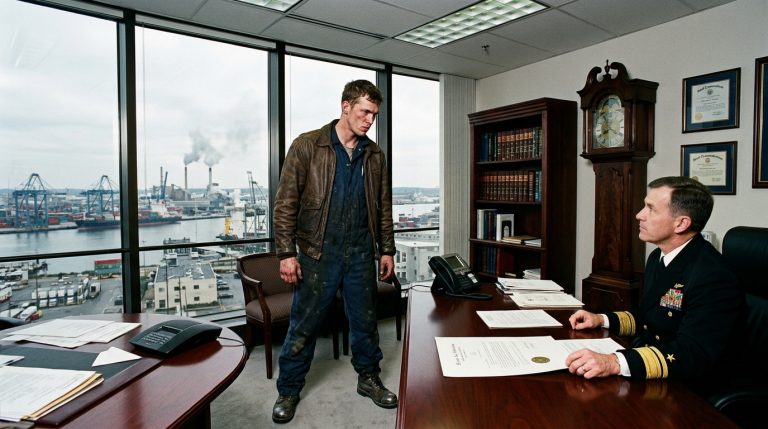
General Delmas sat at his desk, his silhouette a jagged tear in the dimness of the room. He was staring at the window, his hands resting on the armrests of his chair, fingers curled like dead vines. He didn’t look up when she entered, even though he knew who it was. The atmosphere was brittle, humming with the static of unspoken grievances.
“I didn’t give the order to enter,” Delmas said, his voice a gravelly rasp. He didn’t turn.
“The order was given by the storm, General,” Aïcha replied, her voice steady, stripped of the usual military deference that grated on his nerves. “The perimeter is failing. The drainage near the archives is blocked. If the water hits the foundation, the records won’t survive the night.”
Delmas finally turned. His face was a map of old scars and new exhaustion. He studied her, his eyes searching for the flicker of doubt he found in everyone else, but he found only the flat, clean surface of her resolve. He looked at the trail of mud her boots had left on his pristine floor. It was a line—a long, dark streak that seemed to point directly back to the life he had spent fifteen years trying to bury.
“You’re the recruit,” he muttered, his eyes narrowing. “The one from the command.”
“I am the soldier who sees the flood coming,” she corrected.
She didn’t offer a salute. She didn’t need to. She moved to the side of the room, near the shelves, where the air felt coldest. There was a stack of files there, tipped dangerously close to the edge of a water-logged crevice in the wall. As she reached for them, she noticed something that made her heartbeat stutter—a small, silver medal, oxidized and forgotten, tucked beneath a stack of casualty reports from a campaign in the mountains.
It was a crest, identical to the one her father had pinned to his own uniform before he disappeared into the mist of a war that had never been properly accounted for.
She held the medal in her palm, the metal cold and biting. The room suddenly seemed to shrink. The General’s gaze moved from the window to her hand, his eyes widening as he recognized the object. The silence between them shifted; it was no longer the silence of command, but the silence of a secret finally finding its lock.
“Where did you get that?” he whispered, his composure fraying like a worn rope.
Aïcha looked at him, and for the first time, she saw not a General, but a man drowning in his own shadow. “I didn’t find it, General. I was looking for it.”
The wind outside shrieked, slamming a heavy branch against the glass, and the lights in the office flickered, died, and left them in a darkness so absolute it felt like the end of the world.
CHAPTER 2: The Weight of the Static
The silence that followed the death of the power grid was heavy, absolute, and tactile. It pressed against the windows like a living thing, buffered only by the frantic, percussive rhythm of the rain against the roof. Aïcha stood perfectly still, her shadow merged with the deep gloom of the archives. She didn’t move toward the door. She didn’t move toward the General. She simply held the medal, the metal slowly losing its initial biting cold as it absorbed the warmth of her palm.
General Delmas breathed in, a ragged, uneven intake of air that scratched against the stillness. His silhouette, once a rigid projection of authority, now seemed to lean, sagging under the weight of an invisible burden. The medal in Aïcha’s hand wasn’t just a piece of silver; it was a ghost.
“You were looking for it,” he repeated, his voice lower, shorn of its usual defensive edge. “Why would a new recruit from the command center be hunting for the remnants of an infantry unit that hasn’t existed in any official capacity for a decade?”
Aïcha didn’t answer immediately. She allowed the question to hang, a fragile thread in the dark. She could smell the ozone from the storm mixing with the smell of dry rot from the ancient files. It reminded her of the desert—the way the air tasted before the dust storms erased the horizon.
“I wasn’t looking for the unit, General,” she said softly, her voice barely audible over the thrum of the rain. “I was looking for the man who was supposed to be wearing it.”
Delmas shifted. The movement was small, a slight tilt of his shoulders, but it was enough to make the leather of his chair groan—a sound that echoed like a crack in a frozen lake. He wasn’t looking at her, but she felt his focus pinning her to the floorboards. She felt the sudden, irrational urge to explain, to justify her presence, but she throttled it. To speak more was to lose the leverage that this silence provided.
The storm outside intensified. A blinding strobe of lightning tore across the sky, turning the office into a temporary, high-contrast negative. In that micro-second of artificial light, Aïcha saw his face. His eyes were wide, fixed on her, his expression a chaotic swirl of recognition and profound, weary denial. He looked, for an instant, exactly like the man in the photograph she had tucked into her tunic—the same set of the jaw, the same haunted calculation in the brow.
Then, darkness rushed back in, thicker than before.
“You’re a long way from home, soldier,” he muttered, but there was no bite in it now. It was a concession.
“Home is a static concept,” she replied, taking a slow, steady step forward. She could feel the dampness of her boots on the floor, the grit of the mud she had tracked in. “I’ve learned that it’s better to be moving. Moving, you can at least pretend you’re going somewhere.”
She set the medal down on the corner of his desk. The soft clink of metal against wood was loud enough to signal the end of the standoff. She didn’t retreat, but she widened the space between them, giving him the room to exist without feeling cornered.
Delmas reached out. His hand hovered over the medal for a moment, trembling, before he finally closed his fingers around it. She saw the way his knuckles turned white in the flashes of lightning. He didn’t pull it toward himself. He left it on the desk, a silent anchor.
“If you’re here because of them,” he said, his voice tightening, “you’re wasting your time. There’s nothing left to salvage. This base is a cemetery for people who didn’t know how to die when the war ended.”
“Is that why you don’t walk?” Aïcha asked.
The question was blunt, a sharp edge she hadn’t intended to show, but it slipped out, fueled by the frustration of watching a man dismantle his own life.
The reaction was instantaneous. Delmas stiffened, the chair metal screeching as he pushed himself back. “That is a line you do not cross. You are here to follow instructions, not to play psychologist to a superior officer.”
“You aren’t a superior officer right now,” she whispered, her voice firm, unwavering. “Right now, you’re just a man sitting in the dark, clutching a relic of a life you’ve convinced yourself is over. You don’t have to be a General to be a soldier, but you do have to be a person.”
She turned, navigating the room by memory and the periodic flashes of the storm. She didn’t look back to see if he was watching. She walked to the window, watching the rain wash away the world outside. The base felt smaller tonight, more fragile. The facade of the gray, rigid military institution was melting under the relentless pressure of the weather, revealing the soft, tired reality underneath.
She felt a phantom movement behind her—a shift in the air that suggested he was trying to lean forward, perhaps trying to stand, before thinking better of it. The sound of his labored, frustrated breath was the only answer she needed. She didn’t offer a hand. She knew that to help him now would be to confirm his weakness. Instead, she stood at the window, a silhouette against the weeping glass, and waited.
The silence wasn’t empty anymore. It was heavy with the weight of potential. Every drop of rain that hit the pane was a second of his life being reclaimed, if he could only find the courage to hold the medal and remember why he had carried it in the first place. Outside, the storm continued its interrogation of the earth, and inside, the architecture of their lives began, ever so slightly, to crack.
CHAPTER 3: The First Crack in the Armor
The storm had settled into a rhythmic, sullen weeping that drummed against the windowpane, a stark contrast to the sudden, jarring stillness inside the office. Aïcha didn’t move. She allowed the General’s refusal to echo in the room, her gaze fixed on the way his fingers tightened around the edges of the desk. She could see the fraying cuff of his sleeve, the way the fabric was beginning to thin—a small, pathetic detail that spoke volumes about how much of his world he had surrendered to rot.
Delmas didn’t look at her. He kept his head bowed, his eyes focused on the silver medal. The office was dim, lit only by the grey, diffuse light filtering through the rain-streaked windows. It made everything look faded, like an old photograph left too long in the sun.
“You speak as if you’ve lived my mistakes,” he finally said, his voice quiet, stripped of the bravado that usually characterized his interactions with the command staff.
“I’ve lived in the shadow of them,” Aïcha replied. She moved closer, her boots making no sound on the threadbare carpet. She didn’t seek to intimidate; she sought to balance. She reached out and, with a precision that bordered on the clinical, nudged a stack of disheveled reports into a perfect, right-angled alignment with the edge of the desk.
Delmas’s gaze flickered to her hands. He watched them with a strange, predatory intensity. It was the way a man looked at a tool he had lost years ago and suddenly found lying on a workbench, still sharp, still functional.
“Who taught you to do that?” he asked, pointing a trembling finger at the perfectly stacked papers. “That’s not regulation. That’s a habit from the old scouts. The ones who didn’t exist after the reorganization.”
“My father didn’t teach me anything,” Aïcha said, stepping back into the gloom. “I learned it by watching what happens when things aren’t kept in order. When you stop taking care of the small things, the big things don’t just break—they vanish.”
She turned her attention to the rest of the room. It was a workspace that had been slowly consumed by neglect. Coffee rings on the wood, layers of dust on the shelves, the pervasive scent of stale, humid air. She walked toward the bookshelf, running a gloved hand along the spines. She wasn’t just inspecting; she was cataloging his surrender.
“You stopped looking at the maps, General,” she remarked, noting the dusty, rolled-up charts tucked in the corner. “You stopped looking at the logistics. You started looking at the clock.”
“The clock is the only thing that doesn’t lie,” Delmas snapped, though the heat behind the words was gone. “In this place, everything else is a performance. Morel, the inspections, the reports—it’s all theater. Why should I provide a script for a play that closed years ago?”
“Because the actors are still on stage,” Aïcha said. She stopped before a framed photograph on the wall—the one showing a younger Delmas, dust-covered and laughing. The glass was cracked, a jagged line running through his chest. “They’re waiting for a lead. They’re scared, and they’re bored, and they’re turning into things they don’t want to be because they haven’t seen an example of anything else.”
Delmas pushed his chair back, the metal legs scraping harshly against the floor. He tried to stand, his hands gripping the armrests, his body leaning forward with a sudden, desperate surge of will. His legs remained immobile, his feet rooted to the floor as if they were sinking into the earth itself. He groaned—a sound of raw, unvarnished frustration—and sank back into the seat.
Aïcha moved instantly. She was at his side before he could recover his pride, her hand coming to rest lightly on his shoulder. It wasn’t an act of pity; it was an act of tactical stabilization.
“Don’t,” he hissed, batting her hand away. “I don’t need help.”
“I’m not helping you stand,” she said, her voice dropping to a cool, professional register. “I’m helping you stay upright. There’s a difference.”
She didn’t retreat. She stood beside him, a sentry at the edge of his collapse. She noticed the way his pulse throbbed in his temple—a rapid, irregular rhythm. The decoy secret she had unearthed—the medal, the history—was beginning to chafe. She could feel the weight of what she hadn’t said yet. She knew who he was, and she knew why the command had really sent her. They hadn’t sent a soldier; they had sent a mirror. And now, she had to wait for him to look into it without shattering.
“Why are you really here, Aïcha?” he asked, using her name for the first time. The sound of it in the stagnant air felt like a declaration of war.
“I’m here because the storm doesn’t care about your rank,” she said, looking past him to the window where the rain continued to beat against the world. “And because someone has to make sure the records don’t rot before they’re needed. The question is, General, are you going to help me, or are you going to stay in this chair until the building falls down around you?”
She stepped back, leaving him in the silence. She could see his chest heaving, the struggle of a man caught between the safety of his paralysis and the terrifying, demanding pull of the duty he had tried so hard to forget. The atmosphere in the room shifted, the heavy, dead air catching a sudden, sharp draft from the drafty window. It was the first sign of life, a tiny, almost imperceptible intake of breath in a room that had been holding its own for fifteen years.
CHAPTER 4: The Midnight Extraction
The shift in the room was not merely atmospheric. As the heating unit let out a final, metallic wheeze and died, the warmth that had been clinging to the General’s office evaporated, replaced by a damp, biting chill that seeped through the floorboards. It was the smell of the world outside—wet earth, iron, and encroaching winter—invading the sanctuary he had built to keep time at bay.
Delmas didn’t move, but his shoulders hunched, a defensive posture against the cold. Aïcha, meanwhile, remained standing, her breath forming a faint, ghostly mist in the dim light. She didn’t seek the comfort of a coat. She thrived in the cold, it seemed; it was a clarity she understood.
“The infrastructure is failing, General,” she said, her voice devoid of judgment, presenting the fact like a tactical report. “If we don’t move the records from the basement archives to the upper level, the humidity will turn them into pulp by morning. There is an extraction protocol for this. You signed off on it years ago.”
Delmas looked at her, his eyes narrowed. “Extraction? In this weather? The courtyards are flooded. The security lighting is down. It’s a fool’s errand to even consider sending a detail out there.”
“I’m not asking for a detail,” Aïcha said, walking to the heavy, cast-iron coat rack by the door. She retrieved a poncho and a heavy-duty flashlight. “I’m asking for the authorization to move them myself. You can stay here, if you prefer the cold to the movement.”
It was a challenge, sharp and clean. Delmas stared at her, the medal still clutched in his hand. He was grappling with a sensation he hadn’t felt in fifteen years—the prickle of genuine, unmanaged adrenaline. It wasn’t the dull ache of physical pain he was used to; it was the sharp, dangerous edge of a choice.
“You’ll drown out there,” he muttered, though he was already struggling to push his chair back from the desk.
“Then I’ll be the first recruit to drown while trying to save your history,” she countered. She didn’t offer a hand as he maneuvered his chair, watching instead as he used the edge of the desk to pivot, his movements jerky and unpracticed. He was rusty, yes, but the fire was back in his eyes, a stubborn, flickering light of defiance against the very fragility he had been hiding behind.
He made it to the door, his breathing heavy, laboring with the effort. Aïcha opened it for him, the sound of the storm rushing into the hallway like a physical blow. The corridor was a cavern of shadows, stretching toward the back of the building where the stairs led down to the sub-level archives.
The journey was a slow, agonizing process. Delmas didn’t complain, but every time his hands gripped the wheels of his chair, the grit and the cold bit into his skin. Aïcha moved beside him, not helping, just watching. She knew the moment he needed to feel the weight of his own recovery. When they reached the landing, the stairs loomed like a mountain—a vertical challenge to a man who had made the floor his kingdom.
“Wait,” he commanded, halting the chair. He looked at the narrow, slippery concrete steps leading down into the darkness of the basement. The scent of mold was overwhelming here, the smell of neglect and forgotten things. “We go down there, and the air goes out of the room. Do you know what’s in those boxes, Aïcha?”
“I know what’s supposed to be in them,” she said, shining her light into the gloom. The beam cut through the dark, revealing the rows of rusted cabinets that lined the walls. “I know that my father’s name is on one of those manifestos. And I know you were the one who filed it.”
The admission hung in the cold air, heavier than the rain. Delmas turned his head, his gaze piercing. “Is that what this is? A pilgrimage?”
“It’s a rescue mission,” she said.
She turned and began to descend, her boots striking the concrete with a rhythmic, unwavering sound. She wasn’t leading him; she was clearing the path. Delmas watched her, then looked at the dark, yawning maw of the archives. He realized then that he couldn’t stay in the hallway. If he stayed, the memory of what he had allowed to rot would finally consume the last of him.
He pushed his chair to the edge of the first step. He didn’t look at the distance to the bottom; he looked at the silhouette of the young woman in the dark. He gripped the wheels, braced his back, and began the slow, brutal work of descent. The chair bumped, metal scraping against concrete, a harsh, jagged rhythm that mimicked the pulse in his own neck. It was hard, it was dangerous, and for the first time in fifteen years, he was no longer sitting still.
He was moving, and the world—wet, cold, and uncertain—was finally moving with him.
CHAPTER 5: The Burden of the Unspoken
The air in the basement was thick enough to chew—a stale, stagnant cocktail of decomposing paper and the sharp, metallic bite of damp concrete. As the last grating sound of Delmas’s chair settled, the archives groaned in response, a chorus of shifting metal shelves that seemed to warn them of their intrusion.
Aïcha moved ahead, her flashlight beam cutting a jagged, narrow path through the dust-choked air. The light caught the dancing motes of decay, turning the basement into a suspended moment of history that had been buried alive. She didn’t look back at the General. She knew he was there, not by the sound of his movement, but by the subtle shift in the air pressure as he dragged his chair across the uneven floor.
“Watch the lip of the frame,” Aïcha murmured, her voice unnervingly calm given the claustrophobic squeeze of the aisles. “The drainage leak is near the eastern corner. Keep your wheels on the boards.”
Delmas didn’t answer. He was gripping his chair so tightly his knuckles were bloodless. The darkness here wasn’t just a lack of light; it felt heavy, a physical weight that pressed against his chest. It brought back the sensation of the collapsed trench in Afghanistan, the smell of cordite masked by the smell of wet earth. He felt the phantom pressure of rock on his spine, the terrifying, absolute stillness of being pinned.
He shook his head, trying to dislodge the memory, but the archives were a mirror of his own internal landscape.
“Stop,” he wheezed, his voice cracking. He halted his chair, the metal wheels jarring against a slight elevation in the concrete.
Aïcha stopped. She turned, her flashlight casting a harsh, unforgiving light on his face. She saw the sheen of cold sweat on his forehead and the way his eyes were darting, searching for an exit that was ten flights of stairs and a lifetime away.
“You’re seeing it, aren’t you?” she asked. There was no mockery in her voice, only a detached, clinical observation.
“I’m seeing what I buried,” he rasped. He looked around at the towering shelves, the thousands of files—every mission report, every commendation, every casualty list from the last fifteen years of his stagnation. “All of this… it’s not an archive. It’s an epitaph.”
“Then let’s start reading,” Aïcha said, stepping closer. She placed her hand on the back of his chair, her grip firm and steadying. “We have to find the specific files from the ’09 rotation. If we don’t, the damp will destroy the evidence of why the unit was truly dissolved.”
“You shouldn’t be looking for that,” Delmas said, his voice rising in sudden, panicked anger. “That file was sealed by the command. To open it is to invite a court-martial, not just for me, but for the legacy of every man who was left behind.”
“The legacy is already dying,” Aïcha replied, pushing his chair forward. She guided him down the narrow row, the shelves towering above them like canyon walls. “The truth isn’t the court-martial, General. The truth is the rot that’s been eating this base from the inside out because no one had the courage to admit that the mission failed.”
As they reached the eastern corner, the sound of dripping water became rhythmic—a slow, mocking plink… plink… plink—as if the building itself were leaking time. The flashlight beam landed on a rusted filing cabinet that was already beginning to buckle under the moisture.
Aïcha stepped in, her movements fluid and purposeful. She reached for the top drawer, the metal screaming in protest as she yanked it open. The smell of mildew intensified, sharp and acrid. She began to sort through the folders, her hands moving with the grace of a surgeon. She wasn’t just looking for paper; she was looking for a narrative.
Delmas watched, his heart hammering against his ribs. He felt a sudden, sharp, and entirely unbidden flash of fear. He realized that Aïcha wasn’t just here to organize the files. She was looking for a name. She was looking for her father. And he knew, with a sinking, hollow dread, that the file she would eventually pull from that drawer would contain his own signature on the final order.
The temperature in the basement seemed to drop another ten degrees. The archives felt as if they were closing in, the narrow aisles becoming a throat he had to navigate. He watched as Aïcha paused, her fingers hovering over a tab marked in faded, handwritten ink. She went still, her breathing slowing into the controlled rhythm of a soldier readying for impact.
“General,” she said, and her voice had lost its earlier calm. It was now infused with a dangerous, crystalline clarity. “Do you remember the night the extraction order was denied? Do you remember who authorized the retreat?”
The file in her hand was no longer just paper. It was the physical weight of everything he had spent fifteen years pretending didn’t exist. He looked at her, his vision blurring as the shadows of the past threatened to overwhelm the present, and for the first time in his life, he realized he had nowhere left to run—neither in his chair, nor in his mind.
CHAPTER 6: The Breaking of the Chair
The silence in the basement was no longer a void; it was an active participant. Aïcha stood over the General, the beam of her flashlight fixed on the document he held. The paper was yellowed, brittle as a dead leaf, and the ink seemed to bleed under his gaze. It was a casualty report from the ’09 rotation—a document Delmas had signed with a steady hand, a signature that now looked like a jagged, alien mark against the official seal of the command.
“The retreat wasn’t denied because of the weather,” Aïcha said, her voice a low, steady hum that seemed to vibrate against the metal shelves. “It was denied because the extraction zone was never cleared. You ordered them to hold a position that didn’t exist.”
Delmas’s eyes raced over the lines of text. His hands were shaking so violently that the paper rattled, a thin, dry sound that grated against the damp basement air. He could feel the weight of the years pressing down on him—the physical atrophy of his legs suddenly mirrored by the crumbling of his internal defenses.
“I was told…” he began, his voice failing him. He cleared his throat, but the sound was strangled. “I was told the zone was viable. The command logs… the satellite telemetry…”
“The command logs were scrubbed,” Aïcha interrupted. She reached into her pocket and pulled out a small, portable data drive—a clean, modern piece of technology that looked jarring against the decay of the room. “I’ve been tracking the inconsistencies in the supply chain records for three years. The telemetry wasn’t sent to you, General. It was rerouted. Someone at the top wanted that unit to stay in the sector.”
Delmas looked up at her, and for the first time, the man she saw wasn’t just a broken relic. He was a man waking up from a long, drugged sleep, the confusion in his eyes slowly hardening into a cold, sharp-edged realization. He hadn’t just been a victim of his own paralysis; he had been a pawn in a game he didn’t even know he was playing.
“You knew,” he whispered, his eyes narrowing as he studied her face in the pale, blue-white light of the flashlight. “You didn’t come here to save the archives. You came to see if I was still capable of understanding the truth.”
“I came here to see if the man I heard about in the stories still existed,” Aïcha replied. She shifted the light, illuminating the rows of other cabinets. “The decoy secret—the idea that you were just a tragic case of war-time injury—was the perfect cover. It kept you hidden, it kept you quiet, and it kept the people who orchestrated the 2009 failure safe. They didn’t need to kill you, General. They just needed you to stop looking.”
Suddenly, a loud, metallic thud echoed from the stairwell above—the sound of someone, or something, colliding with the reinforced door at the top of the landing.
Delmas started, his grip on the file tightening, tearing the corner of the brittle paper. The echo was followed by the heavy, rhythmic clatter of boots on concrete. Someone was coming down, and they weren’t trying to be quiet.
“Morel,” Delmas muttered, his jaw setting. “He must have been monitoring the power grid logs. He knew we were down here.”
Aïcha didn’t panic. She stepped to the edge of the aisle, her posture shifting from that of a researcher to that of a soldier in the field. She signaled for the light to go out. As the basement plunged into near-total darkness, the sound of the approaching footsteps became the only reality. It was a slow, measured tread—the sound of someone who knew exactly what they were going to find.
“If he finds us with these files,” Delmas said, his voice a low, desperate hiss, “the truth won’t leave this room.”
“Then we make sure it moves faster than he does,” Aïcha replied.
She moved to the back of the General’s chair. She didn’t offer a lift this time; she grabbed the handles and pushed, the chair rolling silently over the debris-strewn floor toward the emergency ventilation shaft that led out into the mud-slicked courtyard. She was no longer just the recruit; she was the architect of his escape.
Delmas felt the chair lurch forward, the sudden momentum catching him off guard. He grabbed the armrests, his heart hammering against his ribs, but he didn’t pull back. As they moved into the dark, leaving the file scattered on the floor, he realized that he had spent fifteen years fearing the truth, but it was the pursuit of it that felt like the first real breath of air he’d taken since the war. The chair bumped over a discarded crate, and in the dark, he reached down, his hands finding his own legs—not with the expectation of movement, but with a new, fierce determination to make them obey, no matter the cost.
The basement door at the top of the stairs burst open, a sliver of light cutting through the gloom, and the game they had been playing in the shadows was over.
CHAPTER 7: The Recognition of Equals
The beam of light from the doorway was a surgical strike against the gloom, illuminating the dust motes as they swirled in the sudden draft. Morel stood at the top of the stairs, his silhouette framed by the harsh, artificial glow of the corridor beyond. He didn’t rush. He moved with the predatory patience of a man who held all the cards, his boots ringing out with rhythmic, metallic finality on the concrete steps.
“General,” Morel said, his voice flat, devoid of the deference he had maintained for years. “I thought you were in your office. It seems you’ve taken a detour into the history you were supposed to forget.”
Aïcha stayed low, tucked into the shadow of a high, iron-bound shelf. She didn’t draw a weapon; she didn’t need to. Her hand was steady, hovering over the emergency release lever for the ventilation shaft, but she was watching Delmas. The General was seated in his chair, his hands gripping the rims of his wheels, his back straight, his eyes locked onto Morel. The transformation in his posture was absolute; the fragility that had marked him for years was gone, replaced by the calcified tension of a command officer facing an insurgency.
“You knew the logs were flawed, Morel,” Delmas said. His voice wasn’t the gravelly rasp of a broken man; it was the sharp, resonant tone of a commander who had finally returned to the front lines. “You were the one who handled the telemetry rerouting in ’09. You didn’t just follow orders. You curated the collapse.”
Morel stepped down, his gaze shifting to Aïcha, who remained a dark smudge in the corner. He smiled, a thin, humorless expression. “Curated? That’s an interesting word, General. I’d call it maintenance. The infrastructure of this base required a certain… consistency. And you, in your chair, were the most consistent asset we had.”
“An asset,” Delmas echoed, the word dripping with venom. “I was a human shield for your cowardice.”
Morel was three steps from the bottom now. Aïcha watched the way he shifted his weight—a tell-tale sign of an aggressive stance, his hand moving toward his hip where a radio, not a firearm, was holstered. He wasn’t planning on a firefight; he was planning to signal the guard.
“General, if you come up those stairs now, I can ensure that the transition remains… quiet,” Morel offered. “Aïcha can be processed as an unauthorized entrant. You can return to your office, and we can pretend that this night was just a symptom of the weather. But if you try to take those files into the light, you won’t just be ending your career. You’ll be ending this unit entirely.”
Aïcha looked at Delmas. She saw the sweat on his brow, the trembling in his hands, but she also saw the way he was positioning his feet—not for support, but for the strike. He was no longer waiting for permission.
“Aïcha,” Delmas said, not looking at her. “The shaft.”
“Now?” she asked.
“Now.”
She yanked the release lever. The ventilation shaft, a heavy metal grate that had been jammed shut for a decade, groaned and swung inward. A torrent of wind and rain rushed in, the sound of the storm deafening.
Morel lunged, his hand reaching for his radio, but Delmas did the impossible. He didn’t just reach for his wheels; he threw his entire weight forward, launching his chair with a force that sent it sliding across the concrete like a battering ram. He slammed into Morel’s legs, the impact sharp and sickening. Morel stumbled, his arms windmilling as he crashed into the shelves, sending a cascade of rusted metal and forgotten paper raining down on him.
It wasn’t a tactical maneuver; it was a desperate, primal reclamation of power.
Aïcha didn’t hesitate. She grabbed the back of the General’s chair and hauled him toward the opening. Outside, the world was a churning sea of mud and chaos, but it was air, it was space, and for the first time in fifteen years, it was theirs.
“Go!” she shouted over the wind.
They tumbled out of the shaft into the mud-slicked courtyard. The cold hit them like a physical blow, a harsh, stinging reality. Delmas scrambled from his chair, his legs buckling, but he didn’t collapse. He clawed at the mud, using his hands and his knees, pulling himself through the filth toward the central courtyard, where the high-beam security lights were finally beginning to flicker back to life. He was moving, he was exposed, and he was finally, terrifyingly, free. Morel was shouting behind them, his voice muffled by the storm, but it didn’t matter. They were no longer in the dark.
CHAPTER 8: The Final Salute: A Legacy Restored
The courtyard was a landscape of churned earth and slick, gray sludge. General Delmas lay on his side for a heartbeat, the wet grit pressing against his cheek. He forced his hands into the mud, his muscles screaming in a symphony of long-dormant pain. He didn’t look back for the chair. He didn’t look back for Morel. He pushed, the strength returning to his limbs not as a miracle, but as a hard-won, grueling assertion of will. He rose to his knees, then, with a heavy, rhythmic groan, to his feet.
Aïcha stood a few paces away, her own uniform torn and stained, her chest heaving. She didn’t move to help him. She understood now: he didn’t need a crutch; he needed the witness of his own survival.
Morel emerged from the mouth of the ventilation shaft, his uniform ruined, his face a mask of rage and defeat. He stopped when he saw them. The courtyard was bathed in the harsh, flickering glare of the security lights that had finally stabilized. There were no guards, no hidden allies, no grand conspiracy left to shield him. The data drive in Aïcha’s hand caught the light, a small, silver promise of accountability.
Morel looked at Delmas—at the man who had been a ghost in a chair, now standing tall, his eyes clear and burning with a cold, unforgiving light. Morel’s hand dropped from his radio. The game, he realized, had been played on a board he had fundamentally misunderstood. He had underestimated the power of a legacy that refused to be forgotten.
“It’s over, Morel,” Delmas said, his voice carrying clearly over the dripping rain. “The command logs will be decrypted by dawn. You spent fifteen years building a cage, and you forgot that you’d eventually have to live inside it.”
Morel stared at them for a long moment, his chest sinking. He understood the finality of the moment. He turned, his shoulders slumping, and began the long, silent walk toward the guard house where the military police would be waiting. He was defeated not by violence, but by the sheer, relentless weight of the truth he had tried to bury.
The cool-down of the night arrived in waves. The tension that had held the base in a rigid, icy grip for years began to dissipate. Delmas walked to the center of the courtyard, his gait stiff, his movements imprecise, but undeniably his own. He stopped near the flagpole, the fabric of the flag heavy and damp, clinging to the pole.
He looked at his hands—the hands that had signed the orders for the retreat, the hands that had spent years clutching the armrests of a cage. He reached out and touched the pole, his fingers finding the rough, weathered texture of the metal. He felt the cold iron against his skin, a grounding, solid sensation that connected him to the earth.
“My father,” Aïcha said softly, breaking the silence. She stood beside him, her gaze fixed on the horizon where the first hint of gray dawn was beginning to bleed into the sky. “He didn’t die because of the retreat. He died because he stayed behind to hold the line so others could reach the extraction zone. He didn’t want the medal, General. He wanted the truth to be kept.”
Delmas looked at her. He saw the pride in her eyes, a reflection of the man he had once been—before the lies, before the paralysis, before he had let his own spirit wither in the name of a false order. He reached into his pocket and pulled out the old, tarnished medal—the one she had found in the archives. He looked at it, then pressed it firmly into her hand.
“The truth is yours, Aïcha,” he said, his voice thick with a sudden, overwhelming peace. “I’ve spent fifteen years waiting for a miracle. I thought it would be a cure. I never realized it would be a reckoning.”
He stood in the center of the courtyard, the rain having stopped entirely. The world felt scrubbed clean. He reached down and picked up a piece of jagged metal, a fragment of the equipment shed that had been torn apart by the storm. He held it for a moment, then set it aside—a small, symbolic act of clearing the debris of his own past.
They stood there for a long time, the old soldier and the young, beneath the quiet, unfolding sky. The base was waking up, lights flicking on in the barracks, the sound of movement returning to the halls, but it was a different world than the one that had existed yesterday. The rot had been exposed, the foundation was being rebuilt, and for the first time in fifteen years, the General stood not because he was told to, but because he finally had something worth standing for.
He turned to Aïcha, the light of the morning softening the harsh lines of his face. He brought his hand to his forehead, his fingers straight, his elbow sharp. It wasn’t the rigid, transactional salute of a subordinate to a superior; it was the acknowledgment of one soldier to another—a recognition of the weight they had carried, and the peace they had earned.
Aïcha returned the salute, her expression serene, the medal tight in her palm. The path forward was long, and the paperwork of justice would be heavy, but the walk ahead was theirs to take.