The Gray House Line: How One Ordinary Family Shattered a Gated Tyranny and Broke the HOA’s Stranglehold
CHAPTER 1: The Midnight Delivery
The coffee was stale, but it burned hot enough to clear the taste of a long shift. I stood at the kitchen counter, rubbing the grit from my eyes while Sarah locked the back slider.
Outside, the streetlights of Crescent Pines buzzed with a low, synthetic hum that belonged to a world we never signed up to join.
On the speckled laminate table sat the plain white envelope. No stamp. No return address. Just our address written in crisp, sharp lettering that looked like it had been run through an office printer three times to get the black just right.
Mia, our oldest, padded into the kitchen in her socks, holding Lucky’s leash. The golden retriever’s claws clicked softly against the linoleum, his tail giving a lazy thump.
“Dad, can I take him out real quick?” she asked, her voice half-wrapped in sleep.
I reached out and flipped the envelope over, my thumb catching the raised edge of the maroon wax seal. The weight of it felt wrong. Too heavy for junk mail, too deliberate for a stray flier.
“Not tonight, kiddo,” I said, keeping my voice flat to mask the sudden tightness in my chest. “Let’s keep it inside.”
“Why?” Mia frowned, her fingers knotting into Lucky’s red nylon leash. “The sign down the road says—”
“The sign doesn’t apply to us, Mia,” I interrupted, sliding a fingernail under the flap. “We’re outside the boundary. You know that.”
I pulled the single sheet of heavy cardstock free. The text was formatted with cold, administrative precision.
Effective immediately and in accordance with section 14B of the Crescent Pines Community Safety Guidelines, all non-certified residents are required to remain indoors after 1900 hours.
My jaw tightened. Down the hall, the baby let out a soft sigh in his crib.
Sarah walked up behind me, resting a hand on my shoulder. Her fingers were cold. She read the lines over my shoulder, her breathing shallow.
“Nineteen hundred hours,” she whispered, her voice dangerously quiet. “They’re military-lacing a subdivision now?”
“They’re playing dress-up,” I muttered, setting the paper down next to the sugar bowl.
I walked to the front window and pulled the vertical blind back an inch. Across the asphalt, the houses of Crescent Pines sat in identical, manicured rows, their porches bathed in the sterile white glare of motion-sensor floods.
Beyond our patch of un-annexed grass, the darkness felt thick, watched, and heavy.
A white SUV rolled past our property line, moving at a deliberate crawl. The light bar on its roof stayed dark, but the silhouette of the driver turned toward our porch, lingering for three agonizing seconds before accelerating into the sterile night.
Lucky let out a low, rumbling huff from the back of his throat, his ears flattening against his skull.
“They’re getting bolder,” Sarah said, her hand tightening on my shoulder until the fabric of my shirt bunched up.
“Let them look,” I said, letting the blind snap back against the glass. “Looking doesn’t change property lines.”
But as I looked down at the heavy brass garage-door crank resting on the mudroom shelf, I knew the paper on the kitchen table wasn’t just a notice. It was an invitation to a fight we didn’t ask for.
CHAPTER 2: The Driveway Confrontation
I didn’t wait for them to knock. I killed the truck engine, shoved the door open, and stepped straight into the glare of their high beams.
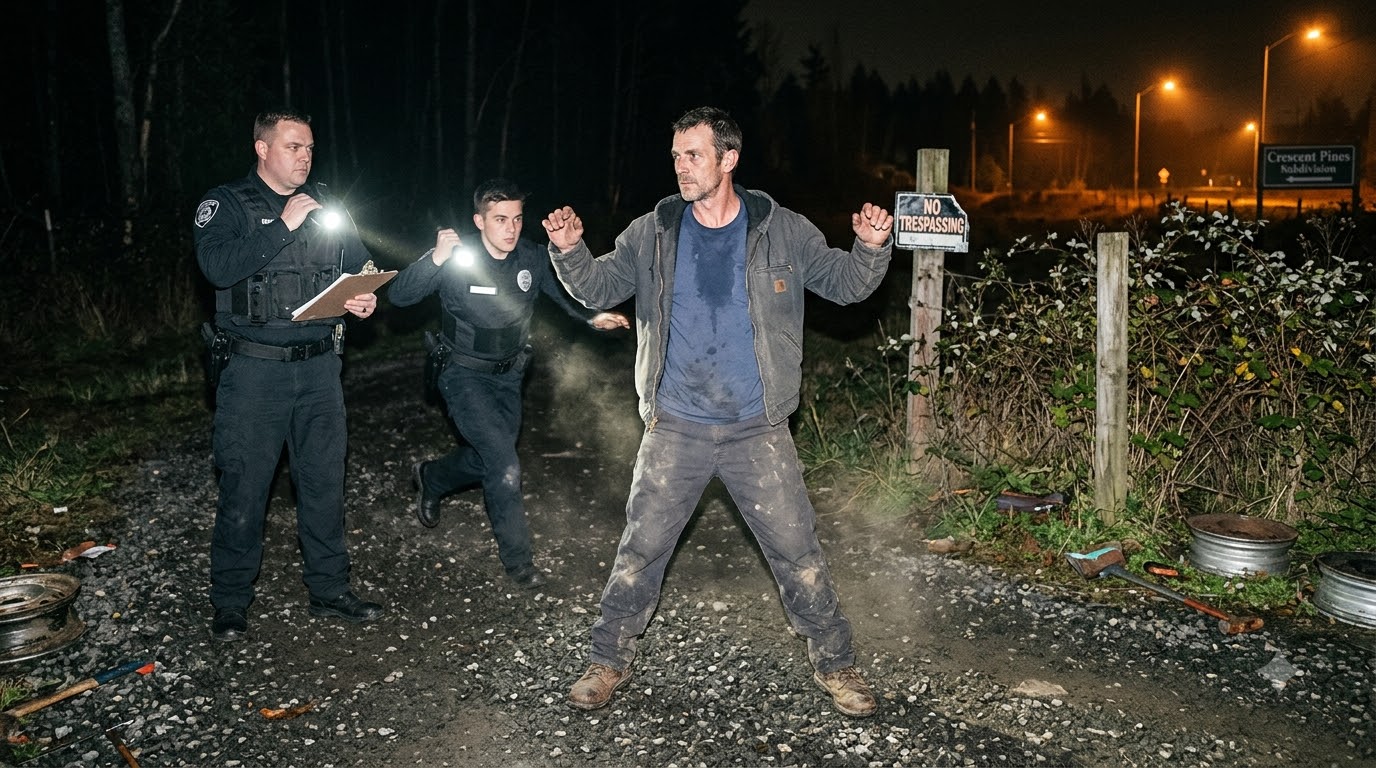
The two men in tactical vests climbed out of the white patrol vehicle with calculated slowness. Clipboard tucked under one arm, flashlight beam locked blindingly at my chest.
“Evening, sir,” the lead guard said, his voice flat and rehearsed. “We’re going to need you to return to your residence.”
“This is private land,” I said, my boots crunching hard against the gravel of our un-annexed driveway. “I don’t live in your subdivision, and I certainly don’t answer to your rent-a-cops.”
The man with the clipboard—name tag blank, face entirely devoid of expression—stepped forward, leaning into a bureaucratic script about preliminary jurisdiction and influence ranges like it gave him the right to police a family’s front yard.
“Section 14B covers all contiguous parcels during restricted hours,” he said, lifting his hand toward my shoulder. “Step back inside, or we escalate.”
When his fingers closed around the fabric of my jacket, every ounce of exhaustion from the double shifts and the constant neighborhood harassment snapped into a cold, hard wire.
I didn’t yell. I didn’t waste breath arguing.
I twisted sharply, caught his wrist, and used his own momentum to spin him hard against the side of the white SUV. The metal thudded loudly under the impact.
The second guard lunged instantly, flashlight swinging like a baton.
I shoved him back into the overgrown grass, sending him tumbling onto his back in the mud.
Before I could square my stance, the sharp wail of a siren cut through the night air. A local patrol cruiser swung around the corner with lights flashing red and blue.
“Hands on your head!” a voice bellowed over a loudspeaker.
I raised my hands just as the heavy click of handcuffs locked around my wrists, cold steel biting into skin.
Across the lawn, Sarah stood on the front porch under the amber porch light, holding the baby against her shoulder. Mia stood beside her, clutching Lucky’s red nylon leash so tight her knuckles were stark white.
They booked me in under thirty minutes for assault on security personnel, throwing me into a holding cell that smelled of cheap disinfectant and old rust.
CHAPTER 3: The Cold Bench and the Retainer
The processing officer slid a yellowed copy of my belongings receipt across the dented metal desk without looking up.
“Sign here, pick up your citation at window three, and keep off the association’s asphalt on your way out,” he muttered, his thumb smudging the ink.
I didn’t answer. I took the receipt, grabbed my keys from the plastic bin, and walked out into the pre-dawn chill where Sarah was waiting in the idling sedan.
The drive home was wrapped in a suffocating silence that didn’t need words. Sarah reheated a pot of coffee we didn’t touch, her hands wrapped around the ceramic mug just to feel the heat.
“They’re going to use the arrest report to claim we’re unstable,” she said, breaking the quiet as the sun began to edge the horizon with gray light.
“Let them try,” I said, pulling my phone from my pocket. “Paper cuts work both ways.”
I dialed Joanna’s number before the clock hit six. She picked up on the second ring, her voice sharp and wide awake as if she had been waiting for the fallout.
By nine o’clock, she had parked her sleek black sedan in our driveway, her heels clicking sharply against the gravel as she marched toward the front door.
She took one look at the HOA curfew letter and the sheriff’s booking citation, her eyes narrowing behind designer frames.
“Do these people even know what the Fourth Amendment is?” she asked, dropping the papers onto the kitchen table with a crisp snap.
She laid out the framework with the cold precision of a veteran litigator who had spent a career tearing down corrupt municipal boards.
“They have zero jurisdiction here,” Joanna said, tapping a manicured finger against the edge of our un-annexed parcel map. “Your land deed predates their entire corporate structure. They cannot detain you, they cannot fine you, and they certainly cannot enforce a curfew.”
Hearing her say it out loud cleared the fog of the jail cell completely.
I wasn’t losing my mind, and I wasn’t helpless.
We filed an immediate formal complaint with the county sheriff’s department, demanding the emergency dispatch logs from the exact minute the private patrol officers had grabbed me.
At the same time, I took a clean, high-resolution scan of the HOA’s curfew notice, cropped out all personal identifiers, and posted it directly to the local community board online.
I added a single sentence: Non-certified residents must remain indoors after 1900 hours.
No rants, no emotional appeals—just the raw, printed proof of what was happening twenty feet outside our front door.
Within two hours, the post ignited across the county feeds, drawing hundreds of shares and a rising wave of public outrage.
The HOA’s official online profile scrambled to post a damage-control response, hiding behind sugary corporate language about maintaining community harmony and avoiding misunderstandings.
Beneath their sanitized PR statement, a local resident replied with a blunt observation that summed it up perfectly: So it’s martial law for anyone who didn’t buy into their country club.
Joanna didn’t stop at the online fallout. She pulled the official municipal boundary maps and spread them across our kitchen table, tracing the green development zone overlay with a red highlighter.
Her finger stopped dead on a thin, pin-raced line that cut thirty feet deep into our front yard.
CHAPTER 4: The Forged Boundary
Joanna tapped the nib of her pen against the margin where the municipal lines had been artificially shifted.
“Look at the registry number,” she said, her voice dropping into a colder register. “This isn’t a clerical error. It’s a deliberate carve-out.”
I leaned over the laminate surface, squinting at the fine print stamped into the bottom corner of the public document.
The name affixed to the authorization stamp belonged to a senior county planner who had passed away six months prior.
“A ghost signature,” I muttered, the metallic taste of anger returning to the back of my throat. “They’re forging municipal records to swallow our land before anyone looks at the tax rolls.”
“Exactly,” Joanna said, sliding her briefcase shut with a sharp thud. “They thought they could rush the annexation through while the county boards were bogged down with seasonal zoning updates.”
I didn’t wait for her to finish packing her files. I grabbed my car keys off the hook and drove straight down to the county assessor’s office downtown.
The clerk behind the high counter squinted at the plat document I slid across the laminate, his glasses slipping halfway down his nose.
“That’s odd,” the clerk murmured, tracing the pin-raced boundary line with a grease-stained thumbnail. “This extension shouldn’t be here. This parcel was exempted back when Crescent Pines was first platted in the nineties.”
“Can you pull the original physical ledger from that filing date?” I asked, keeping my voice level despite the adrenaline humming in my ears.
The clerk hesitated, his fingers hovering over the keyboard before he nodded and shuffled into the back archive room.
When he returned, he laid an old, heavy binder on the counter, opened to a yellowed page bearing a completely different set of coordinates.
The modern digital plat on file had been digitally altered, overridden with a counterfeit annex code linked directly to the HOA’s administrative server.
As I stared at the mismatched numbers, my phone buzzed in my pocket with an anonymous text message containing a single digital link and a brief instruction: Check the HOA member minutes from July. Page five.
I pulled the file up on my phone screen in the parking lot, scrolling past the standard financial padding until I hit the hidden annex notes.
The text spelled it out in plain, unvarnished corporate shorthand: a preliminary commitment from an adjacent parcel owner to clear our land for Clearwater Builders, designated for a new commercial park extension.
They weren’t just trying to control our evening routine or enforce an absurd neighborhood curfew.
They had already sold our backyard to a corporate developer.
CHAPTER 5: The Recovered Frame
I didn’t head straight home after reading the text; instead, I drove two towns over to meet Leon in an old commercial strip basement lit by flickering fluorescent tubes.
Leon sat in front of three glowing monitors, his fingers tapping a rhythmic, uneven beat against the edge of a scarred wooden workbench.
“They tried scrubbing the local hard drives twice,” he said, not looking up as I pulled a chair close to his elbow. “Amateur hour. They overwrote the primary cluster, but they forgot about the cloud cache mirror attached to the security gateway.”
He hit a keystroke, and a grainy video file snapped onto the center screen.
It was the footage from our driveway on the night of my arrest, captured from an alternate angle near the utility pole.
The white patrol SUV rolled into frame, the two guards stepping out with their clipboards and flashlights.
Then the camera panned slightly to the left, tracking a figure crouching behind our overgrown boxwood hedge.
A woman with blonde hair gripped a walkie-talkie close to her mouth, her lips moving sharply in the dim light.
Leon amplified the audio track, stripping away the wind static until her voice cut through the speakers with harsh clarity.
“He’s resisting,” she spoke into the radio, a cold satisfaction edging her tone. “Good. Get ready.”
I stared at the screen, watching myself get shoved against the car while the HOA president orchestrated the entire ambush from the safety of our landscaping.
“It was completely staged from the start,” I said, the weight of the frame settling over my chest like lead.
“Standard entrapment playbook,” Leon muttered, exporting the file to an encrypted flash drive and slipping it across the laminate. “Take this straight to Joanna. Pair it with those forged plat files, and their entire corporate structure is going up in smoke.”
I pocketed the drive, my fingers curling around the cold metal casing.
When I reached home, a black luxury sedan was parked right across the apron of our driveway.
A man in a tailored suit stepped out from the driver’s side as my truck’s headlights washed over him, smoothing his lapels with slow, deliberate arrogance.
“Mr. Miller, I presume,” he said, flashing a tight, corporate smile that didn’t reach his eyes. “I’m with Clearwater Holdings Regional Acquisition. We’d like to make you a very generous offer on this property before things get complicated.”
CHAPTER 6: The Lawn Reckoning
I pulled a dozen folding chairs out from the garage and set them up in a ragged circle right across our front lawn, right where the white SUV’s high beams had blinded me a week ago.
By seven o’clock, half the neighborhood had drifted across the asphalt, carrying paper plates, folding lawn chairs, and an anxious, heavy silence.
Debbie from three houses over sat near the edge, her arms crossed tightly over a plate of homemade banana bread.
“Is this about the curfew notices, Tom?” she asked, her voice dropping into a cautious whisper. “We heard the association is threatening lawsuits against anyone who shows up here tonight.”
“Let them sue,” I said, plugging a portable projector into the extension cord running out the living room window. “Tonight, we’re looking at what’s actually behind their gate.”
Before I could cue the projector, a sharp voice cut across the grass.
Karen, the HOA president, marched up the driveway flanked by two private security guards, her tailored blazer pulled tight against the evening chill.
“Shut this down immediately,” Karen snapped, her finger jabbing toward the screen. “This is an illegal assembly on private association property, and you are all in violation of community safety ordinances.”
A low murmur rippled through the folding chairs.
I didn’t yell, and I didn’t back down; I simply tapped the spacebar on my laptop, casting the recovered security footage against the white sheet pinned to the side of my porch.
The grainy video illuminated the dark yard instantly, playing back the audio of Karen crouching behind our boxwood hedge, giving the order to stage the arrest.
He’s resisting. Good. Get ready.
The speaker echoed clearly across the quiet cul-de-sac.
Karen’s face drained of color, her jaw slackening as she stared up at her own voice projecting off our house.
“That’s a manipulated file—it’s industrial defamation!” Karen shrieked, her composure shattering completely as she lunged forward to swat at the projector stand.
Philip, a retired dentist who sat on the association board, stood up slowly from his folding chair, his face hardening into a bitter scowl.
“I voted yes on the expansion because you told me it was for community green space,” Philip said, his voice carrying over the murmurs of the crowd. “You didn’t just lie to us. You sold our property lines to a developer.”
“You don’t know what you’re talking about—shut up!” Karen screamed, her voice cracking into a desperate, frantic pitch as she pointed a shaking finger at the assembled neighbors. “You’ll all pay fines for this! Every single one of you will lose your homes!”
She turned and tried to march back toward her SUV, but county deputies materialized from the shadows of the street corner, their uniform badges catching the amber glow of the porch light.
“Karen Vance?” the lead deputy asked, holding out a folded paper. “You’re under arrest for fraudulent misrepresentation of zoning authority, conspiracy forgery, and embezzlement of association funds.”
She didn’t get a dramatic speech, and she didn’t get to issue another warning.
The deputies guided her gently toward the back of the cruiser, the metallic click of handcuffs echoing across the lawn where she had tried to build an empire of paper and fear.
Within forty-eight hours, the association accounts were frozen, the board dissolved under a mountain of class-action audits, and Clearwater Holdings folded their local division like a cheap tent.
The county officially reszoned our parcel as permanently outside municipal association reach, stripping away every shred of their fake authority.
By winter, the front yard was quiet again.
I walked out with a fresh cup of coffee, listening to Lucky bark happily at the mail truck while Mia chased the dog across the grass.
Debbie walked up to the fence, setting a warm loaf of banana bread on the wooden post with a soft smile.
“I thought you were the problem,” she said, her eyes crinkling at the corners. “Turns out you were the only sane one left.”
I picked up the bread, walked inside, and hung my keys by the door.
The house was quiet, the air was free, and nobody was ever going to tell us when we had to go inside again.