The Weight of Clear Roads and Crooked Snow Banks Across the Vermont Hills
CHAPTER 1: The Kitchen Notice
The coffee was half-cold in the mug when the rapping started on the screen door. I didn’t rush. Out here in Stowe, winter morning knocks usually meant a neighbor needing a pull out of a ditch or a farmer asking to borrow a chain.
I set the heavy ceramic mug down on the laminate counter and pulled the door open. Brenda Morrison stood on the top step, wrapped in a white puffy jacket that looked like it cost more than my pickup’s transmission. Her hair was sprayed into a rigid, weatherproof halo that didn’t move an inch in the biting wind.
“Mr. Patterson,” she said, her voice dripping with artificial sweetness. “I’m here to deliver this notice personally. We believe in open communication with our service providers.”
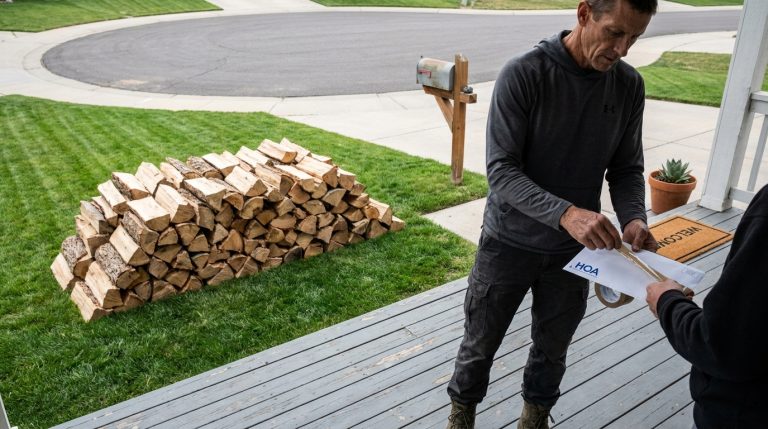
She handed over an embossed envelope. I slid my thumb under the flap and pulled out the crisp paper. Fifteen hundred dollars. A municipal-style penalty levied by the Pine Ridge Estates Homeowners Association. The reason listed in tight legalistic paragraphs was aesthetic non-compliance regarding uneven snow distribution along the north and south verges of the private access road.
I looked at the paper, then up at Brenda’s expectant face, and let out a short, dry laugh. “You’re serious?”
“The fine stands,” she said, her smile vanishing into a thin, unyielding line. “Thirty days to pay or we pursue legal action.”
She turned on her heel, her designer boots crunching sharply against the frozen gravel as she headed back toward her idling Mercedes. I stood on the porch with the paper in my hand, the cold wind biting straight through my flannel shirt, watching her tail lights disappear down the winding tree line.
CHAPTER 2: The Contract Cut
Three days after Brenda’s visit, the response letter left my hands and headed toward the Pine Ridge management office. It was drafted in plain, unyielding prose, citing the exact terms of the original agreement. The contract stated clearly that the private road required clearing, sanding, and basic maintenance, but it said nothing about symmetry, aesthetics, or the specific height of snow banks.
I didn’t need a lawyer to tell me the ink was straightforward.
The reply didn’t come by mail. It arrived as a formal email blast forwarded through the community server, stamped with the digital signature of the HOA board. The language was cold, curt, and immediately effective. They claimed an unwillingness to meet community standards and terminated my snow removal contract on the spot.
I stared at the screen while the kitchen refrigerator hummed a low, steady baseline against the quiet afternoon.
Outside the window, a lone crow picked at the crust of white frost coating the frozen pasture. Without that contract, my winter revenue took a sharp hit, but something else shifted in the quiet air of the room. I reached out and turned the heavy ceramic mug half an inch to the left, my thumb brushing the rough glaze.
They thought firing me was a punishment, a way to strip away my livelihood until I came back asking for forgiveness.
They didn’t look at the property deeds. They forgot who owned the dirt beneath their luxury tires. The private access road to Pine Ridge didn’t belong to the association, and it didn’t belong to Brenda Morrison; it crossed straight across the northern boundary of my personal land under a limited access easement.
An easement grants a right of way, not a guarantee of free labor.
I picked up the land deed and ran a calloused finger down the parcel descriptions, feeling the familiar weight of ownership settle over my shoulders. If they wanted the road plowed now, they had to hire someone else, and nobody else within thirty miles had the heavy equipment or the stomach for that steep, winding incline.
The phone on the counter buzzed once, lighting up with an unknown caller ID from the subdivision.
I let it ring out, watching the screen go dark against the wood grain. The contract was gone, but the road was still mine.
CHAPTER 3: The Frozen Gate
The nor’easter hit the ridge three days later, howling down through the hemlocks and dumping eighteen inches of heavy, wet powder before dawn. Out on the main county highway, the state plows moved steadily, but the private artery leading up into Pine Ridge Estates remained untouched.
My phone started flashing before the sun even cleared the tree line.
Unknown numbers blinked on the screen one after another, buzzing against the kitchen counter with rhythmic persistence. I left them silent, watching the snow drift against the bottom pane of the double-hung window while the old oil heater clicked and wheezed in the basement.
By mid-morning, the quatrième call broke through the pattern.
I picked up the receiver and listened to Gerald’s voice rattling through the earpiece, tight with sudden panic.
—Mr. Patterson, the road’s not plowed, we have doctor appointments and flights out of Burlington, nobody can get past the gate—
—You should talk to Brenda Morrison about that— I said, keeping my tone flat.
Silence stretched down the copper wire before the line went dead with a sharp click.
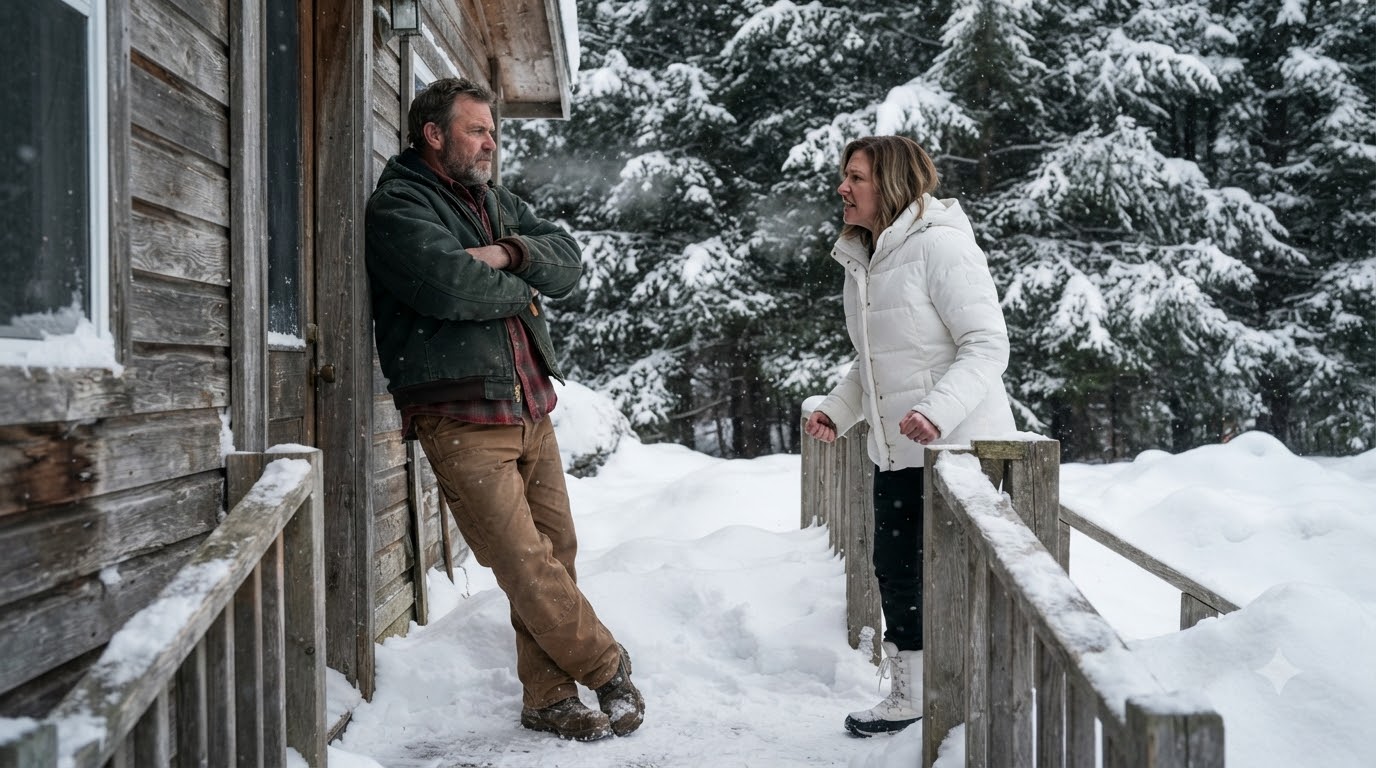
By noon, a silver Mercedes was sliding sideways halfway up the steep incline of my drive, its back tires spinning hopelessly against the deep pack. Brenda stepped out into the freezing slush wearing pristine white boots that vanished instantly into the drift, her face flushed the color of a bruised plum.
She marched straight up to the porch steps, her breath pluming in the bitter air.
—You will plow this road immediately— she snapped, her fingers curling white against the wooden railing.
I leaned against the doorframe, folding my arms across my chest to block the wind.
—You fired me, Brenda. The easement gives you a right to cross my land, but it doesn’t buy my labor or my machinery. Go find someone else to dig you out.—
Her eyes widened in absolute disbelief, jaw trembling as the reality of thirty-seven trapped homeowners settled squarely on her shoulders.
CHAPTER 4: The Pragmatic Voice
Four days after the storm locked the community in place, a sensible pair of boots crunched up my shoveled walkway instead of an idling luxury engine.
Patricia Holmes stepped onto the porch, brushing a drift of white powder from the shoulder of her wool coat before pushing open the screen door. She was a resident down near the gate and a practicing attorney who knew how the county zoning boards operated without needing a lawyer on retainer.
She walked straight into the warmth of the kitchen, taking a seat at the laminate table without waiting for an invitation.
—Mr. Patterson— she said, pulling off her gloves and wrapping her hands around the hot mug of coffee I slid across the wood. —Brenda went too far this time, and the rest of the neighborhood knows it.—
I leaned against the counter, watching her trace the rim of the ceramic cup.
—The board wants to call a vote to strip her authority, but we need the road cleared first on terms that make sense— she continued, looking me straight in the eye. —We want to issue a formal apology, resend that absurd fine, and hand you a proper contract for the rest of the season with no aesthetic nonsense and full upfront payment plus an emergency penalty.—
It was blunt, practical, and entirely reasonable.
—And Brenda?— I asked.
—She voted against the proposal and got herself suspended from board decisions by a four-to-one margin— Patricia said, setting the mug down with a firm click. —She’s isolated, but she’s not going to take it lying down.—
CHAPTER 5: The Courtroom Wall
Two weeks after the new contract was signed and the neighborhood dug out, a fresh packet of legal paperwork arrived at my door, bearing Brenda Morrison’s personal signature.
This wasn’t an HOA matter anymore. She had filed a private civil suit in Lamoille County Superior Court, claiming intentional infliction of emotional distress and unlawful interference with property access.
The courtroom was drafty, smelling of old paper and wet wool as the March wind rattled the tall windows.
Brenda sat at the plaintiff’s table flanked by a high-priced attorney from Burlington, laying out dramatic photographs of stranded cars and reciting a long narrative about missed medical appointments and emotional turmoil. I sat across the aisle alone, with no lawyer by my side, resting my hands on the worn wooden back of the bench.
Judge Harold Kemper looked tired, his eyes shadowed under the harsh fluorescent lights as he flipped through Brenda’s stack of exhibits.
—Where is your statutory authority requiring a private landowner to clear a right-of-way easement at their own personal expense?— the judge asked, his voice cutting cleanly through the quiet room.
Brenda’s attorney stammered, pointing to community expectations and general neighborhood reliance, but offering no actual law.
I stood when my turn came, laying out the timeline with cold, unvarnished facts—the arbitrary fine, the contract termination, and the plain language of the land records proving the road crossed my property.
Judge Kemper didn’t even blink. He dismissed the suit with prejudice on the spot, calling it entirely frivolous, and ordered Brenda to cover all opposing legal fees and costs.
—Case closed— the gavel struck the block with a sharp, echoing crack.
Brenda spun around in her seat, her face purple with unbridled rage, refusing to accept that her weaponized entitlement had finally broken against the solid wall of common law.
CHAPTER 6: The Final Clearing
The legal defeat didn’t soften Brenda Morrison; it pushed her over the edge into petty, destructive desperation. Over the following weeks of early spring, construction nails began turning up scattered across the packed gravel of the private road, puncturing tires and testing everyone’s patience.
Then the entrance sign was defaced with spray paint, and the gate lock was jammed solid with industrial glue.
Patricia Holmes took matters into her own hands, installing a discreet security camera hidden among the lower branches of the pine trees near the entrance. It didn’t take long for the lens to catch what common sense already suspected.
The infrared footage lit up one night, showing Brenda walking out of the treeline with a heavy canvas sack, tossing handfuls of grey iron spikes across the vehicle path before kneeling to slash the tires on Patricia’s SUV.
The state police moved in before morning.
Confronted with high-definition digital proof, Brenda’s high-priced attorney tried to plead extreme psychological stress, but the judge wasn’t buying excuses for criminal mischief and intentional destruction. She was convicted, slapped with heavy fines, ordered to pay thousands in restitution, and sentenced to community service.
By summer, the Mercedes was gone from the driveway up the hill, and the house had a new “For Sale” sign planted firmly in the lawn.
The Pine Ridge association reformed under Patricia’s leadership, expanding my contract to handle year-round maintenance, grading, and drainage with absolute professional respect for how the work was done.
Today, on a raw winter night after a heavy storm, I sit in my truck for a quiet beat with the headlights cutting a sharp path through the dark.
The snow banks on either side of the road are different heights, completely ridiculous if you care about symmetry, but entirely correct if you care about keeping folks moving.
I push the snow where physics demands it, take one last look down the cleared lane, and put the truck in gear.