The Granite Siege: How an Ex-Engineer Engineered the Downfall of a Suburban Tyrant
CHAPTER 1: THE WEIGHT OF STONE
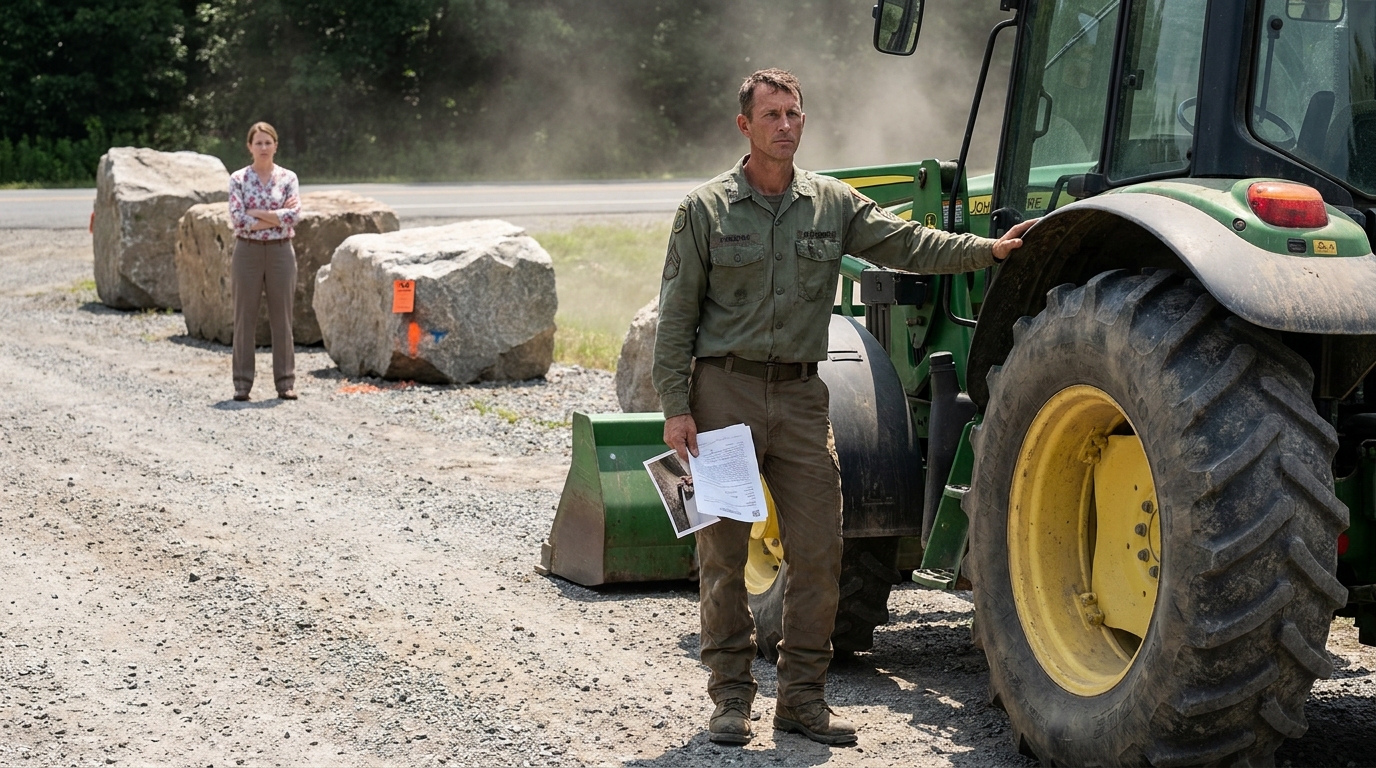
The leather of the steering wheel was already warm against my palms, but the air inside the cab felt thin, stripped of oxygen by the suddenness of the stop. Two hundred yards behind me, the boundary fence of my property cut a straight, unforgiving line through the morning mist, separating forty acres of prime alfalfa from the cookie-cutter symmetry of Oak Meadows.
Ahead of me stood Karen Bishop.
She did not yield ground. Her posture was anchored with the rigid certainty of someone who believed the universe had been mapped out in neat, laminated bylaws. Her arms remained locked across her chest, the fabric of her blouse straining against the motion like canvas pulled too tight over a ribcage.
“You’re trespassing on restricted asphalt, Mr. Thompson,” she said, her voice grating against the quiet like dry grit under a heavy boot. “And that machine is a blight.”
I did not kill the lights, leaving the twin halogen beams cutting a pale, useless yellow wedge through the bright morning sun against the three gray monoliths blocking the road. They were rough-hewn, jagged blocks of Vermont granite, each one heavy enough to crush the front axle of a hay baler. They sat on the gravel access road with an insolent permanence. Sixty years of county easements, recorded in ink that had outlived the men who signed it, meant nothing against the sudden, sharp stroke of her laminated rulebook.
My fingers traced the grain of the steering wheel. Twenty years in the Army Corps of Engineers taught me one immutable law: never react to the enemy’s chosen battleground until you have measured the load bearing capacity of their pride.
“Karen,” I said, keeping the register flat, stripped of any rising inflection that might feed her adrenaline. “That stone doesn’t belong to the association’s common ledger. And this road isn’t yours to fence.”
Her mouth tightened into a pale, bloodless seam. A tiny muscle twitched beneath her left eye, a microscopic betrayal of the calm facade she was trying to wear. “The board voted on common area protection last Tuesday,” she snapped, her chin lifting with practiced disdain. “Effective immediately. Your commercial farming equipment is a hazard to our property values.”
Property values. The sacred phrase of the suburban fiefdom.
I looked past her shoulder, toward the neat rows of pastel siding and manicured Kentucky bluegrass stretching away into the cul-de-sacs. Every house was identical in its manufactured perfection, a monument to the fear of standing out. And Karen was their self-appointed high priestess, intoxicated by the petty authority of handing out two-hundred-dollar fines for unapproved mailbox paint.
The storm was moving in from the west. I could smell it on the wind—a heavy, metallic tang of ozone and wet cedar that promised a three-day deluge by Thursday. If those boulders stayed where they were, my crop would rot in the windrows, turning fifty thousand dollars of hard work into black, slimy mulch.
She thought she had cornered me in a civil loophole. She thought I was just a tired farmer with no stomach for paperwork.
I pulled my hand from the steering wheel and reached down to flick off the tractor’s PTO switch. The sudden silence that rushed in to fill the space was heavy, ringing in my ears like the aftermath of an artillery shell.
“Enjoy the view while you can, Karen,” I said softly, letting the words drop like lead weights between us. “Because by tomorrow, those rocks are going to find a new home.”
She smirked, a quick, sharp twitch of satisfaction that reached right down to the cold knot forming in my gut. “Try moving them without an injunction, Jack. See what the county sheriff has to say about unauthorized heavy machinery on residential turf.”
She turned on her heel, her floral print swinging with crisp precision, and marched back toward the pristine lawn of 121 Blossom Lane without looking back.
I shifted the John Deere into reverse, the gears grinding with a metallic protest that echoed off the neat suburban fences, and backed down the narrow lane. As I rolled past the first mailbox, my eye caught a faint smudge of fresh orange spray paint on the base of the middle boulder—a surveyor’s mark, small and precise, partially hidden beneath a smear of gray dust.
It wasn’t a county mark. It was an inventory tag from a commercial supplier three towns over.
And it meant she hadn’t just placed those rocks yesterday; she had ordered them with a paper trail.
CHAPTER 2: THE CLOSED DOOR OF THE SHERIFFS OFFICE
The orange inventory tag on the boulder’s base did not smudge when I dragged the back of my hand across it; the paint was fresh, applied within the last forty-eight hours, matching the clean, unweathered bite of the chisel marks on the stone’s underside.
I let go of the John Deere’s clutch and left the engine idling. The diesel thrum vibrated through the floorboards, shaking the loose change in the console cup holder. Beside me on the passenger seat lay the plat map of the county, its creases worn soft over five years of land management, the red ink of the original 1960s agricultural easement standing out like a fresh scar against the yellowed parchment.
I did not turn around and drive home.
The unbroken transition from the gravel road to the county precinct took twenty-two minutes of hard driving along the two-lane state highway, the trailer tires humming a high, thin note against the asphalt. I kept the speed precisely at the limit, letting the weight of the machinery behind me anchor my thoughts. In the army, when an objective was blocked by an unauthorized obstacle, you didn’t curse the barrier; you mapped the supply line that brought it there.
The parking lot behind the county courthouse was washed out in the harsh midday glare, white gravel reflecting the heat. Deputy Evans’ cruiser was parked near the side entrance, its rear bumper dusted with the same dry grey silt that lined the Oak Meadows access path.
I cut the engine, the sudden quiet ringing in my ears, and stepped out onto the baked gravel. My boots made a heavy, deliberate crunch as I crossed the lot, carrying the manila folder tucked firmly beneath my arm.
Inside, the precinct smelled of damp carpet, floor wax, and the stale dregs of burnt coffee from the breakroom down the hall.
Deputy Evans looked up from a stack of carbon-copy accident reports as I walked past the low swinging wooden gate. His desk lamp cast a harsh yellow circle over his uniform badge, throwing sharp shadows beneath his cheekbones. He didn’t look surprised to see me; if anything, his shoulders tightened, the posture of a man bracing for paperwork he knew he couldn’t sign.
“Mr. Thompson,” Evans said, his voice dropping into that neutral, professional register cops use when they want to keep a conversation off the official log. “Didn’t expect you back so soon. I thought I made it clear out on the line. Until you’ve got a judge’s signature telling us otherwise, those rocks are a civil dispute between property owners.”
I didn’t sit down in the metal folding chair opposite his desk. I stayed standing, keeping my height, letting the shadow of my shoulders fall across his paperwork.
“Deputy,” I said, keeping my tone level, measured, stripped of any heat. “You’re looking at a civil trespass code when a neighbor plants a decorative bush over a property line. You’re looking at something else entirely when an administrative board uses commercial heavy machinery and industrial-grade rigging to cut off a deeded agricultural right-of-way two days before a harvest.”
Evans reached up, rubbing the bridge of his nose where his glasses had left a pale indentation. “She showed me the association’s common area charter, Jack. On paper, that strip of gravel intersects the subdivision’s internal maintenance perimeter. My hands are tied without a court order.”
“She didn’t use an association charter to buy three three-ton blocks of Vermont granite,” I said, sliding a single sheet of paper out from the manila folder and placing it flat on the center of his blotter.
The deputy’s eyes dropped to the paper. It was a photograph I’d snapped with my phone just before leaving the field—a macro shot of the orange inventory tag, showing the serial number and the imprint of the stone yard three towns over, alongside a partial delivery manifest I’d pulled from public commercial transport logs accessible through the county transit database.
“Look at the serial prefix,” I said, my finger tapping twice against the gloss of the photo. “That’s municipal-grade landscaping stock. It requires a commercial freight carrier and a registered commercial manifest to cross county zoning lines. Oak Meadows HOA isn’t registered as a commercial entity with the department of transportation. They can’t legally contract heavy freight delivery onto residential easements without a public works permit.”
Evans stared down at the serial number. The silence in the small precinct grew heavy, broken only by the rhythmic hum of the wall-mounted air conditioner struggling against the midday heat.
“Where’d you get the manifest number?” Evans asked, his voice dropping an octave.
“I spent five years building bridges and airfields under fire, Deputy. I know how supply chains work,” I said, leaning slightly over the edge of his desk. “Karen didn’t pull those rocks out of her flower bed. She hired an unverified third-party hauler to dump industrial debris onto a state-protected agricultural corridor. That isn’t a civil dispute over grass trimming. That’s illegal dumping and malicious interference with state-mandated food production.”
Evans looked up, his expression shifting from defensive weariness to sharp, calculating evaluation. He didn’t pick up the photo immediately. Instead, he leaned back in his squeaking chair, the metal springs groaning under his weight.
“If I log this as a formal complaint regarding illegal commercial dumping on an agricultural right-of-way,” Evans said slowly, choosing his words with surgical care, “it bypasses the HOA civil exemption entirely. It triggers an immediate code enforcement audit on the transport company.”
“And it forces the county prosecutor to look at who signed the freight receipt,” I added.
Evans let out a slow breath, shaking his head. “You’re playing a very dangerous game, Jack. If you push this criminally and the judge decides the easement wording is ambiguous, Karen’s lawyers will tear you apart in civil court for harassment.”
“Let them try,” I said, pulling the folder back against my chest. “Just log the manifest, Deputy. I’m not asking you to move the rocks today. I’m asking you to do your job and record the crime.”
He looked at the photo one last time, then reached for his keyboard, the plastic keys clicking with sharp, rhythmic precision in the stale air.
As I turned and walked out of the precinct, the heavy glass door swinging shut behind me with a solid, weighted thud, I knew the first domino had fallen. Karen thought she was playing a game of neighborhood bylaws. But the supply chain didn’t care about her bylaws—and neither did the freight manifest.
CHAPTER 3: THE GATHERING OF SHADOWS IN THE SUBURB
The heat coming off the blacktop in the precinct parking lot hit me like the backdraft of an engine compartment, thick and shimmering with oily exhaust fumes. I didn’t get straight into my truck. Instead, I stood by the driver’s side door, letting the cool metal of the fender ground me while I pulled out my notepad and flipped to a clean page.
The deputy had logged the manifest, but a paper trail sitting in a municipal file cabinet was only a defensive wall. To break an entrenched position, you needed active intelligence from inside the perimeter.
I turned the truck south, heading back toward the quiet, sterile arteries of Oak Meadows. The transition from the county seat to the subdivision was like crossing an operational boundary line—from the worn, oil-stained concrete of public infrastructure into a manicured bubble where every blade of grass looked like it had been trimmed with a razor.
My memory flickered back to a forward operating base outside Ramadi, where every sector had its own micro-politics, its own local gatekeeper who controlled the flow of supplies and information through sheer stubbornness. Karen Bishop was cut from that exact cloth. She didn’t rule because she had a legal mandate; she ruled because everyone else was too tired, too isolated, or too afraid of petty social friction to test the perimeter of her authority.
I pulled my truck off the main boulevard, cutting the engine half a block away from the Harrison house. The street was quiet, save for the high-pitched hum of a distant robotic lawnmower creeping autonomously across a flawless green lawn.
I didn’t use the front walkway. I stayed on the sidewalk, my boots crunching softly on the decorative gravel bordering the driveway, until I reached the side gate. David Harrison answered my knock almost immediately, as if he had been standing just behind the frosted glass waiting for the sound of an engine to die.
He opened the door a crack, his fingers white-knuckling the edge of the frame. His eyes darted nervously down the cul-de-sac toward Karen’s house, visible two blocks away like a painted citadel behind its perimeter of pruned hedges.
“I saw the deputy’s car leaving your place earlier,” David whispered, his voice tight with a mixture of apprehension and reluctant hope. “Did… did he do anything about the rocks?”
“Not yet,” I said, keeping my voice low and steady, matching his rhythm. “The law doesn’t move at the speed of an approaching storm, David. But supply chains leave tracks. The company that hauled those granite blocks across county lines didn’t file a residential permit.”
David swallowed hard, his Adam’s apple bobbing. He looked back over his shoulder into the dim hallway of his home, where a child’s plastic tricycle sat parked neatly against the baseboard—the very object that had earned him a two-hundred-dollar citation the month prior.
“If she finds out I talked to you again,” David murmured, his shoulders rounding inward, “she’ll push the architectural review board to flag our fence extension. That’s another thousand dollars in fines we don’t have.”
“She won’t have time to flag your fence,” I said, stepping closer, letting the weight of my military background carry absolute, unshakeable certainty. “Right now, Karen is operating under the assumption that everyone in this subdivision is an individual target she can pick off one by one. Checklists, fines, passive-aggressive notes. It’s a classic divide-and-conquer strategy.”
I pulled a small folded diagram from my shirt pocket—a hand-drawn layout of the subdivision’s utility easements that I’d sketched out from public county plat maps during my lunch hour. I laid it flat on the wooden patio table beside the back door.
“An insurgency doesn’t win by fighting every single rule,” I continued, tracing a finger along the margins of the map. “It wins by cutting the logistics supporting the tyrant. How many other families on this street received violation notices this month over things that are legally outside the HOA’s jurisdiction?”
David stared down at the plat map. The tension in his jaw slackened slightly, replaced by a slow, burning realization.
“Mrs. Gable, four houses down,” he said, his voice gaining a firmer edge. “She got a certified warning letter yesterday because her autumn decorations went up three days before the official holiday window in the covenant. And the Millers—two doors down from her—they got fined for parking a rental van in their own driveway while moving her elderly mother into their spare room.”
I nodded, marking a small cross next to two more addresses on my grid. “That’s three supply lines of fear. If we isolate each complaint, she wins. But if we pool them into a single collective affidavit showing a systematic pattern of financial and administrative overreach, her bylaws stop being a shield and become evidence.”
David looked up from the map, meeting my gaze squarely for the first time. The fear in his eyes hadn’t vanished entirely, but it had shifted—tempered by the bitter fatigue of a man who realized compliance was buying him nothing but a slower execution.
“What do you need me to do, Jack?” he asked quietly.
“Just talk to Mrs. Gable and the Millers,” I said, rolling up the plat map and sliding it back into my pocket. “Tell them to keep every piece of paper, every invoice, every warning letter. Don’t pay a dime of the fines. And tell them that tomorrow evening, we’re holding a conversation out of her line of sight.”
As I walked back down the driveway and climbed back into the cab of my truck, I glanced toward the end of the street. Through the windshield, I could see the upper floor windows of 121 Blossom Lane glinting coldly in the afternoon sun. Karen was up there behind her pristine glass, reviewing her ledgers, entirely unaware that the perimeter walls were already being mapped from the inside.
CHAPTER 4: THE DISCOVERY IN THE GARAGE ARCHIVES
The sun had dropped low enough to cast long, slate-colored shadows across the gravel driveway by the time I turned my pickup off the main asphalt and pulled up to George Bennett’s garage. The door was rolled halfway up, revealing the pale, dust-flecked beam of a work light slicing across a concrete floor that looked like it had been scrubbed with muriatic acid.
George was sitting on a metal folding stool beside an open olive-drab footlocker, a pair of steel-rimmed reading glasses perched low on his nose. He didn’t look up when my tires crunched on the gravel; his thumb was slowly running down the edge of an old cardboard ledger, checking the alignment of a row of metal staples.
I cut the ignition, letting the silence settle in around us before stepping down. The air smelled of dry cardboard, machine oil, and aged paper—the distinct odor of a paper trail that had been buried alive and forgotten by everyone except the man who compiled it.
“David Harrison reached out,” I said, ducking under the lower edge of the garage door and stepping onto the clean concrete. “He talked to Mrs. Gable and the Millers. We’ve got a dozen families ready to sign affidavits regarding the fines.”
George lifted his head slowly, his sharp, pale eyes catching the light of the overhead bulb. He didn’t smile. He just closed the ledger with a dull, dry thump that kicked up a faint cloud of microscopic gray dust.
“Affidavits are good for a civil injunction, Jack,” George said, his voice dry as autumn leaves. “Judges like neat little rows of complaints about bird feeders and tricycles. It shows a pattern of administrative overreach. But paper cutouts don’t explain how Karen managed to balance the association’s general ledger every fiscal quarter while systematically overdrawing the infrastructure account.”
He turned back to the footlocker and reached inside, pulling out a heavy, three-ring binder with black canvas edges. He slid it across the workbench toward me. The cover was stamped with a faded gold label: Oak Meadows HOA – Fiscal Year 2022 / Board Meeting Minutes & Maintenance Disbursals.
“Open it to page forty-eight,” George instructed, tapping a fingernail against the corner of the binder.
I pulled the steel rings apart slightly and flipped the heavy stock paper. The page was filled with neat, fountain-pen entries—recordings of votes, budget allocations, and signature lines. About two-thirds of the way down, a red pen had drawn a sharp, heavy box around an item labeled Item 4B: Common Area Landscape Enhancement (Access Corridor). Next to the item, a formal vote count was tallied: four against, one in abstention, and one in favor.
The vote in favor was initialed with a sharp, angular K.B.
“She didn’t just propose the beautification project for the easement road,” I said, reading the text line by line. “The board explicitly voted it down. The motion failed by a four-to-one margin.”
“It failed because I laid out the engineering estimates for grading and rock placement,” George said, standing up and reaching for a separate file folder filled with carbon copies. “A three-ton granite boulder isn’t a standard floral arrangement item. It requires heavy rigging equipment, a certified transport manifest, and a municipal-class placement crane. When I told the board what it would actually cost out of our reserve fund, they killed the motion before it ever hit the official newsletter.”
He dropped a second set of papers onto the table. These weren’t meeting minutes; they were commercial invoices from a heavy-freight hauling company three towns over—the exact same serial prefix I had spotted on the spray-painted tag of the boulder blocking my alfalfa field.
I picked up the invoice, holding it under the harsh glow of the work light. The date stamped at the top was three days before the boulders appeared on my road. The total amount was billed directly to the Oak Meadows General Maintenance Account, but the delivery address listed at the bottom wasn’t a common area at all.
It was listed under a secondary municipal code for a residential easement buffer zone—specifically, the narrow strip of land intersecting my property line.
“Look at the bottom signature line,” George whispered, leaning in closer, his breath smelling faintly of black coffee and peppermints.
My eyes dropped to the authorization signature. It bore Karen’s angular initials, but underneath it, in a different, hurried hand, was a secondary administrative routing code: Emergency Operational Disbursal – Presidential Override.
“She used an emergency clause,” I murmured, the pieces clicking into place with the cold, sharp precision of a breechblock sliding home. “Under the association bylaws, an emergency override can only be invoked if there’s an immediate structural hazard threatening resident safety—like a burst water main or a downed power line.”
“Precisely,” George said, a dry, humorless sound escaping his throat. “She didn’t have a structural hazard. What she had was a desperate need to establish physical dominance over your access road before the county tax reassessment went through. But to pull the funds without triggering a board audit, she had to classify the purchase as an emergency infrastructure repair.”
I stared down at the invoice, running my thumb over the stamped carbon imprint. This wasn’t just a petty neighborhood feud over a disputed property line. This was an actionable financial crime—a direct, verifiable misuse of corporate association funds to finance a private act of harassment.
“If we attach this invoice to the injunction motion,” I said, looking up from the desk, “her defense attorney won’t be able to argue that this was a standard boundary dispute. The moment a judge sees a presidential override used to buy heavy artillery-grade landscaping rocks for personal retaliation, the civil shield collapses.”
George reached out and closed the binder, the snap of the metal rings echoing sharply in the quiet garage. “She thought she could hide behind the corporate veil of an HOA because she never expected anyone to pull the actual physical receipts from the distributor’s regional office. People like Karen spend so much time managing how things look from the sidewalk that they completely forget to check what’s sitting in the basement filing cabinet.”
He picked up a clean rag and began wiping down his already spotless wrench set, his movements methodical and unhurried.
“Mark Cole is filing the emergency papers at the courthouse tomorrow morning,” I said, sliding the copies of the invoices into my manila folder and securing the clasp. “Make sure you’ve got the original carbon copies locked in a safe place. When Judge Albright looks at these numbers, she’s going to want to see the original ink.”
George paused his wiping, looking up with a hard, flat gleam in his eyes. “They’re already in the safety deposit box at the county bank, Jack. She can’t burn what she can’t reach.”
I tucked the folder under my arm, nodded to the old engineer, and turned back toward the door. The sun had completely dipped below the horizon now, leaving the sky a bruised, dark violet as the first heavy, humid winds of the approaching storm began to rustle the dry leaves along the edge of the subdivision.
The paperwork was locked. The evidence was secured. All that remained was walking into the courtroom and pulling the pin.
CHAPTER 5: THE COURTHOUSE ARSENAL AND THE SILENT TRAP
The courthouse steps were cold under the soles of my boots as Mark Cole and I mounted the concrete risers at precisely 1:30 PM. The humid wind pushed against us, carrying the heavy scent of incoming rain from the western ridges. Inside my leather portfolio, the original carbon invoices George had pulled from the reserve box rested against the formal injunction motion like dry tinder waiting for a spark.
We did not speak as we passed through the heavy oak doors of the security checkpoint. The metal detector frame buzzed softly for the change in my pocket, but the guard, recognizing Mark’s tailored suit and federal bar pin, merely nodded us through without breaking his rhythm.
The corridor leading to Judge Albright’s chambers was lined with polished mahogany wainscoting that reflected the stark fluorescent glare overhead. It was a space designed to intimidate anyone who walked its length—a quiet, echoing canyon where individual rights were weighed against corporate bylaws and municipal ordinances.
“She’s here,” Mark murmured, stopping abruptly before the frosted glass door of Courtroom B.
Through the lower edge of the glass, I could see the sharp, tailored hem of a charcoal power suit and the rigid heel of a designer pump planted firmly on the linoleum. Karen Bishop was already inside, flanked by her legal counsel—a slick, corporate defense attorney named Davies who looked like he spent more billable hours managing PR damage control than reading county property deeds.
I adjusted the grip on my portfolio, the leather cool and firm against my fingers. We hadn’t come here to argue about grass heights or aesthetic covenants. We had come to dismantle the legal machinery she had weaponized against the property line.
Mark pushed the door open, the brass hardware turning with a smooth, oiled click that drew every eye in the room.
The courtroom was smaller than I remembered, intimate in its verticality. Judge Albright’s high-backed leather chair sat empty behind the elevated walnut bench, looming over the opposing tables like a silent arbitrator. On the left side, Karen sat bolt upright, her fingers laced tightly over a leather-bound folio stamped with the Oak Meadows HOA crest. Her face wore that familiar, pinched expression of righteous certainty—the look of a woman who still believed that a well-worded rulebook could bend the physical reality of a state-recorded easement.
As we took our seats at the plaintiff’s table, Davies leaned over to whisper something in Karen’s ear. She didn’t look at him. Her small, hard eyes locked onto me with a cold, venomous intensity, her jaw tight enough to snap a pencil.
“Mr. Thompson,” Davies said, offering a tight, patronizing smile as he gathered his paperwork. “I trust you brought your surveyor’s maps? My client is prepared to demonstrate that your heavy machinery exceeds the weight limits stipulated for common residential roadbeds under Section 4 of the neighborhood charter.”
I didn’t answer him. I simply laid my manila folder flat on the varnished wood, unsnapped the brass clasp, and pulled out the primary stack of documents without a word. Weaponized silence. Let him talk to the empty air while the supply chain did the work.
A side door near the bench clicked open, and the bailiff’s sharp baritone cut through the murmur of the room.
“All rise for the Honorable Judge Albright.”
The courtroom surged upward as one. Judge Albright swept into the room with crisp, efficient grace, her black robes billowing slightly before settling behind the high bench. She did not waste time with pleasantries; she seated herself, adjusted a pair of reading half-glasses down the bridge of her nose, and scanned the docket sheet resting before her.
“Sit down,” she said, her voice dry, sharp, and entirely devoid of patience.
We dropped back into our chairs. The friction of the room shifted instantly, tightening like a winch under tension.
“I have reviewed the preliminary filings for an emergency injunction regarding the access corridor at Oak Meadows,” Judge Albright began, her gaze sweeping across the courtroom before landing squarely on Davies. “Counsel for the defense, your motion claims this is a standard civil boundary dispute over common area maintenance. Is that correct?”
Davies stood smoothly, adjusting his lapels with an air of practiced confidence. “It is, Your Honor. The association is merely exercising its governance over internal roadways to protect residential safety and property values from heavy industrial traffic.”
It was a clean, standard defense—one designed to keep the judge’s focus locked entirely on local zoning trivia.
Mark Cole did not wait for an invitation. He stood up, buttoning his suit jacket with deliberate slowness, and stepped away from our table.
“With respect, Your Honor,” Mark said, his voice carrying an effortless, courtroom-tested resonance that filled every corner of the room, “that defense assumes the obstructions in question were placed under the authority of a valid association vote.”
Davies frowned, glancing sideways at Karen. “Of course they were. The president acted under standard neighborhood maintenance protocols—”
“Mr. Davies,” Judge Albright interrupted, her voice dropping an octave into a tone that instantly froze the lawyer in his tracks. “Let Mr. Cole present his exhibits before you start inventing administrative protocols.”
Mark walked to the center of the well, holding up a single, transparent plastic sleeve containing the original carbon invoice and the municipal freight manifest we had pulled from the transport line.
“Your Honor,” Mark continued, his tone dropping into a clinical, unshakeable rhythm, “we submit into evidence Exhibit A through D: the commercial freight manifests, municipal transport logs, and financial disbursal records for the granite blocks currently blocking my client’s agricultural right-of-way.”
Davies took a half-step forward, his professional composure cracking at the edges. “Objection, Your Honor! These documents are private internal HOA financial matters irrelevant to a property line dispute—”
“They become entirely relevant,” Judge Albright snapped, leaning forward over the bench, her eyes flashing behind her glasses, “when a private association account is used to purchase three tons of industrial granite under an emergency override clause that was explicitly voted down by the board six months prior.”
The courtroom went dead silent.
Karen went rigid. The color drained from her face so fast her skin took on the pale, chalky hue of winter limestone. She turned her head sharply toward her lawyer, her lips parting as if to speak, but no sound came out.
Davies blinked, looking down at his own clean, empty desk as if realizing for the first time that his client hadn’t given him the full story of what was buried in the association’s basement.
“Mr. Cole,” Judge Albright said, her gaze fixed entirely on the documents in Mark’s hand. “Walk me through the disbursal code on that invoice.”
This was the pivot point. The decoy secret of the boundary line had shattered, and the true mechanical core of her control was exposed. But the beast was not dead yet; Karen’s fingers curled into the edge of her leather folio, her knuckles turning bone-white as she prepared for the final, desperate lunge of her defense.
CHAPTER 6: THE SCALES TIP IN JUDGE ALBRIGHTS COURTROOM
The silence in the courtroom did not break; it stretched tighter, humming like a high-tension cable pulled to its absolute breaking point under the weight of the evidence.
Judge Albright did not look at Davies. Her gaze remained pinned to the carbon invoice resting on the polished wood of her bench, her fingers tapping a slow, rhythmic cadence against the edge of the document. Every tap sounded like the drop of a heavy lead weight on dry concrete.
“Mr. Davies,” the judge said, her voice dropping into a quiet, dangerous register that demanded absolute stillness from the room. “Your client filed a motion asserting that these boulders were placed under standard municipal maintenance protocols authorized by the association’s executive charter. Yet this invoice carries an emergency override code dated three days after the board explicitly voted down the exact same landscaping project by a four-to-one margin.”
Davies swallowed hard, his professional poise evaporating as he scrambled to gather his scattered notes. “Your Honor, my client… my client may have misinterpreted the boundaries of her executive discretion under administrative stress—”
“Discretion does not include forging operational codes to bypass a board veto,” Judge Albright cut him off sharply, her eyes flashing behind her half-glasses. “That is not a misinterpretation of bylaws. That is a fraudulent misappropriation of corporate funds for private retaliation.”
Across the aisle, Karen shifted in her seat. The rigid posture she had maintained since the start of the hearing finally buckled. Her hands, previously locked tightly over her leather folio, dropped into her lap, her fingers twitching against the fabric of her skirt with a nervous, erratic rhythm. She leaned toward her lawyer, her lips moving in a frantic, silent whisper, but Davies didn’t look back at her; he was staring straight ahead at the bench, realizing he was carrying a defense built on sand.
Mark Cole stepped back to the plaintiff’s table, his movements measured and unhurried. He didn’t gloat. In logistics, you don’t celebrate a breached perimeter until the enemy’s supply lines are fully severed.
“Your Honor,” Mark said, his voice cutting cleanly through the heavy air, “in light of the unassailable evidence establishing both a malicious pattern of harassment and direct financial malfeasance, we move for an immediate temporary restraining order. We ask the court to compel the immediate removal of the obstructions at the association’s expense, and—given the defendant’s conduct—that the boulders be relocated to a position where they serve as a permanent, unambiguous testament to the bounds of her authority.”
Judge Albright leaned back in her high-backed leather chair, her expression freezing into a mask of judicial iron. She looked past Davies, past the defense table, and fixed her eyes directly on Karen.
“Ms. Bishop,” the judge said, her tone flat and merciless. “Stand up.”
Karen hesitated for a fraction of a second, then slowly pushed herself up from the chair. Her face was bloodless, the sharp angles of her jaw twitching as she met the judge’s gaze.
“You chose to turn a legal property easement into a personal battlefield,” Judge Albright said, her voice carrying to every corner of the room. “You utilized community funds to construct a blockade under false administrative pretenses, all to inflict deliberate financial harm on a nonmember whose property rights predate your entire subdivision.”
She picked up her heavy wooden gavel. The sound of it striking the block didn’t echo; it cracked through the room like a rifle shot.
“The motion for a preliminary injunction is granted in full,” Judge Albright declared. “You and any agent of the Oak Meadows Homeowners Association are restrained from interfering with Mr. Thompson’s access. The boulders must be removed within forty-four hours at the association’s sole expense. And as for the placement of those rocks…”
The judge paused, letting a cold, humorless shadow cross her features.
“…since they were purchased using emergency maintenance funds intended for common infrastructure, they will be relocated by heavy transport directly to the front lawn of 121 Blossom Lane. Let your neighbors see the physical embodiment of your administrative overreach every time they walk down the street.”
A sharp, collective gasp rippled through the gallery behind us. David Harrison let out a audible sigh of relief, while Karen stood frozen, her mouth opening in a silent, horrified protest that was instantly drowned out by the rustle of the courtroom rising as the judge stood and swept back through her private chambers door.
The trap had snapped shut. The legal armor was stripped away, leaving only the cold mechanics of execution.
CHAPTER 7: THE IRON PARADE AND THE FALL OF BLOSSOM LANE
The diesel exhaust hung low over the manicured asphalt of Oak Meadows, smelling of raw sulfur and heavy machine oil as Gus’s 100-ton Grove crane rumbled past the subdivision’s decorative stone entrance sign. Behind it rolled the flatbed truck, its steel bed empty save for three wooden blocking pads, waiting to hoist the gray granite monoliths off my easement road.
I sat in the passenger seat of my Ford F250, watching the gauges settle as we crept down the cul-de-sac behind the county sheriff’s cruiser. The morning sun was bright, catching the polished chrome of the crane’s hydraulic outriggers and throwing harsh, sharp reflections against the pristine white siding of the houses.
We stopped dead twenty yards from the gravel access line. The three boulders sat there exactly where Karen had dropped them, their jagged gray faces mocking the sterile symmetry of the street.
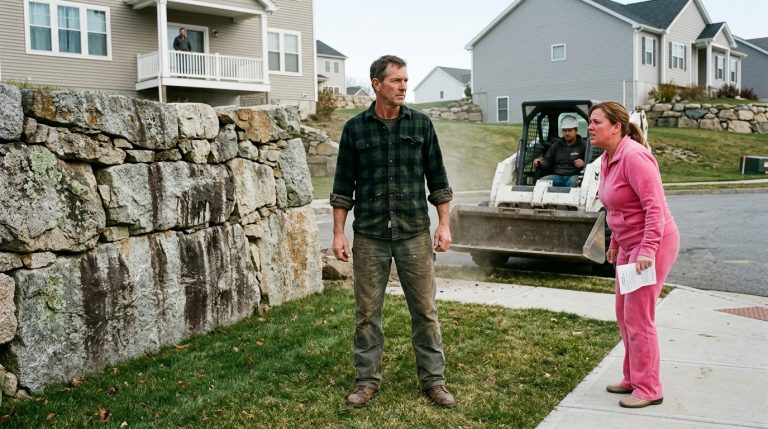
Before Gus could even shift his rig into park, the front door of 121 Blossom Lane flew open with a sharp crack against the exterior wall. Karen stepped out onto her porch, clad not in her usual crisp power suit, but in a bright pink velour tracksuit that seemed absurdly fragile against the industrial weight bearing down on her street. Her face was puffy, her hair uncharacteristically loose around her temples, and her small, hard eyes burned with a manic, desperate fury.
“Stop right there!” she shrieked, marching down her pristine walkway, waving a crumpled sheet of paper like a flag of truce. “You have no legal right! This is private residential property! Sheriff Miller, arrest these men!”
Sheriff Miller, who had stepped out of his cruiser to oversee the execution of the court order, didn’t draw his weapon or flinch. He simply stood beside his open door, folding his arms across his chest with the immovable patience of a man watching a storm hit a tin roof.
“Morning, Mrs. Bishop,” Miller said evenly, his voice carrying clearly across the quiet lawn. “I’ve got Judge Albright’s signed writ right here. The association pays for the removal, and the court dictates the placement. Step back behind the property line, please.”
Karen ignored him, her gaze locking onto me as I stepped down from the pickup truck. Her chest heaved, the fabric of her tracksuit straining against her erratic breathing.
“You did this,” she hissed, pointing a trembling finger straight at my chest. “You destroyed years of community work just because you couldn’t follow a simple neighborhood rule! You’re an outsider, a parasite trying to ruin everything we’ve built!”
I didn’t raise my voice. I didn’t step forward. I kept my weight balanced on my heels, letting the cold, calculating detachment of an engineer dictate every micro-movement.
“You picked the wrong supply line, Karen,” I said, my voice flat and carrying the hard weight of undeniable fact. “You thought you could use corporate association funds to wage a private war against a property right. The ledger caught up with you.”
She let out a high, choked sound of pure frustration, turning back toward the crane as Gus’s crew began sliding the heavy timber outriggers into place with rhythmic, metallic clangs.
“You can’t put those on my lawn!” she screamed, her voice cracking as the reality of the judge’s mandate finally collided with her pristine grass. “My prize-winning roses! Those are regional competition winners!”
Gus didn’t even look down from the elevated cab. He spat a stream of dark tobacco juice into the grass near the curb, pulled a heavy lever, and signaled his rigger with a sharp chop of his hand.
The crane’s steel boom groaned, rotating smoothly over the manicured green carpet of Blossom Lane. The heavy rigging cables descended, dropping like lead plumb-lines straight down into the heart of her prize-winning rose bed.
The first granite boulder was hooked, strapped, and lifted from the earth with a slow, grinding wrench of steel against stone. As it swung through the air, casting a heavy, shifting shadow over the neighbor’s roof, Karen let out a sound that was half-sob, half-shriek, covering her ears with her hands.
The rock touched down with a dull, sickening thud right in the center of the award-winning roses. Stems snapped, petals shredded into a red-and-green paste under three tons of jagged granite, and the pristine turf compressed into a deep, muddy rut beneath the impact.
A second boulder followed, dropping with heavy, final precision beside the walkway. A third settled near the driveway, anchoring the entrance to her home with an immovable, brutalist monument to her own administrative overreach.
The neighborhood was watching from behind their windows and along the edges of the sidewalk. David Harrison stood with his daughter on his shoulders, silently witnessing the collapse of the regime. Mrs. Gable sat in a lawn chair three houses down, sipping coffee with a calm, vindicated smile.
Karen dropped her hands from her face, staring down at the gray stones crushing her life’s work. The fire in her eyes flickered out, replaced by a hollow, vacant shock as she realized the iron grip she held over the subdivision had vanished forever.
CHAPTER 8: THE RETURN OF SILENCE TO THE ACCESS ROAD
The silence that settled over the gravel access road three days later was different from the heavy, charged quiet of the confrontation. It was deep, clean, and undisturbed, broken only by the steady, rhythmic hum of the John Deere 8R rolling smoothly between the tall rows of golden alfalfa.
The storm had broken late Thursday night, dropping two inches of steady rain that soaked deep into the fertile bottomland before washing away the dust of the dispute. By Saturday morning, the air smelled of wet earth, crushed stems, and sun-warmed iron. The crop was safe, baled and stacked neatly in the dry shelter of the northern barn, representing the full preservation of my livelihood and the vindication of every hour logged in the ledger.
I cut the engine of the tractor near the western boundary line and stepped down onto the gravel. The ground was firm beneath my boots. Where the three granite boulders had once sat, leaving deep, jagged gouges in the stone bed, county contractors had spent yesterday morning grading and smoothing the surface back to its original profile. The road was open. Not a single restriction, not a single notice, not a single shadow of manufactured authority remained between my fields and the main artery.
Across the property line, the contrast was absolute.
At 121 Blossom Lane, the front yard was eerily quiet. The three massive granite blocks had been hauled away late Friday afternoon under the supervision of a new moving crew—a removal cost that the court had assigned directly to Karen’s personal liability, forcing her to liquidate her remaining liquid assets to settle the debt. The award-winning rose beds were gone, replaced by raw, dark patches of turned dirt where shovels had dug deep to clear the crushed roots.
The house itself was shuttered. A bright orange For Sale sign, bearing the stamp of a regional liquidation agency rather than a standard suburban broker, stood staked neatly in the center of the devastated lawn. The neighbors had told me the night before that Karen had packed her car in the middle of the night, leaving behind an association in receivership and a set of financial ledgers that the newly appointed interim board—led by George Bennett—was currently handing over to the state prosecutor’s office for a full forensic audit.
Her authoritarian control had never been about community standards or property values. It had been a fragile, desperate facade built to mask an escalating series of financial and personal bankruptcies, using petty fines and simulated power to keep the world from looking too closely at her own crumbling foundation. When tested against real engineering and uncompromising facts, the entire structure had simply collapsed under its own weight.
I walked back over to the edge of the field, where the tall stalks of alfalfa swayed gently in the crisp morning breeze. My fingers brushed against the cool, oiled surface of the tractor’s steering linkage, checking the equipment for the final maintenance run of the season.
Down the road, David Harrison was walking his daughter toward the community park, the little girl’s pink tricycle gliding smoothly along the concrete sidewalk without a single warning letter trailing behind it. Farther down, Mrs. Gable sat on her front porch, her bird feeder swinging freely in the wind, untouched and unbothered.
I climbed back into the cab, pulled the door shut with a solid, satisfying click, and fired up the diesel engine. The machine caught instantly, purring with steady, reliable power. As I put the tractor in gear and rolled down the smooth, unobstructed gravel path toward home, I knew the road was just a road again. And the silence it carried was earned.