The Weight of Iron: A Price Paid in Memories at the Edge of a Forgotten War
CHAPTER 1: The Weight of Forty Dollars
The October sun hung low, casting long, bruised shadows across the rows of folding tables. Dust devils danced between the aisles of the swap meet, carrying the scent of dry earth, cheap motor oil, and the slow, inevitable decay of things no longer needed.
Elias kept his eyes on the man’s hands—calloused, trembling slightly, anchored by a deep-set rhythm of caution. The younger man, who had introduced himself only as Leo, pushed the item forward. It was a brass casing, tarnished to the color of dried blood, sealed with a latch that had been forced once and poorly repaired.
“Forty bucks,” Leo repeated, his voice clipping the end of the sentence. He wasn’t looking at Elias; he was looking at his watch, his foot tapping a nervous, syncopated rhythm against the gravel. “Take it or leave it. I’ve got a long drive ahead.”
Elias reached out, his own fingers stiffening as they met the cold metal. The surface felt wrong—too textured, like skin that had been scorched and healed poorly. He didn’t look at the money he was handing over; he looked at the underside of the casing. There, obscured by a layer of grime that hadn’t seen the light of day in decades, was a faint, scorched seal. A marking he hadn’t seen since the border wars, a sign that the item wasn’t a souvenir at all, but a container for something strictly classified.
“You have no idea what this is, do you?” Elias asked, his voice a low rasp that barely carried over the murmur of the surrounding crowd.
Leo looked up, his brow furrowed in a flicker of genuine irritation. “It’s a brass paperweight, old man. It’s a hobby for you, it’s gas money for me. Don’t make it complicated.”
Elias didn’t answer. He slipped the object into his jacket pocket, feeling the weight of it pull his shoulder down. It shifted against his hip, a solid, unforgiving presence. He stood up, his knees popping with the protest of age, and turned to walk toward the exit.
He didn’t make it ten steps before he stopped. The air had shifted. The ambient noise of the swap meet seemed to drop an octave, and he felt it—a sudden, sharp prickle at the back of his neck. Someone was watching him. Not the casual glance of a passerby, but the calculated, predatory stillness of someone who knew exactly what was now resting in Elias’s coat.
He risked a glance back toward the folding table. Leo was already packing his things, but his movements had changed. He wasn’t rushing anymore. He was steady, methodical, and he was staring directly at Elias’s retreating back with an intensity that made the surrounding heat feel brittle, like glass about to shatter.
Elias turned the corner, his mind already calculating the quickest route to his truck, knowing that the forty dollars had bought him more than just an object. It had bought him the beginning of an ending he thought he’d outrun.
CHAPTER 2: The Friction of Transit
The distance between the folding table and the cracked asphalt of the parking lot felt like a mile of thin, brittle ice. Elias didn’t turn his head, but his pulse hammered against his collar—a rhythmic, insistent thud that matched the heavy, metallic clatter of the casing bumping against his ribs with every step. He focused on the ground, on the way the late October light caught the jagged edges of gravel, and the way the soles of his boots struggled for purchase on the uneven, sun-baked earth.
He was a Sovereign Protector by trade and by habit; he didn’t run, and he didn’t flinch. Yet, as he maneuvered through the thinning crowd, the atmosphere felt dense, saturated with the metallic tang of cooling engines and the dry, rust-laden scent of old iron. The air wasn’t moving. It was held in a state of precarious suspension, waiting for the first sign of instability.
He reached his truck, an aging beast of steel and faded blue paint that had survived more miles than its odometer cared to acknowledge. He didn’t rush his approach. He moved with the studied, deliberate grace of a man who understood the mechanics of his environment. He kept his back to the rows of tables, his peripheral vision locked on the reflection in the side mirror. Leo hadn’t moved. The younger man was still standing there, a ghost in a sea of bric-a-brac, watching.
Elias unlocked the driver’s side door. The latch protested with a sharp, familiar shriek of neglected metal. He slid into the cab, the smell of dust and stale coffee wrapping around him like a heavy, insulating blanket. He didn’t start the engine immediately. Instead, he pulled the brass casing from his pocket and set it on the passenger seat.
It looked innocent enough in the muted light of the cab. A piece of brass. A scrap of history. But as he looked at it, a sudden, intrusive memory spiked through his mind—a phantom sensation of cold, wet mud against his knees and the distant, muffled sound of a command he had tried for forty years to misplace. It was the Psychological Phantom of a decision he had made in a life that felt like someone else’s. The casing wasn’t just a container; it was a trigger. It held the structural weight of an era that had been systematically scrubbed from the public record.
He heard the faint, rhythmic sound of footsteps approaching across the gravel.
Elias didn’t panic. He shifted his weight, his hand moving with trained, almost imperceptible speed to check the position of his gear bag on the floorboard. He felt the cold, familiar bite of a heavy flashlight handle—solid, weighted, reliable. He didn’t draw it, but his fingers rested on it, assessing the balance.
The footsteps stopped. A shadow stretched across the driver’s side window, long and distorted by the setting sun.
“You dropped this,” a voice said.
Elias looked up. Leo stood outside his window, his face partially obscured by the glare on the glass. He held a small, crumpled receipt that Elias must have dropped in his haste to leave the table.
Elias didn’t roll the window down all the way. He lowered it just enough to create a sliver of space—a tactical gap. “You could have kept it, son. It’s just paper.”
Leo’s eyes didn’t flicker. They moved past Elias’s face, resting for a fraction of a second on the brass casing sitting on the passenger seat. The look wasn’t one of greed. It was recognition—the sharp, predatory awareness of someone who had been tracking a scent for a very long time.
“Nothing is ever just paper,” Leo replied, his voice devoid of the earlier irritation. It was flat, transactional, and terrifyingly steady. “People forget that. They think if they shove it in a box and sell it for forty bucks, the debt is settled. It’s not.”
Elias felt the hair on his arms stand up. The silence that followed was heavy, filled with the friction of two men operating on entirely different timelines, yet colliding in this dusty, forgotten corner of the world. Leo stepped back, his expression smoothing into a mask of polite, hollow indifference.
“Have a safe drive,” Leo said, turning on his heel.
Elias watched him walk away. He didn’t start the engine until the younger man had vanished back into the chaos of the swap meet. He sat in the quiet, the smell of iron and dry earth clinging to his clothes, the brass casing pulsing in the dim light like a dormant heart. He was no longer just a collector. He was a caretaker of a truth that was beginning to crack, and he knew, with the cold, hard certainty of a man who had faced the storm before, that the drive home was going to be the longest of his life.
CHAPTER 3: The Architecture of Failure
Elias didn’t fight the truck as it began to lose power. When the engine gave a final, wet cough and surrendered, he simply eased his foot off the accelerator, steering the momentum onto the gravel shoulder. The silence that followed was absolute, a heavy, velvet curtain that dropped over the world, broken only by the rhythmic ticking of the cooling manifold.
He sat for a moment, his hands steady on the steering wheel. This wasn’t just a mechanical lapse; it was a complication. He was twenty miles from the nearest town, and he had no desire to be sitting stationary with an object in his pocket that seemed to be drawing trouble like a magnet.
He climbed out of the cab. The heat of the day was leaching out of the ground, replaced by a sharp, biting chill that smelled of sagebrush and dry, oxidized metal. He popped the hood, the metal hot enough to sting through his calloused palms, and peered into the dark, tangled heart of the engine. It was a mess of belts and frayed wires, a testament to years of deferred maintenance.
He didn’t look for a quick fix. He spent ten minutes methodically probing the connections, his mind cycling through the potential tactical disadvantages of his position. He was exposed. Every passing car—though rare—was a potential threat. Every moment he spent tethered to this breakdown was a moment Leo had to catch up or coordinate an intercept.
While he worked, he pulled the brass casing from his jacket pocket and placed it on the flat, cool surface of the air filter housing. It caught the sliver of twilight, the tarnished metal appearing almost alive in the fading light. He took a small, specialized pick from his belt—a tool designed for delicate, intricate adjustments—and began to scrape away the remaining layer of grime from the scorched seal he had noticed at the swap meet.
It wasn’t a military marking. As the dirt flaked away, revealing the underlying pattern, Elias’s breath hitched. It was a cartographer’s stamp, a specific, local design used by municipal surveyors in the valley forty years ago. But that didn’t make sense. Why would a survey stamp be on a casing meant to hold classified logs?
He focused on the edge of the casing, finding a small, hidden catch—a friction-lock that required a specific, lateral pressure. He pressed, his thumb sliding along the seam. The casing didn’t pop open, but it shifted, a tiny, internal mechanism clicking into a new position. Inside, he heard the faint, telltale slide of paper against metal.
He was standing on the precipice of a revelation that he hadn’t asked for, and as the reality of the object settled into his hands, the desert wind began to pick up, whistling through the empty engine bay. He wasn’t just fixing a truck; he was deciphering a map to a grave.
He glanced toward the road. A pair of headlights appeared in the distance, creeping toward him like the glowing eyes of a predator. He had seconds to decide: hide the item, or force the lock open now and risk being caught with the evidence in his hands. He looked at the headlights, then back to the casing. He chose the latter, his fingers moving with frantic, precision-engineered speed to exploit the mechanical catch he had just discovered.
The brass container gave way, the seam widening just enough for him to pull out a corner of tightly rolled, oil-stained parchment. The paper felt brittle, like dried skin, and as he unfurled it, he saw the faint, hand-drawn lines of a valley layout, marked with small, red crosses that corresponded to farmsteads that no longer existed on any modern map.
The headlights were closer now, the engine whine growing louder, more insistent. Elias didn’t look up. He was reading a list of names, and the first name on the page was his own father’s, followed by the date of his disappearance. The silence of the desert was no longer just empty; it was screaming with the weight of the truth he had been trying to bury.
He shoved the parchment back into the casing and clicked the latch shut, his heart hammering against his ribs. He turned to face the road, the flashlight heavy in his hand, ready for whoever was about to pull up alongside his broken-down life.
CHAPTER 4: The Sentinels Shadow
The oncoming vehicle slowed, its tires crunching into the loose gravel of the shoulder with a sound like grinding teeth. It was a heavy, utilitarian pickup, its frame dusted with the same fine, red silt that coated everything in this valley. Elias stood motionless by his open hood, the brass casing tucked deep into the crook of his elbow, his hand still tight around the flashlight. He didn’t wave for help. He waited.
The truck came to a stop ten feet ahead, its high beams bathing Elias in a harsh, unforgiving luminescence. He squinted, his eyes adjusting to the glare, and watched as the driver’s door creaked open. A man stepped out—tall, gaunt, wearing a windbreaker that snapped in the desert breeze. He didn’t move toward Elias with the urgency of a Good Samaritan. He moved with the measured, cautious tread of someone accustomed to navigating deep cover.
“Engine trouble?” the man asked. His voice was sandpaper-rough, a sound that seemed to have been forged in the very dust that surrounded them.
Elias leaned against the side of his truck, keeping his body positioned between the stranger and the engine compartment where the remnants of the parchment still lay discarded, partially hidden by an air filter housing. “Something snapped. I’m waiting for the temperature to drop before I try the radiator.”
The stranger nodded slowly, his eyes drifting across the engine, then over to Elias, and finally, with a lingering, almost imperceptible curiosity, to the brass object in Elias’s arm. “Not many people out this far at this hour. Usually just the locals heading to the mines or the old-timers holding onto their land.”
“I’m a bit of both,” Elias said. He felt the weight of the casing against his ribs. It felt hot, almost vibrating with the secrets it contained.
The stranger walked toward the back of his own truck, rummaging through the bed. As he turned, he accidentally knocked a small, promotional matchbook onto the gravel. Elias watched it fall, the movement drawing his gaze to the ground. When the stranger finished his task—grabbing a heavy-duty wrench—he left the matchbook behind. Elias looked down. The matchbook was from a lounge in a town that had been effectively erased from the map thirty years ago—the same town where his father had been stationed before he vanished.
It was a small detail, a flicker of a ghost, but it was enough to solidify the atmosphere of impending collision.
“You look like you’ve seen a spirit, friend,” the stranger remarked, stepping closer. He wasn’t smiling. “This road has a way of doing that to people. It’s got a long memory. People think because the buildings are gone, the history is, too.”
Elias stood his ground. “Some things don’t get buried. They just wait.”
“Waiting can be a dangerous game,” the man said, stopping just within arm’s reach. The smell of stale tobacco and old, wet wool wafted off him. “Sometimes you find things that are better left to the desert. The rust, the wind… it keeps the peace for a reason.”
Elias realized then that this wasn’t a coincidental breakdown. He wasn’t just being watched; he was being corralled. He gripped the flashlight tighter, his knuckles whitening. “I didn’t ask for your advice, but I’ll take the wrench if you’re offering.”
The stranger held the tool out, handle first. As Elias reached for it, their eyes locked. For a split second, the man’s expression shifted, the thin veneer of a stranger’s politeness peeling away to reveal a cold, hollow recognition. He knew who Elias was. He knew what was in the casing.
“The wrench is yours,” the stranger whispered, his voice dropping into a register of quiet menace. “But you’re going to find that some bolts aren’t meant to be loosened. Especially the ones holding the past in place.”
The man turned back to his truck without waiting for a reply. He climbed in, the engine roared to life, and he pulled back onto the road, leaving Elias alone in the sudden, ringing silence. Elias looked down at the matchbook on the ground. He bent to pick it up, his knees aching, and felt the brittle, dry paper of the hidden parchment in his pocket. He was no longer just dealing with a seller at a swap meet. He was dealing with a network that had been waiting for this exact moment for forty years. He stepped back into his cab, locked the doors, and realized that the truck wasn’t the only thing that was broken; the world he had carefully maintained was shattering, and there was no way to glue it back together.
CHAPTER 5: The Geography of Deceit
Elias didn’t move for a long time. The tail lights of the stranger’s truck had long since bled into the black horizon, leaving him in a pool of silence that pressed against his eardrums like deep water. He kept his grip on the flashlight, the beam cutting a weak, jittery path through the encroaching dust. His heart was a frantic bird in his chest, hitting against bone, but his mind was clear—terrifyingly so. The matchbook in his pocket felt like a brand. He had to move.
He slid back into the truck, the door slamming shut with a heavy, final thud that seemed to echo across the entire valley. He didn’t turn the key immediately. He unfolded the parchment on the passenger seat, the glow from the dashboard illuminating the faded, sepia-toned lines. He traced the path with his index finger, his nail digging into the brittle paper.
The map showed a cluster of structures near a dried-up wash, labeled with the same red cross he had identified earlier. But as he compared the drawing to his own recollection—a map etched into his brain by decades of solitude and survival—a sharp, dizzying dissonance took hold. He remembered a canyon where the parchment showed a flat basin. He remembered a stone marker, a natural formation that stood like a sentinel, where the map showed only empty, traversable terrain.
His own memory of the land, the land he had walked for forty years, was being contradicted by this document. It was a failure of his own internal architecture. He was the Sovereign Protector, the one who knew every shifting dune and hidden arroyo, and yet, the map was absolute. It was precise, dated, and signed by a municipal surveyor who had been dead for nearly half a century.
If the map was right, his life was a lie. If his memory was right, the map was a forgery designed to lead him into a trap.
He felt the onset of a profound, physical exhaustion. He started the engine; it spluttered, caught, and then roared to life, the vibrations rattling the door panels. He didn’t head back toward town. He turned the truck around, aiming it toward the wash—toward the discrepancy. If he was being led, he would lead them to a place of his own choosing, a place where the terrain was his, not theirs.
The drive was a slow, agonizing crawl through the dark. The headlights bounced off the scrub brush, turning the familiar landscape into a surreal, alien topography of sharp shadows and looming rocks. Every mile felt like an indictment of his past. He wasn’t just chasing the truth about his father; he was deconstructing the foundation of his own identity.
As he reached the edge of the dried-up wash, the truck groaned, the suspension protesting the uneven ground. He killed the lights. He needed the dark. He stepped out, his boots sinking into the dry, pulverized earth that puffed up like grey smoke around his ankles. The smell was overpowering—a thick, metallic scent of iron and deep-buried, ancient dust.
He moved toward where the stone sentinel should have been. In its place, the ground was disturbed, freshly turned, and littered with discarded remnants of a survey crew—twisted metal stakes, rusted iron chains, and the splintered remains of wooden markers. They had been here, and they had erased the physical proof of his father’s last stand.
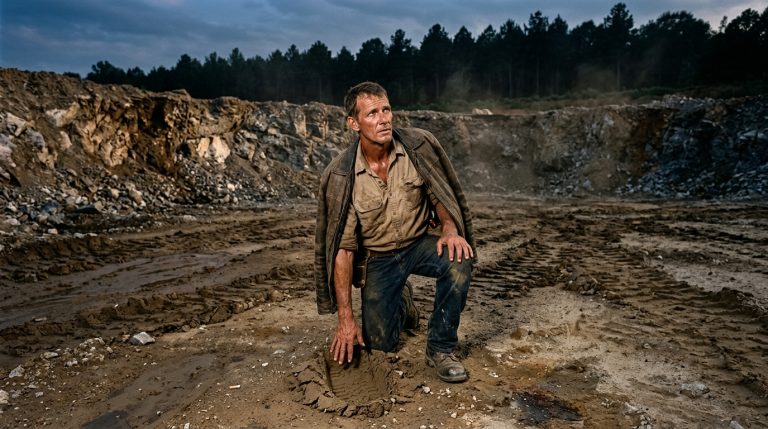
He knelt in the dirt, his flashlight beam revealing a circular depression. He began to dig, his fingers tearing at the dry, unyielding earth. He wasn’t thinking about the stranger, or Leo, or the money. He was thinking about the red cross on the map. He reached a depth of a few inches and his fingers struck something hard, cold, and jarringly metallic.
It wasn’t a marker. It was a steel ammunition box, rusted shut, half-buried in the silt. He gripped the edge and pulled, his muscles straining, the metallic scrape of rust against rust sounding like a scream in the quiet valley. The lid gave way, and he found not a ledger of displacement, but a stack of personal letters—hundreds of them—bound in wire that had long ago eaten into the paper.
He looked at the top envelope. It was addressed to his mother, in his father’s handwriting, dated three days after the official records claimed he had perished in the war. The “displacement” was a myth, a decoy to cover a systematic liquidation of people who knew too much. The true terror of the realization hit him—not that his father was gone, but that he had been alive, nearby, and had been left to rot in this desert, abandoned by the very agency that now wanted this box gone.
The realization shattered the remaining shell of his caution. He stood up, the box clutched to his chest, and turned around, realizing that he hadn’t heard the approach of the other vehicle until the dust began to billow around the wash. They had followed him. They knew exactly where the box was, and they were here to finish the work the desert hadn’t quite managed to complete.
CHAPTER 6: The Decoy Revelation
The headlights grew into twin suns, blinding and white-hot. Elias didn’t look for cover. There was nowhere to run in the flat, pulverized expanse of the wash, and the ammunition box was too cumbersome to discard without losing the only leverage he possessed. He dropped to one knee, pulling the box tight against his chest, his boots sliding in the loose grit as the truck slowed to a halt just yards away.
The engine idled, a deep, rhythmic thrum that vibrated through the soles of his feet. Two figures stepped out, silhouetted against the glare. They didn’t speak; they fanned out with a fluidity that made Elias’s stomach tighten. It was a tactical formation—a closing net. He recognized the movement. It was the same drill he had been taught decades ago, a proprietary rhythm of motion that shouldn’t have been known by anyone outside of his father’s old unit.
“You’re holding onto a lot of history, Elias,” a voice called out. It wasn’t the stranger from the road; this voice was sharper, colder, lacking the gritty cadence of the desert. “That box belongs to the estate. It was never intended for public viewing.”
Elias stood up, his joints aching. “The estate doesn’t exist anymore. Not like this. These letters belong to the families of the people who were erased.”
“Families?” the man laughed, a short, clipped sound. “There are no families. You’re the last one left, and you’re a ghost of a dead man’s legacy. Give us the box, and we can make sure you continue to haunt the desert in peace.”
Elias’s mind raced, searching for an opening. He looked at the box—the decoy. It was exactly what they wanted, the bait he had been maneuvered into uncovering. He realized then that the ledger mentioned in the map, the one he had been expecting, was likely a total fabrication intended to lead him exactly here, to this specific wash, to ensure the destruction of the letters that actually mattered. The ledger was the distraction; these letters were the true, incendiary reality.
“I’m not giving you anything,” Elias shouted back. He shifted his weight, his fingers finding the latch of the ammunition box. He didn’t open it to show them; he opened it just a fraction, pulling out a handful of the letters and dropping them into the dirt, grinding them under his heel.
The reaction was instantaneous. The two men lunged forward, the illusion of their disciplined formation shattering into a frantic, desperate scramble to salvage the papers. They didn’t care about Elias; they cared about the ink.
He didn’t hesitate. He swung the ammunition box—a heavy, improvised weapon—in a wide, bone-crushing arc, striking the first man in the shoulder. The impact was visceral, a sickening crunch of fabric and bone. The man crumpled, and Elias didn’t wait to see the outcome. He shoved the box into the back of his truck, vaulted into the driver’s seat, and slammed the gearshift into reverse.
The truck tires spun, spitting gravel and dust into the eyes of the remaining pursuer. Elias didn’t look back at the wash. He steered the truck into the dark, weaving through the treacherous terrain of the desert floor. He was running, but his mind was burning with a new, sharper clarity. He had the letters. He had the proof of a betrayal that went beyond local land theft—it was a systemic, high-level erasure of an entire community.
As he drove, his mind flickered with the realization that his father had been used as a pawn, trained to build the very system that would eventually discard him. The training he recognized in his attackers was the same training he had carried his entire life. The realization was a phantom limb, a cold, psychological shiver that made his hands tremble on the wheel. He wasn’t just fighting men; he was fighting the mirror image of his own history.
He reached the main road, the asphalt smooth and unforgiving under his tires. He could see the faint glow of the town in the distance—the place where this story would either conclude in a grave or a courtroom. He didn’t head for the police. He headed for the only place that still mattered: the local archive building, a crumbling relic of the town’s history that remained largely unmonitored at this hour. If he could get these letters scanned, if he could upload the images to a secure server, the truth would be impossible to kill.
But as he merged onto the highway, a pair of headlights flickered on in his rearview mirror—not the truck, but a sleek, fast, and silent sedan. They had anticipated his desperation. They weren’t just going to stop him; they were going to ensure he never reached a lightbulb, let alone an archive. The escalation was complete, and he was no longer the protector of a legacy; he was the primary target of an invisible, pervasive power. He pressed the accelerator to the floor, the engine whining in a high-pitched, desperate struggle against the night, the weight of the box in the passenger seat reminding him that he was carrying the burden of an entire generation, and he was quickly running out of road.
CHAPTER 7: The Final Perimeter
The truck swerved, the steering wheel kicking back against Elias’s hands with the force of a live animal. He fought the drift, his boot hammering the brake until the vehicle slewed sideways across the narrow highway, coming to a rest at a forty-five-degree angle across the lane. The sound of shredded rubber slapping against the wheel well was deafening, a wet, rhythmic thwack that seemed to mock his sudden vulnerability.
Elias didn’t wait for the dust to settle. He killed the lights and shoved open the door, rolling out into the cool, biting air of the desert night. He dragged the heavy ammunition box from the passenger seat, his muscles screaming from the exertion, and scrambled toward the cover of a rocky embankment that rose like a jagged, black tooth against the starless sky. He wasn’t breathing; he was vibrating with a cold, singular focus.
In the distance, the sedan’s headlights swept over the horizon, closing the gap with predatory patience. They knew he was crippled. They knew he was cornered.
He dropped behind a boulder, the stone rough and cold against his shoulder. He took a moment to wedge the ammunition box into a natural crevice, then opened it, his fingers moving with agonizing, deliberate care. He wasn’t looking for a weapon. He was looking for the one thing that had been hidden at the bottom of the letters—a key, simple and unremarkable, that had been taped to the back of a photograph of his father.
He didn’t know what it opened, but it was the only piece of the puzzle he hadn’t yet tried.
The sedan pulled up slowly, its lights cutting through the darkness, sweeping over the abandoned truck. The doors didn’t open. Instead, a spotlight ignited from the passenger side, a searing beam that danced over the terrain, searching, probing, catching the glint of Elias’s boot before moving on.
He stayed perfectly still, his pulse barely a flicker, his body molded to the earth as if he were part of the rock itself. He watched through the gap in the stones as a figure exited the sedan—it was the man from the gas station, the one with the windbreaker. He was holding a suppressed pistol, his posture relaxed, arrogant.
“Elias,” the man called out, his voice carrying easily over the wind. “You’ve made this a long night. We’re tired of the chase. Come out, and we leave the letters intact. Try to hide, and we burn the entire ridge. It’s a simple choice for a man who claims to value history.”
Elias watched him. He saw the way the man held the weapon, the way his eyes scanned the perimeter. It was the training again. They were treating this as a clean-up operation, not a negotiation. Elias gripped the small, iron key in his hand, feeling the cold weight of it bite into his palm. It was the key to the archive, he realized—the old archive in town, the one he had been aiming for. They hadn’t just been following him; they had been herding him, waiting for him to reach the only place where the physical evidence could be protected.
He looked at the ammunition box. If he stayed, he died, and the letters would be destroyed. If he fled, he left the archive vulnerable. He looked at the terrain, the way the moonlight cast long, thin shadows across the slope, and he saw the answer. The map. He wasn’t reading it as a map of the land, he was reading it as a map of the infrastructure. The wash didn’t lead to a grave; it led to an emergency drainage tunnel that ran beneath the archive’s foundation, a remnant of the original construction he had helped maintain as a boy.
The man in the windbreaker took a step toward the ridge, his silhouette darkening against the moonlight. “I can see your footprints, Elias. The desert isn’t as good at keeping secrets as you are.”
Elias exhaled, a long, controlled release of tension. He left the ammunition box behind—the letters were already compromised, the narrative already shifting—and began to crawl, not away from them, but toward the drainage pipe hidden under the embankment. He moved with a silent, sliding motion, the iron key pressed against his lips.
He reached the pipe’s rusted, iron grate. It was locked, but as he inserted the key into the heavy, circular padlock, the mechanism groaned and yielded with a soft, metallic click. The sound was swallowed by the wind, but it felt like a gunshot. He slipped inside, the air heavy with the smell of damp earth and stagnant water, and as he began to scramble through the dark, narrow conduit, he heard the first of the flare guns fire, a brilliant, blinding light erupting above the ridge, turning his escape into a stark, neon silhouette. He was beneath them now, moving through the veins of the town itself, and for the first time in his life, he was the one with the advantage of the dark.
CHAPTER 8: The Final Truth at the Archives Heart
Elias pressed his palm against the maintenance door. It was cold, the iron biting into his skin, and he could hear the distinct, heavy crunch of boots on the archive floorboards outside. They had reached the building, and they were methodically checking every entry point. He turned the key in the lock. It moved with a slow, grinding resistance, the sound muffled by the thick, dust-laden air of the pipe. As the lock disengaged, he threw his weight against the door, stepping out into the shadows of the central stacks.
The archive was a tomb of paper—rows of towering shelves groaning under the weight of municipal records, property deeds, and forgotten histories. He moved with the predatory silence of a man who had spent his life navigating the unseen spaces of this town. He didn’t head for the scanners. He headed for the master index, the one place where the true, unredacted records of the valley were kept.
“I know you’re in here, Elias,” the voice echoed through the stacks, hollow and mocking. It was the man from the sedan, his voice bouncing off the high, vaulted ceiling. “There’s no archive left to save. We purchased this land three hours ago. By dawn, this entire structure is scheduled for demolition. You’re fighting a building that’s already dead.”
Elias reached the master index, his flashlight beam trembling as it swept over the rows of ledger spines. He pulled out the one he needed—the thick, leather-bound volume that pre-dated the war. He flipped through the pages, his eyes tearing through the lists of names and land transfers until he found it: the original displacement order, signed not by the military, but by the local council—a council that included the fathers and grandfathers of the men currently running the town.
The “decoy” ledger he had found earlier was just a distraction to keep him off the scent of this, the actual, legal proof of a land grab sanctioned by the very people who claimed to be the town’s stewards. His father hadn’t been a victim of a war; he had been an employee of a land development firm who had realized the scale of the theft and tried to stop it.
“There it is,” the man said, appearing at the end of the aisle. He held a pistol, but he didn’t raise it. He looked tired—a mirror image of the exhaustion Elias felt in his own bones. “You found the ledger. Congratulations. You’ve uncovered a fifty-year-old crime. Does it change anything? The people who signed that are dead. The money is spent. The town you’re trying to protect doesn’t want to be saved. They want to be bought.”
Elias looked at the ledger, then at the man. “If it doesn’t change anything, why are you here?”
“Because it’s my job to ensure that the silence holds,” the man said, taking a step closer. “Not because I believe in the cause, but because the alternative is being part of the wreckage.”
Elias realized then the ultimate truth of the setup. They hadn’t been hunting him to kill him; they had been waiting for him to do the work of finding the ledger so they could ensure it was destroyed, along with the only person who knew it existed.
Elias didn’t retreat. He backed toward the building’s backup generator room, a small space adjacent to the stacks. He didn’t look for a weapon. He looked for the fuel lines—the old, gravity-fed system that powered the building’s lighting. He shattered the glass gauge, the smell of heavy, diesel-like fuel instantly filling the room. He took his lighter from his pocket, the one he used for his pipe, and flicked it.
“You won’t do it,” the man said, his arrogance wavering as the smell of fuel hit him. “You’ll destroy the very history you’re trying to reveal.”
“I’m not trying to save the history,” Elias said, his voice quiet, steady. “I’m trying to make sure it can’t be bought.”
He dropped the lighter.
The flash was instantaneous, a roaring wall of heat that didn’t just consume the records—it illuminated the entire archive in a blinding, purgatorial glow. The man recoiled, his face twisted in horror as the flames leapt up the dry, aged paper. Elias didn’t look back. He scrambled out through the ventilation duct, the heat singeing his hair, the world behind him dissolving into ash and smoke.
As he reached the safety of the dark alleyway, he watched the archive burn. It wasn’t a tragedy; it was a purification. The ledger, the letters, the false maps—it was all going up in a pyre of his own making. He reached into his pocket and felt the small, simple key. He had already scanned the most important documents to a digital drive he had hidden in the town’s water tower two hours ago, before he had ever been cornered. The real truth was safe; the deception was ashes.
He walked away from the fire, the sounds of approaching sirens wailing in the distance like a funeral dirge for a town that was finally, truly, going to have to reckon with its past. He walked toward the edge of town, the desert waiting for him, his back straight, his step light. He found a small, rusted metal tool in the alley—a simple wrench—and he picked it up, feeling its heft. He would return to the site tomorrow, not to mourn, but to begin the work of fixing what could be repaired. He was a Sovereign Protector, after all. He was home.