The Iron Shore of Sentinel Harbor: A Study in Calculated Friction and Institutional Restoration
CHAPTER 1: THE GRAY GATE
The wind off the Atlantic did not blow so much as it scraped, carrying a fine, gray salt-mist that settled into the pitting of the chain-link barrier. Leah Monroe closed her fingers around the webbed handle of her duffel bag, feeling the stiff, dried brine in the canvas. The silver sedan that had dropped her seventy yards outside the perimeter was already a receding pair of red taillights fading into the coastal fog. Before her lay Sentinel Harbor, its crane silhouettes rising through the morning murk like unburied skeletons.
She stepped toward the guard shack. The concrete base of the island was chipped at the corners, exposing rusted rebar that had expanded and split its casing under decades of freeze-and-thaw cycles. Inside the booth, a heater with a bent protective grille buzzed with a dry, metallic rattle. The young Marine didn’t look up from his clipboard; his uniform coat was unbuttoned at the throat, the fabric frayed where the wool met the stiff collar of his undershirt.
“ID,” he muttered, reaching out an ungloved hand without breaking his gaze from a grease-smudged manifest.
Leah slid the plain blue identification card through the slit in the plexiglass. It lacked the gold-leaf border of the Pentagon staff badges or the high-clearance magnetic strips of the Pacific Fleet Command Group. It was the flat, matte plastic of an unassigned administrative transient.
The guard’s thumb ran over the edge of the card, catching on a slight burr in the plastic laminate—a tiny physical discrepancy where the routing codes had been manually sheared down by a cold die in Washington. He flipped it over, his eyes traveling across the name Monroe, L. with the dull neutrality of a man who had looked at five hundred identical names since the mid-watch began.
“Logistics transfer?” he asked, his voice flat.
“Reporting to Reigns’ office,” Leah said. Her voice lacked the sharp, ringing clip of the quarterdeck. It was low, level, and carried the slow weight of the gray water behind them.
Behind the shack, two junior sailors leaned against an unpainted oil drum filled with gravel, their hands wedged deep into their pea-coat pockets. A styrofoam cup sat between them on the concrete barrier, the coffee skin already forming a dark, greasy film in the cold. One of them let out a low snort as she passed, his voice carrying clearly over the thrum of the base generator. “Another clerk to file the back-orders. Maybe this one can find the requisition forms we lost in October.”
Leah did not alter her stride. Her boots, scuffed at the toe where the black polish had cracked to reveal the rough, gray leather beneath, hit the gravel with a rhythmic, unhurried precision. She didn’t look back at the laughter that followed. To her right, the pier road was a stretch of cracked macadam, its potholes filled with brackish water that mirrored the leaden sky. A line of five-ton utility trucks sat in a gravel lot near the fence line, their hoods latched but their tires settling noticeably into the soft earth, green paint peeling in long, brittle flakes like old skin.
She adjusted the weight of the duffel on her shoulder. The strap cut into the muscle through her faded navy hoodie, a dull, familiar pressure. Underneath the heavy cotton sleeve, the skin of her forearm remained covered, the small, indigo outline of the Pacific Fleet trident resting silent against her wrist. She didn’t need the brass on her collar to feel the alignment of the base; she could read it in the loose sag of the perimeter wires, the ungreased hinge of the main gate, and the small, persistent smell of damp fuel that meant a storage tank valve was weeping somewhere down by the water. The outpost was dying of old friction, and she had just stepped inside the gears.
CHAPTER 2: PAPER BURIAL
The glass doors of the headquarters building did not slide so much as they shuddered, their steel tracks clogged with decades of blown coastal sand and salt crust. Leah Monroe stepped over the worn brass threshold, her boots leaving a faint, damp trail of grit on the linoleum. The air inside smelled of industrial floor wax, ancient radiator paint, and the bitter, over-boiled tang of cheap chicory coffee from the ground-floor reception desk.
She dropped her duffel onto the bench near the creaking elevator housing. The metal housing was painted a flat Navy gray that had begun to flake around the rivet heads, exposing patches of red-lead primer beneath. Behind the counter sat Petty Officer Harris, his fingers tapping an uneven, rapid cadence across a keyboard with yellowed, missing keycaps. A half-empty can of energy drink sat near his elbow, vibrating slightly with the low, deep thrum of the building’s subterranean ventilation fan.
“Orders,” Harris muttered without looking up, his eyes bloodshot under the harsh glare of a flickering fluorescent tube.
Leah reached into her pocket and drew out the folded single-page manifest. It was crisp, but the grain of the paper was cheap—the kind used for low-priority personnel transfers whose records were processed through automated bulk queues in Norfolk. She watched his thumb slide the paper across the counter, his skin catching on the ragged edge where the carbon copy had been torn free.
“Third floor,” he said, stamping a temporary base card with a heavy, metallic thud that echoed in the narrow lobby. “Office of Lieutenant Colonel David Reigns. End of the corridor, door on the right. He’ll get you situated in the pool.”
Leah took the card, her fingers touching the cool, slightly greasy film left by the stamp ink. She didn’t look at Harris as he turned back to his monitor, his shoulder blades sharp beneath his chambray shirt. She swung the duffel back over her shoulder, the canvas strap grinding against the seam of her hoodie, and stepped into the elevator cab.
The car rose with a heavy, mechanical groan, the cable vibrating through the iron floor plates directly into the soles of her boots. There were no mirrors inside, only the dull, brushed steel panels scratched with the initials of a hundred transients who had passed through this corridor before her. When the doors scraped open on the third floor, the silence was immediate, thick with the weight of unmoving paper.
The hallway was lined with green linoleum tiles that had cupped and separated at the seams, creating tiny ridges that caught the toe of her boot with every fourth stride. Corkboards hung at regular intervals, their faces hidden behind a dense shingle of outdated directives, weather warnings from three winters ago, and a faded resilience poster whose corner had curled into a yellowed cylinder.
She reached the final door. The frosted glass pane was stenciled with Lt. Col. D. Reigns — Director of Logistics, the black paint cracked into a spiderweb pattern that threatened to peel away at the next hard slam. She knocked twice, the sound flat against the solid oak frame.
“In,” a voice called out. It wasn’t a command; it was an exhalation.
Leah pushed the door open and stepped into a room that looked less like an office and more like a trench carved through an administrative landfill. Stacks of manila folders rose from the floorboards in uneven towers, some held together by rotted rubber bands, others spilling green-lined computer printouts onto the faded rug. Behind a desk of scarred, military-issue mahogany sat Lieutenant Colonel Reigns. His uniform was neat, the ribbons on his chest aligned with a straight edge, but his posture carried the rigid, fragile stiffness of an engine block bolted down under too much torque.
He did not look up immediately. His pen—a cheap plastic ballpoint with a chewed cap—moved across a requisition sheet with a scratchy, irregular bite.
Leah stood at ease, her duffel resting against her calf. Her eyes moved across the desk, navigating the terrain of unapproved vehicle parts requests and fuel vouchers. Near his right hand lay a master division routing slip clamped to a rusted aluminum clipboard. It was here that her eyes stopped. The slip detailed the incoming logistics personnel for the quarter, but the line where her name sat lacked the automated barcode sticker mandatory for all mid-grade administrative arrivals. It was an unlogged discrepancy—a manual bypass that had skipped the automated tracking hub entirely.
Reigns finally set the pen down. The metallic click of the spring was loud in the small room. He rubbed the bridge of his nose, where two red indents showed the weight of his reading glasses, then looked up, his eyes gray and flat like the sea outside.
“Monroe,” he said, his voice carrying the scratchy dryness of a man who spent his days breathing paper dust. “The transfer from Norfolk. Administrative support.”
“Yes, sir,” Leah said. She kept her chin level, her shoulders square but not stiff enough to draw the eye of an officer trained to spot command carriage. “Reporting as ordered.”
Reigns picked up her single sheet of orders, his thumb tracing the scrubbed classification block at the top where the routing codes had been manually cleared. “They told me you had experience with the old requisition system. The manual queues. The ones we use when the primary servers go dark.”
“I know the codes, sir,” she said softly.
He let out a dry, hacking laugh that didn’t reach his eyes. “Good. Because the new system is a phantom. It tells me we have three rotor assemblies sitting in warehouse four, but when my people go down there, all they find is an empty pallet and a puddle of transmission oil. The motorpool is half-paralyzed, communications is running on cannibalized gear, and higher headquarters is measuring my efficiency with an aggregate spreadsheet that doesn’t account for the salt eating the wires.”
He slid a heavy, metal-bound ledger across the mahogany surface. The iron corners scraped the wood, leaving two light white trails in the old varnish.
“You’ll be down in room twenty-three. Major Grace Holloway’s section. She’s sharp, but she’s running on late nights and cold grease. Don’t add to her pile, Monroe. If a form bounces from the supply depot, don’t just dump it back in the tray. Find out who signed the rejection code and make them give you a real part number.”
He looked at her then, his eyes narrowing slightly as he took in the scuffed boots, the faded hoodie, and the complete lack of nervousness in her posture. For a fraction of a second, the silence stretched, the air between them thick with the unsaid weight of two people who understood how machines broke from the inside out.
“I don’t quit easily, sir,” Leah said, her voice dropping into that level register that had once quieted watch centers under fire.
Reigns picked up his pen again, the cheap plastic clicking between his fingers. “We’ll see,” he muttered, already looking down at the next unapproved fuel manifest. “Logistics is down the hall. Room twenty-three. Report to Holloway. And Monroe—keep your head down. The dust in this place has a habit of choking people who breathe too fast.”
Leah took the ledger, its heavy canvas cover rough against her palm, and stepped back out into the gray corridor, the door latch clicking home behind her with the heavy, final sound of an iron gate closing.
CHAPTER 3: THE OIL MARGIN
The brass latch of Lieutenant Colonel Reigns’ office clicked home with a hollow, metallic snap that vibrated through the canvas face of Leah’s ledger. She did not stop to adjust her grip on the heavy book. Turning on her heel, she let her boots find the cupped edges of the green linoleum tiles once more, tracking the narrow, cold corridor down toward the stairwell. Room twenty-three was a basement vault where the floorboards sweated brine whenever the tide rose against the harbor walls, but her orders required an immediate detour to the heart of the station’s physical rot—the motorpool.
She descended the concrete steps, the air turning thick with the smell of unwashed utility wool and low-grade furnace oil. Every landing she passed was dark, lit only by the gray morning glare slicing through narrow horizontal slits in the reinforced concrete masonry. When she reached the ground floor exit, she didn’t pause. She pushed through the heavy steel crash bar, stepping directly back into the slanting rain that scourged the base perimeter.
The walk to the maintenance bays was a half-mile traverse across an open tarmac slicked with an iridescent sheen of leaked diesel and rainwater. Leah walked with her chin down, her hoodie cap drawn forward to shield her eyes from the salt spray. The wind brought the rhythmic, heavy clank-clank-clank of an air-driven impact wrench from the massive corrugated iron structure ahead. The facility bore a faded stencil above the rolling bay doors: Echelons IV & V Maintenance — Keep Clear. The iron sheets of the building were bleeding rust at every seam, the orange scale running down the concrete footings like dried grease.
She stepped inside. The air inside the bay was a cold, pressurized fog composed of hot rubber, pulverized rust, and the sharp, sulfurous bite of old exhaust. Rows of heavy tactical trucks stood elevated on mechanical hydraulic lifts that leaked amber fluid from their packing rings, the puddles below managed by mounds of gray oil-absorbent clay that resembled coarse sand.
In the center of the third bay, surrounded by the disassembled planetary gears of an axle assembly, stood Staff Sergeant Riley Cole. His cover was shoved back on his forehead, his uniform sleeves rolled tight past his elbows to reveal forearms coated in dark, metallic wheel grease. He was snarling at a private who was attempting to clear a cross-threaded nut with a manual breaker bar.
“Drop the bar,” Cole barked, his voice raw from thirty years of shouting over turbines. “You’re stripping the spindle threads. If you gall that steel any deeper, the whole hub is scrap, and we don’t have a replacement allocation left in the system for this quarter. Step back.”
Leah advanced along the yellow safety line painted on the concrete, her scuffed boots making no sound against the grease-slicked floor. She held out the ledger, along with three red-flagged requisition slips she had pulled from the logistics office manifest before descending.
“Staff Sergeant Cole,” she said. Her voice didn’t push through the air; it rode beneath the roar of a diagnostic engine run three bays over, clear and level.
Cole swung around, his jaw set hard beneath a two-day growth of graying stubble. His eyes dropped to the plain plastic transient badge clipped to her chest, then fixed on the red paper slips in her hand. He didn’t reach for them. Instead, he took a soiled rag from his hip pocket and began smeared the black grease across his palms, driving the grit deeper into the creases of his skin.
“Logistics,” he spat, his tone carrying the cold, transactional weight of an NCO who had seen five transfer clerks come and go before the first frost. “Let me guess. More paperwork telling me that the hydraulic seals for my flatbeds are ‘in transit’ from the depot. Let me tell you something about ‘in transit,’ girl. It doesn’t keep a five-ton truck from bottoming out on its bump stops when we load the generators.”
“These are verification logs, Staff Sergeant,” Leah said, stepping closer until she was within arm’s reach of the grease-streaked axle. She did not flinch from the heat radiating off the engine block. “I’m not here to tell you the parts are coming. I’m here to find out why the system says you received them forty-eight hours ago.”
Cole froze, the rag stopping mid-wipe across his knuckles. His eyes narrowed, the skepticism in his face hardening into something sharper, more calculating. He looked at the serial numbers on the top red slip.
“Received?” he whispered, his voice dangerously quiet. “We haven’t seen a logistics delivery truck at this bay since Tuesday. The only thing they brought us was two crates of cold-weather parkas we didn’t ask for and a box of unthreaded bolts. Who signed that manifest?”
“Captain Peterson’s clerk,” Leah replied, her voice remaining entirely neutral, tracking only the raw data. She turned the ledger toward him, pointing to a small manual ink stamp at the foot of the routing column—the same sheared-die mark she had noticed on the gate manifest. “The entry was processed through the off-line manual queue. It bypassed Major Holloway’s desk completely.”
Cole looked from the sheet back to Leah’s face. The mechanics around the bay had gone quiet, the impact wrenches dropping to a collective idle as they watched the exchange. The air between them felt heavy, pressurized by the low hum of the rain on the tin roof above. Cole knew the regulations; he knew that an unverified signature on a parts receipt was a major structural violation, but he also knew that looking too closely at Peterson’s logs usually resulted in a unit’s tool allowance being cut to zero by the end of the month.
“You look new, Monroe,” Cole said, his voice dropping an octave as he stepped into her space, his grease-stained shoulder nearly brushing hers. “Here’s a piece of wisdom from the deck plates. Don’t touch fleet vehicles with your paperwork unless you understand what happens when they don’t move. Rookies shouldn’t be poking around the back-end logs. It makes people… clumsy.”
Leah didn’t back up. She looked down at his forearm, where a faded tattoo of an old construction battalion anchor was partially obscured by a fresh smear of transmission fluid. Her gaze was steady, cold, and entirely devoid of the deference a clerk was supposed to show a senior non-commissioned officer.
“I understand exactly what happens when they don’t move, Staff Sergeant,” she said softly, her eyes returning to his. “A mission fails before it leaves the pier. I’m not asking you to certify an untruth. I’m asking you to mark these three slips as ‘Physically Non-Present’ so I can lock the queue. If we don’t, the system will show this base at eighty percent readiness while your bays are full of dead iron.”
Cole stared at her for five long seconds, his breath coming in short, rhythmic hitches through his teeth. He recognized the tone. It wasn’t the administrative jargon of a clerk trying to clear a desk before 1600; it was the flat, unyielding clarity of someone who had looked at broken machinery under a much darker sky than this one.
He reached out, his thick, grease-darkened thumb grabbing the pen from her ledger with a rough, jerking motion. He jammed the clipboard against his thigh and wrote three words across the red slips, his handwriting a jagged, angry scrawl that tore the top layer of the paper.
“There,” he growled, shoving the ledger back into her ribs. “Non-present. Every single one of them. Now take your papers back to the third floor before the grease ruins your clothes.”
Leah took the ledger back, her fingers checking the wet ink to ensure the notation was clear. She gave him a short, small nod—not a salute, but the quiet acknowledgment of an inspector who had found the first structural crack. She turned back toward the bay doors without another word, her boots tracking the line of yellow safety paint as she stepped back into the cold, gray rain, leaving the mechanics staring after her into the fog.
CHAPTER 4: THE CANNIBALIZED RELAY
The rain did not fall in drops; it flew in flat, gray sheets that slapped against the heavy canvas ledger clamped beneath Leah’s arm. Leaving the greasy warmth of Staff Sergeant Cole’s maintenance bay behind, she kept her eyes fixed on the gravel utility path leading toward the eastern point of the harbor. The gravel ground beneath the thick leather heels of her scuffed boots, each stride calculated to counter the sudden, lateral buffeting of the Atlantic wind. Two hundred yards ahead, isolated behind an internal perimeter of sagging wire mesh, rose the concrete blockhouse of the primary communications hub. Its roof was crowded with an asymmetrical thicket of whip antennas and radar dishes, all hummed with a low, wind-strained vibration that resonated directly into the saturated earth.
She reached the iron security door. The handle was cold, coated in a thick, waxy film of green zinc-chromate paste applied to stave off the maritime scale. She pulled it open, stepping into a narrow vestibule that reeked instantly of hot transformer oil, scorched dust, and the sharp, static tang of localized ozone. The inner steel door was unlatched, vibrating slightly in its frame from the massive air-handling units buried in the floor below.
Leah stepped through into the main operating room. The space was tight, low-ceilinged, and bathed in the sickly amber light of older plasma display terminals. Cable trays hung from the overhead structure like iron vines, packed with thick bundles of black coaxial lines whose braided shielding was fraying at the bends. At the center desk, his headset pushed back until it rested on the thick muscle of his neck, stood Sergeant First Class Daniel Pike. He was leaning over an open equipment rack, a battery-powered inspection lamp held between his teeth, his fingers working inside the chassis with a pair of insulated needle-nose pliers.
“Don’t touch that line,” Pike muttered around the body of the lamp, his eyes tracking a sequence of flickering yellow LEDs on the diagnostic panel. “The current through that bypass is unmetered. If the terminal drops another two volts, the primary transponder loop will dump its buffer, and we won’t have a positive fix on anything within fifty miles.”
Leah didn’t voice an interruption. She moved to the edge of his steel workbench, setting the ledger down on a clear space next to an empty solder spool. Her scuffed boots left two small pools of brackish water on the gray anti-static matting. She waited until Pike pulled his head out of the chassis, the lamp casting a sharp, white circle across the red-flagged requisition forms she had retrieved from her pocket—the ones containing the same manual ink stamp found at the gate and the motorpool.
“Logistics support,” Leah said, her voice dropping below the high-frequency wine of the vacuum-tube amplifiers. “I have the tracking verification for the solid-state relays your section flagged as critical last month.”
Pike took the lamp from between his teeth, his expression hardening as his eyes traveled from her plain plastic transient badge to the red papers. He wiped a hand across his forehead, leaving a faint grey line of dust where his skin had scraped against the top of the chassis.
“Relays?” he said, his laugh short and devoid of humor. “The only relays I’ve seen in thirty days are the ones I cut out of the decommissioned radar trailer behind warehouse three. Look at this frame, Monroe.” He pointed the beam of the inspection lamp into the dark gut of the open equipment bay. “That’s a primary receiver chassis built in ninety-four. The terminal bars are copper-zinc alloy, completely pitted by the salt. The manufacturer stopped drawing the wiring schematics before you finished grade school.”
Leah leaned down, her shoulder nearly touching his as she looked into the illuminated interior. Her eyes didn’t track the dust; they tracked the connections. Two of the massive capacitors at the base of the power supply were wrapped in yellow electrical tape, their lead wires manually soldered to an external jumper block that was screwed directly into the chassis frame. It was a functional repair, but it was highly irregular—a physical discrepancy that proved the base’s critical infrastructure was being maintained purely by localized cannibalization.
“The master system log shows three replacement racks delivered to this sector on the fifteenth,” Leah said, her voice remaining flat, matching the level drone of the machinery. “Signed for by Captain Peterson’s administrative staff. The manifest was routed through the manual off-line loop.”
Pike’s hand tightened around the handle of the needle-nose pliers until the knuckles turned white under the tan skin. He turned his head slowly, his eyes locking onto hers with a sudden, sharp intensity. The air in the blockhouse felt thick, heavy with the dry heat of forty electronic systems operating at ninety percent capacity.
“Peterson hasn’t sent a single crate down this point that wasn’t filled with unshielded patch cords or outdated technical manuals,” Pike said, his words measured, chosen with the careful precision of an NCO who knew how close he was to a safety violation. “On paper, this hub is green. On paper, we have redundancy. In reality, Monroe, we are one hard lightning strike away from going stone deaf. If a storm cell comes in low and cuts the primary line, the tower will have to guide the incoming aircraft with flares and a prayer. Who did you say signed that paper?”
“The stamp belongs to the supply office,” Leah said, her gaze fixed on the pitted copper of the receiver frame. She reached down, her bare index finger tracing the manual ink mark at the corner of the routing form. “It bypasses the regular automated inspection protocol. It means the components are registered as active inventory before they leave the main warehouse yard.”
Pike let out a low whistle through his teeth, his posture straightening until his shoulders squared against the steel framework of the rack. He looked at Leah then, really looked at her, his eyes taking in the absolute stillness of her hands and the complete absence of any clerk-like hesitation in her demeanor. He had seen forty logistics transients in his career; none of them had ever looked at a cannibalized circuit array without blinking, and none of them had ever tracked a routing discrepancy to an off-line manual stamp.
“You’re playing a dangerous game, Monroe,” Pike said, his voice dropping below the hum of the cooling fans. “If you start pulling on that thread, the whole supply chain in this district is going to snap. Peterson has friends at district headquarters who like things exactly the way they are. A quiet base doesn’t get inspected.”
“A quiet base gets broken,” Leah said softly, her blue eyes lifting to meet his with the unyielding iron of a flag officer who had seen ships lost to nothing more than a rusted valve. “Sign the exception block, Sergeant First Class. Mark the components as non-received. I need the raw data locked before the storm cuts the data link to the regional server.”
Pike stared at her, the pliers balanced between his calloused fingers. For three long seconds, the only sound was the rhythmic, high-pitched ping of a line tester tracking an internal short in the adjacent bay. Then, with a single, sharp nod, he set the tool down and took the pen from her hand, pressing the paper flat against the cold steel of the rack as he signed his name across the verification line.
“Non-received,” he said, handing the pen back, his eyes steady on hers. “The line is drawn, Monroe. Let’s see if your office has the stomach to back it when the major gets the report.”
Leah took the ledger, her thumb sliding across the fresh ink to ensure it wouldn’t smudge against the canvas cover. She didn’t offer a promise or an explanation. She turned back toward the inner steel door, her boots striking the anti-static mats with the heavy, unhurried cadence of an overseer marking the boundary of a coming conflict, leaving Pike standing under the amber light of his dying terminals, his lamp already returning to the dark gut of the machine.
CHAPTER 5: THE GATHERING CELL
The heavy iron door of the communications blockhouse clanged shut against its zinc-chromate frame, sealing the static hum of Sergeant First Class Pike’s cannibalized relays behind a wall of cold concrete. Leah Monroe tucked the ledger beneath her jacket, protecting the freshly signed exception blocks from the descending torrent. The Atlantic sky had curdled into an oily black, the clouds low enough to scrape the lightning rods on the warehouse roofs. The wind was a solid wall now, screaming across the tarmac and carrying the bitter smell of unburned furnace oil from the docks. Her scuffed boots found the edge of the service road, each step deliberate as she tracked the dark perimeter back toward the main logistics building.
She entered the basement level of warehouse three through the side loading dock. Inside, the structural iron pillars sweated a thin, salt-crusted moisture that dripped onto the unpainted cement floors. The low buzz of fluorescent tubes provided the only illumination, casting long, jittering shadows across rows of metal shelving. Leah bypassed the central corridor, choosing the rear path that led to the off-line data terminal hidden behind the bulk storage bays.
She pulled a metal stool to the workbench, her movements fluid and silent. The cathode-ray screen of the old tracking terminal blinked awake with a high-pitched whine, illuminating the lines on her face in a cold, greenish hue. Her fingers moved across the keyboard with transactional speed. She wasn’t logging a transfer; she was mapping a systemic leak.
With Pike’s manual exceptions on her lap, she pulled up Captain Peterson’s off-line supply logs. Through subtle, indirect observation of the systemic timestamps, she noticed a sharp physical discrepancy. The digital ledger claimed three hundred high-capacity power units had been physically verified in warehouse four at exactly 0300 on Tuesday. But the gate logs she had reviewed that morning showed the terminal gates were locked down for automated diagnostic testing until 0500 that same day. No delivery truck could have entered. The records had been pre-dated—stamped into the system manually to create a paper layer that hid an empty shelf.
“You’re staying late, Monroe,” a voice said from the shadow of the storage rack.
Leah did not jump. Her hand remained flat on the edge of the ledger as she turned her head. Major Grace Holloway stood under the flickering tube light, her uniform jacket unbuttoned at the neck, her fingers twisting an unlit cigarette. The lines under the major’s eyes were etched deep by weeks of late-night metric reports that never quite balanced.
“Tracing a bounce on the communication relays, ma’am,” Leah said, her voice dropping into the low, steady register that matched the drone of the warehouse ventilator.
Holloway stepped into the green light of the terminal, her eyes dropping to the red slips on Leah’s lap. She didn’t speak for a long moment, the silence between them heavy with the exhaust of a base running on fumes. She reached out, her fingernail catching the edge of the manual stamp on Pike’s signature block.
“Peterson’s mark,” Holloway whispered, her jaw tightening until the muscle flared beneath her ear. “I’ve seen this stamp on six different transponder allocations this winter. Every time I ask for a physical muster of the crates, Peterson produces a signed regional routing directive that takes the inventory out of my jurisdiction. He’s insulated, Monroe. The district office doesn’t want to hear that a logistics captain is running an off-the-books yard.”
“He isn’t running a yard, Major,” Leah said, her blue eyes lifting from the terminal to lock onto Holloway’s tired face. “He’s clearing the records before the shipments even cross the state line. He’s creating a statistical cushion so the command looks operational on the regional dashboard while the actual gear is being diverted elsewhere.”
Holloway let out a dry, breathy laugh that had no warmth in it. She turned her head toward the dark windows, where the rain was now drumming against the glass like iron filings. “And who’s going to stop him? Reigns is buried under a mountain of readiness metrics. If I file a formal non-compliance report, the district commander will suspend our emergency tool budget until an audit is completed. That means Cole’s mechanics don’t get grease, Pike’s hub goes dark, and this base becomes a ghost station.”
“The base is already breaking, Major,” Leah said softly, her hand closing over the heavy canvas cover of her ledger. She didn’t use an administrative label; she didn’t announce her intent. She simply let the physical reality of the numbers on the screen speak for themselves. “The incoming supply aircraft is carrying the high-priority mission kits Cole needs for his flatbeds. If Peterson’s clerk logs those crates into the manual loop tonight, the parts will disappear from our grid before morning.”
Holloway stared at the terminal, the green screen reflecting in her pupils like stagnant water. She reached down, her calloused thumb running over the iron edge of the workbench, feeling the grit and the rust that defined the station’s daily survival. She knew the regulations, and she knew the cost of breaking them.
“The aircraft lands at midnight,” Holloway said, her voice dropping to a low, guarded whisper as she leaned closer to Leah’s shoulder. “Peterson’s team has already cleared the tarmac gate. If you’re going to block that entry log, Monroe, you’ll be doing it without an official counter-signature. If it blows up in your face, Reigns will have to report it as an administrative breach by a transient.”
“I understand the margin, ma’am,” Leah said, her voice level, unyielding.
Holloway gave a single, brief nod, her fingers dropping the unlit cigarette into her pocket as she stepped back into the shadows of the storage bays. “The storm is changing direction. It’s moving off the water faster than the tower predicted. If the data link drops before that flight hits the deck, nobody’s paperwork is going to matter.”
Leah turned back to the terminal, her fingers pressing the keys to lock the diagnostic trace she had established. She didn’t look back as Holloway’s boots retreated down the concrete corridor. She sat alone in the green glow, listening to the iron frame of the warehouse groan against the lateral pressure of the Atlantic cell, her eyes fixed on the countdown timer of the inbound vector.
CHAPTER 6: THE BLIND VECTOR
The old cathode-ray tube screen flicker-died into a sharp green line across its center before snapping into total dark, the internal transformer cooked by a massive external voltage spike. Leah Monroe did not linger on the metal stool. She stood up in the sudden blackness of warehouse three’s rear bay, her fingers automatically locking the canvas strap of her ledger over her forearm. The baseline ventilation drone had stopped, replaced by the immediate, high-register whine of secondary emergency batteries kicking in along the structural iron pillars. Outside the small, reinforced window panes, the storm had achieved a flat, screaming roar that shook the corrugated metal siding of the facility.
She hit the side loading dock door with her shoulder, pushing against the immense lateral pressure of the Atlantic wind. The rain was no longer falling; it was a horizontal spray of freezing sea-brine that cut across the open tarmac like shards of glass. Leah drove her scuffed boots into the slick asphalt, her head down, her navy hoodie instantly saturated and heavy against her neck. The station lights along the pier road were out, leaving only the intermittent, orange flash of a remote yellow warning beacon near the flight line to guide her through the dark. She did not skip a single foot of the quarter-mile traverse, her breath coming in ragged, disciplined gasps as she forced her weight forward into the gale, heading directly back to the isolated concrete blockhouse of the communications section.
When she slammed through the outer iron door of the hub, the vestibule was nearly freezing, the main air-handling units silent. She threw her weight against the inner steel safety door and stepped into a room on the edge of structural collapse.
The primary display terminals were dead, their glass faces black. The space was lit entirely by the harsh, rhythmic rotation of two red emergency strobe lights mounted to the overhead cable trays. The air smelled of high-voltage ozone and fried insulation. Sergeant First Class Daniel Pike was standing at the main console, his headset pressed hard against his right ear with both hands, his teeth bared as he yelled into a battery-powered emergency landline that crackled with violent atmospheric static.
“The tower feed is gone!” Pike shouted, his voice cracking under the load. “The surge took out the line amplifiers on the bridge structure! Cargo flight eight-four-two is under five minutes from the outer marker and they’re running on minimum fuel margins! We don’t have a vector to give them!”
A junior airman sat at the adjacent terminal, his hands shaking so violently he could barely keep his fingers on the backup battery keys. “Ma’am, the automated tracking grid has desynchronized,” he cried out, looking up into the red strobe light as Leah approached the desk. “It’s throwing false echoes across the whole landing sector! It looks like three different targets, but it’s just rain reflection!”
Leah stepped up to the main console, her wet hoodie dripping onto the non-conductive matting. She didn’t look at the manual or ask for a briefing. She reached down, her bare fingers gripping the edge of the aluminum patch frame at the bottom of the rack—feeling the heavy, cold vibration of the emergency generators struggling to hold the voltage loop.
“Pike,” Leah said. Her voice didn’t rise to match the scream of the wind outside or the panic in the room. It was flat, massive, and carried the specific, unyielding timber of a commander who had steered fleet elements through narrow choked channels while under fire. “Clear the primary digital array. Shift the entire terminal feed to frequency three-two-five manually. Now.”
The officer on duty, a lieutenant whose uniform cap was gone and whose shirt was stained with sweat, stepped into her path. “We can’t change the approach protocols during an emergency, clerk! The manual says—”
“The manual was written for a system with active line amplifiers, Lieutenant,” Leah said, her blue eyes fixing his with a cold, kinetic intensity that made him step back two inches into the shadow of the rack. “Frequency three-two-five is an analog multi-band channel. It doesn’t rely on the digital repeater loop on the bridge. It handles the raw signal directly from the tower whip antenna. Pike, pull the jumpers.”
Pike didn’t look at the lieutenant. He dropped the landline handset, grabbed a handful of thick, shielded patch cables from the test bench, and threw himself into the back of the open equipment bay. The sound of his heavy wire cutters snapping through the old copper connectors was a series of sharp, metallic cracks that rose above the howl of the storm.
“Jumpers clear!” Pike called out, his face streaked with black soot where an internal fuse had blown near his elbow. “Analog loop is live on three-two-five! The signal’s going to be dirty, Monroe!”
Leah reached across the airman’s shoulder, her hand taking the heavy black emergency mic from its bulk cradle. She didn’t announce her rank; she didn’t identify herself as an administrator. She simply pressed the transmit bar, her thumb catching on a small, rusted burr in the metal housing.
“Cargo flight eight-four-two, this is Sentinel Harbor Base,” she said into the mesh. Her tone was completely unhurried, flattening the red strobes and the ozone smell into a single coordinate of absolute certainty. “Switch to approach frequency three-two-five. I say again, three-two-five. Confirm when on channel.”
The speaker overhead roared with a deafening torrent of static—the sound of sixty-knot winds tearing at the aircraft’s external antenna arrays. For three long seconds, the room held its breath, the red light rotating across their pale faces. Then, through the crackle of salt interference, a ragged, metallic voice broke through the speaker.
“Sentinel Harbor… this is cargo flight… switching to three-two-five. Reading you… three by three. We are in severe turbulence… fuel warnings active. Requesting immediate vector.”
“Cargo flight eight-four-two, Sentinel Harbor,” Leah replied immediately, her fingers resting lightly on the cold iron edge of the console frame, tracking the micro-vibrations of the emergency power supply. “Maintain heading zero-nine-five. The tower signal is manual, but the line is clear of digital reflection. Step down to two thousand feet. Your ground support is standing by at the line.”
She turned her head to the airman, her voice dropping but losing none of its density. “Forget the automated tracking plates. Get on the emergency landline to the motorpool. Tell Staff Sergeant Cole to bring his portable generator units to the western runway margin now. I want the manual approach lights lit by hand if the primary breaker trips again.”
The airman didn’t hesitate. He grabbed the handset, his fingers moving with a sudden, targeted focus as the order gave him a physical task to anchor his panic.
Leah stood at the center of the dark hub, the emergency mic held level against her jaw, her eyes tracking the single analog needle on the signal-strength meter as it wavered, dropped, and then held its position against the fury of the Atlantic cell. The machine was breaking beneath their feet, but the line was drawn.
CHAPTER 7: THE WHITE UNIFORM
The analog needle on the communication hub’s signal-strength meter had locked firmly into the green sector at exactly 0214, holding steady as cargo flight eight-four-two’s landing gear compressed onto the manual approach line lit by Staff Sergeant Cole’s emergency generators. Leah Monroe did not sleep during the hours that followed the storm’s retreat. She stayed within the lower bays until the wind died to a sharp, icy breath off the Atlantic, watching the cargo crews handle the priority crates under the unblinking eye of Major Holloway’s locked exception manifest. When the first lavender line of dawn cut across the gray rim of the harbor, she left the logistics desk completely, traversing the quiet tarmac toward the commanding officer’s quarters on the hill.
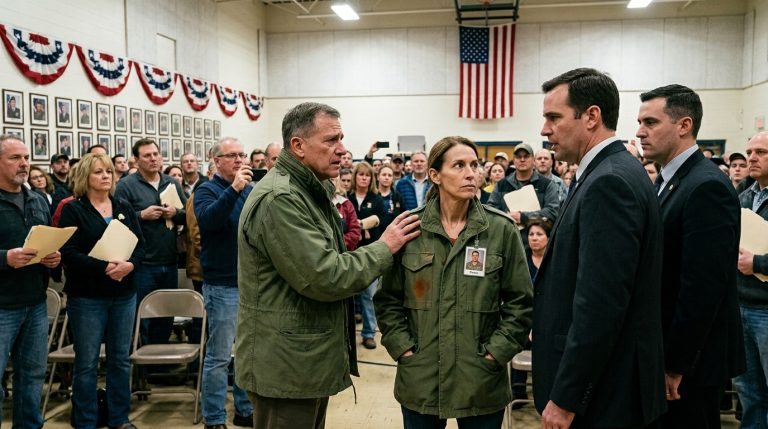
By 0800, the rain had scrubbed the sky until it shone an impossible, pale blue over Sentinel Harbor. The air was a crisp, clear envelope that carried the low, vibrating thrum of the full station assembly gathering on the main parade field. Rows of black boots hit the clean asphalt in absolute unison, the sharp clack-crunch of three thousand sailors and Marines forming a massive, rigid block against the backdrop of the grey harbor cranes. Flags snapped against their high steel ropes with the sound of small firecrackers.
Near the edge of the formation, the atmosphere was thick with the hushed friction of rumors. The morning shift had discovered that the temporary transient who had held the emergency analog loop open during the height of the black-out was gone from her desk, her manual logs sequestered under a division-level seal.
“Some administrative reformer from higher headquarters,” a lieutenant colonel muttered near the reviewing stand, adjusting his white dress gloves. “One of those paper-smart types with an inspection checklist. They’ll be gone before the winter budget locks.”
Behind the motorpool fence sixty yards away, Staff Sergeant Riley Cole stood rigid in his dress blues, a heavy steel wrench still tucked into his belt pocket. His forearm grease had been scrubbed raw with pumice, but the skin was red, his eyes locked onto the podium with a hard, unblinking intensity. Beside him, Sergeant First Class Pike stood with his hands clasped behind his back, his posture unyielding as he monitored the remote speaker link on his lapel.
The master of ceremonies stepped up to the microphone, the metallic feedback a sharp, solitary needle across the asphalt.
“Attention on deck. Prepare for the arrival of the incoming commanding officer.”
The brass band struck up the first heavy chords of the march, the bass drum echoing against the concrete walls of the nearby supply hangar. Every head in the formation turned toward the eastern side of the field.
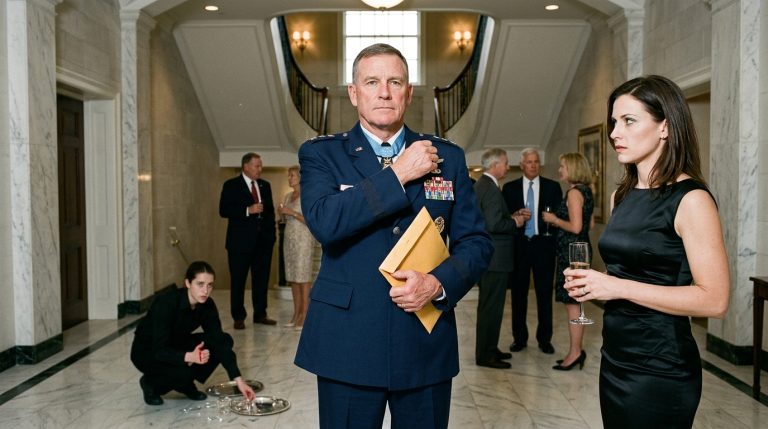
From the shadow of the administration building, a solitary figure stepped into the brilliant morning glare. She did not wear the faded navy hoodie or the scuffed gray boots of a logistics transient. She wore full dress whites, the heavy fabric immaculate, its seams pressed to a razor edge that did not yield to the coastal wind. The polished black shoes caught the low sun, throwing sharp points of white reflection across the black macadam.
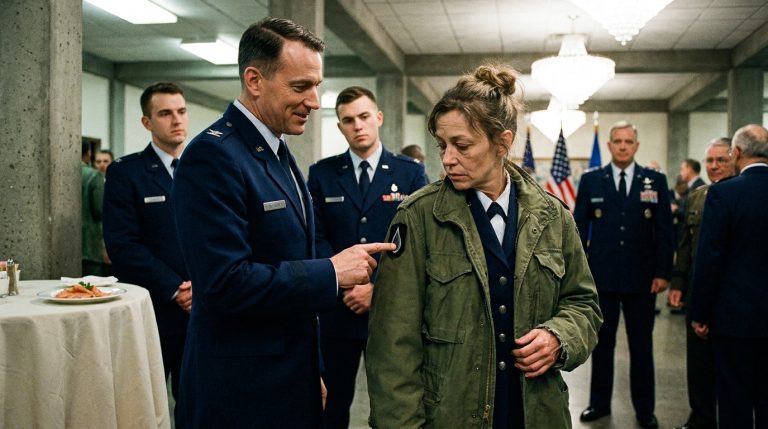
The light found the stars on her shoulder boards—bright, silver, and undeniable. Rear Admiral Leah Monroe walked with a slow, measured stride, her chin parallel to the ground, her hands resting loose at her sides. Every ribbon on her breast, from the Pacific Command Group citations to the small, gold-rimmed combat operational stars, sat precisely aligned to the millimeter.
A collective freeze moved through the front ranks of the formation like a physical shock wave.
Major Grace Holloway, standing at the head of the logistics division block, went entirely pale, her jaw locking so tight the skin around her mouth turned white. Her fingers twitched against the seam of her trousers as her eyes tracked the silhouette of the woman who had sat on a metal stool in warehouse three only six hours prior. Behind her, the junior airman from the communication console swallowed hard, his neck freezing inside his high collar.
The guard who had manuals-inspected her card at the gate stood at full attention near the reviewing stand, his rifle held against his chest. His hand rose to his forehead in a sharp, trembling salute that shook the brim of his dress cap. Recognition hit the base not with a shout, but with a total, suffocating silence that left only the sound of the flag ropes hitting the steel pole.
Leah Monroe ascended the wooden steps of the podium, the wood creaking once under her heel. She paused beside the outgoing commander, her blue eyes sweeping across the sea of white and blue uniforms before her. She did not smile, and her expression carried no triumph. It was the same level, calculating gaze that had took inventory of the pitted copper relays and the stripped axle threads in the dark.
She raised her right hand, the sleeve dropping back just enough to reveal the indigo edge of the Pacific Fleet trident against her wrist, and returned the collective salute of the station with a single, unyielding arc of her arm. The sound of three thousand pairs of boots snapping together in response rolled across the harbor like a single, crisp clap of thunder.
CHAPTER 8: THE CLEAN IRON
The sound of three thousand pairs of boots snapping together in response to her salute rolled across the harbor like a single, crisp clap of thunder, and then the parade field settled into absolute stillness. Rear Admiral Leah Monroe lowered her hand, her gaze locked momentarily with Lieutenant Colonel Reigns before she turned toward the heavy timber doors of the primary administration building. Her white uniform trousers rustled with a stiff, precise friction as she walked, a stark contrast to the soft wet hiss of her old canvas hoodie. She did not delay her transition; she went straight up the concrete stairs, her boots tracking a minimal trail of dry dust across the newly polished entryway floor.
An hour later, the atmosphere inside the commanding officer’s office was quiet, save for the dry scratch of a manual ink pen. The window behind Leah’s mahogany desk looked out over the eastern point, where a salvage barge was already hooked onto the rusted hull of the decommissioned radar trailer. On the dark wood surface lay the single canvas-bound ledger she had carried through the storm, now flanked by two massive folders stamped with the highest administrative security classification.
Captain Peterson stood three paces from the desk frame, his dress uniform immaculate but his face the color of wet lime. His posture was rigid, but his left shoulder dipped slightly—a visceral reaction to the flat green digital printouts Leah had laid out between them.
“The regional routing sheets were signed by district staff, Admiral,” Peterson said, his voice flat, attempting to maintain the defensive stance he had used for months. “The off-line manual loop is an authorized contingency for equipment shortages. The numbers were balanced to ensure our readiness aggregate stayed green on the district dashboard. We were protecting the base’s visibility.”
Leah didn’t raise her tone. She reached down, her index finger touching a physical discrepancy on the top sheet—a manual ink stamp whose sheared-die edge matched the routing logs she had intercepted at the gate terminal during her first watch.
“The aggregate was balanced to trigger automated budget supplements, Captain,” Leah said, her voice dropping into a level register that carried the specific weight of a combat operator who had calculated logistics margins under real ordnance. “You weren’t hiding an equipment shortage. You were creating a paper margin. The parts listed on these manifests never crossed the state line because they were liquidated at the railhead forty miles north. The extra district funds were routed into third-party contractor accounts for infrastructure maintenance that was never performed. That is why Staff Sergeant Cole’s mechanics are using stripped spindles, and that is why Sergeant First Class Pike’s hub was running on cannibalized copper wire.”
Peterson’s jaw tightened, the muscle flaring beneath his cheek as his hand moved toward his pocket—a final, useless gesture of bureaucratic self-preservation. “You start digging into those district accounts, and the whole funding pool for this sector locks down. The base will go dead.”
“The base is being cleaned, Captain,” Leah said softly, her blue eyes meeting his with an unyielding clarity that ended the debate. “The shore patrol is waiting in the anteroom. Hand over your station credentials.”
The captain hesitated for two seconds, his chest rising as if he were about to speak, then his shoulders slumped. He unclipped his base access badge and dropped it onto the desk. It hit the mahogany with a sharp, hollow click. He turned on his heel and walked through the oak door, where two armed Marines closed in on either side of his uniform, their boots clicking in slow, synchronized retreat down the linoleum corridor.
Six months later, the wind off the Atlantic still carried the salt mist, but the friction at Sentinel Harbor had changed its tone.
Leah Monroe walked the perimeter path near warehouse four, her scuffed leather boots hitting the gravel with an unhurried, rhythmic precision. She had replaced the dress whites with her standard utility uniform, the sleeves rolled tight past her elbows. Beside her walked Lieutenant Colonel Grace Holloway, her face clear of the late-night grayness that had shadowed it during the winter black-out. Holloway carried a modern electronic tracking terminal that remained steady, its green data indicators syncing with the regional servers in real-time.
“The final audit from the district office cleared this morning, Admiral,” Holloway said, her voice carrying a resonant, calm confidence. “The diverted funds have been recovered and reallocated to the primary maintenance grid. The manual off-line loop has been deactivated across all sectors.”
Leah didn’t answer immediately. She stopped near the entrance of the primary motorpool bay. The air inside no longer smelled of sulfurous exhaust and old grease; it smelled of fresh sealant and clean turbine oil. Inside, Staff Sergeant Riley Cole was leaning over the engine block of a newly delivered five-ton utility truck. He was using a polished steel torque wrench, his fingers working with a smooth, unhurried precision. He looked up as Leah approached the yellow safety line, his face breaking into a short, small nod of deep professional respect before he returned to the machine.
They walked onward toward the eastern point, where the communications blockhouse stood. The concrete walls had been sealed against the salt spray, and the whip antennas overhead were straight, their copper mountings gleaming under the clear noon sun. Inside the hub, the high-frequency wine of the old vacuum tubes was gone, replaced by the low, steady hum of modern solid-state relays. Sergeant First Class Pike was at the central console, his terminal screens crisp and green, tracking three incoming logistics vectors with zero signal reflection.
Leah reached into her pocket and drew out a small, metallic object she had kept since her first week—a cross-threaded steel nut Cole’s private had stripped during the storm. She laid it on the concrete barrier near the pier road, its raw, gouged edges polished smooth by the constant friction of her fingers. It was a symbolic closure, a physical remnant of a broken machine that had been restored to its proper alignment through practical, unglamorous labor.
The Navy hymn began to echo faintly from the parade grounds down the hill, the brass notes carrying across the calm gray water of the harbor. Leah Monroe drew in a slow, deep breath of the salt air, her hands clasped loose behind her back as she looked out toward the open sea. The base was proud again, its gears clean, its personnel steady, and its command earned not by the brass on a collar, but by the truth discovered in the silence.