The Weight of Stone and Sovereign Earth: A Retiring Engineer’s War Against Suburban Tyranny
CHAPTER 1: THE NOTICE ON THE PORCH
The paper pressed hard against my sternum, carrying the faint, chemical scent of commercial printer toner. Fifty years ago, my grandfather had carved that gravel pit out of the back forty, long before the first vinyl-sided McMansion of Whispering Pines cast its long, artificial shadow over my timberline. Now, a self-appointed queen with a three-ring binder of bylaws stood on my property, demanding I pay to have my own history hauled away or face the seizure of my land.
My fingers didn’t tremble. Twenty years in the Army Corps of Engineers taught me a simple, immutable rule: when an adversary advances with absolute, unearned certainty, they have fundamentally miscalculated the terrain.
“Karen,” I said, my voice dropping into that flat, dangerous register that usually preceded a tactical shift. “You are trespassing, and you have made a grave miscalculation.”
She scoffed, a dry, dismissive sound like gravel sliding down a chute. Her clipboard stayed clutched like a scepter against her chest. “The bylaws are clear, Mr. Henderson. Article Seven, Section Four. Unapproved land modifications and commercial enterprises. We have pictures. We have documentation. You cannot fight this.”
She gestured vaguely toward the dense stand of hundred-year-old oaks marking the ridge that separated my farmhouse from the dormant hollow a quarter-mile away. That gesture triggered a sharp knot of suspicion in my gut. The pit was completely obscured from the subdivision by thick timber. There was no public access, no sightline, and no reason anyone from her committee should have been back there with a camera unless they had crossed my property line with deliberate intent.
I folded the heavy-stock notice into a neat, tight square and tucked it deliberately into my shirt pocket. “You’ll be hearing from my lawyer,” I said, offering the classic, expected response of a cornered man.
Let her think she had backed me into a corner. Let her drive away down my gravel drive in her gas-guzzling SUV, kicking up a cloud of dust that tasted like iron and dry earth. I watched the tail lights vanish around the bend, leaving behind the heavy, cicada-strummed silence of the acreage.
I turned back toward the mudroom, swapped my worn leather slippers for a pair of steel-toed work boots, and grabbed a heavy-duty flashlight from the hook. The sun was beginning its descent, casting long, fractured shadows across the overgrown pasture. My first step wasn’t to call a lawyer or draft a pleading; my first step was to inspect the perimeter, check the physical evidence, and find out exactly who had been walking where they had no business being.
CHAPTER 2: RECONNAISSANCE IN THE DUST
The service road was little more than a pair of parallel dirt scars cutting through the dense timberline, choked with blackberry brambles and knee-high foxtails that hadn seen a tractor blade in a decade. I walked with the steady, measured pace of an engineer measuring a load-bearing wall, my flashlight swinging low in my grip. The evening air was thickening with the metallic dampness of an incoming storm, the humidity sticking to the back of my neck like a wet wool collar.
A hundred yards into the treeline, where the canopy closed overhead to weave a dim, green twilight, the overgrowth abruptly ended.
I stopped. The toe of my boot nudged a patch of damp soil where the weeds had been sheared off clean, pressed flat into the earth by a tread weight far beyond anything my old Ford F-150 could manage. Deep, wide ruts cut into the clay, fresh enough that the moisture was still beading in the grooves left by aggressive commercial lugs. These weren’t the polite, narrow tracks of a suburban crossover or a nosey neighbor out for an evening walk. This was the signature of a heavy tandem-axle dump truck.
My gut tightened with a cold, metallic certainty. Someone had been hauling out of my land.
I didn’t turn back. The rule of reconnaissance is simple: you follow the vector until you find the terminal point, no matter how ugly the coordinates. I kept walking, keeping my eyes locked on the dark line of the tracks as they wound deeper into the property, hugging the base of the steep limestone ridge. The silence of the woods was absolute, save for the rhythmic crickets and the heavy, measured thump of my own boots hitting the packed dirt.
The track curved sharply around a thick stand of hundred-year-old oaks, and the canopy abruptly tore open, revealing the old gravel pit.
I froze at the tree line, my hand coming up to rest against the rough, flaking bark of an oak trunk. The sun-baked, quiet hollow I remembered from my rare visits—a peaceful sun trap where wild turkeys dusted themselves in the gray stone dust—was entirely gone.
In its place was a jagged, bleeding wound in the earth.
An entire section of the western pit wall, rich with the dense, high-grade crushed granite my grandfather had prized for heavy foundation work, had been systematically carved away. Fresh, raw stone faces stared back at me, glittering with pale quartz under the bruised evening sky. Hundreds of cubic yards of material were missing, replaced by wide, muddy pivot turns and the deep, crisscrossing scars of a tracked front-end loader. A discarded cigarette filter, white and sodden with dew, lay half-pressed into the mud near a pool of iridescent hydraulic fluid.
This wasn’t a casual trespass. This was an industrial extraction operation executed with mechanical efficiency.
My fingers tightened around the flashlight casing until my knuckles went pale. Karen’s smug face flashed in my mind, her talk of documentation and bylaws, her absolute, untouchable arrogance. The pieces began to lock together with the brutal logic of a stress calculation under load. They weren’t just complaining about an eyesore; they were manufacturing a paper trail to shut down the very property they were actively plundering, hiding their systematic theft behind the bureaucratic shield of a homeowners association.
I stepped out of the tree line and walked slowly into the center of the scarred hollow, my boots crunching on loose fragments of discarded stone. The air here smelled faintly of diesel exhaust and crushed rock. I knelt, pressing my palm into the damp earth beside the deep print of a heavy work boot—easily a size twelve.
The perimeter was secured, the evidence was physical and undeniable, and the enemy had left their footprints all over the baseline. I stood up, looked toward the distant, hidden line of Whispering Pines visible through the upper branches, and calculated my next vector. I didn’t need a lawyer yet. I needed hard data, and I needed to know how deep the trench really went.
CHAPTER 3: PULLING THE LEDGER
The county records office smelled of damp paper, floor wax, and the quiet, crushing weight of bureaucracy. It was a place designed to make citizens feel small, a labyrinth of metal filing cabinets and high wooden counters where history was reduced to tax lot numbers and acreage valuations. I stood before the waist-height intake counter, my fingers resting on the cold grain of the laminate, waiting for the clerk to return from the back stacks.
Betty, a woman whose gray hair was pulled back into a knot so tight it looked painful, finally emerged from the doorway clutching a stack of heavy ring binders that hit the wooden counter with a dull, authoritative thud.
“Dealing with Karen’s crowd again, are you?” Betty murmured, offering a thin, sympathetic smile that didn’t quite reach her tired eyes. “Bless your heart. Half the county files are just dispute forms with her name on the letterhead.”
“Just looking for baseline documentation, Betty,” I said, my voice low and steady. “Property boundaries, municipal exceptions, and five years of public financial disclosures for the Whispering Pines Homeowners Association.”
She blinked behind her wire-rimmed glasses, sliding the first thick binder across the desk toward me. “Public record, Mr. Henderson. Though I don’t know why you’d want to wade through that swamp. It’s mostly landscaping line items and contract renewals.”
I flipped open the heavy cardboard cover. The pages inside were dense with tables, itemized columns, and corporate signatures. My eyes tracked down the columns, scanning past standard maintenance fees, electricity for the subdivision’s decorative streetlamps, and seasonal plantings. Then, a recurring entry caught my eye, repeating with the mechanical predictability of a metronome across every single quarter of the past five years.
Community pathway and roadbed maintenance.
The figures attached to the line item were astronomical for a neighborhood of beige houses with paved asphalt drives—tens of thousands of dollars allocated every six months for aggregate replenishment and heavy hauling. Below the expense report sat the vendor invoices, crisp corporate letterheads bearing a name I had started tracking down since my boots crunched through the excavated gravel pit: Prestige Landscaping and Hardscapes.
I traced my thumb along the printed total of the most recent invoice. The numbers didn’t represent minor patch jobs on potholes; they accounted for industrial quantities of crushed granite, delivery fees, and heavy equipment operation. They had billed the subdivision’s residents a small fortune for gravel materials over the last half-decade.
My mind flashed back to the raw, bleeding face of the pit wall half a mile from my porch. The math clicked together with the cold, unyielding friction of a gear locking into a transmission. They hadn’t been buying aggregate from an independent quarry down in the valley. They were pulling it for free out of my sovereign 40 acres, billing their own neighborhood top-dollar market rates for stolen stone, and pocketing the difference through corporate accounts.
I pulled out my phone, snapped a clean, high-resolution photo of the vendor ledger page, and let the screen lock. The physical evidence from the pit matched the paper trail in the county records. Betty walked past, dropping a manila folder containing the original 15-year-old survey maps onto the counter.
“Find what you’re looking for?” she asked, pausing to adjust a stack of manila folders.
“Found the blueprint,” I replied, tucking the phone securely into my pocket and closing the binder with a sharp slap that echoed off the linoleum walls. “Now I just need to verify who’s holding the keys to the vault.”
CHAPTER 4: DIGITAL TRAPS AND PERIMETER DEFENSE
The gravel road up to my farmhouse rattled beneath the truck tires, a familiar vibration that usually meant peace, but today carried the distinct frequency of an upcoming engagement. I parked beside the weathered barn, killed the engine, and unloaded a heavy cardboard box from the passenger seat. Inside sat two high-definition motion-activated trail cameras, their ruggedized olive-drab plastic cold to the touch.
An engineer doesn’t wait for an adversary to repeat a breach; an engineer anticipates the vector, hardens the perimeter, and waits for the trigger.
The service road leading back to the stolen granite pit was concealed beneath a thick canopy of oaks, making it the ideal blind spot for unauthorized vehicular traffic. I grabbed a roll of camo tape, a multi-tool, and a handful of mounting brackets from my workbench, then walked briskly down the dirt track until I reached the outer threshold where the commercial tire ruts began.
The air under the trees was cool and damp, smelling of decomposing leaves and wet bark. I selected two mature white oaks flanking the narrowest point of the service track, trees with enough height and girth to keep the digital lenses out of easy reach while granting a wide-angle field of view across the entire dirt path.
Working with methodical precision, I strapped the first camera four meters up the trunk of the eastern oak, angling the lens downward to capture the exact width of the tracks. I camouflaged the plastic housing with strips of bark and dull green tape, blending the device seamlessly into the rough texture of the timber. A quick test sync with my smartphone screen confirmed a crystal-clear, high-definition feed beamed directly to my pocket.
The second camera went up fifty yards deeper along the approach, covering the blind curve where any heavy dump truck would have to slow down and shift gears.
With the digital surveillance array active, the perimeter was no longer porous. Any vehicle coming or going, any footstep crossing the threshold of my land, would instantly ping my device with a time-stamped visual record. They thought they were operating in a forgotten backwoods corner, hidden behind the administrative paperwork of a suburban homeowners association. Now, every load they hauled out would be logged, recorded, and cataloged in real-time.
I wiped a streak of dry soil from my palms, turned my back on the shadowed tree line, and walked back up toward the farmhouse. The trap was set; the next phase required harder numbers, structural depth, and a professional eye to translate the physical theft into undeniable volumetric calculations.
CHAPTER 5: THE GEOTECHNICAL SURVEY
Tom Reynolds filled my grandfather’s old oak kitchen chair like an overloaded transport vehicle. He was a mountain of a man with salt-and-pepper hair and a booming laugh that usually shook loose the dust in any room he occupied, though today his expression was as flat and uncompromising as a concrete slab. His laser transit and GPS rover sat unpacked by the backdoor, their metallic chassis catching the pale afternoon light filtering through the kitchen window.
“Jack,” Tom said, tapping a heavy finger against the lid of his laptop before he even looked up. “I’ve run preliminary calculations on the point-cloud data from your ridge pit. You didn’t just have a few bucketloads skimmed off the top. Someone’s been running a full-scale commercial extraction.”
I pulled out a wooden chair opposite him, straddling the seat and resting my forearms on the scarred oak surface. “How much?”
Tom spun the laptop around. The screen glowed with a complex, three-dimensional topographical wireframe of my forty acres. A massive section of the western ridge was highlighted in a violent, high-contrast shade of crimson, contrasting sharply against the muted green contours of the original county survey maps.
“Look at the delta,” Tom said, tracing the edge of the red volume with a stylus. “Using baseline density metrics for the high-grade crushed granite your grandfather prized, my software calculates approximately nine thousand six hundred cubic yards of material missing from that wall.”
The number hung in the quiet air of the kitchen, heavy and absolute. I didn’t blink. I had seen the raw face of the pit wall, but seeing the loss translated into hard, calculated volume stripped away any remaining ambiguity.
“Current market rate for screened, premium aggregate of that grade,” Tom continued, his voice dropping into professional detachment, “runs anywhere from twenty-five to thirty-five dollars per yard, not counting commercial transport fees. If you factor in the heavy equipment wear, the structural destabilization of the pit slope, and the lack of municipal excavation permits, we aren’t looking at a petty neighborhood dispute. We’re looking at close to three hundred thousand dollars in raw asset theft.”
He reached into his briefcase and slid a heavy, notarized report across the table, stamped with his official state engineering license seal. The paper felt thick, cold, and final.
“You can take this to civil court,” Tom said, watching me closely. “Or you can use it as a crowbar to crack open whatever municipal setup is letting heavy dump trucks onto your property in broad daylight.”
I picked up the report, my thumb brushing the raised seal. The pieces were no longer scattered hypotheses; they were locked coordinates. The physical theft in the pit matched the county records office ledgers, and now Tom’s survey provided the volumetric weight required to break their administrative shield.
“I’m not taking it to civil court, Tom,” I said quietly, sliding the document into my shirt pocket alongside the crumpled HOA notice. “I’m taking it straight to the source.”
CHAPTER 6: FORGING THE ALLIANCE
The screen door banged shut against the timber frame, and Arthur Penhalligan stepped into the kitchen, carrying a thick manila folder under one arm like a ledger at an audit. Close behind him came Marcus Thorn, his sharp eyes scanning the room with the practiced efficiency of a retired detective who never quite switched off his perimeter radar.
They didn’t wait for an invitation. They pulled up chairs opposite Tom’s empty laptop, bringing with them the stale scent of suburban anxiety and the sharp focus of men who had reached their breaking point with Karen’s regime.
“I saw Tom’s truck heading down your drive,” Arthur said, adjusting his glasses as he tossed his folder onto the oak table. “And based on the look of that geotechnical seal sticking out of your shirt pocket, Jack, you’ve got more than just a localized dispute.”
I laid Tom’s volumetric survey report flat between us, weighting the corners with a spare coffee mug. “Nine thousand six hundred cubic yards,” I said, my voice low and steady. “Valued at nearly three hundred thousand dollars in raw aggregate. They aren’t just taking gravel for patch jobs. They’re running a commercial-scale operation out of my back ridge.”
Arthur’s breath hissed through his teeth. As an accountant, the sheer scale of unrecorded inventory movement struck a raw nerve. “That explains the ledger discrepancies,” he whispered, flipping open his own folder to reveal columns of neighborhood maintenance budgets. “For five years, the HOA has poured tens of thousands into a line item called roadbed maintenance. The sole contractor approved for every single yard of material is Prestige Landscaping.”
Marcus leaned forward, resting his heavy forearms on the table. His expression was carved from granite. “And Prestige Landscaping is owned by David Miller,” Marcus added, finishing the equation with cold precision. “Who happens to be the brother of Susan Miller, the HOA treasurer. Karen’s second-in-command.”
The room fell silent, save for the hum of the refrigerator and the distant rumble of thunder rolling across the valley. The pieces were no longer isolated anomalies; they locked together into an airtight framework of systemic abuse. Karen and her inner circle weren’t just protecting property values—they were running a closed-loop financial engine, stealing raw materials from a sovereign parcel and billing their own neighbors a fortune for the privilege of the theft.
“We can’t just hand this to the local magistrate and hope for a clean docket,” Marcus said, tapping a finger against the wood. “Karen has stacked the community board with compliant votes, and anyone who questions her gets hit with selective fines, liens, or intimidation tactics. People in Whispering Pines are terrified of her.”
“Then we don’t attack her directly,” I said, sliding the survey report toward Arthur. “We attack the foundation of her authority. We weaponize transparency.”
Arthur nodded slowly, a hard glint appearing behind his lenses. “We bypass her stonewalling by invoking the minority clause in the HOA bylaws. Ten property owners can legally demand an unredacted audit of all vendor contracts and financial logs. If she refuses, she exposes herself to immediate municipal injunctions.”
“And while Arthur handles the books,” Marcus said, standing up and pacing toward the window that overlooked the darkening acreage, “I’ll start walking the neighborhood. There are dozen of families who have received bogus fines for wind chimes, paint colors, or garden gnomes. We draft a petition for a formal, independent third-party review of the board’s spending. We don’t mention your pit yet. We frame it purely around fiscal accountability.”
I watched them map out the counter-offensive, the accountant and the detective moving with the synchronized discipline of a seasoned command staff. My reconnaissance mission had just evolved into a full-scale insurgency. The trap was set, the perimeter was secured, and the enemy was about to walk straight into an engineered crossfire.
CHAPTER 7: THE POISON PEN AND PUBLIC FRACTURE
The paper was crisp, thick-stock gloss bearing the formal letterhead of Whispering Pines Estates. I unfolded it on the scarred oak table, my eyes tracking down the aggressive, self-righteous typeface penned by Karen herself. It was a special edition circular distributed to every mailbox in the subdivision, a desperate counter-offensive designed to poison the well before Marcus and Arthur could gather the signatures for their audit petition.
She wasn’t just defending her board; she was naming targets.
The paragraph jumped off the page, stark and malicious. She explicitly tied the community’s rising maintenance concerns to outside agitation, directly naming me and painting my sovereign parcel as an active, dangerous commercial hazard threatening their suburban sanctuary. She had taken our quiet tactical flank and dragged it straight into the public square, publishing my name and my property as the scapegoat for her administration’s failures.
A lesser man would have felt a surge of blind anger. An engineer reads the stress cracks in concrete to find where the structure will fail under load.
Karen had just violated her own cardinal rule of administrative control: she had put her panic in writing. By publicly linking my property dispute to the community audit, she had removed any remaining shadow of plausible deniability. She thought she was isolating me behind a wall of neighborhood stigma, cutting me off from local support. Instead, she had handed me the exact piece of combustible evidence needed to blow the doors off her entire operation.
My phone buzzed against the wood, a sharp vibration cutting through the quiet of the room. I picked it up. A notification from the trail camera app flashed across the screen: motion detected at the service road perimeter.
I tapped the screen, loading the live cellular feed. A heavy red dump truck bearing the faded logo of Prestige Landscaping and Hardscapes was rumbling slowly past the second oak tree, its bed laden with fresh stone freshly torn from my ridge. They weren’t even hiding behind discretion anymore; panic made operators sloppy, pushing them to accelerate their extraction schedule before the audit could hit their desk.
I watched the truck rumble deeper into the timberline, kicking up a thick plume of dry dust that settled slowly over the leaves. She wanted a public spectacle. She wanted a visible war across the property line.
I set the phone down, grabbed my heavy work jacket from the peg by the door, and walked out into the cool evening air. The escalation phase had begun. Every extra load they hauled out now was just another recorded felony stacking up against their corporate ledger, and the trap was about to spring shut on all of them.
CHAPTER 8: THE BRIEFING AT THE LAW OFFICE
Ben Carter’s office smelled of aged leather, binding glue, and old coffee. A retired JAG officer who now ran a practice specializing in dismantling aggressively mismanaged homeowners associations, Ben possessed a mind built like a steel trap. He didn’t blink when I dropped the heavy stack of evidence onto his mahogany table.
I laid them out sequentially: Tom Reynolds’s notarized volumetric survey detailing nine thousand six hundred cubic yards of missing granite; the high-resolution trail camera screenshots capturing the Prestige Landscaping dump trucks entering my service road; the unredacted county financial ledgers Arthur had helped pull; and Karen’s latest poison-pen newsletter publicly linking my property dispute to her administrative authority.
Ben leaned back in his leather chair, his fingers steepled beneath his chin as he scanned the top page of Tom’s geological report. A slow, razor-thin smile spread across his weathered face.
“Jack,” Ben said, his voice dropping into a dry, appreciative register. “This isn’t just a civil dispute over property boundaries. This is a complete, self-contained corporate implosion wrapped in a turquoise velour tracksuit.”
“The numbers match the ledger entries,” I said, leaning my palms against the edge of the conference table. “They’ve been pulling raw aggregate from my sovereign parcel for twelve years, billing the subdivision’s residents for premium material they never actually purchased, and splitting the margins through a family-owned landscaping firm.”
Ben pulled a legal pad toward him, uncapping a heavy fountain pen with a sharp click. “Here is our vector of attack,” he said, sketching three crisp points on the paper. “First, a formal cease-and-desist served directly to Prestige Landscaping, cutting off their physical access to your ridge under threat of immediate injunction. Second, a formal notice of impending litigation served to the HOA board, expanding beyond simple trespass into grand larceny, conspiracy, and systematic fraud.”
He paused, looking up from the pad with a sharp, tactical glint in his eye. “And third, the definitive strike: a comprehensive, legally binding invoice totaling over four hundred thousand dollars, covering the full market value of the stolen granite, property remediation costs, and accumulated interest.”
“When do we serve it?” I asked.
“Next Tuesday,” Ben replied, capping his pen. “Whispering Pines has an emergency general assembly scheduled by Karen herself. She’s gathering the entire neighborhood in the community hall to silence the audit petition and publicly reaffirm her board’s control. She thinks it’s going to be her coronation. We are going to turn it into her tribunal.”
The operational parameters were locked. All that remained was to let the enemy march straight into the kill zone of their own making.
CHAPTER 9: THE EXECUTION AT THE ASSEMBLY
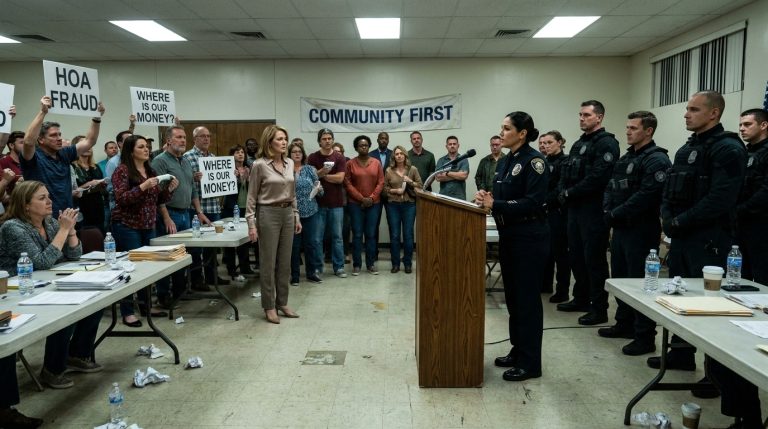
The community hall was packed to the point of suffocation. Rows of folding chairs groaned under the weight of anxious residents, and the air hung thick with stale coffee, low murmurs, and the sharp, defensive tension of a neighborhood bracing for a corporate siege. At the front of the room, behind a long mahogany-veneer table, sat Karen and her board. Karen wore a power-red pantsuit that radiated aggressive authority, her fingers tapping a rhythmic, impatient tattoo beside a chrome gavel. Beside her, Susan Miller, the HOA treasurer, stared down at her lap with pale, bloodless hands.
Karen struck the gavel once, cutting off the room’s whispers with a sharp crack that echoed off the cinderblock walls.
“As you all know,” Karen began, her voice dripping with calculated, theatrical sorrow, “we are here tonight to address a malicious, coordinated smear campaign designed to disrupt the harmony of our community.” She stood up, leaning over the podium as she gestured vaguely toward the back row. “A few disgruntled elements, led by outsiders who refuse to abide by basic rules, are trying to dismantle everything we’ve built. They want to tear down our standards, evade legitimate fines, and waste your hard-earned dues on frivolous witch hunts.”
She paused, building toward her crescendo, her eyes scanning the aisle until they locked triumphantly onto me standing near the back.
“Mr. Henderson thinks the bylaws do not apply to him,” she declared, her voice rising in pitch and volume. “He is operating an illegal, dangerous commercial quarry right on our border, and now he expects us to look the other way while he undermines our property values!”
The room murmured, heads turning back and forth between the podium and where I stood. Karen wore the expression of an empress delivering a final sentence from the throne. She believed she had cornered me in a public pillory.
I didn’t shout. I didn’t rush forward. I simply walked down the central aisle with the measured, unyielding cadence of an engineer inspecting a failing bridge. The crowd parted naturally before me, the tension so thick it felt like walking through water. Ben Carter walked silently at my left shoulder, carrying a single, heavy manila folder. Marcus Thorn held a portable projector and laptop ready by the side staging area.
Karen slammed her gavel down twice, her face flushing a mottled, blotchy crimson. “Mr. Henderson, this is a private association meeting! You have no floor here! Sit down or security will escort you off the premises!”
“You’re right, Karen,” I said, my voice cutting through the hall with a calm, flat resonance that carried into every corner without effort. “I’m not here to debate your fines. I’m here to execute a lien.”
I reached the front table, stepped past the edge of the podium, and laid a thick, legally binding document directly over her speaker notes.
“That is an invoice for four hundred twelve thousand five hundred and fifty dollars,” I said, my gaze locked on hers. “It accounts for nine thousand six hundred cubic yards of premium-grade granite stolen from my sovereign property over the last twelve years by Prestige Landscaping and Hardscapes.”
A collective, sharp intake of breath sucked the air out of the room. Karen stared down at the paper as if it were a venomous insect. Susan Miller let out a low, ragged sob and buried her face in her hands.
“Preposterous!” Karen shrieked, her voice cracking under the sudden weight of the exposure. “Lies! Fabricated documents! We have no contract with them for your land!”
“Oh, but you do,” Marcus said smoothly from the side. He hit a keystroke on the laptop, and the wall behind the podium lit up with a brilliant, high-definition digital display.
The first image to flash across the screen was a crystal-clear, time-stamped trail camera photo of the Prestige Landscaping dump truck rumbling down my service road, loaded to the brim with crushed grey stone. Click. Another slide appeared: the internal county financial records showing five years of astronomical payments from the HOA to Prestige Landscaping under the maintenance line item. Click. Finally, Tom Reynolds’s notarized volumetric wireframe model glowed in violent red, mapping out the exact dimensions of the stolen earth.
“For twelve years,” I said, turning to face the stunned rows of homeowners, “this board has billed your accounts hundreds of thousands of dollars for roadbed maintenance. But they never purchased raw aggregate from an independent supplier. They simply hauled it for free from my ridge, pocketing the margins through a family-owned front company operated by the treasurer’s brother.”
The hall erupted. Shouts of outrage bounced off the walls. Homeowners stood up from their folding chairs, glaring at the front table.
Karen went wild. Her face twisted into a mask of pure panic, and she lunged across the table, not at me, but at the projector stand, trying desperately to knock the equipment over and erase the glowing evidence.
“Silence! You are destroying us!” she screamed, her voice tearing into a desperate screech.
Marcus stepped forward with quiet, immovable authority, gently blocking her path with a solid, professional stance. “It’s over, Karen,” he said softly. “Sit down.”
For a long, agonizing second, she stood frozen, her chest heaving beneath her red pantsuit, realizing with absolute finality that the clipboard, the bylaws, and the manufactured authority had all turned to dust. She slowly sank back into her chair, a defeated bureaucrat staring at the wreckage of her own empire. The vote of no confidence that followed was immediate, unanimous, and absolute.
CHAPTER 10: THE RUSTED TRUTH SETTLES
The fallout from the assembly moved with the relentless, unyielding weight of an engineered demolition. Within forty-eight hours, the legal machinery seeded by Ben Carter and backed by Tom Reynolds’s geological survey locked into place across the district. Prestige Landscaping and Hardscapes folded under the threat of immediate asset seizure, and the insurance carrier representing the Whispering Pines Homeowners Association settled out of court for three hundred and fifty thousand dollars—a sum covering the full material value of the stolen granite, remediation engineering costs, and legal fees.
The criminal investigation, driven by Marcus Thorn’s documentation and Susan Miller’s immediate, cooperative testimony, unraveled the twelve-year embezzlement scheme down to its last fraudulent invoice. Karen and her brother-in-law David faced multiple felony counts of grand larceny, wire fraud, and corporate conspiracy, eventually taking plea deals that traded prison time for heavy restitution and permanent removal from the region.
The community hall meetings changed entirely. Arthur Penhalligan was voted in as the interim president by a unanimous show of hands, his first executive act being the immediate dissolution of the architectural review board and the repeal of every arbitrary fine, restriction, and petty mandate that had terrorized the subdivision for over a decade. The oppressive beige conformity began to fracture under a wave of local color—bright front doors, repaired fences, and an atmosphere where neighbors finally spoke across property lines without fear.
Back on my own forty acres, the physical landscape was undergoing its own transition. I used a portion of the settlement funds to hire an independent, reputable contractor—one who worked with clean paperwork and strict oversight—to remediate the raw scar left behind by the excavation. We regraded the slopes of the old pit, stabilized the limestone sub-base, and reinforced the walls against erosion.
By the following spring, the natural basin filled with clear, cold runoff from the ridge, transforming the scarred hollow into a deep, serene natural pond.
One crisp Saturday afternoon, a group of neighborhood volunteers, led by Marcus and Arthur, hiked down the overgrown service road carrying young maples and saplings. They didn’t ask permission; they just set to work planting new timber along the banks of the water, rooting life back into the dirt where the heavy dump trucks had once torn deep ruts.
Months later, a formal deed of release arrived in my mailbox, executed by Arthur’s new board. It was a legally binding instrument that formally and permanently relinquished any claim, real or imagined, that the Whispering Pines HOA could ever hold over my sovereign parcel. Tucked inside the envelope was a handwritten note from Arthur thanking me for breaking the cycle of administrative tyranny.
The pond became a permanent fixture of the renewed community. Families from the development would walk down the restored path on weekends, their children skipping flat stones across the mirror-like surface of the water. One afternoon, a small girl stopped near the edge, scooped up a smooth, weathered piece of gray granite from the shallows, and looked up at me with wide eyes.
“Is this your rock?” she asked.
I looked down at the stone, feeling the heavy, familiar weight of it in my palm. It was a piece of the exact same geological formation my grandfather had quarreled over fifty years ago, worn down by water and time into something harmless and enduring.
“Yes,” I said quietly, offering a slight nod. “It is. But you can borrow it.”
She smiled, clutched the pebble tightly in her fist, and ran back toward her parents. I watched her go, then turned my gaze toward the rolling hills of my acreage, feeling the deep, settled quiet of the land beneath my boots. The peace I had retired to was no longer a passive, isolated solitude; it was an earned peace, forged in friction and held together by the immutable truth of a community standing shoulder to shoulder. The rust on my old Ford’s tailgate caught the fading golden sunlight, shining like iron and dry earth—a permanent reminder that when boundaries are threatened, the ground beneath your feet is always worth defending.