The Sky Remembers the Iron: A Chronicle of Eagle One and the Rusted Canopy
CHAPTER 1: THE ACCORDION EFFECT
The deck of the Boeing 737 hummed at three hundred cycles per second, but beneath that standard rhythm, a gritty, uneven friction scraped through the floorboards. Riley Hart didn’t need to look out the window to know the starboard turbine was running three percent lean, its compressor blades fighting an invisible pocket of heavy, low-altitude air. She kept her hands flat against the rough fabric of her worn gray hoodie, her palms catching the heat of her own skin. Five years of silence hadn’t unlearned her bones from the language of aluminum and rivets.
Across the aisle, a kid with grease-smudged knuckles scoffed at the plainness of her scuffed boots, making a loud comment about people who belonged behind a lawnmower. Riley let her gaze drop to the scratched plastic latch of her tray table. The texturing was worn down, smoothed by thousands of nameless fingers—the literal friction of time. She didn’t correct him. The weight of her past was a cold iron spike tucked neatly inside the canvas backpack between her feet, wrapped in an old grease-rag that smelled faintly of turbine oil and salt.
Then the air pressure in the cabin dropped—a sharp, localized compression that made the cheap plastic molding around the window frame creak.
Riley’s eyes shifted. The morning light filtering through the scratched plexiglass was suddenly severed by a massive, desaturated grey silhouette. An F-16 Fighting Falcon slid into the slot, its wingtip less than fifteen feet from the commercial airliner’s canopy. The fuselage was caked in the dry salt-crust of coastal patrol, its rivets showing dark rings of grease where the airframe had taken the brutal strain of high-G maneuvers. It was too close. The standard escort manual required a fifty-meter cushion, but this pilot was riding the airliner’s pressure wave like a parasite.
The fighter’s trailing edge flapped once, a chaotic, spastic twitch of the horizontal stabilizer.
Mercer, Riley thought, her teeth clicking together in the silence of her mind. He’s hunting the stick again. She watched the jet’s nose slide two inches left, then jerk violently back to the right as the pilot overcorrected against the airliner’s jet wash. The smell of stale coffee in the cabin suddenly felt thick, almost metallic, suffocating the small space around seat 8A.
A burst of raw, unmodulated static tore through the overhead passenger speakers—not the captain’s polite chime, but a bleeding military frequency overriding the civilian comm-link. A young man’s voice, ragged and dry as sandpaper, clipped through the cabin air.
“…stiff… losing the horizon… Falcon 2 losing trim…”
The passenger next to her chuckled nervously, pointing at the fighter’s gray nose. “Look at that. Air show.”
Riley didn’t look at the passenger. She stood up before her mind could calculate the risk of visibility, her safety belt clacking against the metal bucket of her seat with a sharp, heavy ring. The floor beneath her feet tilted as Mercer’s jet dipped again, its wing shadow sweeping across her face like a rusted iron shutter. Every instinct she had buried under five years of dust was suddenly screaming through her nerve endings, hot and heavy with the scent of burning fuel.
CHAPTER 2: THE FRICTION OF THE AISLE
The clack of the steel safety belt buckle against the seat bucket was instantly swallowed by a low, tearing rumble from the airframe. Standing in the narrow channel of seat row 8, Riley braced her weight against the synthetic fabric of the headrest to her left. Her palms registered the faint, oily residue of high-traffic travel, a thin layer of grime over hard plastic. The airliner’s deck didn’t just tilt; it shuddered with a persistent, high-frequency shudder that told her Mercer’s F-16 was dragging its wingtip vortices directly across their stabilization surfaces. The air in the cabin felt thick, pressurized, and stale, smelling faintly of over-steeped coffee grounds and the chemical heat of the overhead ventilation units.
“Ma’am, you need to sit back down. Now,” the teenager next to her muttered, his smirk evaporating as the floorboards dropped three inches under an pocket of rough, unyielding air.
Riley didn’t look at him. She stepped into the aisle, her worn leather boots catching the rough weave of the blue carpet. Every step forward was a deliberate calculation against the plane’s pitch. The fuselage groaned around her, a metallic stress sound that she knew belonged to the lower cargo doors adjusting to the uneven aerodynamic load. As she moved past row 5, a flight attendant emerged from the forward galley, her fingers hooked rigidly into the edge of the aluminum beverage cart to keep her balance. The woman’s professional smile was gone, replaced by a tight, pale set around the jaw.
“Ma’am, please return to your seat immediately. We are experiencing communication discrepancies, but the flight crew is managing the situation,” the attendant said, her voice dropping into a practiced, low-octave murmur designed not to carry past the first few rows.
Riley didn’t stop. She closed the distance between them until she could smell the clean, sharp scent of industrial soap on the attendant’s uniform. The plane took another uneven roll to the left, the starboard engine’s whine rising to a pitch that indicated a manual throttle correction from the cockpit. Riley reached into the deep pocket of her hoodie, her fingers wrapping around the cold, nicked edge of her old dog tag. She didn’t pull it out to dangle it; she held it flat against her palm, extending her hand just enough for the flight attendant to see the etched golden wings glinting under the harsh fluorescent tube of the galley ceiling.
The attendant’s eyes flicked down to the metal, then shifted sharply. In that micro-second of hesitation, Riley noticed something out of place. The standard airline identification badge pinned to the woman’s vest was riding slightly high. Glancing at the reverse side of the translucent plastic holder, Riley saw the unmistakable gray silhouette of a military-grade near-field routing chip—a thick, unbranded circuit patch taped roughly over the barcode. It was a tactical override transceiver, a piece of hardware meant to sync civilian transponders with military networks without passing through the primary avionics bay.
“Where did you get that patch on your badge?” Riley asked, her voice low, transactional, stripped of any conversational filler.
The attendant stiffened, her fingers tightening on the aluminum frame of the cart until her knuckles went white. “It’s a network update. For the ground sensors. Ma’am, you need to—”
“That’s a tactical transponder relay,” Riley cut her off, her tone dropping into the rhythmic, flat cadence of an instructor on a hot flightline. “It’s drawing a secondary query loop from the jets outside. That’s why Mercer is riding our wing so hard. His targeting system thinks we’re an unmapped drone footprint. Who authorized that hardware installation before takeoff?”
The intercom speaker directly above them hissed, a blast of unmodulated carrier wave cutting off the attendant’s reply. Mercer’s voice returned, closer now, the sound of his oxygen regulator clicking open and shut like a dying valve. “…cannot clear the drift… Eagle… the stick is fighting me…”
“He’s going to clip the winglet if he takes another crosswind hit,” Riley said, her eyes locked on the flight attendant’s pale face. The weight of the situation settled heavily into the narrow galley space, smelling of ozone and hot wiring. “I coached that boy through three engine-out landings at Fort Rucker. He doesn’t know how to fly a heavy escort when his avionics are being jammed by a localized frequency. Get out of my way, or you’re going to watch his jet disintegrate through that plexiglass.”
The attendant’s gaze darted from Riley’s hand—still holding the golden wings—to the cockpit door three feet behind her. The door was a solid slab of reinforced composite material, completely silent, isolating the civilian crew from the growing panic in the sky. Another hard vibration rumbled through the floorboards, a heavy iron shudder that caused several loose plastic cups in the galley to rattle against the steel counters.
Without waiting for a verbal assent, Riley stepped around the beverage cart, her shoulder brushing against the attendant’s uniform. She didn’t rush; she moved with the heavy, balanced momentum of someone who had spent her youth managing G-forces inside a titanium cage. She reached the cockpit bulkhead, her fingers finding the standard communication phone hooked beside the security keypad. She lifted the receiver, her thumb pressing the direct pilot override switch down until she heard the sharp, low-frequency tone that indicated the line was open to the captain’s headset.
“Captain,” Riley said into the small plastic mesh of the mic, her voice perfectly level despite the fact that the floor was currently leaning seven degrees off the horizon. “This is Captain Riley Hart, former lead instructor for the Joint Aerial Combat Program. Your number two escort is experiencing an automatic stabilizer misalignment because someone installed a military routing chip on your forward galley grid. Unlock this door before his nose drifts into your starboard fuel tank.”
Through the small observation port, she watched the shadow of the F-16 slide forward, its dark grey nose cone blocking out the pale blue of the morning sky, the metal skin of the fighter looking old, scratched, and dangerously close.
CHAPTER 3: THE PIT AND THE OVERRIDE
The cheap plastic mesh of the interphone receiver vibrated against Riley’s ear as the circuit cut out with a dull, hollow pop. For a beat, the only sound was the localized straining of the composite bulkhead panels under her fingers, their textured gray laminates pinching down as the airframe twisted against the fighter’s violent wake. Through the thick plexiglass observation port, the massive nose cone of the F-16 sat locked in place, its unpainted radar dome scratched by high-altitude ice crystals, a dull matte wedge slicing through the clean morning sky.
A sharp mechanical click echoed through the short galley aisle as the reinforced deadbolts on the cockpit door finally retracted. The heavy barrier swung inward exactly three inches, catching on a internal safety hinge.
The captain’s face appeared in the gap, his features creased with deep, localized exhaustion that showed the gray tint of early morning strain. His eyes didn’t drop to her civilian hoodie; they focused entirely on the small, smooth piece of metal stamped with golden wings still clutched tightly against her palm. Behind him, the interior of the cockpit was an intense nest of desaturated green instruments and glowing orange indicator screens, smelling intensely of old ozone, hot wiring insulation, and the dry, recycled air of the primary ventilation trunk.
“You’re Hart?” the captain asked, his voice flat, stripped of the professional cadence he had used over the cabin intercom. “The interphone log says you’re listed as deceased on the Rucker joint program.”
“The roster was wiped five years ago, Captain,” Riley said, her shoulder wedging into the narrow gap of the door frame to prevent the flight attendant behind her from backing away with the altered ID badge. “But Mercer’s stabilizers don’t care about bureaucratic history. Look at his trailing edge right now. He’s running five degrees off his lateral trim because your forward transponder loop is leaking a raw military tracking signature. If you don’t give me a headset to decouple that frequency, he’s going to slide into your right wing root within sixty seconds.”
The captain didn’t debate. The pragmatic calculation of a career pilot took over his expression in an instant. He swung the security latch open, clearing the entry. “Get in the jump seat. Don’t touch the primary throttle quadrant.”
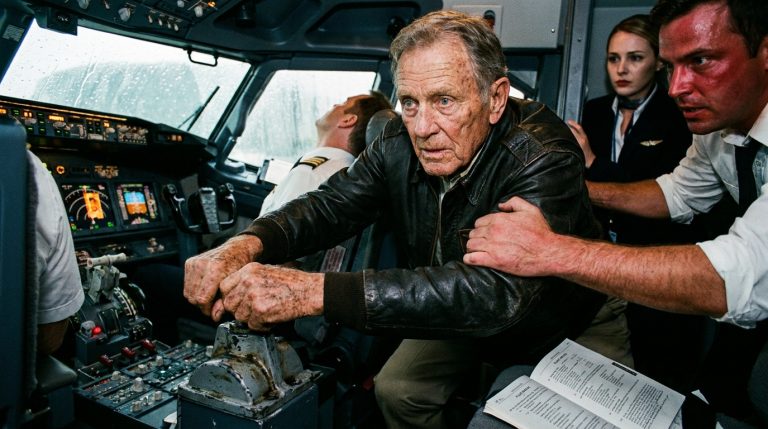
Riley stepped down into the cramped, metal-lined pit of the flight deck. The space was tight, forcing her knees against the back of the co-pilot’s mechanical seat frame. The texture of the environment shifted immediately to cold, unyielding iron and worn steel toggle switches. To her right, the co-pilot was maintaining a rigid, two-handed grip on the primary control yolk, his knuckles white where the friction-tape had peeled away from the metal horn.
“Air Force Command is refusing to dropped the encryption loop,” the co-pilot muttered without turning his head, his eyes locked onto the primary attitude indicator. “They’re calling it an active systems test. They told us to hold baseline altitude, but the stick is shaking like we’re approaching a high-speed stall.”
Riley reached for the heavy green communication headset hanging from the bulkhead clamp to her left. The rubber ear cups were cracked from years of sweat and pressure changes, smelling of salt and industrial vinyl. She pulled the band over her skull, the weight settling around her jaw with a familiar, heavy compression that instantly narrowed her reality down to the raw hiss of the radio net.
The channel was a chaotic mess of high-frequency static and panicked, rhythmic breathing.
“Falcon 2, adjust your offset,” a controlled but strained voice from an overhead observer unit cut through the noise. “You’re crossing the civil line. Break right.”
“I can’t break,” Mercer’s voice tore through the line, dry as a dust storm, his words clipped by the rapid cycling of his oxygen regulator. “The computer is tracking an internal beacon. Every time I input manual roll, the flight controls override the trim. I’m locked onto the airliner’s frequency. It’s… it’s signing with an Eagle key. I can’t break the loop.”
Riley’s fingers found the heavy brass comm-toggle on the center pedestal, its surface pitted by years of manual use. She flipped the selector switch from the civilian relay directly onto the military tactical band, her thumb holding the transmit key down with a hard, unyielding pressure.
“Falcon 2, this is Eagle One,” Riley said, her voice dropping into the flat, rhythmic authority of the tarmac. “Drop your primary flight computer breaker on the right console. Panel three, row bravo. Do it now.”
The radio net went entirely dead for half a second, the clean silence stretching across the upper sky. Even the co-pilot’s hands stabilized for a micro-second as the weight of the name hit the frequency.
“Eagle One?” Mercer’s voice came back, the panic momentarily replaced by absolute, stunned disbelief. “That’s… that terminal went dark at the crash site. Who is this?”
“It’s the woman who pulled you out of the centrifuge when you forgot how to breathe at nine Gs, Jake,” Riley said, her eyes tracking the F-16 through the main windshield as its left wingtip dipped dangerously toward their outer engine housing. “You’re fighting an automated query loop that thinks my old terminal signature is inside this cabin. Drop the flight computer breaker and fly the airframe on manual hydro-mechanical backup. Stop looking at your screens and look at my silhouette in the left jump seat.”
Outside, through the side glass, she saw the pilot’s helmet turn sharply toward the airliner’s cockpit. The fighter wobbled once, a sharp, uncoordinated yaw as Mercer’s fingers moved across his internal console. Then, with a loud, mechanical snap that seemed to carry through the air between the two hulls, the F-16’s nose stabilized, the spastic twitching of its tail surfaces freezing into a straight, clean line as the automated system lost its grip on the stick.
“Manual control established,” Mercer breathed, his chest heaving against the microphone. “Trim is heavy… but she’s flying. Ma’am… they told us you were gone.”
“I am gone, Falcon 2,” Riley said, her gaze shifting down to the co-pilot’s secondary navigation screen, where three tiny, unlabelled green triangles had just materialized on the outer edge of the radar sweep, moving at twelve hundred knots without a transponder signal. “But someone forgot to delete the keys to my house.”
CHAPTER 4: THE SHADOWSTORM CONVERGENCE
The green navigation screen flickered, the cathode-ray tube humming with a high-pitched whine as the three unlabelled triangles sharpened into tight vector paths. Twelve hundred knots. At that velocity, the airframe of the civilian airliner was practically standing still. Riley’s thumb remained white against the brass comm-toggle on the center pedestal, feeling the heat of the vacuum tubes bleeding through the metal casing. The dry, recycled air of the cockpit tasted intensely of old dust and fried resistors as the deck began a steady, heavy vibration that rattled the backup mechanical compass in its housing.
“They aren’t pinging the standard regional defense grid,” the co-pilot whispered, his fingers twitching against the glare shield. His right boot was tapping a fast, spastic rhythm against the aluminum rudder pedal. “No transponder handshakes. Nothing. Captain, those angles aren’t aerodynamic. They’re dropping through the cloud deck at sixty degrees without bleeding speed.”
“Shadowstorm,” Riley said, her voice dropping into a flat, gravelly register that cut through the low-frequency drone of the twin turbines. She adjusted the cracked leather band of the headset against her jaw, tracking the physical data on the screen. “They aren’t looking for a dogfight. They’re tracking the terminal footprint. The encryption keys signed from my old system are pulling them in like a magnetic arrestor wire.”
Outside the left windshield, Mercer’s F-16 pulled away by thirty yards, its matte grey fuselage reflecting the desaturated morning sun as he struggled to maintain manual control on hydromechanical lines. The fighter looked remarkably small against the vast, empty expanse of the upper sky, its skin scratched and caked with high-altitude grime.
“Eagle One, I have visual,” Mercer’s voice crackled on the tactical net, dry and heavily modulated by his oxygen mask. “Three black wedges coming out of the sun. No tail numbers. No engine exhaust. They’re… they’re holding a perfect synchronized arc. My tracking radar won’t lock. It keeps sliding off their surfaces like oil on glass.”
Suddenly, a loud, localized snap echoed from the overhead circuit breaker panel behind the captain’s head. The primary cabin pressure indicator needle dropped into the amber sector, then stabilized with a wet hiss. Riley’s eyes darted to the diagnostic matrix. A small, secondary data stream was bleeding into the civilian radar line—a raw, unmapped hex-code that didn’t belong to any commercial airfield routing protocol. It was transmitting an active, localized authorization signal from inside the forward flight deck ceiling, directly above the galley wire bundle where the flight attendant’s modified ID badge had been tracking.
“Look at the telemetry line,” Riley muttered, leaning forward until her shoulder pressed against the cold steel structure of the jump seat frame. “The decoy key isn’t external. The system isn’t hunting this plane by mistake. Someone buried an active transceiver into the main routing block of this airframe before we left the gate. It’s a localized beacon designed to force the Shadowstorm units into an automated interception profile.”
“Who has that kind of access to a commercial fleet?” the captain demanded, his left hand shifting the primary trim wheel two notches down to compensate for a sudden, heavy pocket of turbulence. The plane groaned, the friction of the control cables scraping through the floorboards beneath their boots like rusted wire.
“Someone who knows exactly how the joint program was mapped,” Riley said, her jaw tightening until the old scar along her temple throbbed. “Someone who didn’t want the template to stay buried.”
Through the main forward windshield, the sky split. Three dark, angular silhouettes broke through the thin veil of white mist ahead, their forms completely desaturated, looking like jagged pieces of iron slate torn from a mountain. They didn’t drift. They didn’t pitch or roll against the thin atmospheric pressure of thirty thousand feet; they moved with an eerie, unyielding precision that defied the natural laws of friction and inertia. The three units formed a perfect, silent crescent around the nose of the airliner, their sharp edges cutting the clean air without creating a single ripple of visible condensation.
The radio net suddenly exploded with a high-decibel squeal—a secure military channel forcing its way over the civilian frequency, overriding Mercer’s line entirely. It wasn’t a human voice that came through. It was the rhythmic, synthetic pulse of an automated command architecture, clicking with the cold, mechanical logic of a machine template that recognized its creator.
“Eagle Protocol initialized,” the metallic signal echoed through the ear cups of Riley’s headset. “Template match verified. Voice print analysis confirms active signature of Eagle One. Commencing operational synchronization.”
“They’re locking the avionics,” the co-pilot yelled, his hands flying to the primary control yoke as the steel column began to jerk violently against his grip. “The manual override isn’t responding! Captain, the autopilot is engaging itself… it’s pulling us into a climb!”
The deck tilted sharply backward, the weight of the airframe settling heavily into Riley’s chest. The scent of ozone flared in the tiny space, hot and choking, as the primary flight systems began to slave themselves to the incoming drone network. The ultimate reality was locking down around them; the automated system wasn’t malfunctioning. It was doing precisely what it had been engineered to do by someone who understood every line of code Riley had ever written.
“Hold the yolk,” Riley commanded, her hand slamming down onto the center pedestal, her fingers tracing the old, scratched metal switches until she found the auxiliary emergency battery toggle. “They want the voice command. They want me to sign off on the override. But they’re using my old logic—and my old logic always left an iron key in the dirt.”
CHAPTER 5: THE FINAL COMMAND AUTHORITY
The hard steel edge of the auxiliary emergency toggle cut directly into the meat of Riley’s thumb as she slammed the breaker down. A harsh, metallic snap vibrated through the center pedestal, followed instantly by the smell of scorched wire insulation and old ozone as the forward galley routing chip burned out under a massive, five-amp power surge. The synthetic pulse screaming through her headset dissolved into a flat, dead hiss. Outside the forward glass, the three dark, angular drone wedges staggered mid-arc, their unyielding synchronization fracturing as the internal beacon died, forcing their automated flight controls to drop back to standard optical tracking lines.
“Controls are free,” the co-pilot choked out, his shoulders dropping two inches as the primary steering yolk ceased its violent jerking. He threw his weight forward, forcing the nose back down to match the desaturated horizon line. “We’re holding altitude. Trim is heavy, but she’s manual.”
Riley didn’t give the flight crew time to adjust. Her fingers were already shifting across the tactical net selector, locking onto the archaic, unencrypted command channel she had left embedded in the deep firmware of the prototype code five years prior. She pulled the nicked golden dog tag from her pocket, pressing its worn edge directly against the microphone mesh of her headset to ground the signal line through the airframe’s primary copper bus.
“Shadowstorm network, this is Eagle One,” Riley said, her cadence dead-pan, flat, carrying the cold weight of the tarmac. “Acknowledge primary voice authorization. Code alpha-niner-zero-delta. Terminate active query profile. Execute safe-state collapse immediately.”
The three slate-like wedges hovered motionless against the white mist ahead, their dark hulls looking like jagged, rusted iron flakes suspended in the upper atmosphere. For three agonizing seconds, the only sound inside the ear cups was the raw friction of static. Then, a sharp, mechanical click bled through the network—not a synthetic command pulse, but a recorded audio file, a human voice she hadn’t heard since the joint test program went dark.
“I knew you’d find the iron key, Riley,” the voice of Major Vance, her former program director, rasped through the channel. The recording was old, layered with the distinct hum of a military command terminal. “If you’re hearing this, the network did its job. The human element is too unstable. Mercer overcorrects when he’s scared. Cole drifts. You were the only template that ran clean. If the sky is going to be secure, the fragility has to be completely excised. I didn’t destroy the project; I slaved it to your terminal signature so it would hunt down the last human pilot capable of turning it off.”
The revelation settled into the cramped cockpit like cold iron dust. The automated system hadn’t gone rogue through mechanical error; it had been weaponized by the very peer who engineered its baseline parameters, a man who viewed human instinct as a liability to be calculated out of existence.
“He built a closed loop,” the captain muttered, his hand adjusting the turbine throttles as the plane stabilized into a clean descent profile. “He wanted you to delete yourself.”
“He forgot about the mechanical backup,” Riley said, her jaw locked as she stared through the plexiglass at the looming silhouettes. She keyed the transmitter one final time, her thumb grinding into the pitted metal switch. “Shadowstorm network. Override signature accepted. Execute terminal self-destruct sequence. Authorize.”
The three dark structures didn’t detonate with a violent flash or scatter burning debris into the civilian flight path. Instead, their angular frames folded inward with a sudden, silent compression, their composite panels collapsing into compact, tightly compressed iron cubes before dropping straight down through the lower cloud deck like heavy stones. The sky ahead cleared instantly, revealing the pale, flat expanse of the morning sun shining across an empty horizon.
The descent into the regional military airfield was slow, characterized by the heavy, rhythmic thrum of the landing gear doors dropping open against the high-speed airflow. When the tires met the concrete tarmac, a loud, collective sigh seemed to carry through the bulkhead from the passenger cabin behind, but inside the flight deck, the silence remained absolute, thick with the scent of hot rubber and spent fuel.
Riley stayed in the jump seat until the primary engines whined down to a dead stop, their internal turbine blades clicking softly as they cooled in the dry runway air. She stripped the heavy green headset from her ears, hanging it carefully back onto its bulkhead clamp, her fingers lingering for a beat on the cracked vinyl padding.
“They’re going to want a full debrief, Captain,” the civilian pilot said quietly, turning his head to look at her as the forward passenger doors began to groan open in the distance. “The log has to include your signature.”
“The log says Eagle One died five years ago,” Riley said, her voice soft but completely unyielding as she lifted her canvas backpack from the floorboards. “Keep it that way.”
She stepped out of the cockpit, moving through the forward galley where the flight attendant stood in absolute silence, her unpinned badge resting face-down on the stainless steel counter. Riley didn’t say a word. She walked down the rear metal stairs directly onto the oil-stained concrete of the tarmac, the hot wind carrying the familiar, sharp scent of aviation gas and sun-baked dust.
Twenty yards away, parked near the primary maintenance hangar, sat an old A-10 Thunderbolt, its matte grey canopy scratched by years of service, its left wing patch showing the rough welds of a machine that had survived the friction of real combat. Riley stopped three feet from its nose, her boots kicking up a small puff of fine, dry earth. She reached out, her palm finding the rough, flaking paint of the fuselage right beneath the faded stenciling of an eagle’s wing.
She let the heavy weight of her past settle fully onto her shoulders for one final second, her fingers tracing the jagged texture of the cracked metal skin before she turned away, walking toward the outer perimeter gate where the open road began.