The Weight of Silence: A Father’s Tactical Unraveling of a Daughter’s Stolen, Fabricated Academic Legacy
CHAPTER 1: THE THRESHOLD
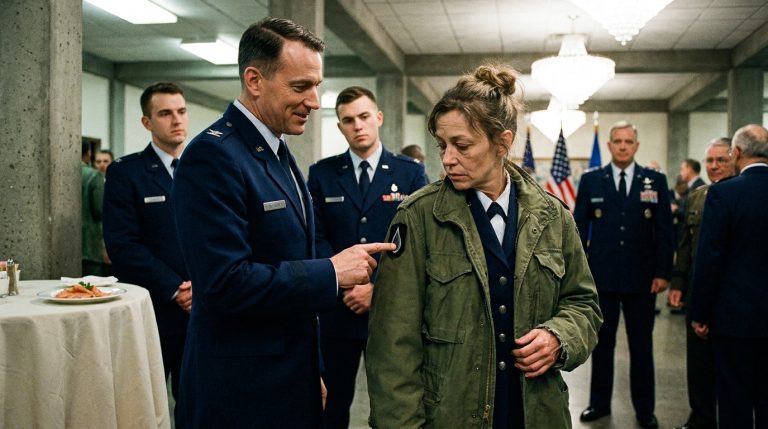
The marble foyer of the university president’s mansion was designed to intimidate, its vaulted ceiling swallowing the sounds of the arriving elite. I stood in my Navy blue dress uniform, the fabric stiff and coarse against skin that had grown accustomed to the soft, worn cotton of a janitor’s work shirt. Every ribbon on my chest felt like an anchor, pulling me toward a gravity I hadn’t felt in fifteen years.
Eleanor glided toward me, her heels clicking against the floor like gunfire. She wore a black dress that looked like it had been tailored from ink and shadows, sleek and utterly devoid of warmth. When she saw me, her eyes flicked over my shoulder, searching for someone—anyone—more important.
“Dad,” she whispered, the word barely a breath of air. She didn’t check my collar or offer a greeting. She merely scanned the room behind me. “The regular suit would have been safer. This crowd… they’re sensitive to optics.”
“Optics,” I repeated. My voice sounded flat in the vast space. I felt the sharp, rectangular corner of the manila envelope against my ribcage. It held 186 receipts. Each one was a testament. Each one was a bullet.
“Sophisticated,” she corrected, her smile not reaching her eyes. It was a cold, efficient expression. “We’re here for the First Generation success fund announcement, not a parade. Just try to keep a low profile. If someone asks, you’re here for maintenance oversight.”
I watched her for a beat, calculating the cost of her gaze. She was checking the room for the Governor, the center of her universe. She was so busy managing the perception of her ‘first-generation’ struggle that she didn’t see the man who had actually lived it standing three feet away.
“I’m not here for maintenance, Eleanor,” I said, my voice barely rising above the hum of the air conditioning.
She didn’t hear me; she had already pivoted, her attention snagged by a group of trustees nearing the appetizer table. She left me standing in the foyer, an inconvenient silhouette against the polished marble. I reached into my pocket and touched the envelope again, feeling the rough paper through the blue wool. The room smelled of expensive cologne and fear. I checked my watch. 7:45 PM. The Governor would be stepping through those doors in less than five minutes.
I adjusted my shoulders, the weight of the Medal of Honor heavy on my chest. Eleanor thought she was the architect of the evening, but she was merely a guest in a house I was about to dismantle. I stepped forward, my boots making no sound on the runner, and moved toward the ballroom.
I stopped. Near the grand staircase, a catering assistant dropped a silver tray. The clatter was deafening, a sudden intrusion of chaos in a room of curated perfection. As the man scrambled to pick up the spilled glasses, I noticed Eleanor’s reaction. She didn’t move to help. She didn’t even look his way. She simply tightened her grip on her champagne flute, her knuckles turning bone-white, her eyes darting toward the ballroom door, terrified that the noise would draw the wrong kind of attention.
She was scared of a dropped glass. She had no idea what was coming for her by dessert.
CHAPTER 2: THE APPETIZER TABLE
The sound of the shattered glass had barely vanished before the foyer returned to its state of strained, artificial elegance. Eleanor didn’t look at the shattered remnants, nor did she acknowledge the young waiter now kneeling in the wreckage, his hands trembling as he collected the shards. She had already pivoted, her shoulders squared, her gaze locked onto a group of three trustees standing near the bar. She was back in character, the youngest, most successful dean in university history, completely divorced from the mess at her feet.
I moved forward, my boots clicking against the marble with a deliberate, heavy rhythm. I wasn’t here to be invisible; I was here to be an observer. I walked past the waiter—noting the sharp gash on his thumb, a small price for clumsiness in a house of glass—and navigated toward the appetizer table.
“Trustee Morrison,” I said, my voice cutting through the ambient hum of polite conversation.
The three of them turned. Morrison, a man whose face was a roadmap of tax shelters and institutional golf courses, blinked at me. His eyes didn’t see a father; they saw a fixture of the building, a piece of the architecture that had somehow detached itself from the wall.
“Raymond,” he acknowledged, his tone dripping with the kind of pleasant indifference one reserves for a gardener or a janitor who’s wandered into the wrong room. “Enjoying the evening? Eleanor’s outdone herself.”
“The evening is still young,” I replied, ignoring the dismissal. I watched his hands. They were resting on the edge of the mahogany table, polished, steady. Beside him, Trustee Chen was sipping a martini, his gaze darting toward the ballroom door every few seconds. They were waiting for the Governor. They were waiting for the announcement. They were waiting for the myth to be carved in stone.
“You look sharp, Ray,” Chen said, gesturing vaguely at my Navy blue uniform with his glass. “Been a while since you’ve been out, hasn’t it?”
“It’s been a while since I had a reason to wear these,” I said. I felt the manila envelope pressing against my ribs—the paper felt like a live wire.
“Well, it’s a big night for the department,” Morrison said, turning his back slightly to include me in the periphery of his attention, but not the center. “First generation success. It’s an inspiring narrative, isn’t it? The kind of story that reminds us why we fund these programs.”
“Inspiring,” I echoed. I glanced across the room. Eleanor was holding court, her hands gesturing in precise, choreographed movements. She was describing a ‘psychological barrier’ to a donor, her face a mask of practiced, earnest empathy. She was the star of her own tragedy, and she was playing it to perfection.
“There are barriers, though,” I said, leaning in. “Financial, logistical. Most people assume the struggle is the lack of money. But sometimes, the real barrier is who you’re standing next to while you’re trying to climb.”
Morrison chuckled, a dry, hollow sound. “You’ve seen a lot of that, I’m sure. Working the halls here, watching the students come and go.”
“I’ve watched more than people realize,” I said. “I’ve watched where the money goes. I’ve watched where the effort goes. And I’ve learned that if you look closely enough, you can tell the difference between a self-made story and one that was bought and paid for.”
Chen paused, his glass halfway to his lips. He looked at me, really looked at me, for the first time. The polite mask wavered for a fraction of a second. He sensed the weight in my voice—the friction of a man who had spent six years scraping survival from the floorboards so someone else could stand on the ceiling.
“That’s a cynical way to look at it, Ray,” Chen murmured.
“Is it?” I asked. I reached into my pocket, my fingers brushing the edge of the envelope. I pulled out a small, white handkerchief and wiped a smudge of dust from my cuff, my movements slow, calculated, and perfectly calm. “Or is it just the truth?”
At that moment, the ballroom doors swung open. A collective intake of breath swept through the room. Governor Walsh had entered, his presence acting like a magnet on the room’s hierarchy. Eleanor’s face lit up with a surge of genuine, desperate relief. She moved toward the entrance with the predatory grace of someone who had just found their lifeline.
I didn’t turn. I stayed perfectly still, watching the trustees watch the Governor. They were predators, too, but they were about to be blindsided. The envelope in my pocket felt heavier than ever, a physical manifestation of the six years that were about to be reclaimed. I didn’t need to chase the moment; the moment was coming directly to me.
“If you’ll excuse me,” I said, turning my back on the trustees. “I have a birthday to attend.”
I walked toward the center of the room, my uniform catching the light, my pace steady, moving directly into the path of the approaching Governor.
CHAPTER 3: THE GOVERNORS SHADOW
The distance between the appetizer table and the ballroom entrance was perhaps thirty feet, but it felt like a tactical maneuver across open ground. I didn’t rush. I walked with the deliberate, heavy-footed cadence of a man who knew exactly how much space he occupied. My eyes remained fixed on Governor Walsh. He was the variable I hadn’t fully accounted for, the wild card who could either serve as the lever to pry Eleanor’s lies open or, if he chose to play the politician, cement them in place.
As I drew closer, Walsh turned his head. His gaze swept over the crowd, dismissing donors and socialites with the practiced ease of a man who had seen it all, until his eyes settled on me. For a second, the mask of the politician slipped. His shoulders squared, his posture shifting into something sharper, more angular—a flicker of the Corporal I had once dragged from a burning vehicle in the desert.
The memory hit me with the force of a physical impact: the smell of burning rubber and kerosene, the blistering heat of the Iraqi sun, and the way the air shimmered with the heat of the fire. I felt the phantom weight of a man’s flak jacket in my hands, the scream of metal being torn apart by an IED. It was a phantom, a ghost of a duty that had never truly left me. I blinked, grounding myself in the sterile, air-conditioned chill of the Michigan mansion.
Walsh wasn’t looking at a maintenance man. He was looking at a relic of his own survival.
Eleanor, still standing to his left, followed his gaze. When she saw me, her expression soured—a quick, sharp tightening of the jaw that she masked almost instantly with a wide, professional smile. She stepped slightly in front of him, as if to block my path, her body language signaling an ownership of the space.
“Governor,” she said, her voice rising in a pitch that signaled performance. “Thank you so much for being here. This program, this center… it’s the culmination of years of work.”
Walsh didn’t look at her. He kept his eyes on me, moving through the crowd with a purposeful stride that forced the guests to part like water. Eleanor’s smile faltered. She looked back at me, her eyes narrow, a silent, desperate command for me to retreat, to vanish back into the shadows of the maintenance closet.
I ignored her. I walked forward until I was within reach of the Governor.
“Staff Sergeant,” Walsh said, his voice low, lacking the performative flourish he’d used for the crowd. He didn’t offer a hand; he offered a nod—a silent, intense recognition that bypassed the room entirely.
“Governor,” I replied.
“You’re wearing the medals,” he noted, his gaze dropping to the Navy blue wool of my uniform. It wasn’t an observation; it was a realization of intent.
“I thought it was time,” I said.
Eleanor moved in, her hand fluttering near her throat, her anxiety beginning to bleed through her composure. “Governor, I’m not sure if you’ve met Raymond. He helps us with the groundskeeping here. Very dedicated, but he can be a bit… informal at these kinds of events.”
Walsh finally turned to her, and for the first time, his gaze wasn’t the warm, political one he used for donors. It was flat, analytical, and cold. “Informal, Dr. Grant?”
“He tends to get overwhelmed by the scale of the university’s mission,” she said, her smile brittle, barely hanging on. “He’s lived a quiet, modest life. I try to protect him from the stress of these gatherings.”
The audacity of it was almost impressive. She was describing a Medal of Honor recipient as a fragile object, a burden to be managed. I felt the manila envelope against my side, the 186 receipts representing 80-hour work weeks, missed holidays, and a lifetime of exhaustion, all being reduced to ‘modest life’ and ‘stress.’
Walsh looked at me again, then back to Eleanor. “I think you might have the wrong impression of your father, Doctor.”
“I think I know my father quite well,” she countered, her voice hardening. “He’s a good man, but he’s never been part of this world. He’s never understood what it takes to rise above one’s circumstances.”
I could see the pulse jumping in her neck. She was terrified that I would say something, that I would break the silence and shatter the mirror she’d constructed for her audience. She was looking at me not as her father, but as a leak in her vessel, a catastrophic failure of containment.
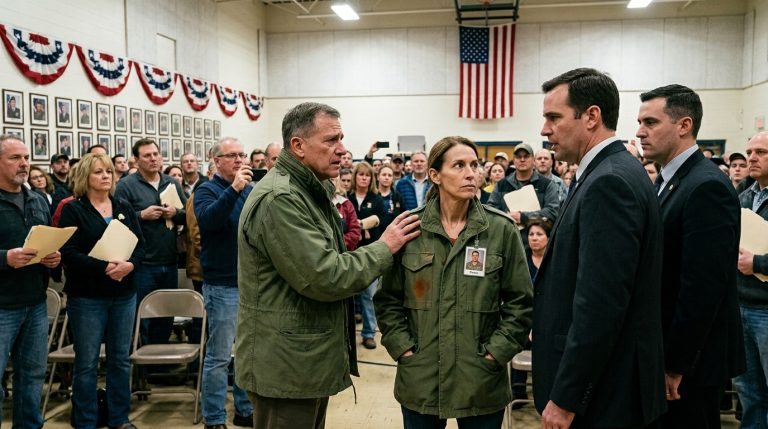
“I’ve lived a quiet life, Eleanor,” I said, my voice cutting through the soft, ambient chatter of the ballroom. I didn’t raise it, but the surrounding guests went quiet, drawn by the sudden gravity of the exchange. “But there’s a difference between being quiet and being invisible.”
“Dad, don’t,” she hissed, leaning close, her perfume cloying and sweet. “Not here. Not now.”
“The Governor was just asking about the center,” I said, turning my back on her and locking eyes with Walsh. “I imagine he’d be very interested in the specific criteria for the success fund. Especially the part about having ‘no family support’ for education.”
Walsh’s eyes flickered—a dark, knowing spark. He stood perfectly still, his hands clasped behind his back, waiting for the next move. He was the judge, and I had just set the stage. Eleanor’s face went pale, a ghost of her former self, and for a fleeting moment, she looked like the girl who used to wait for me in the kitchen while I counted out tuition money on the linoleum table.
She was waiting for me to pull the trigger. And I was just getting started.
CHAPTER 4: THE DINNER TABLE
The silence was not empty; it was heavy, pressed down by the collective weight of ninety-five witnesses. Eleanor’s face remained a masterclass in controlled panic, her eyes darting between Walsh—who stood like a statue of granite—and the nearby trustees, whose interest had shifted from polite curiosity to the scent of professional blood.
“The criteria,” Walsh repeated, his voice low and devoid of the performative boom he’d used earlier. “I seem to recall the donor agreements being quite specific, Dr. Grant. No family history of higher education. A vacuum of support. That was the selling point for the capital campaign, wasn’t it?”
Eleanor managed a laugh, though it lacked any rhythm. “Governor, terminology in academic fundraising is often shorthand for the intensity of the struggle. It’s a pedagogical framework.”
“Pedagogical,” I interjected, stepping into the space between them. I noticed the provost, who had been sitting at the head table, suddenly rise and excuse himself with a frantic, uncharacteristic speed, disappearing toward the side exit. He wasn’t just leaving; he was retreating. “Is that what we’re calling it now? I suppose ‘fraud’ is a bit too blunt for a Georgian estate dinner.”
The room seemed to shrink. A waiter, passing by with a tray of wine, slowed his pace, caught in the gravity of our standoff. I looked at the table—the settings were immaculate, the silver gleaming under the chandelier, yet the entire atmosphere felt like a crime scene where the body hadn’t been discovered yet.
“Dad, you’re exhausted,” Eleanor said, her hand reaching for my arm, her touch a desperate, clawing thing. “You don’t understand the nuances of university policy. Let’s move to the library. We can discuss your… retirement plans.”
“My retirement plans are fully funded by the six years I spent working night shifts here, Eleanor,” I said, letting the words hang in the air. “I don’t need a library. I need an explanation for why the history of those six years was scrubbed from your biography.”
Walsh pulled a small, leather-bound notebook from his inner pocket. He didn’t open it; he simply tapped it against his palm. “Ray, I was looking over the preliminary budget for the Grant Scholarship Fund before I arrived. There’s a discrepancy in the management fees—almost ten percent of the total raised diverted to ‘administrative overhead.’ That seems high for a fund with no staff costs.”
Eleanor’s hand fell away from my arm. The color returned to her face, not in a flush of health, but in the heat of a defensive fever. “The funds are audited. The university oversight committee—”
“The committee that the provost chairs?” I asked, watching the side door where the man had vanished. “The same provost who just left the room? Perhaps he’s gone to check the archives, or maybe he’s gone to shred them.”
The implication hit the trustees like a physical blow. Trustee Morrison, usually the most composed of the lot, stood up. He walked toward us, his napkin still clutched in his hand. “Dr. Grant, is there something about the fund’s financial structure that the board hasn’t been briefed on?”
“There is nothing to report,” Eleanor said, her voice finally breaking. “My father is suffering from a lapse in memory. He is conflating his personal experiences with the professional realities of the university.”
“I remember every single receipt,” I said. I didn’t reach for the envelope yet. It was still in my pocket, a silent, ticking clock. “I remember the stamps. I remember the way the ink looked on the paper when I signed it, ‘Paid in Full.’ I remember the smell of the library at 3:00 AM, the sound of the floor polisher, and the way it felt to know that every cent I earned was buying you a degree that you would eventually claim you earned all by yourself.”
Walsh stepped closer to Eleanor, his shadow falling across her face. “Dr. Grant, as the state’s largest donor to this university, I have a vested interest in the integrity of the capital campaign. If there’s been a misrepresentation of donor funds, the state will not just withdraw its support. It will launch a formal investigation.”
“Investigation,” Eleanor whispered, the word tasting like ash.
I looked at the head table. The university president was watching us, his face a portrait of paralyzed indecision. He knew. He had to know. The entire foundation was built on the lie, and he had been its most vocal champion.
“The library isn’t a bad idea,” I said to Eleanor, my voice cold, surgical. “We can go there, if you like. You can explain it to the Governor, and the trustees, and the cameras that I assume are currently recording this via every guest’s phone in this room.”
Eleanor glanced around. She saw the phones. She saw the faces—not of colleagues, but of witnesses. The mask of the successful academic had finally cracked, revealing the fragile, desperate person underneath, the one who had sacrificed everything—even her own father—to keep from being seen as anything other than a self-made miracle.
She looked at me, and for a second, I saw the truth: she wasn’t hiding from me. She was hiding from the world. She was terrified that if the truth came out, she would be revealed as nothing more than a daughter who had needed her father, and in her mind, that was the ultimate professional failure.
“I didn’t think you would ever come here,” she murmured, a final, pathetic admission.
“I’m a Medal of Honor recipient, Eleanor,” I said, leaning in so only she could hear. “I don’t break under fire. I certainly wasn’t going to break for a lie.”
I turned to Walsh. “Governor, I think the appetizer course is over. Should we move to the main event?”
Walsh smiled, but it didn’t reach his eyes. “I think the truth is a dish best served while it’s still burning, Ray.”
CHAPTER 5: THE PODIUM
The screech was instantaneous and deafening. It hit the ballroom like a physical blow, a high-frequency whine that sent several guests reeling, their hands flying to their ears. The overhead speakers, hidden behind ornate moldings, shuddered and died with a sharp, electronic pop. The sudden silence that followed was even more jarring than the noise; it was heavy, expectant, and suffocating.
I didn’t move. I kept my gaze locked on the podium, where Governor Walsh had been seconds away from speaking. He stood frozen, his hand still gripping the cold metal of the microphone stand as if he were trying to choke the life out of the feedback. Eleanor, standing just to his right, had flinched violently, her composure fracturing under the sudden assault of sound.
“Technical difficulties,” a voice muttered from the wings—the provost, returning with a look of frantic, wide-eyed terror. He scrambled toward the soundboard, his feet sliding on the polished floor.
“Leave it,” I said, my voice projecting clearly across the now-hushed room. I didn’t need amplification. The ballroom was small enough, and the collective anxiety had turned the audience into a singular, listening organism.
Walsh released the microphone stand, his knuckles white. He looked at me, then at the silent, blacked-out lights of the sound equipment. A subtle shift occurred in his posture—the politician fading away, replaced by the man who had faced ambushes in the desert. He didn’t need a microphone to command the room.
“The equipment seems to have given up,” Walsh said, his voice echoing off the vaulted ceilings. “Perhaps it’s for the best. Sometimes, stories are better told without the mediation of electronics.”
Eleanor stepped forward, her movements jerky, frantic. “Governor, we can resolve this in a moment. Please, let’s go to the private office. The staff is working on the system.”
“The system is broken, Eleanor,” I said, moving to stand directly beside the podium. I felt the manila envelope in my pocket; it was the only piece of truth in a room built of vanity and wires. “The system has been broken since the first day you decided to rewrite our history to suit a donor’s preference.”
Trustee Morrison moved closer, his face tight with growing irritation. “Dr. Grant, your father is making some very serious allegations. If there is an issue with the fund’s integrity, the university needs to know now, not after a ‘technical difficulty’ has been resolved.”
“It’s not an allegation,” I said, turning to face the room. I felt the weight of my uniform, the ribbons on my chest—the cost of a life spent in service, not just to the military, but to the daughter I had raised. “It’s an audit. A real one. Every cent that went into that fund, every hour I worked, every sacrifice made in the name of a degree you now claim was earned in a vacuum.”
Eleanor’s eyes scanned the room, looking for a defender, a distraction, an exit. She found none. The trustees were no longer her colleagues; they were investors assessing a failing asset. The guests were no longer supporters; they were witnesses to an unraveling.
“Dad, please,” she whispered, her voice cracking. “Don’t do this to me. I’ve worked so hard for this.”
“You worked for the image, Eleanor,” I said, my voice soft, devoid of the anger I’d felt for years. Now, there was only the cold, hard clarity of a man who had completed his mission. “I worked for your future. The difference is that I didn’t need the world to applaud me for doing it.”
The provost hovered by the side door, his hands trembling as he stared at the soundboard, unable to bring the system back to life. He looked like a man watching a dam break.
Walsh stepped up beside me, placing a hand on my shoulder. It was a firm, steadying weight. “The Raymond Grant Scholarship,” he began, his voice resonant and clear, “was supposed to be announced tonight. But it seems the universe has decided that a simple announcement isn’t enough.”
He turned to the crowd, his eyes sharp as flint. “The fund as it currently exists—the ‘First Generation Student Success Fund’—is being placed under immediate state review. Every dollar contributed will be accounted for, and every claim made by its director will be cross-referenced against the reality of the families who actually built these opportunities.”
Eleanor slumped, her hands gripping the edge of the podium until her knuckles were bloodless. The room went deathly quiet. I reached into my pocket, pulled out the manila envelope, and placed it on the podium. It landed with a soft, final thud—a sound that seemed to ring louder than the feedback screech had.
“The truth is in here,” I said, looking at the room, then at my daughter. “Every receipt. Every time card. Every hour of my life that you tried to erase.”
Eleanor stared at the envelope as if it were a bomb, her world shrinking down to that small, brown package of paper. She looked up at me, and for the first time, I didn’t see the dean, the academic, or the face of a million-dollar success story. I saw a daughter who had finally run out of places to hide.
The dam hadn’t just broken; it had washed everything away.
CHAPTER 6: THE CONFESSION
Eleanor looked at the manila envelope as if it were a predator waiting for her to stumble. Her breath came in short, jagged hitches that echoed in the cavernous silence of the ballroom. She wasn’t just standing on a stage; she was standing on the precipice of everything she had built, and the drop was vertical.
“Pick it up,” I said, my voice quiet, cutting through the heavy, stagnant air.
She didn’t move. Her hands remained pressed against the podium, fingers splayed as if she could hold the wood together by force of will. A cameraman from the local station shifted, the red tally light on his equipment blinking like a judgmental eye.
“Eleanor,” Walsh prompted, his voice surprisingly gentle, which only made it more lethal. “The room is waiting. The records are there.”
She finally reached out, her fingers trembling as she pulled the envelope toward her. When she opened it, the first thing to slide out wasn’t a bank statement, but a receipt—an old, faded slip of paper from 2003, stamped with the mark of the university bursar’s office. I remembered that day; it had been raining, and I had walked three miles to get there because my truck’s starter had failed, and I didn’t want to miss the payment deadline.
She looked at the receipt, then at me. Her eyes filled with an agonizing clarity. For twenty years, she had pushed the memory of that day into the darkest corner of her mind, buried under layers of professional accolades and academic jargon. Seeing it now, physical and undeniable, broke the dam.
“I…” she started, her voice barely a rasp. She cleared her throat, forcing herself to address the sea of faces—trustees, donors, faculty—all of whom were watching her with a mixture of confusion and dawning horror. “I have claimed for years that I am a first-generation student who reached this position through singular, isolated determination.”
She paused, her gaze locking with mine for a fleeting second. The panic in her expression shifted, softening into something deeper—something that looked like the daughter I had once known.
“That is a lie,” she said.
A collective gasp rippled through the room. It was not a polite, dinner-party murmur; it was the sound of a hundred people holding their breath at the sight of a total collapse.
“My father,” she continued, her voice gaining a sharp, desperate edge as she pointed a shaking finger toward me, “did not just ‘help’ with the maintenance of this institution. He paid for every single credit hour of my undergraduate and graduate degrees. He worked three jobs—janitor, security guard, construction—for six years. He didn’t just support me; he emptied his own life so that I could have mine.”
She turned the envelope over, dumping the stack of 186 receipts onto the podium. They fanned out like a deck of cards—a hundred-and-eighty-six small, white shards of paper that effectively dismantled a fifteen-million-dollar facility.
“I chose to erase him,” she said, her voice finally steady, stripped of the professional cadence she’d perfected for years. “I chose to build a narrative of ‘socioeconomic barriers’ because I was ashamed. Not of my father, but of the fact that I needed him. I thought that to be a leader in this environment, I had to be a monument of self-sufficiency. I had to prove that I didn’t come from anywhere, that I arrived fully formed and entirely alone.”
She stepped away from the podium, looking out at the room. She was shaking, her hair slightly disheveled, her dress looking less like an armor and more like a costume.
“I have used this story to raise over two million dollars,” she said, the weight of the confession dragging her shoulders down. “I have used it to build a career, to book speaking engagements, and to secure my position as dean. And every single word of it was bought with my father’s hunger.”
The ballroom remained unnervingly still. The provost, who had crept back into the room, stood by the entrance, his face ashen, looking like he had just witnessed a ritual execution. Trustee Morrison had his head in his hands.
“I am resigning,” she said, the words coming out in a rush, as if she were trying to purge them from her system. “I am resigning from the directorship, and I will be fully cooperating with the university and the state to ensure that the scholarship fund is corrected. I don’t expect forgiveness. I don’t even deserve it.”
She looked at me, a tear tracking a clean line through her foundation. “I just wanted the truth to be out. I couldn’t carry the weight of it anymore.”
She walked away from the podium, leaving the pile of receipts—the physical manifestation of a life’s work—scattered across the polished wood. She didn’t look back. She walked toward the side exit, her head down, passing the frozen guests like a ghost.
I stood at the podium, watching her go. I felt no triumph. I only felt the heavy, ringing silence of a house that had finally been cleared of its debris. The Governor stood beside me, his hand still on my shoulder, steadying me as the room began to stir—the initial shock wearing off, replaced by the chaotic, murmuring reality of what had just happened.
The lies were gone. All that remained was the hard, cold, unvarnished truth, and for the first time in twenty years, I felt like I could finally breathe.
CHAPTER 7: THE AFTERMATH
The ballroom didn’t dissolve; it solidified into a site of inquiry. As the guests began to filter out—some with looks of shell-shocked wonder, others already typing frantically into their phones—the room took on the sterile, cold atmosphere of an interrogation chamber. Trustee Morrison and the university’s legal counsel were already huddled near the head table, their voices low and sharp as they debated the immediate liability of the institution.
I stayed by the podium. My hands, which had gripped the cold wood for so long, felt strangely hollow. Walsh moved toward me, his stride purposeful. He didn’t look like a Governor anymore; he looked like the man who had shared the back of an armored transport, smelling of cordite and sweat.
“You realize what you’ve done, Ray,” he said, not as a question, but as a statement of fact.
“I finished the job,” I replied, my voice raspy. The adrenaline was receding, leaving a hollow ache in my joints that reminded me of my seventy years. “She’s out. The fund is exposed. There’s nothing left to hide.”
“There’s the legal side,” Walsh said, nodding toward the counsel huddling in the corner. “The university will try to minimize the damage. They’ll look for a scapegoat, and while Eleanor has resigned, they won’t want to admit that the president knew. They’ll try to paint her as the sole architect of the fraud.”
I looked over at the President, who was currently avoiding everyone’s eyes, staring intently at the pattern of the ballroom rug. “She’s already taken the fall. That was her choice.”
“She made her choice,” Walsh agreed, his eyes scanning the remnants of the evening. “But you… you’re a hero of the state, Ray. They’ll try to use you, too. They’ll want you to be the face of the new scholarship, to provide the ‘warm’ ending to this cold story.”
I felt a sudden, sharp clarity. The idea of being the face of anything else—of being used again—was intolerable. “I don’t want a podium. I don’t want a memorial fund named after me. I just wanted my daughter back.”
“You might have to settle for the truth,” Walsh said. He placed a hand on my shoulder again, a gesture of solidarity that felt more real than the medals pinned to my chest. “The audit starts at 8:00 AM. They’ll want your testimony. Not as a hero, but as a witness.”
I walked out of the ballroom, through the foyer where I had stood only hours ago. The marble floor felt different beneath my boots—less like a pedestal and more like a path. Outside, the night air was cold, biting against my skin. The rain had begun to fall, a fine, icy mist that turned the parking lot lights into blurred halos of neon.
I found Eleanor standing by her Honda, her shoulders hunched against the wind. She wasn’t crying anymore. She looked small, stripped of the designer clothes and the institutional power. She looked like the girl who used to study in the light of a desk lamp I’d bought at a garage sale, the girl who didn’t know yet that the world would demand she be something other than herself.
“Dad,” she said, her voice barely audible over the sound of the rain.
“You’re going to have to talk to them,” I said, stopping a few feet away. I didn’t reach out; I didn’t want to offer a comfort that would feel like an erasure of what had just happened. “The lawyers. The state investigators. Don’t leave anything out. Not for their sake, and not for yours.”
“I know,” she said, looking down at the pavement. “I just… I keep thinking about that apartment. How much I hated it. How much I wanted to escape it, and you, and the way the paint peeled off the kitchen walls.”
“That apartment was all I could give you,” I said, the words heavy but firm.
“I know that now,” she whispered. “That’s the worst part. I spent twenty years running from the only thing that was ever actually real.”
She looked up, her eyes wide and wet. “What happens to us now?”
“The audit happens,” I said. “And after that, we start over. But this time, we don’t build it on receipts and lies. We build it on who we actually are.”
I turned away, heading toward my old truck, its worn hood reflecting the harsh, unforgiving light of the parking lot. I didn’t look back to see if she was following. I just kept walking, feeling the weight of the night settle into my bones, knowing that for the first time in two decades, I was carrying nothing but the truth.