The Cold Geometry of Vengeance: How a Snowstorm and Silence Broke an Empire
CHAPTER 1: THE TENSION OF CRUSHED CHROME
The winch cable didn’t hum; it shrieked.
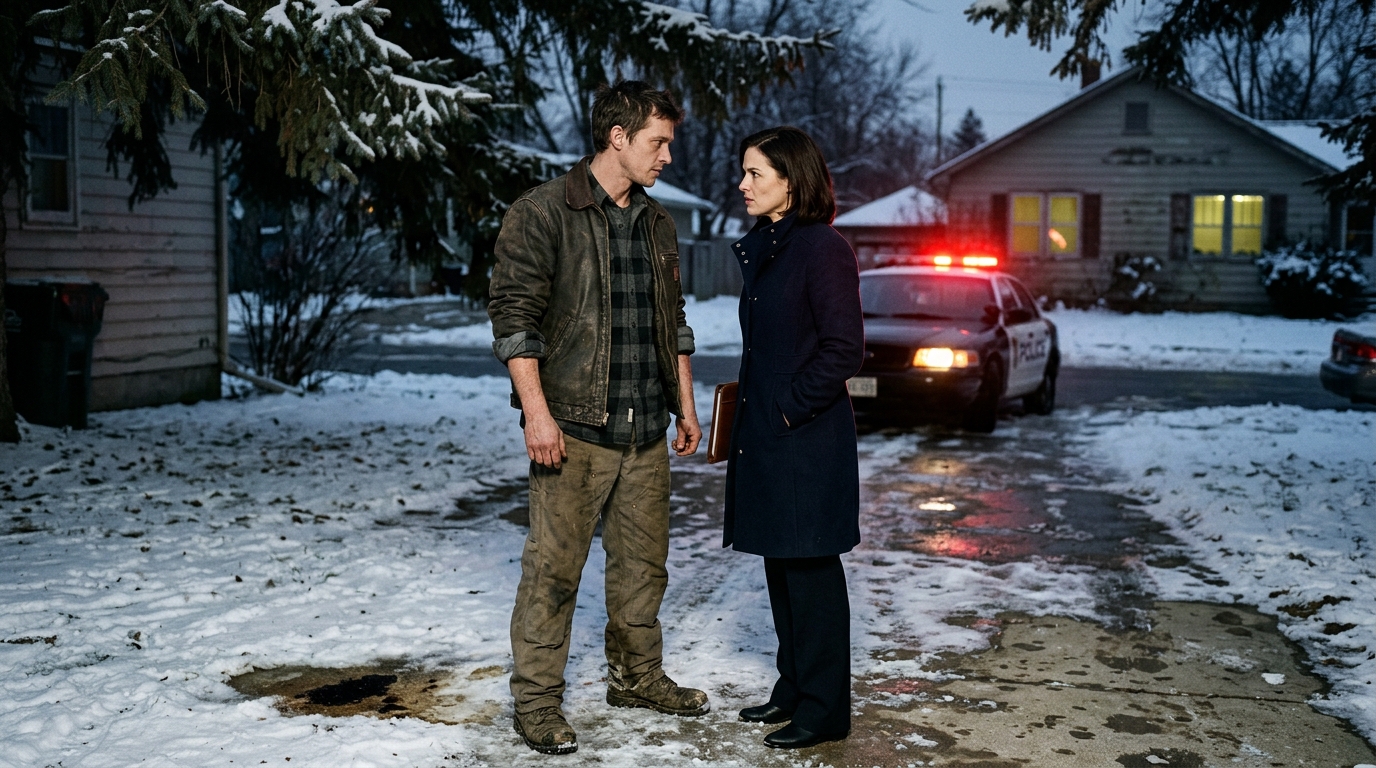
Steel teeth bit into the undercarriage of the 1967 Mustang Fastback, tearing through decades of hand-buffed lacquer like dry paper. Snow dropped from the pine branches above, dusting the crumpled hood where red emergency lights painted the white driveway in rhythmic, bloody pulses.
I rolled a brass spark-plug gap tool between my thumb and index finger. Cold metal against raw skin.
“He’s negligent! He’s a public safety hazard!” Evelyn Hartman’s voice cut through the diesel exhaust. She stood two feet inside the property line, her tailored wool coat pristine despite the slush kicking up off the tow truck’s rear duals. “Look at this mess! He belongs in an assisted facility, not managing heavy machinery!”
My grandfather didn’t move. He stood on the porch step, thin flannel shirt open at the collar, his breath coming in shallow, frosty plumes. His hands, thick with old scar tissue from forty years in the rail yards, stayed jammed deep into his coat pockets. He looked at the shattered windshield, then at the snow under his boots.
He didn’t say a word.
“Officer, write it down,” Evelyn demanded, turning her back on the porch to face the younger patrolman. “The car rolled out of his garage without functioning brakes. It hit my son’s vehicle at the intersection. My boy is in the hospital right now because this old man can’t accept his own limitations.”
The officer clicked his pen. He didn’t look at the garage doors—which were still locked from the inside with heavy brass padlocks. He didn’t look at the drag marks either.
I looked.
The skid lines didn’t start in the driveway. They started fifty feet down the public road, curving toward the house, deep grooves gouged into the packed ice by a vehicle accelerating hard, not rolling backward.
“You’re not signed onto the deed, boy,” Evelyn said, spinning toward me as her leather boots crunched over the ice. She stopped four inches from my chest. Her perfume smelled like cheap lavender over industrial de-icer. “This is an HOA matter. Private property guidelines. You have five minutes to step off this driveway before I have you cited for interference.”
I didn’t step back. I kept rolling the brass tool across my knuckles.
“The winch hook is set to the rear axle,” I said. My voice was flat. Low. “If the car rolled out forward, the front bumper would be caved. The front bumper is untouched.”
Evelyn’s jaw tightened. A micro-tic flared near her left eye, buried under layers of foundation. She snapped her coat tight. “The report is already filed. The damage speaks for itself.”
Behind her, near the idling cruiser, her nineteen-year-old son sat in the passenger seat. His left arm was wrapped in crisp white gauze, but he wasn’t looking at his arm. He was staring at the dashboard, his jaw working rhythmically over a wad of gum, his knuckles white where he gripped the door frame.
He wasn’t in pain. He was waiting for the tow truck to leave.
“The car stays until the state inspector clears the frame,” I said, stepping past Evelyn toward the driver of the flatbed.
“Don’t you dare!” Evelyn yelled, her voice dropping the civic polish, revealing the sharp, jagged edge underneath. “Touch that cable and I’ll have the board place a lien on this house before the snow stops!”
My grandfather’s hand came down gently on my shoulder. His fingers were freezing.
“Let it go, son,” the old man whispered. His voice sounded like dry leaves scraping over concrete. “It’s just metal. We don’t cause trouble.”
Evelyn smiled. It was small, razor-thin, and entirely devoid of heat. She knew the exact weight of a legal threat on a man who had paid his mortgage on time for forty-five years.
“Smart man,” she murmured, turning toward the officer. “Make sure the impound lot charges the daily storage rate to his account.”
The cable snapped taut. The Fastback lifted, its bent rear bumper scraping the concrete with a sound like teeth grinding together.
I didn’t argue. I didn’t raise my voice. I took a mental snapshot of the officer’s badge number, the tow rig’s DOT decal, and the exact angle of the oil stain pooling in the fresh snow where the car had been pulled into the street—not out of the garage.
Evelyn thought she was clearing a hazard. She had no idea she was leaving a trail.
CHAPTER 2: THE ANATOMY OF A PAPER TRAP
The paper didn’t dry; it bled.
Melting snow soaked through the cheap pulp of the letterhead, turning the blue ink of the HOA crest into a jagged, bruised smear. The kitchen smelled of stale coffee grounds and the damp woolen coat my grandfather hadn’t taken off since the tow truck pulled away.
The single bulb hanging above the formica table hummed, a low 60-hertz buzz that vibrated straight through the crown of my skull.
“They want forty-two thousand,” my grandfather whispered. His thumb, thick and permanently stained with machine grease in the creases, rubbed the edge of the table over and over. “For the road repair. The emergency response fee. Community disruption.”
He didn’t look at me. He looked at the yellowed linoleum between his boots.
I pulled a kitchen chair out, the chrome leg screeching against the floor, and sat across from him. I didn’t reach for the paper right away. I rolled the brass gap tool against the rim of my glass.
“Read the header,” I said.
He squinted, his eyes watery in the sharp light. “It says North Ridge Homeowners Association. Liability Assessment.”
“Look under the file code.”
He leaned closer, his chest rising and falling in tight, shallow hitches. “It… it says Incident Log 09-B. Draft status.”
“A draft isn’t a bill,” I said. “It’s a probe. They’re checking to see if your hands shake too much to call a lawyer.”
I picked up the paper. The fiber was coarse, cheap commercial stock, but the stamp at the bottom was fresh. The ink wasn’t HOA stationery; it was printed from a desktop thermal unit. I turned it over. No certified mail tracking number. No clerk seal. Just an ultimatum typed in bold 12-point font demanding a wire transfer to an escrow entity listed simply as Blackwood Administrative Services.
The first seed of the pattern dropped into place. The HOA didn’t use third-party escrow for standard road assessments; they used the county clerk’s portal.
“They said if I sign the acknowledgment, they’ll freeze the daily storage fees at the impound,” the old man said softly. He reached into his pocket and pulled out a worn ballpoint pen, clicking it once. The sound was unnaturally loud in the small room. “Maybe I just sign it. I’ve got fifteen thousand in the union pension fund. If I sell the lathe in the basement—”
“No.” My hand came down flat on the table, covering the paper. The glass rattled.
He stopped clicking the pen. His eyes met mine—frightened, confused, the eyes of a man who spent sixty years believing that people in suits with official-looking paper were automatically right.
“They don’t want your lathe, Grandpa,” I said, keeping my voice down to a low, steady iron. “They want a signed confession before the state police review the dispatch logs from tonight. Where were the keys to the Mustang kept?”
“On the peg by the back door,” he said. “Same place they’ve been since 1984.”
“Was the peg empty when you went out to shovel at six?”
He blinked, his mouth opening slightly as his mind worked backward through the cold. “No. The key was there. I saw the brass ring.”
“Then whoever drove that car didn’t hotwire it, and they didn’t take your keys,” I said. I stood up, taking the paper with me. “They used a secondary set, or they rolled it down the grade in neutral before they ever kicked the starter.”
“Where are you going?” he asked, his hands hovering over the table as if trying to catch the warmth of the overhead light.
“To look at the dispatch log,” I said. “The patrol officer who signed off on the tow didn’t check the ignition lock. Which means he was either blind, or he was paid not to see it.”
I pulled my jacket off the hook by the door. As I stepped onto the porch, the winter air hit my face like a wet towel slapped across the mouth. The street was dead silent now, the snow filling in the deep tire trenches left by the flatbed.
I didn’t take my car. I walked down the driveway to the spot where the Fastback’s rear axle had slammed into the curb.
Kneeling in the slush, I pulled a small penlight from my pocket and clicked it on. The narrow beam cut through the dark, illuminating a jagged sliver of amber plastic buried near the gutter. I picked it up.
It wasn’t from a ’67 Fastback. The plastic was modern, cross-hatched, polycarbonate with a molded manufacturing code along the inner lip: SAE-P2-08.
A turn signal lens from a late-model European sedan.
I slipped the shard into my pocket alongside the brass tool. Evelyn Hartman drove a modern Audi A4. And her son’s arm hadn’t been bandaged because of an airbag deployment from the Mustang’s wheel—he had fresh, parallel glass cuts along his left forearm, the exact angle of a driver’s side window shattering inward under impact.
The phone in my pocket vibrated once. A automated notification from the county public records database I’d flagged two hours ago.
A single file had just been updated under Incident Log 09-B: Status: Pending Owner Restitution Settlement. Investigating Officer: Det. M. Vance.
The same officer who had stood in our driveway ten minutes ago, silently clicking his pen while Evelyn shouted.
CHAPTER 3: THE TACTICAL INTERCEPT
The screen glowed blue against the snow.
Investigating Officer: Det. M. Vance. The same name stamped on the draft assessment in the kitchen. The same officer whose cruiser had idled fifty feet away while Evelyn threatened a home lien.
I turned the shard of amber plastic over in my fingers. SAE-P2-08.
Footsteps crunched down the driveway—deliberate, heavy, ice cracking under leather soles.
I pocketed the shard and stepped back into the shadow of the garage overhang. Evelyn Hartman moved down the walkway, her coat unbuttoned just enough to show the metallic sheen of her silk blouse beneath. She carried a leather-bound folio under her left arm, her right hand holding her phone to her ear.
“He’s not signing,” she said into the phone, her voice carrying sharp over the dead winter air. “Then file the emergency injunction first thing in the morning. Vance has the incident log flagged as pending owner liability. If the old man tries to transfer the deed to the grandkid, block it.”
She paused, stopping right at the edge of the porch steps where the oil stain was still black against the slush.
“I don’t care about the insurance payout,” she muttered, dropping her voice, but not enough. “The car is already at the county yard. If Vance clears the vehicle release before Friday, we lose the leverage.”
She ended the call with a sharp tap on the glass screen and took a breath, smoothing her collar before stepping toward the front door.
I stepped out of the shadow before her boot hit the top wooden stair.
Evelyn didn’t flinch, but her fingers twitched around the leather folio, tightening until the grain creaked. Her posture straightened instantly, her eyes locking onto mine with the flat, calculating coldness of someone who managed people for a living and hated resistance.
“You’re still here,” she said. It wasn’t a question.
“It’s my grandfather’s porch,” I said. “You’re trespassing.”
A faint, mocking smile touched the corner of her mouth. “The HOA covenants grant board officers access to exterior structures for non-compliance evaluations. Section 4, Paragraph B. Read your deed, boy.”
“Section 4 covers visible structural defects,” I said, keeping my voice level, stripped of heat. “It doesn’t cover extortion at nine o’clock on a Tuesday.”
“Watch your language,” she snapped, her tone shifting into the practiced register of municipal authority. “Your grandfather caused thirty-four thousand dollars in property and infrastructure damage tonight. My son is in surgery having glass pulled out of his forearm.”
“From the driver’s side window of your Audi,” I said.
The silence between us hung heavier than the snow falling from the roofline. Evelyn’s chin rose half an inch. Her eyes didn’t drift to the road or to her phone. They stayed locked on mine, two hard gray beads.
“My son was at home when the collision occurred,” she said smoothly. “He went out to assist after he heard the impact from his bedroom. That’s how he was injured.”
“He went out to assist,” I repeated. “And he got glass in his left arm—the arm facing the driver’s door—while standing in the yard?”
“He tripped on the ice near the wreckage,” she said without missing a beat. “The police report reflects his statement. Detective Vance verified it.”
“Vance didn’t take a statement,” I said. “He didn’t open his notebook once while he was standing by his cruiser. I watched him through the kitchen window.”
Evelyn took a step forward, closing the distance until I could smell the sharp, chemical tang of her hairspray over the cold air. She tapped her leather folio against her hip—a rhythmic, impatient strike.
“Listen to me carefully,” she murmured, her voice dropping into a razor-thin whisper. “Your grandfather is eighty-one years old. He has a heart condition he tries to hide, three months of unpaid back dues from last winter, and a garage full of uninspected hazardous fluids. If I push this through the board tomorrow morning, he won’t just lose the Mustang. He’ll lose the house to a sheriff’s sale before the thaw.”
She leaned closer, her eyes gleaming under the porch light.
“Tell him to sign the draft assessment,” she whispered. “We reduce the claim to fifteen thousand, the HOA absorbs the municipal road fee, and Vance closes Incident Log 09-B as an uninsured accident. He stays in his house. You go back to wherever you came from.”
I reached into my pocket, my fingers brushing past the brass spark-plug tool, and pulled out my phone. I didn’t open an app or display a document. I simply held it between us, the screen black, reflecting her face back at her in the yellow light.
“Incident Log 09-B isn’t closed,” I said. “It’s pending owner restitution. Which means Vance left the file open so you could use it as leverage for a signature.”
Evelyn’s eyes narrowed slightly. “You don’t know how this township works.”
“I know how wire transfers work,” I said. “Blackwood Administrative Services isn’t an HOA vendor. It’s a single-member LLC registered in Delaware under a P.O. Box.”
For the first time, her throat moved in a hard, involuntary swallow. Her hand stayed frozen against her leather folio.
“You have until eight tomorrow morning,” she said, her voice dropping all pretense of warmth. “If that signature isn’t in my inbox by then, the county compliance officer arrives with a lock-out order.”
She turned on her heel and walked down the steps, her heels biting hard into the ice. She didn’t look back as she unlocked her Audi, the lights flashing twice—the left front turn signal dead and dark, its housing cracked wide open.
I stood on the porch until her taillights disappeared around the curve of the avenue.
Inside, the house was silent except for the low hum of the refrigerator. My grandfather was sitting where I’d left him, his hands flat on the table, staring at the empty space where the HOA letter had been.
“She came to the door, didn’t she?” he asked softly.
“She came to collect,” I said, walking to the counter and pulling my laptop out of my bag. “She thinks she owns the board, the police department, and the road.”
“She does,” the old man said, his shoulders sinking another inch. “Her husband was the township supervisor for twelve years before he passed. Everyone in the building owes her something.”
“Then we don’t use the township,” I said, opening a terminal window and typing in the direct access portal for the state department of transportation public telemetry logs.
I typed in the location query: Sector-4 Highway Telemetry.
The screen flashed as data streams began to pull up—traffic camera feeds, automated license plate readers, and highway speed sensors along the corridor two miles outside the neighborhood entrance.
If Evelyn’s son was driving the Mustang at the time of the crash, he didn’t just drive it around the block. And if Vance altered the report, he didn’t do it alone.
A red warning prompt flashed on the screen: Access Restricted. Request Requires Authorization Code.
I looked down at the brass tool on the table, then picked up my phone and dialed a number I hadn’t called in three years.
CHAPTER 4: THE SLUSH FUND DISCOVERY
The line picked up on the third chime.
“Talk,” a flat voice said through the speaker. Marcus didn’t do pleasantries, especially not at 9:15 on a Tuesday night from the regional state transport audit desk.
“I’m looking at Sector-4 Highway Telemetry,” I said, leaning over the screen. “File block under Incident Log 09-B. The local municipal portal locked the cross-reference.”
A keyboard clacked rapidly over the static. “Sector 4 covers the state ramp off Route 9. Why are you digging into township dispatch logs?”
“Because a ’67 Mustang was towed out of my grandfather’s driveway an hour ago, and the township detective logged it as a single-vehicle property collision.”
The clacking stopped. “Who’s the investigating officer on record?”
“Detective Vance.”
A short, dry exhale came through the receiver. “Vance doesn’t handle traffic incidents. He’s listed on the township special oversight committee. The only reason his badge number touches a patrol log is if municipal funds are involved.”
“Check the vendor disbursements for North Ridge HOA,” I said, scrolling down my secondary terminal where the public county clerk filings were displayed. “Specifically an entity called Blackwood Administrative Services.”
“Give me thirty seconds.”
The fan in my laptop whined, pushing a thin stream of warm, ozone-scented air against my knuckles. In the next room, the old pendulum clock struck the quarter-hour with a dull, wooden thud. My grandfather hadn’t moved from the hallway frame; his shadow stretched long and thin across the linoleum, motionless as a fence post.
“Got it,” Marcus said. His tone had lost its casual rasp. “Blackwood Administrative Services isn’t an escrow company. It’s a special vendor account set up three years ago under the HOA’s landscape maintenance authorization. But the payee on the quarterly disbursements isn’t a lawn service.”
“Who gets the checks?”
“A private security firm registered to Vance’s brother-in-law,” Marcus said. “Twelve thousand every four months. Listed as ‘routine safety monitoring.’ It’s a slush fund, kid. The HOA board pays Vance’s family business, and Vance signs off on whatever compliance enforcement Evelyn Hartman wants pushed through.”
The decoy fell apart right there. The altered accident report wasn’t just a mother protecting her reckless son—it was a transactional bribe. Vance had altered Incident Log 09-B because his off-the-books paycheck depended on keeping Evelyn satisfied.
“I’m overriding the Sector-4 access lock from my terminal,” Marcus added, his keys clacking again. “Loading the raw highway telemetry feed now. If that Fastback left the neighborhood before the crash, the automated license plate readers on the Route 9 ramp caught the frame.”
The red warning box on my screen dissolved, replaced by a line-by-line data stream.
Timestamps flooded the window in bright white monospace font.
21:04:12 – Route 9 North Ramp – Speed: 78 MPH – Vehicle ID: Classic Coupe (Plate: VA-Historic).
21:06:45 – Highway Mile Marker 14 – Automated Collision Warning Triggered.
I froze. The cursor blinked steady against the screen.
“Marcus,” I said, my voice dropping an octave. “Look at the 21:06 entry.”
“I’m looking at it,” he said softly. The line went dead quiet.
“The township report says the car hit a parked municipal trailer inside the North Ridge subdivision at 21:30,” I said. “This camera caught the vehicle five miles away on the highway twenty-four minutes earlier.”
“Keep reading the state police cross-index line,” Marcus said. His voice was no longer that of a friend doing a favor; it was the sharp, clinical tone of an auditor who had just stumbled onto a crime scene.
Under the 21:06 timestamp, a secondary file code flashed in yellow text: State Trooper Log 11-Alpha – Pedestrian Struck – Driver Fled Scene.
The air in the kitchen felt suddenly thin, as if the cold outside had seeped through the glass and frozen the room solid.
Evelyn hadn’t just engineered a property damage frame-up to save her son from an insurance rate hike. Her son had taken the Fastback onto the state highway, hit a person near the ramp at eighty miles an hour, and limped the shattered car back into the neighborhood. Then Evelyn had called Vance to pull the vehicle from our driveway, alter the time, and pin the entire wreck on an old man before the state troopers traced the vehicle’s paint transfer from the highway barrier.
“They didn’t steal the car to joyride it,” I whispered. “They stole it to create an origin story for the front-end damage.”
“The state police haven’t matched the debris yet,” Marcus said over the speaker. “Vance held the local report back so the county database wouldn’t link Incident Log 09-B to Log 11-Alpha. If your grandfather signs that HOA draft assessment accepting sole liability for the car’s condition, he signs a legal admission that he was the sole operator of the vehicle tonight.”
“And he takes the hit-and-run felony,” I said.
A sudden, sharp knock echoed from the front door.
Not the tentative knock of a neighbor. Three hard, heavy cracks of a heavy flashlight casing striking the solid oak panel.
My grandfather flinched in the hallway, his hand clutching his chest. “Is that… is that the police again?”
I closed the laptop lid halfway, shielding the screen glow, and stood up. My thumb brushed the rough edge of the brass spark-plug tool in my pocket.
“Stay in the kitchen, Grandpa,” I said.
I walked down the narrow hall, the floorboards creaking under my boots, and pulled back the small brass curtain rod on the front door window.
Standing on the porch under the yellow light wasn’t just Evelyn Hartman. Beside her stood Detective Vance, his leather jacket unbuttoned, a manila envelope tucked under his arm, and a county sheriff’s deputy standing two steps behind him on the ice.
Vance didn’t look at the window. He looked directly at the lock, reached out, and knocked again—harder this time.
“Open the door,” Vance’s voice carried flat through the wood. “We have an emergency compliance order from the township supervisor.”
CHAPTER 5: THE CLUBHOUSE CHECKMATE
The brass deadbolt turned with a dry, metallic click.
Cold air hit the hallway instantly, dragging in the smell of idling exhaust and wet leather. Detective Vance stood on the top step, his unbuttoned jacket revealing the silver clip of his badge. Behind him, Evelyn Hartman adjusted her collar, her eyes sharp and victorious. The deputy stood two steps down, his hand resting casually near his duty belt.
“Emergency compliance order,” Vance said, holding up the manila envelope. “Township supervisor’s office authorized immediate seizure of non-compliant property and hazardous materials in the garage under Incident Log 09-B.”
I didn’t reach for the envelope. I stayed in the doorway, my shoulder resting against the jamb.
“The township supervisor doesn’t have jurisdiction over a state highway collision,” I said.
Vance’s eyes flattened. “This is a local ordinance issue—”
“I forwarded Sector-4 Highway Telemetry to the State Police Bureau of Criminal Investigation six minutes ago,” I interrupted.
The deputy’s head turned slightly. Vance didn’t move, but the muscles along his jaw tightened until his skin went pale.
“I also sent them the ledger for The Blackwood Account,” I added, keeping my voice loud enough to carry past him to the deputy. “Twelve thousand dollars every four months from HOA maintenance reserves, paid directly to a private security firm registered under your wife’s maiden name. Listed under ‘routine safety monitoring’ on the municipal compliance sheet.”
The deputy took half a step back on the ice. “Vance, what is he talking about?”
“Shut up, Miller,” Vance growled, not taking his eyes off mine. He leaned in, his voice dropping into a low, raspy threat. “You think a few numbers on a screen change anything tonight? That order is signed. We take the garage, we tow the tools, and your old man is sitting in a county holding cell by midnight.”
“The emergency HOA board meeting started ten minutes ago at the clubhouse,” I said. “Every homeowner on this street is in that room. So is the county assistant prosecutor, who just received the cross-indexed file for State Trooper Log 11-Alpha.”
Evelyn’s breath caught—a tiny, sharp gasp that she tried to cover by smoothing her glove.
“Log 11-Alpha,” I continued, looking directly at her, “covers the hit-and-run at Mile Marker 14 at 21:06 tonight. The paint scraping on the guardrail is an exact match for the Fastback’s passenger quarter panel. But the license plate reader on the Route 9 ramp shows who was behind the wheel when the car left the neighborhood.”
Silence fell over the porch, heavy and suffocating. The wind whipped a spray of dry snow across the doorway, stinging my face.
“Miller,” Vance said, his voice strained. “Execute the order.”
Deputy Miller didn’t move. He looked at Vance, then at the manila envelope, then down at his own chest camera. “Detective… if state CID opened a file on Sector-4 telemetry, we can’t touch this property without a state warrant. You know that.”
“He’s bluffing!” Evelyn snapped, her voice cracking for the first time, losing its polished smoothness. “He’s making up numbers to delay us! Vance, take the keys!”
“I’m not bluffing,” I said. I pulled my laptop off the hallway table and turned the screen toward them.
On the display, the state police portal was live. A green banner flashed at the top: Incident Log 09-B Subsumed into Active Felony Investigation #2026-881A. All Local Civil Enforcement Actions Stayed.
Vance stared at the glowing green text. The manila envelope in his hand crumpled under the pressure of his fingers.
“The meeting is happening right now, Evelyn,” I said softly. “They’re reading the ledger for The Blackwood Account into the official board minutes. If you’re not there to explain why HOA reserves were paying a detective’s family business, they’re going to vote on a special audit before the county sheriff arrives.”
Evelyn turned and looked toward the end of the street.
Two hundred yards away, the neighborhood clubhouse was lit up like a flare in the dark. Rows of parked sedans lined the curb, their exhaust pipes breathing white clouds into the freezing night. Through the double glass doors of the building, dozens of figures were visible, standing around the central dais.
She didn’t wait for Vance. She turned and ran down the driveway, her boots slipping on the slush, her leather folio dropping onto the snow near the curb as she scrambled toward her Audi.
Vance stood on the porch for three long seconds. His breath came in ragged, furious bursts. He looked at me, then down at the brass gap tool resting on the hallway table behind me.
“You ruined your grandfather,” Vance whispered, his voice trembling with cold fury. “You think you won something here? He’ll be tied up in litigation for five years.”
“He’s eighty-one,” I said, stepping forward until we were eye to eye. “He has all the time in the world. You have about fifteen minutes before the state troopers reach the clubhouse.”
Vance didn’t answer. He turned and walked down the steps, his leather boots heavy against the wood. Deputy Miller followed him silently, keeping his distance, already pulling his radio off his shoulder strap to call into dispatch.
I closed the oak door, the deadbolt snapping shut with a final, decisive heavy thunk.
In the kitchen, my grandfather was standing by the stove. He had a small wrench in his hand—an old 3/8-inch Craftsman socket wrench he’d used on the Mustang’s carburetor twenty years ago. His fingers were steady now.
“Is it over?” he asked softly.
“Not yet,” I said, taking my coat off the hook. “We’re going to the clubhouse. You’re going to tell the board where your keys were kept.”
The old man looked at the socket wrench in his palm, turned it over once, and nodded. “Let’s go.”
CHAPTER 6: THE FROZEN QUIET
The snow crunched beneath our boots as we crossed the avenue toward the clubhouse.
Two state police cruisers sat at the curb, their roof lights spinning silent, blue sweeps across the pine trees. Engine exhaust rose in thick, white plumes into the freezing night.
Inside, the hall was stiflingly warm, smelling of damp wool, industrial floor wax, and burnt coffee. Over forty neighbors stood packed along the folding tables, their voices hushed to a low, tense hum.
At the front dais, Evelyn Hartman was shouting.
“This is an internal HOA administrative matter!” Her coat was unbuttoned, her hair disheveled, her hands slamming against the podium. “State troopers have no jurisdiction over municipal property assessment protocols under Incident Log 09-B!”
“They do when Incident Log 09-B involves a felony hit-and-run,” a state investigator said, stepping onto the riser. He wore a gray campaign hat and held a laminated evidence folder. “And they do when Sector-4 Highway Telemetry records your son’s vehicle hitting a pedestrian at Mile Marker 14 before fleeing the scene.”
Gasps rippled through the audience.
Evelyn spun around, her eyes wild, searching the room until they locked onto me and my grandfather standing in the doorway. She grabbed the microphone, feedback shrieking through the ceiling speakers.
“He’s lying!” she screamed, pointing a trembling, manicured finger at my grandfather. “The old man was driving! He’s senile! He came out of his garage, struck my boy’s car, and—”
“The license plate reader caught your son’s face at 21:04,” the investigator cut her off, his voice flat and unyielding. “The paint transfer on the highway guardrail matches the Fastback’s quarter panel. And the bank records for The Blackwood Account show quarterly payments to Detective Vance’s private security firm to suppress municipal oversight.”
Evelyn’s mouth opened, but no sound came out. Her knees buckled slightly, her knuckles white against the edge of the podium as she looked for Detective Vance.
Vance wasn’t looking at her. He stood near the side exit, flanked by two uniformed troopers who were already unclipping pair of steel handcuffs from their duty belts.
Across the room, Evelyn’s son sat in the front row, his head bowed, his hands buried in his lap, silent as the charges were formally read aloud into the record.
My grandfather walked slowly down the aisle. The room parted for him, neighbors stepping back, their heads lowering in shame.
He stopped at the front table, set his old 3/8-inch socket wrench down on the polished wood with a quiet, solid clack, and looked Evelyn directly in the eye.
“You took my car,” the old man said simply, his voice steady and calm. “You broke my fence. And you tried to take my home.”
Evelyn didn’t answer. Her face had drained of all color, stripped of every layer of arrogance and authority she had wielded for a decade. The troopers stepped up beside her, took her by the arms, and led her quietly out through the double glass doors into the snow.
The room remained motionless as the heavy doors clicked shut behind them.
The county official at the microphone cleared his throat. “All municipal claims, fines, and liens against this property are officially voided. Restitution for the vehicle and legal costs will be processed through the state victim’s fund.”
Nobody clapped. Nobody cheered. Justice didn’t arrive with a fanfare; it arrived like the winter cold, settling over the room until every lie was frozen out.
An hour later, the street was completely quiet again.
The state cruisers were gone. The red and blue lights no longer painted the house. The tow truck tracks in the driveway were already being covered by a fresh, soft layer of white.
I stood on the front porch with my grandfather. The air was sharp, clean, and still.
He walked down the wooden steps to the empty spot where his Fastback had sat for thirty years. He looked at the snow covering the ground, then reached into his pocket and pulled out a small tube of grease and a clean rag.
He didn’t talk about Evelyn. He didn’t talk about Vance or the trial to come.
He walked over to the porch railing, where a rusty hinge had been squeaking in the wind all night, adjusted his socket wrench, and tightened the bolt until it sat flush against the wood. Smooth. Silent. Solid.
“It’s going to be a long winter,” he said softly, wiping his hands on the rag.
“Yeah,” I said, stepping down beside him. “It is.”
He looked up at the quiet night sky, his breath rising in a slow, steady cloud, his shoulders straight and light under his coat.
“Come inside,” he said, turning back toward the warm yellow light of the doorway. “Coffee’s still hot.”