The Weight of Standing Water: How a Retired Engineer Let a Suburb’s Own Arrogance Destroy Its Foundation
CHAPTER 1: THE LINE IN THE DUST
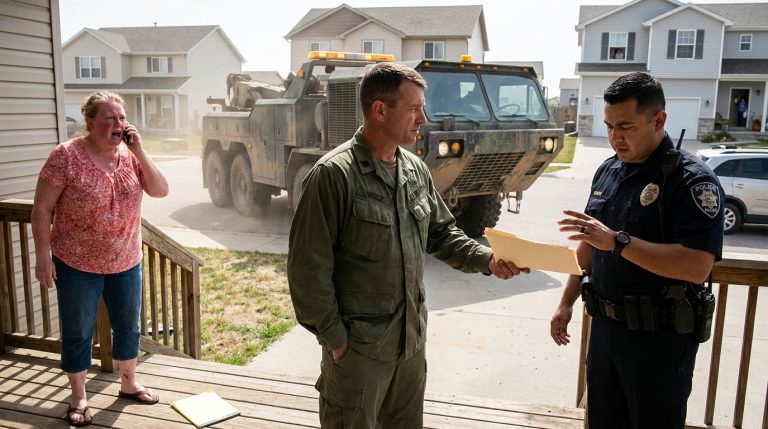
The pink tracksuit looked like a wound against the dry, sun-scorched earth of the property line. It strained at the seams, a bright, aggressive pastel shouting down the quiet browns and deep greens of twenty acres of undisturbed timber and pasture.
“Mr. Henderson, your unsightly swamp is a violation of aesthetic standards and a mosquito breeding hazard,” the voice snapped, sharp and nasal. “The Homeowners Association of Summit Creek Estates formally demands you drain it within thirty days or we will commence legal action and daily fines of five hundred dollars.”
Mark did not turn immediately. His hand stayed planted on the top of the weathered cedar fence post, feeling the dry heat soaked into the wood over decades of sun. Across the freshly driven survey stakes, Karen stood with her arms locked tight over her chest, fists bleached white at the knuckles. Behind her rose the soulless, beige monoliths of Summit Creek Estates—a monument to rapid, thoughtless grading where every lawn wore the identical, chemically forced green of a golf course.
His gaze drifted past her shoulder toward the two-acre stock pond sitting a hundred yards down the slope. Its surface caught the amber weight of the descending sun, cattails rustling softly in a dry breeze that carried the faint, chemical scent of municipal fertilizer. It had been there since the nineteen-seventies, spring-fed and deep, a quiet basin that regulated the watershed long before these asphalt roofs ever checkered the hills.
“Ma’âim,” Mark said, his voice level, stripped of urgency. He turned his head slowly, keeping his weight balanced on the balls of his boots. “That pond has been here fifty years. It’s spring-fed. It handles the natural drainage for this entire sector. It isn’t a swamp.”
Karen scoffed, a dry, clicking sound like a loose fan belt. “It’s an eyesore and a liability. Our property values are paramount. You have thirty days.” She spun on her heel, the crisp rubber soles of her sneakers crunching into the gravel as she marched back toward her identical house.
Mark watched her go, his fingers slowly relaxing their grip on the rough-hewn cedar. Thirty days. She had no comprehension of the machinery she had just set in motion.
CHAPTER 2: THE OAK TABLE STRATEGY
The screen door clicked shut behind him with a dull, familiar thud. The interior of the house was cool, smelling faintly of old paper, cedar, and the dark roast coffee Sarah had already begun brewing. Mark unhooked his work gloves, tossing them onto the mudroom bench with a dry slap of leather against wood, and walked into the kitchen.
Sarah stood by the counter, holding a steaming mug in both hands. She had been watching through the window; her posture was stiff, her sharp paralegal’s eyes already narrowing behind wire-rimmed glasses.
“She really called it a swamp?” Sarah asked, her voice carrying a dry, incredulous edge.
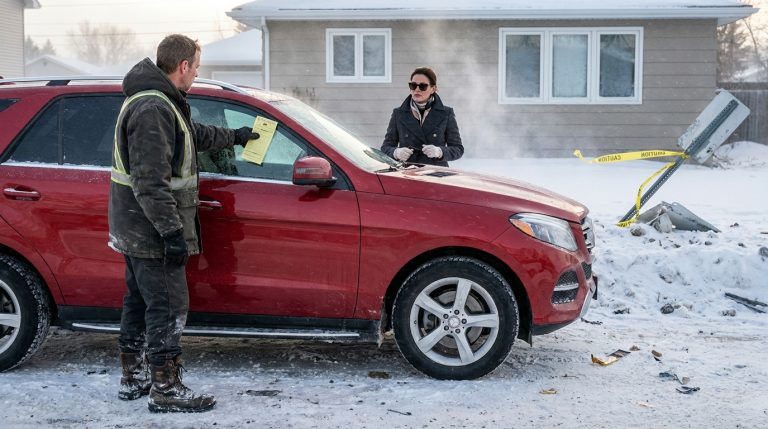
Mark pulled out a heavy chair at the oak dining table and sat down, letting the solid wood take his weight. He reached out and tapped the stiff, cream-colored envelope Karen had shoved into the cedar fence post. It lay there under the pool of lamplight like an invitation to a duel. “Worse,” he murmured, his fingers tracing the sharp, machine-printed font of the return address. “An unsightly swamp. And she’s tacked on a daily five-hundred-dollar penalty starting today.”
Sarah set her mug down with a soft click and walked over, sliding into the chair opposite him. She pulled the document toward her, her eyes scanning the lines with professional speed. Her expression shifted rapidly from amusement to a cold, concentrated resolve. “This is legally toothless, Mark. ‘Aesthetic standards’? That is the vaguest boilerplate municipal fiction I’ve ever read. There is not a single specific bylaw cited here. No section numbers, no county ordinance codes. Just noise.”
“I know,” Mark said, leaning back as the old chair groaned in protest. “People like Karen don’t operate on statute or precedent. They operate on the leverage of intimidation. She thinks she can break this property down the way she broke down the basketball hoops and garden gnomes three streets over.”
He closed his eyes for a fraction of a second, letting memory take him back twenty years. The mud of the engineering corps sites, the massive containment projects, the complex calculus of watersheds and stress loads. You did not fight a structural problem with shouting. You looked for the load-bearing pillar.
“When I bought this place five years ago,” Mark said, his voice dropping into a steady, rhythmic cadence, “I pulled the original survey maps from the county registrar. That pond isn’t just an ornamental pool. It’s a registered natural retention and filtration basin on the official watershed plans. It takes the hill runoff, slows it down through gravel beds, and meters it out to Miller’s Creek.”
Sarah leaned forward, resting her forearms on the scarred oak surface. “And Summit Creek Estates?”
“They clear-cut twenty acres of mature timber last year,” Mark replied, his gaze locking onto hers. “They graded the earth flat and paved over half of it with nonporous asphalt and concrete. I watched their primary retention basin go in from my fence line. It’s a steep-sided drainage ditch at the lowest point of their property, and it’s undersized. Woefully undersized.”
A slow, knowing shadow crossed Sarah’s face. “All that water has nowhere to go when a real storm hits.”
“Right now, they think their engineers built a self-contained little paradise,” Mark said, his hand sliding across the wood to touch the corner of the demand letter. “But looking at the topography, and knowing what I know about how those developers cut corners to save on excavation costs, there is a very high probability their entire master drainage plan relied on my pond acting as their overflow sponge. They didn’t design a drainage system. They designed a funnel that dumps onto my land.”
The silence in the room deepened, thick with the weight of unstated strategy. Outside, the last sliver of the sun dipped below the horizon, plunging the pasture into a slate-gray dusk.
“We don’t scream back,” Sarah whispered, a thin, approving smile touching the corners of her mouth. “If we threaten them with a lawsuit now, they hunker down and hire a defensive posture.”
“Exactly,” Mark said. “We give her rope. We let her believe she’s winning. Tomorrow morning, I draft a response. Not angry. Not defensive. Just dangerously, maddeningly polite.”
He stood up from the table, walking over to the dark bay window that overlooked the pasture and the invisible, dark shimmer of the pond beyond. The frogs had already begun their steady, rhythmic chorus in the gathering dark. It was a sound of deep, ancient survival. Karen wanted a war of standards; she was about to discover what happened when arrogance collided with physics.
CHAPTER 3: THE PERIMETER RECONNAISSANCE
The morning mist clung to the low hollows of the pasture, smelling of damp topsoil and decaying leaves. Mark stepped out onto the back deck, his heavy leather boots crunching against the frosty boards. In his hand, he carried a heavy steel wedge and a roll of plastic flagging tape. He did not rush. A scout who moves too fast misses the footprint in the mud.
He walked down the slope toward the western boundary, where his twenty acres brushed against the manicured perimeter of Summit Creek Estates. The division was stark. On his side, nature was chaotic, layered, and thick with brush; on the other, a uniform carpet of Kentucky bluegrass ran right up to the property marker, maintained by commercial mowers that shaved the earth to the skin.
As he reached the survey stake marking the corner of his land, he paused. His tactical instincts—honed over decades of reading terrain maps and assessing structural vulnerabilities—took over. He knelt beside a small, green plastic utility box housing the common-area irrigation valves for the subdivision. The box sat squarely on the HOA’s side of the line, but the surrounding turf showed clear, undeniable signs of heavy boot traffic crossing the boundary.
A sharp clink of metal against stone echoed softly through the morning air. Mark looked down. Lying half-submerged in the damp mud on his side of the surveyor’s stake was a discarded brass sprinkler head and a black plastic fitting. The landscaping crew had not just crossed the line; they had treated his property as a convenient staging ground, tossing tools and debris across the legal barrier with casual arrogance.
He stood up slowly, his joints popping in the crisp air. Memories of old engineering deployments flickered unbidden through his mind—staging areas, supply lines, and the fatal mistake of underestimating an adversary’s footprint. Karen’s board thought they owned the horizon because their houses were new and painted a uniform shade of sand. They did not see the lines of force running beneath the dirt.
A crunch of gravel on the other side of the fence drew his attention.
“Morning, Mark,” a gravelly voice called out.
Mark turned to see George walking his golden retriever along the paved subdivision path. The old retired history teacher wore a faded canvas jacket, his breath pluming white in the chill morning air. He stopped by the fence, leaning his forearms comfortably on the top rail.
“Morning, George,” Mark said, walking over to meet him.
” Heard about the letter,” George said, lowering his voice and glancing back toward the identical beige rooftops behind him. “Karen’s been working the phone tree all evening. Telling everyone you’re holding up the community standards because you refuse to clean up your ‘swamp.’ She loves a crusade.”
“Let her crusade,” Mark replied evenly, resting his hands on the weathered wood of the fence. “Crusades usually end when the walls run out of water.”
George chuckled, a dry, wheezing sound. “Be careful, son. She’s got the architectural review committee in her pocket. They treat those bylaws like holy writ. But I’ll tell you something else—you keep an eye on that green utility box right there.” He nodded toward the plastic housing near Mark’s feet. “The landscapers are always tinkering with those valves, and I’ve watched their trucks park right over your property line twice this week when you weren’t looking.”
“I noticed,” Mark said, his gaze fixed on the discarded brass fitting in the mud. “Documentation is everything.”
“That’s right,” George smiled, patting his dog’s golden head. “Give a bureaucrat enough rope and they’ll weave their own hammock. Just make sure you’ve got your boots laced tight when it snaps.”
Mark watched the old man continue his morning walk, the golden retriever trotting happily ahead on a bright blue leash. The conversation had confirmed what the physical evidence already screamed. The HOA’s operational discipline was sloppy, driven by haste and a profound disrespect for boundaries. They viewed the world outside their subdivision as a vacant lot waiting to be conquered.
Mark turned away from the fence, pocketing the brass fitting as a physical exhibit for his growing archive. The perimeter was mapped. The trespass was cataloged. It was time to take the next step in the administrative campaign—one that would force the county to pull back the curtain on the developer’s original blueprints.
CHAPTER 4: THE FOIA REQUEST
The county records office smelled of damp carpet, old toner, and the slow, grinding despair of municipal employment. Fluorescent lights flickered overhead with a low, metallic hum that matched the tension in Mark’s shoulders. He stood before a high counter of scratched laminate, resting his palms on the cool surface while a weary clerk with graying hair and half-moon spectacles stared blankly through him.
“You’ll get a response within thirty business days,” the clerk recited, her voice flat and rhythmic as a metronome, stamping a multi-copy form with a heavy, mechanical thud. “That’s standard procedure for public records requests under state code.”
“I understand,” Mark replied, keeping his tone measured and courteous. “Certified copy of the complete, unredacted development file for Summit Creek Estates. Geological surveys, environmental impact statements, and the full stormwater management plan with engineering appendices.”
The clerk didn’t blink. She slid the pink copy across the counter toward him. “It’s all on file. Whether you get it tomorrow or on day thirty depends entirely on the backlog. Next.”
Mark picked up the pink slip, folded it with precise creases, and slid it into the breast pocket of his flannel shirt. He turned and walked out of the building into the harsh glare of the midday sun. The gravel parking lot crunched beneath his boots, a sound that felt remarkably similar to the dry earth of his pasture. The bureaucratic machinery moved at the speed of a glacier, but it moved nonetheless.
He climbed into his truck, the engine turning over with a deep, rumbling growl that settled into a steady vibration through the floorboards. Instead of heading straight back to the property, he took the long route out toward the state highway, his mind working through the tactical timeline. Dave Miller, his old JAG friend turned environmental law partner, had made it clear: you do not rush a defensive adversary when they are actively digging their own trench. You let them accumulate enough rope to secure their own weight.
As he drove, the landscape shifted from town asphalt to rolling agricultural land and dry creek beds. The air through the rolled-down window carried the dry, metallic scent of sun-baked dust and iron ore. His thoughts drifted back to the map data he had reviewed five years ago when he first laid eyes on the property. The county watershed had been mapped decades before the developers moved in with their heavy graders and asphalt spreaders. The natural contours of the land did not care about property lines or subdivision covenants; they obeyed a stricter, older code—gravity.
When he pulled back up his gravel drive, the house sat quiet and still under the wide afternoon sky. Sarah was already at the kitchen table, her laptop open, surrounded by a scatter of legal pads and highlighted printouts. She looked up as the screen door swung open.
“Did they take it?” she asked, her eyes sharp.
“Filed and stamped,” Mark said, walking over to drop the pink receipt beside her laptop. “Thirty business days maximum, though Dave thinks we can rattle the cage sooner if the HOA’s legal counsel pushes things too fast.”
Sarah picked up the slip, scanning the stamp with a grim, knowing smile. “They won’t wait thirty days. Karen is already bleeding them with legal retainer fees for her escalation notices. She’s going to try to force a lien before the month is out. She needs a quick scalp to show her board.”
“Let her try,” Mark said, pulling out a chair and sitting down. “Every legal notice they draft without citing a valid municipal ordinance pushes them deeper into administrative liability.”
The campaign was advancing exactly along the vectors they had plotted. The perimeter was secured, the trespass was documented, and the public paper trail was now anchored in county concrete. All that remained was to wait for the next aggressive move from the subdivision—the inevitable final notice that would hand them the exact trap they were walking into.
CHAPTER 5: THE BAITED HOOK
The desk lamp cast a narrow, harsh cone of light over the heavy oak table. Outside, the wind brushed the dry brush against the siding with a dry, rattling hiss. Mark held the receiver to his ear, listening to the steady, rhythmic clicks of the long-distance connection before a familiar, sharp voice cut through the static.
“Mark,” Dave Miller’s tone was brisk, carrying the clinical edge of a corporate litigator who had just finished reviewing a stack of incoming filings. “I saw the HOA’s second notice. They’ve ballooned the penalties to over ten thousand dollars and they’re waving a formal lien threat in your face. They’ve officially crossed into aggressive territory.”
“They’re following the script,” Mark said, his eyes fixed on the grain of the wood. “Karen wants a definitive scalp before her monthly board meeting. She thinks intimidation is a substitute for jurisdiction.”
“Good,” Dave murmured, the sound of rustling paper coming through the line. “Let her have her momentum. We aren’t going to fight the fine. We aren’t going to argue the statute. We are going to hand her a loaded weapon and let her pull the trigger herself. I’ve drafted a response. It’s a masterpiece of cooperative compliance under protest.”
Mark listened as Dave read through the text of the proposed letter. Every sentence was carefully engineered, wrapped in the soft, yielding language of a citizen weary of conflict, agreeing to drain the pond to preserve community harmony. But buried within the formal prose was the legal equivalent of a landmine: an ironclad indemnification clause that forced the Homeowners Association to assume full, perpetual, and exclusive financial responsibility for every consequence, liability, and ecological damage arising from the removal of the water feature—including downstream flooding, altered water tables, and property destruction within Summit Creek Estates itself.
“She’ll never read past page one,” Dave said with a dry chuckle. “Her ego is too inflated by the illusion of victory. When she shows this to her retained counsel, she won’t ask if it’s a trap; she’ll demand they sign off so she can wave it at her constituents as an unconditional surrender.”
“And if her lawyer catches it?” Mark asked, shifting his weight in the creaking chair.
“Then they advise her to back down, which she is psychologically incapable of doing,” Dave replied smoothly. “Either way, the trap snaps. Send it via certified mail with return receipt requested. Make sure her signature is explicitly required on the dotted line.”
“Done,” Mark said.
He hung up the phone and turned to Sarah, who sat across from him with a printed copy of the county’s engineering blueprints spread out under the light. Her finger traced a line across page thirty-seven—the exact subsection detailing offsite runoff mitigation. The developer’s notes were explicit: the two-acre pond on parcel 7B was calculated to absorb forty percent of excess stormwater during a major weather event. Without it, the subdivision’s lower-lying asphalt basin would fail.
The legal machinery was now fully engaged. Two days later, the green return-receipt card arrived in the mailbox, bearing the bold, angular scrawl of Karen Johnson, President of Summit Creek Estates HOA. She had signed it. She had locked the cage door from the inside and thrown away the key.
Mark looked out the bay window toward the silent, shimmering surface of the pond under the gray afternoon sky. The water was calm, reflecting the stark branches of the oak trees along the ridge. It was the quiet before a heavy drop in barometric pressure. The administrative phase was over. The physical reality was about to test the limits of concrete and pride.
CHAPTER 6: THE DIESEL PUMPS
The morning sky was bruised and low, pressing down on the pasture with the dull gray weight of a heavy wool blanket. Mark walked down the slope toward the edge of the pond, his boots crunching against the frost-bitten grass. Two heavy-duty diesel pumps sat on iron-framed trailers at the waterline, their thick, corrugated intake hoses snaking down into the shallows like dark, sluggish serpents.
A crew of three weathered men stood near the trailers, their faces carved with the quiet fatigue of manual labor. The foreman, a broad-shouldered man named Hank with grease-stained knuckles and a worn canvas cap, looked up as Mark approached. He tipped his head toward the water.
“We’re rigged and ready, Mr. Henderson,” Hank said, his voice grating softly over the idling motor of the support truck. “Got the county non-emergency line notified for the legal discharge path toward Miller’s Creek, just like you specified. Though I still say pumping out a fifty-year basin is a crying shame.”
“Orders are orders, Hank,” Mark replied, his voice flat, giving nothing away. “Let’s begin.”
With a deep, guttural roar, the diesel engines caught. The exhaust pipes spat thin plumes of blue-gray smoke into the damp air, and the thick corrugated hoses jerked violently as the suction took hold. Within seconds, the clear water at the edge began to drop, swirling into a gray vortex around the intake screens. Fish darted frantically in the receding shallows, their silver scales flashing under the oppressive light.
Mark stood on the muddy bank, watching the fluid mechanics unfold with cold precision. This was the theater Karen had demanded. He had already alerted the local news desk with an anonymous tip about a historic property dispute, ensuring a camera crew would arrive to capture the spectacle.
As if summoned by the roar of the engines, a bright flash of pastel color appeared on the ridge above. Karen came marching down the slope, her footsteps purposeful and triumphant. Today she wore a fresh pink tracksuit that matched the one from her initial decree, her face a mask of unearned vindication. She didn’t notice the heavy-duty scale of the pumps or the somber efficiency of the crew; she saw only the dropping water level.
The local news van rolled to a halt near the pasture gate just behind her, doors swinging open as a young reporter and a cameraman scrambled out into the mud.
Karen stepped right to the edge of the property line, her arms crossed triumphantly over her chest, broadcasting a broad, radiant smile directly toward the camera lens. “This is a great day for our community,” she announced loudly, raising her voice over the throaty roar of the diesel motors. “We are finally clearing out an unsightly mosquito hazard and restoring aesthetic standards to Summit Creek Estates. This proves that persistent standards matter!”
The reporter swung the microphone toward her, eager for the soundbite. “So your association formally requested this?”
“Absolutely,” Karen beamed, practically preening for the audience. “The owner has finally agreed to do the right thing and abate this nuisance.”
Mark stepped back into the frame just far enough to maintain his posture of quiet, downcast resignation, offering the reporter a tired, reluctant nod. He let the cameras record the theater of her triumph, knowing full well that every decibel of her public boast was driving another nail into her own foundation.
By late afternoon, the transformation was complete. The vibrant, life-filled two-acre pond was gone, replaced by a massive, stinking crater of wet silt and exposed gray clay. The frogs were silent. The fish had been relocated by the pre-arranged game wardens, leaving behind only an open, bleeding wound in the earth. Karen departed up the hill with her head held high, completely blind to the fact that the plug had just been pulled on her entire subdivision’s safety net.
CHAPTER 7: THE DELUGE OF ARROGANCE
The storm did not arrive with violence; it settled over the hills like a wet shroud, cold and unyielding. Mark stood at the large bay window of his living room, a cup of dark coffee cooling in his hand, watching the gray dawn bleed into a bruised, purple-tinted sky. The rain began as a gentle patter, but within two hours, it had escalated into a relentless, driving downpour that turned the gravel drive into a slick, glistening sheet.
The soil of the pasture, already deeply disturbed and saturated from the draining process days prior, surrendered immediately. Rivulets of brown water cut miniature canyons through the mud, rushing downward toward the empty, two-acre basin. Without the deep, stable cushion of the pond to absorb the initial shock, the runoff accelerated unchecked, spilling over the perimeter stakes toward the western property line.
Mark lifted a pair of heavy rubberized binoculars to his eyes, focusing the lenses through the rain-streaked glass on the low point of Summit Creek Estates.
The subdivision’s primary retention basin—the steep-sided municipal ditch wedged between the asphalt and the property line—was already struggling. Built on the cheap during the original grading process, it lacked the volume and depth required to manage a heavy, prolonged system. Water was sheeting off the endless expanse of nonporous roofs, driveways, and parking lots with terrifying speed, overwhelming the storm drains that had likely choked on loose mulch and lawn clippings weeks ago.
The emergency overflow, designed as a gentle concrete spillway meant to feed into the natural watershed, was now operating as a roaring, white-water chute.
Without the massive, pre-existing retention capacity of Mark’s downstream basin to catch the overflow, the water slammed straight into the flat turf of the subdivision’s common ground. It spread out instantly into a wide, churning lake of muddy debris. Mark watched through the magnified lenses as the floodwaters crept across the manicured lawns with predatory speed, lapping against the curbs and rising steadily up the asphalt drives.
The first vehicles to feel the impact were the sedans parked in the rear rows of the communal parking lot. The brown water rose rapidly past their tires, swallowing the wheel wells and creeping up the painted sheet metal until it reached the door handles. Inside the subdivision, car alarms began to short out in a discordant, electronic wail of dying machinery.
The water continued its relentless advance, finding the absolute path of least resistance—straight toward the community clubhouse. Sandbags someone had haphazardly tossed against the glass doors moments before the worst of the deluge hit were washed away like children’s blocks. The murky brown current breached the threshold, pouring into the pristine interior meeting rooms and fitness center, shattering the illusion of corporate security that Karen’s board had fought so hard to maintain.
A heavy vibration buzzed on the kitchen table. Mark lowered the binoculars and picked up his phone. It was George.
“Mark, you seeing this?” the old man’s voice crackled through the speaker, carrying a sharp edge of disbelief mixed with grim satisfaction. “The lower half of the subdivision is completely underwater. The clubhouse is flooded out, and half the cars in the communal lot are sitting up to their hoods in mud.”
“I have a clear view from the window, George,” Mark said quietly, his eyes tracking the swirling currents near the property line. “Keep your family on the high ground.”
“Oh, my place is safe on the hill,” George laughed dryly. “But Karen’s house? She’s right down in the basin. Her front yard is a raging creek right now. Her phone must be melting down.”
Mark panned the binoculars toward Karen’s residence. Sure enough, the manicured grass of her front lawn had vanished beneath a churning sheet of brown water that was actively scouring the mulch beds against her foundation. She had wanted a pristine, controlled landscape; instead, she had engineered her own catastrophe. The physics of water did not negotiate, and they certainly did not care about aesthetic compliance.
CHAPTER 8: THE DUST AND THE BASIN
The morning after the three-day deluge broke across Summit Creek Estates with a cold, unforgiving clarity. The sun rose over the hills, casting a sharp, white glare across a landscape utterly transformed. The vast temporary lake over the communal parking lot had receded, leaving behind a thick, caked crust of gray silt, stranded debris, and the rusted shells of water-logged sedans. The air smelled of wet topsoil, stagnant mud, and the sharp, metallic tang of burnt-out electrical wiring.
Mark stood on his back deck, looking down toward the muddy crater that had once been his vibrant stock pond. The physical evidence of the disaster was everywhere, but the true revelation—the core truth that had governed every movement of the board’s hurried destruction—lay exposed in the cold light of accountability. The developer’s secret engineering files, the flooded clubhouse, and Karen’s signed confession formed an unbroken chain of undeniable reality: the subdivision had never been self-sufficient. Its entire architecture had relied on his land as a silent, uncompensated sponge.
A heavy crunch of tires on gravel drew his attention. A sleek sedan pulled up to the main gate, and a man in a rumpled suit stepped out. It was Tom Riley, the newly appointed interim HOA president, his face pale, lined with exhaustion, and bearing the distinct terror of a man holding together a collapsing structure. He walked slowly up the wooden steps of the deck, his hands empty, palms open in a gesture of absolute surrender.
“Mr. Henderson,” Tom said, his voice cracking slightly against the morning wind.
Mark did not offer his hand immediately. He let the silence stretch, anchoring himself in the heavy, weathered texture of the deck railing. “Tom,” Mark replied evenly. “You’re a long way from the high ground.”
“We are drowning in litigation, Mr. Henderson,” Tom said, dropping his gaze before meeting Mark’s eyes with a desperate, humbling candor. “The class action suits from the residents are moving forward. The state DEP has issued six-figure fines for the watershed destruction. Our property values have cratered by half overnight. We read the engineer’s report. We know now what that pond was truly doing for us. We were blind, and Karen led us straight over the cliff.”
“Blindness is an expensive luxury, Tom,” Mark said, his voice unyielding. “You demanded I drain a registered watershed feature under threat of fabricated fines and liens. You treated natural topography like an administrative nuisance.”
“We are prepared to make you whole,” Tom rushed to say, pulling a thick leather folder from under his arm. “Whatever it takes. The board has voted unanimously to accept every single term of your proposal. We will cover the full cost of the professional engineering restoration, all legal fees incurred, and the full appraisal value for a permanent drainage and conservation easement. We’re rescinding every cent of the fake fines, and the board has signed off on the fifty-thousand-dollar settlement for harassment.”
Mark looked down at the folder, then raised his gaze to the horizon where the distant roofs of Summit Creek Estates gleamed under the pale sun. The cornered beast had stopped fighting; the system had collapsed under the weight of its own structural deceit.
“And the public record?” Mark asked.
“A formal, written apology, detailing our liability and the exact engineering necessity of your land, has been entered into the official association records,” Tom said, his shoulders slumping in total defeat. “Karen has put her house on the market at a massive loss. She’s leaving the state by the end of the week.”
Mark gave a slow, deliberate nod. The tactical campaign was over. The physics of water had won, and the balance had been restored through absolute, unyielding proof.
Weeks later, the heavy machinery returned to the pasture, not to drain, but to heal. Under the direction of top environmental engineers, the deep basin was reshaped, reinforced with natural stone and native plantings, and allowed to fill once more with the natural spring water that had fed it for half a century.
On a clear, warm evening toward the end of summer, Mark sat on the back deck with Sarah and their neighbor George. The air was rich with the evening chorus of returning frogs, and the surface of the fully restored pond shimmered with the gold and purple hues of the setting sun.
George raised a glass of heavy Kentucky bourbon, his eyes crinkling at the corners. “To the swamp,” he murmured with a dry, knowing grin.
Mark clinked his glass against George’s, feeling the cold glass and the solid weight of the ring in his hand. “To the swamp,” he echoed.
He looked down at the weathered cedar fence post where the original demand letter had been stabbed weeks ago. The wood had a new scar where the staple had been pulled, but the fence stood straight, holding the line between chaos and order. He reached into his pocket, pulling out a small brass fitting recovered from the trespass zone, and tossed it gently into the tall grass, letting the earth reclaim its own. The war was finished. The land was whole.