The Echo of the Phantom: A Journey from the Shadows of Silence toward the Light of Grace
CHAPTER 1: The Amber Glow
The fluorescent signs hummed, a low-frequency buzz that vibrated in Marcus’s jaw. He kept his eyes leveled on the ceramic mug. It was chipped at the rim, a jagged crescent of white against the dark, cooling coffee. He didn’t look up when the boots approached. He felt the floorboards protest—a subtle shift in weight, a rhythmic creak that placed the intruder exactly three feet away.
“Hey, old man,” the voice cut through the tavern’s ambient roar like a jagged blade. It was loud, synthetic, curated for the audience. “You planning on ordering something, or are you just here to stink up the place?”
Marcus didn’t move. He felt the familiar pull of the familiar defense: Breathe. Count. Survive. One, two, three. His pulse, which had been a frantic butterfly in his chest, slowed to a steady, rhythmic thud. He focused on the shadow cast by the jukebox. It was long, distorted, creeping toward his feet like an encroaching tide.
“I’m talking to you, homeless guy. You deaf or just stupid?”
The man, Blake, stepped closer. Marcus could smell him now—the sharp, acidic tang of cheap cologne and the metallic scent of gym sweat. It was the smell of someone who needed to be seen to exist. Marcus, conversely, needed the opposite. He was a master of the invisible, a ghost who had spent nine years perfecting the art of being a background detail.
“Blake, leave him alone,” Tom’s voice came from the bar, calm but edged with warning. “He’s not bothering anyone. I gave him that coffee.”
“Yeah, and that’s the problem, Tom.” Blake turned to the room, arms wide, playing to the crowd. He was a showman, a predator who thrived on the low-hanging fruit of public humiliation. “Look at him. Wearing a torn marine jacket he probably pulled from a dumpster. It’s disrespectful to actual veterans.”
Marcus felt the fabric of his sleeve against his wrist. It was thin, frayed, but the hidden patch beneath the lining pressed into his skin like a brand. His jaw tightened, a hard, involuntary knot of bone and muscle. He didn’t want to look up. If he looked up, he would see the faces—the casual cruelty, the desperate need for a target.
“Breathe,” he whispered, a sound so faint it was swallowed by the ambient hum of the neon.
“I’m betting you never even made it through basic training,” Blake hissed, leaning down, his face inches from Marcus’s. “What war did you fight in, old man? The war against taking a shower?”
Marcus lifted his head. He didn’t do it quickly. He moved with the slow, deliberate grace of something ancient waking up. His pale blue eyes met Blake’s. For a heartbeat, the bar’s noise plummeted. Blake’s bravado flickered, a candle caught in a sudden draft. There was something in Marcus’s eyes—a depth that suggested he was looking through the bar, through the walls, through the very fabric of the room.
“Phantom,” Marcus said. The word was low, rough, dragging against the silence. “Seal Team Six. 2003 to 2007.”
The room seemed to freeze. Then, a sharp, ragged sound punctured the air. Commander James Patterson, who had just stepped through the front door, went perfectly, terrifyingly still. The color drained from his face as if he’d been struck. He didn’t look at Blake. He didn’t look at the crowd. He looked at Marcus, his lips moving in a silent, jagged prayer.
“Phantom?” Patterson whispered.
Marcus saw the recognition, and with it, the intrusion. He had been invisible for nine years. Now, in the space of a single breath, the mask was slipping. He looked down at his chipped mug, the coffee inside showing a perfect, trembling reflection of the ceiling lights—and for the first time in his life, he felt the terrifying weight of being seen.
CHAPTER 2: The Weight of Walls
The room was smaller than the world he had inhabited under the bridge, yet it felt paradoxically vast. Marcus stood still, his breath hitched in the back of his throat. The floorboards beneath his feet were covered in a thin layer of dust that smelled of antiquity and neglected wood. It reminded him—too sharply—of the safe house in Ramadi, the one with the floorboards that groaned under the weight of his boots when the world outside was erupting in fire and shrapnel.
He didn’t move toward the bed. Instead, he kept his hands deep in his pockets, his fingers tracing the jagged edge of the tactical patch sewn into his jacket lining. It was his anchor. Without it, he felt as though he might simply drift away, unmoored by the sudden, unwanted visibility the last two hours had forced upon him.
Downstairs, the tavern had quieted, the cacophony of the evening replaced by the rhythmic, muffled thuds of glasses being gathered and the occasional low rumble of Tom Sullivan’s voice. Marcus listened to the sounds, breaking them down into tactical components. Two people moving toward the back, one cleaning the bar, the subtle cadence of a conversation that didn’t include him. He was no longer the threat, nor the entertainment. He was the subject of conversation, a piece of living history being dissected in real-time.
He moved to the dresser, his movements fluid, deliberate. He laid the photograph down—the faces of five dead men smiling up at him, their eyes caught in a frozen moment of invincibility. He couldn’t look at it directly for long. It felt like an accusation. Why you? the faces seemed to ask. Why the one who stayed?
He stripped off the tattered jacket, folding it with a precision that bordered on the ritualistic. As he did, he caught his reflection in the mirror hanging above the dresser. He barely recognized the face looking back. The beard was a thicket of neglect, the gray hair tangled and wild, but the eyes—those pale, ghost-light blue eyes—remained unchanged. They were the eyes of a man who had seen the edge of the map and had decided to step off.
He lowered himself to the edge of the mattress. It sighed under him, a soft, yielding sound that set his teeth on edge. It was too soft. It lacked the honesty of the concrete bridge supports or the cold, hard earth of the desert floor. He lay back, staring up at the ceiling where a water stain bloomed like an inkblot test. His mind began to loop, the “Breathe, Count, Survive” mantra failing to hold back the encroaching noise.
Fallujah. 2006.
The scent of burning cordite and diesel fuel rushed back into his senses, so vivid he could taste the metallic tang on his tongue. He saw the radio operator’s face, the way the boy’s eyes had widened when he realized the extraction point was gone. He felt the cold iron of the radio in his hand, a dead piece of equipment that had become his only companion during those eleven days of silence.
He realized then that the decoy secret he had held onto—the belief that his survival was a failure of duty—was a comfortable cage. It kept him from having to confront the truth of the sacrifice he had made. If he believed he was a coward, he could endure the shame. But if he was something else—if he was a man who had chosen to vanish to protect a truth that would destroy the sanctity of his team’s final moments—the burden was far heavier.
A sharp knock at the door startled him. He was off the bed in a heartbeat, his posture low, defensive, eyes scanning the room for a weapon that wasn’t there.
“Marcus?” Tom’s voice was muffled, hesitant. “I brought you a change of clothes. Something fresh. I’m leaving them here, alright? No rush.”
Marcus stayed frozen until the footsteps retreated down the hallway. He didn’t relax his shoulders. The tension had migrated from his jaw to his spine, a rigid steel rod that felt ready to snap. He looked at the door, then back to the photograph.
The silence of the room was now a physical presence, a weight he had to negotiate. He knew he couldn’t stay here long. If he stayed, he would be found. Not by the ghosts of his past—they were already here—but by the living, breathing men like Patterson who wanted to “fix” a man who had already committed himself to the void.
He stood up, walking to the window. The street below was wet with rain, the pavement slick and black, reflecting the neon signs like shards of broken glass. He wasn’t safe here. He was being watched, analyzed, cataloged. The irony of it burned: he had spent nine years becoming a shadow, and in one night, he had become the brightest light in the room.
He reached into his pocket and touched the patch once more. He needed to leave, not because he was afraid of Blake or the bar, but because he was afraid of the peace they were offering. Peace was a different kind of trap. It required vulnerability, and vulnerability was the one tactical mistake he had promised himself he would never make again.
He turned back to the room, the walls seeming to close in, the air thick with the scent of dust and fading memories. He had to keep moving. He had to keep the truth locked.
CHAPTER 3: The Mirrors Edge
The clothes Tom had left—a pair of heavy-duty denim jeans and a dark, charcoal-gray thermal shirt—sat on the edge of the mattress like a challenge. Marcus reached out, his hand hovering over the fabric. It was crisp, untouched by the grit of the Roosevelt Bridge or the biting damp of the November nights. To put them on felt like an act of erasure. By shedding the torn military jacket, he was discarding the armor that had defined his existence since 2007.
He picked up the shirt. It was soft, lacking the abrasive texture of the surplus wool he had worn for nearly a decade. He pulled it over his head, the fabric catching slightly on the jagged scar that ran from his eyebrow to his temple. It was a tight fit, a sensory overload. His skin, long accustomed to the rough scrape of coarse, unwashed layers, reacted to the cleanliness with an almost stinging sensitivity. He felt exposed, stripped of his camouflage.
He walked to the dresser and picked up the pair of scissors Tom had left. They were surgical-grade, sharp, and cold. He looked at himself in the mirror, really looked at himself, for the first time in an eternity. The man staring back was a stranger—a collection of graying hair, hollowed-out contours, and tired, pale blue eyes. He didn’t recognize the geometry of his own face.
He pressed the blades to his beard. The first snip was clean, a sharp, metallic sound that seemed to ring against the stillness of the room. He worked methodically, the muscle memory of his former life taking over. In the field, grooming was an operational necessity, a way to maintain control when the world around you was fracturing. He removed the beard in sections, the patches of white falling away like shed skin until only the raw, pale surface of his lower face remained.
He paused, the scissors resting against his jaw. Beneath the hair, the skin was softer, younger, and utterly defenseless. He looked at his reflection and saw a vulnerability that made his heart stutter. He wasn’t Phantom anymore. He was just Marcus, and that realization was more terrifying than the ambush in Ramadi had ever been.
There was a tap on the door, lighter this time.
“Marcus?” Tom’s voice came through the wood, muffled and cautious. “Patterson is downstairs. He’s got the paperwork for the facility. He wants to know if you need anything before he heads out for the night.”
Marcus didn’t answer immediately. He stared at his own image, trying to reconcile the operator he had been with the man who was now standing in a rented room, shivering despite the warmth. He reached out and touched his cheek. It felt wrong. It felt unfinished.
“I don’t need anything,” Marcus finally said, his voice sounding thin, unpracticed. It was a command, but it lacked the steel he usually carried.
“Alright,” Tom said, though he didn’t move away immediately. Marcus could feel his presence through the door, a heavy, patient stillness. “We’re here, Marcus. You’re not doing this alone anymore.”
The footsteps retreated, heavy and slow. Marcus went back to the mirror. He finished the trim, the motions becoming more erratic as the fatigue of the night finally began to seep into his bones. When he was done, he rinsed his face in the basin across the hall. The water was hot, biting against his skin, a stark contrast to the icy, muddy runoff he was used to washing with under the bridge.
He returned to the room and sat on the bed. He felt the weight of the photograph on the dresser. The five men—his brothers, his team, his ghosts—seemed to watch him from the frame. He tried to project his thoughts back to that night in Ramadi, to the decoy secret he had built his life upon. He thought of the tactical failure, the compromise at the extraction point, the split-second decision he had made to hide in the rubble.
But the memory was shifting. It wasn’t as sharp as it had been. Before, he had viewed it as a failure of speed—a missed window for extraction. Now, standing in the sterile, quiet room, he remembered the radio chatter. He remembered the static. He remembered the commander’s voice, specifically the order that had been redacted from the final after-action report: Maintain absolute silence, no matter the cost.
He had never failed them. He had followed the final order. The guilt that had been his cage was built on a foundation of a lie he had told himself to survive the reality of their erasure. If he had spoken, if he had signaled, the operation would have been compromised, and the larger objective—the one that still remained classified—would have failed.
He was keeping a promise to ghosts.
The realization didn’t bring relief. It brought a profound, freezing terror. If his guilt was a fabrication, then he had spent nine years living a life of self-imposed exile for a duty that no one else even knew existed. He was a sentinel for a truth that had been scrubbed from every record.
He lay back on the mattress, the ceiling stain now blurred by the dim amber light filtering in from the streetlamp. He was no longer just an operator or a victim; he was a keeper of a secret that was slowly, inexorably, beginning to burn through his silence. He had to decide: keep the secret and continue his slow disappearance, or face the men like Patterson and let them force the truth into the light.
His eyes closed, but sleep didn’t come. Instead, he heard the faint, rhythmic ticking of a clock somewhere downstairs, a sound that felt like a countdown to a collision he wasn’t sure he could survive.
CHAPTER 4: The Threshold
The transition was not a leap, but a slow, grinding process of surrender. Patterson’s truck pulled through the security gates of the Coronado facility at dawn. The morning light was thin, washing the concrete base in a pale, clinical gray that seemed to leach the color out of everything it touched. Marcus sat in the passenger seat, his hands resting on his thighs. He was wearing the new clothes Tom had provided, yet they felt like a costume—a layer of fabric meant to hide the phantom beneath.
Patterson killed the engine. The silence that followed was heavy, punctuated only by the ticking of the cooling metal.
“We’re here, sir,” Patterson said, his voice stripped of the exuberance he’d shown at the bar. He seemed to recognize that they had crossed a boundary. The legend was gone; only the man remained, and the man was fragile.
Marcus looked out at the building. It was modern, clean, and aggressively unremarkable. It was a place designed to extract pain, to process trauma, and to reintegrate the broken. Every fiber of his being screamed to open the door, keep running, and disappear into the scrub brush that lined the perimeter of the base. But the weight of the promise—the promise to the ghosts, the promise to Patterson—kept him tethered to the seat.
He stepped out. The air felt different here—sterilized, devoid of the grit and diesel-scented humanity of the city. He walked toward the entrance, his pace measured, his eyes tracing the tactical layout of the lobby before he even crossed the threshold. It was a habit, like breathing. He noted the camera angles, the blind spots behind the reception desk, the egress points.
Dr. Reyes was waiting in the lobby. She was standing by a glass-walled office, her posture professional yet softened by an underlying current of genuine concern. She didn’t offer a forced smile. She simply nodded, a gesture of respect that Marcus felt he hadn’t yet earned.
“Mr. Reeves,” she said, motioning toward the office. “Welcome. We’ve kept the intake process as light as possible for today.”
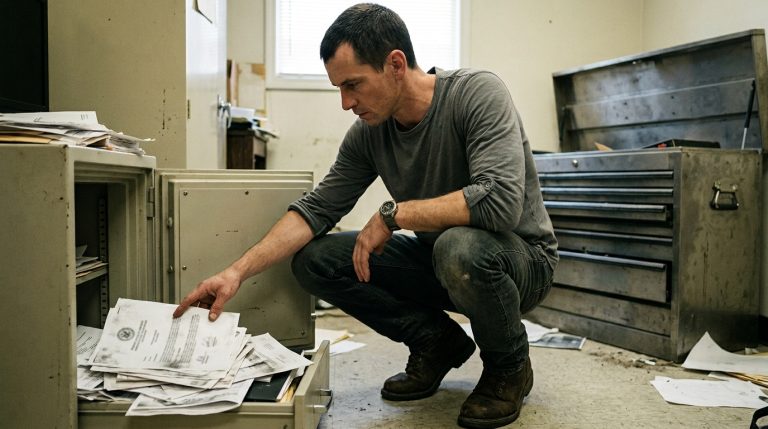
Marcus followed her into the office. The room was sparse—a desk, two chairs, and a large window looking out onto a manicured garden that seemed too quiet, too orderly. On the desk lay a manila folder, thick with paperwork. As he sat, he caught sight of the top document. It wasn’t a standard medical form. In the top right corner, a series of codes—alphanumeric strings that hadn’t existed in his world for nine years—stared back at him. They were the clearance markers for Operation Red Shadow.
His heart didn’t race. It stalled.
“I’ve spent the morning reviewing the limited records available on your case,” Dr. Reyes said, her voice gentle as she opened the folder. “There’s a significant gap between your discharge—or lack thereof—and your re-emergence. That gap is where the healing will have to start.”
Marcus stared at the document. If she had access to those codes, it meant this wasn’t a standard VA facility. It was a clearinghouse. They weren’t just treating his trauma; they were auditing his silence. The decoy secret—that he was a coward who had failed his team—felt suddenly, violently inadequate. He wasn’t a coward. He was a liability.
“The records say you survived alone,” she continued, her pen hovering over the page. “They say you walked out of the rubble of a collapsed building in Ramadi without a scratch, despite the intensity of the ambush. That’s a miracle, Marcus. But miracles are difficult to reconcile with the human mind.”
Marcus watched her hand. It was steady. “It wasn’t a miracle,” he said, the words rasping against his throat. “It was just staying still until the noise stopped.”
“And the noise never really stopped, did it?”
She looked up, her gaze pinning him to the chair. The office air felt like it was thickening, becoming harder to breathe. He looked past her, through the window to the garden where a bird landed on a stone fountain. The bird was gray, unremarkable, but it moved with a frantic energy, searching for something it couldn’t find.
“I’m not here to talk about the tactical side of Ramadi,” Marcus said, his voice hardening, shifting back into the defensive posture he had used for years. “I’m here because Patterson insisted.”
“Patterson brought you here because you’re still a SEAL,” she said, closing the folder and sliding it to the side. “And because the SEAL community leaves no one behind. But you have to decide if you want to be found. Being found means the silence ends. Can you handle the silence ending?”
He thought of the photograph in his backpack—the five men who hadn’t come home. He thought of the radio order. The silence hadn’t been his choice; it had been his mission. If he spoke, if he confessed, the mission would be retroactively ruined. The sacrifice would be for nothing.
“The silence is all I have left,” Marcus whispered.
“Then we’ll start there,” she replied. She stood up, signaling the end of the first encounter. “But know this, Marcus: the truth isn’t something you can carry forever without it eventually breaking you. The questions you’re refusing to answer? They’re going to get louder.”
Marcus stood, his legs feeling heavy, as if the floor were made of lead. He walked out of the office and back into the corridor. The hospital hum—that omnipresent, buzzing sound of artificial light—felt like it was amplifying, filling the space behind his eyes. He wasn’t safe here. He was being dissected by someone who knew exactly where to cut.
He reached the end of the hall, toward the residential wing. He knew that once he crossed into that wing, the life of the ghost would be officially over. He stopped, his hand on the doorframe, the sterile white paint cold under his touch. For a split second, he looked back at the lobby, at the exit. The door was unlocked. He could still run. But he knew, with the cold, absolute certainty of an operator, that there was nowhere left to hide. The secret had already begun to breathe, and it was demanding to be heard.
CHAPTER 5: The Unmasking
Marcus did not cross the threshold immediately. He stood at the edge of the residential wing, his hand still clamped to the cold doorframe, the sterile white paint beneath his fingers feeling like a barrier between the ghost he had been and the man he was being forced to become. The hallway stretched ahead, a long, linoleum-tiled corridor bathed in the harsh, flickerless glare of overhead LEDs. It felt less like a hallway and more like an airlock.
He pulled his hand away and took a breath. It was air-conditioned, devoid of scent, which made his own internal world—filled with the ghosts of dust and cordite—seem all the more intrusive. He walked forward, his boots hitting the floor with a soft, hollow thud that seemed to echo further than it should have. He wasn’t just entering a facility; he was entering an inquiry. Every step was a commitment to the process that Dr. Reyes had initiated.
He reached his room—a door marked only by a brass number—and pushed it open. It was a space designed for total de-escalation: soft lighting, beige walls, no sharp edges. He sat on the bed and stared at the wall opposite him. The stillness was aggressive. He found himself waiting for the sound of movement in the hall, for a voice to call his name, for the sudden, violent disruption of his routine that had characterized his life for nine years. Nothing came.
He reached into his pocket and pulled out the tactical radio, the one he had spent years trying to “fix.” It sat in his hand, a heavy, dead piece of equipment. He turned it over, his thumb tracing the worn buttons. He had told himself that if he could just repair it, he could call back across the timeline, reach those six men, and change the outcome of that night in Ramadi.
He didn’t notice the door opening until the soft rustle of fabric alerted him. Dr. Reyes stood there, holding a tablet. She didn’t enter the room, respecting the thin, invisible line he had drawn around himself.
“The tactical radio, Marcus,” she said, her voice dropping the clinical tone and becoming something sharper, more observational. “You carry it as if it’s a living thing. You don’t take it apart. You just hold it. Like you’re listening to a signal that ended years ago.”
Marcus didn’t look up. He kept his eyes on the radio’s cracked casing. “It’s a record,” he said, his voice flat. “It contains everything.”
“Does it contain the truth, or the version you decided to live by?” She took a step into the room. “I checked the incident log from Ramadi again this morning. I looked at the redacted sections—the parts that aren’t meant for public record, or even standard veteran evaluation. There was a radio command that followed the initial ambush. A directive that required absolute, total comms-silence to protect a secondary, off-the-books objective.”
The radio felt like it grew heavier in his hand. He hadn’t expected her to have that level of clearance. The room felt as though the oxygen were being sucked out of it, leaving him gasping in the vacuum of his own history.
“If that command existed,” she continued, “it means your survival wasn’t a failure of action. It was the successful execution of an order that required your team’s sacrifice and your own total disappearance. You didn’t run, Marcus. You were the only one who could carry the payload of that objective out. You stayed silent because that was the only way to ensure the mission—their mission—remained classified and successful.”
Marcus stood up, the radio sliding from his fingers and thudding onto the mattress. He felt a sudden, sharp tremor in his hands. It wasn’t the shaking of a man who had lost everything; it was the shaking of a man who had been holding up the ceiling of a crumbling building for nine years and suddenly realized the supports were gone.
“Who told you that?” he asked, his voice a low, dangerous growl.
“No one,” she replied. “I read the weight of it in you. You’ve been punishing yourself for a tactical success because you couldn’t reconcile the cost with the honor. You thought your silence was cowardice, but it was the ultimate, solitary act of duty.”
He walked toward her, his movements erratic, the sense of reality around him starting to fray at the edges. The room seemed to contract, the walls pressing in until he was standing face-to-face with the woman who had just dismantled his entire internal world. The decoy secret—his shame, his guilt, his failure—was gone, and in its place was a truth that was, in many ways, far worse: he was a hero who had been robbed of the ability to be proud.
“It wasn’t duty,” he breathed, the words barely audible. “It was a burial. I buried them, and then I buried myself.”
“And now you’re being unburied,” she said, her expression softening. “The memorial ceremony is in two days, Marcus. Patterson is coming to pick you up. He doesn’t know the truth, not fully, but he knows you were there. He knows you deserve more than this.”
Marcus looked past her, into the hallway where the light was still shining. He realized then that the escape he had been planning wasn’t from the facility; it was from the man he was becoming. But he was trapped. The truth was out, the layers of his self-imposed mythology were stripped away, and he had nowhere left to go but toward the one thing he had feared most: the recognition of his own sacrifice.
The radio lay on the bed, silent and broken. He didn’t pick it up. He didn’t need it anymore. He turned away, his gaze settling on the window, the garden, and the world outside that was still turning, oblivious to the ghost who had finally stopped haunting it. He was ready.
CHAPTER 6: The Horizon
The ceremony was not a spectacle. It was a gathering of shadows. Beneath the leaden sky of the Coronado coast, the memorial stood as a monolith of polished black stone, reflecting the restless churning of the Pacific. Marcus stood in the back, his hands buried deep in the pockets of his charcoal coat—a garment that felt, for the first time, like it belonged to his frame. Patterson stood a few paces to his right, his posture stiff, his eyes fixed on the names carved into the stone with the intensity of a man staring into an abyss.
Marcus watched the names. Five names. He had memorized their geometry years ago—the way the curves of the letters caught the light, the specific weight of the granite. Today, a new, temporary plaque had been set up to the side, waiting for the official amendment to the record.
When the time came, the silence was absolute, broken only by the cry of a distant gull. Patterson stepped forward, his hand trembling as he reached for the fabric covering the temporary marker. He turned, looking toward Marcus with a silent, questioning expression—the unspoken request for the Phantom to finally step into the light.
Marcus moved. His boots crunched on the gravel, a dry, rhythmic sound that felt like the snapping of old bones. He reached the wall. He did not look at the crowd, at the veterans who had gathered, or at the faces of families who still held onto the hope that the story of Ramadi wasn’t quite finished. He reached out and placed his hand against the cold stone.
“I didn’t come back,” Marcus said, his voice carrying clearly across the small, hushed assembly, “because coming back would have meant breaking the silence that kept this mission buried.”
He turned to look at Patterson, who had frozen, his eyes widening as the implication settled over him.
“The team didn’t die because of a failure,” Marcus continued, his voice finding a resonance he hadn’t known he possessed. “They died because we were the only thing standing between an unauthorized breach of a secondary objective and the total compromise of our unit’s integrity. We were the wall. They held the line. I was the one tasked with carrying the truth of that objective through the fire, into the void. My silence wasn’t a choice I made for myself. It was the last order they gave me.”
The revelation rippled through the gathered men and women like a physical force. Patterson’s face went white, then slowly, deeply flushed with a mixture of reverence and lingering, agonizing realization. He hadn’t just been mourning a KIA—he had been mourning a secret soldier who had done exactly what he was trained to do, right down to the erasure of his own existence.
Marcus reached out and touched the temporary plaque. The five names were there. Beside them, he began to trace the carving of his own, which was in the process of being removed from the permanent list.
“They were never forgotten,” Marcus whispered, the words intended for the stone rather than the living. “They were just waiting for the mission to end.”
The denouement arrived not with thunder, but with a slow, heavy settling of the air. The ceremony continued, but for Marcus, the narrative had already reached its conclusion. The Payoff was in the release—the physical sensation of the stone’s coldness seeping into his hand, a tangible connection that didn’t demand his guilt. The Poetic Justice of the situation was absolute: he had sought to vanish, only to be brought back by the very people who were duty-bound to honor his sacrifice.
As the crowd began to disperse, drifting away like mist toward the parking lot, Patterson stayed behind. He stood beside Marcus for a long time, the two of them watching the tide.
“I don’t know if I can forgive myself for not seeing it sooner,” Patterson said, his voice quiet.
“Forgiveness isn’t the point, Hawk,” Marcus replied. He looked down at the brass plate he had damaged during his years of struggle—a small, bent clip on his worn field-journal that he had kept in his pocket. He took it out, his fingers fumbling with the metal, slowly, deliberately bending it back into shape until it clicked into its original, functional form. It was a small act, a minor repair, but it was his.
“The point is that the mission is done,” Marcus added.
He stood there for a long time, the wind pulling at his coat, the salt spray cooling the skin of his clean-shaven face. He felt the weight of the years pulling away, not falling off, but settling into the background of his consciousness. He was no longer the Phantom. He was no longer the ghost of Ramadi. He was Marcus Reeves, and for the first time since the ambush, he wasn’t looking at the past. He was looking at the horizon, where the gray sea met the gray sky, and for the first time, the line was clear.
Patterson clapped a hand onto his shoulder, a solid, grounding presence. “Where are you going from here?”
“Back to Sullivan’s,” Marcus said. “Tom needs help with the evening shift. And there’s someone coming in tonight—a kid, maybe twenty-two, just back from a deployment. He’s going to be sitting in the corner, staring at his coffee.”
Marcus turned and started walking toward the parking lot, his stride steady, his gaze fixed forward. He was a survivor, yes. But he was also a man who had earned his place among the living, not by disappearing, but by finally allowing himself to be seen. The silence was over.