The Architecture of Resistance: How a Former EOD Specialist Dismantled a Suburban Tyrant Through Calculated Retribution
CHAPTER 1: THE FIRST LINE IN THE DIRT
The metal of the post hole digger bit hard into the dry earth, sending a dull, jarring vibration straight up through my wrists and into my elbows. My hands, calloused from years of handling heavier iron in much dustier places, closed tighter around the wooden handles. Twenty years of explosive ordnance disposal teaches you a very specific relationship with space: a perimeter is not a suggestion, and a line is never just drawn with chalk. It is a contract written in physics and geometry.
Behind me, the manicured lawns and identical mailboxes of Oak Creek Estates rolled out in neat, identical waves, a landscape so aggressively uniform it felt like a staged film set waiting for the cameras to cut. But here, at the boundary where the subdivision bled into my ten acres of dense woods and wild meadow, the world stopped pretending.
“These signs are a violation of aesthetic harmony, Mr. Garrison.”
The voice cut through the quiet morning air—a grating, high-gloss symphony of entitlement and cheap floral perfume that seemed to lower the temperature by a full degree. I didn’t drop the tool. I didn’t spin around with a sharp retort. Instead, I finished driving the blade another two inches into the dirt, leveraged the weight of my shoulders, and pulled a heavy clod of earth free before turning slowly to face the perimeter.
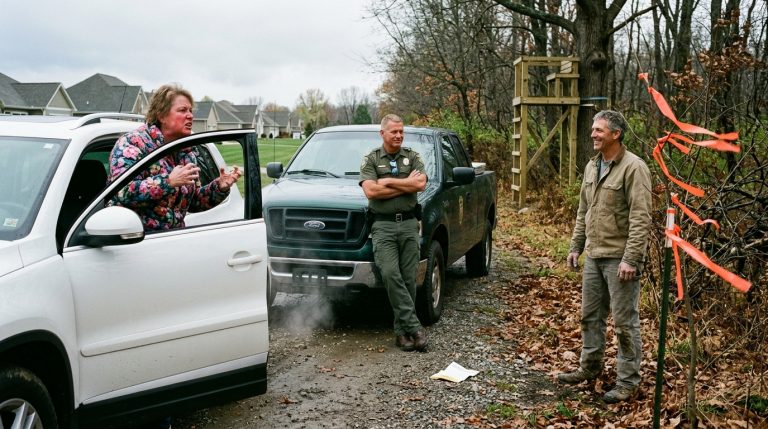
Karen White stood right on the edge of the property line, her pastel pink polo shirt straining against a heavy frame, the HOA oak leaf logo stretched across her chest like a badge of office. She clutched a cream-colored clipboard to her ribs as if shielding the nuclear codes.
“I’m confiscating them as per HOA bylaws section C, paragraph four,” she continued, her chin lifting in an automatic display of administrative superiority. “Unapproved signage.”
My gaze dropped past her face to her pristine white sneakers. The toe of her left shoe was resting a fraction of an inch over the small orange survey flag I had hammered into the dirt that very morning.
“Karen,” I said, keeping my voice down to that flat, level register I used when inspecting a questionable circuit. “Those posts are on my land.”
“The survey stakes are entirely irrelevant to community visibility standards,” she snapped, her eyes narrowing as she took another full step forward, crossing the invisible threshold entirely. Her fingers, weighed down by heavy, ostentatious rings, reached out and gripped the edge of the bright yellow sign bolted to the freshly sunk four-by-four. “The entirety of the Garrison parcel as it interfaces with the association is subject to visual covenants. You cannot just post tacky, aggressive warnings.”
A familiar, cold spike rose up from the base of my neck—the old operational focus, stripped of panic, sharpening every sensory detail around me. I noticed the exact grain of the splintered wood where she had already tested the screws. I noticed the twitch in her left eyelid.
“Don’t touch my property,” I said. The words weren’t loud, but they carried the specific weight of a final warning.
She let out a sharp, barking laugh, her fingers tightening around the yellow plastic, and jerked downward with a sudden, grunting heave. The wood cracked, the screws tearing free with a sharp, splintering shriek. She pulled the sign away like a trophy, a triumphant, smug sneer settling across her features.
“This is coming with me,” she declared, turning on her heel with the clipboard clutched to her chest. “And you’ll be receiving a fine in the mail before noon.”
I watched her walk back toward the uniform lawns without shifting my weight, my eyes locked on the rhythmic sway of her shoulders, already calculating the exact sequence of counters required to dismantle her entire kingdom.
CHAPTER 2: THE PAPER TRAIL AND THE SURVEY MAP
The sound of Karen’s pastel pink polo fading down the asphalt loop didn’t invite relaxation; it signaled a transition in the theatre of operations. I stood by the freshly dug post hole, the handle of the post hole digger still cool beneath my palms, and watched the dust settle where her sneaker had violated the orange survey flag. She thought she had secured a victory by carrying off a chunk of plastic-coated plywood. She didn’t understand the geography of what she was dealing with.
I walked the hundred-yard perimeter slowly, checking every single four-by-four. Each post had been sunk thirty inches into the clay, anchored with a gravel base, and tamped down with the kind of methodical discipline learned from watching how earth behaves under pressure. The missing sign was an annoyance, a minor theft of corporate-branded inventory, but the bigger picture required intelligence gathering.
The kitchen of the farmhouse smelled of old coffee and cedar shavings. Sarah was leaning against the counter, her hands wrapped around a ceramic mug, watching me walk up the back steps. She had seen the tail end of the interaction from the window, her expression tight with that quiet, protective worry that always accompanied any friction involving the subdivision.
“She took the sign, didn’t she?” Sarah asked, her voice low as I unzipped my work jacket and tossed it over the back of a wooden chair.
“She ripped it off with enough force to splinter the grain,” I replied, pulling out the heavy three-ring binder where we kept the property deeds. “Which means she’s escalating from passive-aggressive memos to direct physical interference.”
“Mark, it’s just a sign. Can’t we just let the boundary speak for itself? If she wants to play neighborhood enforcer, let her waste her energy on someone else’s lawn.”
I pulled out the certified county survey map, unfolding the thick blue-backed document across the heavy oak table. The creases were worn from previous reviews, but the red ink delineating the boundary lines remained sharp and uncompromised.
“It was never about the sign, Sarah,” I said, tracing the red line with the tip of my thumb where our ten acres met the HOA’s common strip. “If you give an inch to someone who measures their self-worth by how tightly they can squeeze everyone else into a mold, they don’t stop. They just redraw the map. Twenty years ago, I had to manage volatile ordnance where a misread line meant total structural failure. This is no different. You map the perimeter, you log the anomalies, and you establish a paper trail that holds up under scrutiny.”
I sat down, pulled my laptop toward me, and began drafting a formal response. I didn’t use emotion. I didn’t threaten retaliation or trade insults. Every sentence was clinical, measured, and built entirely on structural facts.
“Dear Ms. White and the Oak Creek Estates HOA Board,” I typed, the keys clicking rhythmically in the quiet kitchen. “Please be advised that the posts and signage in question are located strictly on private property outside the legal jurisdiction of the Oak Creek Estates Homeowners Association, as verified by the official county survey map attached to this communication. Therefore, no violation of association bylaws has occurred. I consider this matter closed…”
Sarah watched me type, her shoulders slowly dropping as the logical framework of the response took shape. She knew as well as I did that bullies like Karen didn’t care about logic, but she also recognized the utility of building an airtight defense before the next wave hit.
“Certified mail?” she asked quietly.
“Return receipt requested,” I said, hitting save and closing the document. “Always leave a paper trail. Let her spend her time writing up fines and printing out gold-embossed letterhead. Every piece of paper she sends is just another piece of evidence proving a coordinated pattern of targeted harassment.”
The reply didn’t take long to materialize. Three days later, the postman delivered a thick, cream-colored envelope bearing the HOA’s gold crest. Inside was a masterclass in bureaucratic delusion. Karen had completely ignored the county survey map, choosing instead to invent a brand-new governance concept out of thin air: the doctrine of aesthetic linkage. She claimed that because the fence posts were visible from the community common area, the entire ten-acre parcel fell under her aesthetic oversight.
I read the letter twice, a grim, humorless smile touching the corners of my mouth. Aesthetically linked. It was the logic of an absolute monarch declaring that anything her eyes could touch belonged to her crown.
I didn’t answer her letter directly this time. Instead, I picked up the phone and dialed Tom Henderson, the retired surveyor who lived three houses down. Tom had spent half a century walking boundary lines across the county before retiring to a quiet porch and a pair of binoculars.
“Tom,” I said when he picked up on the second ring. “I need you to look at a piece of correspondence. It’s got a new legal term you might want to add to your textbooks: ‘aesthetic linkage.'”
There was a long pause on the other end of the line, followed by a low, dry chuckle that sounded like dry leaves scraping across concrete. “Aesthetically linked? Son, I’ve been drawing lines since they used steel chains and transit markers, and I ain’t never heard of a jurisdiction based on line-of-sight daydreaming. Bring it on over. Let’s see what kind of fiction our HOA president is publishing this week.”
I grabbed the letter, walked out the front door, and headed down the asphalt path toward Tom’s house, stepping over the invisible line where the manicured lawns ended and my own rugged sanctuary began. The paper in my pocket felt heavy, but the ground beneath my boots felt solid, and the architecture of the defense was already falling perfectly into place.
CHAPTER 3: THE CHEMICAL SIGNATURE
The screen door of Tom Henderson’s house creaked open before I even reached the top step, the rusted spring letting out a familiar, complaining groan. Tom stood in the doorway holding Karen’s cream-colored letter between a thumb and forefinger as if it were contaminated waste. His porch smelled faintly of cedar sawdust and old pipe tobacco, a grounding contrast to the artificial lilac fog that seemed to follow Karen White everywhere she went.
“Aesthetically linked,” Tom muttered, shaking his head as he stepped aside to let me pass into the dim, paper-stacked interior of his living room. “I’ve walked property lines from here to the county line for fifty years, son. People put up fences to keep out deer, they put up walls to keep out noise, but I ain’t never seen a man try to claim jurisdiction over what his neighbor can see from a lawn chair. She’s building an empire out of thin air.”
I dropped into the worn leather armchair opposite his drafting desk, setting the survey map down beside a clutter of brass-rimmed compasses and rolled blue prints. “She isn’t just building an empire, Tom. She’s testing the perimeter. She thinks a piece of heavy cardstock and a gold-embossed logo give her the right to dictate what happens outside her asphalt loop.”
“And what are you going to do about it?” Tom asked, his faded blue eyes sharp beneath his white brows. “You can logic her to death with county deeds all day long, but bullies don’t surrender because they’re wrong. They double down when they realize they’re being ignored.”
“I’m not ignoring her,” I said, my voice dropping into that flat, measured cadence. “I’m letting her move into the open.”
Back at my own property line the following morning, the reality of that movement became painfully clear. The yellow warning signs I had bolted to the newly driven four-by-four posts were gone. There was no confrontation, no notes tucked into the mailbox, no polite warning. They had simply vanished in the night, leaving behind raw, splintered screw holes where the plastic had been ripped away by force.
When I knelt down to inspect the damage, my fingers brushed against the base of the wood. My hand came away slick with a dark, oily residue.
A sharp, acrid chemical odor hung in the damp morning air—something unnatural, stinging the back of my throat like a mix of solvent and acid. The grain of the pressure-treated timber was already turning a shade darker just above the soil line, soaked through with a foreign fluid that had nothing to do with rain or dew. This wasn’t a petty theft of property signs. This was a calculated, deliberate attempt to compromise the structural integrity of the fence itself.
The old tactical instinct, dormant since I walked away from the explosive ordnance disposal units overseas, flared to life with cold, absolute clarity. You don’t respond to industrial sabotage with polite letters. You treat it like a compromised site.
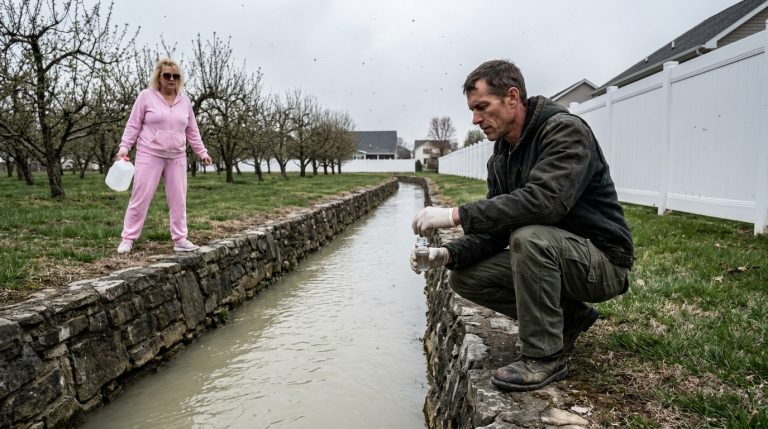
I retrieved a clean plastic baggie and a pocketknife from the kitchen, returning to the post with the surgical precision of an investigator processing a blast seat. Carefully, I scraped several slivers of the contaminated wood into the plastic, sealing it tight. Then I took a sample of the surrounding soil, scooping the dark earth into a second baggie.
Driving into the city an hour later, I bypassed every commercial hardware store and local garage where gossip traveled faster than wire. I headed straight across the county line to an industrial park, pulling up outside a private environmental testing lab where an old friend from the service, Mike, worked as a senior chemical analyst. Mike had traded detonator wires for mass spectrometers years ago, but he still knew how to keep a secret when a fellow veteran walked through his doors with an unmarked sample.
“Mark,” Mike said, pulling off his latex gloves as I dropped the two small baggies onto his stainless-steel counter. “You look like a man who just found an unexploded round in his basement. What are we looking at?”
“Somebody sprayed the base of my fence posts with something intended to make them rot,” I said, keeping my tone strictly neutral. “I need to know what kind of compound eats through treated timber overnight.”
Mike gave me a long, hard look, then picked up the sample bags with a pair of stainless steel tongs. “Leave it with me. Give me twenty-four hours.”
When my phone rang the next afternoon, the usual jovial warmth in Mike’s voice was entirely absent.
“Mark,” he said, the words coming fast and flat through the speaker. “The primary agent isn’t something you buy off the shelf at a garden center. It’s a high-concentration quinone-based fungicide mixed with a cellulolytic enzyme accelerator. In plain terms, it’s a custom-formulated wood-destroying agent designed to break down lignin and cellulose rapidly from the inside out. Whoever put this on your land didn’t just want to ruin your fence. They wanted to make it look like natural decay while completely dissolving the foundation.”
The phone felt heavy against my ear. The perimeter wasn’t just being tested by a bureaucratic tyrant with a clipboard; it was being undermined by someone executing a patient, malicious campaign of structural destruction. The war had moved past paper and ink. It was chemical now, and the architecture of the defense required a completely different caliber of response.
CHAPTER 4: THE ESCALATION TO CEDAR AND SURVEILLANCE
The phone call from Mike had changed the geometry of the entire dispute. When a person moves from stealing plastic signs to deploying specialized quinone-based compounds that target the cellular integrity of timber, they cross an invisible line from civil nuisance to felonious destruction. I didn’t head back to the kitchen to draft another polite administrative reply. Instead, I drove straight past the turnoff for Oak Creek Estates and kept going until the asphalt gave way to the gravel lot of a specialty timber yard twenty miles out of town.
If Karen wanted to play a game of attrition with my property line, I would give her a target expensive enough to force her hand completely.
The yard smelled of resin, dry sawdust, and rich, tannin-heavy earth. I walked the rows of stacked lumber until I found what I was looking for: ten-foot, six-by-six rough-sawn Western red cedar posts. They were dense, aromatic, and carried a price tag that made ordinary pressure-treated pine look like kindling. Each post cost over three hundred dollars. When loaded into the bed of my truck, they represented a heavy, uncompromising statement of intent.
Back at the perimeter, I didn’t work under the cover of dusk or hide behind the tree line. I stripped off my shirt, tossed it over the hood of the truck, and set to work under the high, glaring afternoon sun. The power auger bit into the clay with a violent, roaring whine, chewing through roots and stony soil until I had ten deep, uniform post holes aligned with military precision. I mixed the concrete by hand in a wheelbarrow, pouring the heavy grey sludge around the base of each cedar post before tamping it solid with a heavy iron tamper.
From her back patio two hundred yards away, Karen’s patio umbrella offered a colorful frame of reference. I could see the flash of her silhouette behind the sliding glass door, watching the labor with an intensity that felt less like neighborhood observation and more like a tactical spotter tracking a target. Let her watch. Let her calculate the material cost of ten premium cedar posts sinking deep into ground she claimed authority over.
But physical barriers and expensive timber were only half the strategy. A perimeter left unmonitored is an invitation for sabotage.
That evening, once the sun had dipped below the ridge and cast long, sharp shadows across the meadow, I walked the line with a heavy canvas tool bag. I wasn’t just planting posts anymore; I was establishing an intelligence grid.
From the glove compartment of my truck, I pulled out a tactical-grade cellular trail camera equipped with no-glow infrared night vision and a direct cloud uplink. I didn’t strap it to the fence line where an intruder could easily spot and smash it. Instead, I climbed thirty feet up into the dense, dark crotch of an ancient pine tree standing thirty yards back within my own timberland. From that elevated angle, the camera commanded a sweeping, downward-looking field of view across the entire hundred-yard stretch of the contested boundary.
I mounted a second camera low, hidden inside the hollowed-out core of a thick holly bush, angled precisely to capture the approach vector to the primary posts. Finally, I tucked a thumb-sized, motion-activated audio recorder into a natural fissure in the bark of an old oak right beside the main corner post, its sensitive microphone wired to catch the slightest whisper or footfall.
I descended the pine tree, my boots crunching softly on the dry needles, and walked back toward the farmhouse. The system was live, redundant, and completely independent of local Wi-Fi or visible lights. All I had to do was wait for the trap to spring.
For three days, the woods remained quiet. The cellular network stayed silent, save for the expected nocturnal traffic of white-tailed deer stepping gingerly past the posts and a fat raccoon testing the base of the oak tree. The heavy, sweet scent of fresh cedar hung in the night air like an unspoken challenge.
Then, on the third night, exactly at 1:47 a.m., my phone buzzed against the wooden nightstand with a low, vibrating hum that cut cleanly through the dark room.
I didn’t wake Sarah. I slipped out from under the covers with the practiced, silent fluidity of a man moving through an unfamiliar compound, carried my laptop into the quiet living room, and opened the remote surveillance application.
The infrared feed from the pine tree camera flickered to life in sharp, high-contrast monochrome. A bulky, heavy-set figure wrapped in a dark, shapeless jacket was moving purposefully along the outside of the fence line. The gait was unmistakable—that rigid, self-important stride that belonged to no one else in the subdivision.
Karen White had taken the bait. And this time, she brought more than just a spray bottle.
CHAPTER 5: THE TRAP SPRINGS IN THE DARK
The monochrome glow from the laptop screen cast sharp, pale light across the living room rug, illuminating the grain of the floorboards where I stood motionless. On the display, the infrared feed from the pine tree camera flickered, updating every few frames with brutal, silent clarity. A heavy, bulky silhouette moved along the outer perimeter of the newly driven cedar posts, cutting a stark shape against the frost-rimmed winter grass.
There was no hesitation in the movement. This wasn’t a casual stroll or the erratic path of a late-night wanderer. It was purposeful, rehearsed, and driven by an intense, obsessive compulsion.
I didn’t rush toward the door. In ordnance disposal, moving too fast in an unverified theater is how you miss the secondary tripwire. Instead, my thumb moved deliberately across the trackpad, hitting the local record button to ensure a permanent, redundant local copy was locked down while the cloud uplink streamed the data to an offsite server. My breath came slow and even, matching the steady rhythm of the night outside.
On the screen, the figure stopped directly in front of the primary cedar post—the one anchored deepest in concrete and placed squarely in the crosshairs of the 4K lens and hidden audio feed.
The audio file, streaming live through a pair of high-impedance headphones resting around my neck, crackled to life with the crisp rustle of dry leaves and the sharp snap of frozen grass. Then came a low, grating mutter, caught with startling, bone-chilling clarity.
“Think your fancy wood and your expensive lawyers mean anything…”
The voice was unmistakable. Even distorted by the faint hiss of the digital feed, the self-righteous cadence belonged entirely to Karen White.
On screen, she knelt down with a heavy, deliberate grunt. Her gloved hands reached into the pocket of her dark, shapeless jacket and pulled out a small, metallic spray bottle—the exact garden mister I had suspected. Without hesitation, she began to pump the nozzle, dousing the base of the expensive Western red cedar post with a rhythmic, vindictive motion. The dark liquid pooled instantly against the fresh grain, soaking deep into the porous wood fibers.
I watched the timestamp tick upward in the corner of the monitor. 1:49 a.m.
She wasn’t finished. After soaking the first three posts with the custom-formulated quinone solution, she stood back up, reached into another pocket, and produced a clear plastic baggie. The infrared light caught the glint of moist earth packed tightly inside it, teeming with pale, squirming shapes. Termites. Wood-boring larvae collected from somewhere outside the subdivision, harvested to complete the illusion of a natural, catastrophic infestation.
She dug a shallow trough into the frozen topsoil right against the base of the post, tipped the baggie upside down, and patted the dirt flat over the writhing mass with her gloved palm.
“Let’s see you explain this to your insurance,” she whispered to the empty night, a short, triumphant chuckle escaping her lips before she turned and retreated back toward the shadows of the subdivision.
I closed the laptop lid. The screen clicked shut, plunging the room into absolute darkness. The evidence wasn’t circumstantial anymore. We had the face, the motion, the toxic chemical signature, the biological vector, and her own voice narrating the crime in high definition. The perimeter had held, and the trap had closed with absolute, irreversible precision.
The following morning, the frost on the grass glittered under a pale winter sun, but the air along the fence line carried that familiar, acrid chemical sting. I walked out to the cedar posts, my hands shoved deep into my jacket pockets, looking down at the dark, oily stains glistening against the pale wood. I didn’t need to take more samples. I pulled out my phone and dialed David Chen directly.
“David,” I said, keeping my voice level as the ringing tone cut off. “The trap is sprung. We have the video, the audio confession, and the biological drop.”
There was a sharp intake of breath on the other end of the line, followed immediately by the rustle of papers shifting across a mahogany desk. When David spoke, his professional composure had vanished, replaced by a razor-sharp, predatory focus.
“Send the files to my secure server right now,” David commanded, his words coming fast and hard. “We aren’t going to the local precinct this time. I’m calling my contact in the county prosecutor’s office. We’re bypassing the desk sergeants and going straight to the property crimes division with a felony package they can’t ignore.”
Within two hours, I was sitting across a cold, steel-framed table in a secure interview room at the county sheriff’s department, flanked by David and a senior detective named Miller. Detective Miller had the tired, unblinking eyes of someone who had spent decades cataloging human malice, but as the high-definition video began to play on the laptop screen, her expression hardened from professional skepticism into cold, concentrated fury.
She watched the footage of Karen spraying the chemical agent twice. She leaned in closer as the audio filled the sterile room, Karen’s venomous whisper echoing off the concrete walls. And when the screen showed the baggie of termites tipped into the soil, Detective Miller reached out and tapped the pause button with the tip of her pen.
“Well,” the detective said, her voice dropping an octave as she looked up from the screen to meet my eyes. “That’s Karen White. And that right there is a multi-count felony indictment.”
She began listing the charges without needing to check her notes: willful destruction of private property exceeding the felony threshold, unlawful application of restricted chemical agents, and environmental contamination. The legal machinery, once mobilized, moved with the inexorable weight of an avalanche.
By late afternoon, two county cruiser units rolled silently down the asphalt of Oak Creek Estates, their tires crunching on the frost as they cut off the exits to Karen’s pristine, pastel-trimmed driveway. I watched from the edge of my property line as the front door of her house swung open.
Karen stepped out onto her porch, her face settling into that familiar, indignant mask of administrative superiority, clearly expecting another minor grievance or a routine HOA inquiry. A deputy stepped forward, holding the crisp, folded pages of a signed search and arrest warrant.
I saw her expression shift in real-time. The righteous annoyance melted away, replaced by a sudden, slack-jawed shock that seemed to drain all the color from her skin. She sputtered a protest, shaking her head as the deputy unclipped the steel cuffs from his belt.
The click was too far away to hear across the hundred yards of open air, but in my mind, it rang out with absolute, deafening clarity.
They turned her around, guided her stumbling steps down the wooden porch stairs, and placed her into the back of the cruiser. The queen bee of Oak Creek Estates had been unceremoniously deposed, her perfect little kingdom crumbling into the cold winter dirt because she had finally run headfirst into a perimeter she could neither bully nor break.
CHAPTER 6: THE FINAL LEDGER AND THE BURNING BYLAWS
The dust kicked up by the county cruisers drifted slowly across the asphalt of Oak Creek Estates, settling over the immaculate lawns like a grey film. I remained standing right where I had been on the edge of the property line, my hands shoved into the pockets of my jacket, watching the red tail-lights vanish around the corner of the cul-de-sac.
The legal machinery didn’t pause for breath once the cuffs clicked into place. Over the following weeks, David dismantled the administrative architecture of the homeowners association piece by piece. The search of Karen’s garage had unearthed not only the bolt cutters and the half-empty container of the quinone-based wood-rotting agent, but also the digital receipt for the termite colony starter kit downloaded from an exotic pest supply site. Her digital footprint was as sloppy as her tactical execution. Faced with the mountain of high-definition video, audio confessions, and chemical lab reports, her defense collapsed before it ever entered a courtroom.
A plea deal followed swiftly: five years of probation, three hundred hours of community service, and a court-ordered restitution package totaling just over fifty thousand dollars to cover the cedar posts, labor, and legal fees, secured by a mandatory lien placed directly against her house.
Simultaneously, David filed a massive civil suit against the Oak Creek Estates corporate entity, citing gross negligence and systemic complicity by the board of directors. The association’s insurance carrier, staring down the barrel of our evidence package, rushed to the settlement table to avoid a public trial that would have wiped out their reserves.
The climax arrived on a cool Saturday afternoon inside the rented conference room of a local hotel, packed to capacity with every homeowner who had ever received a tyrannical memo or a petty fine. The remaining board members sat at the front table like hostages waiting for a tribunal.
David took the podium with the calm, measured authority of a prosecutor delivering a final verdict. Without raising his voice, he projected the high-definition video onto the large overhead screen. The room fell into a heavy, suffocating silence as Karen’s venomous whisper echoed through the speakers: Let’s see how smart your expensive wood is against this… a little biological assistance.
A collective, shuddering gasp rippled through the audience. The illusion had shattered completely. The mask of community standards was stripped away, revealing the petty, fragile terror that had governed their lives for years. Maria stood up first, recounting the threat of a lien over her son’s basketball hoop. The Millers followed, detailing months of harassment over mailbox paint. One by one, the silent majority found their voice. Before the meeting adjourned, two of the remaining board members tendered their resignations in absolute disgrace.
The subsequent election transformed the neighborhood overnight. Tom Henderson, the retired surveyor whose decades of mapping lines had laid the bedrock of our defense, was overwhelmingly voted in as the new association president. Maria stepped in as treasurer. Their very first order of business was a complete structural overhaul of the community rulebook.
Every ambiguous, subjective clause that Karen had weaponized—including the infamous aesthetic harmony section governing sightlines and color codes—was struck from the bylaws with a red pen. The tyranny of taste was officially dead.
To mark the conclusion of the conflict, the new board organized an open community barbecue on the common area right at the edge of my property line.
Tom stood before the gathered neighbors holding a thick copy of the old HOA rulebook. With a deliberate, symbolic motion, he flipped open to the page containing the aesthetic harmony clause, held it up for everyone to see, and dropped the entire booklet straight into the flames of the barbecue grill. We watched the paper curl, blacken, and turn to ash as the crowd erupted into thunderous, cathartic applause.
The legal proceedings forced Karen to sell her house and downsize far away from the neighborhood she had tried to rule. A few months later, a young family with two small children moved into her old address. Within a week, a bright, colorful children’s swing set was erected on their front lawn, its vibrant plastic legs breaking every old rule of visual conformity. No one raised a finger. No one drafted a memo.
That evening, I stood on the back porch of the farmhouse, watching the sunset paint the sky in deep shades of amber and slate over my ten acres. Sarah came out and stood beside me, sliding her arm around my waist, her posture relaxed and steady.
Footsteps crunched softly on the gravel path leading up from the common area. Tom walked over holding a pair of cold bottles, stepping across the invisible boundary without a second thought. He handed one to me, and the three of us stood in comfortable, unbroken silence, looking out over the land.
The magnificent Western red cedar posts stood tall and unmolested along the woodline, their dark grain catching the last rays of light. I didn’t take down the single “No trespassing” sign I had bolted back onto the primary post. It stayed there not as a threat, but as a historical marker—a quiet, permanent reminder that true peace is never handed down as a gift; it is measured, maintained, and fiercely defended.
The sanctuary was secure. The ledger was balanced. The war was over, and the silence that settled over the woods was the sound of absolute victory.