The Weight of Silence: A Combat Medic’s Journey from Invisibility to the Classroom of Truth
CHAPTER 1: THE FOURHOUR MILE
The dawn over Arlington did not break with color; it seeped into the landscape, a grey wash that turned the rows of white markers into bone-white teeth biting into the earth. Olivia sat in her sedan, the blue and white waitress uniform still clinging to her skin. Her name tag, a thin slip of silver, caught a stray beam of light. It was a lie of a name tag, a uniform of a life that had served as a fortress for seven years, and now, it felt impossibly fragile.
She had meant to go home. The plan had been etched in her mind since the newsletter arrived, a soft, persistent itch in the back of her brain. Go home. Change into black. Arrive as a civilian, not a diner waitress with coffee stains on her apron. But at 11:14 PM, when the last customer left the diner and the silence of the parking lot closed in, the momentum of the highway had pulled her instead, a magnetic force she didn’t possess the will to resist.
She looked at her hands. They were steady—too steady. They were the hands of someone who had spent seven years practicing the art of not moving, not feeling, not existing in any space that demanded an accounting. In the passenger seat, the obituary clipping lay folded into a neat, sharp square. It was the only map she had.
A gust of wind rattled the car door, and the sound of the ceremony’s distant, rhythmic drumming drifted toward her. It was a precise, hollow sound, the heartbeat of an institution she had walked away from without looking back. She touched the challenge coin in her pocket, its surface worn smooth by the frantic, nightly turning of her thumb. It was the only part of her that hadn’t changed, a physical relic of a night that she had spent thousands of nights trying to rewrite.
She opened the door. The air was colder than she expected, sharp enough to cut through the fabric of her apron. As she stepped out, her heel caught on the edge of the asphalt—a small, jarring trip that forced her to stumble, to physically reorient herself in the world she had spent years mentally avoiding.
She walked toward the gates, the weight of the apron feeling like an anchor. Every step toward the fence was a step away from the diner, away from the safety of her anonymity, toward the man who had been the architect of the mission that shattered her. She didn’t look at the other mourners. She kept her eyes on the ground, tracing the patterns of the cracks in the walkway, searching for a path that didn’t lead to a confrontation.
But the guards were already turning. The movement in the back of the section was subtle, yet to her, it felt as loud as a gunshot. She saw the young specialist, his uniform far too crisp, his eyes already narrowing as they swept over her apron and the hair she had neglected to unpin after her shift. He was already stepping forward, his posture hardening into a wall.
She had come here to pay a debt, not to be recognized. But as the specialist’s voice sharpened, “Ma’am, this section is for family and distinguished guests only,” she realized the past was not a ghost; it was a physical space, and she was currently standing in the center of it, entirely, impossibly exposed.
CHAPTER 2: THE FRICTION OF THE GATES
The specialist’s fingers twitched, not toward a weapon, but toward the radio clipped to his shoulder. He was young enough that his primary instinct was to call for backup when the math didn’t add up. To him, the scene was a binary equation: authorized guests were inside the perimeter; everyone else was a variable to be removed. And here, in the grey, hushed expanse of Arlington, Olivia was a variable that refused to be solved.
“Ma’am, I’m going to need you to step back,” he repeated, his voice climbing an octave, losing its professional veneer. He glanced toward the sergeant, who was currently moving through the crowd with the deliberate, heavy-footed pace of a man who dealt in certainties.
Olivia didn’t move. She couldn’t. It wasn’t defiance—not the way they interpreted it. It was inertia. She had spent seven years keeping herself small, keeping the edges of her life sanded down so that she wouldn’t catch on anything. But the sight of the rows of white markers, the familiar geometry of a military formation, had locked her joints. The air here tasted of damp earth and floor polish, a sensory trigger that yanked her back to the compound, to the weight of the medical kit, to the frantic, blood-slicked rhythm of the triage.
“I said move, ma’am.” The specialist stepped forward, his boot scuffing the manicured grass. He reached out, his hand hovering near her elbow—a gesture intended to usher her toward the public viewing area on the hill.
Olivia felt the heat of his palm before it made contact. The touch was the catalyst. She pivoted, not to fight, but to distance herself, her movement fluid, trained, and entirely reflexive. She didn’t mean to reveal how she moved, but she caught his wrist with a grip that hadn’t forgotten the leverage points of a combat environment. It was an involuntary correction, a muscle memory that surfaced from the depths of her seven-year silence.
The specialist froze, his eyes widening as he registered the speed of her reaction. He wasn’t just looking at a waitress anymore; he was looking at someone who possessed a dangerous kind of stillness.
“Hey!” The sergeant was here now, his boots grounding into the soil, his presence cutting off the air around them. He stopped three feet away, his gaze sweeping over Olivia, cataloging the apron, the name tag, the untidy hair, and finally settling on her hands—which she had already released, pulling them back into her pockets as if they were contraband.
“What is the problem here?” the sergeant demanded, his voice a low, authoritative rumble that drew the attention of a nearby colonel.
“She’s refusing to move to the public section, Sergeant,” the specialist said, his voice breathless, betraying his unease. He was still staring at her wrist, trying to reconcile the woman in the apron with the woman who had just checked his movement with a precision that didn’t belong in a diner.
Olivia turned to the sergeant. The wind tugged at the hem of her apron, the fabric fraying at the edges. She focused on the buttons of his uniform, on the brass that shone with an oppressive, reflective light. She couldn’t look at his eyes; they were the eyes of every superior officer who had ever signed a document that sent her into the dark.
“I’m just here to pay my respects,” Olivia said. Her voice was steady, the result of years of practicing how to speak without revealing the depth of the resonance beneath. “I don’t need a seat. I just need a moment.”
The sergeant frowned, his brow furrowing as he processed the request. He looked at her unit insignia, the worn, faded embroidery on her bag that had been through the wash a thousand times. He squinted at it, his brain trying to categorize it, to find the regulation that matched the unit to the woman. It was a mismatch—a piece of history out of place in a modern, starched landscape.
“You’re not on the guest list,” the sergeant stated, his tone shifting from dismissive to suspicious. “And this attire is clearly inappropriate for this service. You’re a disruption.”
“I am not a disruption,” Olivia said, her gaze flickering for a fraction of a second to the casket resting under the flag. “I am just a person standing on a piece of ground.”
The sergeant stepped closer, invading her personal space, his posture radiating the cold, hard logic of the institution. “You are standing on a restricted site with unauthorized identification. If you don’t turn around and walk back to your vehicle, I will have the military police escort you off the grounds.”
Olivia’s hand touched the challenge coin in her pocket. It was cold, the edges biting into her skin. She had come here to let go of the past, but the gatekeeper was doing everything in his power to ensure it remained securely locked. She looked at the sergeant, then at the specialist, seeing the reflection of her own invisibility in their eyes. They didn’t see a medic; they saw a waitress. They didn’t see a human being with a debt to settle; they saw a clerical error in the funeral arrangements.
She took a slow, measured breath, the scent of the nearby magnolias clashing with the sterile, metallic smell of the military machinery around her. She was not going to move. Not today. Not after four hours of night driving and seven years of waiting.
“Call them,” she said, her voice dropping into a register that made the sergeant pause. “Call the police. But I am not moving until the service is finished.”
The sergeant’s face flushed a deep, mottled red. He leaned in, ready to issue an ultimatum, but before he could speak, a ripple moved through the crowd behind him. A young captain—a man whose face was a study in controlled, watchful silence—turned his head. He had been standing in the formation, a statue of discipline, but now his focus had shifted. His gaze landed on Olivia, and the air between them seemed to vibrate with the shock of recognition.
He didn’t move yet. He simply watched, his eyes narrowing as he scanned her face, stripping away the apron, the name tag, the exhaustion. He was reading her, and for the first time in seven years, the person looking at her wasn’t looking at a waitress. He was looking at a ghost.
CHAPTER 3: THE CAPTAINS INTERVENTION
The captain did not look at the sergeant again. He had effectively erased the man from the immediate reality of the conversation, reducing him to mere background scenery. Instead, he maintained his focus on Olivia, his expression neither pitying nor demanding. It was simply observant, a scientist noting the state of an anomaly.
“Olivia Reeves,” he said again, the name sounding foreign and yet strangely anchored in the morning air. He stepped slightly closer, creating a private bubble of stillness amidst the surrounding commotion. “I know who you are. I’ve seen the reports.”
Olivia felt a sharp spike of adrenaline, followed immediately by a dull, aching fatigue. The reports. The sterilized, sanitized versions of the night at the compound—the versions that lived in folders and briefing rooms, devoid of the smell of cordite and the sound of the rain. “Reports are just ink on paper, Captain,” she murmured, her voice barely carrying over the distant, muffled sound of the color guard’s footsteps. “They rarely capture the cost.”
“I’m not here to debate the ink,” he replied, his voice dropping into a register that only she could hear. He shifted, his hand moving to the pocket of his dress blues, almost as if he were checking for something, before he caught himself. “I’m here because you are standing at the edge of a memory that a lot of people here would prefer to keep buried. General Harris… he had his reasons for everything, but not all of those reasons were ever properly communicated to the field.”
The sergeant, still standing nearby, seemed to be vibrating with suppressed agitation. He looked from Olivia to the captain, his jaw working as he tried to reassert his authority. “Captain, I don’t know who this is, but she’s causing a scene and—”
The captain’s head snapped toward the sergeant, not with a shout, but with a look of such absolute, chilling detachment that the sergeant’s voice simply vanished. “She is not causing a scene, Sergeant,” the captain said, his tone as cool as the frost on the nearby headstones. “She is the guest of the family. Unless you have a direct order from the family to remove her, I suggest you return to your post and ensure the perimeter remains secure. There is a great deal of work to be done, and your current performance is… inefficient.”
The sergeant looked like he had been struck. He hovered for a second, caught between the instinct to argue and the overwhelming weight of the captain’s rank and conviction, before finally executing an abrupt, jerky about-face. He retreated into the crowd, his frustration visible in the stiff, awkward line of his shoulders.
Olivia watched him go, a strange, hollow sensation blooming in her chest. She had spent seven years believing the system was an monolith, an immovable, uncaring entity that had discarded her the moment her usefulness ended. Seeing the sergeant—a man who had spent his career polishing the brass and shouting orders—so easily dismissed, made the ground beneath her feet feel suddenly, alarmingly thin.
“Why?” she asked, turning her gaze back to the captain. “Why intercede? I’m in a waitress uniform. I’m nobody to this crowd.”
“That’s exactly why,” the captain said. He gestured toward the distant, shimmering rows of the cemetery. “Most people here are performing a role. They’re here because they’re supposed to be, or because they need to be seen. You are the only person here who doesn’t have a script. You came because you felt you owed a debt to a man who, by all accounts, spent his final years wondering if you were still alive.”
Olivia stiffened. “Wondering?”
“He didn’t just ‘wonder’ in the abstract, Reeves.” The captain’s gaze softened, the intensity of his focus shifting from tactical to something more human. “He tried to reach out. The problem was, you didn’t want to be found. And when a person with your specific skill set decides to go off-grid, they tend to be very, very good at it.”
He didn’t wait for her to respond to that. He stepped to the side, widening the gap between them and the mourners. “The family knows you’re here. They’ve been waiting for a moment, a sign. If you’re willing to walk with me, I can take you to them. If you’d rather disappear before the service concludes, I won’t stop you. But you should know… the General left instructions. There’s something he wanted you to have.”
Olivia looked at her hands again. The faded uniform, the lack of any rank or recognition, felt less like a costume now and more like a bridge. She was a bridge between the life she had abandoned and the reality she had been avoiding.
“What is it?” she asked, her voice cracking just enough to betray the tension.
“An answer,” the captain replied, his eyes steady on hers. “To the question you’ve been asking yourself every night for the last seven years.”
He held out his arm—not in a gesture of chivalry, but as a silent, unwavering point of navigation. Olivia took a final look at the gate, at the road that led back to her diner, her quiet life, her safe, small world of order pads and coffee. Then, she looked at the captain, and for the first time in years, she chose the path that led directly into the heart of the storm.
“Lead the way,” she said.
As they began to walk, the crowd seemed to naturally part. People recognized the captain—they recognized his uniform, his bearing, his quiet, unmistakable gravity—and they stepped back, their whispers dying into a reverent silence. They weren’t looking at her as a waitress anymore; they were looking at the woman walking beside him, the woman who had somehow earned his escort. The air felt heavy, charged with the weight of unsaid things, and as they moved toward the front row, Olivia realized that the invisibility she had cherished was finally, irrevocably, shattered.
CHAPTER 4: THE EPIPANY OF PAPER
The distance between the perimeter and the front row was not just physical; it was a traversal of social hierarchy that Olivia had spent seven years avoiding. As they neared the family section, the atmosphere thickened. The air here smelled faintly of lilies and heavy, expensive perfume, a stark contrast to the sterile, sharp scent of the groundskeeper’s chemicals and the dry earth of the open trench.
The captain slowed his pace as they approached. The general’s wife was standing in a small circle of individuals whose presence was marked by a certain, practiced stoicism. She was dressed in black that seemed to absorb the morning light, her face a pale, composed mask. As they neared, her eyes—sharp and observant despite the obvious toll of grief—found Olivia’s.
There was no confusion in the woman’s gaze. There was only a profound, heavy recognition. She didn’t look at the waitress uniform with judgment; she looked at it with the knowing eye of someone who had lived through the peripheral casualties of the military life.
“Captain,” the woman said, her voice quiet but carrying with a strange, reverberant clarity. She turned her attention to Olivia. “And you must be Olivia.”
The name felt like a weight being placed directly into Olivia’s hands. She stopped, her heels digging slightly into the manicured turf. “I’m sorry for your loss, ma’am,” she said, the rote response feeling hollow against the reality of the situation.
“Loss is a complicated thing,” the wife replied, her gaze lingering on Olivia’s apron. She reached into the pocket of her coat, a motion so slow and deliberate that it felt like an unfolding of time. “He asked for this to be given to you today. Not before. Today.”
She produced an envelope. It was thick, cream-colored, and sealed with a touch of wax that had begun to crumble at the edges. Olivia took it. The paper was cool, textured beneath her fingertips. It didn’t feel like a piece of mail; it felt like a heavy, physical object, something that had been carried for too long to be ignored.
“He wanted you to know,” the woman continued, her voice dipping lower, meant only for Olivia. “He said the silence was the thing he regretted most. Not the orders. The silence after.”
Olivia slipped the envelope into the deeper pocket of her apron, beneath her order pads and pens. The weight of it against her hip was grounding, a physical anchor that kept her from drifting away as the reality of the moment threatened to overwhelm her. She wanted to open it right here, to tear into the mystery of the last seven years, but the ceremony was shifting. The chaplain had begun to move toward the podium.
“You should sit,” the captain whispered, gesturing to an empty chair in the front row, tucked strategically between a distant relative and the captain himself.
Olivia sat. She felt absurdly visible in her work clothes, a rogue variable in a field of polished uniforms and somber suits. The service began—a blur of familiar liturgy, the cadence of which she could have recited by heart. It was the same rhythm as the memorial services she had attended after Operation Sentinel Ridge, the same cadence that had once made her want to scream.
But as the chaplain spoke of service and sacrifice, Olivia found herself tracing the outline of the letter in her pocket. Her mind drifted, not to the eulogy, but to the compound. She felt the phantom weight of the med-kit on her shoulders, the heat of the fire, the way the light had shattered against the walls.
A sudden, jarring shift occurred in her perception—a V-2 phantom. For a heartbeat, the sunlight hitting the general’s casket seemed to mimic the harsh, blinding flare of the secondary explosion that had ended her career. She felt the grit of sand against her eyelids, the taste of metallic dust. Her pulse spiked, her fingers twitching against her apron, her breath hitching in a way that felt dangerously close to a panic response.
She leaned forward, her elbows on her knees, burying her face in her hands for a fleeting second. She wasn’t just at a funeral; she was at the end of a long, circular path. She felt the captain’s hand briefly touch her shoulder—a firm, grounding pressure—and the vision receded. The smell of lilies returned, drowning out the imagined stench of burning oil.
The service concluded with a finality that hit like a physical blow. As the crowd began to rise, the general’s wife leaned down to whisper one final thing. “Read it,” she said, her eyes wet but fierce. “Don’t carry the mystery. Carry the truth.”
Olivia stood, the letter burning against her leg. She knew that as soon as she left this field, as soon as she was back in the isolation of her car or the privacy of her kitchen, she would open it. She looked at the captain, who was standing at attention, his eyes fixed on the casket as it was prepared for interment.
She turned and began to walk away, not toward the gate this time, but toward the relative solitude of a large, ancient oak tree at the edge of the section. She needed distance. She needed to be away from the uniforms, the expectations, and the weight of the collective grief that she didn’t feel she had the right to share. She walked until the sound of the mourners became a distant hum, her feet steady, her mind clear, the apron billowing slightly in the rising wind. She reached the trunk of the oak, leaned her back against the rough, aged bark, and reached into her pocket for the seal.
CHAPTER 5: THE WEIGHT OF THE REVELATION
Olivia held the paper with hands that refused to stop shaking. She had retreated to the shadow of the oak tree, a place where the noise of the funeral felt muffled, reduced to a low-frequency hum. The letter—three pages of dense, cramped handwriting—began with an apology that didn’t feel like a comfort. It felt like a surgical incision.
“I am writing this because the truth is a burden that has occupied too much space in my life,” the first paragraph read. His hand was shaky, the ink pooling in places as if he had struggled to maintain control. “I withheld the intelligence report that reached my desk six weeks after your final operation. It would have cleared your name, it would have validated your choice, and instead, I allowed it to be buried in the bureaucracy of the classified archives. I thought I was protecting the mission, but I was only protecting my own convenience.”
Olivia read the lines again, her vision swimming. The “unforgivable” shot—the one that had haunted her sleep for seven years, the one that had convinced her she was a monster—was suddenly recontextualized. The woman she had killed, the woman whose death had served as the anchor for her guilt, was a high-level cartel lieutenant responsible for dozens of civilian deaths. The compound hadn’t been a neutral space; it had been a command node. Her actions hadn’t been a moral failing; they had been a tactical necessity.
But the relief she expected never came. Instead, a cold, hollow dread settled in her stomach. If the shot hadn’t been a tragedy, then her entire life for the last seven years—the diner, the anonymity, the way she had systematically destroyed every bridge back to her former self—had been built on a foundation of completely unnecessary penance. She had been punishing herself for a crime that didn’t exist.
She paced in the shadow of the oak, her boots scuffing the dry, compacted earth. She looked down at her waitress uniform—the blue fabric, the white apron, the name tag—and suddenly, it felt like a prison garment. She hadn’t been hiding; she had been serving a sentence in a cell she had built herself.
The wind surged, and the second page fluttered. “The classification was lifted in three years,” the letter continued. “I searched for you. I used resources I shouldn’t have. I tracked your movements, your employment, the way you had erased your digital footprint. Every time I got close, you had already moved again. I realized then that you didn’t want to be found because you were convinced you deserved to be lost.”
Olivia felt a wave of nausea. The general hadn’t been an enemy; he had been a man trying to fix a mistake that was already too large to repair. The complexity of the reality began to bleed into the edges of her perception. She looked at the distant, retreating figures of the mourners, the way they moved with such certainty, such purpose. How many of them were carrying their own versions of this? How many were operating under the weight of information that was fundamentally, tragically incomplete?
She tried to fold the letter back into its original crease, but her fingers were clumsy, numb. She felt a sudden, sharp spike of paranoia. What if the letter itself was a manipulation? What if this was just another layer of the military’s theater, designed to pull her back in, to force her to account for her skills now that they had a need for them? The captain’s offer—the training program—echoed in her mind. Was it a coincidence that he appeared the moment she was ready to be brought back into the fold?
She stopped pacing and pressed her back against the rough bark of the tree, closing her eyes. The scent of the earth, the rustle of the leaves, the distant, mournful sound of a bugle playing ‘Taps’—all of it felt disconnected, as if she were viewing the world through a thick, distorted lens. She had spent seven years cultivating a specific kind of numbness, and this truth was far too sharp, far too serrated to exist comfortably within the life she had constructed.
She had to know if it was real. She had to know if the woman was who the letter claimed. The doubt was a parasite; it wouldn’t let her rest until she had verified every word. She tucked the letter into the inside of her jacket, over her heart, and reached into her pocket for her phone. The screen was cracked, the battery low, but it was enough. She stood there, in the quiet of the funeral’s edge, and began to dial a number she hadn’t touched since the day she left the base—a secure, encrypted line that she had kept in her contacts, not because she intended to use it, but because it served as a boundary.
The connection tone was distorted, crackling with static. She waited, her pulse hammering against her ribs, as the line on the other side began to ring. Every second that passed felt like a year. She needed to know. She needed to break the seal on the final reality, even if it destroyed everything else.
CHAPTER 6: THE FRAYING LINE
The static persisted for five excruciating heartbeats, a sharp, white-noise hiss that seemed to mock her impatience. Olivia gripped the phone, her knuckles white, her breath coming in ragged, shallow drafts. Then, the hiss vanished, replaced by the hollow, impersonal tone of a disconnected circuit. She stared at the screen. The number she had dialed—a relic of a life she had systematically dismantled—was no longer active. The bridge she had been so afraid of wasn’t just broken; it had been erased.
She lowered the phone, her hands trembling. The silence that followed was heavy, suffocating. She looked down at the letter tucked into her jacket, the cream-colored edges now crinkled from her frantic handling. If the bureaucracy had closed the file on that night, if the records were purged or reassigned, she was standing on an island of truth that no one else in the world could—or would—verify.
She heard the crunch of gravel behind her. Olivia didn’t turn; she didn’t need to. The cadence of the footsteps was distinct, deliberate, and entirely too familiar.
“The line hasn’t been active for years, Olivia.”
The captain stood a few feet away, his hands clasped behind his back, his posture as rigid and composed as it had been during the ceremony. He didn’t look like he had been following her; he looked like he had been waiting for the exact moment when she realized her isolation was absolute.
“You knew,” she said, her voice barely a whisper, though it felt loud in the stillness of the cemetery. She turned to face him, the letter still clutched in her hand like a weapon. “You knew the records were gone. You knew this letter was the only thing left.”
“I knew that some things are best left to the people who actually lived through them,” the captain said, stepping closer. The sunlight caught the gold of his insignias, a blinding glint that seemed to emphasize his authority. “Bureaucracy is a convenient shroud. It hides the mistakes, but it also buries the heroics. I didn’t bring you here to confirm a file. I brought you here to confirm a person.”
Olivia felt a flash of irritation—a sharp, stinging heat that cut through the numbness. “I’m not a project, Captain. I’m not a ‘case study’ for your training program to dissect. I’m a person who has spent seven years believing I was a monster, all because someone forgot to cross-reference a report.”
“And yet,” the captain countered, his voice not rising but deepening with an intensity that forced her to stop pacing. “You’re still here. You didn’t break. You went to a diner, you worked, you lived, and you kept yourself together. You built a life in the ashes of the one you thought you burned. That is not a failure of character, Olivia. That is a demonstration of the exact kind of resilience that we are losing in the field.”
He moved closer, his eyes searching hers, looking for the flicker of doubt that he could convert into action. “I don’t need you to confirm the records. I need you to confirm yourself. Do you believe what he wrote? Do you believe you were a soldier who made the right call in an impossible situation?”
Olivia looked at the letter, then at the captain, then at the distant, grey horizon. The doubt was still there, a jagged, persistent splinter in her mind. But as she looked at the captain, she realized the truth wasn’t something to be found in a database or a memo; it was a weight she had to decide whether to carry.
“I don’t know if it matters what I believe,” she said, her voice turning hard. “If the truth doesn’t exist outside of this paper, then it doesn’t exist for anyone but me.”
“Then let it exist for the students,” the captain replied, his voice soft, persuasive. “Let it exist in the way you teach them to navigate the grey. If you won’t do it for the record, do it for the ones who are currently standing in the dark, wondering if they’ve done something unforgivable. Be the person who tells them that they haven’t.”
He turned to leave, sensing that he had pushed as far as he could. He left her standing beneath the oak, the letter now feeling less like a confession and more like a mandate. As he walked away, his stride steady and unhurried, Olivia realized that the “decoy” secret—the idea that she was broken—had been replaced by a much more terrifying reality. She wasn’t broken; she was burdened. She had been given the authority to define the legacy of a mission that everyone else had forgotten.
The wind picked up again, rattling the branches above, casting long, shifting shadows over the ground. She tucked the letter away, not into the apron this time, but into the pocket of her own jacket. The waitress apron, stained and weary, felt suddenly like a weight she could finally shed. She looked at the gate one last time. There was no going back to the diner, not really. The life she had built was a shell, and it had been cracked wide open. She took a step forward, then another, walking toward the path that led away from the cemetery and toward the uncertain, beckoning reality of the classroom.
CHAPTER 7: THE ARCHITECTURE OF RESILIENCE
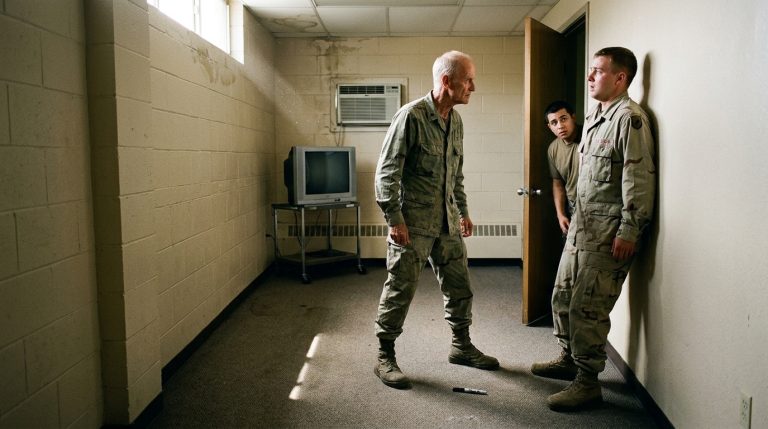
The training hall was a sprawling, industrial expanse of polished concrete and high, vaulted ceilings—a space designed for the simulation of high-stakes pressure. It was empty of students, the rows of chairs pushed back into orderly stacks against the perimeter. The air was cool, smelling of industrial cleaner and the subtle, metallic tang of simulated environments.
Olivia walked toward the center of the floor. Her heartbeat was a steady, rhythmic thrum in her ears, matching the hollow echo of her boots on the concrete. She felt like a phantom revisiting a past that she had long ago stripped of its meaning.
She stopped where the captain had stood. The small, flat box containing the new challenge coin sat on a metal folding table, stark and unadorned. Beside it, the folded flag from the funeral rested in a glass case, a vibrant splash of color in the muted palette of the room. It was here that she had taught for six months, here that she had unpacked the memories of Sentinel Ridge for the benefit of those who would follow her path.
She reached into her jacket and drew out the letter. She didn’t open it; she didn’t need to. She knew the words by heart now—the general’s admission of the bureaucratic error, the confirmation of the cartel lieutenant’s identity, the apology for the years of silence. But standing here, in the heart of the machine that had created her, the truth felt different. It wasn’t a revelation of exoneration; it was a realization of the fragility of the entire system.
The captain emerged from a side office, his footsteps measured. He stopped at a respectful distance, his hands clasped behind his back. “You’ve spent the last six months showing them the interior of the job,” he said, his voice quiet, almost conversational. “You showed them the human weight of the technical skill.”
“And yet,” Olivia said, her eyes fixed on the flag, “I spent six months teaching them from a place of half-truth. I told them the mission was a tragedy. I told them the casualty was a non-combatant.” She turned to look at him, her gaze piercing. “I taught them that the cost of the job is the guilt you carry. I was teaching a lie, Captain.”
“You were teaching them to be human,” he corrected, his tone implacable. “The facts were incorrect, yes. But the struggle? The weight of the decision-making process under fire? That was the most honest thing they’ve ever heard. You didn’t lie to them about the reality of the cost; you just misidentified the source of the debt.”
Olivia felt a surge of cold, analytical clarity. He was right, but it didn’t change the fact that she had been an instrument of his program, a tool used to forge a narrative that served the institution’s need for “humanized” leadership. “Was this the plan?” she asked, her voice dropping, sharp with the edge of a blade. “Did you know the records were purged? Did you know the general had that letter?”
The captain paused, the silence stretching until it became a physical presence. He didn’t look away. “I knew the general was holding onto something that wouldn’t let him rest. And I knew that you were the only person capable of carrying the burden of that truth without being crushed by it. The program needed someone who understood not just how to save a life, but how to live with the consequences of taking one when the situation demanded it. You aren’t just a combat medic, Olivia. You’re a bridge.”
She felt a moment of absolute, blinding fury—not at him, but at the entire architecture of the life she had been forced to inhabit. She had been steered, maneuvered, and placed exactly where they needed her to be. But as the anger surged, it hit a wall of cold, pragmatic realization. She wasn’t a victim of their system anymore; she was the one holding the keys to the classroom.
She picked up the box with the new challenge coin. It was heavy, solid in her palm. “They’re coming back next Tuesday,” she said, her voice devoid of emotion, a flat, utilitarian statement.
“They are,” the captain confirmed.
“Then I’m going to change the curriculum,” Olivia said. She looked at him, her expression a mirror of the calm, unwavering authority he had spent years trying to cultivate in his best recruits. “I’m going to teach them that the truth isn’t something that happens to you. It’s something you construct, even when the world gives you incomplete information. And I’m going to teach them that the cost of the job isn’t guilt. It’s the constant, unyielding maintenance of your own humanity.”
The captain nodded, a single, sharp motion that looked almost like an acknowledgment of a peer. He reached out and touched the case containing the flag, his hand lingering for a moment. “That is exactly what they need to hear.”
He turned to walk toward the office, leaving her alone in the center of the hall. Olivia looked down at the coin, then at the empty room. The training hall felt smaller, less like a sprawling, industrial machine and more like a tool—a piece of equipment she could use to build something of her own. The weight in her pocket—the letter, the burden of the last seven years—didn’t disappear, but as she stood there in the fluorescent glare, she realized she finally knew where to put it down. It wasn’t a wound anymore; it was a compass.
CHAPTER 8: THE NEW UNIFORM
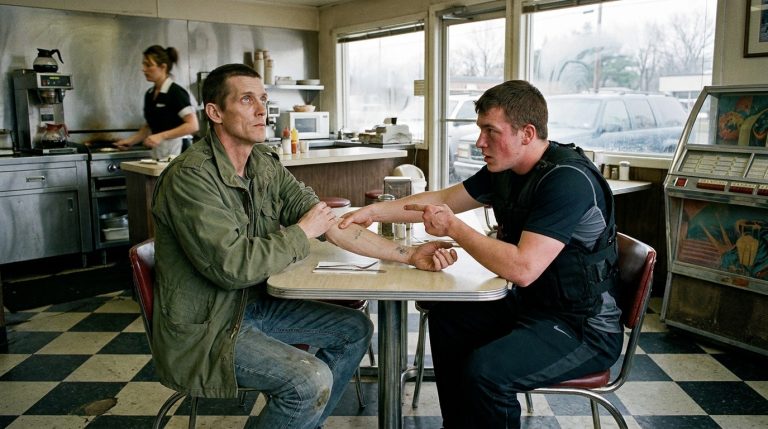
The transition was not a sudden snapping of threads, but a gradual, deliberate shedding. Olivia walked into the diner, the Friday night rush already in full swing. The bell above the door gave its familiar, tinny chime—a sound she had heard thousands of times, yet today, it felt resonant, a signal of return rather than retreat. The air was thick with the smell of ground coffee, frying onions, and the comfortable, lived-in scent of a community that hadn’t changed even while she had been entirely rewritten.
She didn’t go to the back to put on her apron. Instead, she stood by the counter, the letter tucked securely in her inner jacket pocket, feeling the weight of it—no longer a burden, but a testament. She looked at the regulars: old man Miller in the corner booth with his crossword, the night-shift crew from the plant, the local students who came for the cheap burgers. They were the people she had served for seven years while she was playing the role of someone who didn’t exist. Now, she was simply Olivia.
The diner owner, a gruff man named Sam who had never asked too many questions, looked up from the grill. He saw her standing there in her civilian clothes, her expression unreadable, and he paused, his spatula hovering. “You’re late, Liv,” he said, though there was no heat in it. “Shift started ten minutes ago.”
Olivia looked at him. She saw the lines of age around his eyes, the fatigue in his posture, the quiet resilience of a man who worked six days a week to keep a small corner of the world functional. She realized, for the first time, that he wasn’t just a boss; he was a person who had given her a place to hide, and in doing so, had inadvertently helped her survive.
“I’m done with the apron, Sam,” she said. Her voice was steady, clear. She didn’t offer an excuse; she didn’t offer a reason.
Sam leaned against the counter, wiping his hands on a rag. He studied her, really looked at her, and seemed to notice the change—not in what she wore, but in the way she occupied the space. The invisibility was gone. She was rooted. “Okay,” he said slowly, sensing the finality in her tone. “What’s the plan?”
“I’m going to finish the shift,” she said, reaching for a pot of coffee. “And then I’m going to start living the rest of my life.”
She spent the next four hours doing exactly what she had done for seven years, but the experience was fundamentally altered. Every interaction—the pouring of coffee, the taking of orders, the small talk with the regulars—became a practice in connection rather than a performance of distance. She was present, fully and completely. When she cleared the final table at 2:00 AM, the diner was quiet, the fluorescent lights buzzing with a low, rhythmic comfort.
She went to the back, to the small locker she had used as a makeshift archive for her own existence. She took out the waitress apron, the blue and white fabric that had been the armor for her exile. It was frayed, worn thin at the hem, and stained with the remnants of a thousand meals. She looked at it, feeling neither sadness nor regret. It had served its purpose. She folded it into a tight, neat square and placed it in the trash bin—a final, quiet act of closure.
She walked out into the cool, pre-dawn air. The sky was turning a soft, bruised purple, the stars fading into the coming day. She reached into her bag and pulled out the small, brass challenge coin the captain had given her. She felt its sharp, bright edges. It was a tangible object, a piece of reality that she could carry into the future.
She got into her car, the same sedan that had carried her four hours through the dark to Arlington, and sat for a moment. She looked at the dashboard, then reached into her pocket and pulled out the folded, encased flag from the general’s funeral. She placed it gently on the passenger seat—a symbol of a debt finally paid, and a legacy she was now free to carry on her own terms.
She thought of the classroom, the thirty-two students, the gray, industrial hall. She thought of the truth she would teach—the truth of the weight, the cost, and the responsibility of the choices we make. The road ahead wasn’t clear, and it certainly wouldn’t be easy, but for the first time in seven years, the path forward belonged to her.
She turned the key in the ignition. The engine hummed to life, a steady, rhythmic sound that promised progress. She didn’t look back at the diner, or the road she had come from. She pulled out of the parking lot and onto the highway, moving into the morning light, her hands firm on the wheel, her mind finally, beautifully quiet.