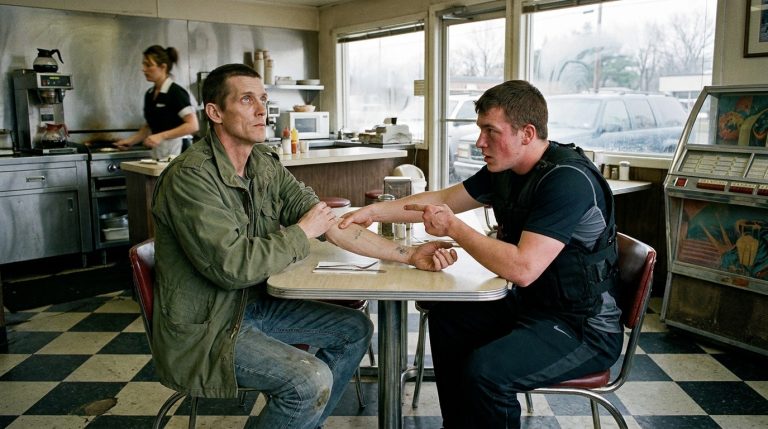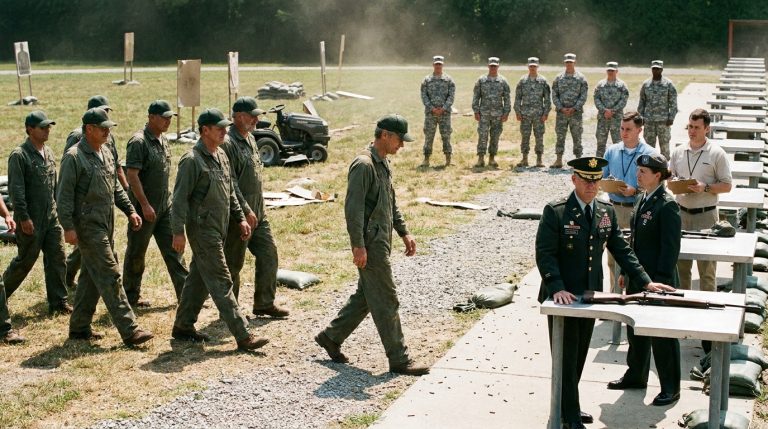
These represent the physical weight of identity and the “ledger of ghosts” that Thorne failed to see beneath Arthur’s surface.
CHAPTER 1: THE FRICTION OF POLISHED OAK
The coarse twill of the gray jumpsuit chafed against Arthur’s neck every time he leaned into the stroke. His left knee ground with a dry, wooden click—a souvenir from a ditch outside Savannakhet that the doctors had never quite set straight. He ignored it, focusing instead on the small square of flannel between his thumb and the glass display case. Inside, the Vietnam-era flight helmet sat under the amber recessed lighting, its olive paint cracked like dried mud.
Behind him, the Officers Club hummed with the high, brittle chatter of men who had won an exercise on a digital map. The air smelled of expensive single-malt scotch, floor wax, and the clean, chemical scent of institutional laundry starch. It was a soft room. The mahogany tables were deep and free of scars, their surfaces reflecting the glittering rows of medals pinned to stiff, unwrinkled wool.
“Gentlemen, a teachable moment,” a voice cut through the low rumble of the lounge. It was smooth, uncalloused, and possessed the sharp, clipped cadence of a man who measured his self-worth by the straightness of his gig-line.
Arthur didn’t turn. He applied another drop of the white polish to his rag. The fluid smelled faintly of ammonia and old copper—a sharp, stinging note that cut through the perfume of the celebration. Through the reflection in the glass, he watched Brigadier General Marcus Thorne approach. Thorne’s uniform was immaculate, the single silver star on his shoulder epaulet catching the light like a small, cold tooth. Three young captains trailed him, their expressions carefully molded into identical masks of sycophantic interest.
The general’s leather soles didn’t make a sound on the thick Persian rug. He stopped two feet behind Arthur, his presence announced by the sudden drop in volume from the nearby tables.
“Attendant,” Thorne said. The word was flat, dry, and dropped like a heavy ledger on a desk. “This is a restricted function for commissioned officers and their invited guests. Your duties were to be concluded before 1800 hours. Explain your presence.”
Arthur finished the long, slow circle he was tracing on the glass. He let the breath out of his lungs slowly, feeling the dry scrape of his throat before he forced his spine to straighten. The joints in his lower back gave three distinct pops. He turned, holding the damp flannel cloth in his right hand, his thumb tucked into the seam to hide the gray crescent of grease beneath the nail.
“My apologies, General,” Arthur said. His voice was rough, like iron dragged over gravel. “The event supervisor requested I remain on standby in case of any spills. Just trying to keep the place looking its best for you, gentlemen.”
Thorne let out a short, thin breath that didn’t reach his chest. His eyes traveled down the front of Arthur’s jumpsuit, pausing at the bleach stains on the knees and the frayed hem where the fabric met the heavy, black rubber-soled shoes.
“Looking its best?” Thorne’s lip twitched, a tiny movement that revealed the pale edge of his teeth. “Your very presence here detracts from the atmosphere. This club is a monument to warriors. To strategists who outmaneuvered nations. It is a sacred space. It is not a utility closet for you to loiter in.”
The silence stretched sideways from the table, cooling the air. The captains stood behind Thorne, their eyes fixed on the silver star on Thorne’s shoulder, waiting for the cue to look away.
“Frankly, it’s an embarrassment,” Thorne murmured, stepping closer. The smell of his cologne—something sharp and synthetic—crowded out the ammonia. “Tell me, old man, since you seem so comfortable in this hall of heroes, did you ever do your part? Did you ever wear a uniform, or has your entire contribution to this nation been waged with a mop and a bucket?”
Arthur looked down at the floor. The pattern of the rug was intricate, a maze of red and blue wool woven so tightly the grease from the kitchen couldn’t penetrate the fibers. He felt the cold iron weight of forty years under his skin. His left forearm grew heavy where the jumpsuit sleeve had ridden up an inch, exposing the tail of a green, faded snake tattoo—coiled, blunt-nosed, and half-buried in the white hairs of his wrist.
Thorne’s eyes dropped to the skin. “And what, pray tell, is that? A memento of your fierce battles with a clogged drain? Speak up. I want to hear it. What was your call sign?”
Arthur looked up, his pale blue eyes locking onto the general’s smooth, unblemished face with the slow, dead weight of an iron anchor hitting mud.
“My call sign,” Arthur whispered, the sound dropping into the room like a heavy stone, “was Viper One.”
CHAPTER 2: THE RESONANT SHARD
The two words did not dissipate; they hung in the heavy, scotch-scented air of the lounge like the smell of spent cordite after a breach. Arthur did not lower his chin. His thumb remained pressed against the rough, white flannel cloth, his fingers feeling the cold grease beneath the rim of the glass display case. He kept his eyes leveled precisely at the bridge of Brigadier General Thorne’s nose—a fixed, unblinking reference point that had nothing to do with deference and everything to do with measuring an opponent’s center of gravity.
Thorne’s smirk stayed fixed on his face for three full seconds, a rigid piece of plastic that had frozen before his brain could catch up to the change in the room’s density. The young captains behind him remained poised to laugh, their chests slightly expanded, their mouths half-open, waiting for the signal to deliver the next rehearsed chuckle.
Then came the sound from the far end of the long mahogany bar.
It wasn’t a shout. It was the sharp, percussive crack of crystal meeting marble, followed immediately by the dull, heavy splash of hundred-proof bourbon pooling across polished stone. Command Sergeant Major Frank Kowalski had dropped his glass. The thick-bottomed tumbler hadn’t slipped; it had simply ceased to be held, as if the nerves in the senior enlisted man’s hand had been cleanly severed by a wire cutter.
Arthur did not look toward the noise. He knew the sound of Kowalski’s boots without turning—the heavy, uneven thud of a left heel that had been rebuilt with stainless steel pins after an engagement in the U Minh Forest. The leather of those boots began to drag across the floor, slow and heavy, the friction of the thick soles cutting through the absolute stillness of the room.
“Sir,” Kowalski said. His voice didn’t carry the sharp, parade-ground brass it usually held when addressing officers. It was thin, dry, and vibrated with the low, raspy rattle of a man who had swallowed too much gray smoke from a burning bunker. He didn’t look at Thorne. His eyes, fixed on Arthur’s faded jumpsuit, were wide, the pupils shrunk to tiny black pins against the pale green of his irises. “General… step back from the cart.”
Thorne’s neck twitched. The silver star on his shoulder epaulet jerked under the recessed spotlight. “Sergeant Major, control yourself. The attendant is simply attempting to evade a disciplinary citation with a ridiculous—”
“I said step back, sir.” Kowalski’s hand didn’t go to his hip—there was no sidearm on his dress uniform—but his fingers curled into a thick, calloused fist that trembled against the seam of his blue trousers. The fabric creaked under the strain. “Now.”
To Thorne’s left, the Master Gunnery Sergeant from the Marine Embassy Guard Contingent moved. He didn’t advance; he retreated. His right foot slid six inches backward into the deep pile of the Persian rug, his weight shifting automatically into a low, defensive stance, his shoulders squaring against an invisible threat. A chief master sergeant near the card tables simply sat down, his face turning the color of wet limestone as he stared at the snake tattoo on Arthur’s wrist.
The younger officers in the room looked between their superiors, their collective confidence evaporating like steam off an engine block. They couldn’t read the designation. To them, “Viper One” was a radio call sign from a history book they hadn’t opened, a scrap of old nomenclature from a war that had ended before their fathers had started shaving. But they could read the terror in the leather-furrowed faces of the men who actually ran the base. The atmosphere grew thick, cold, and smelled faintly of copper and old grease—the unmistakable iron tang of collective fear.
Thorne felt it first in his throat. The skin above his stiff collar flamed a dull, blotchy red. His administrative authority, built on a foundation of clean carbon copies and unchecked boxes, was spinning in place, its gears failing to find purchase on the raw, unpolished reality standing in front of him. He took one half-step backward, his polished shoe catching slightly on the edge of the rug with a dry, fabric scrape.
“This is absurd,” Thorne muttered, though his voice had dropped an octave, losing its sharp, administrative edge. He pointed a single, stiff finger at Arthur’s chest, but his hand was high, his elbow tucked too close to his ribs—the defensive posture of a clerk cornered by a stray hound. “The man is a janitor. Look at the record. He’s been on the Ramstein custodial roster since the ninety-something transition. He’s an unrated civil servant.”
Arthur let his arm drop slowly to his side. The flannel cloth remained bunched in his palm, a gray, coarse weight. He could feel the cold draft from the heavy oak entrance doors at the far side of the lounge—the distinct, high-pressure drop that occurred right before the staff cars arrived from the flight line. The wind outside was picking up, driving the gray German rain against the high, leaded windows of the club with a rhythmic, metallic rattle.
“The record,” Arthur said softly, his voice barely rising above the low hum of the ventilation system, “has more than one layer, General. Some of them don’t use paper.”
Kowalski had reached the edge of the circle now. He stopped three feet from Thorne, his chest heaving under his medals, the rows of silver and bronze stars clinking together with a small, dry sound like loose coins in a pocket. He looked at Arthur’s eyes, then down at the faded green ink on the weathered skin of the forearm, and finally back up.
“The fence,” Kowalski whispered, his eyes unblinking. “Seventy-one. The radio went out after the second air strike. We had forty-eight men left in the tall grass, and the whole regiment was coming down from the ridge. A voice came through the static on the reserve link. Just one man. He didn’t ask for coordinates. He already had them.”
Arthur’s thumb rubbed the rough hem of his jumpsuit pocket. He didn’t answer. The memories weren’t a sequence of events anymore; they were just the smell of damp earth, the white-hot flash of magnesium flares, and the long, freezing silence that came after the noise stopped.
“General,” Kowalski said, his head turning slowly toward Thorne, his voice dropping into a flat, lethal register that made the young captains step back another six inches. “You need to stop talking. You need to stop talking right now before the rest of this room finds out exactly how small that star on your shoulder really is.”
Thorne opened his mouth to reply, his chest expanding as he tried to claw back the authority slipping through his fingers, but the words died behind his teeth. From the main foyer, the massive double oak doors of the club didn’t just open—they struck the interior walls with a percussive, hollow boom that vibrated through the floorboards and rattled the crystal decanters behind the bar.
The cold air from the tarmac flooded the room, carrying the sharp, heavy smell of burnt aviation fuel and wet asphalt. Two men in dark, charcoal-wool suits entered first, their boots striking the floor in perfect, unhurried synchronicity, their eyes already sweeping the lounge for exits before their hands had even left their coat pockets. Between them walked a silver-haired mountain of wool and granite.
Four stars, polished to a dull mirror finish, sat on each of his shoulders. General Wallace had arrived.
CHAPTER 3: THE COLD FOOTSTEPS
The brass hinges of the double doors groaned under the strain of their violent rebound against the plaster, a raw, metal-on-metal screech that drove the last remnants of celebration out of the room. General Wallace did not pause at the threshold. His four silver stars caught the amber lighting, turning the dim lounge into an interrogation cell by their sheer presence. His trench coat, stiff with frozen North Sea rain, let off a faint, oily smell of water-repellent canvas as he cut a straight line across the room toward the display case.
Arthur did not change his posture. His left knee remained locked, the dry wood friction in the joint a steady, grounding ache beneath his gray jumpsuit. He squeezed the white flannel cloth into a tighter ball within his palm, his skin sensing the cold grease transferring from the brass nameplate. To his right, Brigadier General Thorne stood frozen, his right foot still caught halfway between the Persian rug and the hardwood border, his hands suspended in the air like a clerk caught mid-calculation.
The two men in dark suits stayed exactly one pace behind Wallace, their leather-soled shoes making a sharp, synchronized snap on the uncarpeted sections of the floor. Their lapel pins—the small, matte-blue shields of the Air Force Office of Special Investigations—gleamed under the low spotlights. They did not look at the officers or the shattered glass near the bar; their eyes remained locked on the structural exit points and the space immediately surrounding the janitorial cart.
Wallace halted exactly twenty inches from Thorne. The cold air radiating from his coat hit the Brigadier General’s face first, causing Thorne’s jaw to twitch as the skin around his eyes tightened into a gray, paper-like paleness.
“General Thorne,” Wallace said. The voice was a low, vibrational grate that seemed to come from the floorboards rather than his throat. It lacked the administrative polish Thorne used to command his captains; it carried the flat, unyielding mass of a stone wall. “Your perimeter security is currently redirecting three logistics transports because your personal staff failed to clear the secondary gate log. Yet, I find you here, conducting a seminar on value.”
Thorne swallowed. The motion was sharp, his Adam’s apple catching on the stiff, starched edge of his collar with a faint rustle of cotton. “Sir… the gate log was processed under standard NATO procurement guidelines. I was—we were addressing a critical breach of protocol within the club. The attendant—”
“Silence.” Wallace did not raise his tone. He simply dropped the single syllable like an iron ingot into wet sand.
The room seemed to lose another three degrees. Command Sergeant Major Kowalski remained at the edge of the circle, his breathing heavy, his thick fingers still curled into a rigid seam against his trousers. He was staring at the floor right between Wallace and Arthur, his expression fixed in the hard, defensive cast of an infantryman waiting for the artillery bracket to close in.
Wallace turned his head slowly, his eyes passing over Thorne’s silver star as if it were a smudge of graphite on a clean ledger. His gaze settled on Arthur. The four-star general’s expression didn’t soften; instead, the deep lines around his mouth tightened into a configuration of profound, institutional weight. He closed the remaining distance between them, his boots grinding a single stray shard of Kowalski’s shattered glass into fine, white powder against the marble floor.
Standing ramrod straight, Wallace brought his right hand up to his brow. His fingers were locked, his palm perfectly flat, the seam of his sleeve stretching with a tight creak of heavy wool. It was a salute delivered with the maximum physical exertion of a forty-year career—not the loose, transactional gesture given in the hallways of the Pentagon, but a hard, deliberate acknowledgment of an unyielding force.
Arthur looked at the general’s hand. The skin on Wallace’s knuckles was rough, scarred from old winter deployments, a texture Arthur recognized without looking. He did not return the salute. He couldn’t. His right hand was still stained with ammonia and brass polish, and his left leg wouldn’t allow his heel to clear the floor properly. He simply let his shoulders settle an inch, his gray jumpsuit wrinkling across his chest like old tarp over an engine.
“Mr. Jenkins,” Wallace said, his voice dropping into a deeper, raspy register that didn’t carry past the immediate circle but held the heavy authority of a closed vault. “The transition was handled through the wrong channel. The system has been operating on a dead manifest for thirty years. I am here to verify the status in person.”
Thorne’s eyes flickered between the two men, his administrative brain trying to parse the nomenclature. “Sir… with respect, there must be an identity discrepancy. The civil service registry has this man logged under a Layer 1 administrative designation. A clerk. There is an active flag on his file regarding a supply-line deficit from seventy-four. He was—”
One of the dark-suited agents stepped forward, his leather shoes clicking once against the floor. He didn’t speak, but his right hand moved slightly toward the interior of his charcoal coat, his thumb catching on the edge of the lapel. The movement was small, tactical, and entirely devoid of hesitation. Thorne stopped speaking instantly, his breath hitching in his throat with a dry, rattling hiss.
“The registry you read, Thorne,” Wallace whispered, his gaze returning to the Brigadier General with the cold finality of an execution order, “was written for men who need paper to believe in a war. The man you have been standing over for the last ten minutes has his name written in places your clearance cannot even locate on a screen.”
Arthur looked down at his cleaning cart. A drop of the white ammonia fluid had spilled onto the rusted metal rim of the bottom bucket, beginning to eat through the gray film of dust that had gathered there over the course of the evening shift. He reached down slowly, his fingers wrapping around the coarse wooden handle of the mop, his grip firm, his knuckles turning the color of old bone under the dark twill of his sleeve.
“The manifest is old, General,” Arthur said softly, his voice cutting through the silence like a dull saw through green timber. “Let’s not make a mess of the floor.”
CHAPTER 4: THE LEDGER OF GHOSTS
“Let’s not make a mess of the floor,” Arthur repeated, his rough voice scraping across the dead quiet of the lounge. His fingers remained clamped around the coarse hickory handle of the mop, the wood grainy and dry under his calloused palm. He did not pull the cleaning cart back. He stood his ground by the display case, a gray fixture absorbing the stark glare of the ceiling fixtures.
General Wallace lowered his right hand from his brow, the crisp wool of his sleeve settling with a heavy hiss against his side. His eyes shifted from Arthur to Thorne, the expression on his granite-carved face hardening into something cold, clinical, and completely devoid of bureaucratic patience. He reached into the deep left pocket of his rain-stiffened trench coat and withdrew a slim, black leather document carrier.
The brass clasp of the folder was tarnished, showing a green hint of corrosion along its edges—a texture of heavy use that contrasted sharply with the flawless, mirror-polished brass on Thorne’s uniform.
“The registry, General Thorne,” Wallace began, his tone dropped into an unhurried, rhythmic rasp that carried to every frozen corner of the room, “is an administrative shield. It is designed to ensure that when people like you look into the system, they see exactly what they have the capacity to comprehend.”
Wallace unclasped the carrier with a single, practiced flick of his thumb. The sound of the thick, aged paper shifting inside was loud, like dry autumn leaves being crushed under a boot. He pulled out a single sheet of heavy cream stock. At the top edge, a dense, purple ink stamp had been struck through with three heavy black lines, but the underlying letters were still readable through the grease-resistant ink: CLASSIFIED UMBRA COSMIC.
Thorne’s gaze dropped involuntarily to the paper. His chest remained hollowed out, his posture stiff and awkward as his leather-soled shoes stayed pinned to the hardwood border. “Sir… with all due respect to your authority, the logistics command server at Ramstein has a certified ledger. File seven-four-dash-alpha. It lists this man as an unrated administrative clerk who was discharged following a severe supply-line deficit in Thailand. It’s an open-and-shut records match.”
The dark-suited agent on the right stepped closer to Wallace, holding open a small leather folder of his own. Inside the folder, pinned beneath a clear plastic sleeve, was a secondary document jacket. Arthur’s pale blue eyes caught the edge of that sleeve. There was a handwritten notation in red grease pencil along the margin—a series of reversed digits that matched the serial numbers stamped into the old receiver of an XM177E2 carbine he hadn’t cleaned since the spring of 1972. It was a live field tracking code, completely omitted from the standard personnel network.
“The supply-line deficit you found in your server, Thorne,” Wallace said, his voice dropping into a lethal, low whisper that made the young captains behind the Brigadier General shift their weight in panic, “was twenty-four cases of specialized ordnance that disappeared from an unlisted depot in Uorn Thani. Your ledger says he stole them. What your ledger does not say—because your clearance stops at the perimeter fence—is where those cases went.”
Wallace struck the cream paper with the back of his hand, the sharp snap echoing like a small-caliber report.
“They went across the border into a sanctuary that didn’t exist on any map your command uses,” Wallace continued, his eyes drilling into Thorne’s flinching face. “They were delivered by this man, on foot, through a valley held by a full regiment of the North Vietnamese Army. He went in with four men. He came out alone, carrying the operational logs of the enemy’s regional headquarters. The record you think you own is a dead skin, Thorne. It was manufactured to give the agency total deniability while he spent three years doing things that would have caused a global crisis if his face was ever put on a standard manifest.”
The room grew so still that the rhythmic trickling of the spilled bourbon from the bar could be heard clearly as it hit the drain beneath the marble floor tiles. Command Sergeant Major Kowalski took a long, shaking breath, his jaw tightening until the old scars along his jawline turned a stark, bloodless white. He knew the cost of that deniability. Every senior non-commissioned officer in the lounge knew it—it was the bitter, unwashed salt of the old service that the peacetime bureaucracy tried to scrub away with clean regulations and neat personnel profiles.
Thorne’s left hand rose slightly, his fingers twitching toward his silver shoulder star as if looking for the physical reassurance of his rank, but his arm lacked all momentum. The administrative logic he had used to corner Arthur—the rules, the timelines, the clean 1800-hour curfew—had been stripped down to its bare, rusted frame.
“He was a ghost, Thorne,” Wallace whispered, stepping within six inches of the Brigadier General’s face, the smell of damp canvas and old iron completely dominating the space between them. “And you just spent ten minutes trying to measure his value with an office ruler. You are a glorified storekeeper who thinks he understands the architecture of a war because he knows how to route a transport caravan.”
Arthur looked down at his own hand. The skin across his knuckles was thin, spotted with age, but the grip he held on the mop handle was steady, the old muscle memory of the jungle tracking teams still locked deep within the bone. He didn’t look at Thorne’s defeat with satisfaction; he looked at it with the cold, pragmatic assessment of a man who had watched empires exhaust themselves against the mud.
“The ledger is closed, General,” Arthur said quietly, his voice cutting through Wallace’s low tirade like a heavy blade through vines. “The rain is coming through the seals on the south window. We should move this before the wood begins to warp.”
CHAPTER 5: THE HANDOVER OF THE UNIFORM
The water continued to seep through the southern window frame, a small, dark bead tracking down the wood paneling to drop with a dull click onto the baseboard. Arthur didn’t shift his stance. He held the grainy hickory handle of the mop across his body, his knuckles remaining fixed and gray under the harsh overhead track lighting. Beside him, General Wallace turned his massive wool-clad shoulders away from the glass display case, his boots grinding a final grain of shattered crystal into the floor as his focus narrowed entirely on the broken silhouette of Brigadier General Thorne.
Thorne was breathing in shallow, rhythmic spurts that barely rustled the starched linen of his shirt. His silver star seemed to have lost its hard luster under the dimming atmosphere of the lounge, turning into a dull pocket of zinc against his epaulet. His arms hung down, his fingers loosely open as if he had dropped an invisible parcel and was still waiting to hear it strike the floor.
“Bring your full dress uniform, your resignation letter, and whatever is left of your honor,” Wallace said, his voice dropped to a level, mechanical rasp that cut cleanly through the sound of the storm outside. He did not extend his hand; he kept his fingers tucked securely into the stiff pockets of his trench coat. “Zero-six-hundred tomorrow, Thorne. Not an administrative second later.”
Thorne’s throat cleared itself with a dry, clicking rattle. He attempted to square his shoulders, but the fabric of his jacket gathered around his collar in an awkward, bunched heap. “Sir… the operational integrity of the logistics sector requires a certified transition protocol. The NATO files—”
“The logistics sector will be managed by an officer who knows how to read an unlisted field tracking code,” Wallace cut him off, his voice flat and heavy like iron plate dropped on timber. He gestured slightly with his chin toward the two OSI agents standing behind him. “These gentlemen will escort you to your quarters now. You will have exactly forty minutes to clear your personal effects from the administrative terminal. Every keystroke will be logged on a dead-line monitor.”
The agent on the left stepped into the small gap between Thorne and the mahogany card tables. His leather-soled shoes made a sharp, deliberate slide against the wood floor, a sound devoid of hesitation. He didn’t offer a polite gesture; he simply held his right arm extended toward the open double doors of the foyer, his gaze fixed directly on the bridge of Thorne’s nose.
Thorne turned. The movement was slow, lacking the crisp, ninety-degree efficiency he had displayed when walking into the room. His polished shoes dragged across the edge of the Persian rug, the thick wool pile resisting his stride with a faint, whispering rustle. The three young captains who had followed him in stood frozen like concrete pillars, their faces drained of color, their eyes fixed firmly on the floorboards as their general stumbled past them without a word. They didn’t offer a salute. They didn’t move to open the path. They simply remained in place, waiting for the shadow of the silver star to clear the room.
Arthur watched the small procession move through the wide doorway into the cold, marble-tiled foyer. The two dark-suited men walked exactly one pace behind Thorne, their movements synchronized and silent, their coats giving off a faint, chemical smell of rain-proofing as they vanished into the dim corridor.
The room didn’t relax after the doors cleared. The silence that remained was thicker, weighted down by the presence of forty years of unacknowledged service that had suddenly been dropped into the middle of the lounge. Command Sergeant Major Kowalski remained at attention, his chest heaving slightly under his rows of combat decorations, his eyes still locked on the faded green snake tattoo on Arthur’s wrist.
Wallace turned back to Arthur, his expression returning to the hard, unblinking cast of an administrative judge. He reached inside his leather document carrier and pulled out a small, metallic object—a simple steel key attached to a heavy, unpolished brass tag bearing a four-digit identification sequence.
“The clerical error regarding your pension and active benefits was not generated by a network failure, Art,” Wallace said softly, his voice dropping into a dry whisper that barely reached Arthur’s ear over the steady patter of the rain against the glass. “The file was locked from the inside by someone who wanted to ensure the designation ‘Viper One’ never showed a live ping on a standard administrative server. The recovery package is waiting at the annex.”
Arthur looked at the key. The brass tag was scratched, its surface showing the yellow-brown tarnish of a tool that had been kept in a damp locker for decades. He did not reach out to take it. He kept his hands wrapped tightly around the wood of the mop, his thumb tracing a long splinter that had split from the grain near the iron collar of the frame.
“A dead manifest doesn’t need a key, General,” Arthur said, his voice rough and low. “The people who knew that designation are either buried in the tall grass or sitting behind a desk in Washington. The civil service registry suits me fine.”
“The registry is gone, Art,” Wallace replied, his hand remaining steady as he laid the key directly onto the glass top of the display case, right next to the white flannel polishing cloth. “The authorization came down from the director’s level two hours ago. The cart stays here. Your shift is concluded.”
CHAPTER 6: THE WEIGHT OF LEAVING
The unpolished brass tag hit the plate glass with a sharp, hollow tink that sounded far too small for the sheer weight of the file it represented. Arthur didn’t look at the steel key. His gaze remained fixed on the white puddle of ammonia polish on his bottom bucket, which had slowly spread until it touched the rusted rivet holding the handle together. The raw, sharp sting of the chemical cleaner was starting to dry into his nostrils, leaving behind the bitter taste of industrial salt.
General Wallace stepped back one full pace. The stiff fabric of his trench coat gave off a dense, canvas rasp as his shoulders cleared the narrow aisle between the display cases. He did not offer another word of instruction, nor did he look toward the bar. He simply checked the face of his matte-black field watch—its protective lens deeply scratched across the zero-index marker—before gesturing to his remaining escort.
“Ten minutes, Art,” Wallace murmured, his voice dry, flat, and already drifting back into the colder register of a command channel. “The vehicle is idling behind the secondary fuel depot. The gate is holding for our manifest.”
Arthur didn’t nod. He let his left hand slide down the coarse, grain-split hickory handle of the mop until his knuckles scraped against the iron collar. He lifted the wet twine from the bucket with a slow, heavy pull that made the rusted wringer squeak in protest—a sharp, metal-on-metal cry that bit into the dead silence of the lounge. One by one, he began the methodical, silent work of packing his gear. He tucked the damp flannel cloth into the side bracket of the yellow plastic cart, ensuring the gray, iron-tinted stains faced inward, away from the light.
At the far end of the long mahogany bar, Command Sergeant Major Kowalski didn’t break his posture. His heels remained driven together into the deep blue weave of the Persian rug, his blue trousers pressed so hard his knees visibly locked under the fabric. As Arthur gripped the rusted push-handle of the cart, his black rubber-soled shoes making a dull, wet squeal on the marble tile, Kowalski’s chin came up.
It was a slow, agonizingly rigid motion. The Sergeant Major’s right arm came up next, the heavy wool of his dress sleeve creaking against his ribs as his hand snapped to the brim of his service cap. The hand was trembling—not from age, but from the immense, compressed kinetic energy of a forty-year-old memory that had just been dragged out of the Cambodian mud into the clean light of a peacetime officers club.
Following Kowalski, the Master Gunnery Sergeant from the Marine Embassy guard snapped his heels together. The distinct, metallic clack of his leather dress shoes struck the hardwood floor border like a hammer on an anvil. Then the chief master sergeant. Then, one by one, the young captains who had stood behind Thorne like silent walls began to shift their weight, their faces tight with a mixture of raw bureaucratic panic and deep, unwashed shame. They didn’t look at Arthur’s face; they looked at the faded green snake tattoo on his exposed wrist as it pushed the heavy, rusted cart down the center aisle of the lounge.
Arthur kept his eyes three feet ahead of the cart’s front wheel. The left caster was loose, wobbling with a dry, rhythmic friction that rattled the plastic bottles of window cleaner inside the tray. He didn’t accelerate his pace. He walked with the same slow, calculated limp that had marked his entire fifteen-year tenure on the Ramstein custodial staff, his bad knee clicking with the dull regularity of a worn gear inside a machine.
The air in the foyer was even colder than the lounge. The massive oak double doors stood completely open, allowing the freezing German rain to blow sideways into the marble vestibule, coating the clean stone floor with a slick, dark sheen of moisture. The smell of burning jet fuel from the flight line was thick out here, a heavy, sulfurous cloud that rolled off the tarmac and settled into the corners of the ceiling.
Arthur stopped the cart by the small utility alcove right next to the entrance. He didn’t use a locker key; he knew the friction of the latch. He unhooked the mop, placing it into the corner rack where the wood could dry without warping against the concrete. His fingers came away from the hickory handle smelling of old timber and raw oil. He reached down to his gray jumpsuit pocket, his thumb catching on the edge of the small steel key Wallace had left on the display case—he had picked it up without thinking, a reflex from an era when you never left an unlisted tool behind on a clean surface.
He pulled the small brass tag out just far enough to read the four-digit serial number under the dim bulb of the alcove. The teeth of the key weren’t standard civil service issue; they were cut deep and irregular, designed for a mechanical tumbler that didn’t exist on any commercial safe on this base. It was a lock that required brute force and a precise sequence to open—a rusted truth that belonged entirely to the dark.
General Wallace stood five feet out on the stone steps, his trench coat already soaked to a dark, leaden charcoal by the driving rain. He didn’t look back to see if Arthur was following. He simply watched the twin headlights of a dark, unmarked utility van slice through the gray curtain of water near the secondary gate, its tires hissing loudly against the wet asphalt.
Arthur pulled the heavy zipper of his gray jumpsuit up to his collar, tucking the green tail of the snake tattoo completely out of sight beneath the coarse, frayed fabric of his sleeve. He stepped over the wet brass threshold of the club, his black shoes sinking into the rain-slicked stone of the path as the oak doors behind him began to swing shut under the force of the wind.
CHAPTER 7: THE SECURITY TRANSIT
The cold rain did not let up as Arthur’s rubber-soled shoes cleared the bottom stone step, splashing a thin, mud-tinted layer of grit across the hem of his gray jumpsuit. General Wallace’s heavy wool trench coat remained ahead of him, a dark, non-reflective wall absorbing the direct glare of the vehicle’s high beams. Neither man spoke as they crossed the narrow strip of cracked asphalt separating the Officers Club from the curb where the dark utility van sat idling, its exhaust pipe letting off a thick, rhythmic rattle against its iron bracket.
Arthur reached for the side door handle. The metal was bare, oxidized by the damp Rhineland climate until its surface had the rough, coarse texture of unpolished shale. He squeezed the latch, feeling the mechanical linkage catch with a heavy, ungreased clank before the sliding door scraped back along its track. Inside, the vehicle was stripped to its skeletal frame—no commercial carpeting, no base transportation markings, just cold, corrugated steel floorboards showing the primer coat through long, parallel scratches where heavy crates had been hauled.
He climbed inside, his bad knee giving its predictable wooden click as he shifted his weight onto the metal bench. Wallace followed, his mass causing the van’s leaf springs to squeak with a dry, metallic protest that cut through the low thrum of the diesel engine. The sliding door slammed shut behind them with a flat, concussive thud, sealing out the immediate sting of the wind but trapping the dense, stale smell of damp canvas, gun oil, and hydraulic fluid.
The van rolled forward without delay. Arthur watched the driver through the wire mesh partition that separated the cabin from the rear cargo space. The man wore a standard olive-drab flight jacket, but the shoulder epaulets were entirely bare, and his hands, clamped firmly onto the worn rubber of the steering wheel, were covered in thin, fire-resistant Nomex gloves. There were no logbooks on the dashboard, no base decals on the windshield—only the pale green glow of an unlisted tactical radio terminal mounted beneath the glove box, its frequency display locked on a encrypted dead-channel.
As the van cleared the gravel perimeter of the club, Arthur’s fingers went to his jumpsuit pocket, tracing the deep-cut teeth of the key Wallace had left behind. His thumb rubbed the edges of the unpolished brass identification tag. Through the small, wire-reinforced window in the rear door, he watched the polished mahogany facade of the Officers Club recede into the rain, its amber lights refracting through the streaming water until they were nothing but blurred, yellow smears against the dark tree line of the base.
The route they were taking was intentional. The driver avoided the primary, well-lit thoroughfares connecting the command headquarters to the main exchange, turning instead down a perimeter lane that ran adjacent to the secondary fuel depot. Out here, the gravel was loose, striking the underbelly of the van with a sharp, metallic scatter that sounded like dry bone fragments hitting a tin sheet. To their left, the massive, cylindrical tanks of aviation fuel loomed out of the dark, their industrial bulk showing patches of dark primer and rusted seams where the protective paint had flaked away under the salt-heavy air.
“The registry entry Thorne found wasn’t an administrative error, Art,” Wallace said after three long miles of silence, his voice barely rising above the deep, resonant vibration of the floorboards beneath their boots. He didn’t turn his head; his chin was tucked into the stiff collar of his coat, his eyes fixed on the wire mesh partition. “The theft charge from seventy-four was verified by a signed authorization out of the Bangkok station. It was kept active on Layer 1 so that if anyone within NATO logistics attempted to audit the unlisted transport manifests from that quarter, they’d hit a dead wall. A corrupted file is easier to ignore than an empty space.”
Arthur let his arm rest against the cold steel of the interior ribbing, the friction of the coarse twill sleeve keeping his forearm from sliding with the vehicle’s sway. “The Bangkok station hasn’t had a live line since the evacuation, General. Whoever signed that manifest has been out of the loop longer than I’ve had this mop.”
“The signature wasn’t paper, Art. It was an automated trigger,” Wallace murmured, his hand moving slightly within his pocket, the fabric giving off a faint, dry rustle. “The moment Thorne pulled that specific file number, it flag-pinged an alert directly to the Office of Special Investigations annex. If we hadn’t crossed the gate when we did, the server would have wiped the entire section automatically under a standard security quarantine. They didn’t just want to hide your designation. They wanted to make sure the tracking code for the salvage operation remained locked behind the theft record.”
The van shifted gears, its transmission whining with a high, strained pitch as the driver turned the wheel sharply to the right. The tires left the loose gravel, hitting the cracked, unmaintained asphalt of the base’s northern quadrant—the old storage area that had been partitioned off during the late seventies and left to gather rust under the pine trees.
Arthur looked out the side window. Through the gray blur of the storm, he could see the silhouette of the old OSI annex approaching—a low, flat-roofed concrete structure surrounded by a double layer of chain-link fence that had turned a dull, orange-brown from decades of exposure. There were no lights in the windows, no standard security detail at the gate. The van didn’t slow for a checkpoint; the driver simply pulled up to a mechanical barrier that lifted automatically as the green radio terminal on the dash emitted a short, three-tone pulse.
The tires ground to a final, heavy halt against the concrete apron of the loading dock. The driver cut the engine, and the sudden absence of the motor’s vibration left a hollow, ringing silence inside the steel cargo bay, broken only by the steady, metallic pinging of the cooling exhaust pipe underneath.
“We’re at the threshold,” Wallace said, his fingers finally coming out of his pockets as he reached for the rear door latch. “The box is inside. Let’s find out exactly whose name is on the bottom of that manifest.”
CHAPTER 8: THE THRESHOLD OF THE VAULT
General Wallace’s thumb pressed down on the mechanical latch of the rear door. The heavy iron mechanism gave an ungreased, stubborn clunk that resonated through the stripped floorboards of the van cargo bay. Cold rain immediately swept into the dark interior, carrying the sharp scent of wet asphalt and rotting pine needles from the fence line. Arthur shifted his weight, his bad knee clicking twice with its dry, wooden internal friction as his black rubber-soled shoes found the slick concrete of the loading dock.
They did not rush. Wallace stepped out first, his canvas trench coat heavy with water, the hem scraping against his mud-spotted boots with a rhythmic, coarse drag. The driver stayed inside the cabin, the engine dead, leaving the courtyard silent except for the low, percussive drumming of the storm against the corrugated tin awning above the dock.
Wallace led the way toward a low, iron-reinforced security door set deep into the concrete wall of the annex. The paint was peeling in long, brittle flakes, exposing patches of deep orange rust underneath that came away on Arthur’s fingers as he braced himself against the frame. Wallace pulled a heavy, unlisted proximity card from his interior coat pocket and held it against a gray plastic reader that had been mounted directly into the brickwork. The terminal didn’t buzz; it released the internal deadbolts with a slow, heavy hiss of compressed air.
The interior hallway was narrow, chilled, and smelled of long-dead ozone and industrial floor sealer. Yellow incandescent bulbs, encased in thick wire cages, cast long, static shadows across the concrete floor. There were no personnel desks, no digital tracking monitors, no administrative clutter—only a single, long corridor that ran twenty yards deep into the subterranean core of the building.
They reached the end of the line at a reinforced blast door made of unpainted, cold-rolled steel. Pitted with age and showing the rough swirl marks of an industrial grinder, it looked entirely disconnected from the digital infrastructure of the modern base above. Mounted in the center of the door was a mechanical three-tumbler lock assembly. Right below it sat a secondary keyway with a heavy steel collar.
Arthur reached into his jumpsuit pocket, his thick, calloused fingers wrapping around the irregular cut teeth of the key Wallace had left on the display case. The brass identification tag scraped against his palm, its raw metal edge a familiar, grounding texture. He stepped forward, his limp giving a final, hard echo against the narrow concrete walls before he lined up the key with the steel lock.
The teeth didn’t slide in cleanly; the cylinder was stiff from decades of stagnation. Arthur had to apply steady, lateral pressure, feeling the internal brass pins resist his thumb before they finally clicked into their deep grooves one by one. He turned the key sixty degrees to the right. A deep, heavy spring inside the mechanism snapped back with a metallic crack that sounded like a dry branch snapping under a heavy boot.
“The file on Layer 1 was the shield, Art,” Wallace said, his voice low and flat as the blast door swung open three inches on its massive, grease-darkened hinges. “The theft allegation kept the clerks from looking at the numbers. But the content inside this safe belongs to the absolute final reality. Operation Serpent’s Kiss didn’t end when you crossed the fence in Berlin. It ended when your original identification logs were quarantined to guarantee deniability for the agency’s entire European network.”
Arthur pulled the door open the rest of the way. The hinges gave a low, iron groan. Inside the small, concrete vault sat a single, floor-mounted green field safe from the early seventies. Its combination dial was brass, tarnished to a dark, greenish-black hue by thirty years of trapped humidity.
Arthur didn’t look at the files stacked on the shelf above the safe. His eyes went directly to the small, unblemished steel security box resting on top of the iron locker. He reached out, his thumb catching on the small latch. Inside, resting on a scrap of faded olive-drab parachute shroud, lay a pair of heavy, dull-finish military dog tags. The steel was scratched, the stamped letters filled with a thin line of dried gray clay from the Mekong Delta: JENKINS, ARTHUR M. US56488312. Pinned right beneath the chain was a small, unpolished silver medal—the Star of the Clandestine Services community, completely devoid of an inscription or an official name.
The ultimate truth was entirely clear now, stripped of bureaucratic lies, administrative curfews, and the neat, polished arrogance of men like Thorne. The system hadn’t forgotten Arthur; it had buried his name under a mountain of artificial rot to keep the foundation of the peacetime alliance from cracking under the weight of the secrets he carried.
Arthur picked up the dog tags. The steel was cold against his calloused skin, but the metal felt solid, unyielding, and completely clean of the ammonia polish he had spent the last fifteen years using to scrub away the tarnish of others. He closed his fingers over the tags, feeling the distinct, hard edges press into his skin until they left a deep, bloodless mark in the center of his palm.
He did not put them around his neck. He simply dropped them into the deep interior pocket of his gray jumpsuit, zipping the coarse fabric closed with a slow, deliberate pull that sealed the metal away into the dark where it belonged.
The tension in the concrete room slowly began to settle into a deep, atmospheric stillness. The heavy vibration of the diesel engines from the flight line outside had faded to a distant, hollow murmur, leaving the vault completely quiet. Arthur looked at Wallace, his pale blue eyes no longer carrying the ancient, burning spark of the old operational designation, but the calm, pragmatic clarity of a man who had seen his ledger cleared to the very last page.
He walked over to a small, iron-legged work stool in the corner of the vault that had a torn canvas seat. Sitting down slowly, he took a pocket knife from his belt and carefully trimmed a loose, fraying thread from the cuff of his gray sleeve. Once the thread was clear, he smoothed the fabric flat with his thumb, checking the stitch line to ensure the seam would hold through the rest of the winter shift.
“The vehicle is still idling, Art,” Wallace said softly, his posture loosening slightly as he rested his heavy arm against the open steel frame of the vault door. “The path to the retirement annex is clear. Your pension is secure.”
Arthur looked at the small silver medal remaining in the box, then back down at his black rubber-soled shoes. “The path is fine, General. But the south window at the club is still going to leak if someone doesn’t reset the lead weights in the sash before morning.”
He stood up, his bad knee giving one last, quiet click, and walked out of the vault into the cold, clean rain of the northern gate.