The Weight of the Serpent: A Cold Reckoning Within the Ranks of the Elite Vanguard
CHAPTER 1: THE CERTAIN WEIGHT OF BONE
The vinyl booth was cold, biting through the fabric of Glenn Patterson’s thin sweater. He didn’t look at the man hovering over him. He focused, instead, on the precise way the sugar granules dissolved into his black coffee, creating a dark, swirling galaxy that held more peace than the reality surrounding him.
“I’m talking to you, old man.”
Cutler’s voice was sharp, a jagged blade of sound that tore through the quiet hum of the Scrambled Egg. The man was a mountain of synthetic fabric and tactical arrogance, his knuckles scarred from training exercises that the civilian world called war. He leaned in, his shadow eclipsing the table, his eyes hunting for a flicker of fear.
Glenn felt the heat of the man’s proximity—a frantic, pulsing energy that lacked the stillness of a man who had actually faced the dark. He kept his gaze on the mug. The tattoo on his left forearm was a simple design, a serpent swallowing its own tail, a black circle framing a star. It was blurred, the ink pushed deep into the skin decades ago by a needle made of sharpened bamboo.
“Is this a joke?” Cutler sneered, tapping his finger against the ink. “Stolen valor? You think you can wear that and pretend you were part of something?”
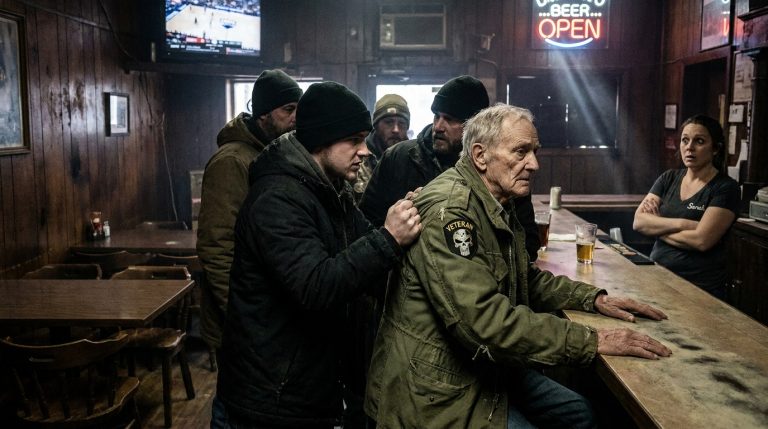
The waitress, Sarah, stopped mid-motion at the counter. The air in the diner tightened, the scent of sizzling bacon turning acrid. Regulars pulled back, their movements instinctually guarded, sensing the predatory shift in the atmosphere.
Cutler didn’t wait for an answer. He reached out, his grip tightening around Glenn’s bicep. The touch was physical, intrusive, and demanding. It was the mistake of a man who thought history was written by those who shouted the loudest.
The moment Cutler’s skin made contact, the diner’s walls seemed to shimmer and fray. The mundane fluorescent light was replaced by the suffocating, heavy gloom of a triple-canopy jungle. The chatter of the diner faded into the distant, rhythmic wamp-wamp of Huey rotors struggling against a storm. A voice, young and desperate, whispered into his ear—Stay with me, Pat. Just stay with me. It was a memory of a pact, a blood-soaked promise made by five men in a hidden camp that hadn’t existed on any map, for a country that officially wasn’t there.
Glenn blinked. The jungle dissolved back into the vinyl booth. The smell of burning diesel and rot was gone, replaced by the mundane scent of cleaning fluid. But the chill in the air remained, sharper than before. He felt the cold, hard pressure of Cutler’s fingers on his arm.
He pulled his arm back, slowly, with a deliberate grace that was entirely foreign to the frantic, sweating man standing over him. Glenn looked up, his pale blue eyes clear and terrifyingly still.
“It means something to the people it was promised to,” Glenn whispered, his voice a low, raspy rumble that carried the weight of a half-century of silence.
Cutler stiffened, his face reddening. He didn’t see the ghost. He only saw a quiet, fragile man who refused to break on cue. He leaned in again, his breath hitching, a dark, venomous satisfaction spreading across his face.
“Let’s see how much you value it,” Cutler said, grabbing the old man’s arm with a violent, final force. “Let’s take this outside and see what you’re really made of.”
As he pulled, the diner door triggered—not with the casual jingle of a regular, but with the heavy, calculated swing of someone who owned the very air he breathed.
CHAPTER 2: THE ECHO OF A SILENT ROOM
The sound of the diner door was violent, a sharp metallic clatter that cut through the thick tension. Cutler didn’t look back, but his grip on Glenn’s arm faltered, the sheer kinetic energy of the room shifting toward the entrance. Glenn remained anchored in his seat, his arm still held by the younger man, but the distance between them had grown. The air inside the Scrambled Egg had shifted from stagnant heat to something thin and cold, the kind of cold that preceded a storm.
“Cutler,” Reyes whispered, his voice an urgent, jagged prayer. “Let it go. Something’s wrong.”
Cutler didn’t listen. His ego was a fragile, high-pressure vessel, and it was currently reaching its structural limit. He stared at Glenn, his pupils dilated, searching for a reaction—a flinch, a tremor, a plea. He found only the same placid, pale-blue stillness. It was that silence that broke him. Cutler didn’t like the silence because it mirrored the void he carried behind his own bravado.
“I said move,” Cutler hissed, pulling at Glenn’s arm.
The movement was sloppy. In his arrogance, Cutler underestimated the leverage of a man who had spent years calculating angles in shadows. Glenn didn’t resist the pull; he leaned with it. He shifted his weight, rotating his hip just enough to turn the defensive posture into an offensive pivot. He didn’t strike; he simply existed as a fixed point in space. When Cutler pulled, he dragged himself off-balance, his own momentum working against his pride.
The phantom of the Laotian jungle surged in Glenn’s mind—the heavy, suffocating humidity, the taste of metallic iron in the back of his throat. He saw the face of a younger man he had carried across a river of black mud, a man whose skin felt as cold as the vinyl booth was now. The memory wasn’t a choice; it was a sensory anchor, pulling his focus away from the diner and into the deeper, darker topography of his own history. Keep the promise, the phantom whispered. Don’t quit.
Glenn stabilized himself, his hand resting calmly on the table. He didn’t look at the other patrons, though he could feel the weight of their collective gaze—a hundred eyes pressed against the glass of his life. He looked at Cutler, who had stumbled, his shoulder catching on the edge of the next booth. The younger man recovered instantly, but the mask of the elite warrior had slipped. For a micro-second, Cutler looked like nothing more than a frightened boy who had stumbled into a forest he didn’t know how to navigate.
Sarah, the waitress, was moving behind the counter with a predatory grace. She hadn’t gone for the police. She had slipped into the back office, her movements jerky and precise. The muffled sound of a conversation followed—a sharp, high-pitched urgency that Glenn recognized from a different life. It was the sound of a call being placed to a contact that shouldn’t exist, a request for a favor that couldn’t be quantified in money or law.
“You’re making a mistake,” Glenn said, his voice quiet, barely audible over the hum of the refrigerator.
“I’m cleaning up the unit,” Cutler snapped, recovering his stance. He adjusted his jacket, his eyes darting toward the window as if expecting a threat. “You’re a stain, old man. You and your little trinket.”
He reached for the tattoo again, his fingers twitching, driven by a neurotic need to dismantle what he couldn’t comprehend. But before his hand could descend, the floor beneath them vibrated. It was a low-frequency hum, the kind that traveled through the soles of boots before it reached the ears. It was the sound of heavy metal in motion, the synchronized roar of high-displacement engines cutting through the late-afternoon lull of the highway.
Outside, the parking lot was suddenly occupied. Three black, government-plated Chevrolet Suburbans skidded into the lot in a formation so perfect it looked like a choreographed dance of death. The vehicles didn’t just park; they occupied the space, creating a physical barricade between the diner and the world beyond.
Cutler stiffened. The arrogance leaked out of him, replaced by a sudden, icy confusion. He stepped back, releasing Glenn’s arm. The shift in his body language was immediate—the predator had become the prey. He looked at his partner, Reyes, whose face had gone bloodless, his eyes fixed on the lead vehicle.
“What is this?” Cutler whispered, the bravado finally dissolving. “We’re on authorized downtime. Who the hell is this?”
Glenn didn’t look at the vehicles. He stared at the salt shaker on the table, watching the way the light refracted through the glass. He knew the shape of this intrusion. He knew the weight of the men who would step out of those doors. He felt the phantom memory of the jungle tighten in his chest, a compression of air and bone.
The diner door groaned again as the lock clicked. The silence that followed was heavy, artificial, and absolute. It was the silence of a grave.
“They’re not here for the food,” Glenn murmured, his eyes finally shifting to the door. “And they’re certainly not here for you.”
As the handle turned, the metallic scraping of the hinges sounded like a death knell in the tiny, cramped space of the diner. Glenn braced himself. He wasn’t afraid of the confrontation; he was simply exhausted by the reminder that, no matter how much time passed, the dark always found a way to reach back for the things it had failed to bury.
CHAPTER 3: THE ARRIVAL OF THE SHADOWS
The chime above the door didn’t just ring; it seemed to shatter the remaining pretense of the morning. General Marcus Thorne stepped into the diner, his presence acting as a vacuum, drawing every ounce of oxygen toward his polished, obsidian-black oxfords. He did not look at the patrons, whose faces were pale masks of confusion, nor did he acknowledge the shivering waitress near the kitchen. His gaze was fixed, a laser-guided instrument of absolute authority, locking onto the table where Glenn sat.
Cutler had retreated a step, his back hitting the cold edge of a counter. His hands, usually so steady when handling a rifle or navigating a climb, were now trembling with a rhythmic, unwanted twitch. He looked from the General’s four-star insignia to the old man in the booth, and for the first time, he saw the absurdity of his own position. He was a mountain of gear and arrogance, currently being dismantled by the simple, terrifying reality of a man who didn’t even bother to look up.
Reyes, standing beside him, had his head bowed, his chin pressed against his chest. He understood the geometry of this room better than Cutler. He knew that when the highest-ranking special operator in the nation entered a space to find an old man being insulted, the career longevity of everyone present had just reached a hard, unyielding expiration date.
The General moved with a predator’s economy of motion. He didn’t rush. He navigated the narrow space between the booths as if he were walking through his own office, his security detail falling in behind him in a silent, synchronized phalanx. They didn’t draw weapons; they didn’t need to. Their mere existence, the sheer mass of their professional indifference to the world outside, was enough to make the room feel like an interrogation cell.
Glenn finally looked up. He didn’t rise. He didn’t offer a salute. He simply watched the General approach, his pale blue eyes reflecting the overhead fluorescent light with a sharpness that belied his eighty-one years.
“Marcus,” Glenn said, his voice a low gravel that seemed to vibrate through the tabletop.
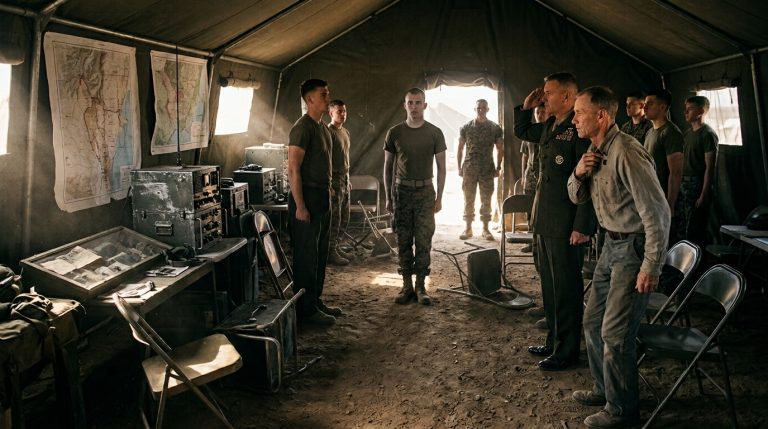
General Thorne stopped two paces away. He clicked his heels together, a sharp, resonant sound that echoed against the linoleum. The shift in his posture was total; the man who commanded the most lethal forces on the planet was suddenly, impossibly, a subordinate. He held his hand up in a crisp, textbook salute—a gesture of profound respect that ignored every protocol of his rank.
The diner was so silent that the distant hum of a refrigerator in the back sounded like a turbine. Cutler’s mouth opened, then snapped shut. He was witnessing a structural collapse of his own reality. He had been taught that he was the apex. He had been taught that the history of the unit began with him and his contemporaries. Seeing the General—a man he worshipped from a distance—treat this relic with such reverence was not just confusing; it was physically painful.
“It’s been too long, Glenn,” the General said. His voice was thick, layered with a history that Cutler couldn’t even begin to decode.
“You got old, Marcus,” Glenn replied, a sad, faint smile touching the corners of his lips.
The tension in the room wasn’t just about the General’s arrival; it was about the subtext. Cutler watched, his heart hammering against his ribs, as Thorne finally turned his attention to the two operators. The General’s expression shifted. The reverence he had shown Glenn vanished, replaced by a cold, arctic void that seemed to drop the ambient temperature of the room by ten degrees.
“You,” Thorne said. The word was a singular, surgical strike. He didn’t shout. He didn’t have to. The air itself seemed to recoil from his voice. “You questioned this man. You questioned his service.”
Cutler tried to speak, but his voice failed him. He felt like a boy caught in a lie that had grown into a monster. He reached out to adjust his jacket, a nervous, instinctive tick, but the General’s eyes caught the movement. The gaze was so heavy, so laden with the weight of thousands of decisions, that Cutler froze.
“Sir, I…” Cutler managed, the words dying in his dry throat.
Thorne didn’t let him finish. With a slow, deliberate movement that felt like a cinematic sequence, the General unbuttoned the cuff of his right sleeve. He didn’t look at Cutler as he did it; he watched Glenn, a silent conversation passing between them that excluded everyone else in the building. He folded the fabric back, exposing his forearm to the harsh, unforgiving light of the diner.
There, etched into his skin, was the serpent—the black circle, the star, the mark that Cutler had mocked just minutes before. It was a mirror, a dark reflection of the old man’s own history.
The patrons gasped. Sarah clapped a hand over her mouth, her eyes darting between the two men. The room began to swim in Cutler’s vision. He realized, with a sickening thud in his gut, that the “stolen valor” he had been so proud to uncover was nothing more than a decoy—a petty, arrogant misunderstanding of a reality far more profound than he was equipped to handle. He hadn’t been protecting the unit; he had been mocking its very foundation.
General Thorne stepped closer to the counter, his shadow falling over Cutler. “This man is not a relic,” the General whispered, his voice dangerously low. “He is the architect. And today, you have insulted the foundation of everything you claim to represent.”
The atmosphere in the room shifted. It was no longer a confrontation; it was an execution of character. Cutler felt the urge to run, but he was pinned by the weight of the moment, unable to move, unable to breathe, forced to face the reality of his own insignificance in the face of a legend that had been hiding in plain sight.
CHAPTER 4: THE EVISCERATION OF PRIDE
The diner was a vacuum of sound. Cutler stood frozen, his skin crawling under the General’s gaze. He wanted to look away, to break the connection, but Thorne’s eyes were like two cauterizing irons. Beside him, Reyes had taken a half-step back, his boots scuffing the linoleum—a sound that seemed deafening in the stillness.
General Thorne didn’t move. He held the sleeve of his uniform back, the serpent tattoo visible, a coiled relic of a war that had been wiped from every official ledger. The General’s face, usually a mask of stoic command, flickered. For a split second, a micro-expression crossed his features—a tightening at the corner of his eye, a momentary hesitation that Glenn, watching from the booth, caught with surgical precision. It was the crack in the armor. Even a four-star general, when confronted with the ghosts of his own making, still bled.
“You look at this mark,” Thorne said, his voice dropping, “and you see a shortcut to authority. You see an accessory.” He stepped closer, the heels of his shoes clicking with rhythmic, terrifying finality. “But you do not know the cost of the ink.”
Thorne turned, his movement sharp, and faced the room. He didn’t address the patrons; he addressed the atmosphere itself. “In 1968, in a country that didn’t technically exist on our maps, there were five men. Not units. Five men. They were not fed by supply chains or bolstered by air support. They were the friction that kept the world from sliding into total collapse. Glenn Patterson was the spine of that team.”
Cutler felt a cold sweat break out along his hairline. He had spent his entire career chasing the prestige of the elite, studying the manuals, mastering the drills, and here, in this greasy-spoon diner, he was being told that the manuals were merely the shadow of something he couldn’t grasp. The “stolen valor” decoy—his entire justification for the confrontation—was now exposed as a pathetic, juvenile attempt to impose order on a chaotic reality he was too small to understand.
“My office. 0500 tomorrow,” Thorne commanded, his voice returning to a sharp, clinical register. “Be prepared to surrender your credentials. Every single one of them.”
Reyes bowed his head deeper. “Yes, sir.”
Cutler’s jaw worked, his throat bobbing as he swallowed the bile of his own humiliation. He looked at the General, hoping for a flicker of mercy, a hint of professional camaraderie, but he found none. Thorne had already pivoted. He was finished with them. The two operators were no longer soldiers to him; they were broken tools that had failed a basic stress test.
As Cutler and Reyes turned to retreat, their steps heavy and uncoordinated, the diner’s front door swung open again, though this time it was merely the wind. The cold air rushed in, swirling around the tables. Cutler bumped into a chair, the screech of metal on floor echoing his inner collapse. He walked toward the exit, the glare of the parking lot light blinding him. He felt exposed, stripped of his identity, the tactical gear he wore suddenly feeling like a costume he had no business inhabiting.
Glenn remained in the booth. He watched them leave, not with triumph, but with a profound, weary sadness. He didn’t gloat. He simply watched the door close on them.
“They’ll learn,” Thorne said, his voice returning to a normal volume, though it still carried the weight of a command. He moved to the booth opposite Glenn and sat down. He didn’t ask for permission; he belonged there.
“Will they?” Glenn asked, his voice rasping. “Arrogance is a hard habit to break, Marcus. It’s the armor people wear when they’re afraid of being empty.”
Thorne looked at his own tattoo. He traced the lines of the serpent with his thumb. “I’m putting them in Legacy. It’s the only way. They’ll spend their days in the archives, reading the reports they think don’t exist. If they can’t be warriors, they will be the keepers of the stories.”
Glenn shifted, his joints stiff. He looked out the window at the three black Suburbans idling in the parking lot. The security detail was still in place, their eyes scanning the horizon for threats that weren’t there. It was a display of power that felt increasingly hollow to him. The real threats, he knew, weren’t the ones in the jungle; they were the ones that took root inside a man’s heart when he forgot that service wasn’t about the title, but about the burden.
“You’re being too kind,” Glenn murmured.
“I’m being efficient,” Thorne corrected, though his gaze softened as he looked at his old friend. “The unit needs to remember what it was like to be a ghost. I’m tired of the noise, Glenn. The noise is what killed the rest of them.”
Glenn leaned back against the vinyl. He felt the phantom weight of a man on his back—the younger, wounded Marcus Thorne, heavy as a stone, his blood soaking into Glenn’s shirt as they crawled through the Laotian undergrowth. It wasn’t a memory he could share; it was a physical sensation, a permanent curve in his spine.
“The noise doesn’t stop, Marcus,” Glenn said softly. “It just gets quieter.”
As the afternoon light began to slant through the diner window, casting long, sharp shadows across the floor, the General sat in silence. He didn’t speak. He simply existed there, a four-star commander in a greasy booth, waiting for the world to catch up to the reality that had just been quietly, lethally re-established.
CHAPTER 5: THE WEIGHT OF THE ARCHIVE
The silence in the diner was no longer heavy with threat; it was thick with the dust of history. Cutler and Reyes had been gone for hours, their departure a quiet, shuffling exit that marked the end of their careers as frontline operators. Now, they were ghosts in their own world, reassigned to the bowels of the Legacy program—a fate that, to them, was far more punishing than a court-martial.
General Thorne stood up, his movements fluid and precise. He adjusted his service cap, the stars on his shoulder catching the dim light of the afternoon. He didn’t say goodbye. He didn’t have to. The bond between them was a physical tether, one that didn’t require the pleasantries of the civilian world. He turned and walked toward the door, his detail opening it for him with the same rhythmic synchronization he had arrived with. As he exited, the diner seemed to breathe again, the air rushing back into the space to fill the void he left behind.
Glenn remained in the booth. He watched the General’s Suburbans pull away, their black paint gleaming under the harsh parking lot lights. He felt a sudden, sharp ache in his knee—a souvenir from a fall in 1969 that the doctors had told him would never fully heal. He ignored it, focusing instead on the coffee in his mug, now stone-cold and bitter.
He didn’t need the General to tell him what would happen to the two young men. He knew the archive. He had spent years in the shadows of the command structure, watching the unit grow, change, and lose its way. The archive wasn’t just a place for records; it was a grinder for the spirit. It was where they sent the men who needed to learn that their strength was nothing compared to the endurance of those who came before them.
The following weeks were a slow, grinding descent for Cutler. He sat in a cubicle buried deep within the windowless basement of the JSOC headquarters. The air was stale, recycled, and smelled of ozone from the massive server stacks that ran along the far wall. His job was simple, and in its simplicity, it was torture: he was the administrative custodian of the Legacy program. Every file, every mission report, every death notification—it all passed through his desk.
He sat before a glowing monitor, his eyes aching from the strain. His hands, which had once been built for the tension of a trigger pull, were now occupied with sorting digital records. He was currently processing a batch of declassified after-action reports from the early 1970s. He tapped a key, and a file opened.
It was a mission brief from Laos. His breath hitched. He had heard the whispers, the ghost stories that the General had alluded to, but seeing them in black and white was a different matter. He read about a five-man team, call sign ‘Omega,’ dropped into a hot zone without air support or intelligence. He read about their survival, their impossible extraction, and the names of the men who had been left behind.
Cutler felt a cold chill. The mission report was stamped with a red seal: Project Omega. Unauthorized. He looked at the file, then back at his own hands. He was currently wearing the administrative badge of the Legacy program—a badge that felt like lead. He looked at the cubicle wall, where a simple, framed document hung. It was the creed of the quiet professional. He had recited it a thousand times, but today, for the first time, he actually read it.
His phone buzzed on the desk—an internal notification from Reyes. Reyes was in the room next door, managing the logistics for the veteran speakers who were scheduled to visit the base the following month. The tone of the message was curt, professional, stripped of all the arrogance that had once defined their partnership. They were no longer peers; they were fellow penance-bearers.
Cutler looked at the clock. It was 17:00. He stood up, his body feeling stiff and unanchored. He walked to the breakroom, the fluorescent lights humming overhead. The hallway was lined with portraits of men from previous generations—operators in gear that looked archaic, their faces weathered by the harsh, unfiltered light of the missions they had carried out in the dark.
He stopped in front of a photograph of a younger man, his face barely more than a boy, grinning in front of a transport plane. He recognized the eyes. They were the same eyes he had seen in the diner—the same pale blue, the same placid, terrifying stillness.
He didn’t feel anger. He didn’t feel the need to posture or defend himself. He felt a deep, hollow exhaustion. He reached out and touched the frame, the glass cool beneath his fingertips. He realized that the “stolen valor” he had been so fixated on wasn’t about the tattoo, or the old man, or the diner. It was about his own failure to recognize that he was standing on the shoulders of men who had done things he couldn’t even imagine.
As he stood in the hallway, the hum of the servers vibrating through the floor, Cutler finally understood the nature of his punishment. It wasn’t about being demoted. It was about being forced to witness the truth, day after day, until the arrogance that had defined his life was eroded away, bit by bit, by the sheer weight of history.
He turned and walked back to his desk, the fluorescent lights flickering. He had a hundred files left to sort, and for the first time in his life, he didn’t want to finish them quickly. He wanted to read them. He wanted to understand why they were there, and why, despite everything, they had never quit.
CHAPTER 6: THE FINAL MEASURE OF THE PROMISE
The archive was silent, save for the rhythmic, cooling tick of the server racks. Cutler stood in the narrow corridor of the basement, his fingers trembling slightly as he held the photograph he had pulled from the archives—a picture of a group of men, their faces blurred by the humidity of a Laotian jungle, their eyes staring into a future they would never personally inhabit. He wasn’t looking at the past anymore. He was looking at his own reflection in the darkened glass of a file cabinet, and for the first time, he realized the man looking back was an intruder.
He heard footsteps—slow, deliberate, and heavy—echoing down the concrete hallway. He didn’t turn. He knew the gait. It was the sound of a man who had walked through hell and expected the world to respect the journey.
Glenn Patterson stopped behind him. The air seemed to condense around the old man, bringing with it the faint, phantom scent of wet earth and gunpowder. Glenn didn’t speak. He simply stood there, his presence a quiet, immovable weight. Cutler slowly turned, the photograph still clutched in his hand. He looked at Glenn, expecting anger, expecting the same icy condemnation he had felt in the diner, but the old man’s face was unreadable, softened by the harsh, unflattering light of the basement.
“You’re still here,” Glenn said, his voice a low rumble.
“I’m reading,” Cutler replied. His voice was raw, stripped of the bravado that had defined him for a decade. He held up the photograph. “I read about the extraction. I read about the men who stayed behind.”
Glenn looked at the image. A flicker of recognition crossed his eyes—a momentary, painful connection to a version of himself that no longer existed. He didn’t take the photo. He simply nodded. “We made a promise,” he said softly. “The star in the center of the serpent wasn’t a rank or a title. It was a commitment. Five of us. We said that as long as one of us was drawing breath, the mission hadn’t failed. The mission was the memory.”
Cutler looked back at the photograph. He saw the star on the arm of the man standing next to a young, bandaged Marcus Thorne. It was the same mark. He finally understood the core truth: the tattoo wasn’t a claim to fame, it was a brand of service—a permanent, physical reminder that the unit’s strength was not derived from its equipment or its budget, but from the willingness to be forgotten in the service of something greater.
“I thought I was defending the unit,” Cutler whispered, the confession feeling like a jagged stone in his throat. “I thought if I didn’t keep the standard, it would turn into something soft. Something weak.”
“Strength isn’t the absence of humility, son,” Glenn said. He reached out and placed a hand on Cutler’s shoulder. His grip was surprisingly firm—the hand of a man who had pulled himself out of the mud a thousand times over. “Strength is knowing exactly what you’re standing on. You weren’t protecting the standard. You were guarding a door you didn’t even know was locked.”
The realization hit Cutler with the force of a physical blow. He had spent his career looking for enemies, hunting for weaknesses, and in doing so, he had missed the quiet, enduring power that had actually allowed him to exist. He wasn’t a protector of the legacy; he was a beneficiary of a debt he hadn’t yet begun to pay.
Glenn turned and began to walk back toward the archive entrance, his gait uneven. Cutler followed him, the photograph still in his hand. They walked out of the sterile, windowless basement and into the early morning light of the base. The sky was a pale, promising gray, the air crisp and clean.
They reached the edge of the parking lot where an old, rusted pickup truck sat. Glenn stopped and looked at the vehicle. He reached into his pocket, pulled out a small, worn-out wrench, and began to adjust the loose bolt on the tailgate—the same task he had been struggling with in the hardware store weeks prior. He worked with a slow, focused intensity, his hands steady.
Cutler watched him. He stepped forward, instinctively offering his own hand to hold the gate steady. Glenn looked at him, his pale blue eyes searching Cutler’s face for a long moment, then gave a slight, appreciative nod. Together, they tightened the bolt. The metal clicked into place. The repair was small, insignificant, and completely silent, but in the context of their meeting, it felt like the final brick being laid in a foundation that had been crumbling for years.
“What happens now?” Cutler asked.
Glenn closed the tailgate and turned to face the sunrise. “Now, you go back inside. You finish the files. You learn the names of the men in those photos. And when you look in the mirror, you try to ensure that the man you see is worthy of the ones who didn’t come home.”
Glenn climbed into his truck, the engine turning over with a steady, reliable rhythm. He didn’t look back as he drove away, the truck disappearing into the morning traffic. Cutler stood alone on the pavement, the photograph tucked safely into his pocket. He wasn’t the man he had been in the diner, and he knew he would never be again. He turned toward the headquarters, his stride no longer the predatory prowl of an elite operator, but the measured, deliberate walk of a man who finally understood the weight of the ground he stood upon.
He didn’t need the credentials anymore. He didn’t need the applause of his peers. He had the archive, he had the stories, and he had the quiet, heavy duty of keeping the promise alive. As he walked toward the door, the world felt different—less like a battlefield and more like a long, arduous march that was finally, after all these years, worth the effort.