The Weight of a Kept Word: A Modern Neo-Western of the Blue Ridge Forest
CHAPTER 1: THE BANKING OF THE FIRE
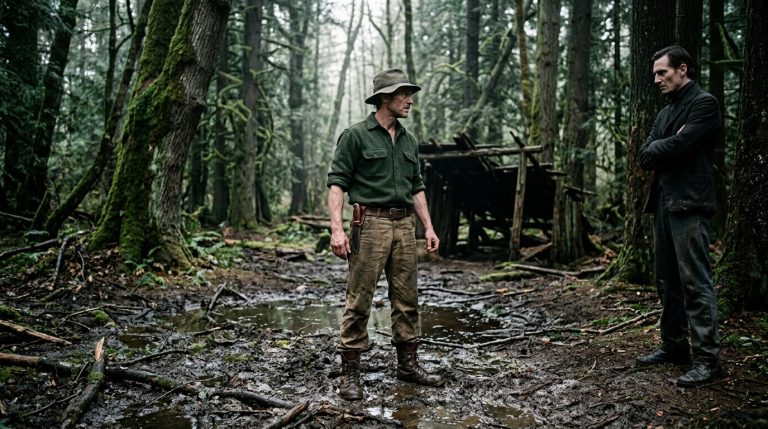
The ash tasted like dry iron when Owen squeezed his palm down into the dirt. He didn’t stomp the coals—his father had drilled that out of him by the time he was eight. Stomping left a footprint; it kicked gray soot into the low hemlock needles, creating a beacon for anyone who knew how to read the floor of the Pisgah National Forest. Instead, he scooped a handful of damp humus, banking the small fire until the orange glow choked under a skin of black earth.
He was twelve, his chest flat against the cold root of a white oak, his fingers turning cold inside his khaki scout uniform shirt.
The sound came again from the southwest, clearing the ridge line at exactly 7:19 p.m. It was a rhythmic, heavy dragging. A man’s stride, but uneven, burdened by an awkward distribution of mass. Owen slid his hand down to his belt, touching the small, square frame of his red-filter headlamp. He didn’t click it on. In these mountains, a white beam was a flare that destroyed thirty minutes of natural night vision in a microsecond; a red filter kept the eyes adjusted to the jagged edges of the limestone outcrops.
He parted the thick, leather-leaved rhododendron branches with a slow, deliberate pressure that made no sound.
The man broke through the cedar scrub forty yards out. He was tall, over six feet, his breath coming in ragged, whistling gasps that suggested an unconditioned chest wearing a dark jacket too thin for an October drop in temperature. He wasn’t looking at the stars or the trail markers. His head jerked back over his shoulder every ten paces, a paranoid, clinical scan of the dark woods behind him.
But it wasn’t the man’s frantic rhythm that made the skin on Owen’s neck turn to gooseflesh. It was the shape draped across his forearms.
A small child. Her small body was twisted like a broken branch, her head lulling uselessly against the rough denim of the man’s sleeve. In the pale, filtered moonlight filtering through the bare oak canopy, Owen caught the specific, jarring texture of the fabric: fleece pajamas, bright purple, patterned with tiny, ridiculous unicorns. One leg hung low, bare and pale. A single white sock was missing, leaving her small toes exposed to the sharp briars.
Parents don’t carry unconscious children three miles from the nearest road, Owen’s mind stated with the flat, emotionless logic of his survival manual. Parents don’t run through limestone sinks in the dark.
The man paused, shifting his grip on the girl’s hips. His boots slid against a patch of slick clay, the iron eyelets of his hiking shoes scraping a dry rock with a sharp clink. He muttered something into the collar of his jacket—low, bitter words about a single mile left and an ending that was already paid for.
Owen didn’t look back at his lean-to shelter. He didn’t think about his waterproof notebook or his half-empty canteen sitting by the dead coals. His fingers drifted to the sharp briar branch right where the man had stepped, noticing a tiny snag of white cotton thread caught on a thorn. The girl’s missing sock had been torn off here. The realization hit him not as fear, but as a mathematical equation that needed a solution. He stepped into the man’s shadow, keeping exactly thirty yards of dense timber between his boots and the heavy, dragging sound ahead.
CHAPTER 2: THE 83MINUTE SHADOW
The white thread of the unicorn sock didn’t just snag; it hung like a miniature broken flag on the gray dogwood thorn. Owen didn’t drop his stance as he slipped past it. His weight remained shifted over his midfoot, knees slightly bent to absorb the sudden dips in the limestone shelf. Every movement was a calculation of friction—how much pressure a patch of dry moss could take before it sheared off the rock face, how quietly his boot leather could roll from heel to toe against the frozen mountain loam.
Up ahead, thirty yards into the rising gloom, David Walsh was moving with a erratic, heavy rhythm that was beginning to change.
Owen noticed the shift within the first ten minutes of the climb. David wasn’t just looking over his shoulder anymore. His stride was lengthening, the heavy dragging of his left heel cutting a deeper, cleaner furrow through the wet hemlock needles. He was shifting the weight of the unconscious girl higher onto his chest, pinning her small, purple-clad shoulder against his collarbone to free his right hand.
Then came the click. It wasn’t the metallic snap of a knife blade or the slide of a bolt. It was the dry, plastic crunch of a cheap utility toggle.
Owen froze, his torso half-concealed by the flaking bark of a dead box elder. He pressed his ribs flat against the wood, breathing through his nose to keep the white vapor of his breath from expanding into the crisp air. David didn’t turn around. Instead, he reached down to a low-hanging briar cluster, his fingers working with a fast, practiced efficiency that didn’t match his previous frantic pace. When he stepped away, the branch didn’t spring back naturally. It stayed pinned to the ground by a thin loop of dull, zinc-coated wire that glinted faintly in the rising moonlight.
A trip wire. Not a military ordnance, but a primitive mechanical warning system—a spring-tensioned branch rigged to swing backward if a boot caught the low loop.
The realization sat cold in Owen’s belly. David wasn’t just running blindly into the deep timber; he was building a perimeter behind himself as he went. The panicked civilian act was a skin he was shedding with every foot of elevation they gained. He knew someone would eventually come up the Deep Creek trail, and he was transforming the natural topography of the ridge into a series of small, mechanical bottlenecks.
Owen lowered his center of gravity, his fingers checking the small brass compass in his uniform pocket without drawing it out. The needle would be swinging northeast now, tracking up toward the high limestone shelves where the old timber companies had abandoned their cutting camps fifteen years ago. The air was growing thinner, carrying the sharp, metallic tang of iron ore deposits buried beneath the limestone slabs.
He adjusted his pace, expanding the gap to forty yards. He couldn’t afford to look at the ground anymore; he had to read the line of David’s shoulders through the dense gray lattice of the rhododendron thicket. Every time David stopped to alter a branch or drop a heavy marker, Owen memorized the micro-geometry of the trail. A displaced stone here, an unnaturally bent fern there.
The physical cost of the pursuit was already registering in Owen’s calves. The weight of his survival pack—packed with the six precise granola bars, the emergency blanket, and the iodine tablets—seemed to press harder into the small of his back with every vertical foot. His tongue felt thick and dry, tasting of the iron-heavy mountain air, but he didn’t reach for his canteen. The slosh of water against plastic was a sound that carried over a hundred yards in a forest this silent.
David cleared the first major ridge line at exactly 8:12 p.m. His outline disappeared behind a massive jutting block of weathered limestone that looked like a rusted iron wedge driven into the dirt.
Owen didn’t rush the corner. He waited three full breaths, counting the slow, wet thud of his own heart against his ribs. When he reached the edge of the limestone block, he didn’t look through at eye level. He dropped to his hands and knees, sliding his face along the cold, grit-covered stone at ground level to minimize his silhouette.
Below him, the mountain dipped into a narrow, dark bowl where the hemlocks grew so dense their tops locked together like a rotting thatch roof. In the center of that bowl, a single, greasy yellow light flickered through the trees. It wasn’t a modern flashlight. It was the low, smoky orange flare of a kerosene lantern, its fuel-heavy smell already drifting up through the damp drafts of the sinkhole.
David was down there, standing on a low wooden porch that sagged toward the mud under the weight of his boots. The girl’s purple pajamas were a small, distinct blotch of color against the gray, rotted cedar planks of the cabin wall.
Owen pulled his legs beneath him, his fingers tightening around the strap of his pack as he prepared to descend into the bowl. The target was no longer moving; it was settling into a fortress of old timber and rusted tin, and the sixty-seven-hour clock had just begun its first real notch.
CHAPTER 3: THE TIN ROOF CLEARING
The descent into the basin required an entirely different mechanical discipline. Owen kept his center of gravity mere inches from the earth, sliding his boots laterally against the shale banks rather than stepping forward. The smell of kerosene grew thicker, overriding the crisp scent of wet hemlock bark with a heavy, greasy weight that seemed to coat the back of his throat. Down here, protected from the high ridge winds, the silence was absolute—save for the slow, regular thwip-thwip of water dripping from the orange, rusted tin overhang of the cabin roof.
He halted sixty feet from the clearing’s edge, his form entirely absorbed by a dense cluster of wild rhododendron bushes.
Through the missing window glass, the cabin’s interior layout was laid bare. It was a single-room skinning shack, abandoned long enough for the structural cedar beams to bow toward the mud floor. A single kerosene lantern hung from an iron meat hook screwed into the ceiling ridge, its smoky yellow wick casting long, trembling shadows across the floorboards. David Walsh stood near the center of the room, his jacket thrown onto a rotted wooden cot in the corner. He was breathing heavily, his hands working at the straps of his nylon pack with a frantic, uncoordinated friction.
On the floor beside him lay the child. The purple fleece of her pajamas was dark with grease stains from the trail, and her small chest rose and fell in short, irregular shudders.
Owen watched through the open window frame as David reached down, grasping the girl’s shoulders to drag her toward the only sound piece of furniture in the room—a heavy, three-legged oak chair that leaned heavily against a vertical roof support. She stirred then, her small fingers twitching against the rough floor planks as consciousness began to filter back into her face. Her head lulled back, her eyes blinking rapidly under the harsh flare of the hanging lantern.
“Uncle David?” Her voice came through the empty window frame, paper-thin and vibrating with an unadulterated terror that made the blood in Owen’s ears feel hot. “Where are we? I want my daddy.”
David didn’t answer with words. His face remained flat, a hardened mask of gray skin and sweat-matted hair. He reached into his canvas sack and pulled out a coil of half-inch sisal rope—the rough, unrefined utility kind that left long trails of loose hemp fibers whenever it scraped across a surface. He forced her into the chair, his movements entirely transactional, lacking either hot anger or hesitation.
“Don’t move,” he said. His voice was flat, an iron plate dropping onto stone.
The girl began to cry, the sound muffled instantly as David pulled a wide strip of gray cotton cloth from his pocket and tied it securely behind her ears, cutting her voice off into a small, rhythmic whimpering. He worked systematically, wrapping the stiff hemp lines around her small wrists, pulling them tight against the rear vertical slats of the chair before dropping to his knees to secure her ankles to the thick, hand-hewn legs.
Owen’s fingers tightened against the cold earth beneath his palms. His scout master had spent three weeks teaching Troop 47 how to recognize the logic of an adversarial scenario—how to differentiate between an accidental hazard and a deliberate threat. This wasn’t an emergency that would resolve itself with time. Every knot David tied was a physical calculation intended to remove her agency entirely.
David stood up, his joints popping with a dry, sharp click in the quiet room. He walked back to his pack, ignoring the muffled, frantic head shakes of the girl behind him. He drew out a small, silver casing—a generic burner phone with its screen brightness turned down to its lowest setting.
“Your daddy took my life ten years ago,” David muttered to the wall, his words arriving as a low, gravelly vibration that carried clearly across the sixty-foot gap to Owen’s hiding spot. “He told the old man I was stealing from the till. Got me cut clean out of the will. Everything went to Jake. The house, the shop, the club. He got the whole brotherhood, and I got the street.”
He held the small silver screen up toward the girl’s face, though she couldn’t see the text through her tears.
“Thirty-eight thousand dollars,” David said, his voice dropping into a rhythmic, rhythmic hiss. “That’s the number on the paper. I sent the text twenty minutes ago from the ridge. He’s got sixty-seven hours to pull it out of the club’s safe and leave it in the iron drop-box at the Deep Creek trailhead. Sunday morning, 2:00 a.m. That’s the line.”
He turned his back to her, his hand sliding the phone back into the deep pocket of his denim trousers.
“He thinks he can buy you back with the club’s coin,” he whispered, his fingers trailing along the rusted edge of an old wood stove that sat cold in the corner. “He’s wrong. I’m keeping the envelope, and I’m leaving you out here under the floorboards anyway. Money doesn’t fix ten years of sleeping in a sedan. Only losing what he loves makes the ledger match.”
Owen’s breath hitched slightly, his lungs freezing as he processed the structure of the threat. The ransom wasn’t a transaction; it was a distraction. David had no intention of releasing her when the clock expired. The sixty-seven-hour timeline was simply the amount of time he calculated it would take for his brother to break under the pressure before the final execution.
David checked the dial of his wristwatch, then turned toward the crooked wooden door. “I’m going down to the lower creek bank to anchor the perimeter lines,” he said, his boots already moving toward the threshold. “Don’t go making noise. The wind down here carries everything straight to the rock wall.”
The door groaned on its single rusted hinge as he pushed it open, his shadow lengthening across the wet weeds of the clearing before the darkness of the lower trail swallowed him whole. The kerosene lantern remained hanging from the meat hook, its low, smoky flare illuminating the small girl tied to the leaning oak chair, her body shaking against the hemp cords. Owen stayed perfectly still for ten seconds, his eyes fixed on the empty path where David had disappeared, his mind already decomposing the distance between his rhododendron bush and the rotted sill of the cabin wall.
CHAPTER 4: THE SOVEREIGN BENEATH THE PLANKS
The cold grease from the rotting sill plate smeared across the shoulder of Owen’s khaki uniform as he dropped his weight into the mud. He didn’t rush the crawl. The space beneath the floorboards was a narrow, eighteen-inch pocket of compressed dark, smelling heavily of ancient rot, rusted iron nails, and the dry, powdery dust of bored cedar beetles. He dragged his frame forward by his forearms, keeping his belt buckle flat against the frozen earth to prevent his survival pack from scraping the underside of the hand-hewn heart-pine planks above.
Every square inch of the crawlspace was an exercise in friction. Strands of old, fibrous spiderwebs caught across his eyelashes and the rim of his forehead, but he didn’t lift a hand to clear them. A single sharp movement could rattle the loose stone foundation blocks anchoring the cabin’s southeastern corner.
He tracked the smoky yellow glare of the lantern filtering down through the half-inch gaps between the floorboards. The light cut the darkness beneath into long, precise geometric bars that shifted over his face as he advanced. Directly above him, the three-legged oak chair groaned against the vertical support beam, its wooden feet vibrating with the small, rhythmic shudders of the child bound to its frame.
Owen stopped when his forehead cleared the center joist. He pressed his ear against a gap where the pine had split away around an old hand-forged square nail.
“Hey,” he whispered. The sound was little more than a controlled release of air from his teeth, targeted straight up into the light.
The vibration above stopped instantly. The wooden legs of the chair didn’t rattle, but a sudden shift in the alignment of the shadows told him the girl’s head had jerked downward, her eyes scanning the dark lines between her feet.
“Down here,” Owen breathed, keeping his voice beneath the level of the dripping tin roof outside. “Don’t make a sound. Look straight down through the wide board by your left heel.”
A small, muffled gasp vibrated through the floorboards. Through the narrow slot, Owen caught the glint of a dark brown iris, wide and reflecting the orange flare of the hanging kerosene lamp.
“My name is Owen,” he whispered, his fingers reaching up into the gap, his nails catching on the rough, splintered underside of the wood. “I’m twelve. I’m a scout. I was camped out on the lower fork when I saw him bring you in. I’ve been trailing him since seven o’clock. I know who he is. I know what he’s doing.”
The girl made a sharp, frantic whimpering behind the gag, her small heels tapping against the pine planks.
“Listen to me,” Owen said, his voice hardening with the steady, repetitive cadence his father used when checking a damaged trail line. “I’m going to slide my fingers up to clear the knot behind your ears, but you can’t scream. If he hears anything from the creek bank, we lose the window. Do you understand? Nod your head if you understand.”
The shadow above moved in a slow, vertical arc. Owen extended his right arm fully, his fingers squeezing through the half-inch slot. The wood bit into the back of his knuckles, scraping a thin line of skin away against a rusted iron bracket, but he didn’t pull back. His fingertips caught the edge of the gray cotton cloth, working the coarse knot where David’s sweat had dried into the fabric. He twisted, using the leverage of the floor joist until the loop slid down over her chin.
The girl sucked in a sharp, rattling breath that tasted of kerosene smoke and cold. “Uncle David is going to kill me,” she whispered, her voice cracking into the small, dark space. “He said my daddy took his money. He said he’s going to leave me under the dirt where nobody can look.”
“Your dad is Jake Walsh,” Owen whispered back, his eyes catching a gray, waterlogged scrap of paper wedged between the sill plate and the foundation stone near his left elbow—an old commercial insurance record from 2011, its rusted staples long since dissolved into orange powder. He didn’t pull it loose yet; his focus remained fixed on the small circle of light above. “He’s already looking for you. I left trail blazes every fifty yards from the main creek crossing—broken dogwood branches pointing northeast, stacked limestone cairns by the draw. They’re going to find this clearing.”
“How long?” she whimpered, her bare toes twisting against the wood. “It’s so cold.”
“I don’t know,” Owen said, his hand sliding into his pack to extract his half-filled canteen and his last whole granola bar. He passed the neck of the plastic bottle through the widest gap first, the material clicking softly against her ankle bone. “Drink it slow. I’m not leaving the ridge. I promise you that. I’ll be forty yards out in the rhododendron every time he’s inside, and I’ll come back under the planks every time he leaves to check his lines. A scout keeps his word.”
She clutched the neck of the bottle with her bound fingers, her head lowering to reach the cap. “My name is Lily,” she whispered.
“I know,” Owen said. “Now I have to pull the cloth back up. If he sees the knot loose when he checks the perimeter, he’ll move you down into the limestone sinks, and the markers won’t work. Stay still.”
He reached through the splintered gap again, his fingers cold and coated in foundation grime, pulling the gray cotton back into place and tensioning the knot until the shadow of her head stabilized against the lantern light. He had just finished securing the loop when the distant, heavy thud of leather boots struck the wet clay of the lower clearing outside, the stride returning with a fast, measured cadence that meant the window was closed.
CHAPTER 5: THE COLD SOAKING
The first drop of rain hit the orange tin roof with a sharp, metallic ping that sounded exactly like a firing pin striking an empty chamber. Within ninety seconds, the high mountain draft pushed a wall of gray water over the ridge line, turning the dry soil of the basin into a slick, freezing slurry. Owen lay flat behind the fallen hemlock log, his chin pressed into the wet moss to keep his profile lower than the rotted bark line. His uniform shirt, already thinned by two days of trail friction, soaked through instantly, pinning the cold fabric against his shoulder blades like a sheet of iron.
Inside the cabin, the smoky yellow glow of the kerosene lantern flickered wildly as the wind forced its way through the open window frame.
David Walsh had returned, his boots leaving thick, deformed wedges of red clay across the threshold. He didn’t look toward the floorboards or notice the faint disturbance in the foundation dirt where Owen had crawled out. His hands were occupied with a short length of black insulated wire he’d stripped from an old automotive harness down by the creekbed. He slammed the crooked wooden door against its rusted hinge, pinning a heavy oak timber across the frame to lock out the storm.
Through the gap in the log, Owen watched the temperature on his wrist altimeter drop steadily toward thirty-nine degrees. The air was thick with the scent of wet slate and ozone.
By 6:30 p.m., full darkness had sealed the basin, and the drizzle had hardened into a steady, freezing downpour that began to pool around the cabin’s foundation stones. Through the empty window frame, Owen caught the silhouette of Lily’s shoulders. The wind was driving the rain straight through the glassless opening, striking her small frame in a relentless, rhythmic spray. The bright purple fleece of her unicorn pajamas was completely sodden now, clinging to her ribs as her torso shook with the violent, uncontrollable tremors of early-stage hypothermia. Her head hung low, her teeth clicking against each other with a frantic, metallic cadence that carried over the sound of the rain.
David ignored her. He sat on the edge of the rotted canvas cot, his fingers turning a small iron wrench as he tightened a bracket on his pack, his mind entirely insulated within his own ledger.
Owen waited forty minutes, calculating the interval between David’s glances toward the window. When the man stood up to pace toward the cold wood stove in the opposite corner, Owen shifted his weight. He didn’t rise; he slid forward on his stomach, his elbows dragging through the cold mud of the clearing until he reached the southeast foundation corner. The rotted sill plate was slippery with grease and water, but he found the gap, lifting the loose heart-pine plank with the slow, uniform pressure of a lever.
The crawlspace was a freezing sinkhole now, two inches of muddy runoff pooling around the structural stones. Owen dragged himself beneath the floorboards, his teeth clenched so hard his jaw ached, his focus fixed entirely on the bar of orange light above.
“Lily,” he whispered, his breath rising as a thick white vapor through the half-inch gap.
The clicking of her teeth stopped for a fraction of a second. A low, ragged whimper came through the gray cloth gag. Owen reached up through the slot, his fingers gray with foundation grime, and caught the knot behind her ears. He untied it with three fast twists, pulling the wet fabric down around her collar.
She couldn’t speak at first. Her lips had a distinct, bluish tint under the yellow lantern flare, and her small fingers were curled into rigid, unyielding claws against the armrests of the oak chair. “I can’t… I can’t feel my toes, Owen,” she gasped, her whole chest heaving with a short, shallow rhythm. “The water… it keeps coming through the glass.”
“You have to move them,” Owen whispered, his own limbs vibrating from the cold mud beneath his stomach. “Wiggle them against the wood. Keep the blood sliding.”
He knew the metric. His wilderness first aid manual was explicit: once the shivering turned from voluntary to involuntary, the core temperature was dropping below ninety-five degrees. He reached behind his back, his stiff fingers working the rusted brass zipper of his survival pack. He didn’t hesitate. He pulled out his official fleece scout jacket—the heavy, green layer that had kept his own core stable through the two nights on the high ridge.
He forced the fabric up through the narrow plank slot, the thick material bunching against the splinters until he used the flat of his palm to drive it into the room above.
“It’s going to be tight,” Owen breathed, his voice tight as his skin contracted against the freezing draft. “I can’t get your arms into the sleeves because of the hemp lines, but I’m draping it over your chest. Pin it with your chin, Lily. Keep the heat inside the wool.”
She pulled her head down, trapping the dry green fleece against her collarbone with a desperate, heavy pressure. “What about you?” she whispered, her chin shaking against the fabric. “You’re… you’re in the mud.”
“I have the rain jacket,” Owen said, though the thin nylon of his orange shell was already failing to hold his body heat against the wet clay. “It’s Saturday night. The sixty-seven hours are half gone. My dad is a ranger; he knows how to read the deep creek draw, and I’ve left the blazes clear. If they don’t break the clearing by dawn, I’m coming out from under these boards with my knife. I’ll clear the ankles first, and we’ll take the limestone line to the highway. We deal with it step-by-step.”
A sudden, sharp scrape from the floorboards near the cold stove cut the connection. David’s heavy tread was moving back toward the center of the room, the wood groaning under his heel. Owen reached up, his fingers catching the gray cotton gag, re-tensioning the knot behind Lily’s ears until the fabric was secure, before sliding his frame backward into the dark water of the clearing just as the heavy timber latch on the cabin door began to slide.
CHAPTER 6: THE COLUMN OF WHITE SMOKE
The freezing mud felt like an iron collar against Owen’s throat as he backed clear of the rotting cedar sill. He didn’t stand up when he broke the cover of the rhododendron line. His body was running on less than four hours of sleep total, the muscle groups in his thighs vibrating with a low, uncontrollable twitching that had nothing to do with the wind. The rain had ceased just before dawn, leaving the basin choked in a dense, desaturated gray mist that smelled of wet slate and extinguished wood ash.
Every breath tasted of raw moisture and iron. He checked his wrist. It was Sunday morning, 6:00 a.m. The target deadline was roughly twenty hours out, and his core baseline was slipping.
He began the six-hundred-yard vertical climb toward the eastern ridge line, using the trunks of the stunted white oaks for leverage. His fingers were so stiff from the midnight soak that he had to wrap his entire forearm around the bark to pull his ninety-four-pound frame up the limestone shelves. The thin orange rain shell offered no heat, only a coarse, rhythmic swish-swish that he timed precisely to the intermittent gusts of the mountain wind to mask his progress. He couldn’t afford a time-skip; he had to chart every foot of the ascent, avoiding the drainage troughs where the red clay had turned into a slick, deceptive grease.
He reached the crest at 7:03 a.m. The ridge was a narrow, exposed spine of fractured shale and rusted ironstone deposits, entirely blasted by the high-altitude drafts.
Owen dropped his survival pack onto a flat slab of rock, his hands moving with a mechanical, clumsy precision. This was the highest tactical node within a three-mile radius. If a rescue detail was monitoring the quadrant, this was the only grid location capable of piercing the canopy density of the deep creek basin. He didn’t look for safety; he began to construct a tool.
He gathered the wood in three separate layers, following the geometric principles laid out in the second chapter of his survival handbook. First, the core matrix: a tight teepee of dry pine needles and flaking birch bark he had harvested from the underside of a fallen log on Friday night, preserved inside his waterproof kit bag. Next, the structural fuel: a dense lattice of dead oak twigs, arranged to allow maximum oxygen circulation. His fingers shook violently as he pulled out the small magnesium bar and the scraper blade.
He struck the flint four times, the dull iron edge throwing a shower of cold, blue-white sparks against the dry tinder. On the fifth stroke, a small pocket of orange fire bloomed against the white birch bark.
Owen didn’t let the flame expand into a clear heat. The moment the oak twigs caught, he reached for the surrounding ground cover, gathering armfuls of damp pine boughs, green moss torn from the limestone sinks, and waterlogged fern leaves from yesterday’s storm. He smothered the open flame systematically, using the flat of his palm to pack the green weight onto the hot coals.
The reaction was immediate. The trapped moisture and the volatile oils in the pine needles generated a thick, unyielding column of heavy white smoke that rose six hundred feet into the clear morning sky like an iron rod.
He stood up, his body outlined in the blinding orange of his survival jacket against the gray stone. His arm burned with a deep, lactic ache as he drew out the three-by-three-inch polished metal signal mirror from his uniform pocket. Squinting through the central sighting hole, he located the thin gray line of the northern highway eight miles across the valley.
Dot. Dot. Dot. Dash. Dash. Dash. Dot. Dot. Dot.
He repeated the sequence for ninety minutes without pause, his fingers freezing around the metal frame, the surface of the mirror accumulating a thin film of his own gray breath. His vision blurred at the margins—the classic symptom of sleep deprivation his father had warned him about when tracking lost details. The landscape began to shimmer, the dark green of the hemlock canopy below looking like an undulating sheet of rusted iron.
At 10:03 a.m., a distant, rhythmic thudding cut through the mountain draft from the south. It wasn’t the wind. It was the distinct, heavy chop of rotor blades compressing the cold air.
Owen didn’t stop the mirror sequence. He locked his focus on the white nose of the Asheville search-and-rescue helicopter as it cleared the southern ridge. The aircraft was banking hard, its thermal array sweeping the lower draws three miles wide of the cabin. He shifted the mirror’s alignment, catching the sun’s reflection at a forty-five-degree tilt, driving the blue-white flash directly into the pilot’s cockpit glass.
The helicopter hovered for twelve seconds, then tipped its nose forward, the roar of the turbine engine expanding down into the basin as it broke its grid pattern and accelerated straight toward the white column of smoke. Owen didn’t drop to his knees. He raised both arms, his fingers locked into a rigid V, his boots remaining anchored to the rusted ironstone as the rotor wash began to tear at the edges of his orange shell.
CHAPTER 7: THE BREACHING STORM
The downwash from the search-and-rescue helicopter flattened the low scrub oak leaves against the shale like iron plates. Owen stood entirely anchored under the hurricane of cold air, his boots wedged into the limestone split, his right arm remaining locked into a straight, geometric line that pointed forty-five degrees down into the dark draw. He didn’t drop his frame as the white underbelly of the aircraft cleared the tree spikes. Through the cockpit plexiglass, the dark helmet of Captain Shaw tilted downward, her binoculars catching the bright orange silhouette of his survival shell against the desaturated stone.
The loudspeaker broke through the twin-turbine whine with a metallic, vibrating rasp. “Ground units converging. Scout, stay clear of the baseline draw.”
Owen didn’t retreat to the trail. He slid down the drainage shelf behind the smoke column, his elbows tracking the raw furrow he had worn into the red clay during the morning climb. The real-time transition down the slope was a blur of high-friction braking against tree roots and flaking slate slabs. Below him, the silence of the basin was being systematically dismantled by the physical convergence of forty distinct boots crushing the briar blocks from the north and south lines.
He reached his observation log behind the wild rhododendron line at 10:38 a.m., his uniform pants torn clean through at the left knee, revealing a patch of gray skin coated in ironstone grit.
The clearing was already a cold pressure cooker. Through the glassless cabin frame, Owen could see David Walsh standing by the door timber, his burner phone pressed against his jaw, his left hand gripping a four-inch lockback blade he had drawn from his utility harness. His shoulders were raised into a rigid, defensive block, his breath coming in short, white bursts that fogged the rotted cedar planks.
“I have the girl,” David screamed toward the timber latch, his voice rising into an unstable, vibrating pitch that cut through the low rumble of the idling ground vehicles. “You touch the frame, and I’ll open the baseline. I sent the ledger text. Sixty-seven hours or the debt is paid in red.”
Outside the door, the mud of the clearing didn’t shift with an accidental weight. It exploded.
The crooked cedar door didn’t simply clear the frame; the old iron strap hinges sheared straight off under a massive, two-hundred-and-twenty-pound mass of leather and focused velocity. Jake Walsh came through the threshold like a falling oak, his heavy riding boots driving the splintered wood straight into David’s chest. The impact sounded like an iron wedge hitting a dry log—a dull, solid thud that drove David backward until his spine struck the rusted casing of the cold wood stove in the corner.
The four-inch lockback blade clattered against the pine floor planks, its silver edge sliding into a half-inch gap between the boards.
“That’s my daughter,” Jake said, his voice dropping into a low, terrifying growl that seemed to vibrate through the structural foundation stones beneath Owen’s chest. He didn’t use a weapon. His hand—scarred across the knuckles with old grease burns—closed around David’s throat, lifting his frame until David’s heels cleared the red clay wedges on the floor.
Behind him, two massive riders wearing the winged death’s-head patches across their heavy denim cuts bypassed the struggle entirely, their movements synchronized with the clinical precision of a tactical extraction detail. One rider, his gray beard reaching the brass buckles of his belt, dropped his weight beside the three-legged chair, his hands drawing a pocket tool to sever the stiff hemp ropes around Lily’s ankles. The other, a younger man with black tribal ink tracing his neck line, locked David’s arms behind his shoulder blades, the chrome joints of the handcuffs clicking shut with three distinct, metallic snaps.
“Secure,” the older rider grunted, his palm sliding beneath Lily’s shoulder as the wet green scout fleece slipped away from her chest.
Lily didn’t stand. Her limbs were completely rigid, the sixty-seven hours of compression and freezing runoff having turned her muscles into unyielding wire. She lulled forward into Jake’s leather-clad chest as he dropped David onto the boards, his arms sweeping her small frame up against his collarbone with a single, continuous lift.
“Owen told me,” she whimpered behind her tears, her teeth clicking against the rough cowhide of Jake’s vest. “The scout… he stayed under the floorboards, Daddy. He gave me the green jacket. He said you were counting the blazes.”
Jake froze, his eyes scanning the dark, glassless window frame where the mist was beginning to drift inside the room. “Who’s Owen?”
Owen drew himself up from the wet rhododendron needles, his bare, muddy knee dragging against the rotted sill plate as he stepped through the broken door frame. He was twelve, his khaki scout shirt soaked completely through, his shoulders shaking with the final adrenaline collapse of three days without a bed. He stood in the gray light of the clearing, a tiny, ninety-four-pound ghost covered in pine pitch and foundation grime.
“I am,” Owen said, his voice cracking into the damp room. “I kept the line.”
CHAPTER 8: THE RESTITUTION OF IRON
The silence that followed Owen’s words was heavy, smelling of the damp red mud on his clothes and the cooling kerosene from the dark lantern above. Jake Walsh didn’t move for three long breaths, his leather-clad arms remaining hooked under Lily’s small, shivering frame. He looked down at Owen—at the torn scout uniform, the thin orange nylon shell crusted with foundation loam, and the raw line of skinned skin across his knuckles.
“The scout,” Jake murmured, his voice cutting through the quiet basin with the dry friction of an iron grate sliding over granite. He didn’t drop his stance. He turned his torso slowly, ensuring Lily’s head remained pinned securely against his shoulder before he stepped past the shattered timber latch of the doorway.
Outside, the mountain afternoon had settled into a gray, desaturated stillness. The ground teams were already clearing the baseline draws, their flashlights cutting through the residual mist while the low rumble of the emergency transport idling down by the gravel road provided a constant, mechanical vibration. Two county deputies had David Walsh pinned face-down against the slick clay slope, his arms wrenched behind his belt line where the heavy chrome joints of the handcuffs caught the pale daylight.
Margaret Reeves, the district attorney’s investigator who had converged with the northern team, stood near the edge of the clearing, her fingers leafing through a waterlogged synthetic folder. She didn’t offer a polite preamble. Her eyes tracked the gray, waterlogged ledger sheet Owen had pulled from beneath the sill stone—the document from 2011 showing a secondary, commercial death-benefit clause on Lily Walsh, executed three weeks prior by an independent broker in Asheville.
“He didn’t want the thirty-eight thousand from the safe, Jake,” Margaret said, her voice dropping into a flat, clinical rhythm as she stepped toward the porch planks. “The text line was a decoy to lock the club’s movement to the trailhead. He had a quarter-million dollar payout scheduled on the girl’s confirmed demise, listed under a corporate insurance umbrella. He was planning to leave her beneath the joists and point the federal tracking detail straight at your clubhouse on the east side.”
David didn’t struggle against the clay. His face was gray, his teeth matted with the red dirt of the basin as the deputies hoisted him toward the lower draw. “Jake got the whole inheritance,” he hissed, his voice cracking with the bitter, dry pressure that had built for ten years inside his sedan. “He got the old man’s respect. He got the ledger. I was just balancing the iron.”
“The iron is balanced,” Jake said, his eyes remaining fixed on his brother’s retreating outline until the thick rhododendron lattice swallowed the deputies’ jackets. He didn’t give a villain speech. He simply adjusted his grip on Lily, his massive boots turning back toward the kid who had spent sixty-seven hours inside the mud.
The real-time transition to Mission Hospital in Asheville was a slow, exhausting sequence of grinding gears and high-altitude draft through the transport windows. By 4:00 p.m., the white tiles of the emergency wing had replaced the limestone shelves of the forest. The hospital staff had pushed two metal beds side-by-side in the corner room of the pediatric floor, separated only by a low canvas curtain that remained drawn back to keep the line of sight clear.
Lily was hooked to a twin-port IV line, the transparent fluids dripping systematically into her forearm to counteract the severe dehydration. Her small wrists were bound in soft cotton gauze where the rough hemp lines had left deep, red rope burns across her skin. She was clutching a gray stuffed rabbit a nurse had left on her mattress, her eyes fixed entirely on the opposite bed.
Owen lay flat under the white hospital sheets, his limbs finally still after three days of voluntary tension. A separate IV needle was pinned into the back of his right hand, rehydrating his ninety-four-pound frame with a slow, regular rhythm. His official fleece jacket—washed and folded by a volunteer detail—sat on the iron table near his pillow, its green wool smelling faintly of laundry soap instead of kerosene smoke.
The door groaned on its brass hinge as Jake Walsh entered, followed by Park Ranger Mike Matthews. Both men looked hollowed out by the timeline, their skin gray under the fluorescent tubes, but their shoulders had lost the rigid distortion of the pursuit.
Jake pulled a heavy steel chair between the two mattresses, his large form sinking into the metal frame with a deep, weary sigh. He reached into the pocket of his heavy cowhide vest and drew out a small, folded object made of stiff, oiled leather. It was a miniature, hand-cut riding vest, its back panel embossed with the clean, white lines of the winged death’s-head logo, the front flap carrying a single brass-lettered patch: Honorary Member.
“This doesn’t make you a rider, kid,” Jake said, his voice dropping into a soft but rough cadence that filled the small white room. “You’re twelve. You’ve got your own trail to mark. But it means every brother from here to the coast knows your name and knows what you did under those floorboards. If you ever find yourself in a tight draw anywhere in this country, you pull this leather out, and the line moves.”
Owen reached out his left hand, his fingers tracing the coarse grain of the hide, his knuckles still dark with the residual stains of the foundation grime. “I just… I kept the promise,” he whispered, his voice thin but steady against the click of the IV machines. “A scout keeps his word.”
“You did more than keep a word,” Mike Matthews said, his hand dropping onto his son’s shoulder with a firm, heavy pressure that carried eighteen years of quiet pride. “You trusted the geometry of the trail. You stayed when the safe choice was to run.”
Across the room, Lily pulled the dry green fleece higher against her neck, her chin resting on the stuffed rabbit as a small, real smile broke through the gray trauma of her face. “He didn’t leave me alone,” she said.
Owen looked down at the leather vest resting on his sheets, then out through the clean double-pane window toward the blue, jagged line of the ridge where his signal fire had broken the canopy. The rusted iron and the cold mud were behind them now; the line had been held, and the world had settled back into its proper, quiet weight.