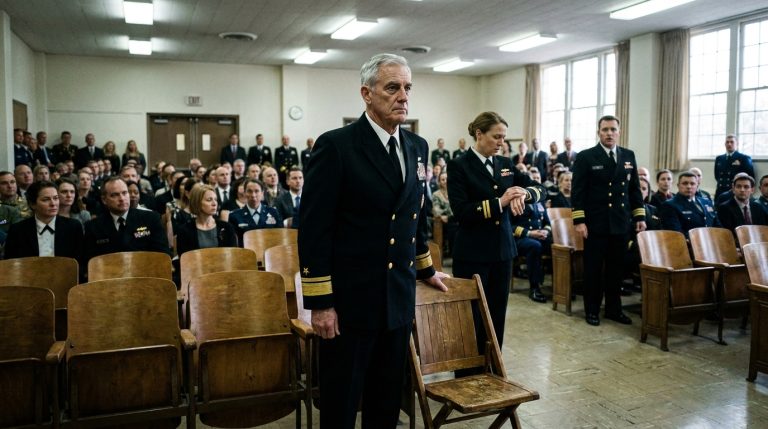
The Silent Pulse of Norfolk: A Master’s Legacy in the Heart of a Sleeping Steel Giant
CHAPTER 1: THE WEIGHT OF THE PIER
The 1986 Ford F-150 rattled to a stop against the security gate, the engine emitting a final, tired puff of exhaust that hung in the humid Norfolk air. Harold Miller didn’t rush. He sat for a moment with his hands resting on the steering wheel, his fingers tracing the worn, cracked vinyl—a texture as familiar to him as his own skin. He adjusted his faded navy baseball cap, the fabric thin and soft from years of service, and climbed out.
He felt the weight of the leather toolbox in his hand before his feet even hit the pavement. It wasn’t just the iron and steel inside; it was the accumulation of decades. He walked toward the pier, his knees giving a faint, rhythmic protest that echoed the slow, steady gait of a man who had walked through the guts of enough ships to know that urgency was the enemy of accuracy.
Captain William Evans stood at the edge of the pier, his posture a taut wire of frustration. Beside him, Commander Morgan clutched a tablet that flickered with red diagnostics, the screen casting a pale, sickly light on his sweating face. Evans watched Harold approach, his gaze sweeping over the old man’s jeans and the scuffed leather jacket with a cold, performative disgust.
“Admiral Carter’s solution,” Evans muttered, the sound sharp enough to slice through the heavy air. “A grandfather with a hobbyist’s trunk.”
Harold didn’t quicken his step. He approached the group, his blue eyes calm, observing the scene not with the defensiveness of a man being mocked, but with the detached focus of an engineer assessing a structural fault. He stopped a respectful distance away, his eyes moving past Evans, past the officers, and locking onto the massive, hulking silhouette of the USS Gerald R. Ford.
“Captain,” Harold said, his voice a low gravel, unbothered by the hostility hanging in the air.
“Let me be clear, Mr. Miller,” Evans stepped into his space, his voice dropping into that dangerous, forced whisper that aimed to humiliate. “My engineers are the best the Navy has ever produced. MIT, Stanford, the Academy. They have spent three days tearing this ship apart. If they cannot find the heart of the problem, I seriously doubt your antiquated toolbox will yield a miracle.”
Harold looked at the captain, then back at the ship. He reached out, his hand hovering briefly near the gangway railing, feeling the cold, unresponsive iron.
“I’m not looking for a miracle, Captain,” Harold said quietly. “I’m just looking for what’s stopped breathing.”
Evans laughed, a brittle, sharp sound that didn’t reach his eyes. “Fine. Go ahead, Grandpa. But understand this: when you fail—and you will—I expect you to stand before my crew and admit that this was nothing more than a pathetic waste of time.”
Harold nodded, a subtle movement, and began the slow climb up the gangway. As he stepped onto the deck, the silence hit him again. It wasn’t empty; it was pressurized. He looked at the horizon, where the afternoon sun was beginning to dip, casting long, fading shadows across the flight deck. He felt a sudden, sharp chill, an intuition that the ship was hiding something in its architecture—a secret buried under layers of new, untested logic. He didn’t know what it was yet, but he knew the taste of a machine that was being lied to by its own sensors.
CHAPTER 2: THE ANATOMY OF DISDAIN
The climb up the gangway felt like walking into a tomb, albeit one made of multi-million dollar steel. Harold kept his movements deliberate, his hand resting on the railing, feeling the vibration of the ship—or rather, the lack of it. It was a cold sensation, a deadened resonance that ran contrary to the sheer scale of the vessel. Beside him, Commander Morgan and Lieutenant Johnson moved with an urgency that betrayed their desperation; they were young, their minds wired to the rapid-fire flicker of the digital interfaces they lived by, yet they walked with a hesitant, almost fearful grace.
They passed through the airlock into the heart of the ship, where the air was thick, stale, and unnervingly still. The lighting was sharp, clinical, and unforgiving, washing over the bulkheads in a way that made the polished surfaces feel abrasive. Harold paused for a fleeting second, catching a scent that stopped him—a faint, sour tang of overheated insulation mixed with stagnant air.
Suddenly, the cold, industrial environment dissolved. For a heartbeat, Harold wasn’t on the Gerald R. Ford in Norfolk; he was back on the USS Abraham Lincoln in 1989, the year the cooling systems had buckled under the weight of an unexpected heat spike. He remembered the precise way the copper piping had shuddered under the strain, the way the air had grown heavy with the smell of failure before the alarms even thought to sound. The memory was sharp, intrusive, and it tightened the muscles in his chest—a phantom echo of a crisis long since resolved.
“Mr. Miller?” Johnson’s voice was hesitant, snapping Harold back to the present. The lieutenant was holding a tablet at a sharp angle, the screen reflecting in his anxious eyes. “We’re nearing the propulsion control room. Sir, I… I apologize for the Captain’s behavior on the pier. He’s under immense pressure.”
Harold didn’t look at him. He kept his gaze fixed on the overhead conduits, tracing the lines of steel as they disappeared into the ceiling. “Pressure is a constant in this business, Lieutenant,” Harold said, his voice as dry as worn leather. “The problem is whether it’s being applied to the ship or to the people.”
They entered the control room, and the atmosphere shifted from stifling to hostile. Three engineers were huddled around a central console, their faces illuminated by the red glare of dozens of warning lights. The room felt like a command center for a losing battle. When Harold walked in, the conversation died instantly. The three engineers looked up, their expressions a mix of exhaustion and blatant skepticism.
Lieutenant Davis, who sat at the primary terminal, stood up. He was lean, dressed in a crisp uniform that seemed far too immaculate for the work at hand. He looked at Harold, then at the toolbox in his hand with undisguised annoyance. “Who is this, Commander?”
“Harold Miller,” Johnson said, his tone firmer now, though he didn’t quite meet Davis’s eyes. “He’s been brought in to assist with the propulsion diagnostics.”
Davis let out a hollow, humorless laugh. He gestured to the wall of monitors, where the words Safety Lockout Engaged flickered in a rhythmic, taunting cadence. “We’ve had every diagnostic tool in the Navy running on this system for seventy-two hours. We’ve replaced the primary processors, re-indexed the fuel injection protocols, and verified the integrity of the turbine housing. There is nothing left to assist with, unless he’s brought a ghost-buster in that box of his.”
Harold set his toolbox down on the deck. It made a solid, heavy thud that seemed to momentarily drain the tension from the room. He didn’t offer a retort. Instead, he walked toward the main console, his movements slow and methodical. He didn’t reach for the keyboard or the screen; he stood back, his head tilted slightly, his eyes scanning the data with the patience of an old man reading a landscape he’d walked a thousand times before.
He didn’t care about the red warnings. He didn’t care about the panicked logs scrolling on the secondary screens. He looked at the ship’s reactions to the diagnostics—the way the system hesitated, the specific, labored cadence of the fans, the micro-vibrations he could feel through the soles of his boots. It wasn’t the sound of an electrical failure; it was the sound of a system gasping for air.
“You’ve been looking at the symptoms,” Harold said, his voice cutting through the hum of the monitors. “You’ve been arguing with the machine. It’s telling you it’s broken, so you’re trying to fix the breakage. But look at the logs again.”
Davis crossed his arms. “We’ve looked at them until our eyes bled.”
“Then look at the environment,” Harold corrected, turning to face them. His blue eyes, clear and steady, seemed to pull the focus of the room toward him. “The ship isn’t failing. It’s defending itself. The question isn’t why the turbines are locked; the question is what they’re trying to prevent from happening.”
A heavy silence fell over the room. Johnson stared at him, his brow furrowed in sudden, dawning curiosity. Davis, however, looked ready to snap. The friction between the old, hard-won knowledge Harold carried and the sterile, algorithmic certainty the younger engineers relied on was palpable, a crackling tension in the air. Harold turned back to the control panel, his fingers hovering inches away from the display, as if he could sense the heat radiating from the hardware itself. He knew, with a certainty that reached into his bones, that the answer was hidden in the physical space of the engine room—not the lines of code.
CHAPTER 3: THE SILENT DIAGNOSIS
The walk from the control room to the lower propulsion decks was a descent into a different kind of reality. As they left the pressurized, climate-controlled corridors behind, the ambient temperature began to climb, pressing against Harold’s skin like a thick, woolen blanket. Commander Morgan led the way, his steps quick and purposeful, while Lieutenant Johnson trailed behind, occasionally casting nervous glances toward the older man.
Harold didn’t speak. He focused on the texture of the journey. He felt the ship through his feet—the subtle, irregular thrum of auxiliary pumps, the way the vibration changed as they moved deeper into the hull. To the engineers, it was just a ship, a vessel of steel and wire; to Harold, it was a living, complex creature that had gone quiet. He reached out and touched a bulkhead, his calloused fingertips sliding over the painted steel. The surface felt warm, unnaturally so, a sign of energy trapped where it shouldn’t be.
They reached the entrance to the main engine room. The heavy blast doors stood slightly ajar, and as they pushed through, the heat hit them like a physical wave. The sheer scale of the space was daunting—vast, vaulted ceilings and a labyrinth of piping that twisted and turned like the veins of a titan. But it was the silence that was the most jarring. Normally, an engine room of this class would be a symphony of mechanical output, a deep, resonant roar that vibrated in the marrow of your bones. Now, it was muted, reduced to a hollow, wheezing sound that didn’t belong in a warship of this magnitude.
Harold stepped over the threshold, his eyes immediately sweeping the room. He didn’t look at the gauges, the sensors, or the glowing status tablets that the Navy engineers were so enamored with. He looked at the shadows, the corners where dust collected, the angles of the pipes, the way the light played off the various joints and connections.
“Mr. Miller?” Johnson’s voice was small in the vast, hollow space. “The propulsion core is right here. We’ve checked the turbine seals three times. Everything is within standard tolerance.”
“Tolerance on paper is a luxury,” Harold murmured. He pulled a small, battered flashlight from his jacket pocket—a simple, incandescent tool that threw a warm, yellow pool of light against the grey, industrial environment. He clicked it on, the beam cutting through the dimness. “Physics doesn’t have a margin of error.”
He began to walk the perimeter of the primary turbine, his eyes moving with a predatory intensity. He stopped near a cluster of fuel-delivery pipes, crouching low. His knees cracked, a sound that seemed abnormally loud in the quiet room, but he didn’t falter. He leaned in, listening. Not to the machinery—it was dead—but to the movement of the air itself.
He noticed a subtle shift. A faint, inconsistent whistling sound, buried under the low hum of the auxiliary fans. It was a sound of air being forced through a restriction, a sound of strain. He stood up, his gaze tracking the line of the ductwork that snaked toward the ceiling, disappearing into the upper shadows of the compartment.
“Morgan,” Harold said, his voice level. “How old are the intake vents in this sector?”
Morgan looked up from his tablet, frowning. “They were overhauled during the last maintenance cycle, just a few months ago. Why?”
Harold didn’t answer immediately. He walked a few paces further, his light dancing over the ceiling grids. He felt the air. It felt heavy, stagnant, as if the room were struggling to turn over its own atmosphere. He thought back to the records—the change in contractors, the pride of the new installation—and then he looked at the intake grates again. They looked perfect. They were clean, shiny, and structurally sound. To a younger eye, they were invisible. To Harold, they were the exact point where the ship’s ability to communicate had been severed.
He moved to a ladder, his hands finding the familiar grip of the rungs. “I need you to open that access panel,” he directed, pointing to a section of the ductwork high above the deck. “And be careful. If I’m right, you’ve been feeding this ship, but you’ve been starving it of the one thing it needs to function.”
Johnson blinked, looking up at the high, shadowed panel. “That’s a sealed compartment, sir. There’s nothing in there but the air filtration interface.”
“Exactly,” Harold said.
As he began to climb, the air grew hotter and thinner. He felt a sudden, sharp, and entirely unwelcome memory: the USS Abraham Lincoln, the way the filters had been packed too tightly by a well-meaning but inexperienced crew, effectively suffocating the turbines. He pushed the thought aside, focusing on the immediate physical reality. He reached the platform, his breath coming in shallow, controlled bursts.
He wasn’t just looking for a mechanical error; he was looking for the evidence of a fundamental disconnect between the engineers who designed the system and the reality of the environment it operated in. He reached for the latch on the access panel, his fingers feeling the slight vibration of the metal. If the ship was indeed choking, the answer would be here, written in the debris and the pressure marks of an intake that was never meant to be so restricted. He took a breath, prepared his hands, and pulled.
CHAPTER 4: THE GHOST IN THE FILTER
Harold stood steady on the maintenance platform, his hand still gripped on the latch of the access panel. The dust—a fine, metallic grey powder—settled slowly onto his sleeves and the dark leather of his jacket. It was a stark, almost poetic contrast to the pristine, white-painted bulkheads that surrounded them. Down on the engine room deck, he could see Morgan and Johnson staring up, their faces pale in the diffuse, industrial light.
He didn’t move immediately. He reached out with his free hand, catching a pinch of the dust between his thumb and forefinger. It was coarse, gritty, and lacked the greasy sheen of modern synthetic lubricant. He rubbed it together, watching it smear into his skin.
“Mr. Miller?” Morgan’s voice drifted up, tight and edged with a mixture of hope and fear. “What did you find?”
Harold didn’t answer. He clicked his flashlight on again, directing the beam deep into the maw of the ductwork. The light revealed an interior coated in the same grey sediment, a thick layer that looked like it had been accumulating for months, slowly building up until it created a physical barrier to the airflow. He moved the light further, focusing on the filter element itself. It was the correct model, certified, and officially installed—but the way it was seated in the intake manifold was fundamentally flawed. The rubber gaskets, designed to be flexible, had been forced into a rigid, non-standard position to accommodate a mounting bracket that clearly hadn’t been engineered for this specific duct geometry.
It was a classic, albeit catastrophic, error of modern standardization. The people who installed these had been following a manual, not the machine.
Harold pulled a small, multi-tool from his pocket and carefully scraped a section of the seal. It came away with a brittle snap. “It’s not broken, Morgan,” Harold called down, his voice echoing in the vast, hollow chamber. “It’s been strangled.”
He moved to the filter itself, his fingers working with a precision that belied his age. He wasn’t rushing; he was dismantling. He loosened the mounting bolts, feeling the tension bleed out of the metal as the improper bracket shifted. It was a misalignment of only a few millimeters, but in a system designed for high-velocity, high-pressure airflow, those few millimeters were the difference between a pulse and a vacuum.
“The air isn’t moving,” Harold continued, his voice steady. “The system is trying to pull it through this restriction, but the seal is creating turbulence. The turbines detect the pressure drop, the safety protocols trigger, and the whole thing shuts down to protect itself. It’s not a software failure. It’s an environmental one.”
He looked at the filter element again. Embedded in the grey sediment, he found a small piece of blue plastic—a fragment of a shipping tag, likely left behind during the ‘preventative maintenance’ cycle three months ago. It was a tiny, insignificant thing, a mere sliver, yet it had acted as a nucleation point for the dust, creating the very blockage that had silenced the ship.
He pulled the fragment free, holding it up so the flashlight caught the glint of the blue plastic.
“This,” Harold said, looking down at the two men, “is why your PhDs couldn’t find the problem. You were looking at the digital heartbeat, but you forgot that the ship has to breathe first.”
Johnson climbed up the ladder, his movements frantic. He reached the platform, gasping, and leaned in to see what Harold had uncovered. When his eyes caught the layer of dust and the misaligned bracket, his jaw dropped. “That’s… that’s the intake filter. It’s brand new. The logs say it passed every airflow test at the time of installation.”
“Logs tell you what someone wants to believe, Lieutenant,” Harold said, stepping back to give the younger man space. “The ship only tells you what is.”
Harold felt a pang of something—not pity, but a profound, weary understanding. He had seen this countless times before: the shift from the tactile, messy, intuitive work of real engineering to the abstract, screen-based maintenance that removed the operator from the machine. They were so busy watching the data that they had stopped feeling the heat.
“I need a soft brush and a vacuum,” Harold commanded, his voice dropping into the quiet authority of someone who had commanded many engine rooms in his day. “And I want that bracket removed. We aren’t going to fix this with more sensors. We’re going to fix it by giving this machine its lungs back.”
Johnson looked at him, his expression reflecting a sudden, uncomfortable realization. The arrogance he had brought onto the ship with him was rapidly dissipating, replaced by the crushing weight of the truth. He looked at the filter, then back at Harold, his eyes searching the older man’s face for some sign of condescension. He found none. There was only the calm, steady patience of a man who had seen the same ghosts before and knew how to lay them to rest.
“I’ll get the equipment,” Johnson whispered, turning toward the ladder.
Harold stayed on the platform for a moment longer, looking into the darkness of the ductwork. He could feel the weight of the ship around him—the dormant power of a billion-dollar warship, now reduced to a physical mystery that he, an old man with an ancient toolbox, was currently holding in his hands. It wasn’t about the fame or the challenge. It was about the ship. It was about the fact that something so massive, so important, could be brought to its knees by something as small as a piece of blue plastic and a misaligned gasket.
He closed his eyes for a second, listening to the silence of the engine room. It felt different now. Less like a tomb and more like a held breath, waiting to be released.
CHAPTER 5: THE REAWAKENING
The shiver that ran through the deck wasn’t a malfunction; it was the ship reacting. The automated safety systems, sensing an unauthorized adjustment to the intake manifold, were fighting back, pushing a surge of pressure into the lines that threatened to blow the very gaskets Harold was trying to seat. The air around the platform grew heavy, the sound of the auxiliary systems whining in protest as they struggled to maintain their logic-driven parameters against the mechanical reality Harold was imposing.
“Mr. Miller!” Johnson shouted from the deck below, his voice nearly drowned out by the sudden, rising screech of an alarm. “The pressure sensors just spiked! The system is trying to lock the intake valves entirely. If it seals, we’re going to lose the vacuum seal on the whole turbine bay!”
Harold didn’t look down. He knew the rhythm of this. He held his position, his fingers locked onto the bracket, feeling the vibration of the metal as the automated dampeners attempted to force the ducting back into its ‘optimal’—but physically impossible—configuration. “Keep your hand on the manual override, Lieutenant,” Harold ordered, his voice clipped and devoid of panic. “Don’t let it cycle. If it cycles, it’ll lock the seals for good.”
Johnson scrambled to the console at the base of the ladder, his face pale as he watched the digital readout. “It’s bypassing my commands! The system doesn’t recognize manual input while the safety lockout is active!”
“Then give it a reason to recognize you,” Harold snapped. He jammed his multi-tool into the gap of the mounting bracket, using it as a lever. He could feel the metal protesting, the heat of the intake housing radiating against his knuckles. He wasn’t fighting a person; he was fighting a set of assumptions that had been programmed into the ship’s nervous system.
The vibration grew more violent. A bolt on the nearby support strut rattled loose, pinging off the bulkhead with the sound of a gunshot. Harold didn’t flinch. He leaned his entire body weight into the lever, the muscles in his arms burning, his grip steady despite the slick sheen of sweat coating the leather of his jacket.
“Johnson! The auxiliary power!” Harold yelled. “Dump the excess load from the non-essential lighting and cooling sectors. If you starve the system’s logic board, it’ll have to drop the safety protocol to preserve power for the turbines.”
“That’s a direct violation of the restart protocol!” Johnson hesitated, his eyes darting between the screen and the high platform where Harold hung, precarious and determined.
“The restart protocol is for ships that know how to breathe,” Harold countered, his voice grinding out through clenched teeth as the bracket gave a fraction of a millimeter. “Do you want to follow the manual, or do you want to start the engines?”
Johnson didn’t hesitate a second longer. His fingers flew across the console. Below deck, the lights in the engine room flickered and died, replaced by the warm, flickering yellow glow of the emergency beacons. The screeching of the alarms modulated, shifting from a sharp, angry whine to a deeper, strained moan as the ship’s computer struggled to reallocate power.
The result was instantaneous. The pressure in the intake ductwork plateaued. The vibration subsided, and for a moment, the only sound was the heavy, rhythmic thumping of Harold’s own heart and the distant, cooling tick of metal contracting in the sudden drop in output.
“It’s holding,” Johnson whispered, his voice trembling. “The override is… it’s accepting the manual state.”
Harold seized the moment. He ripped the bracket free, the sound of tearing metal sharp and final. With the obstruction removed, he pushed the filter into its natural, unforced position. He felt the gasket seat—a soft, firm ‘thrum’ of rubber against steel that told him everything was aligned exactly where it needed to be. He reached for the bolts, his movements rapid and practiced, spinning them into place and tightening them until the intake manifold felt like a single, unified piece of iron.
He remained there for a moment, breathing in the scent of oil and warm dust, his hands resting on the cool surface of the ducting. He felt the ship beneath him begin to change. It was a subtle, almost psychic shift—the ‘stiffness’ of the air intake was gone, replaced by a sense of readiness.
“Try the ignition again,” Harold said, his voice quiet, almost lost in the vastness of the room.
He climbed down the ladder, his knees and back protesting the exertion. He stepped onto the deck, his leather jacket heavy with grime, and walked toward the console where Johnson stood, his eyes wide and fixed on the monitors.
“If this works,” Johnson began, his voice thick with a new kind of respect, “I’m going to have a lot of explaining to do.”
“You won’t have to explain anything,” Harold said, stepping up beside him and placing a hand on the console—not to touch the controls, but to steady himself. “You’ll just have to show them the air.”
He nodded to the screen. Johnson swallowed hard, his finger hovering over the primary ignition switch. This was the moment of truth. If the obstruction had been the cause, the turbines would wake. If there was a deeper issue—something hidden in the electronic architecture that he had only glimpsed—the ship would remain cold, and he would have reached the limit of his own, weathered wisdom. He watched the screen, his expression unreadable, waiting for the ship to give its answer.
CHAPTER 6: THE IGNITION
Johnson’s finger pressed down. The mechanical click of the switch was shockingly loud in the muted room. For a heartbeat—a long, agonizing pause—nothing happened. Harold felt the air pressure in the room shift, a subtle thinning as the auxiliary pumps began their final diagnostic cycle. Then, a low, resonant groan rose up through the deck plates. It started as a vibration, a tactile hum that traveled from the floorboards into the soles of Harold’s boots, climbing up his shins with the persistent energy of a giant shifting in its sleep.
The groan deepened, spiraling into a steady, rhythmic thrumming that began to shake the loose dust from the bulkhead panels. Harold didn’t move. He kept his eyes on the pressure readouts, watching the lines climb with a measured, disciplined grace. They weren’t erratic; they were following the steady, predictable path of a system that had finally found its rhythm.
“Pressure is stable,” Johnson said, his voice barely audible over the burgeoning roar. He was staring at the screen as if it were a window into another world. “Temperature is holding. We’re… we’re within parameters.”
The turbines began to spin, their whine rising from the depths like a rising wind. It was a beautiful, terrifying sound—the sound of 100,000 tons of steel suddenly finding its purpose. Harold closed his eyes for a moment, letting the vibration wash over him. It was the same feeling he had carried for forty years: the realization that when you stopped trying to force the machine to do what the manual told you it should do, and started listening to what it was telling you it needed, the machine would reward you.
But the triumph was short-lived. The ship’s automated core, sensing the sudden, massive intake of air and the change in operational status, began to fight back in a new way. The overhead lights flickered, casting long, dancing shadows across the engine room as the central computer attempted to reconcile the ‘manual’ startup with its own programmed safety constraints. The alarm klaxons blared once, a sharp, piercing sound, before the ship’s electrical system surged and stabilized.
Harold looked up. “Don’t let it cycle,” he warned, his voice projecting through the noise. “If it tries to recalibrate the intake while the turbines are at thirty percent, it’ll force a shutdown. You need to switch the control to local—take the software out of the loop.”
Johnson looked at the console, his hands hovering over the array of switches. “If I go local, I’m effectively blinding the main command center. They won’t know why the engines are running.”
“If you don’t go local,” Harold shouted, pointing at the console, “there won’t be a ship to command.”
Johnson grabbed the toggle switch, his face a mask of focus, and flipped it to ‘Local.’ The effect was immediate. The ship’s centralized computer warnings went dead, replaced by the honest, raw telemetry of the turbines themselves. The roar became uniform, powerful, and utterly devoid of the hesitant, stuttering quality it had exhibited for the last three days. The USS Gerald R. Ford was back.
Harold stepped back from the console, his work done. He felt a profound sense of exhaustion settle into his frame—a deep, marrow-level tiredness that only comes after a long, intense engagement with a problem you knew you could solve, but that cost you every bit of your focus to address. He reached for his toolbox, his fingers brushing against the worn leather.
Across the room, the door to the control suite slid open with a sharp, pneumatic hiss. Captain Evans stood there, his face pale and his eyes darting from the glowing green panels to the turbines, and finally to Harold. The Captain’s pride was visible in his posture—a rigid, almost defensive stance—but as he looked at the screens, the reality of the situation seemed to hit him. He saw the readings. He saw the evidence of a machine that had been broken by his own policies, fixed by a man he had mocked.
Evans walked toward them, his boots echoing on the metal grating. He stopped a few feet from Harold, his gaze shifting to the open access panel high above, where the filter had been corrected. He looked back at Harold, his mouth opening and closing as if he were trying to find words in a language he hadn’t yet learned.
“You fixed it,” Evans said, his voice stripped of its usual sharpness. It wasn’t a question. It was a statement of defeat.
Harold picked up his toolbox. “I didn’t fix it, Captain. I just gave it enough room to fix itself.”
“The Admiral will want a full report on the diagnostic failure,” Evans continued, his eyes still locked on the turbine status. “My engineers are going to have to explain how they missed something this fundamental.”
Harold looked at the Captain, seeing the turmoil beneath the uniform—the realization that the world had changed, that the reliance on digital interfaces had blinded them to the simple, physical truth of the ship’s needs. He didn’t feel any triumph. He felt only the weight of the responsibility he had carried for the last few hours, a weight that was now shifting back onto the shoulders of the men who were paid to carry it.
“Maybe they shouldn’t explain,” Harold said, his voice quiet. “Maybe they should just start by cleaning the vents.”
He turned and began the long walk toward the exit. The roar of the ship surrounded him—a living, breathing, pulsing sound that meant he had succeeded. He walked past the bulkhead, past the startled crew members who were just beginning to realize the silence had been broken, and out into the corridor where the air was still warm, but moving. He was done. He had fulfilled the purpose that had brought him here, and as he reached the deck, the evening light greeted him with the soft, bruised purple of a sunset that whispered of a return to the quiet, steady life he had left behind.
CHAPTER 7: THE AFTERMATH
The corridor was narrow, illuminated by the low-slung, hum-filled lights that hummed with a different pitch now that the ship was finally alive. Harold didn’t rush to leave; he kept his pace steady, the cadence of a man who didn’t need to hurry because he knew exactly who he was. When he reached the main intersection, the heavy steel door slid open, and Captain Evans stepped out, his face a complex map of exhaustion and reluctant enlightenment.
Evans didn’t speak immediately. He looked at the toolbox in Harold’s hand—that battered, scarred shell of brown leather—and then up at Harold’s face. The arrogance that had fueled him on the pier seemed to have evaporated, leaving behind something much more brittle. He looked like a man who had spent three days building a fortress of logic, only to watch it crumble because of a single, misaligned gasket.
“The logs,” Evans finally said, his voice quiet, lacking the abrasive edge he had wielded like a weapon earlier. “I looked at the telemetry from the engine room. I saw the shift when you moved that bracket.”
Harold stopped, shifting the weight of the toolbox. “The ship wasn’t fighting you, Captain. It was just trying to survive.”
Evans stepped closer, his boots clicking sharply on the polished deck. “I’ve spent twenty years in this service, Harold. I was taught that the systems we operate are the most advanced, most perfect expressions of engineering ever conceived. I was taught that if they fail, it’s because a component is defective or the software has glitched. I wasn’t taught that the air itself could turn against us.”
Harold looked at the Captain, noting the way his hands—clean, manicured, unburdened by the grease of a real engine—trembled slightly. “It’s not a defect,” Harold said softly. “It’s a design of paper. You’re trying to build a world where everything is controlled by a screen, but you’re still sailing on an ocean that doesn’t care about your software. When you stop looking at the machine, you lose the ability to understand it.”
Evans looked down at the floor, his shoulders slumping. The silence that followed wasn’t heavy or hostile; it was the quiet, hollow space where a man’s ego used to be. “I made a promise on the pier,” Evans said, his voice barely a whisper. “I told you I’d resign if you fixed what my engineers couldn’t.”
Harold shifted the toolbox, the weight of it comforting in his grip. “Promises made in arrogance are just words, Captain. They don’t change the state of the machinery. And they certainly don’t fix the ventilation.”
“It’s not just about the resignation,” Evans looked up, his eyes searching Harold’s. “It’s about the fact that I spent seventy-two hours looking for a ghost in the code while the ship was choking to death in plain sight. My crew… they’re the best, but I taught them to trust the monitors more than their own eyes. I broke that. I don’t know how to fix it.”
Harold set the toolbox down on the floor—the sound was a dull, final thud in the sterile corridor. He leaned against the bulkhead, his knees finally allowing themselves a moment of relief. “You don’t fix it with a new protocol, Captain. You fix it by showing them. You take them down into the engine room, you show them the dust, and you tell them that sometimes the smartest thing in the room is the person who’s willing to get their hands dirty. You don’t resign. You teach.”
Evans was silent for a long time. He looked at the toolbox, then at the grease-stained cuff of Harold’s jacket. The realization seemed to settle on him, not as a sudden revelation, but as a slow, painful change in temperature. He realized that his power wasn’t in the rank on his shoulder, but in the trust he had betrayed by valuing theory over reality.
“I’m going to have to report this,” Evans said, his voice firming up, though the bitterness was gone. “I’m going to have to tell the Admiral that my engineers—that I—failed to identify a mechanical obstruction because we were too busy reading charts.”
“That’s the first honest thing you’ve said since I arrived,” Harold said, a faint, weary smile appearing at the corners of his mouth.
Evans nodded, a slow, solemn motion. He didn’t offer a handshake—it felt too small a gesture—but he held Harold’s gaze with a new, quiet respect. He stepped aside, opening the corridor for the older man to pass. “Thank you, Mr. Miller. I don’t think I can repay the service you’ve done this ship today, but I’ll make sure it’s noted.”
“I don’t need a note,” Harold said, picking up his toolbox. “I just need to know the ship is breathing.”
He turned and continued toward the gangway, his footsteps echoing in the long, metallic hall. He felt the rumble of the turbines through his feet, a steady, rhythmic, and perfectly functioning heartbeat. As he reached the end of the corridor, he didn’t look back. He didn’t need to. He knew that the ship would sail, and for the first time in three days, he knew it would do so with a crew that might—just might—start learning how to listen again.
He stepped out onto the pier, the night air cool and salty against his face. The Gerald R. Ford stood tall against the darkened sky, a massive, illuminated silhouette of iron and intent, ready for the sea. Harold walked toward his truck, his silhouette small against the scale of the warship, but as he reached the door and placed the toolbox in the back seat, he felt a profound, quiet peace. The work was done. The giant was awake, and he, an old man who had spent his life listening to machines, had played his part.
CHAPTER 8: THE ECHO OF PURPOSE
The workshop in Virginia Beach smelled of salt, ozone, and the clean, metallic tang of cold steel. It was a space defined by the textures of a lifetime: the rough, oil-stained grain of the workbench, the polished sheen of wrenches worn smooth by decades of use, and the cooling weight of a small outboard motor resting on the stand. Harold Miller sat on a high stool, his movements unhurried, his hands steady as he seated a final gasket into the motor’s casing.
Outside, the sun was sinking into the Atlantic, painting the horizon in layers of bruised orange and soft, faded indigo. It was a sight he had seen a thousand times, yet it never failed to ground him. The recent, frantic urgency of the USS Gerald R. Ford felt like a dream—a loud, metallic echo that had finally dissipated into the quiet hum of his daily life.
His phone, resting on the corner of the bench, had been silent for days. That was how he preferred it. The consulting arrangement with Admiral Carter was a standing offer, a door left ajar, but for now, the only thing that mattered was the steady, rhythmic pulse of the motor he was tuning. He picked up a screwdriver, its handle worn down to a comfortable, matte finish, and tightened the final bolt.
He didn’t think about the Captain’s apology or the Admirals’ letters of commendation. He thought about the ship itself—the way it had shuddered, the deep, visceral resonance of the turbines finally pulling air, and the way it felt to stand on that deck and know, with absolute, physical certainty, that he had helped a titan find its breath. It wasn’t about being a legend; it was about the simple, fundamental dignity of knowing how things worked and, more importantly, knowing when to leave them be.
He stood up, his knees protesting in a familiar, dull rhythm, and walked to the wall where a faded photograph of the USS Gerald R. Ford was now pinned. It sat beside the others—the Nimitz, the Lincoln, the Enterprise—a gallery of giants that carried the imprint of his invisible work. He touched the edge of the paper, feeling the crisp, sharp texture of the print. It was a record of service, but it was also a record of connection. Every ship he had touched was a part of the history of the world, and every ship he had fixed was a testament to the fact that, in a world turning toward the abstract, the physical reality of the machine was the only truth that truly lasted.
He walked to the back porch, sliding the screen door open with a quiet creak. The evening breeze carried the cool, sharp scent of the coming night. He sat in his favorite chair, the wood weathered and smooth, and looked out at the water. The horizon was fading into a deep, velvet black, and for the first time in his life, Harold felt no desire to be anywhere else.
He realized then that the “5-Pillar Catharsis” he had lived wasn’t a destination; it was the work itself. The payoff was the ship at sea. The poetic justice was the realization that the most sophisticated sensors in the world were no match for the intuition of a man who understood the relationship between oxygen and steel. The cool down was this porch, this quiet moment under the stars. The symbolic closure was the outboard motor he had just finished—a small, humble machine that needed his care just as much as the carrier had. And the character arc? It wasn’t a change, but a strengthening: he was, and would always be, the man who listened.
He looked down at his hands—calloused, stained with oil that no amount of scrubbing would ever fully remove, and marked by the scars of a life spent crawling through the dark hearts of ships. They were good hands. They were honest hands.
A seagull cried out in the distance, a thin, lonely sound that drifted over the water. Harold leaned back, watching the first stars blink into existence above the waves. He had spent his life bringing giants to life, and as he sat there, he knew that somewhere in the vast, dark expanse of the ocean, the Ford was cutting through the swells, its turbines humming with the breath he had restored.
The workshop light was still on, a warm, golden beacon in the gathering dark. He knew he’d be back in there tomorrow, or the day after, because the world would always have things that were broken, and there would always be a need for someone who knew that the most important tools weren’t the ones that measured the world, but the ones that helped you feel its pulse.
He closed his eyes, listening to the steady, rhythmic wash of the tide against the shore. The ship was sailing. The work was done. And in the silence of the Virginia night, Harold Miller was, finally, exactly where he was meant to be.