The Anchor Stone: Defending the Last Free Acre Against the Uniformity of the Subdivisions
CHAPTER 1: THE WEIGHT OF THE SHUTTERS
The afternoon heat did not rise so much as it settled, heavy and oil-thick, over the dry turf of Whispering Pines. Across the property line, where the beige vinyl siding of the subdivision met the peeling green paint of the grandfather’s shutters, the world was divided by an invisible line of bitter geometry.
I stood by the old brick barbecue pit, turning the beef patties with a long-handled iron spatula that had been in the family since the Truman administration. The metal was pitted with tiny craters of rust, cool to the touch in the shadowed recess of the wrap-around porch, but burning hot where the hickory coals licked upward. Around me, four friends from the city sat on weathered Adirondack chairs, talking over the low, rhythmic thrum of an old blues cassette playing through a portable speaker.
It was quiet, as quiet as an afternoon could be when thirty years of suburban sprawl pressed in on three sides like water against a dyke.
Then came the click.
It was not the sound of a cicada or the dry rattle of a sunflower leaf against the wire mesh. It was distinct, sharp, and entirely artificial—the mechanical shutter simulation of a device held steady by a pair of pale, rigid fingers resting on top of the dividing fence.
I did not turn my head immediately. I let the fat from the beef drop onto the coals, sending up a sharp, blue-gray tongue of smoke that drifted toward the neighbor’s yard. When I finally shifted my gaze, the boxwood hedge had parted slightly. Brenda stood there, her silver-gray bob immaculate, her linen tunic pressed without a single crease despite the ninety-degree heat. Her phone was raised, the black glass lens aimed squarely at the grease-spattered surface of my grill, then panning slowly to catch the faces of my guests.
She did not lower the device when our eyes met. Her chin lifted half an inch, the standard calibration of a woman who viewed the earth as her personal ledger.
“You’re exceeding the decibel threshold,” she said. Her voice was thin, carrying easily over the muted strains of the blues guitar. “And the smoke is drifting across the setback line. Section twelve, paragraph four.”
“There is no setback line here, Brenda,” I said, my voice low, anchored by the familiar weight of the spatula in my hand. “You know that. The county map hasn’t changed since nineteen-forty-eight.”
“The county map is irrelevant to community standards,” she replied, her thumb flicking against her screen to save the image file. “When you purchased this liability from your grandfather, you inherited the obligations of the valley. We don’t tolerate industrial smoke pits sixty feet from a master-planned patio.”
She turned on her heel before I could answer, her white orthopedic walking shoes making no sound on her manicured mulch. She walked back toward her rear patio, where a glass table sat surrounded by four identical chairs, entirely unoccupied, reflecting the harsh glare of the mid-summer sun like a mirror made of ice.
I looked down at the iron spatula in my hand, feeling the microscopic ridges of rust bite into my palm. The grill was cooling, the meat was nearly done, but the air felt suddenly thin, as if the oxygen had been carefully rationed and distributed only to the houses that matched the color code.
My friend Marcus leaned back in his chair, swirling the ice in his plastic cup. “She’s got that look again,” he murmured, watching the empty space where Brenda had just vanished. “The look my grandmother used to get right before she called the county health inspector about our oak tree.”
“She’s not calling the health inspector,” I said, setting the spatula down on the brick ledge. “She’s building a file.”
I wiped my hand on a grease-stained rag, but the scent of woodsmoke and iron lingered in the cracks of my skin. As I walked toward the back door of the house—past the rusted hand-forged mailbox that my grandfather had hammered out of an old truck fender—my foot caught slightly on the raised lip of the concrete step. It was a crack the developers had offered to patch ten years ago, back when the first bulldozers tore up the clover fields to lay down the drainage pipes for Whispering Pines. My grandfather had told them to take their concrete and pour it in their own driveways.
I pushed the heavy screen door open, the rusted spring groaning in its housing, and stepped into the dim, cool interior of the kitchen. The sunlight cut through the small window above the sink, illuminating floating motes of dust that danced around a stack of unopened mail on the counter.
Among the bills and circulars sat a thick, cream-colored envelope bearing no return address, stamped with a single red meter mark from the township postal hub. It had arrived that morning, tucked half an inch beneath the lip of the rusted box outside.
I picked it up, feeling the heavy, expensive grain of the linen paper. When I slid my thumb under the flap and pulled the single sheet out, my eyes went straight to the bottom line, where a bold, computer-generated signature sat above the title of Community Association Compliance Officer. It wasn’t a warning about smoke or decibels. It was a formal notice of a five-hundred-dollar municipal fine, accompanied by a stamped legal rider detailing the immediate initiation of a statutory lien against the deed of the property for failure to cure structural non-conformity.
And written neatly in the margin, in black ink that had been pressed down hard enough to bruise the fiber of the paper, was a single handwritten note: Your grandfather’s signature died with him.
CHAPTER 2: THE SOUND OF DEFIANCE
The paper did not tremble in my hand, though the silence of the kitchen felt suddenly thin, stretched taut over the bone-dry heat of the afternoon.
I set the cream-colored envelope down on the worn laminate counter next to a half-empty mug of cold coffee. The handwriting in the margin was precise, the ink pressed so hard into the wood-pulp paper that the fibers had buckled under the ballpoint. It was an intentional physical mark, left behind like a boot print on a clean floor. Brenda had not merely mailed a municipal fine; she had staked a claim.
Outside, the heavy canopy of the old apple tree cast a mottled shadow across the back deck, where the smoke from the grill had long since died away into a faint, gray ghost of hickory ash. The four plastic chairs remained where Marcus and the others had left them before the sudden chill of that official letter cut the afternoon short. They had seen the look on my face when I came back through the screen door—the quiet, tightening stillness that usually meant a fence line was about to be disputed or a rusted gate needed welding shut.
“Everything alright inside?” Marcus called out, his voice drifting through the open window from the edge of the lawn.
“Just a municipal paperwork issue,” I answered, keeping my tone flat, stripped of the grit that was beginning to gather in the back of my throat.
I did not go back outside immediately. Instead, I stood by the sink and looked through the grease-filmed pane at Brenda’s backyard. Her lawn was a masterpiece of manufactured conformity, every blade of Kentucky bluegrass cropped to an exact two-inch height, unblemished by a single dandelion or stray clover. In the center of her back patio sat the glass-topped table, completely bare, reflecting the blinding midday sun. It was a space designed to look like a photograph rather than a place where anyone actually lived.
My grandfather’s voice came back to me then, not as a clear memory, but as a low, gravelly caution he used to mutter while oiling the teeth of his hand-saws in the barn. A man who lets another fellow draw his boundaries loses the ground under his boots before he even feels the soil shift.
The notice on the counter cited a five-hundred-dollar fine under municipal ordinance four-point-two, but it was the second paragraph that held the real weight. A statutory lien. The legal machinery designed to quietly strangle an independent property by piling unpayable municipal debts against the title until the county stepped in to auction off the residue to the highest bidder—which, in a valley completely swallowed by Whispering Pines, meant the development corporation that had been trying to bulldoze the old farm since nineteen-forty-eight.
I reached out and picked the paper up again, folding it precisely along its original creases before sliding it into the pocket of my canvas work jacket.
When I stepped back out onto the deck, the heat hit my face like the blast from an open woodstove. Marcus and the others were packing up their coolers, sensing the abrupt shift in the atmosphere. We didn’t talk much as they loaded their gear into the trunk of the sedan parked out on the asphalt turnaround—the small private patch of gravel that the county had legally grandfathered in alongside our driveway.
“Call if she pulls anything else,” Marcus said, slamming his trunk shut with a dull, heavy thud. “That woman’s got too much time on her hands.”
“She’s got a calendar,” I replied, watching the sedan kick up a thin cloud of dust as it rolled down the curving private lane that skirted the perimeter of the subdivision.
When the tail-lights vanished behind the high wall of manicured arborvitae lining the neighbor’s property, the silence returned, heavier and sharper than before. I walked down the wooden steps of the deck, my boots crunching on the dry gravel path that led toward the northern fence line.
Along the rusted chain-link barrier, the sunflowers I had planted earlier that spring stood tall and rigid, their heavy yellow heads tilted downward under the weight of their seeds. They formed a dense, living wall that completely blocked the view from Brenda’s back porch. It was an ugly wall to anyone who measured beauty in green symmetry, but to me, it was the only line of defense left between our history and their blueprints.
As I reached the corner post near the old tool shed, my boot struck something hard and metallic buried just beneath the surface of the dry earth.
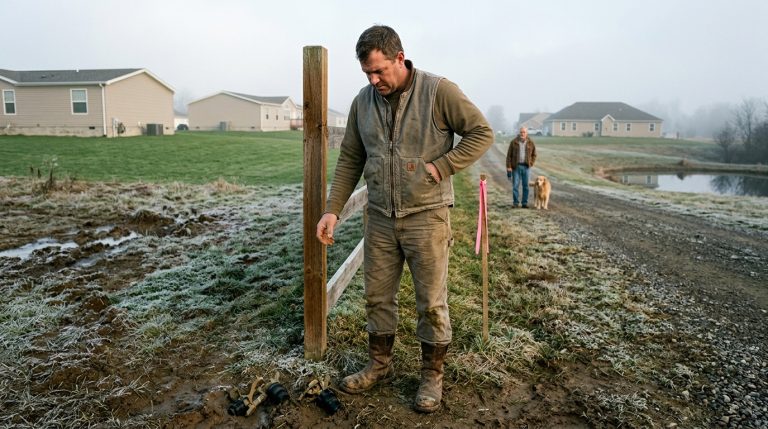
I paused, kneeling down in the dirt and brushing away a layer of decaying leaf mold and dry clay. My fingers scraped against the cold, oxidized surface of an old iron survey stake—bent slightly to the west, its top jagged and rusted red where a previous crew had tried to drive it past the bedrock decades ago. It was a physical marker, buried deep and ignored by the modern world, holding its ground against the invisible lines drawn on corporate maps three towns away.
I sat back on my heels, wiping the rust dust from my hands onto the knees of my jeans, and stared across the barrier toward Brenda’s silent, perfect lawn. The first move had been made, wrapped in official stationery and stamped with the cold weight of a municipal threat. But a lien wasn’t a court order, and a signature on a compliance notice didn’t make a rule where no law existed.
The county records office downtown was open until four. And the old deed books in the basement vault didn’t care about neighborhood standards.
CHAPTER 3: THE COLD IRON THRESHOLD
The engine of the old pickup didn’t roar to life; it sputtered through a choked exhaust before settling into a deep, metallic rattle that vibrated straight through the floorboards. I dropped the gearshift into first, my palm pressing against the polished wooden knob that my grandfather had whittled down from a piece of seasoned hickory. The tires crunched over the dry driveway gravel, kicking up a white tail of dust that hung suspended in the heavy afternoon air behind the tailgate.
There was no time to waste on hesitation. A statutory lien filed with municipal backing wasn’t a warning shot; it was a slow-acting poison meant to rot a property title from the inside out until the county clerk’s office processed a tax sale out from under the foundations. Brenda had crossed the line from petty neighborhood surveillance into an administrative assault, and the only place to stop a legal paper trail was at the source where the ink was originally poured.
The narrow asphalt lane curved sharply around the perimeter of Whispering Pines, hugging the high, uniform brick wall that the developers had built in nineteen-ninety to hide the old gravel pits. As I rounded the bend, the neat, identical roofs of the subdivision rolled past like rows of teeth on a zipper. Not a single car sat out of place in any driveway. Every mailbox stood at the exact same height, gleaming with fresh black paint and polished brass numbers. It was a landscape engineered to erase anything that didn’t fit the template.
Half a mile down the road, a blue delivery van trundled out from a side street, forcing me to brake hard. The truck’s front end dipped, and the loose tire iron rattling behind the passenger seat let out a sharp, metallic ping against the floor. I waited, jaw clenched, watching the van crawl past with its corporate logo plastered in bright vinyl across the side panels—the exact same real estate conglomerate that had been trying to buy out our family’s acreage since the Eisenhower administration.
When the van turned away toward the highway, I shifted back into gear and kept moving.
The county municipal annex sat at the edge of the old downtown district, a flat-roofed brick building built in the late sixties, surrounded by cracked pavement and stunted oak trees. It smelled of damp carpet, floor wax, and decades of municipal carbon paper. Inside, the air conditioning hummed with a low, tooth-aching whine that did nothing to pull the sticky summer heat from the narrow corridors.
I pushed open the heavy glass door marked Plat and Deed Records and stepped up to the high counter of scarred blonde oak. Behind it, an elderly clerk with thick bifocals and a gray cardigan was stamping a stack of yellow building permits with mechanical rhythm. Thump. Thump.
“Looking for historical parcel exceptions,” I said, laying my driver’s license flat on the wood grain. “Nineteen-forty-eight through fifty-two. The Whispering Pines original plat map and the grandfathered enclave riders.”
The clerk didn’t look up immediately. She finished stamping the final permit, slid the stack to her left, and adjusted her glasses down the bridge of her nose. Her eyes scanned the license, then flicked up to my face, lingering on the grease smudge across my thumb and the dust on the shoulders of my canvas jacket.
“You’re down from the valley,” she noted, her voice dry as parchment. “The old homestead off Miller Creek Road. The one the developers have been trying to annex into district four for twenty years.”
“That’s the one,” I said. “I need the original exclusion charter signed by the county commissioner on October twelfth, nineteen-forty-eight. And I want to see if any secondary amendments have been logged against that parcel within the last thirty days.”
She turned toward the massive wall of vertical metal file cabinets behind her, her fingers trailing expertly along the rusted steel handles. “Thirty days? That’s unusual. Usually, people only come down here when they’re selling off timber or fighting a zoning variance for a shed.”
“Somebody tried to attach a lien,” I replied, my voice steady, keeping the friction out of my tone. “Using an unverified municipal compliance code from an HOA that doesn’t own the dirt under my porch.”
The clerk paused, her hand resting on the handle of a heavy drawer marked 1940-1950 Enclaves. A faint, knowing smile touched the corners of her mouth—the look of someone who had watched three generations of corporate developers try to swallow the county one acre at a time, and watched old homesteaders hold their ground with nothing more than rusted fence wire and stubborn pride.
She pulled the drawer open with a heavy metallic screech that echoed off the acoustic tile ceiling, reaching deep into the dark recess of the file to pull out a thick, leather-bound ledger protected by a sheet of acid-free tissue paper.
“Let’s see what they filed,” she murmured, laying the heavy book flat on the counter. “Because if that parcel was carved out under the historic homestead exemption act, no neighborhood association on earth has the legal authority to touch a shingle on your roof—let alone put a lien on your gate.”
CHAPTER 4: THE DUST OF ARCHIVES
The silence in the records vault was different from the dry, windless quiet of the valley. Here, it smelled of trapped humidity, vinegar-based ink, and the slow, chemical decay of paper that had outlived the men who signed it.
I leaned over the counter, my palms flat against the scarred blonde oak, watching the clerk’s finger trace a series of faded red ink lines that mapped out the original Whispering Pines development grid. The paper was heavy, rag-woven, and yellowed at the margins like old ivory.
“Right here,” the clerk said, tapping a small, uncolored square punched out of the center of the sprawling subdivision blueprint. It looked like an island choked by a sea of identical, numbered parcels. “Parcel Four-B. Excluded under the emergency agricultural retention statute of forty-eight. Your grandfather didn’t just refuse to sell; he filed a perpetual maintenance covenant that legally severed this half-acre from any subsequent master association district formed within five miles of the creek.”
She lifted her glasses and looked up at me, her expression deadpan. “In plain terms, son? The HOA doesn’t have jurisdiction over your gravel driveway, let alone your fence line. Whoever drafted that lien notice didn’t pull it from county registry. They pulled it out of a private developer’s template.”
I stared down at the map. Something caught the overhead fluorescent glare—a faint, oily smudge in the margin right next to the parcel boundary stamp. It wasn’t old ink. It was fresh ballpoint residue, greasy and dark, identical to the pressure mark on the compliance letter sitting in my jacket pocket.
“Has anyone else pulled this specific ledger in the last month?” I asked, my voice dropping an octave.
The clerk blinked, her finger pausing on the page. She turned the heavy ledger toward herself, squinting at the sign-out slip tucked into the inner binding. A thin slip of gray cardstock covered with names and dates.
“Well, now that you mention it,” she muttered, sliding a yellowed plastic scraper under the edge of the card. “County records are public, of course. Anyone can request a file pull if they fill out a municipal information form.” She ran her nail down the column of recent dates, stopping at an entry marked three weeks prior. “Here it is. Brenda Vance. Listed as a community compliance liaison for Whispering Pines Phase One.”
The pieces locked together with the dry, heavy click of an iron latch falling into place.
Brenda hadn’t stumbled onto an administrative error. She hadn’t accidentally misread a municipal boundary map. She had come down here, pulled the exact historical records, and deliberately manufactured a fake legal instrument using the HOA letterhead as camouflage. The five-hundred-dollar noise fine was never about decibels or barbecue smoke; it was an initial pressure test. A simulated violation designed to test whether I had the resources, the time, or the knowledge to fight back before they escalated the liens and forced a quiet tax foreclosure.
“She knew,” I said, the words tasting like dry iron in my mouth.
“Oh, she knew,” the clerk replied, closing the ledger with a dull thud that sent a small puff of gray dust rising into the fluorescent light. “People don’t accidentally miss a perpetual covenant stamped in red ink right in the center of the master plat. That exemption has been a thorn in the developers’ side since they poured the first foundation. They want that access road cleared out so they can widen the north entrance. Your grandfather’s garden is right in the middle of their turning radius.”
I straightened up, feeling the cool air of the annex office prickle across the back of my neck. The confrontation back at the fence line had felt personal—a bitter neighbor armed with a clipboard and a smartphone camera. But this was larger. It was an organized, systematic squeeze executed by proxy, using neighborhood bylaws as a club to beat down the last piece of independent land in the valley.
“Can I get certified copies of this page?” I asked, patting the canvas pocket where the compliance notice lay folded. “And the original covenant rider?”
“You can,” the clerk said, pulling a heavy brass hand-press toward her edge of the counter. “And you’re going to need more than copies if you want them to stop. People who play with forged liens don’t usually give up just because you show them a map. They double down.”
She fed a sheet of heavy bond paper into the press, pulled down the weighted iron lever, and stamped the state seal into the fiber with a sharp, echoing crack.
When I walked back out through the heavy glass doors into the blinding late-afternoon sun, the heat hit my face like a physical wall. The old truck was waiting by the cracked asphalt curb, its faded green hood covered in a fine layer of downtown dust. I climbed inside, tossed the manila envelope containing the certified seals onto the passenger seat, and turned the key.
The engine caught instantly this time, roaring through the rusted exhaust as I pulled away from the curb. The road back to Whispering Pines stretched out ahead of me, a long, asphalt ribbon cutting through the manicured suburbs. I knew exactly what was waiting at the other end of that drive—a pristine house with an empty patio, a manicured lawn, and a woman with a clipboard who was about to find out that some roots run deeper than concrete.
CHAPTER 5: THE BOARDROOM CORRECTION
The heavy oak door of the Whispering Pines community center stood ajar, letting out a thin stream of chilled air conditioned down to an artificial winter. Inside, the monthly executive board meeting was already underway. Through the crack in the frame, I could see the polished mahogany conference table surrounded by four members of the HOA board, their heads bowed over neat stacks of printed agenda packets. Brenda sat at the far end, her clipboard resting squarely in front of her like a lectern, a red pen poised between her fingers.
I did not knock. I pushed the door open until it struck the interior wall with a sharp, flat hollow sound that instantly cut through the low murmur of the treasurer’s report.
The silence that followed was absolute. All four board members looked up simultaneously, their expressions shifting from polite boredom to defensive irritation. Brenda’s pen froze mid-stroke above her notepad, her eyes narrowing as she recognized the scuffed canvas jacket and the dust-streaked boots stepping across the commercial carpet.
“Excuse me,” the board treasurer began, adjusting his wire-rimmed glasses. “This is a closed executive session for property owners and elected association representatives only. If you have a grievance regarding lawn maintenance or trash bin placement, you need to file a formal ticket through the online portal—”
“This isn’t about a trash bin,” I said, my voice carrying flat and even across the quiet room.
I walked down the length of the long table, the rubber soles of my boots squeaking faintly against the slick tile. I didn’t stop until I reached the opposite end from Brenda. Without a word, I reached into the breast pocket of my jacket, pulled out the heavy manila envelope containing the certified county records, and dropped it onto the polished wood surface. The package slid across the mahogany grain, coming to a dead stop right against the edge of Brenda’s pristine clipboard.
The treasurer frowned, looking down at the embossed state seal gleaming in the overhead light. “What is the meaning of this?”
“That’s a certified copy of the nineteen-forty-eight land patent and perpetual exemption covenant for Parcel Four-B,” I said, keeping my gaze fixed squarely on Brenda’s face. Her pale fingers had tightened around the red pen until the knuckles turned white. “It’s the land my grandfather refused to sell when the developers bulldozed the rest of this valley. It is legally, structurally, and permanently exempt from every guideline, fee, and oversight this association was ever chartered to enforce.”
Brenda’s chin lifted, her voice cutting in before the treasurer could touch the envelope. “The association charter grants us absolute architectural and environmental oversight across the entire geographic footprint of the valley. A fifty-year-old oversight doesn’t exempt anyone from noise violations and public nuisance codes.”
“It’s not an oversight, Brenda,” I replied, stepping closer to the table so the wood barrier separated us like a low fence. “And it’s not a municipal code violation. It’s a forged lien.”
I reached out and tapped the corner of the envelope, sliding the certified county clerk’s sign-out registry out onto the table. The page was clearly marked with the signature and date of the person who had pulled the historical plat maps three weeks prior.
“You didn’t stumble across an administrative error,” I continued, letting the words drop one by one like stones into a dry well. “You came down to the county basement, pulled the original exemption file, and then wrote up a fraudulent compliance fine on official HOA letterhead anyway. You used the association’s name and threat of a statutory lien to manufacture a fake debt, hoping I wouldn’t spend a morning down in the archives checking your math.”
The treasurer pulled the sign-out sheet toward himself, his eyes scanning the handwritten name at the bottom of the log. The color began to drain rapidly from his cheeks. He looked up at Brenda, then back down at the official state seal stamped into the paper.
“Brenda…” the treasurer whispered, his voice tightening. “Did you pull these records?”
“I was executing routine compliance verifications for the northern perimeter buffer,” Brenda snapped, her composure cracking for a fraction of a second as her fingers dug deeper into the plastic barrel of her pen. “The board authorized comprehensive neighborhood stabilization measures last quarter.”
“The board authorized boundary maintenance,” another board member interjected, standing up halfway from his leather chair. “We never authorized anyone to issue unverified statutory liens against exempt enclaves. If the county auditor sees this, the entire association’s charter is exposed to fraud liability.”
Brenda stood up then, her chair scraping sharply against the floor tiles. The absolute, unshakeable authority she had worn like a uniform for years seemed suddenly brittle, stripping away to reveal the raw panic of someone whose administrative empire had been built on stolen stationery.
“You’re protecting a weed-choked junk lot in the middle of a master-planned community,” she said, her voice rising, losing its cool bureaucratic cadence. “If we don’t force them out, property values across the entire north sector will drop ten points before winter.”
“Property values aren’t the issue here, Brenda,” the treasurer said, his hands flat on the table, pushing the manila envelope away from him as if it were contaminated. “Fraud is. The executive committee will be holding an emergency vote on your status as president effective immediately.”
I didn’t wait to hear the rest of the vote. I turned on my heel, the heavy rubber soles of my boots squeaking once against the floor, and walked back toward the open exit doors. Behind me, the sharp, chaotic sound of raised voices filled the boardroom—arguments over liability, unauthorized filings, and corporate exposure echoing off the acoustic ceiling tiles.
When I stepped back outside into the late afternoon air, the sun was dipping low behind the uniform rooftops of Whispering Pines, casting long, dark shadows across the manicured lawns. The valley was quiet, but for the first time in ten years, the silence didn’t feel like a siege.
CHAPTER 6: THE LONG SUNSET
Months passed before the dust entirely settled over the north property line.
The emergency board vote had not merely stripped Brenda of her title; it had unraveled a decade of quiet, bureaucratic intimidation that had kept the edges of Whispering Pines uniform and sterile. Without her clipboard patrolling the perimeter, the neighborhood seemed to exhale. The letters threatening fines for non-regulation mailboxes stopped arriving, and the local real estate conglomerate quietly closed its acquisition file on Parcel Four-B, realizing that a perpetual covenant stamped in nineteen-forty-eight could not be bullied out of existence with a fake municipal lien.
It was late autumn now, the air sharp and dry, smelling of woodsmoke and damp earth.
I stood on the wrap-around porch, looking out over the back garden. The sunflowers had long since dried, their heavy heads bowing toward the soil, but the wild turf remained untouched, green and unmanicured beneath the falling oak leaves. Just beyond our fence, Brenda’s house sat in quiet isolation. Her windows were clean, her lawn cropped to its usual two-inch perfection, but the white orthopedic walking shoes no longer appeared by the property line at six o’clock. She was just another neighbor now, living behind glass that reflected only her own empty yard.
I set my coffee mug down on the weathered wooden railing and picked up a heavy brass hammer and a fistful of galvanized iron nails.
The southwest corner of the porch railing had loosened slightly over the summer—a small, natural wear-and-tear from years of leaning against the grain while watching the weather roll in across the valley. It wasn’t structural, but it needed attention. I knelt down beside the upright post, testing the joint with my thumb. The wood was solid white oak, seasoned hard by decades of sun and frost, refusing to rot despite the moisture creeping up from the ground.
With deliberate, measured strikes, I drove the first nail home, the sharp ring of iron against brass echoing clear and bright through the quiet afternoon.
Behind me, the screen door groaned on its rusted spring as it drifted slightly in the draft, but I didn’t turn around. There was no need to look over my shoulder anymore. The boundaries were set, the deed was secure, and the old house stood exactly where it always had—an island of stubborn history holding its ground against the tide of identical roofs.
I wiped a fleck of sawdust from the railing, stood up, and looked out toward the horizon where the sun was dipping below the tree line, painting the autumn sky in shades of deep amber and dust.