The Iron Grade: How a Self-Built Mountain Access Road Triggered an HOA War
CHAPTER 1: THE PAPER ENVELOPE
The envelope sat on the granite counter, pristine and sterile. Cream linen stock. Aspen Vale HOA crest stamped in gold leaf.
I didn’t open it with a knife. I rolled a worn, scratched brass caliper across my palm, the cold metal clicking rhythmically against my knuckles.
Inside was a single sheet of heavy paper. Courtesy Notice, the heading read in a neutral sans-serif font. The prose was smooth, polished, and dripping with simulated concern. It identified my private access road above Aspen Vale as a “proposed secondary emergency egress” for the upcoming wildfire season.
Attached was a map. I laid the brass caliper across the page, measuring the shaded gray line.
They had colored my private driveway—cut through three hundred yards of solid granite with my own rented excavator—in the exact same hue as their public access lanes.
A four-millimeter shift on paper. On the mountain, that was twenty feet of stolen timber and crushed base rock.
“They’re testing the fence,” I said to the empty cabin.
I opened my laptop, booted the scanner, and logged the document. I didn’t just save the image; I preserved the full EXIF data, embedded the postmark timestamp, and stored the PDF on two separate offline drives.
Three years ago, when I bought twenty acres above the ridge, the county planner sat across from me in a cramped basement office and made one thing clear: We don’t maintain routes above the creek line. You build it, you own it, or you walk.
So I built it. I ran the grade lines by hand. I set the culverts to route snowmelt away from the embankment. I paid six thousand dollars in cash for three-inch crushed slate and drove the roller until my spine buzzed for three days.
I kept every receipt. Every fuel slip for the skid-steer. Every delivery order from the quarry.
I pulled the heavy leather binder from the iron safe in the corner. Page forty-two: Parcel Survey 1109-A. Page forty-six: Private Access Assessment. Page fifty: Deed of Easement Exemption.
My phone chimed on the table. A text from Miller, my surveyor.
Heard Celeste Harmon’s committee brought on a new civil consultant out of Denver. Vanguard Excavation. They’ve been pulling GIS maps for your quadrant.
I tapped the brass caliper against the granite counter. Vanguard.
The HOA wasn’t asking for a favor. They were establishing a paper trail to justify an occupation. In the language of land disputes, if you let a lie sit on paper for thirty days without a written denial, it starts looking like consent to a judge.
I pulled up my email draft, attached the notarized deed, and typed three sentences.
Your map contains a material error regarding Parcel 1109-A. The road segment shaded in gray is private property built and maintained exclusively at my expense. No public or corporate access is authorized.
I hit send, printed the confirmation, and clipped it to the HOA envelope.
Outside, down at the lower gate, the faint hum of a diesel engine echoed up the gulch.
I picked up the brass caliper, slipped it into my heavy canvas jacket, and walked out into the mountain air.
CHAPTER 2: TACTICAL LINE
The metal of the latch bit cold into my palm.
Down at the lower turn, two hundred yards through the pine needles, the diesel engine didn’t turn off. It idled with a wet, rhythmic thrum—the heavy-bottomed rattle of a late-model work truck.
I didn’t open the gate. I shifted my weight, letting the heel of my boot lock into the gravel, and pulled the brass caliper from my canvas pocket. I didn’t measure anything. I just held the weight of it, feeling the knurled adjustment screw press against the pad of my thumb while I watched the tree line.
A white Ford F-250 rolled into view, moving at five miles an hour.
No company logo on the door. Fresh magnetic plates covered the side panels, leaving rectangular shadows where the paint was clean. On the dashboard sat a yellow plastic binder with a grease-pencil code scribbled across the spine: Vanguard Excavation – Corridor Permit 84-B.
The truck stopped five feet short of my timber post. The driver’s side window rolled down three inches.
“Private route,” I said before the man inside could clear his throat.
The driver was forty, wearing a pristine high-visibility vest that had never seen a grease pit or a trench. Beside him, a guy with a tablet kept his eyes glued to a satellite map overlay.
“We’re doing a preliminary line check for the Aspen Vale Safety Committee,” the driver said. His voice was flat, practiced. “Roadway assessment for emergency clearing.”
“You’re fifty feet past the easement boundary,” I said. My voice didn’t rise. I kept it low, level with the idle of his engine. “Turn it around on the public shoulder.”
The guy with the tablet finally looked up. He didn’t look angry; he looked like a mid-level auditor who had expected a soft target and found a steel fence instead. He tapped the screen.
“County GIS shows a fifteen-foot public right-of-way extending to the upper culvert,” he said.
“County GIS shows a draft layer updated four days ago by Apex Land Solutions,” I replied, bringing my left hand up to rest flat on his side mirror. “A draft that hasn’t been ratified, hasn’t been noticed, and hasn’t cleared the recorder’s office. You put a tire past this post, and I file an unlawful entry report with the sheriff before you hit the main road.”
The driver looked at the guy with the tablet. The tablet guy didn’t argue. He made a quick note, swiped the screen dark, and nodded toward the turn.
“We’ll follow up through the board,” the driver said, rolling the window up until only an inch remained.
“Do that,” I said.
I stood on the gravel shoulder and watched the truck back down the narrow switchback, its exhaust leaving a faint blue haze in the cold morning shade.
They weren’t trying to break the gate today. They were probing for hesitation. They wanted to see if I’d raise my voice, make a threat, or give them a reason to file for an emergency injunction based on “owner hostility.”
Instead, I gave them silence and a precise cite of their own illegal survey file.
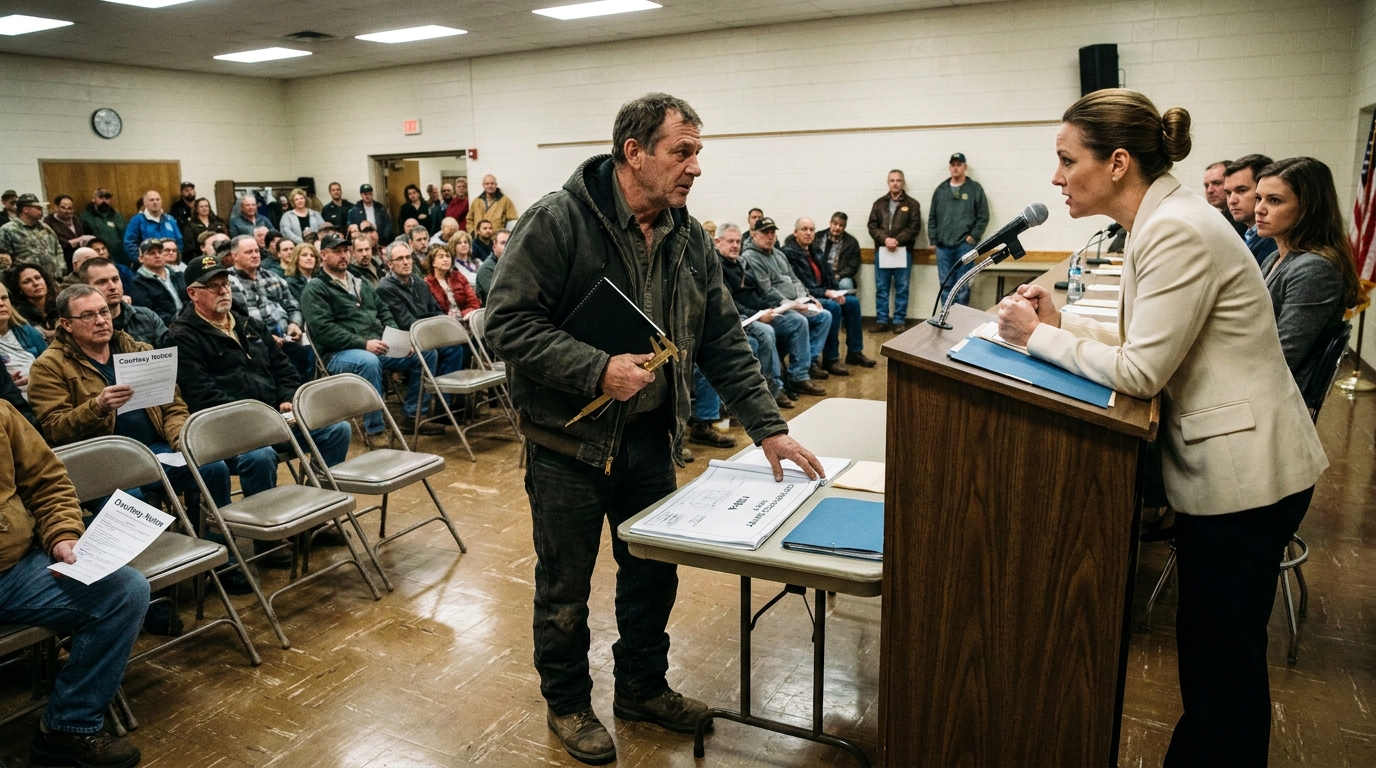
By six o’clock that evening, the Aspen Vale HOA community hall was half-full. The room smelled of industrial floor wax and stale drip coffee. Residents sat in padded folding chairs, holding printouts of the same “Courtesy Notice” I had received that morning.
Celeste Harmon sat at the center of the oak dais. She wore a tailored cream blazer, her hands folded neatly over a blue manila folder. Her hair was pulled back into a tight, severe knot. Beside her sat two junior board members who looked like they were there to vote yes on whatever she pointed at.
I took a chair in the back row, right next to the emergency exit. I didn’t take off my canvas jacket. I pulled out a small black notebook and rested my brass caliper on top of it.
“We need to discuss the Northern Perimeter Egress,” Celeste began. Her voice was warm, authoritative, carrying the easy cadence of someone who used rules as an extension of her personal preference. “During last year’s dry spell, we all saw how quickly the lower road choked up during the fire drill. We cannot afford to have three hundred families trapped behind a single choke point.”
A murmur of agreement ran through the front rows. Classic framing. Establish an undeniable danger, link it to the community’s fear, and then offer the pre-selected target as the only logical sacrifice.
“To that end,” Celeste continued, tapping her blue folder, “the board has initiated a dialogue to formalize access along the historic logging spur above the creek. We are seeking a cooperative agreement to ensure our emergency crews have unrestricted routing authority.”
She didn’t name me. She didn’t name Parcel 1109-A. She made it sound like an old path the forest had forgotten, rather than a road I had carved out of stone with three months of sweat and six-figure receipts.
A resident in the third row raised a hand. “Has the owner agreed?”
Celeste favored the man with a small, sympathetic smile. “We are in active communication. Naturally, private interests can sometimes obscure the broader need for community safety. But no single owner should obstruct a route that materially benefits the greater mountain community. We are confident the law recognizes the necessity of shared resilience.”
I opened my notebook. I wrote down the exact sentence: No single owner should obstruct a route that materially benefits the greater mountain community.
Then I stood up.
The room didn’t fall silent immediately, but the low hum died down as I walked down the center aisle. I didn’t walk fast. My work boots made a dry, deliberate crunch against the linoleum.
I stopped ten feet short of the dais. Celeste’s eyes locked onto mine. Her expression didn’t break, but the muscle at the corner of her jaw tightened by a fraction of a millimeter.
“You’re speaking about my road, Celeste,” I said. The room went entirely still.
“This is a general board briefing,” she said smoothly, leaning toward her microphone. “Specific owner consultations are held in executive session—”
“You sent a contractor from Vanguard Excavation onto my parcel at 8:30 this morning,” I interrupted. I didn’t raise my voice; I let the acoustics of the high-ceilinged room carry it. “They carried a survey map generated by Apex Land Solutions. A map that illegally shifts my southern property boundary by twenty feet to create a fictitious public corridor.”
Celeste’s hands remained folded, but her knuckles turned slightly pale against the cream fabric of her blazer.
“The board is reviewing all historical access points to ensure compliance with county hazard mandates,” she said, her tone dropping two octaves into cold, bureaucratic defense. “If there are boundary discrepancies, they will be handled through proper administrative channels.”
“There are no discrepancies,” I said. I reached into my jacket pocket, pulled out a folded piece of paper, and laid it flat on the table in front of her. “That is the certified copy of Parcel Survey 1109-A, recorded with the county clerk nine years ago. It includes the original engineered drainage plan and the private access permit.”
I took half a step closer, letting the shadow of my shoulders fall across her blue folder.
“If another unbadged vehicle crosses my lower gate without a court order signed by a district judge, I won’t call the HOA board,” I said softly. “I’ll file a civil rights claim against you personally for tortious interference and unauthorized land conversion. And I’ll name Apex Land Solutions as a co-defendant.”
For three seconds, nobody in the room breathed.
Celeste didn’t look at the paper I had laid down. She looked directly into my eyes, her face set like cold marble.
“Safety isn’t a private asset, sir,” she said, her voice dropping all warmth.
“Neither is my land,” I replied.
I turned on my heel and walked out the double doors into the night air. The cold wind off the ridge hit my face, carrying the sharp scent of pine and crushed slate.
I had drawn the line in front of forty witnesses. She couldn’t pretend this was a misunderstanding anymore. This was a war of documentation, and she had just realized I was keeping score in steel, not paper.
CHAPTER 3: ARMED ENCROACHMENT
The cold mountain air hit my throat like scraped iron as the double doors clicked shut behind me.
Down in the valley, the lights of Aspen Vale looked like scattered embers trapped under a floor of low cloud. I walked to my truck, unlocked the door, and didn’t start the engine right away. I sat in the cab, pulling the brass caliper from my pocket and letting its dull edge slide back and forth across my knuckles until my hands stopped absorbing the chill of the hall.
She wasn’t going to wait thirty days for a administrative response. People like Celeste don’t retreat when you hand them a deed; they increase the pressure until the paper looks fragile.
At five-thirty the next morning, the sun hadn’t cleared the east ridge. A thick layer of frost crusted the windshield of my pickup.
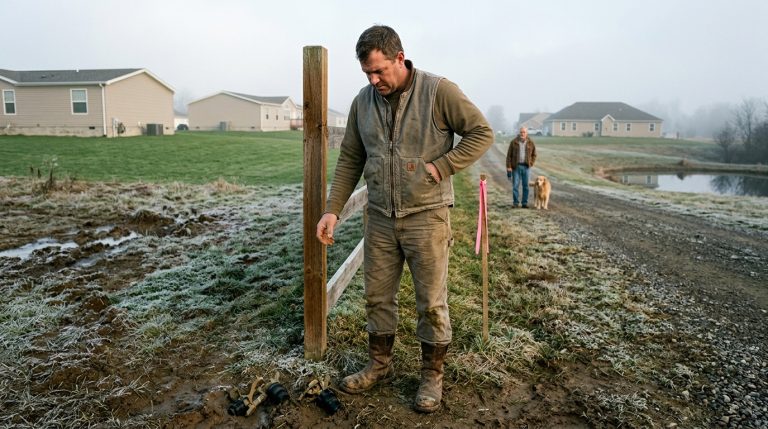
I didn’t take the main drive down. I pulled on my heavy canvas coat, locked the cabin, and walked the north fence line on foot, stepping silently through the frozen pine needles. The air was dead quiet, save for the distant, metallic thrum of an idling diesel engine down near the turnout.
When I reached the upper rise overlooking my gate, I stopped behind a thick cluster of Douglas firs.
Two men in black tactical trousers and matching dark windbreakers stood on my side of the timber post. They weren’t local county deputies. They wore branded shoulder patches showing a stylized eagle—private contract security. Beside them, a freshly printed, laminated sign was zip-tied directly to my iron latch.
NOTICE OF INTERIM ROUTE RESTRICTION: ACCESS LIMITED UNDER EMERGENCY SAFETY MANDATE PENDING BOUNDARY CLARIFICATION.
No county seal. No magistrate’s stamp. Just the high-gloss sheen of fresh lamination and two hired bodies standing on my crushed stone.
I pulled my phone from my inner pocket, set it to record, and stepped out from the cover of the trees.
My boots made no sound on the soft pine floor until I hit the gravel five yards behind them.
“You’re on private land,” I said.
Both men turned at once. The taller one had a radio clipped to his chest harness and a heavy tactical flashlight resting in his right hand. He didn’t reach for his belt, but his stance widened, feet locking into the base rock I had paid twelve hundred dollars to haul up the mountain.
“Site’s restricted, sir,” the tall one said. His voice had the flat, hollow detachment of a guy getting paid twenty-two dollars an hour to act like an authority. “HoA safety protocol.”
“Who signed the order?” I held the phone steady, keeping both of them and the laminated sign in the frame.
The guard gestured vaguely toward the sign. “Instruction came down from the board chair. Ms. Harmon. We’re posted here until the survey corridor clears.”
“Ms. Harmon doesn’t hold municipal authority over Parcel 1109-A,” I said. I tapped the edge of my phone against my palm. “You’re standing fifty feet past a recorded property line. Move your feet to the asphalt shoulder, or you’re named individually in an unlawful detainer suit.”
The shorter guard shifted his weight, his eyes darting toward the sign, then to my face. He recognized the tone. It wasn’t anger; it was the cold, mechanical rhythm of a man building an evidentiary exhibit.
“We’re just executing the post assignment, boss,” the shorter one muttered, taking a half-step back toward the public road line.
“Then execute it on public dirt,” I said. “Off the rock.”
The tall guard held my gaze for three seconds, measuring my frame against his instructions. Then he spat into the frost, turned, and took four deliberate paces back onto the county asphalt. The shorter one followed immediately.
I didn’t touch the laminated sign. Removing it by hand gave them a claim of property destruction. I photographed the zip-ties, the logo on their jackets, and the exact position of their boots relative to my fence post.
“Who’s up on the turnout?” I asked, looking past them toward the upper bend.
Neither guard answered.
I didn’t waste time arguing. I turned on my heel, walked forty yards back up the embankment into the tree line, and pulled a compact carbon-fiber drone from my rucksack. I set it on a flat granite slab, powered the rotors, and launched it straight up through the pine canopy.
The live feed spiked on my controller screen.
Four hundred yards up-slope, deep inside my parcel boundaries where the private turnout widens for timber hauling, a heavy track-hoe was already working.
The yellow boom of a excavator dipped into my drainage ditch. Two laborers in orange vests were setting string lines across my shoulder, driving orange-topped wooden stakes directly into the virgin dirt. Standing off to the side, wearing clean leather boots, a high-visibility vest, and holding a clipboard, was Celeste.
Beside her stood a man in a gray fleece jacket with a small embroidered chest logo: Apex Land Solutions.
I zoomed the camera lens down to maximum resolution.
The laborers weren’t just clearing brush. They were cutting a three-foot trench directly through my engineered drainage culvert, redirecting the runoff angle away from my lower field toward the slope, physically altering the ground profile to match the altered map they had presented at the hall.
They were building the “pre-existing condition” in real-time. If they held that trench for forty-eight hours and laid pipe, they could claim the infrastructure was already integrated into the neighborhood system before a judge could issue a stay.
I locked the drone’s position, set it to hover at eighty feet, and hit record. The screen captured the track-hoe teeth ripping through my slate base, the Apex Land Solutions logo on the survey jacket, and Celeste pointing directly at my turnout post.
I lowered the controller, slipped the brass caliper out of my pocket, and tightened the thumb screw until the steel jaws locked solid.
They weren’t just probing anymore. They had brought heavy equipment onto my mountain.
I walked out of the woods, picked up my phone, and dialed my attorney’s direct line while keeping my eyes fixed on the smoke rising from the track-hoe down in the gulch.
“Miller,” I said as soon as the line connected. “Get a judge on the line. I’ve got heavy machinery on Parcel 1109-A and video footage of Celeste Harmon supervising the trenching.”
CHAPTER 4: THE SCOPE SHEET
“Send the drone video to my secure portal now,” Miller said, his voice cutting through the speaker before the third ring finished. “Don’t engage the operator. Don’t touch their stakes. Let them dig their own legal grave.”
“They’re three feet into my slate base,” I said. My thumb pressed into the cold glass of the phone until my nail turned white. “Another two hours and they breach the main culvert lining.”
“They’re committing willful conversion on camera,” Miller snapped. “I’m filing an emergency preservation notice and serving Vanguard Excavation directly. If their foreman has two brain cells, he’ll shut that engine down the second he hears the word ‘indemnity.'”
I hung up, lowered the phone, and walked down the ridge line, keeping to the high rocks where the pine needles dampened my steps.
Down in the turnout, the excavator engine roared, its hydraulic arms straining as the bucket bit into my compacted slate. A diesel haze hung heavy over the yellow bucket. Celeste was still standing beside the Apex Land Solutions surveyor, her finger tracing a line across a laminated blueprint taped to the hood of a white pickup.
I didn’t yell. I stepped down off the rock face, my boots crunching into the loose gravel ten feet behind the track-hoe’s counterweight.
The operator saw me in his side mirror. The machine froze, its bucket suspended three feet above the open trench, dark mud dripping from the steel teeth.
“You’re operating on private property, son,” I called out over the idle of the engine.
The cab door slid back with a loud, metallic clatter. A broad-shouldered foreman with grey-stubbled jaws and grease-stained gloves stepped out onto the iron track. He didn’t look arrogant; he looked tired.
“We got a site work order from the Aspen Vale Road Committee,” the foreman said, pointing a gloved thumb toward Celeste. “Corridor Permit 84-B. Supposed to be an existing county easement.”
“Corridor Permit 84-B is an unratified draft application,” I said, pulling my brass caliper from my pocket and setting its sharp tip against the wooden stake closest to his track. “You’re thirty yards past the county line. The owner of Vanguard Excavation just received a preservation notice from my attorney. Every yard of dirt you move from this second on carries personal civil liability.”
The foreman stopped on the iron tread. His eyes shifted from my face to the brass caliper in my hand, then past me toward Celeste, who was already marching across the rutted dirt, her clipboard held against her chest like a shield.
“Don’t stop the rig, Hank,” Celeste commanded, her voice sharp enough to slice through the idle. “We are operating under interim emergency authorization. The county review is pending.”
The foreman looked down at her from the track of his machine. “Pending ain’t approved, Ms. Harmon. He just said the word ‘preservation notice.’ My boss doesn’t cover my bail if this turns into an illegal trenching warrant.”
“The HOA indemnifies your crew!” Celeste barked, but her right hand twitched, her thumb nervously picking at the metal clip of her board—a micro-action that betrayed the icy composure of her voice.
“You can’t indemnify an intentional trespass, Celeste,” I said softly.
The foreman didn’t argue. He reached into his cab, pulled a folded, grease-smudged paper from behind the driver’s seat, and hopped off the iron track. He walked past Celeste without looking at her and handed the sheet directly to me.
“Read section three,” the foreman muttered under his breath. “I told her this looked like a boundary shift when we offloaded the rig. She told us to follow the revised scope.”
I unfolded the paper. It was a Vanguard Excavation internal work order, marked with a red stamp: SPECIAL REVISED SCOPE – CLIENT DIRECTIVE.
My eyes scanned down the bullet points:
Relocate existing timber gate thirty yards uphill.
Reclaim private turnout into neighborhood emergency pull-off.
Mask prior drainage cuts for visual continuity.
Present as pre-existing route during county walk.
Present as pre-existing route during county walk.
The words weren’t a vague legal argument or an honest mistake about a boundary line. It was an explicit instruction to alter the physical terrain before the county inspector arrived, faking a historical record to deceive a public officer.
I looked up from the page. “Who drafted this instruction?”
“Her brother-in-law,” the foreman said flatly, nodding toward the Apex Land Solutions surveyor, who had already begun quietly packing his tripods into the back of his truck. “Apex Land Solutions wrote the scope. We just executed the contract.”
Celeste’s face lost every drop of color. The rigid posture she maintained in board meetings crumbled into a rigid, defensive silence. She opened her mouth to speak, but no sound came out.
“Hank,” I said to the foreman, holding the paper firmly in my hand. “Take your machine off my mountain. Leave the trench as it sits.”
“Works for me,” the foreman said. He turned to his operator inside the cab and yelled over the idle. “Shut it down! Pack the trailer!”
I folded the scope sheet, slipped it into my inner coat pocket next to my brass caliper, and looked at Celeste.
“The emergency hearing is tomorrow at two,” I said, my voice level and cold as the frost on the pines. “Bring your brother-in-law.”
CHAPTER 5: THE COUNTY HEARING
The overhead projector hummed with a low, mechanical buzz, casting a harsh rectangle of blue light onto the wall behind the commissioners.
Twenty-four hours of cold silence had condensed into this room. The air was thick with the smell of wet wool coats and ozone from the electronic display. I sat at the petitioner’s table next to Miller. My canvas coat was folded over the back of my chair, and my fingers rested flat against the table, holding the weight of my brass caliper against the oak grain.
Across the aisle, Celeste Harmon sat rigidly upright. She wore a dark charcoal suit today, her posture immaculate, her expression set in a mask of professional composure. Beside her sat the lead counsel for the Aspen Vale HOA and her brother-in-law, the principal from Apex Land Solutions. He kept his head down, feverishly tapping notes into a tablet.
The county hearing chair tapped his gavel twice. “Item four on the emergency docket. Parcel 1109-A access petition and interim safety corridor order.”
Celeste’s attorney stood immediately. He didn’t look at us. He addressed the three commissioners with a practiced, smooth resonance.
“Commissioners, the HOA acted under reasonable, good-faith belief that a historical egress existed,” the attorney stated, spreading his hands. “Due to heightening wildfire risks, the board initiated a routine clearing project under Corridor Permit 84-B. Any technical boundary overlap was an inadvertent error by our site surveyor, which we are prepared to remedy through standard variance procedure.”
It was a clean, sanitized defense. Reduce a fraudulent land conversion to a simple administrative mistake.
“Is that all?” the commissioner asked, squinting over his glasses.
Miller didn’t stand up with grand flourish. He simply touched a key on his laptop.
“The record shows otherwise, Mr. Chairman,” Miller said quietly. “We ask the commission to view Exhibit C.”
The blue screen behind the bench flickered and snapped into sharp focus.
The drone stills appeared first. High-resolution, geotagged aerials showing my timber posts, the exact GPS coordinates of Parcel 1109-A, and the trenching crew working thirty yards inside my boundary.
A quiet whisper rippled through the gallery behind us.
“These photos establish the physical line,” Miller continued, keying the next file. “Now let us examine the administrative line.”
The screen shifted to a dual-layer overlay. The official county GIS base map sat in crisp black lines. Overlaid in translucent red was the map submitted by Apex Land Solutions. The red lines didn’t just drift; they made a precise, calculated bend right at my turnout, pulling my gate and three hundred yards of slate road directly into the HOA corridor.
“Notice the metadata,” Miller said, zooming in on the lower margin. “The source file was exported directly from an account tied to Apex Land Solutions—a firm owned by Ms. Harmon’s family member—three days before the HOA sent its first ‘Courtesy Notice’.”
Celeste’s lawyer cleared his throat loudly. “Chairman, preliminary survey drafts are routinely revised during field walks—”
“They weren’t field-walking,” I spoke up, my voice cutting through the room with steady, low momentum.
I stood up, walked to the projector podium, and laid a single physical sheet of paper under the document camera.
The image hit the wall ten feet high.
SPECIAL REVISED SCOPE – CLIENT DIRECTIVE.
Relocate existing timber gate thirty yards uphill.
Reclaim private turnout into neighborhood emergency pull-off.
Mask prior drainage cuts for visual continuity.
Present as pre-existing route during county walk.
The room went dead silent. The hum of the projector fan seemed to double in volume.
“This is the internal work order provided directly by the site foreman for Vanguard Excavation,” I said, pointing to the third bullet point on the screen. “This wasn’t a surveyor’s honest mistake. This was an explicit instruction to physically alter my land, destroy my drainage cuts, and present the altered ground as a pre-existing route during your upcoming county walk.”
The chair leaned forward, his eyebrows pulling down into a hard line. “Where did this document originate?”
“It was issued under Corridor Permit 84-B,” I replied. “Authorized by Ms. Harmon, designed by Apex Land Solutions, and executed under the threat of private security forces placed on my parcel.”
The county chair turned his eyes slowly toward Celeste. “Ms. Harmon?”
Celeste didn’t flinch, but her jaw tightened until the skin over her cheekbones looked paper-thin. Her hand hovered near her folder, her fingers twitching uselessly against the edge of the blue paper.
“The board’s priority has always been community safety,” she said, her voice dropping all warmth, hardening into a sharp, brittle defense. “If the contractor took liberties with the physical scope, that is a matter between Vanguard Excavation and the site engineers.”
“The foreman’s statement is attached to page three,” Miller added without raising his voice. “He confirms the instruction came directly from you in person.”
The county sheriff, who had been standing quietly by the double doors near the back, walked down the center aisle. He leaned over the bench and spoke quietly to the county chair for fifteen seconds.
When the sheriff stood back up, the chair clicked his pen, set it down on his pad, and looked across the bench at Celeste’s counsel.
“The interim safety corridor application under Corridor Permit 84-B is denied with prejudice,” the chair stated, his tone flat and unyielding. “This board is issuing an immediate cease-and-desist against Aspen Vale HOA and Apex Land Solutions. Furthermore, this record will be transferred directly to the District Attorney’s office to review potential falsification of public records and unlawful trespass.”
He struck the wooden block once. Clack.
Celeste didn’t look back at the gallery. She packed her blue folder into her leather briefcase, her movements abrupt and jerky, and walked rapidly out through the side exit before the crowd could filter into the aisle.
Miller leaned over and closed his laptop with a soft click. “That’s checkmate on the administrative front.”
I picked up my canvas coat and slipped the brass caliper back into my pocket. The cold metal felt warm against my palm now.
“Now we fix the mountain,” I said.
CHAPTER 6: FINAL GRADE
The county building doors swung shut behind us, cutting off the murmur of the hearing room.
Miller stopped on the granite steps outside, zipping his leather jacket against the biting mountain wind. He reached into his briefcase, pulled out a certified copy of the injunction order, and tapped it against his knuckles.
“Cease and desist is formally served,” Miller said, his breath fogging in the crisp afternoon air. “The county clerk logged the correction thirty seconds after the gavel fell. Apex Land Solutions won’t be drawing lines on Parcel 1109-A again, and Vanguard Excavation’s insurance provider already pulled their site bond.”
“And Celeste?” I asked.
Miller let out a short, dry breath. “The HOA board called an emergency session ten minutes ago. They aren’t waiting for the district attorney. She was forced to resign her presidency before she reached the parking lot. The liability risk was too high.”
I didn’t answer right away. I pulled my brass caliper from my coat pocket, feeling the cold weight of the metal settle in my palm. The thumb screw was still locked right where I had set it—twenty feet, the exact distance they had tried to steal on paper.
“Thanks, Miller,” I said, offering a firm hand.
He shook it once, hard. “Go take your road back.”
The drive back up the ridge took forty minutes. Late afternoon light filtered through the Douglas firs, casting long, sharp shadows across the switchbacks. As the tires hit my gravel turn, the crunch under the chassis sounded different—cleaner, firmer, stripped of the tension that had hung over the mountain for the past month.
At the lower gate, the laminated signs were gone. The private security guards had cleared out, leaving only the dark tread marks of their idling truck on the county shoulder.
I pulled the truck onto the turnout, stepped out, and walked up to the ditch where Vanguard Excavation had dug their trench.
The yellow track-hoe was gone, but the ground was still raw. Mud had pooled at the bottom of the cut, and the string lines Apex Land Solutions had set were hanging limp from snapped wooden stakes.
I walked back to the bed of my truck, pulled out a flat-headed iron shovel and a three-foot spirit level, and stepped down into the mud.
For two hours, I didn’t think about court filings, county exhibits, or corporate land firms. I worked in steady, rhythmic motion. I cleared the loose slate from the trench, reset the gravel bed beneath the steel culvert, and packed three-inch crushed rock around the intake until the drainage angle sat dead level against the spirit bubble.
Every shovelful of dirt was a restoration. Every stone packed into the shoulder was a boundary re-established not by legal mandate, but by physical labor.
When the last layer of crushed rock was leveled, I stood back and wiped the sweat from my forehead with the back of my sleeve. The culvert sat flush, the runoff channel clear, directing the mountain water cleanly down the slope away from my timber line.
Dusk was settling over the valley when I finally walked to the upper gate.
The heavy iron frame, hung from two eight-inch cedar posts I had set deep into the granite years ago, swung smoothly on its grease fittings. I pulled the gate shut, pulled the thick iron chain through the latch, and snapped the brass padlock closed.
The click echoed sharply down the gulch.
I stood by the fence for a long moment, watching the evening light fade to deep indigo above the ridge. The wind blew through the high pines, carrying the cold, clean scent of pine resin and wet stone.
Down below, the suburban grid of Aspen Vale glowed like a harmless constellation of streetlights. They had tried to carve a path through my life using paper, lawyers, and quiet assumptions. But paper burns, lawyers leave when the bill comes due, and assumptions shatter when they hit stone.
I reached into my pocket, touched the cool, smooth brass of the caliper one last time, and turned back toward the cabin.
The road was mine. It had always been mine.