The Weight of Stone and Bureaucracy: How a Retired Marine Outmaneuvered a Suburban Tyrant
CHAPTER 1: THE FIRST INCURSION
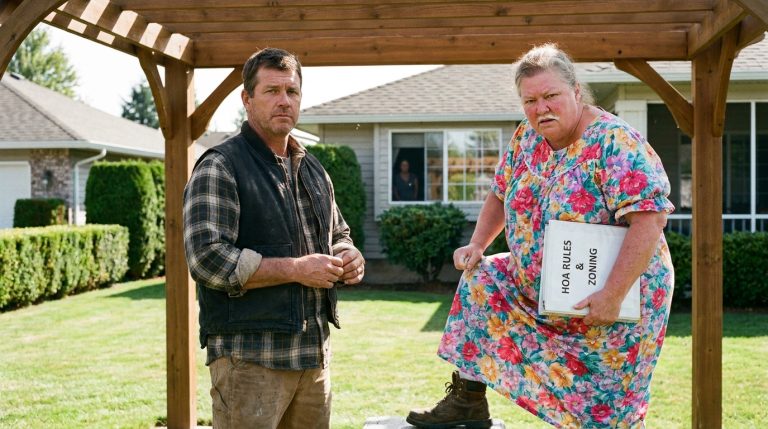
The sun beat down through the humid South Carolina canopy, turning the air into a shimmering, malevolent mirage that clung to the skin like a wet wool blanket. At the edge of the property line, the two river-stone columns stood completed—four feet tall, three feet square, mortared with the quiet, methodical precision of a man who had spent twenty-five years engineering structures meant to withstand heavy ordnance. They were permanent. They were anchored. And they were, according to the shrill voice echoing across the asphalt, an illegal atrocity.
“I don’t care if they were carved by the hand of God and delivered by angels, Sergeant Major.”
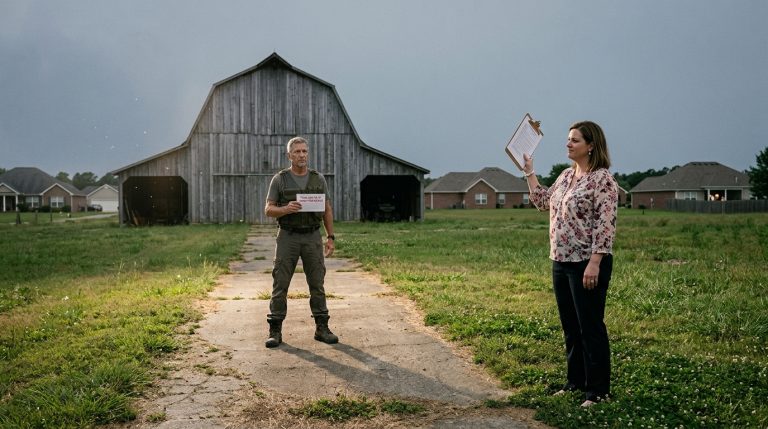
Jack turned slowly. Karen Prescott, president and supreme administrator of the Oak Ridge Meadows Homeowners Association, stood beside her customized electric golf cart. Her floral-print muumuu stretched across a frame built entirely for confrontation, one hand clutching a wooden clipboard like a scepter, the other a walkie-talkie tuned to her network of neighborhood lookouts. Her face was flushed, beaded with sweat and the intoxicating high of petty jurisdiction.
Jack looked from her puce, furious expression down to the base of the columns, sitting squarely ten feet back from the curb on land his great-uncle Silas had walked a century ago.
“Ma’am,” Jack said, his voice level and flat, mimicking the density of a freshly poured concrete slab. “I submitted the blueprints six months ago. They were approved. I have the signed documentation inside.”
Karen offered a bloodless, tight-lipped slash of a smile that never touched her eyes. “An administrative error. Reconsidered in an emergency session and retroactively denied. You have seventy-two hours to clear the debris, or the association will contract a demolition crew and bill you five thousand dollars for non-compliance.”
The internal calculation was instantaneous. A younger man might have shouted, might have let the blood pound in his temples until reason fractured. Jack merely registered the threat as a tactical variable. He saw the way her fingers whitened around the clipboard, the subtle twitch of panic hidden beneath layers of manufactured authority. She thought she was holding every card in a standard suburban dispute.
“Karen,” Jack said, dropping the formal title entirely, letting the air thin between them. “These columns aren’t going anywhere. Check your survey maps before you threaten a veteran’s property.”
Her laugh was a sharp, barking dismissal as she waved her smartphone like a winning lottery ticket. “Your property is whatever the HOA says it is. I have our attorney on speed dial.”
She climbed back into her golf cart, gunning the electric motor with a jerk of the wheel, leaving Jack standing in the quiet heat of the morning. But as the hum of the cart faded down the paved street, the internal machinery in Jack’s mind did not settle; it clicked into a cold, clinical lock, turning over a sudden, inexplicable discrepancy in the county easement layout he had glimpsed while pulling permits months prior—a discrepancy that suggested the very road she drove on had never truly belonged to the developers at all.
CHAPTER 2: THE ARCHIVES OF THE PAST
The humid South Carolina air felt thick enough to chew as Jack dropped the tool back into the bed of the F-250 and walked toward the house. The screen door gave its familiar, dry squeak—a small acoustic anchor in a world suddenly tilting on its axis. Inside, the quiet hum of the central air conditioning offered a sterile barrier against the heat, but it did nothing to cool the calculated rhythm of his thoughts.
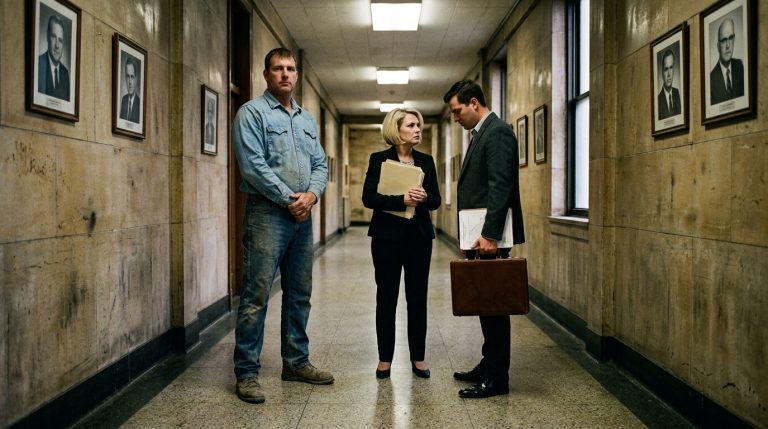
He didn’t speak immediately. He walked through the hallway, his boots clicking with measured precision against the hardwood floors that he and Sarah had sanded and sealed by hand three months ago. Sarah was sitting at the oak kitchen table, a mug of black coffee cradled between her hands, watching him with the quiet, practiced intuition of a woman who had spent two decades married to a combat engineer.
“She called you out,” Sarah said softly, before he could open his mouth. It wasn’t a question.
“She delivered a deadline,” Jack replied, stepping over to the counter and pouring himself a glass of water. The glass was cold, sweating condensation onto the dark wood. “Seventy-two hours. Five thousand dollars. Standard intimidation playbook, run by someone who has never faced a real obstacle in her life.”
“And the other thing?” Sarah’s eyes narrowed slightly, noting the way Jack’s shoulders were set—not with the defensive tension of a man under attack, but with the focused stillness of a man scanning a grid map. “You’ve got that look. The one you had outside Kandahar right before we found the secondary cable.”
Jack set the glass down. The ice cubes clinked against the rim, sharp and clean. He walked back to the entryway where his laptop bag sat, unzipped the front pocket, and pulled out a folded, yellowed sheet of paper he had retrieved weeks ago during a routine property check at the county tax assessor’s office. It was a secondary municipal sketch, a minor auxiliary printout showing the original municipal expansion lines for Oak Ridge Meadows prior to the 1998 residential build.
“When I was pulling permits for the well and the driveway extension,” Jack said, spreading the paper flat across the kitchen table, his finger tracing a faint, hand-drawn vector near the western perimeter, “I noticed something off about the easement offsets. The county road curves three feet wider than the legal right-of-way allows. But look closer at the pre-development block mapping.”
Sarah leaned in, her gaze following his calloused finger. “That’s the community center access lane.”
“That’s more than an access lane,” Jack said, his voice dropping into a register that was completely devoid of anger, operating purely on tactical logic. “Karen thinks she’s protecting a suburban kingdom built on solid rock. But according to the historical county plat records from when my great-uncle Silas still owned the timber track, the primary utility and parking grid for that community pool doesn’t sit on the developer’s tract at all. It sits on a one-acre carve-out that was never legally transferred.”
Sarah looked up, her expression shifting from apprehension to a slow, sharp realization. “Are you telling me…”
“I’m telling me that she didn’t just threaten a veteran over two river stones,” Jack said, turning away from the table to look out the front window where the two stone pillars stood immutable in the sunlight. “She just declared war on a property line that cuts straight through the middle of her swimming pool.”
The house was quiet save for the low hum of the refrigerator. Jack didn’t call Maria Sanchez immediately. There was no need to rush a strike before the reconnaissance was absolute. Instead, he opened his notebook, pulled out a sharp graphite pencil, and began mapping the chain of custody for the old deeds—tracing the ownership back through the decades, lining up the coordinates, and preparing to build a case that couldn’t be dismantled by a clipboard or a walkie-talkie.
CHAPTER 3: THE RETALIATION GAMBIT
The morning air outside the window was already growing heavy, baking the asphalt of the Oak Ridge Meadows access road into a soft, tarry heat. Jack did not linger over the paperwork. The graphite marks were clear, the historical parcel lines mapped with a precision that left no room for bureaucratic ambiguity. But blueprints on a kitchen table were static things; they needed motion, friction, and a catalyst to force the opposition’s hand.
He rose from the oak chair, sliding the historical plats into a durable manila folder. Sarah watched him from across the room, her expression a mix of caution and unwavering support.
“Where are you heading?” she asked, her voice quiet.
“Nowhere yet,” Jack said, his hand resting briefly on the back of the chair. “First, we let the pressure build in the boiler.”
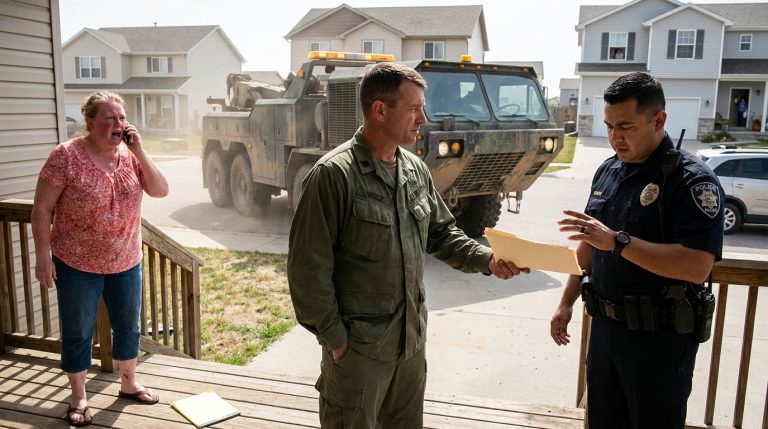
The pressure didn’t take long. Just past mid-morning, while Jack was out by the side porch inspecting the mortar joints on the second stone pillar to ensure the curing process was holding against the humidity, the quiet rumble of a heavy-duty diesel engine broke the neighborhood calm. It didn’t sound like a standard delivery van or a resident’s sedan. It had the deep, resonant rattle of a commercial towing chassis.
Jack didn’t rush. He set down his trowel, wiped his hands deliberately on a shop rag tucked into his belt loop, and walked out toward the driveway.
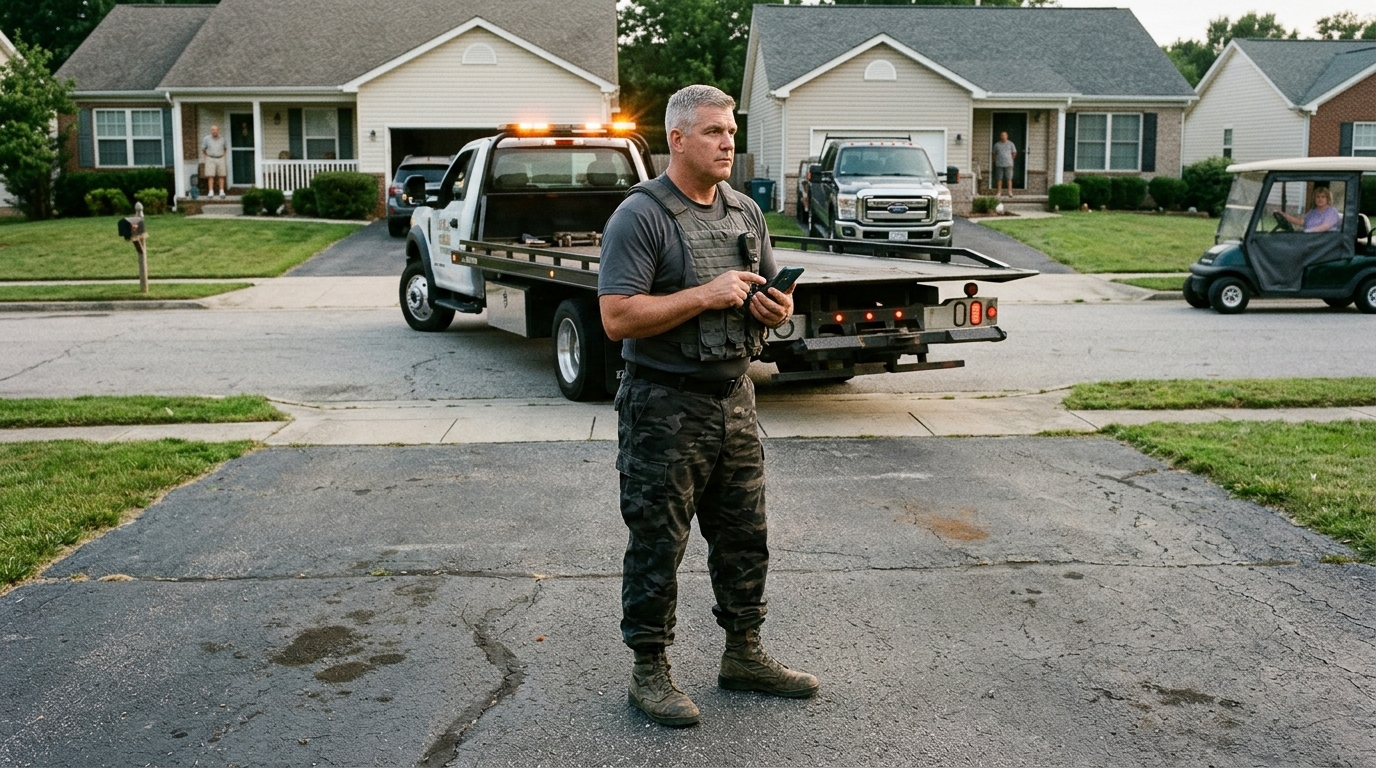
Parked precisely three feet off the curb in front of his property was an industrial flatbed tow truck, its amber hazard lights pulsing in the glaring sunlight. A driver with thick forearms and a faded work shirt was already hopping down from the cab, a clipboard clutched in one hand. Across the street, half-concealed behind the tinted window of her electric golf cart, Karen Prescott sat observing the maneuver with the rigid posture of a commander watching an artillery strike.
“Mr. Jack Riley?” the driver barked, his voice carrying over the idle of the diesel engine as he approached the front of Jack’s Ford F-250.
“That’s right,” Jack said, stepping forward to block any further movement toward the truck bed. His posture was completely relaxed, shoulders dropped, weight balanced evenly on both boots—the posture of a man who had evaluated hostile geometry a thousand times before.
“Work order from the Oak Ridge Meadows Homeowners Association,” the driver said, holding out a pink slip of paper with a transactional shrug. “Commercial vehicle parked in violation of section nineteen dash B. I’ve got orders to haul it to the impound yard off Cooper River Road.”
Jack glanced down at the paper. The ink was fresh, the signature at the bottom an aggressive scrawl bearing Karen’s official stamp. He didn’t raise his voice. He didn’t look across the street toward the golf cart. Instead, he pulled out his phone, unlocked the screen with a steady thumb, and tapped the speaker icon.
“Before you hook up that winch,” Jack said softly, his tone devoid of threat but heavy with undeniable finality, “you might want to call your dispatcher. Tell him you’re about to tow a registered private vehicle off a public municipal right-of-way under an invalid administrative order.”
The driver stopped dead, his hand hovering over the hydraulic control lever on the side of the flatbed. “Look, mister, I just get the work orders. I don’t write the bylaws.”
“And I’m telling you that the moment your hoist touches this bumper, my attorney files an injunction for grand theft conversion against your company,” Jack said, maintaining eye contact without a flicker of doubt. “Furthermore, the county sheriff’s department is three minutes away on a routine patrol sweep. You want to spend your afternoon explaining an unauthorized seizure to a deputy?”
The driver blinked, his gaze darting past Jack toward the empty street, then back to the formidable stillness of the retired Marine. The calculation was swift. Towing a car for an HOA was one thing; getting dragged into an active property seizure with a sheriff’s deputy involved was entirely bad for business.
With a muttered curse, the driver dropped the clipboard to his side, spat a stream of tobacco juice onto the asphalt, and turned back toward his cab. “Not paid enough for this neighborhood bullshit,” he muttered, climbing into the seat. The transmission slammed into reverse, the tires crunching against the gravel as the flatbed backed away and sped down the block, leaving Karen Prescott stranded in her golf cart with her walkie-talkie and her widening eyes.
From three houses down, a front door creaked open. Tim Henderson peered out from his porch, watching the tow truck retreat in stunned silence, while old Mr. Abernathy stepped off his front step, his eyes fixed on Jack with a newfound, electrified respect. The crack in the facade had widened, and the first true currents of resistance were beginning to flow beneath the surface.
CHAPTER 4: THE DEMOLITION STANDOFF
The morning sun climbed higher, burning off the residual mist over the timber line and baking the South Carolina clay until it hardened like baked ceramic. Jack didn’t leave the porch immediately after the tow truck retreated. He stood by the railing, his eyes fixed on the empty stretch of street where Karen Prescott’s electric golf cart had vanished. He knew the retreat of a commercial tow truck was not a surrender; it was merely a bruised ego regrouping for a heavier assault.
The retaliation arrived precisely six days later, exactly at dawn.
There was no polite warning letter this time, no passive-aggressive slip of paper tucked beneath a windshield wiper. Instead, the quiet morning was shattered by the deep, concussive roar of a heavy diesel flatbed hauling a commercial Bobcat loader equipped with an industrial-grade hydraulic jackhammer attachment. Behind it rolled a multi-axle dump truck and a pickup bearing the bold lettering of Bedrock Busters Demolition.
Jack stepped out onto the front porch with a mug of black coffee, his movements unhurried. He watched the convoy rumble down the lane and grind to a halt right at the edge of his property line. Four men in high-visibility neon vests and hard hats spilled out from the cabs, their movements sharp and purposeful, like an engineering unit deploying in a contested sector. Leading them from her golf cart was Karen Prescott, her khaki pantsuit pressed to military standards, her expression locked in a triumphant grin that looked entirely too sharp for comfort.
Without a word, Jack set his coffee mug down on the porch railing, walked down the wooden steps, and met them squarely between his two river-stone columns. The granite caps caught the morning light, cold and gray.
“Mr. Riley,” Karen announced, her voice pitched to carry across the asphalt for the benefit of the crew. “As per the final notice and executive board decree, we are here to execute a forced structural remediation. You have one final chance to step aside before we clear these unapproved obstructions.”
The foreman, a heavy-set man with a thick handlebar mustache and a cigarette tucked behind his ear, stepped past her, jabbing a thumb toward the Bobcat. “Look, mister, we got a signed municipal contractor work order and a cash deposit. We’re taking these pillars down in twenty minutes. Don’t make it difficult.”
Jack didn’t blink. He kept his weight balanced on his heels, his hands resting easily at his sides, refusing to yield a single inch of the gravel approach. “You cross that property line with that rig, and you’re assisting in an illegal demolition on private land,” Jack said, his voice dropping into that quiet, flat register that brooked no argument. “The title for this footprint doesn’t belong to the association.”
The foreman laughed, a dry, dismissive sound, and signaled the equipment operator. The Bobcat’s engine roared, black exhaust puffing into the humid air as the heavy steel tracks ground forward, the iron tip of the jackhammer trembling with potential kinetic energy just feet away from the hand-laid river stones.
“Proceed,” Karen snapped, her eyes wide with vindictive glee.
The Bobcat lurched forward, its tracks biting into the edge of the lawn—and then, out from the side access lane behind the house, a Charleston County Sheriff’s cruiser slid silently into position, its blue lights flashing without a siren. Deputy Miller stepped out from behind the door, his hand resting casually on his service belt, his expression radiating absolute, institutional exhaustion.
“Hold it right there,” Miller called out, his voice cutting cleanly through the diesel roar.
The Bobcat driver slammed his boot onto the brake pedal, the hydraulic whine pitching downward into silence. The foreman spun around, his face draining of color as he looked from the uniform to Karen’s disintegrating smile.
“Ma’am,” Deputy Miller said, stepping up to the edge of the property line and looking directly at Karen. “Did you authorize a third party to destroy property on land currently under a disputed title injunction?”
Karen sputtered, her hands flying to her clipboard. “It’s an HOA covenant violation! He’s trespassing on community standards!”
“You’re standing on private land directing a structural demolition without a verified deed,” Miller replied coldly, pulling out his citation book. “That crosses the line from a civil dispute straight into criminal destruction of property. Jack, do you wish to press charges?”
Jack looked at the foreman, who was already backing away from the Bobcat with his hands raised in defensive surrender. “Not today, Deputy,” Jack said evenly. “Just make sure they clear out before my legal counsel files the full property injunction.”
The dismantling of Karen’s authority was immediate. Within ninety seconds, the demolition crew scrambled back into their trucks, abandoning the site with frantic gear shifts and flying gravel. Karen stood entirely alone in the middle of the empty street, her grip on her clipboard slipping as the reality of her isolated defeat finally settled over her shoulders. Jack turned his back on her, walking slowly back toward the porch, knowing the final, irreversible chess piece was already moving into place.
CHAPTER 5: THE LEGAL NUKE
The silence that followed the failed demolition was not peaceful; it was the heavy, suspended tension before an atmospheric collapse. Jack did not linger on the front steps. He walked straight into the cool, shadowed interior of the house, his boots clicking evenly across the hardwood floors until he reached his office. The manila folder containing the hand-drawn 1932 plat map and the county tax assessor records sat squarely in the center of his desk, waiting.
Sarah appeared in the doorway moments later, leaning against the frame with her arms crossed, her breathing steady but her eyes sharp. “She’s not going to let this go, Jack. That public humiliation out there… she lost whatever grip she had left.”
“She lost it the moment she tried to enforce a non-existent boundary,” Jack said, reaching for his phone. He dialed Maria Sanchez’s office directly, bypassing the assistant.
Maria picked up on the second ring, her voice crisp and businesslike. “Sergeant Major. If you’re calling to tell me another tow truck tried to haul off your truck, my calendar is already cleared for a conversion lawsuit.”
“The tow truck was last week, Captain,” Jack replied, leaning against the edge of the desk. “Today, she brought a Bobcat with an industrial jackhammer. Deputy Miller had to threaten them with a felony conspiracy charge just to get them off the property.”
A sharp, dangerous chuckle came over the line. “Music to my ears. Did they touch the columns?”
“Not a scratch. But the timeline just compressed. If she’s willing to hire heavy equipment for a daytime raid, she’s past rational mitigation.”
“Then we drop the payload,” Maria said, her tone hardening into absolute professional focus. “I’ve already had the independent survey team wrap up their work on the perimeter. The ground-penetrating radar and GPS locators confirm every coordinate. The community center, the pool, and roughly sixty parking stalls are sitting entirely inside the unceded one-acre parcel originally held back by your great-grandfather in the thirties.”
Jack stared down at the red-penciled rectangle on the map. “And the title insurance?”
“That’s the tactical nuke,” Maria said smoothly. “The developer who built Oak Ridge Meadows in ninety-eight used a shell corporation that dissolved a decade ago. When they mortgaged the community complex, the bank accepted defective collateral. The moment we file a quiet title action and name the bank, the title insurer, and the HOA as joint defendants, the entire financial structure of that subdivision goes into cardiac arrest. The bank will call the loan due within forty-eight hours.”
“File it,” Jack said quietly.
“It’s already drafted,” Maria replied. “And because she served you with written harassment notices and forced a criminal trespass attempt this morning, we are tacking on a substantial claim for punitive damages. Process server is heading out to hand her the summons at the community pool this afternoon while she’s holding court with her board.”
The execution of the lawsuit was swift and surgical. Within twenty-four hours of Maria filing the complaint in the Charleston County Court of Common Pleas, the shockwaves hit the neighborhood. The HOA’s panic was immediate. Their legal counsel, a residential attorney unequipped for multi-million-dollar title collapse, advised an immediate, unconditional settlement, but Karen refused to listen. Instead, she dug her heels into the sand, proposing a massive special assessment on every household to fund a personal defense war against the man she viewed as an invader.
That miscalculation was her final error. By driving her own board to mutiny, she handed the neighborhood directly to the resistance. The emergency meeting called to vote on the special assessment was no longer a procedural formality; it was the staging ground for a complete administrative overthrow. Jack closed the folder, slid the documents into his briefcase, and prepared for the final confrontation inside the very building that bore his family’s name.
CHAPTER 6: THE FALL OF THE IRON CURTAIN
The air inside the Oak Ridge Meadows community center was thick, charged with the collective claustrophobia of a hundred homeowners packed shoulder-to-shoulder into a space built for half that number. Every folding chair was occupied; people lined the side walls, shifting their weight anxiously on the linoleum floor. Jack walked through the double doors side-by-side with Sarah and Maria Sanchez, forming a quiet, disciplined block that moved with absolute spatial authority. They did not rush. They stepped into the room with the measured cadence of personnel entering a secure briefing.
At the front of the hall, seated behind a long folding table on the elevated stage, Karen Prescott gripped a wireless microphone. She wore a bright red power suit that clashed violently with the ashen, drawn look of her skin. Her hair was sprayed into an unyielding helmet, but her hands trembled visibly against the black plastic of the mic casing.
Jack took a seat in the center of the front row, directly beneath the edge of the stage. Maria slid into the seat to his right, resting her leather portfolio on her knees, while Sarah settled quietly to his left.
Karen forced a tight, brittle smile that didn’t reach her eyes, tapping the microphone to cut through the low hum of murmurs rippling across the room. “Neighbors, friends,” she began, her voice strained and tight. “We are facing an aggressive assault on our community values, an attempt by an outsider to dismantle the foundation of everything we’ve built here.”
She pointed a rigid finger directly down at Jack. “One man seeks to take our pool, our center, our heritage, through frivolous legal maneuvers. The board proposes a two-thousand-dollar special assessment per household to fund our defense. All in favor of the assessment, signify by saying aye.”
A heavy, suffocating silence filled the room. Not a single voice answered. The silence stretched, absolute and crushing, until Tim Henderson called out a sharp, definitive “Nay” from the back row. Mr. Abernathy echoed it immediately, and within seconds, a rolling chorus of dissent filled the hall.
Karen’s mouth opened and closed, her face losing its last vestige of color. “Wait—you don’t understand, he’s trying to—”
Maria Sanchez stood up. She did not use a microphone; her voice carried with the sharp, effortless projection of a trained litigator. “Actually, Ms. Prescott, that is entirely incorrect.”
Karen slammed her plastic gavel onto the table, a sharp, cracking sound that echoed through the PA system. “You are not a homeowner! You have no standing here!”
“On the contrary,” Maria said, stepping forward into the aisle with a single folded document in her hand. “As my client is the legal owner of this building and the one-acre parcel it rests upon, I believe that gives us every right to address the room. In fact, under the unassailable title search and historical plat mapping from nineteen-thirty-two, everyone currently sitting in this room is technically a guest on my client’s land.”
A collective gasp swept through the assembly. Maria turned her gaze from the stage to the sea of anxious faces in the audience, laying out the core truth step by step. She detailed how the original developer had built the entire complex on unceded property without a valid title, how the bank’s collateral was fundamentally void, and how Karen’s aggressive campaign had triggered a cascading legal catastrophe. She did not stop there; she offered the settlement directly to Frank, the board’s interim accountant sitting near the side.
“Mr. Riley has no desire to close your center,” Maria stated clearly. “He offers to deed this one-acre parcel, including the clubhouse and pool, to the homeowners of Oak Ridge Meadows for the sum of one dollar, under two strict conditions: the immediate dissolution of the current HOA board, and a permanent injunction barring Ms. Prescott from ever holding an administrative role again.”
Frank reached out and took the paper with trembling hands. A heartbeat later, he moved to accept the settlement. The second the vote was called, the room erupted into a thunderous, cathartic roar of approval. There was not a single dissenting voice.
Karen sat frozen on the stage, the red power suit suddenly looking like a oversized costume. Her reign of petty authority had evaporated in an instant, stripped away not by force, but by the immutable weight of the law and undeniable truth.
Within days, the old HOA was officially dissolved, replaced by a transparent, democratically elected association with fair, sensible bylaws. Karen’s house went on the market, and within a month, she packed her remaining belongings into a car and drove away without looking back, leaving the neighborhood to its quiet, sunlit peace.
The aftermath settled over the property like a deep breath after a long march. One afternoon weeks later, Jack stood at the edge of his driveway, a small brush in his hand as he applied a final, protective coat of linseed oil to the mortar joints of his river-stone columns. The afternoon sun cast a warm, golden glow across the rough granite surfaces, catching the texture of the stone that had started it all.
Sarah walked out from the porch, stepping gently onto the gravel path with two glasses of iced tea, handing one to him before leaning her shoulder lightly against his arm. She looked down the street where children were laughing near the community pool, and then up at the sturdy pillars standing guard at the entrance.
“Was it worth it?” she asked softly, her voice carrying a deep, tranquil satisfaction. “All the friction, the letters, the standoff?”
Jack set the brush down on a wooden block, wiped his hands on a clean rag, and took her hand, feeling the solid, unyielding reality of the earth beneath his boots.
“Yeah,” Jack said, his gaze steady on the horizon. “It was worth it. We have our roots now, and they’re anchored in stone.”