Echoes of the Minefield: A Legacy of Sacrifice, Understanding, and the Quiet Bond of Shared Survival
CHAPTER 1: The Weight of Silence
The room smelled of floor wax and expensive cologne. It was a space designed for order, for the crisp, predictable alignment of stars and stripes, where respect was measured in the crispness of a salute and the uniformity of a stance. Dutch Harrison sat in the third row, his fingers resting on the worn leather of his briefing folder. He did not look up when the chair scraped back behind him. He did not rise when the rhythmic thrum of forty pairs of heels echoed against the linoleum.
He was a ghost in a machine of iron.
General David Cain entered, his presence pulling the room’s gravity toward the podium. At the sound of the General’s boots, the collective motion was instantaneous—a wave of crisp, pressed wool rising in unison. Dutch remained seated, his hands folded neatly over his lap. To his left, a young captain shifted, his brow furrowing as he caught sight of the elderly man’s stillness. The captain leaned down, his voice a low, urgent serration in the quiet.
“Sir, the General,” the captain hissed.
Dutch didn’t turn. He stared ahead, his eyes fixed on the blank wall behind the podium. He felt the phantom ache in his right shin, a dull, rhythmic throb that pulsed in time with the silence of the room. It was a familiar, fading texture—the memory of a pressure mine that had gone off long before these officers were born, yet it felt as immediate as the hum of the air conditioning.
The General reached the podium, his four stars catching the overhead glare. He looked out over the assembly, his gaze professional and detached, until it struck the third row. The silence in the room shifted then, thickening, turning from an atmosphere of routine to one of sharp, jagged speculation. The General stopped speaking, the briefing folder in his hands closing with a soft, final thud.
He didn’t need to shout to be heard. He simply looked at the old man who refused to move.
“Colonel Harrison,” the General said, his voice quiet, carrying no malice, only a weight that hung suspended in the air. “Why didn’t you stand when I entered?”
The captain next to Dutch held his breath, his face flushing with the indignity of the perceived slight. The room was a mirror, reflecting forty variations of shock and offense. Dutch felt the cold press of the chair against his back and the slow, mechanical stiffness of his right leg. He looked up, his eyes meeting the General’s, and for a fleeting, heart-wrenching moment, the distance of five decades dissolved.
“Because you told me I didn’t have to, sir,” Dutch said.
The air in the room didn’t just vibrate; it seemed to shatter. The captain beside him gasped, a sound so small it was almost invisible, while the woman behind them exchanged a panicked look with her colleague. The context of their world—the rules, the protocol, the rigid hierarchy—felt like a frayed fabric ready to tear. Dutch kept his gaze steady, his heart rhythmic and slow, waiting for the echo of that promise to ripple outward.
CHAPTER 2: The Ripple of Protocol
The silence lasted three heartbeats, then four. To anyone else in the room, it was a momentary lapse in military decorum, an awkward glitch in the clockwork of the Pentagon. To Dutch, it was the sound of a closing door—the finality of a choice made in the light of day. He felt the phantom pressure on his right heel, a dull, rhythmic throb that pulsed in perfect synchronicity with the slow ticking of the wall clock.
He didn’t need to look at General Cain to know the man’s expression. He knew the set of that jaw, the specific way the light caught the four stars on those epaulets. They had been brothers-in-arms in a world of ghosts, and now they were two men standing on opposite sides of a crowded room, divided by the weight of a promise that had somehow become an albatross.
General Cain didn’t look away. Instead, he stepped down from the dais. The movement was fluid, controlled, the walk of a man accustomed to having his path cleared. The officers in the first and second rows parted like wheat before a scythe, their faces a mixture of confusion and growing unease.
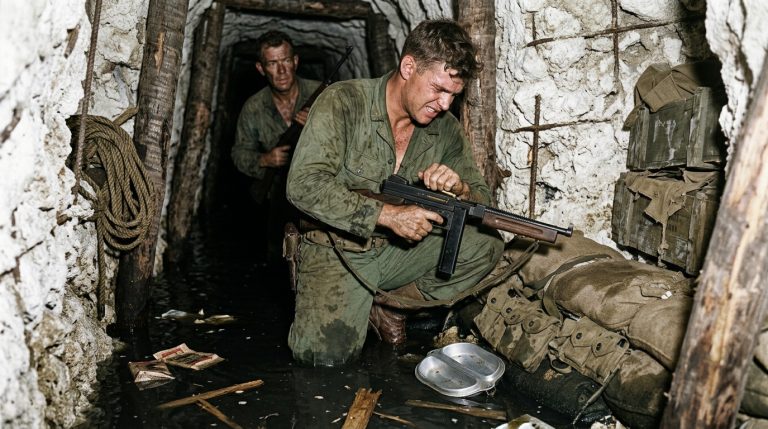
Dutch remained where he was. He focused his attention on the texture of his folder, his fingertips tracing the slight indentation of the embossed seal on the cover. He thought of the field in Quang Tri, the smell of cordite and wet earth, the way the silence had felt then—not like this, not bureaucratic and stifling, but sharp and hungry. He remembered the specific sensation of the pressure plate beneath his boot, the way the world had narrowed down to a singular point of physics and sacrifice.
He hadn’t intended to draw this much attention. He was just a consultant, a relic invited for his tactical insights on the current theater. But the past had a way of bleeding into the present, staining the sterile floorboards of this room with the color of memory.
The General reached the third row. He stopped, his boots aligned perfectly with the end of the aisle. The air between them felt thick, vibrating with the unspoken history that defined them. Cain’s eyes softened, just a fraction, a shift that only Dutch would notice.
“Colonel,” Cain said, his voice dropping to a register that bypassed the rest of the room. It wasn’t an order; it was a recognition.
“General,” Dutch replied, his own voice steady, carrying the gravel of decades.
A collective breath seemed to escape the room. The captain beside Dutch—the one who had tried to whisper earlier—had gone stiff, his eyes darting between the two men. The realization that there was a story here, one that defied the standard manual of conduct, was beginning to dawn on the others. They weren’t looking at a man who was failing to pay respect; they were looking at a man who was somehow participating in a ritual they didn’t understand.
Dutch shifted, the internal mechanism of his prosthetic giving a faint, metallic click that went unheard by everyone but him. It was a sound that grounded him, a reminder that the pain was real and the sacrifice had been earned. He felt a sudden, sharp intrusive thought—the sensation of falling, of the world tilting on its axis as the ground beneath his feet threatened to erupt. He blinked, pushing the ghost of the minefield back into the dark recesses of his mind.
“I didn’t expect to see you here, David,” Dutch said, his voice quiet. He used the name deliberately, a bridge built over a chasm of rank.
“I didn’t expect you to be so stubborn after all these years, Dutch,” the General countered. There was a glimmer of something—not amusement, but a deep, weary respect.
“I’m an old man,” Dutch said, leaning back into his chair. “Stubbornness is the only thing that keeps the joints moving.”
The General held his gaze for another moment, then, with a sharp, decisive movement, he turned back to the room. The forty officers stood at attention, their postures rigid, their eyes fixed on the blank space above the back wall. They were waiting for an eruption, a disciplinary moment that would restore order.
“Colonel Harrison,” the General said, his voice rising to address the room, “is here today to ensure our logistics are beyond reproach. If he chooses to remain seated, it is for reasons that do not require your oversight.”
The tension in the room didn’t disappear, but it shifted. It became something else: curiosity, shadowed by a sudden, creeping sense of inadequacy. The officers hadn’t been reprimanded, but they had been rebuked.
As the General turned back toward the podium, the room began to exhale, the sound a soft, collective sigh that settled into the corners of the room. Dutch watched him go, the weight of the moment pressing down on his chest. He knew this was only the beginning. The story would spread through the halls of the Pentagon before the lunch hour. The mystery of the seated Colonel would become the talk of the staff, and the quiet, faded threads of his life would be tugged at, pulled, and picked apart by people who only saw the surface of things.
He opened his briefing folder, the paper cool and dry under his palms. He didn’t look at the other officers. He didn’t look at the captain, who was still staring at him with a bewildered, humbled expression. He simply waited for the briefing to begin, his mind already calculating the variables of the deployment, his body held in place by the weight of a duty that had never truly ended. He was tired—an ancient, bone-deep exhaustion—but he was here. He was still the equation’s answer.
CHAPTER 3: Whispers in the Corridor
The fluorescent lights of the corridor hummed with a sterile, flickering rhythm that grated against the edges of Dutch’s composure. He stepped out of conference room 4E, his right leg moving with that familiar, calibrated precision. Every step was a negotiation between his will and the mechanical reality of the prosthetic. The hallway was crowded, filled with the shifting tides of Pentagon personnel—analysts, junior aides, and senior officers moving toward their next appointment with the speed and purpose of a hive.
He expected to walk toward the exit, to leave the suffocating intimacy of the briefing behind. Instead, he found his path partially obstructed by a young officer, a man no older than twenty-five, standing near a wall-mounted glass display case. The officer was clutching a manila folder, his knuckles white against the paper. The label on the file, written in bold, handwritten ink, read: Project Quang Tri.
Dutch stopped, the movement instinctive. He felt the cold iron of the floor through his left heel, the slight drag of the right. He didn’t look at the officer directly, but his peripheral vision caught the slight tremor in the man’s hand as he adjusted his grip. It was a small, almost imperceptible detail—a physical discrepancy in the ordered ecosystem of the hallway.
Quang Tri.
The name pulled at his focus, a sudden, sharp anchor. He hadn’t heard that name spoken aloud in years, not outside of his private conversations with David. To see it written, held by a man who looked like he’d barely finished basic training, was like seeing a ghost materialize in the middle of a crowded street.
Dutch slowed his pace, the stiffness in his leg suddenly feeling more acute. He wasn’t supposed to be here, in the transit zones of the building. He was supposed to be gone, a consultant whose work was finished. He felt a flare of something cold, a protective instinct he hadn’t fully realized he was still carrying. The decoy secret—the idea that he was just a grumpy, stubborn old man—was a shield he had worn for decades. But if the details of the minefield, the specific logistics of that patrol, were being circulated in a file, then the shield was beginning to thin.
“Excuse me, sir,” the young officer said, not looking up, his voice tight. He stepped aside, his gaze fixed on the floor.
Dutch looked at the officer. The man’s name tag read Lt. Miller. Miller didn’t make eye contact, but there was a tension in his shoulders that went beyond simple deference to a superior. It was the tension of a man holding something he didn’t quite understand, something that frightened him.
“That’s a heavy folder you’ve got there, Lieutenant,” Dutch said, his voice quiet, textured with the wear of years.
Miller froze. He looked up, his eyes darting to Dutch, then quickly back to the folder. “Just logistics, sir. Historical archive review for the Chairman’s office.”
“Historical,” Dutch repeated, the word tasting like ash. “History is rarely as clean as a manila folder, son.”
He didn’t wait for a reply. He walked past, the mechanical click of his leg sounding louder than the bustling activity around him. He felt the officer’s eyes on his back, a prickling sensation that made the fine hairs on his neck stand up. The secret of the minefield was being exhumed, piece by agonizing piece. He wondered how much the staff knew. Did they know about the pressure plate? Did they know about the seven Marines who had gone home? Or were they just looking at the maps, the casualty reports, the clinical math of a war that had ended before they were born?
He turned the corner, the light in the hallway shifting from the clinical white of the office area to the warmer, yellow-tinged glow of the main lobby. The transition did nothing to soothe the unease curling in his gut. He realized now that his arrival today hadn’t just been a briefing. It was an investigation. David hadn’t just invited him to talk strategy; he had invited him to witness the unravelling of their shared past.
Dutch reached the elevators, his fingers brushing the cool steel of the button. He felt a profound sense of isolation. He had spent fifty-three years cultivating the persona of the “stubborn old man,” a living monument to a forgotten day. But the Pentagon was a creature of memory, a place that thrived on cataloging the past. He saw now that he was part of that catalog, an artifact that had suddenly become relevant again.
As the elevator doors slid open, a wave of cold air spilled out, carrying the scent of rain from the outside world. He stepped inside, the cabin empty. The doors closed, sealing him in a small, mirrored box. He looked at his reflection—the gray hair, the lines around his eyes, the suit that fit a little too loosely on his frame. He looked like an 82-year-old man who had lived a quiet, unremarkable life.
He looked at the floor, at the reflection of his own shoes. The right one was a perfect match for the left, designed to mimic the stride of a man with two legs. It was a masterful illusion, a piece of engineering that had sustained him for over half a century. But as he stood there, watching the numbers on the control panel blink from four to three, he realized that the illusion was cracking.
He needed to talk to David. Not as a consultant, not as a retired Colonel, but as the man who had stood on that mine. He needed to know why the files were being opened now. He needed to know if the promise—the promise that he would never have to stand again—was being buried under a mountain of administrative historical review.
He leaned against the wall, the metal cold and unyielding against his shoulder. The pain in his leg was intensifying, a dull, throbbing heat that reminded him of the mine’s weight. He closed his eyes, hearing the faint hum of the elevator cables, imagining the ground beneath him—not the tile of the Pentagon, but the mud of Quang Tri. He was still standing there, in his mind, waiting for the command to jump, waiting for the rest of his life to begin.
The elevator pinged, the sound sharp and jarring. The doors opened to the lobby, where a fresh crowd of officers and civilians waited, their faces filled with the hurried energy of the living. Dutch took a breath, adjusted his jacket, and stepped out. He was Dutch Harrison, the man who knew how to wait. And he would wait, for as long as it took, to ensure that the truth remained his to tell, and not theirs to interpret.
CHAPTER 4: The Storm Breaks
The lobby’s sliding glass doors parted with a soft, pneumatic hiss, and Dutch stepped into the sudden, violent deluge of a Virginia afternoon. The transformation of the world was absolute. One moment he was shielded by the conditioned air and hushed whispers of the Pentagon, and the next, he was assaulted by the roar of water against concrete. The gray sky had turned the color of bruised slate, and the rain was coming down in sheets, blurring the familiar geometry of the parking structure into a collection of indistinct, weeping shapes.
He reached for his cane, the handle cool and reassuring against his palm. He needed to get to his car, but the intensity of the storm made the walk across the blacktop feel like a tactical maneuver. He paused under the narrow overhang of the entrance, the mist clinging to his suit. He felt the cold dampness seeping into the synthetic fibers of his prosthetic leg—a sensation he had learned to endure, but never to welcome. It brought with it a phantom chill, a biting reminder of the night he had lost the limb, the memory so potent it almost distracted him from the immediate reality of the rising water levels at his feet.
He began to move, his pace measured, avoiding the deepening pools of oil-slicked water. Every step was a calculation of weight distribution and traction. The roar of the rain was all-encompassing, a white noise that stripped away the world’s distractions, leaving him alone with the encroaching anxiety of the Project Quang Tri file. If they were digging into the patrol reports, they would eventually find the discrepancies. They would find the logistical impossibilities of the bomb squad’s arrival time—the forty minutes he had spent pinned to the earth.
A black sedan, idling near the curb, splashed through a puddle, sending a spray of water toward his shins. Dutch didn’t flinch. He kept his eyes on the target—his older, reliable sedan parked three rows back. He felt the familiar strain in his lower back, the compensating muscles firing with a dull, persistent protest.
As he navigated the rows of cars, his mind returned to the young officer, Miller. The fear on the boy’s face wasn’t about a mission; it was about the implication of the documents. Someone, somewhere in the upper echelons, was looking to rewrite the history of that patrol, perhaps to serve a contemporary narrative of strength or sacrifice that didn’t align with the messy, silent reality of the minefield. They were trying to sanitize the grit of the past to build a more palatable present.
The rain intensified, the wind whipping the downpour into a stinging, horizontal spray. Dutch reached his car, his hand fumbling for the keys. The metal was slick, the key sliding against the lock until he finally found the purchase to turn it. He climbed inside, the interior smell of old leather and stale coffee a sudden, grounding comfort. He sat in the darkness for a moment, the rain drumming a chaotic, frantic rhythm against the roof.
He didn’t start the engine. He reached into the glove box and pulled out a small, worn photograph—the only one he carried. It was a picture of Marcus Kane, taken shortly after their return from the war. Marcus was smiling, his arm around a young David. It was a faded image, the colors bled out by the relentless persistence of time, but the expressions remained clear. It was a testament to the life that had followed the mine.
Dutch held the photo, his thumb tracing the worn edge. He realized that the decoy secret he had played for years—the “stubborn old man” routine—was no longer sufficient. It had been a passive defense. But the files were active. Someone was pushing, and if he remained passive, the truth of the seven Marines who had survived would be erased, replaced by the sterile, bureaucratic myth they were currently constructing.
He needed to see Marcus. Not just to satisfy the old man’s request, but to safeguard the truth. If the files were being opened, then Marcus was in danger, too. The history of the minefield was the history of their survival, and if the Pentagon managed to frame that history as something other than what it was—a desperate, brutal, and ultimately human event—then the meaning of their lives would be fundamentally altered.
He started the engine, the car coughing into life. He checked the rearview mirror, the glass distorted by the relentless rain. For a fleeting second, he thought he saw the black sedan from earlier idling in the lane behind him, its headlights cutting through the gray mist like two unblinking, predatory eyes. He watched it for a long, steady moment. It didn’t move. It didn’t turn its lights. It just waited, a silent sentinel in the storm.
Dutch put the car into reverse, his heart rate steady, his mind already shifting into a state of heightened, strategic awareness. He wouldn’t lead them to Marcus. If they were following him, he had to be the decoy. He turned the wheel, not toward the exit that led to the highway, but toward the service road that circled the outer perimeter of the facility—a long, winding path that would take him through the construction zones and back toward the city center.
He was no longer just Dutch Harrison, the retired Colonel who refused to stand. He was the sergeant on the patrol, the man holding the ground, the man ensuring that the others got home. The storm outside was rising, and the game of shadows had finally begun in earnest. He felt the familiar, heavy weight of the responsibility return, and with it, a cold, clear resolve that burned through the damp and the fatigue. He wouldn’t let the files define them. He would be the one to write the final entry, even if he had to hold the line for another fifty years.
CHAPTER 5: The Mirrors Edge
Dutch kept his grip on the wheel firm, his knuckles white against the dark leather. The car hummed as it maneuvered through the serpentine curves of the service road, the tires singing a wet, high-pitched note against the asphalt. Behind him, the black sedan remained a constant, disciplined presence, maintaining a precise distance that betrayed professional training. It was a rhythmic, calculated pursuit—too steady to be a random tail, too patient to be a mistake.
His right leg pulsed with a dull, throbbing heat. The prosthetic joint felt sluggish, the humidity of the storm having seeped into the housing, affecting the internal dampeners. Every time he pressed the brake, he felt the resistance in the mechanical feedback loop, a slight hesitation that forced him to compensate with his left foot. It was a friction he had lived with for over fifty years, but tonight, it felt like a liability.
He glanced again at the rearview mirror. The headlights behind him blurred, the rain distorting the light into long, golden streaks that danced across the glass. For a disorienting second, the interior of the car felt like a cramped bunker, the smell of rain mixing with the faint, metallic tang of the prosthetic’s hydraulic fluid. He felt the phantom pressure of the mine again—a cold, immutable weight on his heel. His perception wavered; he wasn’t driving through a suburban construction zone, he was crawling through the tall grass of the Quang Tri province, the air thick with the smell of ozone and rot. He shook his head, the motion sharp and sudden, forcing his focus back to the road.
He was Dutch Harrison. He was the man who survived.
He accelerated. The road ahead was narrow, bordered by dense woods that leaned inward, their branches heavy with rain. He knew this perimeter well; he had mapped it out in his head years ago as a contingency. He pushed the sedan into a tight turn, the tires skidding slightly on the slick surface before regaining their purchase. He felt the weight of the car shift, the physics of the maneuver demanding a precision he usually avoided. Behind him, the pursuit sedan followed the line perfectly, its own headlights unwavering.
They weren’t just following him; they were herding him.
The realization hit him with the force of a physical blow. They didn’t want to stop him on the open road where witnesses might see; they were waiting for him to break, waiting for him to make a mistake that would provide the pretext for an “accident” or an “intervention.” They were banking on his age, his fatigue, and the inherent frailty of his prosthetic to finally fail him.
He checked the dashboard clock. The time was ticking away, a steady, indifferent march toward the hour he was supposed to meet Marcus. He realized that the decoy secret—the idea that he was a relic, a man out of time—was the very thing they were using against him. They expected him to be the “stubborn old man,” incapable of maneuvering, incapable of defending his own history. They hadn’t counted on the fact that he was still the same man who had disarmed a minefield by the sheer force of his own will.
He checked the map on his phone, the screen casting a pale, sickly light on his face. He was approaching the old bridge that crossed the drainage canal, a bottleneck where the service road narrowed to a single lane. If he could create a blockage there, he could force the tail to reveal its identity.
His heart rate was steady, his breathing controlled. He felt a strange, quiet calm settle over him, the same sensation he had experienced forty minutes into the patrol, when the reality of the mine had fully sunk in. It wasn’t fear; it was the clarity of a finished equation.
He tapped the brakes, not to slow down, but to test the tail’s response. The black sedan matched him instantly. He eased onto the shoulder, his wheels crunching into the wet gravel. The sedan slowed, its engine note dropping to a low, aggressive rumble. Dutch didn’t stop. He feathered the gas, keeping the car crawling forward at a walking pace, forcing the pursuit car to either pass or commit to a stop.
He watched the sedan through the mirror. It pulled alongside him, the tinted windows hiding whoever was inside. For a moment, the world seemed to hold its breath. The rain hammered against the roof, the sound deafeningly intimate. Then, the passenger-side window of the sedan began to slide down, a thin, mechanical whine that rose above the storm.
Dutch didn’t look. He kept his eyes on the road, his left hand resting on the door handle. He was ready. He was the answer, and he would not be erased by the sterile efficiency of a file clerk or the silent pressure of a suit in a sedan. As the window reached its limit, he saw a sliver of a face, eyes obscured by dark glasses, a hand resting on the door frame.
It was the young officer, Miller.
The recognition was instantaneous, a sharp, cold jab to his gut. The boy was shaking, his hand tight on the handle, his gaze flickering from Dutch’s car to the road ahead. He wasn’t a professional operator. He was terrified, a cog in a machine he didn’t fully comprehend, doing the bidding of a power that had no regard for his life, let alone the truth of the minefield.
Dutch felt a wave of pity, so profound it almost buckled his resolve. They had sent a child to do the work of a monster. He didn’t accelerate away. He didn’t swerve. He simply slowed further, until his car was practically at a standstill. He looked over, locking eyes with Miller through the rain-streaked glass. He didn’t show anger. He didn’t show fear. He showed only the calm, immovable weight of the truth.
Miller’s hand faltered. The sedan slowed, the driver clearly confused by Dutch’s sudden lack of evasion. The boy looked at Dutch, then at the road, then back to Dutch. The conflict in his expression was raw, unrefined, and agonizingly human. Dutch raised his hand, gesturing toward the bridge ahead—a simple, clear directive to move on.
Miller hesitated, his grip on the door loosening. The sedan began to pull ahead, its engine surging with an audible reluctance. As the car sped up, merging back onto the main road, Dutch watched it disappear into the gray sheets of rain. He was left alone on the side of the road, the silence of the storm returning with a renewed, heavy intensity.
He sat there for a long time, the engine idling, the heater blowing a dry, artificial warmth against his hands. He hadn’t fought, yet he had won. He hadn’t revealed the truth, yet he had protected it. He felt the pain in his leg, a dull, throbbing reminder of the cost of that truth, but for the first time in fifty-three years, it didn’t feel like a burden. It felt like a foundation. He put the car in drive and pulled back onto the road, heading toward the only home that mattered, his mind clear, his mission set.
CHAPTER 6: The Weight of Memory
The Virginia evening was cooling, a gentle breeze rustling the leaves of the old oak trees that lined the Kane property. Dutch climbed out of his car, his movements deliberate. Every muscle in his frame felt the accumulated tension of the day, a symphony of aches that seemed to vibrate in sympathy with his prosthetic leg. He reached for the porch rail, his grip steady. Marcus was sitting in a wicker chair, his silhouette dark against the warm, amber glow of the house lights.
Dutch climbed the steps one at a time. The wood creaked under his weight, a rhythmic, familiar sound. Marcus didn’t rise—at ninety-one, such movements were no longer a given—but he leaned forward, his face etched with the deep, cragged lines of a life lived long and hard. His eyes, though dimmed by age, retained a sharp, piercing clarity that cut through the twilight.
“You took your time,” Marcus said, his voice a soft, dry rasp.
“Had a bit of trouble on the service road,” Dutch replied, settling into the adjacent chair. He let his legs stretch out, the prosthetic clicking once as he locked the knee into a comfortable position.
They sat in silence for a while, the only sound the distant chirping of crickets and the rustle of the wind. There was no need for superficial pleasantries. They were two men who had shared the singular, defining tragedy of their lives, and the silence between them was an old friend, well-worn and comfortable.
“David told me about the briefing,” Marcus finally said, not looking at Dutch, but out into the darkening yard. “He told me they were looking into the patrol reports.”
Dutch felt a muscle in his jaw tighten. “They’re digging, Marcus. Looking for a narrative. Something to pin to the wall, to hold up as a model of the Corps.”
“They don’t understand,” Marcus said. “They don’t know the weight of the math.”
“They know the numbers,” Dutch said, his voice flat. “But they don’t know the cost.”
Dutch reached into his inner pocket and pulled out the old photograph—the one he’d looked at in the car. He handed it to Marcus. The old man took it with trembling fingers, his gaze lingering on the image of himself and his son. He passed it back, his eyes misting.
“You know, Dutch, for all these years, I’ve felt like I was living on borrowed time. Every birthday, every celebration, every time I saw David advance in his career… it was all built on those forty minutes.” Marcus turned his head, looking directly at Dutch. “You didn’t just save me. You saved the possibility of a future.”
“It was a decision,” Dutch said, his voice firm, shedding the protective layers he had spent a lifetime constructing. “I saw the mine. I knew the radius. It wasn’t a hero’s choice, Marcus. It was a soldier’s. I had the training, and I had the position. You were a Lieutenant with a patrol to lead. That’s all.”
“That’s not all,” Marcus insisted, his hand reaching out to touch Dutch’s arm. “You held it down until the team was clear. You stayed there, knowing the risk. That was a sacrifice of the self, Dutch. Don’t cheapen it now.”
Dutch looked at his prosthetic leg. He flexed his toes, the mechanical response immediate and precise. For the first time, he didn’t view it as a burden or a badge of honor. He saw it for what it was: the physical manifestation of the price he had been happy to pay.
“I’m tired, Marcus,” Dutch admitted, the honesty of the words leaving him feeling suddenly light.
“We’re both tired,” Marcus smiled, a weary, genuine expression. “But we’re still here. And the truth… it’s still ours. David is going to bury those files. I made sure of that before you arrived. He’s going to mark them ‘operational necessity’ and seal them for another fifty years. The military gets its protocol, and we get our peace.”
Dutch nodded. It was the only resolution that made sense. The files would remain a closed loop, the reality of the minefield hidden away where it couldn’t be sanitized or misrepresented. It was the final protection of the patrol—a last act of duty to the men who had come home, and the ones who had remained in the earth.
He stood up, his leg feeling steady. He turned to Marcus and, for the first time in their fifty-three-year friendship, he didn’t just shake his hand. He embraced him. It was a brief, powerful connection, a folding together of two lives that had been inextricably bound by the heat of a single, fateful decision.
“I’ll see you again, Marcus,” Dutch said.
“See you soon, brother,” Marcus replied.
Dutch walked down the steps, the night air cool against his face. He reached his car and sat in the driver’s seat, the quiet of the house fading into the distance. He looked down at his right leg, at the dark, synthetic covering that housed the prosthetic. He realized he didn’t feel the phantom pain anymore—or if he did, it was no longer a signal of loss, but a reminder of endurance.
He started the engine and began the drive home, the road ahead clear, the dark highway stretching out before him like a promise. He had done the work, he had held the line, and the secret was safe. The math had worked out, the generations had flourished, and he, the sergeant who had stayed behind, was finally, truly, moving forward. He didn’t look back at the Kane house as he drove away; he focused on the road, the steady rhythm of his own heartbeat a quiet, triumphant drum against the silence of the night.