Mara Ellison Refuses to Run When the Past Comes Back to Claim Her $600 Harley
CHAPTER 1: SCRAPING PAVEMENT
Six hundred dollars left a hollow ring inside the ceramic cookie jar, but the scraped metal under Mara’s fingernails proved she wasn’t dreaming.
The 1965 Harley-Davidson sat dead in the dirt at the edge of the yard. Rusted flaking paint hung off the gas tank like dead skin, and the front tire held just enough air to drag, not roll.
“Thing doesn’t run,” the seller muttered, wiping sweat from his thick neck with a rag that smelled of sour diesel. “Probably never will.”
Mara didn’t offer a word. She handed him six folded bills—every cent saved over eight months of double shifts at the diner—and grabbed the chrome handlebars. The metal was pitted, cold, and bite-rough against her calloused palms.
Jacob grabbed the left rear turn signal bracket. Sophie, seven years old and oblivious to the tight knot in her mother’s stomach, pushed against the rusted rear fender with both small hands.
The front wheel shrieked against the sun-baked asphalt of Fair View Drive. It was a dry, metal-on-metal scream that echoed straight up the row of low-rent duplexes.
Windows slid open. Mrs. Patterson stepped onto her porch, holding a dead potted fern like a shield, her mouth drawn into a thin, pale line of absolute disapproval.
Across the street, two teenagers paused on their bicycles. One raised a smartphone, angling the lens toward Mara’s straining arms.
“Look at Fair View’s finest!” he called out, his voice cracking with easy cruelty. “Six hundred bucks for scrap iron!”
Mara kept her jaw locked. Sweat ran down the back of her neck, stinging the sun-burned skin above her collar. Her thighs burned with every forced foot of pavement.
“Mom,” Jacob grunted, his breath coming in ragged gasps. “People are watching.”
“Let ’em watch,” Mara said, her voice low and raspy. “Watching don’t cost them a dime.”
They heaved the massive iron frame off the exposed street and shoved it deep into the dark alcove beneath the concrete apartment stairwell. The shade hit Mara like a wet towel, cold and heavy.
She collapsed against the brick wall, her arms trembling from the sheer deadweight of the machine. Sophie sat straight down on the dirt, kicking her pink sandals against the tire.
Mara reached into her apron pocket, her fingers closing instinctively around her subtext object—a grease-stained brass ignition key attached to a frayed wire ring. She turned the hard brass edges against her thumb, using the small bit of metal to ground her surging pulse.
She knelt beside the frame to clear away a clump of dry mud wedged near the lower crankcase.
Her fingernail struck something hard and intentionally cut into the iron.
Mara scraped away the dried grime. Carved deep into the lower frame tube were three crisp, block capital letters: RMC.
They weren’t scratched by a stray rock or pitted by rust. They were struck with a heavy punch, clean and deep enough to survive twelve years of weather.
Jacob leaned over her shoulder, his chest heaving. “What’s that mean, Mom?”
Mara’s thumb traced the jagged edge of the carved R. A strange, cold prickle started at the base of her neck, completely at odds with the thick afternoon heat.
“I don’t know,” she whispered, her thumb pressing so hard against the brass key in her pocket that the edge cut into her skin. “But somebody meant for it to stay.”
CHAPTER 2: WHISPERS AT THE DINER
Ray slammed a plate of thick-cut bacon onto the pass-through window, the grease popping like tiny firecrackers against the heated stainless steel.
“You’re slacking, Mara,” Ray growled, his voice carrying the rasp of thirty years spent breathing fryer oil. “Table four needs a warm-up, and you’re standing there staring at the floor like it owes you money.”
“On it,” Mara said quietly, her voice flat, grounded.
She picked up the glass carafe. The dark liquid sloshed inside, dark as motor oil, sending a wave of burnt-bean steam up into her face.
She turned into the main dining room of the Oakridge Diner. The morning sun was weak, slicing through grease-smeared blinds to lay pale, caged bars across the cracked vinyl booths.
The diner was packed with the usual 6:00 AM crowd—utility workers with dirt under their fingernails, long-haul truckers smelling of stale diesel, and retired farmers who nursed a single two-dollar cup for three hours.
Usually, nobody looked at her. Mara Ellison was part of the background, as invisible and permanent as the chipped salt shakers.
Today, every eye in the room tracked her shoes as she walked.
A booth full of county road workers went silent the moment her apron brushed the edge of their table. A fork hovered halfway to a trucker’s mouth, suspended in mid-air.
“Hear about the bike on Fair View?” a man near the register muttered, his voice barely carrying over the hum of the refrigerator.
“Yeah,” another replied, scraping a thumbnail across his burnt toast. “Rusted out ’65 Harley. Dragged it home yesterday.”
Mara stopped at table four, leaning over to fill an old farmer’s mug. The dark liquid trickled out, steam rising in thin white curls. She didn’t let her hand shake, but inside her pocket, her thumb dug hard into the jagged wire of the brass key ring.
“Initialed,” the trucker added, leaning across the aisle, his voice dropping into a conspiratorial rasp. “Scraped the rust off the frame. Three letters.”
The farmer looked up at Mara, his eyes milky with cataracts but sharp enough to catch the sudden stiffness in her neck. “What kind of initials?”
“RMC,” the man at the counter said softly.
The entire left side of the diner went dead still. The low rumble of conversation dropped off like a stone falling into a dry well. Ray stopped scraping the flat top grill behind the counter, his spatulas hanging silent in his massive, grease-stained hands.
“Nobody carves RMC into a frame,” the old farmer murmured, staring right through Mara’s apron. “Not unless it belonged to Cole.”
“Cole’s been under the dirt twelve years,” the trucker grunted, shuffling his boots against the floorboards. “Or under a lake. Point is, the Maddox family doesn’t leave their iron lying around in stranger’s yards.”
“Then who sold it to her?”
“Someone who wanted to get rid of a ghost before the ghost woke up.”
Mara set the carafe down on the table with a firm, solid thud that cut through the low murmurs. “Coffee’s fresh,” she said, her voice steady enough to mask the sudden, cold hollow opening up in her ribs. “Let me know if you need more.”
She turned back toward the kitchen, but her path was blocked.
A tall man stepped through the front door, the screen door slapping shut behind him with a sharp, wooden crack. He didn’t wear a leather vest or patches, just a dark blue work shirt, heavy boots, and jeans stiff with axle grease. His skin was leathered from the sun, and his eyes scanned the room with a slow, deliberate weight that made two off-duty road workers immediately look down at their plates.
Duke Ramirez didn’t look like a criminal, and he didn’t look like a savior. He looked like an anchor dropped into shifting mud.
He walked straight toward the counter, bypassing the empty booths, his heavy boots making no sound on the worn linoleum. He didn’t order food. He didn’t look at Ray.
He stopped two feet from Mara, his frame blotting out the pale morning light coming through the front blinds.
“Miss Ellison,” Duke said. His voice was low, deep, and devoid of the easy cruelty she’d heard on her street yesterday. “We need to talk about the machine under your stairs.”
Mara didn’t step back. She pulled the carafe closer to her hip, her thumb hooking into her apron string. “It’s paid for. Six hundred dollars.”
“I know what you paid,” Duke said softly, his eyes resting on her face with a heavy, calculating quiet. “I want to know if you know whose blood is mixed in with the rust.”
CHAPTER 3: CONFRONTATION AT THE FENCE
“No blood,” Mara said, her voice dropping into a register so cold it surprised even Ray at the grill. “Just six hundred dollars of my own sweat and a bill of sale.”
Duke stared at her for two long seconds, taking in the grease-stained apron, the tired set of her shoulders, and the refusal in her eyes. He gave a single, terse nod. “Fair enough, Miss Ellison. But fair don’t keep wolves off your porch.”
The afternoon heat was thick as mud by the time Mara made it back to the apartment lot.
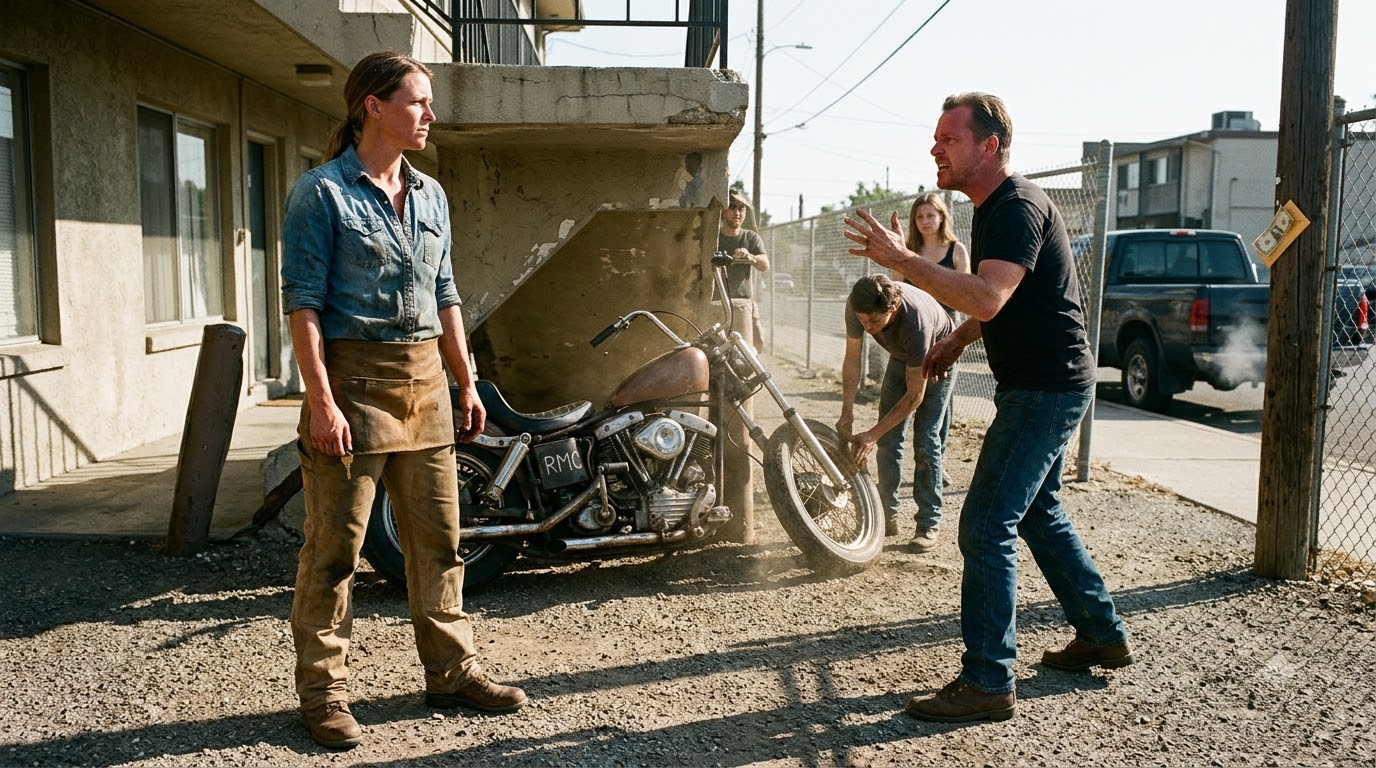
The Harley sat wedged under the stairwell, its rusted frame catching the sharp angle of three o’clock sunlight. Jacob and Sophie were sitting on the bottom step, Jacob carefully scraping dry mud off the front wheel with a ice-pop stick.
Before Mara could reach the bottom step, a boots-on-gravel crunch sounded near the chain-link perimeter fence.
The seller stood there, hands jammed deep into his work pants. He wasn’t wearing his shop shirt today. His posture had lost its embarrassed slouch, replaced by the rigid, restless twitch of a man who realized he had made a terrible mistake.
“Hey,” he called out, his voice clipping through the hot air. “Ellison.”
Mara stopped, shifting her grocery bag to her left arm. “You’re on private property, Miller.”
Miller didn’t step back. He stepped forward, his thumb hooking over his belt loop, trying to project a weight he didn’t possess. “Need the bike back.”
Mara let out a short, dry breath. “It’s sold. You took the cash.”
“Deal’s off,” Miller snapped, his jaw tightening as he took two fast paces toward the stairwell alcove. “Buddy of mine owned that frame before I found it. He wants it back. I brought your six hundred.”
He slapped a dirty paper envelope against the chain-link fence post. The crack echoed across the quiet courtyard.
“I don’t care about your buddy,” Mara said, stepping directly between Miller and her kids. She didn’t raise her voice, but her posture locked like concrete. “You sold it. You took money I scraped together twenty bucks at a time while my kids ate beans. It’s mine.”
“You don’t get it, lady!” Miller shouted, his composure snapping as he took another aggressive step, his boots kicking up dust. “That frame’s got eyes on it now! You think you can just drag a piece of history onto Fair View Drive and play tough single mom?”
“Mom,” Jacob whispered, standing up and pulling Sophie behind him.
“Stay back, Jacob,” Mara said smoothly, her eye locked on Miller’s face.
She pulled her hand from her pocket. The grease-stained brass ignition key glinted in the sunlight, resting flat across her knuckles. She didn’t brandish it like a knife; she held it like a seal.
“I didn’t steal it,” Mara said, her voice steady as iron. “I didn’t hide it in a ditch. I pushed it down the middle of the street in broad daylight. If your people want this machine, they can come talk to me face to face. But you aren’t touching it.”
Miller’s face went red, then pale. He looked past her shoulder, his eyes darting toward the street where a dark pickup truck had just idled to a stop at the curb, its engine rumbling like distant thunder.
“You’re an idiot,” Miller muttered, his confidence evaporating into frantic desperation as he backed toward the gate. “You’re sitting on a bomb, Ellison.”
“Then I’ll sit on it,” Mara said. “Get off my lot.”
CHAPTER 4: THE IRON PERIMETER
Miller scrambled backward toward the gate, his boots dragging in the dirt as the passenger side door of the truck swung open.
Duke Ramirez stepped out first, his heavy boots hitting the pavement with a clean, deliberate crunch. Behind him came three more riders, moving in a silent, disciplined line that instantly squeezed the air out of Fair View Drive. They didn’t shout. They didn’t draw weapons or flash patches. They simply took the space, spacing themselves six feet apart along the curb until Miller was effectively pinched against his own fence.
Then the driver’s door opened.
Ronan Maddox stepped down onto the asphalt. He was taller than Duke, his shoulders broader, carrying a graying beard cut close to the jawline. His eyes swept the street—taking in Mrs. Patterson’s twitched curtain, the two teenagers frozen on their bikes, and the dirty six-hundred-dollar envelope sitting on the fence post—before settling on Mara.
“Miss Ellison,” Ronan said, his voice deep, quiet, and rough as gravel.
Mara didn’t back up an inch. She shifted Jacob and Sophie slightly behind her waist, her grip on the brass key tightening until the wire ring bit hard into her thumb. “If you’re here to back up Miller’s story, you’re wasting your gas.”
“Miller’s a middleman who talks too much when he’s scared,” Ronan said softly. He didn’t look at Miller, but Miller shrank two inches deeper into his collar anyway. “I’m not here for your money, and I’m not here to scare your kids.”
Ronan walked past the gate, his eyes tracking directly to the dark alcove under the stairwell where the rusted Harley sat. He crouched beside the machine, his large hands hovering an inch above the frame without touching it.
Duke stepped up beside him, clicking on a small steel flashlight. The bright LED beam cut through the shade, illuminating the lower manifold.
“Show her, Duke,” Ronan muttered.
Duke reached down with a pair of long-nosed pliers, clamped onto a sheared bolt near the lower cylinder head, and backed it out with two effortless twists.
“Snap-cut,” Duke said, holding the metallic fragment up so Mara could see it. “Manifold screw was notched with a file, then torqued until it was holding by a hair. You kick this starter or push it down a hill to jump it, the vibration drops the valve straight into the cylinder. Engine locks at thirty miles an hour. Launches whoever’s on the seat straight over the bars.”
Mara’s breath hitched in her throat, her chest tightening as she looked from the jagged metal bolt to Sophie’s pink sandals sitting on the bottom step.
“That wasn’t wear and tear,” Ronan said, standing up slowly, his eyes locking onto Mara’s with absolute, unyielding clarity. “Someone didn’t want Cole’s bike running again, but they didn’t want to scrap it either. They set a landmine and left it in a yard for an amateur to buy.”
“They wanted an accident,” Mara whispered, her dry wit dissolving into cold, pragmatic fury.
“They wanted a distraction,” Ronan corrected. “Which means this stopped being about a lost motorcycle twelve years ago. This machine was hidden here as collateral, and whoever notched that bolt is coming back to make sure nobody asks what’s buried inside the frame.”
He turned toward his men at the curb. “Unload the flatbed. We aren’t taking the bike anywhere. We’re rebuilding it right here in this lot.”
Mrs. Patterson’s front door creaked open five inches. “You can’t do construction in this lot!” she yelled, her voice trembling with weaponized authority. “I’ll call the city manager! I’ll have the property towed!”
Ronan didn’t even turn his head. “It’s private maintenance, ma’am. Go back inside.”
CHAPTER 5: REBUILDING BALANCE
“Hold that bracket, Jacob,” Duke ordered softly, pointing a black-greased thumb toward the lower frame tube.
Jacob didn’t hesitate. He dropped to his knees in the dirt, his small hands clamping firm around the cold iron pipe while Duke unbolted the compromised intake manifold.
Mara stood right at the edge of the alcove, her fingers resting against the cool brick wall. Across the courtyard, Miller was still standing by the street corner, pacing back and forth like a caged dog while two of Ronan’s riders watched him with deadpan silence.
Ronan pulled a heavy steel box from the flatbed and set it on the bottom stair with a thud that shook the concrete rail. He opened the lid, revealing clean, oily replacement hardware, fresh rubber lines, and a hand-honed cast iron cylinder sleeve.
“You’re fixing it,” Mara said, stepping closer. “Not taking it.”
“I told you,” Ronan said without looking up, his fingers selecting a six-millimeter Allen wrench. “We don’t take what isn’t ours. You paid your six hundred. The iron belongs to you. But the mess inside it belongs to us.”
“And Miller?” Mara asked, leaning in so the kids wouldn’t hear.
“Miller thought he was middle-man for a local crew running stolen parts off the interstate,” Ronan said, his voice dropping into a rasping murmur. “He stored this frame in his yard for three years because he was too terrified to sell it and too greedy to scrap it. Then you walked up with six hundred bucks cash, and he thought he found his clean exit.”
“He thought I’d get hurt when it broke, or sell it off to some chop shop before anyone noticed,” Mara said, her thumb sliding over the brass key in her pocket.
“He didn’t think at all,” Duke interjected, applying twenty pounds of torque to a fresh manifold nut until the metal gave a clean, sharp snap. “That’s Miller’s problem. He lives five minutes at a time.”
Across the lot, Miller suddenly snapped. He shoved his hands into his pockets and took three fast, aggressive steps toward the stairwell, his face red and splotchy under the sun.
“This is harassment!” Miller screamed, his voice cracking as he pointed a trembling finger at Ronan. “You can’t just occupy an apartment parking lot with heavy equipment! I’m calling the landlord! I’m calling the owner of this whole block!”
Mrs. Patterson poked her head back out her window, holding her phone like a weapon. “I’ve already got the property manager on line three, Miller! They’re sending a tow rig!”
Mara stepped out from the shade of the stairwell, walking straight toward the gate until she was five feet from Miller’s red face.
“Call him,” Mara said, her voice flat, dry, and carrying across the entire courtyard. “Tell him you sold a sabotaged vehicle on his property. Tell him you took six hundred cash from a tenant for a machine meant to wreck under her feet. Go ahead, Miller. Pull out your phone.”
Miller froze, his thumb hovering over his screen as his throat hitched. He looked at Mara’s unblinking eyes, then past her shoulder at Ronan Maddox, who was calmly tightening the final head bolt on a motor that hadn’t breathed in twelve years.
“I didn’t notch that bolt,” Miller stammered, his posture collapsing into a pathetic, desperate hunch as he tried to shift the blame to empty air. “I just stored the frame! I didn’t know what was in the manifold!”
“You knew enough to bring six hundred bucks in an envelope to buy my silence,” Mara said, stepping directly into his personal space until Miller backed his heel against the chain-link fence. “Take your envelope off my post and get off my street.”
Miller reached out with a shaking hand, snatched the dirty paper envelope off the wire fence, and turned on his heel, stumbling down the sidewalk without looking back once.
Behind her, a sharp, metallic click echoed through the alcove.
Ronan stood up, turning a key in a freshly wired ignition switch. The starter motor grunted once, coughed a cloud of dry dust out the open pipe, and then roared to life—a deep, rhythmic, thunderous pulse that vibrated straight through the concrete floorboards under Mara’s feet.
CHAPTER 6: THE DUSTY HORIZON
The iron frame thuttered with a deep, low rumble, the exhaust pulsing smooth and clean against the concrete steps.
Ronan reached over, clicked the kill switch, and the engine cut out into a heavy, peaceful silence. Duke wiped his tools down with a red rag, tossing them back into the flatbed with sharp, final thuds.
Ronan stepped up to Mara, reaching into his heavy canvas jacket. He didn’t pull out a demand, and he didn’t pull out a checkbook. He handed her a small, folded piece of yellowed paper.
“Found it inside the air cleaner box when we pulled the throat apart,” Ronan said softly. “It’s in Cole’s handwriting.”
Mara unfolded the note with careful fingers. The pencil lead was faded, but the words cut through twelve years of dust: If this iron’s moving again, someone had the grit not to let it rot. Don’t chase ghosts. Just keep the wheels turning.
“Cole knew what kind of men were circling his shop back then,” Ronan said, meeting her eyes directly. “He hid the frame where it would only be found by someone willing to push it themselves. You earned this machine, Miss Ellison. All six hundred dollars of it.”
“And the people who notched that bolt?” Mara asked, her thumb tracing the paper’s edge.
“They’re cut out,” Duke said, closing the flatbed tailgate with a loud, metallic latching sound. “We tracked the supply line back to the county line three hours ago. There’s nothing left for them to reclaim here.”
Ronan nodded once, stepping back toward his truck. “You aren’t invisible anymore, Mara. People on this street know you don’t break.”
Mara didn’t answer with grand promises. She simply slid Cole’s note into her apron pocket alongside her brass ignition key, walking over to the machine.
She swung her right leg over the heavy leather saddle. The machine balanced under her weight, solid, heavy, and completely stripped of its ghosts. She turned the brass key into the new tumbler, pressed the thumb starter, and felt the iron spring to life beneath her palms—a steady, vibrating pulse of absolute independence.
Mrs. Patterson watched from her porch, her hand resting motionless on her dead fern, completely out of complaints.
Jacob and Sophie stood on the bottom step, grinning as the engine thotted softly in the late afternoon sun. Mara didn’t look at the windows, and she didn’t look back at the apartment door. She twisted the throttle just enough to feel the mechanical tension, kicking the stand up, and guided the machine smoothly out onto the open pavement of Fair View Drive.