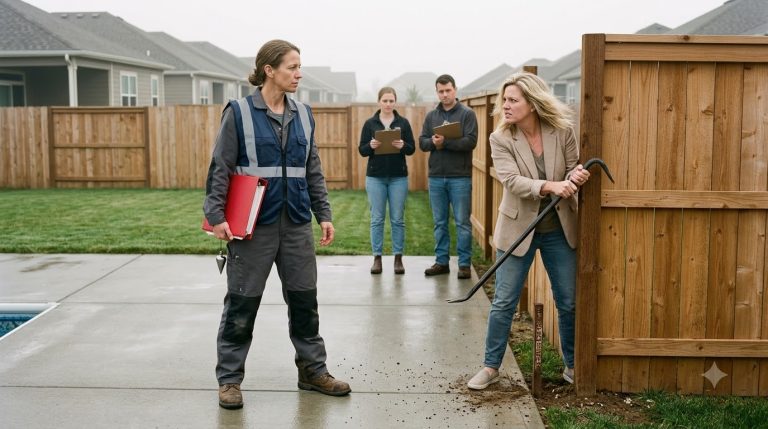
The Iron Shackles Of Ownership: How A Quiet Property Owner Taught A Delusional HOA Queen A Floating Lesson In Real Estate Law
CHAPTER 1: DAWN INTRUSION
The coffee pot sat cold on the counter, but the sound coming down from the water was unmistakable.
A sharp, metallic clink echoed across the damp timber of the dock, followed closely by the muffled, rhythmic thump of a bassline playing through a small speaker.
I stood in the center of the kitchen floor, staring down at my bare feet planted firmly against the cold linoleum.
I hadn’t opened the boat house in a month.
The heavy steel padlock had been clicked shut with enough grease on the shackle to keep the salt air from seizing it, and the key sat on a brass hook right by my coffee maker.
Yet Kenny G was drifting softly across the lake at five in the morning.
I reached for the old flashlight on the counter, my thumb finding the worn rubber switch out of pure habit.
The batteries were fresh, but the weight of the metal casing felt heavier than usual against my palm.
I didn’t bother pulling on socks; I shoved my feet straight into my rubber-soled work boots, leaving the laces untied so they slapped against my ankles with every step.
The path down to the water was choked with damp gravel and wild ferns heavy with morning dew.
Every breath tasted like cold iron and rotting cedar.
I figured it was a raccoon that had squeezed through the old drainage slats, or maybe some local kid looking for a dry place to crash out of the wind.
You get used to small nuisances when you live at the edge of the county line, far enough from town that common sense is often the only law anyone respects.
The boat house door stood slightly ajar.
A thin strip of warm, amber light cut across the dark water of the slip, spilling out over the wooden decking where my old cedar kayak usually sat untouched.
I stopped three paces short of the threshold, my boots crunching softly on the gravel.
The air didn’t smell like mildew or damp canvas.
It smelled like lavender.
Thick, heavy, synthetic lavender that hung in the mist like perfume in a barbershop.
I clicked the flashlight on, sweeping the beam across the open doorway.
A pink inflatable flamingo floated unsteadily in the water right beside my boat lift, its plastic neck bobbing with the gentle rise of the lake.
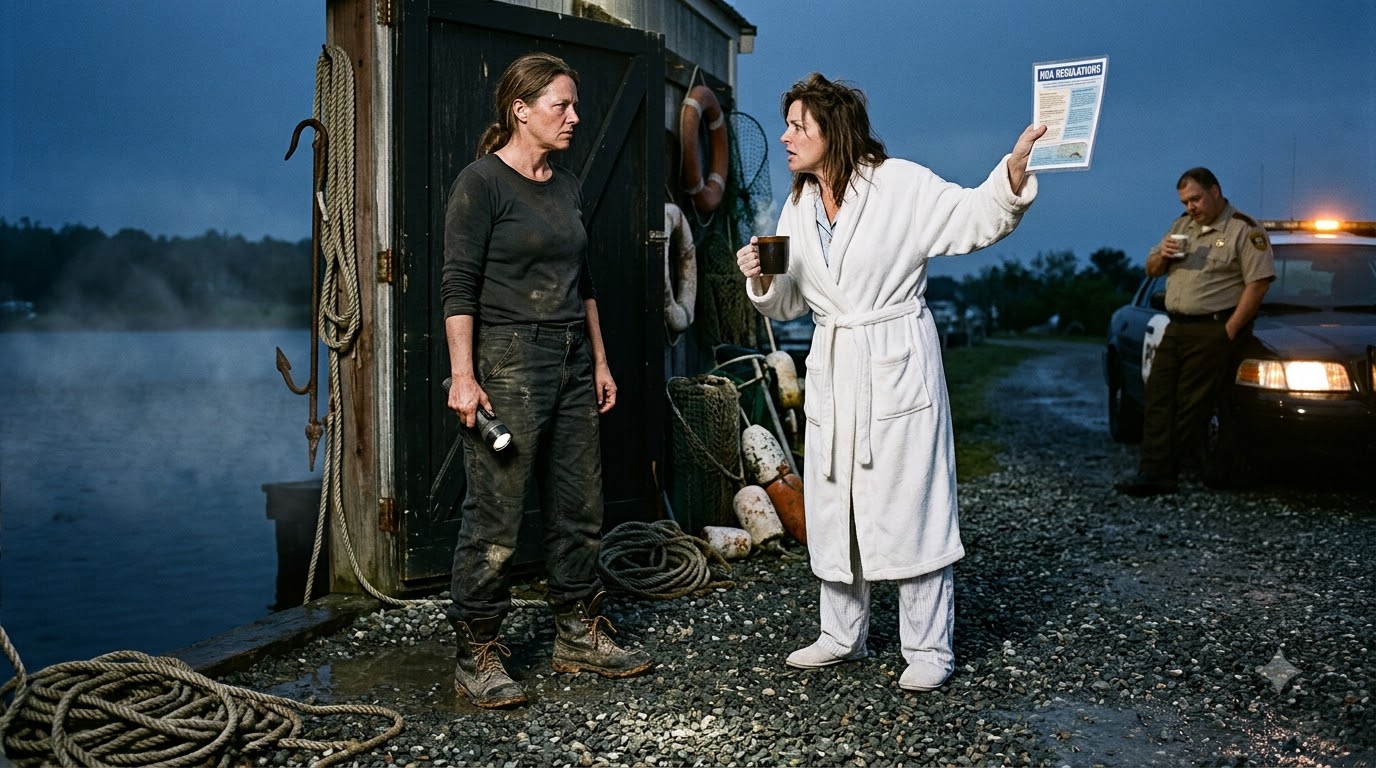
And sitting comfortably in my favorite canvas folding chair, wrapped in a plush white bathrobe with a ceramic mug of steaming tea in her hand, was Karen.
She didn’t jump. She didn’t drop her mug.
She simply turned her head toward the beam of my flashlight, squinted against the glare like a sunbather checking a noon sky, and offered a casual, two-finger wave.
It was the exact same wave she used at the annual neighborhood association bake sale when she expected everyone to hand over twenty dollars for stale brownies.
My thumb stayed locked on the flashlight switch.
The beam trembled just a fraction, not from fear, but from the sudden, jarring realization that my private property had been colonized by a suburban tyrant.
CHAPTER 2: LAMINATED DELUSION
I let the flashlight beam drop from her face, letting the light catch the pink inflatable flamingo bobbing beside the dock.
“Abandoned,” I said, tasting the word like sour milk. “There’s a full solar array on the roof and a security deadbolt on the frame.”
Karen didn’t blink.
She simply shifted her weight in my folding chair, the aluminum legs screeching against the cedar planks.
She reached down to the small side table she must have hauled up from the neighborhood common racks, picked up her ceramic mug, and took a slow, deliberate sip.
“Well, it hasn’t been occupied in three weeks,” she replied, her voice smooth and dripping with the casual condescension of someone who spent twenty years chairing the landscape committee. “In our community bylaws, that classifies as a dormant asset. Under Article Twelve, Section Four, dormant waterfront structures revert to shared neighborhood access for wellness and recreational utilization.”
I stared at her, waiting for the punchline, waiting for her to crack a smile and admit she was pulling my leg.
Instead, she picked up a neatly folded piece of cardstock with a gold foil seal—our local homeowners association logo—and tapped it against her knee.
“You really should attend the quarterly meetings,” she added, adjusting the lapel of her plush bathrobe. “You’ve built this lovely little sanctuary right on the edge of our jurisdictional buffer zone, but you keep it locked away like a hermit. A community thrives on shared energy, not padlocks.”
The sheer audacity of it hit me not with a flash of blind rage, but with a cold, heavy weariness.
I didn’t live in their HOA.
I bought this parcel three years before the subdivision even broke ground on the cow pasture up the hill.
My deed was recorded with the county courthouse, mapped out by a licensed surveyor who knew the exact coordinates of the shoreline.
Yet here sat Karen, treating my private dock like an extension of the community pool house because the grass near my boat ramp was slightly overgrown.
“You’re not inside my property line,” I said, stepping past the threshold onto the dock, my boots thudding hard against the wood. “And that pamphlet doesn’t override a county deed.”
Karen didn’t flinch, but her fingers tightened around the ceramic mug until her knuckles went pale.
She reached over and grabbed the laminated pamphlet again, holding it up like a shield.
“We filed the boundary expansion rider six months ago,” she said, her voice sharpening just enough to cut through the hum of Kenny G. “When you fail to maintain active aesthetic compliance, the association board has the right to step in and stabilize the neighborhood property values. I’m just here protecting my investment.”
I stopped two feet from her chair, looking down at the hand-painted rocks she had arranged along the dock rail—little pastel stones with words like Serenity and Mindfulness scrawled in black Sharpie.
My kayak paddle, which I had left leaning against the back wall, had been moved to make room for a rack of yoga mats.
She hadn’t just broken in; she had moved her entire suburban reality onto my timber.
“Get your things,” I said, my voice dropping an octave. “You have ten minutes to clear this deck before I lock the gate permanently.”
Karen smiled, a tight, thin curve of the lips that lacked any warmth at all.
“Try it,” she whispered, leaning back and closing her eyes as the jazz music swelled over the water. “I already texted the deputy on duty that you’re harassing a resident during a scheduled wellness session. Let’s see who the county listens to.”
CHAPTER 3: BLUE UNIFORM INDIFFERENCE
Deputy Miller didn’t turn off his cruiser’s engine.
The amber light bar on the roof pulsed in slow, rhythmic flashes against the cedar siding of my house as he climbed out, smoothing the front of his tan uniform shirt with one heavy hand.
He didn’t look down at my property plat map, nor did he glance at the survey stakes marking the exact boundary line fifty yards up the hill.
Instead, his eyes drifted straight toward the water, where Karen was already holding open the screen door of the boat house with a steaming mug in her hand.
“Morning, Tom,” the deputy said, his voice flat and worn out from a twelve-hour shift handling highway speeders and neighbor disputes. “Got a call about a disturbance down by the docks. Mrs. Gable says you’re disrupting her wellness session.”
I pulled the padlock out of my pocket, letting the heavy shackle catch the morning light.
“She broke into my private boat house, Miller,” I said, pointing a finger down the rocky trail. “It’s locked property outside the HOA limits. Look at the deed I filed with the county courthouse three years before that subdivision even cleared the timber.”
Miller let out a long, dry breath, a small cloud of morning mist escaping his lips before he reached down to adjust the heavy leather belt on his hip.
“I looked at your papers last month when you called about the fence line, Tom,” he muttered, shaking his head. “And Mrs. Gable showed me her association packet. She’s got documentation stating the structure falls under dormant community oversight. That makes this a civil matter, not a criminal trespass.”
I stared at him, the blood humming hot and steady behind my ears.
“Civil matter? She changed my locks and put up a pink flamingo.”
“Take it up with a judge,” Miller replied, turning his back on me and heading down the path toward the water where Karen was waiting with a fresh ceramic saucer.
I watched as the deputy accepted a cup of hot tea from her hands, listening with a polite nod as she explained her vision for a weekend mindfulness retreat.
There was no badge of authority protecting my property line today; the uniform had decided it was easier to drink tea with the loudest voice in the neighborhood than read a county deed.
When Miller finally climbed back into his cruiser and rolled down the lane without another word, Karen gave me a crisp, cheerful salute from the dock rail.
I stood alone on the gravel driveway, the weight of the steel padlock heavy against my ribs, realizing that if the law wasn’t going to clear my land, I was going to have to find a language a suburban tyrant couldn’t argue with.
CHAPTER 4: THE LEGAL LOOPHOLE
Midnight had come and gone without a sound from the water, save for the faint, tinny echo of Kenny G drifting up through the dark trees.
I sat under the harsh glare of a single brass desk lamp, turning page after page of state water statutes until my eyes burned.
The deputy had washed his hands of it, and the homeowners association had slammed the door on my letters.
They thought they had locked me out of my own land with their fake bylaws and laminated jurisdiction riders.
They forgot that a piece of real estate is only as fixed as the ground it rests on.
I paused at Chapter 412 of the municipal code, focusing on the subsection governing riparian rights and navigable waterways.
There it was, printed in small, precise serif text that nobody ever bothered to read unless they were settling a marina dispute.
The moment a permanent structure built over water loses its rigid physical attachment to the deeded bedrock and floats freely on the surface, its legal classification shifts entirely.
It ceases to be real property under local zoning boards.
It becomes a vessel.
And a vessel is governed by maritime transit rules, not neighborhood landscape committees.
I leaned back in my wooden chair, the joints groaning under the shift in weight, and stared out the kitchen window toward the dark silhouette of the boat house down by the lake.
The high-water line from the spring thaw had lifted the entire wooden platform just a fraction off its concrete footings.
The slack in the old mooring cables wasn’t a maintenance oversight; it was an open door.
If it wasn’t a fixed building anymore, and if the HOA’s jurisdiction only covered dry land within their registered subdivision plat, then Karen wasn’t occupying a community-adjacent amenity.
She was squatting on an unmoored watercraft floating in the middle of a public lake.
A slow, hard grin settled into the corners of my mouth as I closed the statute book with a dry thud.
She wanted a retreat center.
I was about to give her a voyage she would never forget.
CHAPTER 5: THE RUSTED ENGINE
The tugboat looked like it had survived three wars and a hurricane, its iron hull scarred with orange scabs of rust and gray primer.
It idled at the edge of the public boat ramp two miles down the shoreline, blowing a thick puff of dark blue smoke into the damp morning air.
The operator leaned out of the pilot house, wiping a greasy wrench against his overalls and squinting across the water.
“You sure about this, mister?” he shouted over the heavy, rhythmic thrum of the diesel pistons. “Moving a docked structure across county water line without a local permit usually stirs up a hornet’s nest.”
I tossed a heavy coil of nylon tow line onto the rusted steel deck, my boots landing hard behind it.
“It’s not a structure anymore once it leaves the pilings,” I said, my voice cutting through the exhaust fumes. “Check the maritime code under unanchored floating platforms. It’s classified as a drifting vessel.”
The operator let out a short, gravelly bark of laughter, shook his head, and reached for the gear shift.
“Well, maritime law is a funny thing when you put enough horsepower behind it,” he muttered, throwing the transmission into forward. “Hook her up.”
By midday, we had navigated the twin hulls around the rocky bend of the shoreline until we sat fifty yards off my private cove.
The boat house stood quiet in the midday sun, its windows draped with the white sheer curtains Karen had hung up over my tool racks.
The pink inflatable flamingo bobbed lazily on the ripples near the slip, completely unaware that its floating retreat center was about to experience a severe change in latitude.
I stood on the bow of the tug, holding the heavy steel shackle pin between my thumb and forefinger as we drifted closer to the old wooden pilings.
The mooring cables were already slack, just as the high-water line had left them.
All it took was two heavy loops of nylon line dropped over the corner posts, and the entire structure groaned in protest as the diesel engine took up the slack.
Karen stepped out onto the front deck, a ceramic plate of cucumber sandwiches balanced in one hand, her face contorted in sudden, absolute outrage as the floorboards beneath her feet began to slide away from the shore.
CHAPTER 6: DRIFTING INTO OBLIVION
Karen dropped her plate of cucumber sandwiches, the porcelain shattering against the freshly swept deck boards with a sharp, brittle crack.
“Stop right there!” she screamed, lunging toward the edge of the receding platform as the gap between her floating retreat and my shoreline widened by three feet, then ten, then twenty. “You are violating association property! I will have the sheriff back here before you can blink!”
I stood on the bow of the rusty tugboat, keeping my hand steady on the nylon tow line as the diesel engine hummed a deep, steady bassline.
“There’s no sheriff coming, Karen,” I called back across the water, my voice carrying clean and flat over the gray ripples. “Check your association plat map. You’re past the property line. You’re past the municipal boundary. You’re floating on open state water.”
Her face flushed a deep, mottled crimson that clashed violently with her plush white bathrobe.
She whipped out her phone, punching the screen with frantic, stabbing gestures, pressing it to her ear while her eyes darted frantically around the open lake.
“Deputy Miller! Yes, it’s me—he’s kidnapping my wellness center—no, I am not joking, send a cruiser—”
Her voice faltered as the tugboat pulled her further out toward the center of the basin, where the cellular signal bars flickered and died against the distant tree line.
The HOA president’s emergency backup plan dissolved into a string of angry, unintelligible muttering as her screen went black.
The boat house drifted smoothly in the wake of the tug, trailing its pink inflatable flamingo like a pathetic little anchor of entitlement.
By afternoon, we had anchored the unmoored platform out past the deep-water marker, right where the state water commission designates public recreational drift zones.
The HOA board members stood in a cluster on the distant public beach, staring through binoculars at their former queen stranded a quarter-mile offshore with her yoga mats and lavender candles.
Karen didn’t last forty-eight hours out there on her floating Pinterest board before she had to signal a passing fisherman to tow her back to the public dock under the humiliation of a hundred staring neighbors.
Her board seat vanished at the next election, replaced by a quiet amendment called the boundary clause that barred any HOA official from ever setting foot outside registered neighborhood bounds.
I walked back down the rocky path to my private dock that evening, the air smelling of clean cedar and cold lake water instead of synthetic lavender.
The heavy steel padlock slipped smoothly back onto the boat house door with a sharp, satisfying click that echoed across the quiet cove.
I turned the key, pocketed the brass ring, and walked back up to my kitchen to pour a cup of hot coffee, leaving the lake to the wind and the silence where it belonged.