Standing Ground Against Overreach: How One Property Consultant Defeated an Unruly HOA President
CHAPTER 1: THE MORNING BREACH
The sun had barely scraped the horizon. It painted the sky in pale, washed-out gold.
I stood in the center of my kitchen, wrapped in silence. My coffee was hot and bitter against my tongue.
Then came the scrape. It was sharp, jagged, and entirely unwelcome.
Metal grating against dry concrete.
I set the ceramic mug down on the counter with a quiet, deliberate click. My pulse didn’t race with blind panic. It settled into a heavy, rhythmic thud.
I stepped up to the kitchen window and looked out at the pool deck.
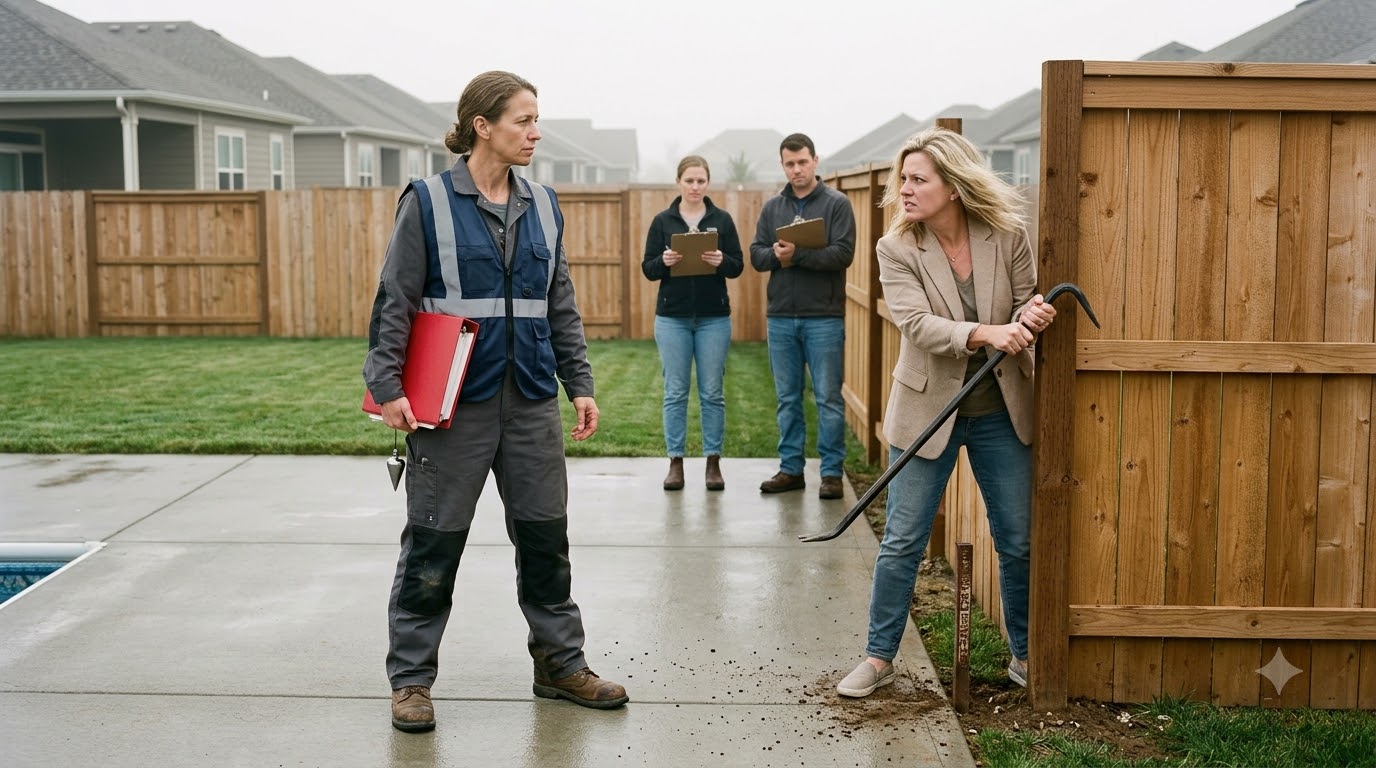
There she was. Karen, the HOA president, stood in a pressed beige blazer that looked absurdly out of place in the morning mist. A heavy iron crowbar was gripped in her manicured hands. Two lackeys flanked her, holding clipboards like shields.
They were prying at the corner post of the privacy fence I had finished anchoring just the day before.
“Get it off his property before he thinks he can do whatever he wants,” Karen barked. Her voice cut sharply through the morning air.
She thought she owned the world. She certainly acted like she owned every square inch of this subdivision.
My surveyor stakes were hammered firmly into the dirt. The property lines were clear. She was standing six feet inside my legal boundary.
Without the security cameras to instantly bail me out, I had to rely on something far more permanent. Paper, cold law, and cold physical presence.
I reached into my pocket and wrapped my fingers around a heavy, worn brass plumb bob. I rolled its cold metal weight between my thumb and forefinger.
I didn’t yell out the window. I didn’t give them the satisfaction of an early warning.
I turned away from the glass, walked to the hallway closet, and picked up a thick binder stuffed with county deeds, permits, and certified maps.
The lock on my back door turned with a dry, mechanical click.
I stepped out onto the cool concrete of the pool deck, letting the heavy wooden door swing shut behind me.
Karen didn’t look up immediately as I approached. She jammed the tip of the crowbar deeper into the cedar joint, straining against the wood.
“You’re swinging that tool in the wrong zip code, Karen,” I said. My voice was flat, level, and completely devoid of fear.
She froze, the crowbar suspended mid-lever. She spun around, her face twisting instantly from smug authority to defensive irritation.
CHAPTER 2: THE PAPER WALL
Karen snatched her hand back from the fence post as if the cedar had burned her.
“You don’t have authorization for this structure,” she snapped, stepping back while her lackeys shifted uncomfortably behind her.
I didn’t blink. I pulled the top file from the thick binder tucked under my arm and flipped it open to the county-certified stamp.
“Section four, paragraph two of the municipal code grants property owners full clearance for privacy barriers up to eight feet,” I said, my voice cutting through the morning stillness with flat, unyielding weight.
She stared at the document, her jaw tightening until the skin around her mouth went white.
“The HOA doesn’t recognize that municipal override,” she shot back, raising her voice to reclaim territory she was rapidly losing.
Without my security cameras to rely on, every word had to be anchored to hard physical evidence. I tapped a finger against the embossed county seal on the paper.
“The county recorder’s office recognizes it, and that’s the only stamp that carries legal weight in this zip code.”
Karen’s gaze darted down to the corner of the pool deck where the concrete met the foundation. Her eyes locked for a fraction of a second on a small, rusted metal pin embedded in the stone—a mismatched lot-line marker that didn’t match standard county blueprints.
It was a tiny, misplaced anomaly, but her reaction to it was immediate and sharp. She covered it quickly with the heel of her shoe, shifting her weight to block my view.
“You’re making a massive mistake,” she warned, her voice dropping into a low, threatening register. “The board will vote to fine you out of this house before the week is over.”
“Send the paperwork,” I replied, sliding the folder back against my chest with a dry, heavy slap. “I keep every single notice in a file twice this thick.”
She turned on her heel, motioning furiously for her clipboard-wielding lackeys to follow.
They retreated down the driveway, their boots crunching loudly over the gravel in angry rhythm.
I stood alone on the deck, the heavy brass plumb bob pressing cold against my thigh through the fabric of my pocket.
The first wave had broken against the boundary line, but the real pressure was only just beginning to build beneath the surface.
CHAPTER 3: THE BROKEN TRUST
Dennis didn’t look like a man ready to start a war. He stood near the edge of the lawn, clutching a worn manila folder against his chest like a shield.
“I saw what she tried to pull this morning,” Dennis said, his voice dropping low as he glanced nervously toward the empty street.
I didn’t invite him inside right away. I let the silence stretch between us, feeling the rough texture of the cedar post beneath my fingers.
“People around here usually look the other way when Karen starts drawing lines,” I replied, my tone flat and testing.
Dennis swallowed hard, a bead of sweat catching the pale sunlight near his collar. He wasn’t looking for glory; he just looked tired of walking on eggshells.
“She didn’t just draw lines on your property,” Dennis muttered, extending the worn manila folder across the gap. “She did it to my lot five years ago, and I backed down because I didn’t want the trouble.”
I took the folder, feeling the grit of old paper between my thumbs.
Inside lay a stack of original neighborhood covenants stamped long before Karen took over the board.
A sharp memory hit me—the exhausting years spent wading through bureaucratic red tape for clients who had everything stolen by small-minded officials.
I flipped the pages until my thumb stopped on a heavily altered clause near the back.
“These architectural amendments,” I said, pointing to a stark mismatch in the ink quality. “They aren’t registered with the county clerk.”
Dennis gave a slow, grim nod, his eyes avoiding mine out of lingering guilt.
“She backdated them last month to force compliance on any new construction near the commercial corridor,” Dennis admitted.
I closed the folder with a sharp snap that echoed across the quiet lawn.
The first layer of the deception was cracking right open, and it pointed straight toward the municipal archives downtown.
CHAPTER 4: THE COUNTY RECORD
The air inside the municipal building smelled like old paper, floor wax, and stalled bureaucracy.
I dropped the heavy stack of property records onto the scarred oak intake counter with a hollow thud.
The clerk behind the glass didn’t look up from her computer screen right away. She typed another slow sentence before sliding her gaze toward me with professional exhaustion.
“If you’re filing a standard grievance, the window closes in twenty minutes,” she said, her voice flat.
I slid Dennis’s backdated covenants across the counter alongside my own certified property title.
“I’m not filing a grievance,” I replied, keeping my tone level. “I’m executing a boundary audit on an active municipal easement grab.”
She glanced down at the papers, her eyes catching the irregular ink stamps near the bottom corner.
A sharp crease formed between her eyebrows as she pulled the file closer under the desk lamp.
“These amendment signatures don’t match the county register from that fiscal year,” she muttered, her fingers tapping a nervous rhythm against the keyboard.
“Because they were manufactured after the fact,” I said, leaning closer to the glass. “Cross-reference the commercial zoning applications submitted by the subdivision president for the adjacent strip development.”
The clerk’s fingers paused entirely over the keys.
She clicked open a secondary database, her screen illuminating her face in pale blue light.
“The commercial expansion permit lists a private access corridor cutting directly through the rear property lines of this subdivision,” she whispered, the realization hitting her voice all at once.
The true purpose of the harassment wasn’t just aesthetic control or petty neighborhood rules. Karen had been systematically pushing residents off their land to clear a commercial easement for a lucrative outside developer.
The second layer of the deception had just blown wide open, exposing a massive legal liability right in the middle of public records.
CHAPTER 5: THE INJUNCTION HEARING
Karen sat across the aisle in a tailored navy suit, her posture rigid and her face flushed with absolute indignation.
She leaned toward her attorney and whispered a sharp, frantic instruction, refusing to accept that her control was slipping.
The magistrate adjusted his glasses, scanning the municipal easement printouts I had slid across the bench.
“These documents indicate a systematic alteration of property boundaries without public notice,” the magistrate said, his voice carrying a dry, judicial weight.
Karen stood up before her counsel could speak, her hands slamming flat against the railing.
“This is an administrative vendetta by an uncooperative resident who refuses to follow standard neighborhood guidelines!” she snapped, her voice echoing loudly through the room.
She refused to surrender, doubling down on her manufactured authority with total, unearned arrogance.
I didn’t yell or point fingers across the aisle. I kept my fingers steady, resting flat against the edge of my binder.
“The guidelines she’s enforcing were backdated after my privacy fence was erected,” I said, my tone flat, calm, and completely level. “They were designed to clear a private commercial easement through residential titles.”
The magistrate glanced back down at the fraudulent covenants, then up at Karen’s rigid expression.
“The court grants an immediate preliminary injunction halting all HOA enforcement actions against this property,” the magistrate ruled, striking his gavel once more.
Karen turned red, her jaw trembling with suppressed fury as her entire defense dissolved into thin air.
CHAPTER 6: THE QUIET POOLSIDE
The afternoon sun hung low over the subdivision, casting long, unbroken shadows across the cedar planks.
Inside the neighborhood, the HOA board had dissolved into sudden, chaotic resignations as the commercial easement scandal went public.
Neighbors who used to pull their curtains shut when I walked past now offered quiet nods from their front porches.
I walked out to the pool deck and pulled a heavy wooden chair up to the edge of the water.
There were no crowbars, no clipboards, and no uninvited voices shouting over the fence line.
I reached into my pocket, pulled out the heavy brass plumb bob, and set it down on the concrete table.
It sat still, its metal tip pointing straight down to the solid ground beneath my feet.
I poured a fresh cup of coffee from the ceramic pot I brought outside, watching the steam rise into the cool evening air.
The water in the pool was completely calm, reflecting the pale orange light of the sunset without a single ripple.
For the first time since I moved into this house, the boundary lines belonged to me, and the noise was entirely gone.
I sat back in the chair, took a slow sip, and let the quiet settle over the yard.