The Iron Chamber: The Blood and Corrosion of the Umurbrogol Pocket
CHAPTER 1: THE WEIGHT OF BRASS
The brass felt too long.
James Donovan rolled a single cartridge between his thumb and index finger. Standard .45 ACP sat stubby in the palm, heavy with lead and soft jacket alloy. This was different. The casing stretched a quarter-inch longer than it should have, capped not with a rounded lead ball, but with a dark, dull copper matrix that smelled of industrial solvent and machine grease.
A heavy 7.7mm burst hammered the coral lip three feet above his head. White rock sprayed sideways, sharp as razor glass. Dust bit into the raw flesh of his cheek. Donovan didn’t blink. He kept his eyes locked on the headstamp stamped into the base of the shell: FAEXP44.
“Load them,” Sergeant Whitmore growled. He was crouched against the damp wall of the limestone crevice, his face smeared with grease paint and pulverized coral. His hands shook as he pried open the metal band on a green-painted wooden crate. “Don’t sit there measuring the damned thing.”
“It’s light,” Donovan said. His voice was flat, dried out by sixty days of salt air and cordite. He tapped the copper tip against his thumbnail. “Weight’s all wrong. Center of gravity sits back near the primer.”
“It’s explosive, Jimmy,” Whitmore spat, shoving a twenty-round stick magazine into Donovan’s chest. “It ain’t meant to weigh like lead. It’s meant to blow.”
Outside the crevice, the Umurbrogol ridge groaned under the impact of naval salvos. Fourteen-inch shells from the Mississippi tore through the air like freight trains running on ruined tracks. The ground jumped. Coral dust rained down from the cave ceiling, coating the grease on Donovan’s Thompson submachine gun in a white, chalky film.
Donovan thumbed the first round into the magazine. The spring fought back. The steel feed lips scratched the extended brass casing, leaving a thin, bright line along the metal.
He stopped. On the floor of the crate, beneath the tar-paper lining, lay a small card printed on water-resistant stock. Red ink spanned the top margin.
SPECIAL HANDLING: FM OD 89144. DO NOT STORE ABOVE 80°F. DISCARD IF COPPER SHOWS GREEN OXIDATION.
Donovan reached into the crate, prying the paper loose. Underneath the card, the wood bore a secondary stamp in black stencil, partially sanded off: PROJECT GLASS-JAW.
“Donovan,” Whitmore barked, grabbing his shoulder collar. The sergeant’s thumb rubbed raw against a blister on his own palm, a twitching, involuntary rhythm. “We got three minutes before the barrage lifts. Firing Port Three is covering the gulley. If that Nambu stays active when the boys move, Company B gets slaughtered on the wire.”
“The brass is oxidizing,” Donovan said quietly, holding up a cartridge from the bottom layer. A faint ring of verdigris ran around the primer pocket. “Look at the seal.”
“It fires or it doesn’t,” Whitmore said. His grip tightened until the fabric tore at the seam. “We don’t have a choice. Load the stick.”
Donovan didn’t argue. Argument was a luxury for men with rear-echelon billets. He slammed the box magazine into the Thompson’s mag well. The latch caught with a heavy, mechanical clack. He pulled the bolt back. The heavy actuator locked into the rear notch, exposing the open chamber.
He didn’t inspect the bolt face. He didn’t check his canteen. He slid his thumb down to the fire selector switch, flipping it off full-auto and locking it into single-shot.
Semi-auto only, the briefing had said. Do not cook them off.
Through the narrow split in the coral shelf, forty-seven yards across a moonscape of shattered rock, Firing Port Three sat buried in three feet of poured aggregate and coconut logs. The dark slit remained silent, waiting for the naval shells to stop. They knew the timing. The defenders knew the American infantry would come the second the thunder died.
Donovan pressed his shoulder into the walnut stock. The wood was cold, slick with his own sweat. He aligned the aperture sight with the black rectangle across the gap.
The naval bombardment cut out. The sudden silence hit harder than the explosions, a suffocating vacuum that filled instantly with the metallic clatter of Japanese bolts closing across the ridge.
“Take it,” Whitmore whispered.
Donovan squeezed the trigger.
CHAPTER 2: THE FRACTURE POINT
The firing pin struck the primer.
The Thompson didn’t bark with the dry, punching snap of standard .45 ball. It cracked with a heavy, wet thump that shuddered through the walnut stock, driving the steel buttplate back into Donovan’s collarbone with twice its normal recoil.
Across forty-seven yards of ruined coral, the frangible copper projectile struck the edge of Firing Port Three.
There was no pause. No ricochet ricochet-whine. A violent, brilliant flash of magnesium-white light burst against the grey aggregate wall, followed instantly by a sound like a heavy sledging hammer breaking dry oak. The three-foot concrete lintel split down the center. A cloud of fine, pale dust blew outward, carrying jagged chunks of aggregate that bounced off the jagged rocks ten feet in front of Donovan’s hideout.
Inside the darkness of the bunker, something metallic screamed—a heavy spring snapping under tension, followed by the dull, tumbling clatter of a dismounted Nambu machine gun hitting the dirt floor.
Donovan didn’t cheer. His cheek stayed pressed against the comb of the stock. Through the haze of hanging cordite and white lime dust, he saw the rectangular aperture had widened into a jagged, raw tear. The rebar inside glowed dull orange for a fraction of a second before cooling black.
“Hit,” Whitmore hissed, his breath hot against Donovan’s ear. The sergeant’s hand remained clamped on Donovan’s shoulder, his fingers twitching in rhythm with his pulse. “Hit it again. Before they bring up another crew.”
Donovan adjusted his aim by a fraction of an inch, aligning the front sight post with the dark gap where the lintel had collapsed. He squeezed the trigger a second time.
The bolt cycled backward, stripping the second FAEXP44 round from the stick magazine. The spent casing ejected upward, tumbling through the air. Donovan caught a flash of it in his peripheral vision—the extended brass was scorched jet-black from the mouth down to the shoulder, the metal warped into an oval near the rim.
The second round struck the interior backwall of the bunker.
The detonation inside the enclosed concrete cell was muffled, a deep, concussive crump that pushed a jet of black smoke and pulverized paper out through the breach. A high-pitched ringing filled Donovan’s left ear. The overpressure wave traveled across the forty-seven yards of open air, slapping his face with a sudden, warm draft that smelled of burnt sulfur and cooked grease.
Silence followed. The heavy 7.7mm chatter that had pinned Company B to the coral slopes for six hours was gone.
“Movement,” Donovan grunted.
Through the clearing smoke, two shapes scrambled through the ruined aperture. They weren’t raising rifles. They were bent double, hands clawed over their ears, blood leaking dark and thick from their noses and mouths. The concussive wave inside the five-by-five concrete chamber had ruptured their eardrums before the fragmentation could catch them.
Donovan didn’t pull the trigger. He lowered the barrel by two degrees, his eye tracking the men as they stumbled over the shattered log revetment and collapsed into the trench line behind the bunker.
“Finish them,” Whitmore growled, his voice rasping over the grit in his throat.
“They’re out,” Donovan said. His finger stayed resting outside the trigger guard, pressed flat against the receiver. “Gun’s cold.”
Whitmore snatched the binoculars hanging from his neck, pressing the lenses to his eyes. “The frame is caved in. The whole roof is sagging.” He pulled the glasses down, looking at Donovan’s Thompson with a look that was half awe and half revulsion. “Two shots. It took the 75s two days to do that on Ridge Eight.”
Donovan didn’t answer. He tilted the submachine gun sideways, inspecting the ejection port.
A thick, greasy residue coated the bolt face—not the fine black soot of standard pistol powder, but a tacky, yellow-green film that smelled faintly of ammonia. He reached out with his thumb, wiping a smear of the grease onto his knuckle. It felt hot to the touch, chemically active, biting into the small cuts on his skin with a sharp, stinging burn.
He looked down at the crate sitting in the dirt between his knees.
The paper label marked FM OD 89144 was peeling away from the damp pine board. Beneath it, stamped directly into the grain of the wood, was a secondary serial block: FRANKFORD-44 / BATCH 09-B.
Donovan picked up one of the unfired cartridges from his spare magazine. The copper-jacketed projectile felt slightly loose in the brass neck. He applied pressure with his thumb, twisting it. The projectile rotated three degrees inside the casing with a soft, wet crunch, as if the internal explosive core had softened under the tropical heat.
“Donovan,” Whitmore said, crawling forward to peer over the lip of the rock. “Company B is moving up the draw. We got to keep pace. The ridge line expands into a two-way trench fifty yards up.”
“These rounds aren’t stable, Sarge,” Donovan said softly. He held up the loose cartridge. “The heat’s getting to the binder. The copper’s shifting on the seated lead.”
Whitmore didn’t look at the bullet. His gaze was fixed on the ridge line, where the first squad of Marines was scrambling out of the wash, bayonets fixed, moving toward the neutralized bunker. “They work, Jimmy. That’s all that matters to the captain. Load the second stick.”
Donovan looked at the yellow grease on his knuckle, then at the scorched, deformed casing lying in the coral at his boots. He picked up the empty shell. The brass was paper-thin near the neck, split clean along the seam where the copper matrix had separated upon leaving the chamber.
He slid the split casing into his fatigue pocket, next to the brass calipers.
“Moving,” Donovan said, stepping over the crate and thumbing the fire selector back to semi-auto.
CHAPTER 3: THE MISFIRE LINE
Donovan’s boots crunched against the sharp gravel as he cleared the wooden crate, his thumb resting flat over the fire selector of the Thompson.
Three paces ahead, Whitmore hugged the left wall of the drainage cut where the limestone met a reinforced trench line. The air here was heavy, trapped between twelve-foot walls of white coral and rotting coconut logs. The sun sat high, baking the moisture out of the damp earth and turning the corridor into an oven. Sweat stung the corners of Donovan’s eyes, but he kept his gaze locked on the bend twenty yards forward.
“Stay tight,” Whitmore murmured, his eyes fixed on a low, narrow tunnel opening cut into the base of the trench wall. “The trench leads to an underground magazine. Company B wants it clear before they bring the mortar section past the draw.”
Donovan didn’t answer. He adjusted his grip on the front handguard. The wood felt tacky, coated in the thin, yellow chemical residue that had blown back through the ejection port during the second shot.
They reached the tunnel archway. It was barely four feet high, braced with split palm trunks that smelled of damp rot and old soot. A cool draft pushed out from the darkness inside, carrying the thick scent of iron filings and stagnant water.
Whitmore unhooked a two-cell brass flashlight from his webbing, keeping the beam angled down at the mud floor. “Two men wide inside. Watch the overheads. The Japs like wire-triggered grenades in the low clearance.”
Donovan crouched, tilting the Thompson sideways so the barrel wouldn’t catch on the timber props. They stepped into the subterranean corridor. The daylight behind them cut off instantly, swallowed by the rough, hand-chiseled coral walls.
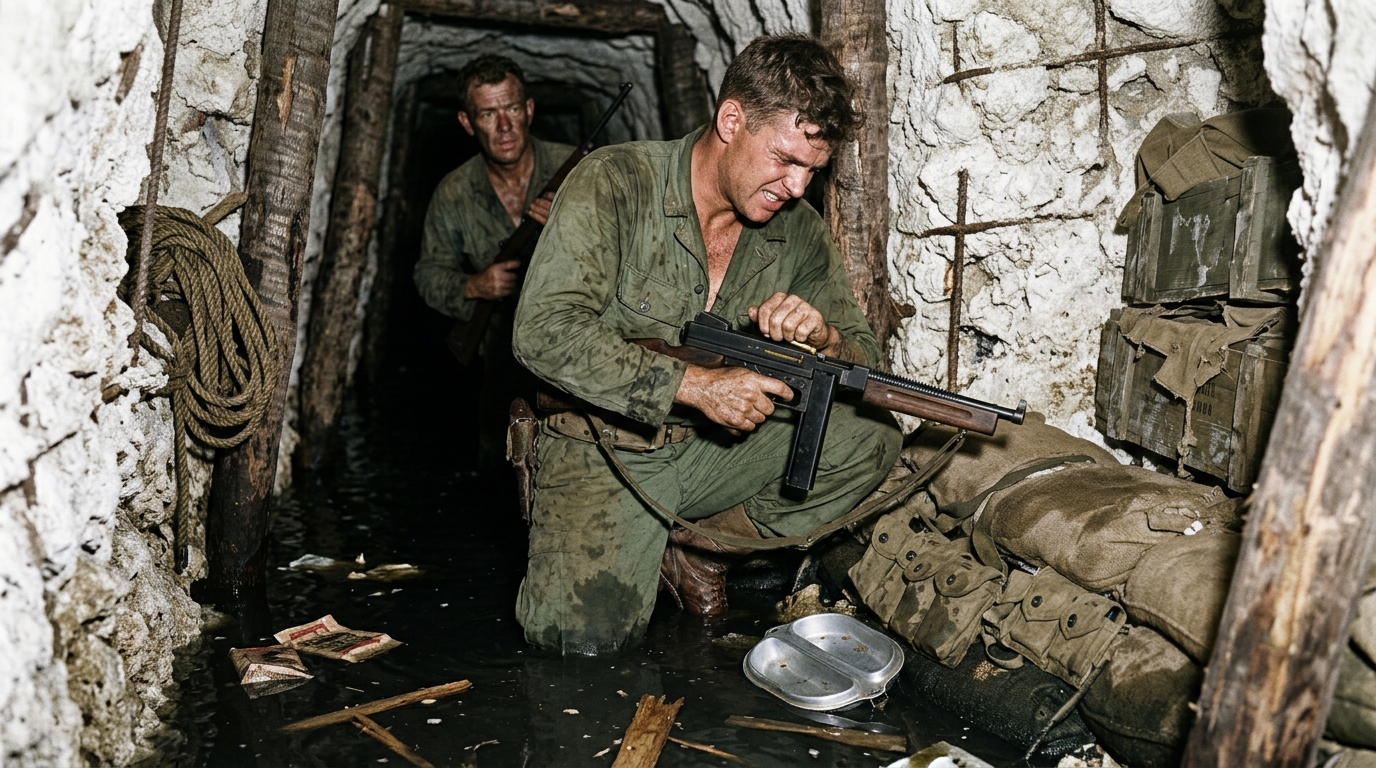
Fifteen feet in, the tunnel dropped into a shallow water-filled sump. The water came up over the ankles of Donovan’s combat boots—cold, dark, and thick with floating debris.
A sharp, metallic click echoed from thirty feet ahead in the dark.
Whitmore froze. The flashlight beam quivered against the surface of the black water.
Donovan didn’t wait for an order. He snapped the Thompson up into his shoulder, tracking the beam’s outer edge where a low sandbag barricade blocked half the passage. A shadow moved behind the sacking—a helmet rim catching the pale reflection of the torchlight.
Donovan squeezed the trigger.
The bolt slammed forward. The firing pin struck the primer of the third FAEXP44 round.
There was no crack. No flash. Just a hollow, dead clack of steel hitting brass.
The weapon didn’t cycle. The round sat cold in the chamber.
“Misfire!” Donovan growled, stepping sideways into the wall to clear Whitmore’s line of sight.
Across the water, the shadow behind the sandbags rose. The distinct, rhythmic clack-clack of a Type 96 light machine gun bolt retracting tore through the narrow tunnel space.
Donovan reached up with his left hand, raking his knuckles across the actuator knob to manually cycle the bolt. The bolt moved back half an inch and seized. The extended brass casing of the misfired round had swollen inside the chamber, its copper-jacketed nose wedged tight against the throat of the barrel.
“It’s stuck!” Donovan yelled.
Whitmore lunged forward, thrusting his M1 carbine over Donovan’s shoulder. He fired three rapid shots into the darkness. The sharp bang-bang-bang in the enclosed space was deafening, the muzzle blast scorching the air inches from Donovan’s ear.
A cry came from behind the sandbags, followed by the heavy splash of a body hitting the sump water.
Donovan jammed the heel of his palm against the Thompson’s charging handle, driving it backward with the full force of his weight. The extractor claw groaned against the brass rim. With a dry, tearing sound, the casing popped free, tumbling into the dark water between his boots.
He didn’t wait to inspect the cleared chamber. He shoved the bolt forward manually, forcing the next round into battery.
He looked down into his palm where the extracted cartridge had momentarily rested against his fingers. The copper nose had not just deformed—the frangible jacket had split wide open inside the magazine lip, oozing a sticky, grayish slurry of degraded C2 compound that smelled intensely of ammonia and wet salt.
The humidity inside the tunnel hadn’t just degraded the storage crates outside. The moisture was penetrating the copper matrix itself, turning the explosive core into a soft, expanding paste that trapped the bolt mid-cycle.
“Donovan,” Whitmore panted, his carbine barrel smoking in the dark. “Did you clear it?”
“Clear,” Donovan said, his voice dropping into a hard, cold register. He looked at the next round visible at the top of the stick magazine. The headstamp read FAEXP44. “It’s not just the heat, Sarge.”
“What?”
“The air in here,” Donovan said, wiping his slime-coated thumb against his trousers. “The copper’s porous. The water gets inside and rots the charge before you can pull the trigger.”
Whitmore didn’t reply immediately. He kept his light pinned on the sandbag wall ahead, where a thin trail of dark blood was spreading through the stagnant water toward them.
“We got two more bunkers along this main line,” Whitmore said quietly, his voice lacking its earlier conviction. “Company B is relying on us to blow the embrasures.”
“If I pull this trigger in the next room,” Donovan said, holding up his left hand where the grey residue was already hardening into a crusty, yellow scale against his skin, “the whole chamber might cook off in my face. Or it won’t fire at all when a three-man squad comes around the corner.”
Whitmore reached into his pocket, his hand searching until he pulled out a small, bent brass coin—a unit token from the 1st Marines. He rolled it over his knuckles, the metal clicking softly in the quiet tunnel.
“We keep moving,” Whitmore said. “We don’t have another option, Jimmy. The company doesn’t have satchel charges left.”
Donovan looked at the dark tunnel stretching deeper under the limestone ridge. He reached down into his fatigue pocket, feeling the cold, paper-thin edge of the split brass casing he’d saved from Chapter 2. He slid his thumb over the jagged metal edge until it cut into his skin.
“Then you keep your carbine ready,” Donovan said, stepping over the submerged sandbag. “Because the next one isn’t going to break the bunker. It’s going to break the gun.”
CHAPTER 4: THE SALT CORROSION
Donovan’s left boot came down into the dark water on the far side of the sandbag, the impact sending a ripple across the surface that slapped against the slime-coated timber props.
Beside him, Whitmore kept his carbine raised, the small beam of the brass flashlight shaking over a low wooden doorway cut into the right side of the main corridor. The door hung off its iron hinges, splintered inward by an earlier charge. Inside, a narrow supply alcove smelled of mildew, grease, and wet cardboard.
“Check the room,” Whitmore whispered, his thumb restlessly flicking the safety of his carbine on and off—click, click. “If there’s an observer post connected to the upper ridge, we get caught in a crossfire when we hit the main chamber.”
Donovan ducked beneath the sagging header, sweeping the Thompson’s muzzle across the alcove.
The space was six feet square, lined with rough-sawn pine shelving that had warped under the tropical humidity. Abandoned equipment lay scattered across the mud floor: empty brass shell casings, discarded canvas webbing, and three crate lids marked with Japanese characters.
In the back corner, half-buried under a collapsed shelf, sat an olive-drab shipping container. It wasn’t Japanese.
Donovan knelt in the shallow mud, his knees sinking two inches into the muck. He swept away a handful of wet rot to expose the steel banding straps securing the lid. The steel was heavily corroded, covered in thick flaking rust that bit into his bare thumb.
“American crate,” Donovan said.
Whitmore stepped into the alcove, angling his light down. “Supply dropped it short during the beachhead push? Company A lost two supply rafts on the reef.”
“No,” Donovan said. He slid the flat tip of his brass calipers beneath the rusted strap, leveraging it upward until the metal snapped with a dry ping. “This didn’t come off a raft.”
He pried the wooden lid loose. Inside, seated in molded cardboard trays, were twenty metal cans—the heavy, vacuum-sealed tins used for tropical ammunition packing. But the stencil on the tin lids wasn’t standard ordnance blue. It was stamped in red enamel, running across a bold text block:
ORDNANCE FIELD REPORT / ATTACHMENT B
REF: ORDER-891
PROJECT GLASS-JAW FIELD TEST EVALUATION
Donovan’s hand froze over the lid.
He pulled a folded sheets of water-resistant paper tucked inside the seam of the box lid. The paper was stiff, coated in a light layer of wax, but the edges were already curling from the tunnel’s moisture. He unfolded it under Whitmore’s beam.
The top line read: FRANKFORD ARSENAL SPECIAL ORDNANCE DIVISION — RESTRICTED.
His eyes scanned down the mimeographed text, cutting past the technical tables to the typed remarks near the bottom margin:
…Initial batch testing (Frankford-44, Lot 09-B) indicates a 14% failure rate in tropical humidity environments exceeding 85% relative humidity. Piezoelectric detonator matrix demonstrates extreme sensitivity to thermal expansion, resulting in premature chamber ignition or total dud status after 120 days storage…
Donovan stopped reading. His thumb pressed against the wax paper, leaving a smeared print of yellow chemical residue from his skin.
“They knew,” Donovan said softly.
Whitmore leaned closer, squinting at the page. “Knew what? Read the numbers.”
“The rounds,” Donovan said, turning his head to look Whitmore dead in the eye. “They didn’t ship these to Peleliu to crack the Umurbrogol caves because we were out of satchel charges. They shipped them because they needed a division to pull the trigger in eighty-five percent humidity.”
“That’s crazy,” Whitmore snapped, his voice dropping into a harsh, agitated whisper. His hand twitched, the carbine safety clicking twice in rapid succession. “It’s an experimental round, Jimmy. Things go wrong in production.”
“Read the date, Sarge,” Donovan said, pointing a calloused finger at the bottom stamp. “October 12th. Five weeks before we landed. The arsenal ran the chamber test in Maryland and logged the failure. Then they packed four thousand crates and loaded them onto the Rangely.”
Whitmore stared at the sheet, his chest rising and falling in short, shallow breaths. He reached out, his thumb rubbing raw against the blister on his palm, but he didn’t touch the paper. He couldn’t.
“Company B is waiting,” Whitmore said, though the authority in his voice was gone, replaced by a hollow, brittle quiet. “We got forty yards of tunnel left before the command bunker. If we don’t clear the firing port, the mortar squad gets wiped on the open ridge.”
“If I load another magazine from this lot,” Donovan said, reaching down to tap the Thompson’s receiver, “the third round is going to cook off in the chamber. It won’t wait for the firing pin.”
He looked at the open box. Nested beneath the paper was a small cardboard carton marked INSPECTION LOG — FIELD OPERATORS ONLY.
Donovan picked it up, tearing open the tab. Inside lay three brass test gauges and a small logbook with blank lines for casualty counts, misfires, and barrel erosion metrics. The pages were completely clean, waiting for him to fill them out.
Donovan folded the waxy memo sheet twice, sliding it inside his fatigue jacket next to his brass calipers and the split casing from Chapter 2. The sharp metal edge of the casing pressed through his shirt, biting into his ribs.
“We move to the command bunker,” Donovan said, grabbing the Thompson’s handguard and rising from the mud. “But I’m not firing semi-auto anymore.”
Whitmore looked at him, his face pale under the grease paint. “The manual says—”
“The manual was written by a clerk in Philadelphia who wanted to see if my fingers would blow off,” Donovan said, flicking the Thompson’s selector switch with a hard, metallic click back to full-automatic. “Now we do it my way.”
CHAPTER 5: THE SUBTERRANEAN BREACH
The selector switch rested in the forward detent, locked flat against the Thompson’s steel receiver. Full-auto.
Donovan stepped out of the alcove mud and back into the knee-deep sump water of the main corridor. Whitmore followed three paces behind, his carbine held low, his boots dragging through the dark sludge with a heavy, wet splash.
“Forty feet to the command hatch,” Whitmore rasped. His jaw was set tight, but his eyes kept darting to the waxy paper bulging inside Donovan’s fatigue jacket. “If the firing port isn’t clear, we can’t breach the inner bulkhead. The steel plate is two inches thick.”
“It’ll clear,” Donovan said.
They reached the end of the drainage run where the corridor opened into a high-ceilinged command cell. The air here was suffocatingly hot, smelling of burnt oil, copper dust, and raw sewage. Through a double-layered barricade of crushed coral bags, a shaft of harsh tropical sunlight cut down from a wide observation embrasure sixty yards up the ridge line.
Behind the sandbags stood the heavy iron bulkhead door, bolted shut from the inside with three vertical locking bars. To its left, the observation slit sat at eye level—a eight-inch slot reinforced with railroad ties and heavy iron angle stock. A long-barreled Nambu Type 92 machine gun poked through the steel gap, its heavy cooling fins dark with grease.
A boot scraped against concrete inside the cell. A shadow shifted across the light beam.
Donovan didn’t stop to take cover behind the timber props. He drove his boots into the sump floor, leaning his body weight forward to absorb the violent climb of an unrestricted submachine gun burst.
He pressed the trigger flat to the grip.
The Thompson roared. In the enclosed stone chamber, twenty-round bursts of FAEXP44 didn’t sound like gunfire; they sounded like a continuous series of directional demolition charges. The weapon shook violently in his hands, the foregrip vibrating so hard the wood bit into his left palm.
Three rounds struck the iron angle stock around the embrasure in less than half a second.
The piezoelectric detonators didn’t fail. They didn’t misfire. Under the sudden, intense heat of rapid automatic cycling, the degraded C2 payload inside the elongated copper shells ignited with catastrophic velocity.
A blinding, violet-white flash tore the darkness of the command cell apart. The heavy iron angle stock snapped like dry pine. Concrete aggregate disintegrated into a high-pressure cloud of razor-sharp gravel that blasted backward into the bunker interior. The heavy Nambu machine gun was ripped off its tripod mount, its steel receiver twisted like wet paper before collapsing into the trench dirt.
The overpressure wave hit Donovan in the chest like a swinging oak beam. The blast kicked back down the corridor, slamming him against the damp coral wall. His ears didn’t just ring; they went instantly numb, filled with a flat, dry silence that deadened the sound of falling rock.
Smoke rolled thick and white through the breach—not soft cordite haze, but a dense, acrid chemical cloud that burned his throat on the first breath.
Donovan dropped the empty stick magazine into the mud. His hands didn’t shake. The skin on his palm was red, scalded by the yellow chemical grease that had boiled out of the ejection port during the full-auto dump.
He slammed his second-to-last magazine into the well, pulling the bolt back manually to clear a half-crushed casing from the chamber.
“Whitmore!” he shouted, but his own voice sounded miles away, buried under the roaring silence in his head.
The sergeant was down on one knee behind the sandbag barrier, coughing violently, his knuckles bloody where he’d scraped them against the rough coral wall to arrest his fall. He looked up at the embrasure, his mouth open in a soundless yell.
The two-inch iron bulkhead door wasn’t locked anymore.
The force of the internal explosion had sheared the outer hinge pins clean off the frame. The iron slab hung cocked at an angle, held only by the bottom bolt, leaving a twelve-inch gap between the iron and the jamb.
Through the gap, a figure moved.
Major Kuroda stood amidst the ruined command maps and shattered radio gear. His uniform was torn, splotched with white lime dust and dark grease, but his hands were steady. He wasn’t reaching for a pistol. He was pulling the iron pin from an artillery lanyard tied directly to a bank of buried scuttling charges beneath the floorboards.
He looked through the twelve-inch gap in the broken door, his eyes locking onto Donovan’s face with a cold, absolute certainty.
Donovan didn’t raise the Thompson to shoot. He knew the remaining copper-jacketed rounds in his magazine would crumble against the iron door edge at this angle.
Instead, he lunged forward, thrusting the heavy steel barrel of the Thompson directly into the twelve-inch gap, using the submachine gun’s receiver as an iron lever against the bent bulkhead frame.
He threw his entire body weight against the stock, driving his boots into the mud, leveraging the steel receiver against the iron door to jam the Scuttling lanyard before Kuroda could pull it clear.
The steel scraped against iron with a sharp, screaming screech of metal on metal.
“Whitmore!” Donovan roared, his shoulder muscles straining against the door frame as Kuroda pulled back on the lanyard with all his strength. “The bar! Drive the carbine under the bolt!”
CHAPTER 6: THE UNMARKED CRATE
The steel receiver groaned under the leverage.
Donovan threw his hips forward, his shoulder muscle grinding against the walnut stock as the metal receiver wedged deeper into the gap between the frame and the heavy iron door.
Inside the command cell, Major Kuroda shifted his footing on the slick limestone floorboards. His jaw tightened, a muscle jumping along his cheek as he yanked the braided wire lanyard with both hands. The cord drew taut—steel wire cutting into his bare fingers—but the iron door couldn’t swing wider. The Thompson’s thick receiver held the gap like an iron wedge, trapping the firing mechanism’s spring three inches short of its release catch.
“Whitmore!” Donovan snarled through grit-filled teeth. “The frame!”
Whitmore didn’t hesitate. He scrambled out of the mud on all fours, driving the steel muzzle of his M1 carbine beneath the bottom lip of the bulkhead door. He threw his weight upward, leveraging the barrel against the concrete sill.
With a dull, heavy crunch, the bottom hinge pin snapped. The two-inch iron slab tipped sideways, falling flat into the interior mud with a deafening thud that shook the floorboards.
The tension on the lanyard collapsed. Kuroda stumbled backward into the shattered map table, the slack wire coiling harmlessly across his boots.
Donovan didn’t raise his weapon. He stepped through the threshold, his boots landing heavy on the iron door face lying in the mud. The Thompson’s receiver was bent two degrees out of alignment, the barrel shroud scorched jet-black and smelling of burnt oil.
Kuroda didn’t reach for his sidearm. He stood behind the broken table, his hands resting flat on a wet, ink-stained grid map. His breathing was shallow, his eyes fixed not on Donovan’s face, but on the weapon in Donovan’s hands.
“The copper matrix,” Kuroda said. His voice was low, rasping from the white dust coating his throat, speaking in clear, measured English. “It breaks inside the concrete. It does not penetrate.”
“It penetrates enough,” Donovan said. He kept the barrel angled down at the floor, his finger rested flat along the receiver casing.
Kuroda looked down at the brass headstamps scattered across the threshold—scorched, split casings bearing the mark FAEXP44. A faint, bitter smile touched the corner of his mouth.
“You bring a weapon that destroys itself to break a wall,” Kuroda said softly. He pulled his hands back from the table, placing a small leather-bound logbook onto the wood between them. “Your officers know the casing splits in high humidity. The field reports from the first island stated the pressure curve destroys the chamber after fifty rounds.”
Donovan didn’t blink. He reached into his fatigue jacket with his left hand, pulling out the folded waxy memo sheet he had recovered from the supply alcove.
“Order-891,” Donovan said, laying the paper onto the table next to the logbook. “Project Glass-Jaw. They didn’t care if the barrel split. They needed to measure how many rounds a Marine could fire before the receiver failed in eighty-five percent salt air.”
Kuroda glanced at the paper, his eyes tracing the red stencil at the top margin. He didn’t look surprised. “Then we are both inventory in this ridge, Corporal.”
He didn’t make a sudden move. He didn’t reach for a grenade. Kuroda slowly unbuckled his leather belt, dropping it onto the table alongside a brass pocket watch with a cracked crystal. He sat down on the overturned wooden ammunition box behind the desk, resting his elbows on his knees, his hands loosely clasped between his legs.
“The ridge is yours,” Kuroda said, his voice flat, devoid of anger or pride. “The tunnel network behind this wall was sealed two hours ago by our own engineers. There is nowhere left to retreat.”
Silence settled over the command cell. Outside, forty yards up the draw, the heavy, rhythmic thumping of American 60mm mortars began to fire, dropping smoke shells along the upper ridge line to cover Company B’s advance. The muffled thuds rattled the dust hanging in the air, but inside the subterranean bunker, the violence had run its course.
Whitmore stepped through the doorway, his carbine held loosely in one hand. He looked at Kuroda, then at the paper sitting on the table, and finally at Donovan’s bent Thompson.
“Company B is crossing the wash,” Whitmore said quietly. His voice had lost its harsh edge; he sounded exhausted, his shoulders sagging beneath his wet canvas webbing. “The captain wants a radio report on the bunker’s structural status.”
“Tell him the bunker is neutralized,” Donovan said.
He reached down to the desk, picking up the small leather logbook Kuroda had placed there. He tucked it into his jacket pocket alongside the waxy memo sheet, the brass calipers, and the split cartridge casing from the first firing port.
Donovan walked over to a dry corner of the cell where an unbroken wooden supply crate sat resting on two pine blocks. He set his Thompson down on the flat wood.
He pulled a small screwdriver from his utility pouch. Methodically, without rushing, he began to turn the retaining screw on the Thompson’s trigger frame. The metal was still hot, biting into his calloused fingertips, but he kept his hands steady.
Clack.
The lower receiver separated from the upper receiver. He pulled the bolt assembly free. The steel actuator was warped, the firing pin face pitted and scorched by the yellow chemical gas that had leaked past the chamber seal during the full-auto burst.
He didn’t throw it away. He took a oily rag from his pocket and began wiping down the bolt, clearing away the tacky, greenish residue until the dark steel beneath showed through the grime.
Whitmore watched him from the doorway, his hand resting against the iron jamb. “What are you doing, Jimmy? The squad’s moving up to Ridge Ten in twenty minutes.”
“I’m fixing the gun,” Donovan said. He picked up his brass calipers, measuring the clearance on the bolt channel. “I’m making sure it fires standard ball when we hit the next ridge.”
He slid the cleaned bolt back into the upper receiver. The steel parts met with a crisp, solid click. He tightened the retaining screw, locking the frame back together.
Donovan picked up a standard twenty-round magazine filled with dull, heavy .45 ACP ball ammunition—the stubby lead rounds he’d carried since the beachhead. He thumbed one out, checking the headstamp under the dim shaft of sunlight cutting through the shattered embrasure.
Standard brass. Clean primer. No experimental stamps.
He loaded the magazine into the Thompson, racking the bolt back until it caught on the sear. He flipped the fire selector switch down to semi-automatic, locking it into place.
Donovan walked back to the threshold, stepping over the fallen iron door and out into the subterranean corridor. He didn’t look back at the supply alcove or the green-painted crates of FAEXP44 resting in the mud.
He stepped into the shallow water, his boots cutting a slow, steady path back toward the daylight at the mouth of the tunnel, ready for the next ridge.