The Weight of Iron and Authority: How a Retired Veteran Dismantled a Suburban Tyranny
CHAPTER 1: The Weight of an Inch
The humidity of the afternoon carried the faint, dry scent of cut grass and impending conflict, but the air immediately surrounding the front porch was entirely dead, frozen by the precise, rhythmic jab of a manicured finger. Five feet and four inches of accumulated suburban authority stood planted squarely on the lawn, encapsulated in a violently floral muumuu that strained against three hundred pounds of righteous indignation.
Frank Miller did not blink. A quarter-century spent navigating the rigid, unyielding infrastructure of the US Army Corps of Engineers had trained him to view human chaos not as an emotional assault, but as a structural load test. Every structure had a breaking point, and every loud voice carried a specific, quantifiable lack of foundation.
“I don’t care if it leads to the center of the earth,” Karen snapped, her voice cutting through the heavy air with the sharp edge of a rusted blade. “That rusty piece of junk is an affront to this community, and it will be gone by Friday or I’ll have it ripped out myself and send you the bill for the sod.”
She was pointing down at the heavy, slanted steel doors of the root cellar—a battleship-gray fixture of solid plate and reinforced hinges that had anchored the property long before the surrounding acreage was bulldozed, subdivided, and rebranded into the sterile geometry of Oak Meadows. The door was as much a part of the original farmhouse foundation as the load-bearing timber beneath the floorboards. Losing it would mean losing the cool, dark sanctuary where years of self-sufficiency—preserved goods, emergency gear, and harvested yields—rested in disciplined rows.
More immediate than the financial loss, however, was the structural insult of the threat. The casual arrogance of a woman proposing to alter a man’s land without a moment of hesitation or respect for history.
Frank let the declaration hang, his face locked into the neutral, unreadable mask he had perfected during decades of dealing with stubborn colonels and belligerent contractors. He kept his weight balanced evenly on the balls of his feet, his hands resting loose at his sides. He did not raise his voice. He did not offer the shouting match she clearly craved.
“I see,” Frank said, his tone flat, measured, and dangerously calm. “I’ll expect a formal written notice of this alleged violation citing the specific article and section of the CC&Rs you believe it violates. Please send it via certified mail.”
Karen’s face, already flushed from the exertion of her march across the sod, deepened to a bruised shade of plum. The demand for paperwork, for protocol, short-circuited her momentum. She took a sharp breath, her eyes narrowing as she searched his expression for a crack.
“Don’t you play your games with me, Mr. Miller,” she hissed, taking a step closer, though the invisible barrier of his unyielding posture kept her at bay. “You know the rules. All exterior structures must be approved by the Architectural Review Committee.”
Frank gave a slow, barely perceptible tilt of his head. “And I’m sure the written notice will detail that,” he replied quietly, turning his back on her with deliberate, agonizing slowness to walk toward his front door. “Have a nice day, Karen.”
The mechanical click of the heavy wooden door sealing shut behind him felt heavier than any curse word he could have shouted. He locked the deadbolt, the internal mechanism sliding home with a solid, metallic thud, and turned to find Sarah watching him from the kitchen threshold, her brow furrowed with quiet anxiety. But Frank felt only the cold, sharp clarity of an engineer stepping onto a freshly surveyed job site, knowing precisely where the first rivet needed to go.
CHAPTER 2: The Archives of the Past
The silence inside the hallway was dense, smelling faintly of old cedar and the cooling grounds of morning coffee. Sarah remained by the kitchen threshold, her hands wrapped tightly around a ceramic mug, her gaze fixed on Frank as he crossed the linoleum. There was no celebration in the quiet click of his boots against the floor; an engineer did not celebrate a stress test until the load calculations were verified down to the last decimal point.
“She’s going to escalate, Frank,” Sarah said softly, her voice carrying the weariness of a decade spent watching the neighborhood transform from quiet timber and open field into a grid of manicured lawns and invisible tripwires. “People like that don’t just take a paper trail and walk away.”
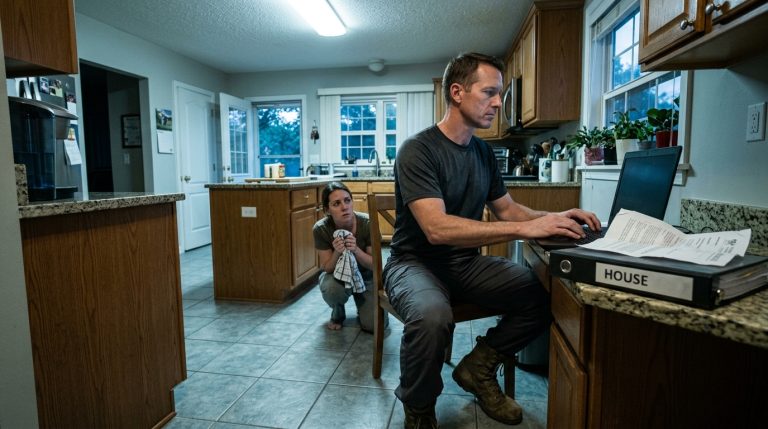
“Let her,” Frank replied, his voice dropping into an even, rhythmic cadence. He pulled out a wooden chair and sat down, dragging a thick, binder-bound copy of the Oak Meadows Covenants, Conditions, and Restrictions across the table. “Paper is predictable. Emotional tyranny relies on noise because it has no architecture. If she wants to build a case on aesthetics, she has to submit to the structure of the document itself. And people who rule by impulse never read the fine print.”
He flipped open the heavy binder, his thumb catching the edge of the tabbed index. A sudden, intrusive memory flickered behind his eyes—the smell of diesel fuel and damp canvas from a forward operating base in the engineering corps, where a single miscalculated load calculation on a temporary pontoon bridge could sink an entire platoon. The principle was identical. Karen was treating the neighborhood like her personal parade ground, failing to realize that every rule she brandished had an origin, and every origin had a paper trail buried deeper than any HOA board meeting could reach.
The local rules were clear on surface-level restrictions, but Frank knew from decades of municipal experience that private covenants could never legally override pre-existing county easements or public infrastructure mandates. The trick was finding where the old land lines intersected with the modern subdivision plat.
“Where are you starting?” Sarah asked, sliding a fresh mug of coffee across the wood toward him.
“Downtown,” Frank said, standing up and reaching for his jacket. “County records office. The land was farmland before it was a subdivision. Every spade of dirt turned in the seventies had to cross a utility corridor. If that root cellar door was there before the first cookie-cutter foundation was poured, it has a grandfathered legal status tied to something much bigger than Karen’s architectural committee.”
The drive downtown took twenty minutes, the landscape shifting from the uniform pastel siding of Oak Meadows into the older, heavier brick and limestone architecture of the county seat. The county clerk’s office smelled of aging paper, floor wax, and the quiet, unhurried diligence of bureaucrats who had outlived dozens of local political fads.
Frank bypassed the front service counter, heading straight for the massive, flat-topped reference tables where historical plat maps were housed. He unrolled a massive, crackling blueprint dated 1978—a yellowed, linen-backed survey map from the era when the county infrastructure was first mapped across the rural acreage. The paper was stiff, resisting the weight of his brass paperweights at the corners, but the ink was sharp.
His finger traced the grid of the old farm roads until it hit the coordinates of his current property. There, cutting diagonally across what was now a cluster of quarter-acre residential lots, was a thick, cross-hatched line labeled Multi-Utility Corridor Easement.
And right at the precise location of his root cellar, stamped in small, precise engineering font, was a square symbol marked with three letters: EAP.
Emergency Access Point.
The realization did not bring a rush of triumph; it brought the cold, analytical satisfaction of a missing gear sliding perfectly into place. He pulled the corresponding legal filings for the easement, his eyes scanning the dense paragraphs of legal boilerplate until he found the specific operational clause. Any structure built over the multi-utility corridor at an designated emergency access point must maintain a clear, operable hatch of at least four by four feet to allow subterranean maintenance crews access to the primary trunk lines.
Karen wasn’t just trying to remove an eyesore. If her forced landscaping decree went through, she would be legally compelling a homeowner to obstruct a critical public utility corridor servicing hundreds of homes.
Frank pulled out his phone, dialed the county clerk’s direct line for archival copies, and ordered certified duplicates of the plat map and the original 1978 easement agreement. As the clerk stamped the documents with the raised metallic seal of the county, Frank felt the tectonic plates of the local neighborhood politics shift entirely. The war wasn’t about a rusty gray door anymore. It was about a foundation built on structural negligence, and he was holding the blueprints to the whole thing.
CHAPTER 3: The Gathering Storm
The transition from the cool, paper-scented quiet of the county courthouse back to the sun-bleached asphalt of Oak Meadows was jarring. The air hung thick with humidity, and the manicured lawns stretched out on either side of the road with an artificial, almost aggressive symmetry. Frank slid the heavy manila envelope containing the certified plat maps and the 1978 easement agreement onto the passenger seat of his truck. The documents did not rattle; they rested with the heavy, unyielding mass of absolute fact.
He drove slowly through the subdivision, keeping his speed well below the posted limit, his eyes tracking the uniform pastel facades of the quarter-acre lots. To an observer, the neighborhood looked tranquil—a textbook illustration of suburban peace. But through the lens of a former engineer, the entire grid revealed itself as a fragile illusion built on convenience and selective memory. Karen’s administrative power relied entirely on the fact that no one ever looked below the surface layer of grass and gravel.
When he pulled into his driveway, Sarah was waiting by the kitchen window. She watched him step out of the truck, her expression a mix of caution and inquiry. He did not rush toward the house; he took his time closing the truck door, the solid mechanical thunk echoing off the asphalt, before walking up the gravel path.
Inside the kitchen, the smell of fresh coffee hung in the air. Frank laid the manila envelope flat on the wooden table, tapping it once with a calloused finger.
“She sent another notice while you were out,” Sarah said quietly, gesturing toward a crisp white envelope propped against the sugar bowl. It bore the embossed, generic oak tree logo of the association, its lines sharp and aggressive.
Frank picked it up without opening it immediately. “Let me guess. The fine doubled, and the tone turned into an ultimatum.”
“Word for word,” Sarah replied, leaning against the counter. “She’s treating it like a personal crusade. If you don’t comply by next week, she’s threatening a property lien.”
Frank finally slit the top of the envelope with a pocketknife, sliding out the stiff sheet of paper. It was a masterpiece of bureaucratic condescension, demanding the immediate removal of the “eyesore structure” under penalty of compounding financial ruin. Karen had dispensed with any pretense of dialogue; she was swinging her gavel blindly, assuming the sheer weight of her title would crush any resistance.
“She thinks she’s holding a hammer,” Frank murmured, his eyes scanning the aggressive loops of Karen’s signature at the bottom of the page. “She doesn’t realize she’s standing on a gas line.”
He did not reply to Karen directly. Instead, he opened his thick binder of covenants and turned to the section detailing association duties—specifically, the mandatory annual inspections of utility easements and access points within the community’s jurisdiction. The text was unambiguous. The HOA was legally required to certify these inspections with the county public works department every single year.
Frank reached for his phone and dialed the public works department, confirming what he already suspected: no such filings existed. For a decade, the board had neglected its fundamental legal duty while fixating entirely on aesthetic infractions like flower colors and flagpoles.
The strategy required broadening the perimeter. An isolated homeowner fighting an HOA was a localized nuisance easily crushed by legal fees; a homeowner coordinating structural evidence with regional utility conglomerates was an entirely different tactical reality. Frank spent the afternoon drafting three separate, precisely worded notifications. They were not emotional complaints; they were formal, factual advisories addressed to the legal departments of Piedmont Gas Company, Tri-County Water Authority, and OmniCom Fiber.
Each letter outlined the exact coordinates of the multi-utility corridor easement, referenced the county plat maps, and formally notified the corporate stakeholders that the local homeowners association was actively attempting to compel a resident to permanently obstruct a critical public utility access point.
He printed three copies, slipped them into FedEx envelopes with signature confirmation required, and drove down to the local shipping center to dispatch them. The giants were waking up, and they moved with an inertia that no amount of floral-print stationery could stop.
Back at home, as the afternoon shadows lengthened across the lawn, Frank pulled out his address book and began making a different kind of call. If the neighborhood was going to weather what was coming, the resistance could not remain a one-man operation. He needed to speak to the others—the ones who had already felt the bite of Karen’s arbitrary decrees.
He called Dave, the retired Marine two streets over who was currently fighting a losing battle over a twenty-year-old flagpole. Then he reached out to Maria, the elderly widow whose ceramic gnomes had become targets of executive wrath, and the Millers, the young family being drained by daily fines over the shade of a wooden swing set.
“Saturday morning,” Frank told Dave over the line, his voice steady and low. “My kitchen table. Bring your paperwork. It’s time we looked at the actual blueprints of this neighborhood.”
He hung up and walked out to the front porch, casting his gaze down toward the heavy, weathered steel doors of the root cellar. The sun was dipping below the horizon, casting sharp, angular shadows across the grass. The structure remained completely silent, but beneath the damp earth, miles of iron pipe and fiber-optic cable hummed with invisible pressure, waiting for the exact moment the circuit closed.
CHAPTER 4: Awakening the Giants
The response did not arrive with the dramatic flair of Karen’s pink flyers or the aggressive scrawl of certified warning letters. It came through cold logistics, manifested in electronic delivery receipts and precise corporate typography.
Frank sat at the wooden kitchen table under the amber glow of a single overhead lamp, sorting through three distinct FedEx confirmation slips. Each envelope had reached its destination—Piedmont Gas, Tri-County Water, and OmniCom Fiber. But it was the physical discrepancy on the tracking logs that signaled the shift: the signatures were not signed by low-level customer service clerks or local administrative assistants. They had been pulled directly by senior corporate counsel and directors of risk management.
A mechanical tap of his knuckle against the wood broke the quiet. The system was reacting.
For a week, the daily accumulation of fifty-dollar fines on the HOA’s internal ledger had continued its silent march, but the mailbox remained free of fresh threats from Karen. It was the unnatural calm before an absolute squall. She was likely banking on her impending public hearing, oblivious to the fact that her administrative sandbox was built over a federal utility fault line.
The phone on the counter rang, breaking the silence with a sharp, electronic chirp.
Frank picked up the receiver on the second ring, keeping his voice entirely neutral. “Miller.”
“Mr. Miller?” The voice on the other end was clipped, razor-sharp, and stripped of all retail pleasantries. “David Chen, in-house legal counsel for Piedmont Gas Company. I’m calling in reference to the notification you dispatched regarding the property coordinates at 128 Old Farm Road.”
Frank leaned back against the counter, his eyes fixed on the dark window pane reflecting his own steady silhouette. “I’m listening, Mr. Chen.”
“We have reviewed the county plat maps and the historical multi-utility easement documents you referenced,” Chen continued, the sound of rhythmic paper-shuffling echoing faintly through the line. “Let me be entirely unambiguous with you. The access hatch on your property sits directly above a high-pressure natural gas main. The motion currently being processed by your local homeowners association to force the removal and permanent sealing of that access point is not merely a breach of right-of-way. It is a direct violation of state utility codes and federal pipeline integrity regulations.”
There was a calculated pause, heavy with institutional weight.
“If that association votes to move forward with physical obstruction,” Chen added, his tone dropping into a chillingly formal cadence, “we will not be filing a civil injunction. We will initiate immediate criminal referral proceedings against the individuals authoring the directive. Furthermore, our engineering division has flagged your note regarding the association’s complete failure to perform mandatory annual safety certifications. We are petitioning the State Utility Commission for a full, comprehensive audit of Oak Meadows infrastructure—billed directly to the HOA.”
“I figured as much,” Frank replied evenly.
“We will have representatives present at their next scheduled public hearing,” Chen said, clicking the line dead without a formal goodbye.
Before Frank could even place the receiver back on its cradle, the phone rang again. This time it was Eleanor Vance from the Tri-County Water Authority, echoing identical legal alarms regarding the subterranean master shutoff valves. Twenty minutes later, OmniCom Fiber’s regional counsel chimed in, cementing the corporate blockade. The giants had been awakened, and they were marching toward Oak Meadows with heavy boots.
The escalation was absolute, but the primary tactical hurdle remained: Karen had already scheduled her public show trial for the following week, intending to use the community clubhouse as a gallows to humiliate him in front of his neighbors. She was entirely blind to the corporate artillery lining up behind him.
Frank stepped out onto the porch into the sharp, midnight chill. He looked down toward the heavy, weathered steel doors of the root cellar, half-shrouded in the angular shadows of the yard. The steel was cold, unyielding, and heavy with history. Let her build her stage. Let her sell tickets to her own execution. The trap was set, and the trigger was already pulled.
CHAPTER 5: The Public Execution
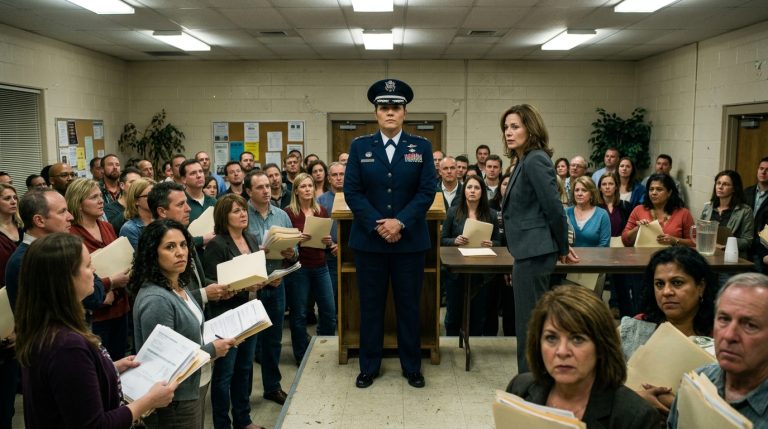
The fluorescent lights of the community clubhouse hummed with a sickly, yellow pallor, casting harsh angular shadows across the folding chairs and the cheap polyester tablecloth draped over the head table. The room smelled faintly of stale coffee and suburban panic. Two dozen homeowners sat scattered among the rows, caught between neighborly curiosity and the grim, electric anticipation of a public flaying.
At the center of the head table sat Karen, flanked by her two loyal board members, Bob and Brenda. Karen wore a bright red blazer—a tactical armor meant to project absolute authority. She surveyed the room with the smug, untouchable certainty of a queen holding court over a subservient fiefdom, her hand resting casually next to a small wooden gavel. In the very back row, half-shrouded by the glare of the exit sign, sat three figures in sharp corporate suits, watching the proceedings with an icy, detached stillness.
Frank walked down the center aisle with slow, measured strides, his boots clicking rhythmically against the linoleum. Sarah walked quietly beside him, her hand slipping into his arm, anchoring the perimeter. Dave and Arthur Henderson sat a few rows ahead, a silent phalanx of experience.
Karen struck the gavel once, the sharp crack echoing through the tense air.
“This monthly meeting of the Oak Meadows Homeowners Association is now in session,” Karen announced, her voice pitched for maximum theatrical impact. She sped through the preliminary business with dismissive haste, her eyes darting repeatedly toward Frank. When she reached the end of her agenda, her posture stiffened into a pose of sorrowful executive duty.
“We now move to the special executive hearing regarding the ongoing, flagrant violation at Lot One,” Karen declared, pointing a manicured finger directly at Frank. “For months, this board has attempted to work with Mr. Miller to preserve the aesthetic harmony and property values of our community. His obstinate refusal to remove an unapproved, industrial eyesore from his front lawn has left us no choice.”
With a dramatic flourish, she gestured to an easel beside the table. A large foam board was unveiled, displaying grainy, distorted photographs of the root cellar door taken from angles designed to make the weathered steel look like a rusted relic abandoned in a junkyard.
“This,” Karen proclaimed, her voice rising with manufactured outrage, “is what Mr. Miller believes is acceptable in our neighborhood. A piece of industrial junk mocking our standards. Therefore, I move that the board authorize a licensed contractor to forcibly remove the structure at the owner’s expense, landscape the area with sod, and place an immediate lien on the property for all accrued fines and legal fees.”
“Second!” Brenda chirped instantly, her head bobbing with violent agreement.
Karen smiled, a tight, victorious curve of her lips. “Before we vote, association rules require we allow the resident to speak. Mr. Miller? Do you have any defense for your defiance?”
The trap was fully sprung, exactly where she wanted it. She expected a stammering defense of property lines or a plea for aesthetic compromise.
Frank stood up. He did not rush. He picked up his slim, dark file folder, walked past the rows of turning heads, and stepped up to the small wooden lectern facing the room. He looked past Karen, locking his gaze directly onto his neighbors.
“Good evening,” Frank said, his voice level, resonant, and entirely devoid of emotion. “My name is Frank Miller. I won’t be speaking about aesthetics tonight. This issue has never been about taste. It is about physics, public safety, and the law.”
He opened the folder, pulled out a laminated sheet, and placed it on the overhead projector. The stark, black-and-white lines of the 1978 county plat map bloomed on the wall behind Karen. Frank picked up a laser pointer, the crimson dot resting firmly on a thick line cutting through the subdivision grid.
“This is the official county plat map,” Frank began, his tone that of an instructor briefing a command staff. “This line represents a fifty-foot multi-utility corridor easement granted before a single home in Oak Meadows was built. It passes directly under several of our properties, including mine. And this symbol here, marked EAP, denotes a legally mandated emergency access point.”
Karen shifted in her seat, her triumphant smile faltering into a rigid line.
Without breaking rhythm, Frank swapped the transparency, projecting the dense legal text of the easement agreement. He read the clause aloud, emphasizing the mandatory four-by-four-foot operational opening required for subterranean maintenance. Then he displayed the HOA’s own governing covenants, highlighting the section where the community legally bound itself to protect and uphold every pre-existing easement of record.
“The structure the board wishes to remove,” Frank continued, letting the words drop with heavy, structural weight, “is not an aesthetic violation. It is the legally required access cover for the high-pressure natural gas main, the primary water trunk line, and the fiber-optic data trunk servicing this entire region.”
A sharp, collective intake of breath swept through the room. The neighbors in the middle rows began turning to one another, their expressions shifting from passive spectators to alarmed stakeholders.
“Furthermore,” Frank concluded, placing his final document on the projector—the blank public works certification record, “our CC&Rs require this board to conduct and certify annual safety inspections of this access point. According to county records, this board has never performed a single inspection in ten years. The motion on the table is not just reckless; it is an attempt to legally compel the destruction of critical infrastructure, exposing every household here to catastrophic liability.”
The silence that followed was absolute. Karen sat frozen, her face draining of color, her eyes darting frantically toward Bob and Brenda, who stared blankly at the wood grain of the table, paralyzed.
Before Karen could stammer a defense, a tall man in the back row stood up. The sharp lines of his dark suit cut through the yellow haze of the room like a blade.
“My name is David Chen,” he said, his voice cold and devoid of retail warmth. “I am an attorney with Piedmont Gas. Every word Mr. Miller has stated is correct. If this board votes to approve this motion, we will not file a civil suit. We will immediately petition the state attorney general’s office for criminal charges against the individuals authoring this obstruction.”
Two more figures rose beside him—Eleanor Vance from the Tri-County Water Authority and Mark Peterson from OmniCom Fiber. Their statements struck the room with the force of an artillery barrage, detailing massive civil liabilities, state utility audits, and immediate criminal referrals.
The room exploded into white-hot chaos. Homeowners were on their feet, shouting over one another, turning their pent-up fury directly toward the head table.
“You’re going to get us all sued!” a voice roared from the middle rows.
“Resign! Resign!”
Karen grabbed her gavel and banged it frantically against the table, her authority instantly reduced to splinters. “This meeting is adjourned!” she shrieked over the roar.
“Nobody is adjourning anything,” Dave the Marine boomed, standing tall in his seat. “According to association bylaws, I move for an immediate vote of no confidence in the president.”
“Second!” shouted the Millers, Maria, and half a dozen others in unison.
The vote was not a contest; it was a landslide execution. Karen was stripped of her title on the spot, her administrative kingdom collapsing into dust under the very rules she had weaponized. Bob and Brenda fled the clubhouse through the side exit before the shouting even subsided. Arthur Henderson stepped forward to steady the room, nominating an interim board composed of himself, Dave, and Frank to manage the crisis, cooperate fully with the impending utility audits, and restore order.
With a unanimous show of hands, the interim board’s first official act was passed: the retroactive nullification of every arbitrary fine and unwritten aesthetic violation levied by the previous administration. The oppressive cloud hanging over Oak Meadows evaporated in a single stroke. The fight was over, and the foundation was secure.
CHAPTER 6: The New Foundation
The weeks following the special hearing moved with the relentless, unyielding precision of heavy machinery clearing away debris. Under the interim stewardship of Arthur Henderson, Dave, and Frank, the Oak Meadows Homeowners Association underwent a complete structural overhaul. The secretive Architectural Review Committee was permanently dismantled, replaced by a transparent process with clear, written guidelines voted on by the entire community. The culture of fear that had defined Karen’s tenure dissolved, replaced by a quiet, functional cooperation.
The utility audits mandated by Piedmont Gas, Tri-County Water, and OmniCom Fiber were swift, comprehensive, and disruptive. Crews in high-visibility vests and heavy trucks became a fixture of the neighborhood for a month, utilizing ground-penetrating radar and microscopic inspection cameras to evaluate every foot of subterranean infrastructure.
When the engineering teams finally arrived at Frank’s property to assess the root cellar access point, they brought specialized diagnostic gear. They unbolted the heavy, weathered steel doors, descending into the cool darkness with bright halogen lamps. After hours of careful structural analysis, their lead engineer emerged with a solemn report. The subterranean junction was fundamentally sound, but the access ladder was aged, and the ventilation required modern safety upgrades.
Instead of forcing Frank to remove the structure, the utility companies and the newly reformed board determined that the HOA was legally and financially responsible for modernizing the access point to current public safety standards.
The financial audit of the previous administration’s books ran concurrently, uncovering the systematic misuse of community funds. Karen’s landscaping budget had been diverted to install a private sprinkler system and decorative koi pond at her own property, while legal fees had been funneled into predatory enforcement letters. Presented with the findings and the threat of criminal prosecution by Arthur Henderson, Karen folded instantly. Two days later, a certified cashier’s check for just over fifteen dollars thousand was delivered to the HOA mailbox, recovering the misappropriated funds down to the exact cent.
Those recovered funds, paired with a structured reserve adjustment, fully covered the utility-mandated upgrades for the root cellar and replenished the community’s depleted accounts. The neighborhood was healing, its structural integrity restored through the unyielding application of process and law.
It was a crisp Saturday afternoon three months later when the final physical transformation took place. Frank stood at the edge of his front lawn, watching a professional crew hoist a brand-new, heavy-duty industrial steel hatch into place over the root cellar collar. It was built to commercial specifications, solid, impenetrable, and painted a crisp, authoritative safety yellow. Bolted directly into the fresh concrete collar was a gleaming, thick brass plaque.
The inscription caught the sharp afternoon light: Critical Utility Access. Do not obstruct. By order of the Tri-County Utility Commission.
It was undeniably more conspicuous than the old, weathered gray doors had ever been, but it stood not as a symbol of defiance, but as a permanent monument to order, safety, and lawful protection.
Down the street, the steady rumble of a large moving truck broke the quiet hum of the afternoon. Frank turned his head slightly. A pair of movers were wrestling heavy cardboard boxes out of Karen’s front doorway, their movements stiff and sullen. Karen stood near the driveway, her expression tightly locked, watching the truck fill up. Her house, featuring the immaculate, association-funded landscaping she had fought so bitterly to control, wore a bright red For Sale sign staked firmly into the turf. She had won her superficial battles, but in the end, she had engineered her own absolute collapse, losing her home, her authority, and her standing.
The screen door of the farmhouse creaked open behind him. Sarah stepped out onto the porch, the afternoon sun catching her hair as she carried two tall glasses of cold iced tea. She walked down the gravel path, paused for a moment to look at the bright yellow hatch and the gleaming brass plaque, and offered a soft, knowing smile.
“Looks like the grade is finally leveled,” she said quietly, handing him a glass.
Frank took the glass, the condensation chilling his calloused fingers. He took a long, slow sip, letting the crisp tea settle, and looked out across the neighborhood. The distance hum of a lawnmower drifted from two blocks over. The laughter of children echoed faintly from the newly installed playground equipment near the center green. The entire landscape operated with a smooth, silent frictionlessness.
He didn’t smile with triumphant glee; an engineer did not cheer for a bridge that simply held its weight—he expected it to. But as he looked down at his land, secure, protected, and anchored by laws that served the community rather than a tyrant, a deep, profound sense of quiet satisfaction settled into his bones. The noise was gone. The structure was sound. And the foundation would hold.