The Echo of the Steel: A Master Gunsmith’s Final Lesson on Legacy, Forgiveness, and Human Connection
CHAPTER 1: The Threshold of Indifference
The bell above the door gave a sharp, metallic ring that seemed to cut the shop’s stale air into jagged pieces. Walter stood on the threshold, the weight of the blanket-wrapped rifle pulling at his shoulder. It was a heavy, lopsided burden, but compared to the ghosts he’d been carrying for the last five years, it felt like a feather.
Behind the counter, Tyler Brennan was a blur of distracted youth, his thumbs dancing over a smartphone screen with an intensity he clearly didn’t intend for the physical world. The shop smelled of synthetic oils and fluorescent hum—a sterile, antiseptic scent that made Walter’s nose itch.
“Help you?” Tyler asked, the words clipped and flat, barely glancing up.
Walter moved to the counter, his boots scuffing on the polished linoleum. He felt the familiar ache in his knees, the rhythmic protest of seventy-eight years, but he pushed past it, focusing instead on the soft texture of the wool blanket beneath his fingertips.
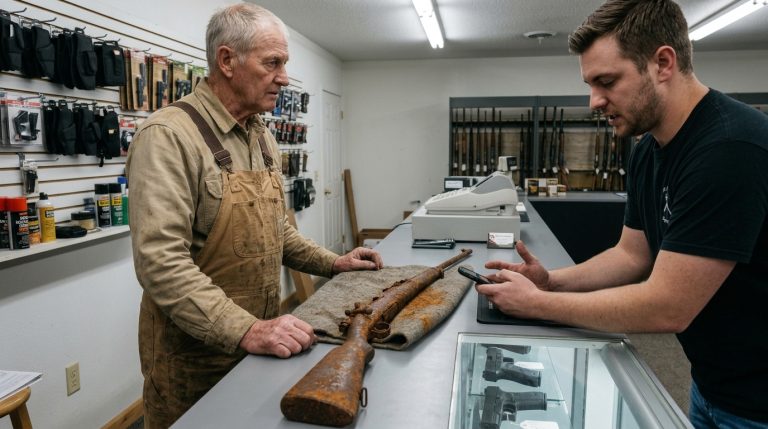
“I found this,” Walter said, his voice raspy, unpracticed. He pulled back the corners of the blanket, unveiling the corroded, orange-crusted metal of the 1903 Springfield. It looked like a drowned thing, a relic pulled from a shipwreck. “I’m looking to restore it.”
Tyler finally set the phone down. He looked at the rifle for exactly three seconds—the time it took to dismiss a lifetime of work—and then his mouth curled into a smirk that was as sharp as a scalpel.
“You’re joking, right?” Tyler didn’t even lean in. He barely flicked his gaze across the receiver, now a pitted, oxidized ruin. “That thing is beyond saving. You’d be wasting your money and my time. Besides, restoration work like that is way above your pay grade, Gramps. Throw it in the trash and save yourself the headache.”
The words landed not as a surprise, but as a confirmation of the world Walter had been inhabiting since he’d closed his barn doors fifteen years ago. A world that measured value by output and speed, not by the depth of the work.
Walter felt the familiar, dull thrum of a tremor in his hand. He gripped the edge of the blanket, the coarse wool grounding him. He looked at Tyler—not with the fire of a man seeking a fight, but with the hollowed-out clarity of a man who suddenly realized he was standing in the presence of a mirror. Tyler was young, arrogant, and terrified of anything that didn’t have a modern warranty.
“The rust is just surface oxidation,” Walter said, his voice surprisingly steady, though it lacked the weight it once held. “The integrity of the steel is still there. If you looked closer—”
“I don’t need to look closer.” Tyler pushed the bundle back across the counter, the metal clanging against the glass with a sound of profound finality. “It’s scrap. And I don’t deal in scrap.”
Walter watched the rifle slide toward him. His fingers brushed the cold, rough oxidation. He didn’t feel anger—that was too simple, too fleeting. Instead, he felt a sudden, sharp clarity. He reached out and gathered the corners of the blanket, enveloping the rusted metal back into the darkness.
As he turned to leave, his eyes caught a reflection in the shop window. Behind him, Tyler had already returned to his phone, the momentary interruption of his day forgotten. But in the reflection, Walter saw the shop’s empty display cases, the lack of depth, the profound lack of history.
He walked toward the door, his heart beating a slow, steady pulse against his ribs. He had come here looking for a hand. He had come here looking for a way to bridge the gap between his old life and this lonely, quiet present. But as he stepped back into the sharp, golden light of the October afternoon, a new, disturbing realization hit him with the force of a physical blow: the rifle was not the only thing in this town that had been buried in the dirt and left for dead.
He looked down at his own hands—spotted with age, trembling slightly—and realized he wasn’t just restoring a piece of history. He was reaching for something that had vanished the day he lost Dorothy.
CHAPTER 2: The Anatomy of Rust
The screen door of the farmhouse clicked shut with a familiar, metallic snap, leaving Walter in the quiet, dusty embrace of his own home. He stood in the entryway for a long moment, the weight of the blanket-wrapped rifle still anchored to his shoulder. Outside, the Virginia hills were beginning to catch the early, amber light of sunset, but in here, the house was draped in the long, gray shadows of a life held in stasis.
He walked through the kitchen, past the table where he took his morning coffee, and out toward the converted barn. The air grew cooler as he crossed the small yard, the smell of damp earth and late-season tomatoes clinging to his clothes. Every step felt heavier than the last, not because of his age, but because of the sharp, stinging memory of Tyler’s dismissal. Above your pay grade, Gramps.
Walter reached the barn door and slid it open. The smell hit him first—a thick, dry cocktail of old oil, cold iron, and the faint, sweet scent of sawdust. It was a smell he hadn’t fully inhabited in fifteen years. Dust motes danced in the sliver of light from the doorway, illuminating the hulking, canvas-draped silhouettes of his lathes and milling machines. They stood like sleeping sentinels, waiting for a command that had been revoked a decade and a half ago.
He moved to the workbench, his boots sounding hollow against the concrete floor. He cleared a space, pushing aside a stack of yellowed manuals and a rusted set of calipers. When he laid the bundle down, the silence of the room felt predatory. It wasn’t the peaceful quiet of his retirement; it was the suffocating silence of a man who had forgotten the sound of his own purpose.
As he unwrapped the blanket, the rifle appeared again, a brutal piece of history etched in oxidation. He stared at it, and for a fleeting, terrifying moment, his mind jumped back to the afternoon he had packed these very tools away. He could hear Dorothy’s voice—not in the room, but in the marrow of his bones—soft, practical, telling him that there was no shame in resting. But looking at the corroded frame of the 1903 Springfield, he felt the lie of that comfort. His retirement hadn’t been a rest; it had been a long, slow fading.
He pulled the workbench lamp closer. The light flickered, then stabilized, casting a harsh, yellow glow over the rusted surface. He picked up a magnifying glass, his hand steadying as the muscle memory took over. The tremor he’d felt in the shop was gone, replaced by a cold, precise focus. He wasn’t Walter the gardener anymore; he was the man who had calibrated the tools of presidents.
He began the disassembly. Every screw was frozen by a century of neglect and environmental abuse. He didn’t force them—that was the amateur’s mistake. Instead, he treated the metal like an old friend who had gone stubborn with age. He applied penetrating oil with a dropper, watching the golden liquid seep into the rusted threads, listening for the microscopic hiss of friction being defeated.
One by one, the components gave way. The trigger guard, the floor plate, the receiver screws. As he laid each part out on a clean white rag, he felt the barrier between his present and his past thinning. He wasn’t just working on a rifle; he was performing an autopsy on his own inaction. The grit under his fingernails, the metallic taste of oil in the air—this was the texture of his identity.
He reached the electrolysis tank in the corner, a large, heavy-duty plastic vat that had remained shrouded under a layer of grime. He dragged it to the center of the workbench, the plastic scraping against the concrete. It was going to take time to set up the power supply and the electrolyte solution. He would need washing soda, distilled water, and a steady current. He moved through the motions with a grace that surprised him, his body shifting into the old rhythms as if he’d never stopped.
There was a moment, just as he finished mixing the solution, where he stopped. The room was deathly quiet. He looked at his reflection in the dark, murky surface of the water, and he saw not a man fixing a toy, but a man preparing to bridge a chasm. If he could strip the rust from this steel, could he strip the stagnation from his own heart?
He submerged the receiver. The water rippled, cold and clear for a second before turning murky as it reacted with the oxidation. Walter didn’t look away. He watched the first microscopic bubbles rise, a slow, rhythmic hiss that promised renewal. It would take days for the process to work, days of patient monitoring and careful adjustments. For the first time in five years, the clock on the wall didn’t feel like it was counting down to an end. It was counting up, measuring the labor he had left to offer.
He turned off the overhead light, leaving the barn to the soft, rhythmic hum of the power supply. The smell of oil and iron lingered, not as a memory of what he had lost, but as the foundation of what he was about to reclaim. He walked back toward the farmhouse, the night air cool against his skin, his mind already calculating the hours of work ahead. He had a lot to do, and for the first time in a long time, the weight in his chest felt like something he could finally carry.
CHAPTER 3: The Shaping of Memory
The barn was a cathedral of dormant industry. Outside, the Virginia sun had dipped below the horizon, bathing the landscape in the bruised purple of twilight, but inside, Walter was tethered to the amber pool of his workbench lamp. He reached for the block of American black walnut he had pulled from the rafters earlier that morning. It had been aging in the dry, stable air for two decades, a relic of a time when Dorothy would sit in the doorway of the barn with a book, the rhythmic sound of his chisel providing the steady heartbeat of their afternoons.
He hefted the wood. It was dense, cool, and carried the quiet weight of patience. He set it on the workbench, the grain tight and straight—the kind of timber that didn’t just hold steel; it cradled it. He needed to turn this dormant mass into a cradle for the 1903 Springfield, a process that demanded more than just precision. It demanded an understanding of the wood’s spirit.
Walter picked up his block plane. He began with long, slow strokes, the blade singing against the walnut as it removed a thin, translucent shaving. The air filled with the clean, sharp scent of wood fibers being exposed. Each stroke was a conversation, a negotiation between the material and his intent. He found himself thinking of the young man, Tyler, and the sterile, hurried environment of Precision Arms. Tyler saw gunsmithing as a transaction—parts, labor, invoice. Walter saw it as an act of restoration, a way of stitching back together the frayed edges of the world.
He moved to the chisels, selecting a heavy-duty gouge for the initial inletting. He had to fit the receiver to the stock with near-perfect tolerance. If the bed was too loose, the rifle would be an aimless, rattling ghost of its former self. If it was too tight, the tension would warp the wood. He worked by feel, his calloused thumb testing the resistance of the walnut, his eyes tracking the light as it caught the curve of the grain.
As he worked, a memory surfaced—unbidden and sharp. He was twenty-five, sitting in a government workshop in Springfield, the air thick with the smell of coal smoke and progress. He had been nervous, his hands shaking just as they had today, only then it had been ambition, not age, that pulsed in his veins. He had been fixing a rifle for a high-ranking officer, someone whose name was now lost, but whose demand for perfection had defined Walter’s entire career. He remembered the feeling of finishing that job—the sudden, startling quiet when he realized he had succeeded. He had brought the rifle home to show Dorothy, expecting her to be impressed by the mechanics, but she had only touched the grain of the stock and smiled. It’s the soul of the tree, Walter, she had said. You’ve let it breathe.
He put the chisel down. The silence of the barn felt heavy, pressing against his ears. He realized that for the last five years, he had been trying to fill this silence with noise—with gardening, with books, with the rhythmic ticking of the radio. But the silence wasn’t a void; it was a space where the past still lived.
He picked up a smaller rasp to refine the tang channel, and that was when his hand stopped.
His thumb traced the edge of the newly exposed walnut, and his gaze shifted back to the receiver he had left on the mat. He had been cleaning it for hours. He picked up his magnifying glass again, aiming the lamp’s focus precisely on the hidden stamping he had previously identified. He had cleaned more of the rust away, exposing a secondary mark he hadn’t fully processed in the initial assessment.
He wiped the metal with a clean rag. The serial number was 456789, just as he had thought. But beneath that, partially obscured by a deep pitting that the electrolysis hadn’t fully cleared, was an inspector’s cartouche—a small, stylized box that looked like a bird in flight. He paused, his heart thudding a slow, heavy rhythm against his ribs. He knew that mark. It belonged to an obscure batch of rifles sent not to the front lines, but to a specialized reconnaissance unit, a group that had effectively vanished from the official records in the chaotic months of 1918.
This wasn’t a standard infantry weapon. The weight, the balance, the specific modifications to the trigger guard he had noted earlier—everything pointed to a provenance that should have been in the archives.
He stared at the metal. A strange, cold prickle crawled up his neck. Why would a rifle like this be buried in a garden in rural Virginia, three thousand miles from where it was supposed to have been decommissioned?
He shook his head, pushing the thought back into the shadows of the shop. It’s just a rifle, he whispered to the empty room. But he knew, with the instinct of a man who had spent four decades listening to the secrets of steel, that it wasn’t. The rifle was a thread, and he had only just begun to pull it. He returned to the stock, his movements slower, more deliberate. He had to keep working. He had to finish this. The secret, whatever it was, could wait until the wood was ready to hold it.
He gripped the rasp, the grit of it biting into his palm, and began to work again, the sound of metal on wood filling the shop, a lonely, persistent song of renewal in the growing dark.
CHAPTER 4: The Alchemy of Forgiveness
The drive into Lexington was a blur of gray asphalt and encroaching dusk. Walter sat behind the wheel of his old truck, the partially restored Springfield resting on the passenger seat, swaddled in its wool blanket like a fragile, dangerous child. Every vibration of the engine seemed to telegraph through the metal, a reminder of the secrets etched into the receiver. The reconnaissance unit, the missing records, the impossibility of its presence in his garden—each piece of the puzzle felt like a mounting pressure, a fever he couldn’t quite break.
He arrived at Precision Arms just as the last of the streetlights hummed to life. The shop window was a beacon of artificial white light in the gathering gloom. He parked, his hands lingering on the steering wheel for a moment to steady the tremor that had returned, persistent and sharp. He had come here to finish what he started, but the purpose had shifted. He no longer cared about the validation of a twenty-nine-year-old shop owner. He needed to know if the gunsmith recognized the mark. He needed to know if the past was as buried as everyone claimed.
He pushed open the door. The chime rang, the sound brittle and impatient. Tyler was at the counter, his posture hunched, his eyes fixed on a bench vice where a modern tactical rifle lay disassembled. He looked up, his face shifting from concentration to a mix of irritation and genuine confusion.
“I told you, Gramps, I don’t—” Tyler started, but the words died as he saw Walter set the bundle on the counter.
Walter unwrapped it, the action fluid and practiced. The metal, now deep-blued and gleaming under the harsh shop lights, looked startlingly alive against the counter’s scarred surface. He didn’t say a word. He pushed the receiver toward Tyler, specifically pointing to the small, faint cartouche he had cleaned to near perfection.
Tyler leaned in. The irritation melted away, replaced by an intense, narrow-eyed focus. He reached for his jeweler’s loupe, the movement hesitant. He stared at the mark for a long time, the silence in the shop stretching until the humming of the fluorescent lights seemed to deafen them both.
“Where did you get this?” Tyler’s voice was barely a whisper. He wasn’t looking at the rifle as a piece of junk anymore; he was looking at it as an artifact. “That mark… that’s not from a standard assembly.”
“It was in my garden,” Walter said, his voice steady, stripped of its earlier defensive edge. “Tell me what you see.”
Tyler adjusted the loupe, his fingers trembling ever so slightly. “This shouldn’t exist. The reconnaissance units… they were dissolved before the Armistice. Most of these were pulled, re-serialized, or destroyed. This rifle is… it’s a ghost.” He looked up at Walter, his eyes wide. “How did you do this? The finish, the inletting, the timing—you didn’t just restore a Springfield. You brought back something that was supposed to stay lost.”
Walter watched him, seeing the shift. The arrogance that had defined their first meeting was gone, replaced by a raw, unvarnished hunger for the truth. Tyler was seeing the depth of the craft, the way that history could be held in the palm of one’s hand if one only knew how to listen to the metal.
“The craft isn’t about what’s easy, Tyler,” Walter said, his tone low and resonant. “It’s about what’s true. You spent three years building rifles for people who wanted to look like soldiers. I spent forty years making sure that when a soldier pulled the trigger, the world moved the way it was supposed to.”
Tyler retreated a step, his hand still hovering near the receiver. He looked at Walter, really looked at him—not as a relic, not as an old man in overalls, but as a repository of a language he was only just beginning to learn. “I don’t know the history of this unit,” Tyler admitted, the confession costing him visible effort. “I have the old ledgers from my father’s time. There are records… lists of serial numbers that were marked as ‘Restricted’ or ‘Destroyed’. If I looked, I might find something. But why would you go to all this trouble for something that puts a target on your back?”
“Because,” Walter said, his gaze drifting to the rifle, “it was buried, but it wasn’t dead. And neither am I.”
The shop door chimed again, breaking the tension. A regular customer walked in, a man in a tactical jacket looking for a quick cleaning, his presence an unwelcome intrusion into the quiet gravity of the moment. Tyler looked back at Walter, his jaw set.
“Stay,” Tyler whispered, abandoning the incoming customer for a heartbeat. “Wait until I lock up. If this is what I think it is, we’re going to need more than just tools to fix it.”
Walter nodded once. He felt the shift—a bridge, fragile and untested, but holding. He had come here to prove his worth, but he had found something far more dangerous: a partner who finally understood that they weren’t just working on steel. They were working on a memory that, for reasons he didn’t yet fully grasp, someone had gone to great lengths to hide. As he stood in the glow of the shop, waiting for the truth to catch up to him, the weight of the rifle felt less like a burden and more like a warning.
CHAPTER 5: The Unveiling
The shop had gone silent. The casual customer had long since left, and now, the only sound was the rhythmic clicking of the deadbolt as Tyler locked the front door. He turned, his face pale under the harsh, overhead lights. He walked toward the back office, a cramped space cluttered with the detritus of his father’s career—stacks of brittle, yellowing ledgers, invoices dating back thirty years, and cardboard boxes overflowing with paper.
Walter followed him, his boots clicking on the floor. He felt a strange, cold tension in his gut. The rifle lay on the counter, still gleaming, a silent sentinel watching over them.
“My father didn’t talk much about the ‘Restricted’ inventory,” Tyler said, his voice echoing slightly in the narrow office space. He started pulling boxes from the top shelf, the dust dancing in the air like fine, gray snow. “He just told me that some things in this industry don’t go back into circulation. He called them ‘orphans’.”
He hauled a thick, leather-bound book onto the desk. The cover was cracked, the binding fraying at the edges. He opened it, the parchment dry and brittle. They huddled over the desk, the light of the lone desk lamp casting long, distorted shadows against the walls. Tyler flipped through the pages, his finger tracing lines of faded ink.
“Here,” Tyler said, pointing to an entry dated July 1948. It was a list, a string of numbers. He tracked down the column, his finger stopping at the same serial number etched into Walter’s rifle. “456789. It’s marked here as ‘Returned to inventory, status: Disposition Pending’. But there’s a note in the margin.”
Walter leaned in, his eyes straining. The handwriting was cramped, hurried. Owner declined recovery. Subject deemed hazardous to reputation.
“Hazardous?” Walter whispered. The word felt like a physical weight. “How could a rifle be hazardous to a reputation?”
“Look at the name listed in the margin,” Tyler muttered, his finger tapping the paper. “It’s not a military designation. It’s a signature.”
Walter felt the air leave his lungs. He recognized the name, a man who had been a titan of the defense industry in the late forties, a man whose shadow had loomed over every project Walter had ever touched during his time in the workshop. The realization hit him with a jarring, surreal force: this wasn’t just a military weapon. It was an object of influence, a bargaining chip in a game he hadn’t even known was being played. The reconnaissance unit, the secrecy—it was all a cover for something far more domestic and far more ruthless.
His breath hitched. He had spent his entire life believing his work was for the country, for the sake of integrity and function. But as he looked at the ledger, he felt the foundation of his career shift. He had been a small cog in a machine that valued reputation over history, a machine that discarded anything that dared to reveal its compromises.
“My wife,” Walter started, his voice barely audible. “She always said the past has a way of coming back to claim its debt.”
Tyler looked up, his expression guarded. “What do we do, Walter? If we go public with this, if we trace this back, we’re going to be stepping on a lot of ghosts.”
Walter looked at his hands, those calloused, oil-stained hands that had once built weapons for the very people who had orchestrated this silence. He felt a sudden, sharp clarity. He wasn’t afraid. The anger he had felt in the shop a week ago had burned out, replaced by a cold, resolute purpose.
“We don’t go public,” Walter said, his voice hardening. “We finish the work. The rifle isn’t the threat, Tyler. The threat is the silence. And I’m done being part of it.”
He turned back to the counter, leaving the ledger open on the desk. The rifle waited, its blued surface reflecting the light of the shop. He knew what he had to do. The final assembly, the last touch of oil, the quiet dignity of a job completed to its absolute, uncompromising end. He had realized, in that stifling office, that his restoration wasn’t just about the rifle; it was about the truth. And the truth, he decided, was the only thing worth leaving behind.
CHAPTER 6: The Silent Bench
The office was still. The only sound was the distant, muffled traffic of Lexington filtering through the walls. Walter looked at the ledger, then at the rifle, and finally at Tyler. The young man’s face was transformed, stripped of its cynicism, etched with the weary realization of a truth that was larger than a business, larger than a reputation.
“You don’t need to do this,” Tyler said, his voice quiet. “If we put this back in the records, if we link it to the VMI collection under the original unit markings, the questions will start. Someone will come looking for that ledger.”
Walter didn’t flinch. He reached out and closed the ledger, his fingers pressing into the cracked leather. The act was final. “Let them come,” he said. His voice, though aged, carried a core of iron. “I’ve spent fifteen years hiding from the silence, Tyler. I’m not going to spend the rest of my days hiding from the past.”
He stood up, his joints aching with the fatigue of a week’s labor. He picked up the rifle. It felt lighter now—a tool, not a burden. He walked out of the office and through the shop, his steps firm. Tyler followed, the shop lights reflecting off his glasses. They didn’t speak. They didn’t need to. In the space of one week, they had traveled the distance from arrogance to understanding, a journey measured not in miles, but in the slow, meticulous removal of rust.
The transition to the Virginia Military Institute was seamless, almost ceremonial. A few days later, Walter stood in the quiet, climate-controlled halls of the VMI Museum. The Springfield was already displayed behind glass, its deep-blued receiver gleaming against a velvet backdrop. The plaque beside it was simple, describing the model and the era, though it stopped short of revealing the unit’s classified history. Walter found he didn’t mind. The truth wasn’t in the plaque; it was in the steel itself.
He heard footsteps and turned to see Tyler approaching. The young man stood beside him, watching the rifle. For a long time, neither of them spoke.
“I looked through the records again,” Tyler said softly, his eyes fixed on the display. “I found a letter. It was from the officer who was supposed to sign off on the destruction of these units. He didn’t sign it, Walter. He just… left the file open.”
Walter nodded, a small, sad smile touching his lips. “There were always men who believed that some things were worth more than orders. We weren’t the only ones, Tyler. We were just the ones who were left.”
The atmosphere in the room was cool, heavy with the weight of artifacts, yet for Walter, it felt remarkably light. He looked at his hands. They were clean, the stains of linseed oil and bluing finally washed away, but he could still feel the grit of the workbench, the resistance of the walnut, the sharp, satisfying click of the bolt assembly. He had repaired the rifle, yes, but in doing so, he had repaired the memory of his own service. He had validated the long, quiet years of his life, proving that he hadn’t been forgotten, only waiting for the right work to call him back.
He turned to Tyler, who was watching him with a look of genuine, unfeigned respect. The arrogance was gone, replaced by the humble, searching curiosity of a true apprentice.
“The shop is yours, Tyler,” Walter said, his voice gentle. “But remember what I told you. The tools are just the beginning. The real craft happens when you realize you’re not just fixing objects. You’re holding the pieces of someone else’s life together.”
Tyler nodded, his throat working. “I’ll keep the bench open for you, Walter. Whenever you want.”
Walter stepped back from the display. The room began to blur at the edges, a soft, golden haze settling over the rows of glass and steel. He felt a profound sense of closure. He looked at the rifle one last time—the mark of the reconnaissance unit visible only to those who knew where to look. It was a silent testament, a piece of truth that would outlast the reputations of the men who had tried to bury it.
He walked out of the museum, the afternoon air hitting his face with a refreshing, sharp chill. He took a deep breath, the scent of autumn leaves and wet pavement filling his lungs. His work was done. The rifle was safe, the secret was anchored, and his legacy—the real one, the one he had built in the hands of a young man—was secure.
He walked to his truck, the engine turning over with a steady, reliable hum. He didn’t look back. He headed home to the farmhouse, to the garden he had tended with such meticulous care, and to the chair by the window where the classical music still played, soft and rhythmic. For the first time in his life, he wasn’t carrying anything. He was simply moving, a man at peace with the weight he had carried, and ready for the long, quiet sleep of a master who had finished his task.