The Geometry of Friction: A Tale of Rusted Brass, Cold Steel, and the Unforgiving Horizon of the Hindu Kush
CHAPTER 1: THE COLD LINE AT CORONADO
The air downrange didn’t smell like victory; it smelled like the back of an engine block—scorched oil, sulfur, and the bitter tang of salt eating away at the galvanized target stanchions. Harper Vance didn’t look at the quarter-sized cluster at the center of the card. She didn’t have to. The rifle felt cold where her cheek met the adjustable riser, the metal surface pitted by three years of sea spray that no amount of solvent could fully smooth out.
“Clear and safe,” she said. Her throat felt lined with iron filings.
Behind her, Master Chief Sullivan let out a breath that sounded like a shovel striking gravel. He didn’t write on his clipboard immediately. He tapped the brass tip of his pen against the metal clip, a slow, metallic tick-tick-tick that matched the rhythm of the tide slapping the concrete barriers outside. “You’re pulling three millimeters to the left on the exhale, Ghost. Still dead center, but the wind didn’t give you that. You did.”
“The bolt’s sticking on the guide rails, Master Chief. It needs a file, not a brush.” Harper stood, her boots crunching through the layer of spent green-tarnished hulls littering the deck. She didn’t do theatrical. She cleared the chamber, locked the slide back on her Sig P226, and laid it beside the long gun with its muzzle pointing directly into the gray soup of San Diego Bay.
“The Commander’s waiting,” Sullivan said, his eyes fixed on the target paper as if looking for a flaw she hadn’t given him. “He’s got the after-action from Syria on his desk. The ink’s dry, but the brass at the Pentagon are still sweating through their starch.”
The walk to Commander Steel’s office was five minutes of dead air through corridors that tasted of damp wool and industrial floor wax. Every frame on the wall was a chronicle of corrosion—black-and-white glossies of teams from the Mekong delta whose names were scratched out of the official ledgers, and color prints from 1987 where the edges had turned a chemical yellow. She stopped before the center frame. Her father’s fingers were hooked into Jack Steel’s tactical vest, both of them grinning with the hollow-eyed intensity of men who hadn’t slept since the previous Tuesday. Her father’s watch face was cracked, a spiderweb pattern across the mineral crystal that she knew still sat in a cedar box in her bedroom.
“You’re tracking dirt into my briefing room, Vance.”
Steel didn’t look up when she stepped through the door frame. He was sixty-three, and his skin had the texture of dried beef casing, tanned by three decades of high-altitude glare and low-grade diesel smoke. On his desk lay a single manila folder with a red security strip running corner to corner. The corner was frayed, the fiber string snapped.
“Thirty-seven confirmed, sir,” Harper said, her back straight but her heels dug into the linoleum.
“The ROE said overwatch, Lieutenant. Overwatch means you watch the line. You don’t cross it to turn an observation post into a salvage yard.” Steel finally raised his eyes. They were the color of stagnant river water. “General Ashford’s office called twice before the sun cleared the horizon. They aren’t looking to give you a medal, Harper. They’re looking for the serial number on the firing pin that broke the chain of command.”
“The Marines were in a funnel, sir. If I stayed behind the glass, they’d be scrap metal by noon.”
“Then you let them be scrap metal until the birds arrive,” Steel growled, his hand coming down on the red-striped folder with a dull thud. “That’s the gray line. You think your father died a hero because he stayed on that mountain? He died because the logistics didn’t care about his conscience. Ashford remembers the report Cole filed in ’03. He remembers the friction. Now go home, look at the surf, and pray the review board gets bored before they find a reason to strip your trident.”
The beach house in Ocean Beach smelled of salt-rot and old grease when she let herself in forty minutes later. She didn’t wash her hands. She sat on the edge of the unmade mattress, pulled the drawer beside the door, and let her thumb follow the small, carved initials CV on the paracord wrap of her father’s SOG knife. The cord was stiff with age, the grease from his palms turned to a dry, gray crust between the nylon weaves.
Outside, a car door slammed. Not the loose rattle of a local beach junker, but the heavy, reinforced thud of a government-spec chassis. Harper didn’t reach for the weapon in her waistband; she just shifted her weight until her hand rested naturally on the crossguard of the blade. The rusted screen door rattled once before a shadow broke the glare of the noon sun.
CHAPTER 2: THE SALT AND THE SUIT
The screen door didn’t just rattle; the rusted steel mesh hummed against the rotting cedar frame, a low, vibratory grating that stopped precisely when the footsteps on the gravel did. Harper’s thumb remained locked against the crossguard of her father’s SOG knife. She didn’t lift the blade from the cedar drawer. She simply measured the resistance of the floorboards beneath her boots, calculation shifting into muscle memory as the heat of the midday sun choked the small kitchen into a dead, airless box.
“The latch on the back window is stripped, Harper,” a voice said through the wire weave. It wasn’t the gravel-and-iron register of Jack Steel. It was smooth, dry, and carried the specific, clipped cadence of the Eastern Seaboard—someone who spent their mornings reading intelligence summaries and their afternoons deciding which parts of them to burn. “If I were Malik Rashid’s people, I wouldn’t have used the porch. I’d have been inside three minutes ago while you were still staring at Cole’s old logs.”
The screen door swung open with a dry, ungreased screech. Victoria Cross stepped onto the peeling linoleum, her charcoal-gray wool suit entirely clean despite the dust blown off the coastal highway. She didn’t look like she belonged in Ocean Beach, and she didn’t look like she cared. Her silver bob was cut with the surgical precision of an executive order, her eyes the flat, polished blue of industrial drill bits.
Harper didn’t drop her hand from the drawer. “The Navy says I’m on administrative leave, Director. That means my door is locked to the Agency unless there’s an authorization code stamped by the Joint Chiefs.”
“The Joint Chiefs are currently rewriting the rules of engagement for the eastern Mediterranean so General Ashford doesn’t look like a fool on C-SPAN,” Cross said, her voice dropping into the quiet space between the rhythmic thuds of the surf outside. She pulled out a rusted metal chair from the Formica table, her manicured fingers ignoring the flakes of oxidized primer that stuck to her palm. She sat without being invited. “I don’t need the Joint Chiefs. I have a satellite array that went dark over the Hindu Kush seventy-two hours ago, and I have ten names that aren’t on Ashford’s ledger.”
Harper slowly withdrew her hand from the cedar drawer, letting it close with a dull, wooden click. She stayed on her feet, her boots planted where the linoleum had worn down to the bare ply. “Seals don’t drop off the grid in the Kush unless their comms infrastructure is iron-capped. If Hawkins went quiet, it’s because he chose to.”
“Tyler Hawkins didn’t choose anything,” Cross replied. She reached into her leather portfolio and drew out a set of thermal prints. The paper was heavy, standard-issue reconnaissance stock, but the edges were curled from the humidity of the agency vehicle’s climate control. She didn’t slide them across the table; she laid them down like a challenge. “Three days ago, Team Five was assigned an overwatch profile on a valley six miles north of the Durand Line. The target was Rashid. The orders were to observe, confirm identity, and wait for a conventional strike package.”
Harper’s gaze flicked to the top sheet. The grainy, green-tinted heat signatures showed eight distinct bodies arranged in a tight perimeter within a stone courtyard. There were no weapons signatures next to them. No infrared strobes. Just the cold, white-hot blooming of plastic explosive blocks being strung along the perimeter walls like fence wire.
“They were sold,” Harper said. It wasn’t a question. Her voice had the same flat, dangerous weight as the brass she had left on the Coronado range. “The deployment schedules for Team Five don’t pass through standard regional logistics. They go through the deputy director’s office. Through Ashford.”
“Ashford signed the stand-down order forty-eight hours ago,” Cross said, her fingers tracing the margin of the thermal print where the digital timestamp read LOCKED. “He cited weather protocols over the Hindu Kush. Said the cloud ceiling made extraction impossible. But my analysts picked up a secondary transmission from a terminal inside the Coronado gear cage—an old logistics account that hasn’t been active since your father’s unit was deactivated in 2005. Someone leaked the insertion grid to Rashid’s couriers forty-eight hours before Hawkins ever turned his transponder on.”
A cold, familiar friction settled behind Harper’s ribs. It was the same sensation she felt when the windage turret on her Leupold scope didn’t click cleanly—the indication that something in the mechanism was stripped, hidden beneath the paint, working to throw the shot three inches wide at a thousand yards. She looked at the signature on the bottom of the intelligence brief. The initials were standard bureaucratic scrawl, but the routing code was personal.
“Travis Bennett,” Harper murmured, her thumb unconsciously testing the calloused skin of her index finger. “He was the case officer assigned to my father’s liaison detail in Khost. He’s the one who verified the DNA on the remains we buried.”
“Bennett is currently at Bagram, managing the regional intelligence node,” Cross said, standing up. The metal legs of the chair scraped against the floor with a sound that set Harper’s jaw. “He’s also the one telling the rescue coordination center that Hawkins’s team is already dead. He wants the file closed, Harper. He wants it closed before anyone asks why an old Vance-era logistical channel was used to route a Tier One team into an unmapped valley.”
“And you want me to pull the trigger because Steel can’t.”
“I want you because you’re the only shooter who knows how Bennett thinks, and you’re the only one with a reason to look past the decoy,” Cross said, her hand reaching for the screen door. She didn’t look back as she pushed it open, letting the salt air rush into the small kitchen once more. “The Agency SUV is idling out front. We have a C-17 clearance at North Island in two hours. You can stay here and wait for the Navy’s review board to strip your trident, or you can come down to the cage and pick your steel. The deployment orders are already in your file. They’re signed by me.”
Harper stood alone in the center of the kitchen for five seconds. The smell of the old floor wax mixed with the exhaust from the idling truck outside. She turned back to the cedar drawer, pulled it wide, and took her father’s SOG knife, sliding the sheath onto her belt until the cold steel of the pommel dug into her hip. She didn’t pack a bag. There was nothing in this house that belonged to the person she had to be once she stepped across that threshold.
CHAPTER 3: BAGRAM TRANSIT
The gravel outside didn’t compress cleanly beneath Harper’s boots; it yielded with a dry, jagged grind that caught the edge of her worn heel. The Agency SUV’s exhaust pipe cast a thin, trembling haze across the desaturated California concrete, the scent of unburned hydrocarbons mixing with the low-grade salt rot of the shoreline. She didn’t look back at the screen door as it settled into its frame with a final, hollow click. Her focus was entirely locked on the physical space three inches ahead of her—the tactical transition from the stagnant calm of administrative grounding to the relentless friction of an active deployment.
The interior of the vehicle smelled of stale climate control and heavy, vulcanized floor mats. Victoria Cross didn’t offer a hand, and she didn’t check the rearview mirror as she pulled the heavy chassis into the lane. Her fingers remained flat against the leather-wrapped wheel, her silver bob stationary as the coastal highway gave way to the perimeter fences of North Island Naval Air Station. The silence between them wasn’t empty; it was transactional, filled with the low hum of the transmission and the distant, metallic whine of a C-17 Globemaster warming its turbines on the tarmac half a mile out.
The transition through the flight line was an exercise in pure logistics. No words were wasted on briefings that hadn’t been stamped with an agency routing code. When the heavy transport plane cleared the coast, the vibrations through the aluminum floorboards settled directly into Harper’s teeth—a steady, rhythmic rattling that lasted through the long, thin hours over the Atlantic, through the industrial grease of the Ramstein refueling stop, until the pressurized air finally hissed out of the seals over Bagram Airfield.
The air that rushed into the cargo bay at dawn local time tasted of fine, gray limestone dust and burnt kerosene. The horizon wasn’t an open blue; it was a wall of jagged, desaturated stone peaks that looked like rusted iron teeth rising out of the desert floor. A single, unpainted Humvee was idling at the edge of the concrete, its tires caked in the pale, chalky mud of the southern valley.
“The node is in the basement of the old Soviet logistics depot,” Cross said, her voice barely cutting through the high-pitched whistle of the descending turbine blades. She didn’t look at Harper as she swung her leather portfolio over her shoulder. “Bennett doesn’t know you’re on the manifest. He thinks the Agency is routing a replacement sniper out of Germany. Keep your muzzle down until we’re behind the blast doors.”
The walk across the gravel courtyard was six minutes of unskit, real-time exposure to the thin, freezing mountain air. Harper’s left ankle, the one that had caught the hard edge of a loose rock during the Syria extraction, throbbed with a dry, deep ache that matched the thud of her pack against her spine. She ignored it. Pain in this environment wasn’t a warning; it was simply a baseline variable to be calculated into the drift of the shot.
The shooting range behind the logistics depot was nothing more than a trench cut into the limestone, backed by a row of pockmarked steel targets that had turned a dull, oxidized red under the high-altitude sun.
“You’re thirty minutes late, Director,” a voice boomed from the firing line.
Master Chief Grant Sullivan stood with his boots buried in the gravel, his customized Remington 700 resting across his forearm like a tool he hadn’t cleaned since the last rain. His hair was a stiff, iron-gray wire brush, and his face had the hard, pitted texture of stone that had survived too many winters. He didn’t look at Cross; his eyes, small and dark behind his shooting glasses, fixed directly on the slim silhouette of Harper’s pack.
“The manifest said Ghost,” Sullivan said, his voice dropping into a low, gravelly rasp that sounded like concrete being turned in a mixer. “I didn’t expect Cole Vance’s kid to be the one holding the long gun. I served with your father in Ramadi, Lieutenant. He knew how to read a wind, but he also knew when to stay behind the log. You didn’t do that in Syria.”
Harper didn’t drop her pack. She stepped directly to the bench, her fingers catching the latches of her hard case with a clean, sharp snap. The cold iron of the MK13 Mod 7’s receiver met her palm with a familiar, heavy resistance. “The wind in Syria was pushing five knots from the east, Master Chief. The target wasn’t moving. If I stayed behind the glass, the Marines would have been buried in the sand. I don’t look for the log when the line is clear.”
“The wind down this trench is fifteen knots, gusting twenty out of the north gap,” Sullivan replied, his jaw tightening as he pointed a calloused finger toward the steel plate six hundred yards downrange. The red paint was entirely gone from the center, replaced by a jagged pattern of old gray lead splashes. “Five rounds. Best grouping keeps the lead. If you pull three millimeters to the left here, the scree will catch the boat-tail before it ever hits the plate.”
Harper didn’t look at him. She dropped into the prone position, her knees grinding into the sharp limestone grit until her weight was perfectly distributed across the skeletal frame of the rifle. The bipod dug into the dirt with a small, dry crunch. She brought her eye to the Leupold scope, her thumb catching the windage turret—one click, two clicks, three clicks right—adjusting for the pale, shimmering heat waves that rose off the rocks between her position and the steel.
The world narrowed to the small, gridded circle of glass. She could see the deep pitting in the iron plate, the white crust of salt that had dried along the lower margin. Her breathing settled into the four-count rhythm her father had carved into her skull before she was old enough to hold her own brass. Four counts in. Hold. Squeeze on the exhale between heartbeats.
The rifle bucked against her shoulder with a smooth, heavy shove that smelled instantly of oxidized copper and spent powder. Through the glass, a small, gray lead flower bloomed precisely half an inch below the previous strike mark. She didn’t wait for Sullivan to read the hit. She worked the bolt, the spent casing flying over her shoulder to land in the limestone dust with a dry, metallic tink.
“That’s one,” Sullivan muttered behind her, his spotting scope humming as he turned the focus ring. He didn’t say anything else, but the rhythmic tapping of his boots against the gravel stopped entirely.
CHAPTER 4: THE MOUNTAIN SCRAMBLE
The spent casing hadn’t even finished cooling in the pale dust before Master Chief Sullivan’s hand closed over the brass tube of his spotting scope with a sharp, mechanical click. He didn’t look back at the rest of the team as they stood by the limestone trench. His boots shifted, grinding the white stone dust until a fine, chalky cloud rose around his ankles. “A two-inch group at six hundred doesn’t buy you an easy path up the northern ridge, Ghost. The scree up there doesn’t have a floor, and the air won’t give you four counts to fix your mistake.”
Harper didn’t answer. She stood smoothly, her hands executing the immediate clearing procedures on the MK13—bolt back, magazine unlatched, chamber verified by a single, bare finger testing the cold iron feed ramp. The weight of the system didn’t leave her arms; it settled into the coarse canvas of her sling as she re-torqued the hardcase latches. The team was already shifting around her, their bodies silhouetted against the stark, unpainted walls of the old Soviet depot. Doc Rivers was already hauling three sixty-pound packs onto the tail-gate of the unpainted Humvee, his breath emerging in short, gray plumes that tore apart instantly in the high-altitude draft.
The physical transition from the limestone base to the foot of the northern ridge line left no room for narrative ellipsis. Every kilometer was registered in the steady, rhythmic punishing of the vehicle’s suspension against the unmapped dry creek beds. When the engine finally died at the base of the steep ascent, the silence that rushed back was absolute, broken only by the metallic ping of the hot exhaust manifold cooling against the frozen mud.
“Load up,” Sullivan muttered into the dark. “Radio silence starts when the boots hit the shale.”
Harper hoisted the sixty-five-pound pack, the heavy nylon straps cutting directly into the old scar tissue on her collarbone. She checked the retention on her belt; her father’s SOG knife was positioned precisely three inches forward of her right hip bone, the cold steel pommel hitting the edge of her tactical vest with every step. They moved out in a single file, the intervals frozen at five-meter lengths. Sullivan took point, his heavy frame moving with a slow, mechanical leverage that seemed to ignore the vertical grade. Harper was second, her focus pinned entirely to the heel-strikes of his boots as they broke through the frozen crust of the lower slope.
The terrain wasn’t just steep; it was structurally unstable. Every third step through the limestone scree required a conscious weight shift, her ankles locking against the sliding gravel to prevent the heavy pack from pulling her center of gravity past the point of recovery. The cold air at eight thousand feet tasted of iron filings and dry stone dust, drying her mouth until every swallow felt like scraping fine sandpaper down her throat.
Two hours into the vertical scramble, the environment shifted without warning. A sudden, sub-zero gale screamed through the north gap of the peaks, driving a wall of frozen grit directly across their line of march. The green glow of Harper’s night vision goggles became a swirling mass of static as the dust picked up the ambient infrared light. She paused, her right hand dropping instantly to the bipod mount of the long gun, her weight lowering until her knees were jammed into a narrow crevice between two basalt boulders.
Behind her, Doc Rivers slipped, his boot losing traction on a patch of black ice hidden beneath the loose shale. The heavy scrape of his pack against the rock face echoed across the ridge like a small explosion. Harper didn’t turn her head. She reached back blindly, her gloved fingers catching the heavy webbing of his chest rig, her arm locking into a single, rigid strut until his weight re-centered over his heels.
“Thanks,” he whispered, his voice a dry rasp inside the team frequency.
“Watch the shelf,” Harper replied, her dialogue transactional and clipped. “The ice is bleeding out of the stone where the sun doesn’t reach.”
They didn’t stop to rest. The movement remained a continuous, real-time negotiation with gravity and the failing air. Her left ankle, the old injury from the Mediterranean insertion, throbbed with a persistent, cold heat that vibrated all the way up her tibia. She calculated the pain as a fixed distortion—an extra two pounds of resistance to be applied to her lead leg with every upward thrust.
By 0540, the pitch of the ridge began to flatten into a narrow, wind-scoured spine of exposed granite. The limestone gave way to hard, black ironstone that had been polished smooth by centuries of glacial drafts. Sullivan dropped to one knee behind a low breastwork of shattered rocks, his spotting scope already sliding forward over the stone lip.
Harper crawled into position beside him, her chest flat against the freezing granite. She deployed the MK13’s bipod with her left hand, her fingers recognizing the dry, ungreased friction of the aluminum legs as they locked into the frozen dirt. Through the circle of the Leupold glass, the valley floor opened up twelve hundred yards below—a dark, jagged bowl of stone huts and mud brick enclosures arranged around a central courtyard.
The target was exactly where the thermal prints had predicted, but as the first pale light of dawn caught the eastern rim of the valley, Harper’s eye locked onto the physical layout of the stone perimeter. The wire cables running from the central posts weren’t standard communications lines. They were heavy, military-grade detonation cords, and they didn’t lead toward the main command hut. They disappeared directly into the foundations of the stone structures where the hostages were tied.
She slowly rotated the windage turret one click to the left, her eye never leaving the crosshairs. The decoy was visible, but the real trap was already buried under the dirt.
CHAPTER 5: OVERWATCH HORIZON
The dawn light did not warm the valley; it stripped it bare, turning the mud-brick rooftops below into a flat, desaturated expanse of cracked clay and grey shadow. Harper’s right index finger remained static against the cold face of the trigger shoe. Her eye was frozen behind the Leupold glass, tracking the thick, dust-caked lines of detonation cord where they emerged from the base of the wood posts. At twelve hundred yards, the lines looked like dried, black veins splitting the earth—a hard, physical reality that rendered General Ashford’s official “observation protocol” entirely obsolete.
“The main lead runs thirty meters straight through the drainage channel,” Harper whispered, her breath freezing instantly against the rifle’s stock. “It’s not an improvised array, Master Chief. Those are military-grade crimps. Clean joints. It’s laid down by someone who has an endless supply of logistics crates and a manual from the Soviet withdrawal.”
Sullivan didn’t shift his posture behind the spotting scope. His elbows were dug so deep into the loose granite shards that the coarse fabric of his cold-weather layer had begun to fray, spitting out tiny white strands of synthetic insulation into the dirt. “I see the loops, Ghost. Rashid didn’t dig those trenches himself. He’s running an active perimeter grid, but he’s drawing the power source from the high structure. Look at the conduit on the east wall.”
Harper adjusted the parallax dial, the dry, ungreased aluminum clicking three increments to the right under her thumb. The frame of her focus drifted off the central courtyard, sliding across the pockmarked stone facings of the two-story wing. The windows were narrow, barred with rusted structural iron rebar that had oxidized into thick, orange scales. Behind the third vertical pane, a pale green light flickered with a rhythmic, mechanical pulse—the distinct diagnostic signature of an encrypted tactical terminal.
Before she could adjust the elevation to track the line, her closed-circuit tactical tablet—strapped flat to her left forearm over her sleeve—vibrated with three short, blunt pulses. The screen didn’t display a standard Agency routing code. It bypassed the encrypted link Cross had established, flashing a raw, white-text line across the liquid crystal: MONGOOSE 6 // OVERRIDE DATA PARALLEL.
A secondary data file bloomed below the header, the metadata showing an internal transfer timestamp from forty-eight hours ago. It was an extraction manifest from an unlisted facility in Helmand, but the cargo weight wasn’t listed in pounds or equipment crates. It was marked under a single, archived personnel identifier: VANCE, C. – RETENTION LAYER 4.
A sudden, sharp whistle of static cut into her inner-ear piece—not the broad-spectrum white noise of a atmospheric disturbance, but the low-frequency, localized hum of a transmitter operating within five hundred meters of their own ridge line.
“Jordan,” Harper said, her jaw tightening until the bone clicked. “You’ve got a parasitic signal on the sub-channel. It’s bleeding off our close-range relay.”
“I’m tracking it now, Ghost,” Jordan’s voice came back, tight and clipped through the noise. “But it’s not an external jammer. The origin signature is registered to an Agency-coded hardware encryption key. It’s routing from our own rear element.”
Harper’s gaze didn’t leave the scope, but her internal map shifted instantly, calculating the physical geometry of the ridge behind her. Travis Bennett was sitting forty meters down the reverse slope, his fingers flat against his logistical kit, his expensive watch face covered by a strip of dark, non-reflective tape. He wasn’t monitoring the tactical node; he was managing the feed.
Through the glass, the central courtyard below fractured into motion. The narrow metal door of the command structure swung back, its heavy iron hinges throwing off a small flake of red rust that fell into the grey dust. Malik Rashid stepped onto the packed clay, his posture erect, his hands clasped loosely behind the coarse wool of his traditional vest. He didn’t look like an insurgent commander hiding in a cave; he moved with the precise, calculating economy of an officer who had survived the Spetsnaz details in Kabul before the walls came down.
Two fighters followed him, dragging Tyler Hawkins by the harness of his torn tactical vest. Hawkins’s boots left two jagged, parallel tracks in the dirt, his head lolling to the left until his chin hit the blood-stiffened canvas of his collar. They dropped him three feet from the central post, right where the black detonation cord looped out of the soil like an uncoiled snake.
“He’s setting the timing sequence,” Sullivan growled, his hand tightening around the barrel of his spotting scope until the metal groaned. “He’s not waiting for dusk, Ghost. He knows we’re on the high line. He’s looking right at the gap.”
Harper shifted her crosshairs until the center chevron settled precisely on the small silver skull-pendant pinned to Rashid’s lapel. The range read twelve hundred and fifteen yards. The wind was quartering from the northeast at eight knots, a dry, cold draft that would carry the bullet four inches low if she didn’t take the slack out of the second stage. Her finger tightened on the trigger face, her father’s knife a heavy, cold presence against her hip bone as she prepared to shatter the protocol.
“TOC to Overwatch,” the radio speaker in her ear pieces hissed with a dry, bureaucratic crackle. “The weather front is down to five hundred feet. No air assets authorized for your quadrant. Maintain observation posture. Repeat: stand down.”
Harper didn’t look away from the chevron. The real trap wasn’t below them in the mud; it was sitting forty meters behind her on the shale, waiting for her to follow the rule.
CHAPTER 6: THE UNAUTHORIZED TRIGGER
The radio speaker didn’t just crackle; the dry, static hiss from the tactical operations terminal cut through Harper’s earpiece like a serrated wire, vibrating against the bone of her jaw before dissolving into the sub-zero mountain wind. She didn’t adjust her cheek weld. Her eye remained entirely locked behind the Leupold glass, the reticle stabilized directly on the rusted iron plate of the technical truck’s engine casing down in the valley floor.
“Overwatch, acknowledge stand down,” the voice repeated, flat, distant, and cushioned by three layers of satellite lag from an air-conditioned command desk at Bagram.
Harper didn’t use the transmit toggle on her chest rig. Her thumb reached up, catching the serrated circumference of the elevation dial on the MK13. She turned it two increments down—click, click—dropping the trajectory path from Rashid’s lapel to the exposed, oxidized linkage of the compound’s main generator line running along the northern perimeter wall. “The fuel line has a copper coupling three inches below the secondary intake flange,” she said, her voice dropping below the register of the gale. “It’s completely corroded, Master Chief. If I strike the iron block, the spark will catch the drainage sump before the command wire can signal the courtyard.”
Sullivan’s breathing didn’t alter. His shoulder stayed jammed into the granite lip, his boots dug into the brittle shale until the leather of his toes was caked in fine grey silt. “The Apache is two minutes out from the northern gap, Ghost. They’re flying under the soup line without transponders. If you break the generator now, the technical will pivot toward the high trail before the birds can lock the thermal signatures. It’s a clean miss if you don’t anchor the truck first.”
“I have the block,” Harper replied.
Forty meters down the reverse slope, the dry crunch of shale indicated movement. It wasn’t the measured, wide-interval stride of Jordan Blake or the rhythmic scramble of Doc Rivers. The footfalls were heavy, irregular, driven by the frantic momentum of someone whose systemic data loop had just fractured. Travis Bennett scrambled over the low crest of the ridge, his tactical vest unzipped at the flank, his hand gripping a field-frequency transmitter whose indicator light was flashing a violent, unencrypted red.
“Vance!” Bennett rasped, his breath catching in his throat as his boots slipped on a shelf of black ice. He didn’t drop his weapon, but he pointed the transmitter directly at the back of her helmet like an authority badge. “The terminal just logged an unauthorized target acquisition code from your forearm array. You’re painted, Lieutenant. Ashford’s office has an active line to the detachment commander. If that firing pin drops, you aren’t just going to the brig—you’re turning this valley into a legal execution room.”
Harper didn’t rotate her head. She didn’t look at the transmitter in his hand, and she didn’t calculate his distance. She simply let her body adjust to the five-knot windage variance that was currently whistling through the iron prongs of her muzzle brake. “Jordan,” she said into the short-range link. “Kill the reverse-slope relay.”
“Relay isolated,” Jordan’s voice came back instantly, stripped of any hesitation.
“What are you doing?” Bennett shouted, his boots grinding into the limestone as he took a step forward, his expensive watch catching the hard, pale glare of the rising sun. “I have the clearance codes for the extraction package! If you don’t pull back behind the ridge line, Rashid’s operators will hit the detonation switches on the main compound columns before the first boot hits the valley floor!”
“The switches are dead, Bennett,” Harper said. Her voice was colder than the granite pressing against her ribs. “They were dead when Hawkins turned his transponder on. You didn’t give them an insertion grid; you gave them a cemetery. You used the ’05 logistical tracking logs from my father’s old file because you knew the data would route directly through Ashford’s private terminal. It was a closed loop.”
Through the glass, she saw Malik Rashid raise his left arm, his fingers extending toward the technician standing by the stone corner of the command hut. The man’s hand was resting on a rusted iron box—the old manual generator box that fed the detonation cord.
Harper didn’t wait for the four-count inhale. She didn’t let the rhythm of her heart settle between the pulses. Her finger took the remaining four ounces of slack out of the second stage.
The rifle didn’t jump; it drove back into the pocket of her shoulder with a sharp, heavy slam that shattered the morning silence like ice breaking over an engine block. The muzzle blast tore a three-foot cone of limestone dust out of the rocks ahead of her, the smell of burning copper and sulfur instantly filling her nostrils. Twelve hundred yards down the valley, the heavy iron block of the technical truck’s engine casing disintegrated into a grey spray of metal fragments and oxidized oil. The drive belt snapped with a visible, whip-like recoil, wrapping around the steering column before the driver could clear the frame.
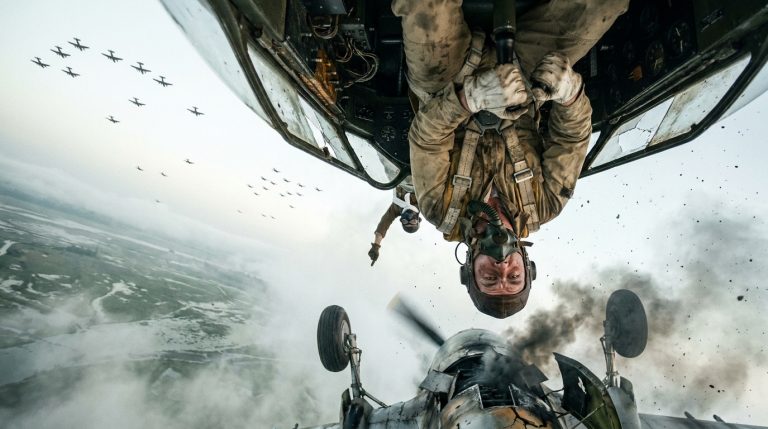
Before the sound of the report could echo back from the eastern cliffs, a low, structural thrumming vibrated up through the granite floorboards of the ridge. It wasn’t the wind. It was the synchronized, rhythmic thumping of twin four-bladed rotors cutting through the fog layer at the mouth of the gap. An AH-64 Apache gunship cleared the mountain rim, its nose down, its thirty-millimeter chain gun swiveling with the automatic, predatory precision of an unchained machine.
The canvas-tearing roar of the weapon filled the basin within three seconds, every explosive round turning the mud-brick walls into a red, airborne powder. The Taliban fighters didn’t pivot toward the ridge; they were torn apart where they stood by the kinetic velocity of the air support.
“Go!” Sullivan roared, his hand catching the top carry handle of his long gun as he lunged up from the rock lip. “Doc, get the litters down the western draw! Ghost, keep the tower down!”
Harper worked the bolt, the spent copper cylinder flying past Bennett’s face to strike the frozen shale with a clear, sharp ping. She didn’t look at the Agency officer as he stood frozen in the dust. She re-centered the crosshairs on the eastern tower where a heavy machine gun crew was trying to clear the debris from their shield. Her second shot went through the steel plate with a dry, metallic crack, the iron fragments pinning the gunner to the deck before he could touch the spade grips. She was already moving before the body hit the floorboards, her boots tracking the descent down the rocky face in real-time, every step driven by the active weight of the hunt.
CHAPTER 7: THE FIREMANS EXTRACTION
The secondary shot had barely settled its echo into the ironstone cliffs before Harper was up off her chest, her knees absorbing the jarring, mechanical shock of the down-slope shift. She didn’t sling the MK13 over her back; her fingers held the weapon by its primary carry handle, the short-suppressed barrel pointing down into the canyon as her boots tore through the sliding shale. Every step down the western draw was a direct negotiation with the physics of a crumbling descent, her old ankle injury registering a dull, grinding heat that she cataloged and dismissed against the sheer momentum of the sweep.
The basin below had turned into an unmitigated cauldron of black iron dust, pulverized mud-brick, and the acrid, metallic stink of burned fuel. The Apache gunship was circling three hundred feet overhead, its rotor wash driving a cyclonic wall of fine limestone grit across the courtyard that reduced visibility to less than twenty meters. Through the green-and-grey haze of the particulate cloud, Sullivan’s heavy silhouette was already clear, his broad shoulders squared as he lunged through the pockmarked frame of the main compound door.
Harper reached the perimeter wall in real-time, her boots clearing the low, collapsed gap where her first round had anchored the technical truck. The vehicle’s frame was still ticking as the remaining oil leaked onto the scorched clay, a slow, sizzling hiss that smelled of roasted iron and spent transmission fluid. Doc Rivers was already down on both knees next to Tyler Hawkins, his fingers executing immediate field triage with the blind, transactional economy of a surgeon working under a deadline. He was cutting away the bloody fabric of Hawkins’s sleeve, his medical shears catching the glint of the firelight with a dull, silver reflection.
“The internal line is solid,” Doc rasped over the short-range channel, his breath short and shallow. “But the shoulder’s fully out of the socket and the femoral wrap is saturated. We need to lift him before the secondary cells recover from the air strike.”
“Jordan,” Harper said, her back hitting the cold, pockmarked stone of the east wing’s entry arch. Her hand went to her belt, her thumb testing the serrated notch of her father’s SOG knife to verify the retention latch hadn’t caught on the shale during her descent. “Where is the transponder for the inbound bird?”
“The Blackhawk is crossing the northern perimeter ridge now, Ghost,” Jordan’s voice cut through the localized static, her tone tight but steady. “But the automated tail-code signature on the IFF return isn’t matching the manifest Cross pulled at North Island. The tracking node is registering it under a different administrative cluster—it’s an old Special Operations Group registry from the conventional logistics bank.”
The cold friction behind Harper’s ribs tightened into a specific, hard knot. It wasn’t an error in Jordan’s console; it was the second layer of the layout beginning to bleed through the smoke. She didn’t trace the wire; she pushed through the splintered wood frame of the eastern threshold, her HK416 carbine coming up into her shoulder pocket with an automatic, mechanical click.
The interior of the wing smelled of ancient horsehair insulation, dry rot, and thirty years of accumulated saltpeter. The floorboards were unpainted cedar, worn down in the center to deep, grey hollows where the wood fibers had split into long, needle-like splinters. At the far end of the narrow corridor, a shadow broke the grey light filtering through the barred window—a tall, emaciated figure whose knees were trembling under the weight of an old canvas coat.
Sullivan broke through the adjacent doorway two seconds later, his face caked in black powder residue, his breath rattling inside his chest like dry gravel. He didn’t look at the tactical terminal pinned to his sleeve. His gaze locked directly onto the gaunt face of the old man standing in the corner, where a silver beard had grown wild over the jagged white tracks of old interrogation scars.
“Cole,” Sullivan said. The master chief’s voice lost its gravelly bark, dropping into a low, rough register that sounded like two millstones grinding to a halt. “Jack Steel said you were on the mountain in ’05, you old bastard.”
The man in the canvas coat didn’t reach for a weapon. His eyes, clear and sharp behind the grey skin of his eyelids, fixed directly on the gold trident pinned to the center of Harper’s chest rig. His mouth opened, but the sound that emerged was a dry, ruined whistle—the vocal cords scarred by years of breathing the unfiltered fumes of low-grade kerosene heaters in a limestone cellar. “Breathing, Harper,” he whispered, the words coming out in the specific, four-count cadence of the Coronado line. “Control the breathing.”
“Dad,” Harper said. She didn’t drop the muzzle of her carbine, her eyes scanning the dark corners behind him for any remaining structural leads or secondary detonators, but the internal map she had carried for thirteen years dissolved into the dry air of the cell.
“He’s clean, Ghost,” Sullivan growled, his long gun swinging back on its single-point sling as he stepped forward. Without waiting for an order, the old master chief lowered his center of gravity, catching Cole Vance by the hip line and lifting his skeletal frame into a perfect, functional fireman’s carry. The fabric of the old canvas coat ground against the cordura of Sullivan’s vest with a dry, scratching friction as he adjusted the weight. “The bird’s on the deck. We clear this canyon now or we stay here permanently.”
They moved back down the corridor in an unbroken column, Harper taking the point position, her weapon sweeping the clearing outside where the purple smoke from Jordan’s grenade was already mixing with the grey fog layer. The Blackhawk flared hard over the western stone huts, its rotor blades throwing up a massive, blinding storm of limestone gravel that stung Harper’s face through her goggles.
The crew chief was already hanging out of the open door, his gloved hand gesturing toward the litter where Doc and Jordan were rolling Hawkins onto the floorboards. Sullivan lunged across the open ground, his boots digging into the clay as he hoisted Cole Vance through the threshold, throwing the broken captain into the dark interior of the cabin before scrambling up behind him.
Harper was the last element on the dirt. She pivoted, her carbine tracking the empty window frames of the command hut one final time as the turbine blades wound into a high-pitched, screaming whine. There were no targets left in the mud, but as the chassis lifted three inches off the shale, she looked back at the reverse slope where Travis Bennett had been left standing in the rocks. He wasn’t reaching for his radio; he was sitting flat on the gravel, his hands empty, his eyes fixed on the turning blades of the helicopter with the dead, blank expression of a piece of equipment that had outlived its design parameters.
The helicopter banked hard toward the northern gap, the valley dropping away into the grey mist below until the stone huts looked like nothing more than a row of old, oxidized iron teeth buried in the sand.
CHAPTER 8: THE FIVEPILLAR CATHARSIS
The wheels of the Blackhawk didn’t touch down smoothly on the Bagram tarmac; they struck the sun-baked concrete with a blunt, crushing thud that rattled straight through the aluminum floorboards and into Harper’s boots. The scent of acrid cordite and burned turbine fuel followed them into the open air, heavy and suffocating as the rear cabin door slid back on its ungreased guide rails. She didn’t let go of her father’s hand. Cole Vance’s skin felt like dried parchment wrapped over iron cable, the calluses from thirteen years of manual survival scraping against her thumb as the medical corpsmen swarmed the deck with high-sided litters.
The transition from the flight line to the secure quarantine annex left no room for narrative escape. Every meters-thick concrete barrier they passed was a physical marker of the system that had sought to bury them. In the center of the white-tiled diagnostic room, Victoria Cross stood completely motionless, her charcoal suit pristine despite the fine layer of gray limestone dust that had filtered through the building’s intake vents. Beside her, two stone-faced federal marshals stood with their hands resting flat on their heavy utility belts, their eyes pinned to a side door where the low hum of an automated recording system was already active.
“The log is clear, Lieutenant Commander,” Cross said, her voice dropping into the quiet space between the rhythmic clicks of the ceiling fans. She didn’t slide a manila folder this time; she pointed directly to an administrative display screen where a series of encrypted red files were actively flashing the word DELEGATED. “Travis Bennett signed the final transfer authorization forty-eight hours ago. But the master encryption key didn’t route through Kabul. It was registered to an off-grid terminal inside General Ashford’s private study at Coronado. The legacy containment wasn’t an accident; it was a line item in the department’s unvouchered budget since 2005.”
The double-layer layout was completely bare now. The tactical intelligence showing Hawkins’s captured unit wasn’t just a localized decoy—it was the final, programmatic trigger intended to eliminate the Vance bloodline under the guise of an unauthorized combat failure. General Ashford had kept Cole Vance locked in the dark like an insurance policy, a living anchor to ensure that if his daughter ever inherited her father’s dynamic tactical philosophy, she could be lured into a clean, unmappable box and erased from the ledger.
The side door swung open with a heavy, metallic click. General Marcus Ashford walked through the frame under escort, his three stars catching the harsh glare of the fluorescent tubes with a dull, silver reflection. His jaw was locked into a rigid, defensive square, but his eyes weren’t looking at the marshals. They were fixed on Cole Vance, who sat upright in his hospital bed, his white beard clean but his scarred fingers resting flat on the adjustable aluminum frame.
“You think a field inquiry can dismantle thirty years of doctrine, Vance?” Ashford said, his tone sharp, weaponized, and entirely stripped of bureaucratic camouflage. He took a single step toward the bed, his boots striking the linoleum with a heavy thud before a marshal’s hand caught his elbow. “The stability of the regional command structure required the elimination of unpredictable field variables. Your father broke the line in ’03, Harper. He thought a personal conscience could dictate the logistics of a global deployment. If the department hadn’t contained the fallout then, the entire special operations infrastructure would have fractured before the first surge.”
“The infrastructure was already rotten, Marcus,” Cole Vance said. His ruined vocal cords ground out the words with the dry, steady friction of two stones turning against each other. He didn’t raise his voice, but his right hand reached down, his thumb tracing the old spiderweb crack across the mineral crystal of his watch face—the same piece Harper had returned to his wrist during the transit. “You didn’t protect the doctrine. You protected the serial numbers on the procurement crates. You buried my team because we logged the civilian tracking metrics you wanted to clear from the server.”
Ashford didn’t offer a defense. His face went entirely pale, the deep lines around his mouth tightening as Cross stepped forward, sliding a printed warrant onto the steel tray at the foot of the bed. The charge sheet wasn’t marked under standard military protocol; it bore the black stamp of the federal treason registry, a closed-loop indictment that no bureaucratic connection could override.
“The transport is waiting at the north hangar, General,” Cross said, her blue eyes flat as drill bits. “Your clearance codes were revoked twenty minutes ago by executive order. You’re entering the system as an unclassified asset.”
The room slowly emptied of the noise, the heavy boots of the marshals fading down the hallway until the only sound remaining was the slow, mechanical hum of the heart monitor attached to Hawkins’s line two doors down.
Harper sat on the edge of the metal stool beside her father’s bed. The kinetic energy of the mountain scramble had fully discharged, leaving behind only the cold, real-time texture of the aftermath. She reached into her pocket, her fingers finding the gold trident Jack Steel had pinned to her dress uniform years ago. The lower left barb was slightly bent from a hard landing in Syria, the polished surface darkened by the sulfur residue of her own rifle smoke.
She pulled a multi-tool from her belt, the ungreased plier jaws opening with a dry, metallic creak. Slowly, methodically, she applied a steady, measured pressure to the gold prong, watching the metal yield until the silhouette was perfectly aligned once more—a quiet, deliberate repair of the only legacy that mattered.
“Devgru logged the transfer request,” Harper said, her perspective entirely locked on the small gold eagle in her palm. “Team Six. The deployment orders are locked.”
Cole Vance looked at his daughter, his scarred hand coming down over hers until the gold metal was sandwiched between their calloused palms. The warmth of the contact was the first clean thing she had felt since the screen door in Ocean Beach had swung open. “They didn’t give you that room because of my name, sweetheart,” he whispered, his clear green eyes casting their own light into the sterile white space of the ward. “You cast your own shadow now. Go show them what Ghost can do.”
The high-altitude sun began its descent behind the jagged peaks of the Hindu Kush outside the window, casting long, elongated shadows across the concrete barriers that looked less like iron teeth and more like old stone markers settling into the quiet desert floor.