The Architecture of Retribution: How an Engineer Dismantled a Suburban Empire of Petty Tyranny
CHAPTER 1: The Ultimatum at the Driveway Edge
The words hung in the oppressively humid air, thick and sticky like the scent of overheated asphalt and Karen’s cloying floral perfume. She sat enthroned in her white golf cart, a modern-day Buddha of the cul-de-sac, her plus-size frame draped in a pastel pink tracksuit that strained at the seams. A clipboard, her scepter of suburban power, rested on her lap. Her face, a mask of smug satisfaction, was framed by a helmet of stiff, blonde sprayed hair.
This wasn’t a negotiation. It was a declaration of war.
The sheer audacity of it, the unblinking, entitled confidence in her voice, hit me with the force of a physical blow. Ten thousand dollars. Foreclosure. For planting trees. My trees. The very living wall that shielded her and the rest of the manicured neighborhood from the relentless prairie winds that had once made these backyards almost uninhabitable.
A dry, humorless laugh almost escaped my lips, but I choked it back. It was the kind of absurdity you’d hear about in a barracks late at night—a story so ridiculous it had to be fabricated. But this wasn’t a story. This was my home. This was my property. And this woman, this self-appointed queen of beige siding and uniform lawn height, was threatening to strip it all away.
I felt the old, familiar calm settle over me. The precise mental drop that always came in the moments just before the chaos, the one that had kept me breathing in environments far more dangerous than this manicured slice of suburban purgatory. My heart rate slowed down, clicking into a rhythmic, methodical thrum. My focus narrowed. I looked past her pastel tracksuit at the line of trees in question.
They weren’t a random collection of sickly saplings. They were a multi-row mixed species windbreak—a living wall of eastern red cedar, bur oak, and hackberry that I had planned, purchased, and planted with my own two hands five years ago. They stood tall and defiant along the western edge of my property, casting long, sharp shadows across the sun-bleached grass.
She expected me to yell, to argue, to crumble under the sheer weight of her manufactured authority. That was what people like her fed on: emotional friction.
I gave her nothing. I simply held her gaze, my expression completely flat, my hands tucked casually into my pockets where my fingers brushed against the cool metal of my keys.
“Foreclosure, Karen?” I asked, my voice dangerously quiet, cutting cleanly through the hum of distant traffic. “Are you sure that’s the word you want to use? Because that’s a very specific, very legal process. You start throwing words like that around, you better have your paperwork in perfect order.”
A flicker of uncertainty—just a tiny, micro-second crack in the smooth veneer of her arrogance—crossed her face before she papered it over with fresh bluster. But I had caught it. In the corner of the architectural violation notice she clutched, I noticed a missing tracking stamp, a minor administrative discrepancy that shouldn’t have been absent on a formal legal filing.
CHAPTER 2: The Anatomy of a Windbreak
The white golf cart whined like an over-stressed alternator, its plastic chassis vibrating as Karen jammed her foot down on the pedal. A spray of crushed limestone and gravel kicked up from the tire, rattling against the low brick edging of my driveway before she pivoted the vehicle around and peeled back toward the cul-de-sac.
I didn’t blink. I didn’t shift my weight. I stood right where I was, my boots planted on the concrete apron of my driveway, watching the pink blur of her tracksuit recede down the street.
The paper in my hand felt heavy—not because of its physical mass, but because of the sharp, unyielding edges of the corporate threat printed across it. Ten thousand dollars. A nice, clean, terrifying number designed to trigger panic in anyone who didn’t know how systems actually worked.
A memory flickered at the edge of my consciousness, unbidden—the smell of diesel fuel and sun-baked mud from an engineering site outside of Fort Leonard Wood, where a miscalculated load-bearing wall could get people killed. This suburban cul-de-sac was built on a different kind of foundation, but the mechanics of collapse were identical. People like Karen built their entire authority on a single structural flaw: the assumption that pressure would always cause a bend, never a break.
I turned away from the street and walked slowly toward the western edge of the property line.
The sun was cutting low through the late afternoon, casting long, sharp shadows across the manicured turf. Standing there, cutting straight across the flat prairie horizon, were the trees. Five years ago, they had been pathetic little sticks in plastic sleeves, vulnerable to the stray soccer balls of neighborhood kids and the brutal, scouring bite of winter gales.
Now, they were twenty feet of dense, unyielding biology.
I reached out and touched the trunk of the nearest eastern red cedar. The bark was rough, scaling in dry ribbons that scraped against my thumb. It was a tactile reminder of time and labor—hours spent digging post-hole depth trenches, hauling mulch, and consulting with the county agronomist to get the spacing precisely right. Every species had a purpose. The cedars formed the dense core, the bur oaks provided structural mass against the high-velocity gusts, and the hackberries anchored the outer perimeter.
They weren’t an eyesore. They were an engineered shield.
Behind me, the screen door of the house squeaked open on its hinges. The sound was unnaturally loud in the quiet air. Sarah didn’t step outside immediately; she lingered in the threshold, her silhouette framed by the cool interior light of the kitchen. She had seen the golf cart leave. She had watched the confrontation from behind the sheer curtains, her hands likely wrung tight in a dish towel.
“Mark?” Her voice drifted across the patio, tight with a quiet, suppressed dread. “What did she say this time?”
I didn’t answer right away. I let my fingers trace the jagged line of a cedar branch, feeling the resilient snap of the needles. If I walked back inside now, I would bring the tension of the driveway with me, tracking that manufactured panic straight onto the cool granite of our kitchen counters. That was what Karen wanted. She wanted the poison to spread inward, infecting the house before it even reached the courtroom.
Instead, I took a deliberate, measured breath, letting the clean scent of pine and dry earth clear the cloying trace of floral perfume from my senses.
“She didn’t say anything new, Sarah,” I called back, my voice steady, carrying easily across the grass. “She just showed me her hand.”
I turned my back to the open prairie and walked toward the house, each step slow, deliberate, and entirely my own. The paper in my back pocket folded crisp against my hip with every movement. The war hadn’t started today; today was just the day we stopped pretending the peace was real.
CHAPTER 3: The Silent Kitchen and the ThreeRing Binder
The screen door slapped shut behind me, the sound unnaturally sharp in the quiet kitchen. Sarah was standing by the island, a damp dish towel clutched tightly in her hands. She had watched the entire exchange from the window, her silhouette framed by the fading evening light cutting through the glass. Her brow was etched with a deep, worried line, the kind of tension that didn’t come from a minor disagreement over lawn ornaments, but from a fundamental threat to our stability.
I didn’t speak. I walked across the cold tile floor, pulled the folded legal notice from my back pocket, and smoothed it flat against the cool granite countertop. The black-and-white text stared back at us like a mechanical challenge.
Sarah’s eyes scanned the lines, her breath hitching slightly as she hit the figure. Ten thousand dollars. Foreclosure threats.
“Foreclosure?” Her voice was a tight, dangerous whisper, stripped of its usual warmth. “Mark, she can’t be serious. Over trees? The very trees that kept our patio furniture from ending up in the next county during last spring’s gales?”
“She’s entirely serious,” I said, my tone flat, unyielding, maintaining the cold discipline of a man inspecting a compromised perimeter. “And she’s counting on the fact that most people see a legal threat and fold before they look at the foundation.”
I turned away from the counter, walked over to the corner desk where my laptop sat in sleep mode, and reached down to the lower shelf. My fingers brushed against the thick, heavy spine of a three-ring binder labeled simply: HOUSE.
Every document related to the acquisition, zoning, and structural history of our property lived inside those rings. I pulled it out, the metal rings clicking shut with a dry, mechanical snap as I carried it back to the kitchen island and dropped it next to Karen’s letter. The sheer weight of the binder felt like a counterweight to the flimsy sheet of paper she had weaponized.
“If she wants to play by the rules,” I murmured, flipping the heavy plastic cover open, “we’re going to read every single word she skipped.”
The pages fell open to the tab marked HOA COVENANTS. I had memorized these pages five years ago, before we even poured the foundation. The developer who had laid out Whispering Winds Estates had long since vanished, leaving behind a boilerplate set of restrictions drafted by a corporate legal mill to cover a former soybean field. The terms were broad, designed to protect property values while the lots were still selling, but they were filled with structural loopholes for anyone willing to trace the administrative chain of command.
I ran my finger down Section 4, Paragraph 2, tracking the wording on architectural review standards. It spoke of maintaining a harmonious aesthetic and preventing blatant nuisances, but it explicitly required that any enforcement action be backed by a recorded architectural review committee vote and a standardized, published fine schedule.
“Look here,” I said, tapping the page with the blunt edge of my thumb. “She’s claiming the board voted on this. But under Section 4, a fine cannot exceed twenty-five dollars a day without a formal majority vote recorded in the official meeting minutes filed with the county clerk.”
Sarah leaned in closer, her anger shifting into a sharp, focused curiosity. “And she’s charging one hundred.”
“Four times the legal threshold,” I replied, the corners of my mouth tightening into a thin line. “Which means either she didn’t hold a legitimate vote, or she fabricated the penalty schedule entirely to pad the numbers.”
A sudden, sharp shadow cut across the kitchen window as a car drifted slowly past on the street outside. For a fraction of a second, a strange, paranoid prickle ran down my neck—the distinct sensation of being watched through the glass, of invisible lenses tracking our movements. It was an irrational thought, a ghost of old operational habits where every perimeter was hostile, but it underscored the reality of our position. We weren’t just homeowners dealing with an annoying neighbor; we were targets in a managed conflict.
I pulled my laptop toward me and popped the lid, the screen illuminating our faces in a pale, clinical glow.
“We don’t argue with her on the lawn,” I said, my fingers resting lightly over the keys. “We don’t call her, and we don’t beg for an exception. We build a digital dossier.”
I created a new folder on the desktop, naming it with the cold precision the situation demanded: Operation Defoliation. Inside, I dropped high-resolution scans of Karen’s letter, paired side-by-side with digital photographs of the windbreak taken from three distinct angles. Then, I dug deeper into the binder, extracting the original, rubber-stamped landscaping permit from five years prior—the one bearing the signature of the original developer’s architectural committee before Karen ever set foot in the neighborhood.
The framework was taking shape. Every document was a brick in a wall designed to trap her in her own administrative bureaucracy.
Sarah watched the screen load the files, the lines of anxiety on her face slowly straightening into a cold, resolute calm that mirrored my own. She reached out and placed her hand over mine, stopping my fingers on the keyboard.
“Make sure she doesn’t have an exit, Mark,” she said quietly.
“She won’t,” I replied, looking down at the screen. “People who build empires out of paper always forget how easily paper burns when you introduce the right facts.”
CHAPTER 4: Operation Defoliation: Documenting the Battlefield
The hum of the laptop fan was the only sound in the kitchen as I settled into the task, moving with the measured rhythm of an engineer drafting a stress test. Sarah remained close, her presence a silent anchor against the mounting friction of the dispute.
“If she wants to treat this like a legal violation,” I muttered, my fingers flying across the keyboard to name the newly created folder, “we’ll give her a masterclass in bureaucratic compliance.”
Operation Defoliation wasn’t just a collection of grievances; it was a counter-offensive built on hard data. The first step was establishing an unassailable digital chain of custody. I took the folded legal notice Karen had left on my windshield, flattened it under the scanner built into our home office printer, and pulled a high-resolution PDF directly into the root directory.
Then came the visual proof. I walked back outside into the sharp glare of the late afternoon, taking my phone out to capture every angle of the western property line. I framed the shots deliberately—not just to show the lush, green density of the eastern red cedars and bur oaks, but to capture the physical reality of the wind scouring the open, unprotected prairie beyond our fence line. I photographed the precise distance between the trunks, the healthy spread of the mulch beds, and the stamped concrete borders that marked the exact boundaries of the easement. Every pixel was a brick in a defensive wall.
Back at the kitchen island, I pulled up the digitized records of the original landscaping plan from five years ago. I placed it side-by-side on the screen with the current photographs. The alignment was absolute. The species matched, the placement matched, and, most crucially, the rubber-stamped approval from the developer’s original architectural committee sat clear and legible in the corner of the PDF.
As I cross-referenced the files, a minor discrepancy caught my eye—a missing tracking signature on a secondary enforcement notice archived from a previous neighborhood dispute two years prior. It was a tiny administrative oversight, the kind of loose thread that bureaucratic tyrants leave behind when they assume no one will ever look closely enough to pull it. I highlighted the missing entry and saved it into a subfolder labeled Anomalies.
“She didn’t just invent the fine schedule,” I said softly, half to myself as I linked the files into a chronological spreadsheet. “She skipped the verification steps entirely to fast-track her own authority.”
Sarah leaned over my shoulder, her eyes tracing the rows of data. The initial shock of the foreclosure threat had fully dissipated, replaced by the cold, steady focus of someone watching an adversary walk straight into a prepared trap.
“She thinks she’s the only one who knows how the rules work because she’s the one holding the clipboard,” Sarah said, her voice dropping into a sharp, analytical register. “She forgot that other people spent years managing logistics where mistakes weren’t just embarrassing—they were fatal.”
“People like that always assume compliance is automatic,” I replied, saving the master database and backing it up to an encrypted cloud drive. “They mistake a quiet homeowner for a soft target. But a quiet homeowner is just someone who hasn’t been given a reason to audit the system yet.”
The dossier was complete. Every photograph, every receipt from the nursery where I purchased the saplings five years ago, every digital copy of the HOA bylaws with the violated clauses highlighted in yellow—it was all locked down, cross-referenced, and timestamped.
I closed the laptop lid with a soft, decisive click. The digital defense line was drawn. Now, it was time to move beyond the boundaries of our own property line and see who else in Whispering Winds Estates was tired of living under the shadow of the pastel pink tracksuit.
CHAPTER 5: The First Brick in the Wall at the Courthouse
The morning air outside carried the sharp, dry chill of late autumn, biting at my hands as I walked down the concrete path away from the house. I didn’t drive the truck directly to the local strip mall annex where the neighborhood HOA usually handled its administrative notices; I pointed the wheels downtown, toward the county courthouse—a cold, imposing structure of limestone and iron that smelled perpetually of floor wax, damp wool, and historical ink.
This was where systems lived when they weren’t being hidden behind pastel paint and polished door knockers.
The main records hall was quiet, save for the rhythmic clatter of ancient mechanical keyboards and the shuffle of leather shoes on marble tile. I bypassed the tourist desks and headed straight for the deeds and municipal filings counter. Behind the knee-high wooden partition sat Gloria, her name tag pinned straight above a no-nonsense blouse, her fingers moving steadily across a ledger.
“Looking for plats or liens today?” she asked without looking up, her voice dry as parchment.
“Both,” I said, resting my forearms against the polished wood of the counter. “Whispering Winds Estates. I want the comprehensive filing history for the subdivision over the last twenty-four months, specifically targeting municipal liens and administrative fee structures.”
Gloria paused, her fingers stopping over the keys. She raised her head, her sharp eyes studying me with a sudden, quiet intensity. A faint, knowing smirk touched the corner of her mouth. “Fighting the board, are you? You wouldn’t be the first from that patch of green turf to sit at my tables looking for a paper trail.”
“Let’s just say I prefer to verify the architecture before someone tries to tear down my walls,” I replied evenly.
She reached beneath the counter and hauled out a massive, heavy ring binder stuffed with heavy carbon-copy printouts and municipal filings, sliding it across the wood with a dull thud. “Take a seat at the long wooden table by the eastern window. You’ll find what you need in the back sections. Just don’t mark the pages.”
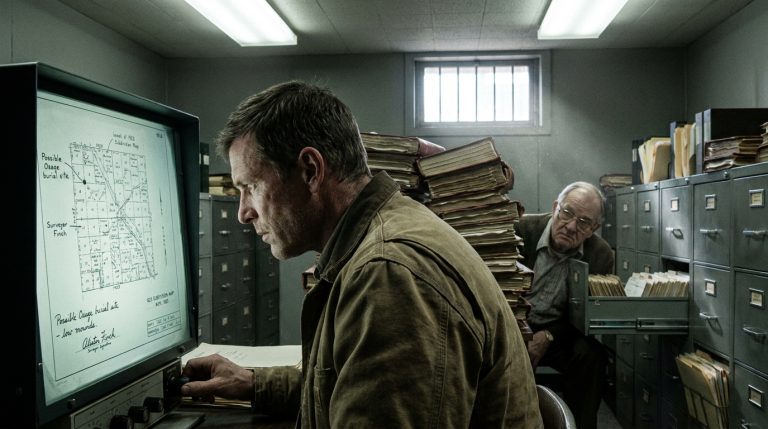
I carried the ledger over to the heavy oak table, the wood cold beneath my sleeves. Whispering Winds Estates was laid out across the blueprints like a sterile grid of rectangular lots carved ruthlessly out of an old soybean field. But as I flipped past the original developer’s plats and dove into the recent administrative appendices, the texture of the paperwork changed.
The filings grew messy. Marginal notes appeared in tight, cramped handwriting—not from county clerks, but from internal HOA legal representatives. I traced the lineage of liens filed against homeowners in the subdivision over the past two years. Three distinct properties had faced sudden, aggressive foreclosure proceedings initiated by the association’s private counsel.
I cross-referenced the names and dates. One was an elderly couple whose children had moved them into assisted living; another was a young military family abruptly transferred overseas. The third was a single homeowner who had lost his job during the prior winter. In every single case, the pattern was identical: a sudden, exorbitant compliance fine levied without warning, followed immediately by a rapid acceleration toward a forced lien before the owners could mount a defense.
It wasn’t just arbitrary bullying. It was a mechanical pipeline. The fines weren’t meant to correct behavior; they were designed to force distress sales, extracting administrative and legal fees at every turn.
A shadow fell across the table. I looked up, expecting Gloria, but found only the pale winter light filtering through the tall, wire-reinforced glass panes. My phone buzzed in my pocket—a sharp, single vibration that cut through the silence of the hall. I pulled it out. It was an email notification from my work address, but the sender field was empty, carrying only a string of encrypted metadata.
I didn’t open it. I simply slid the phone back into my pocket, my jaw tightening as the reality of the machinery settled over me. Karen wasn’t acting alone because she couldn’t; she was operating a localized extraction point, squeezing the margins of vulnerable residents to mask something much larger rotting beneath the surface of the subdivision’s accounts.
I turned back to the ledger, my pencil moving steadily across a clean sheet of paper, transcribing file numbers, dates, and names. The first brick in the wall was laid. The foundation was cracked, and I had the exact coordinates of the fracture.
CHAPTER 6: The Coalition of the Silent
The heavy oak doors of the courthouse swung shut behind me with a solid, resonant thud, cutting off the murmur of the records hall. A sudden, biting gust of wind swept across the stone plaza, carrying the scent of dry asphalt and exhaust fumes, rattling the bare branches of the ornamental trees lining the square. The temperature had dropped ten degrees while I was buried in the municipal ledgers, the afternoon sky tightening into a flat, bruised gray.
I pulled my jacket tighter around my chest, feeling the hard edges of my notebook pressed against my ribs. The data from the deeds office wasn’t just a collection of abstract numbers; it was a map of human friction. Three families systematically squeezed out of their homes over two years, their distress sales processed through the exact same local title agency, wrapped in the sterile administrative language of association liens.
If Karen operated on isolation—making every targeted homeowner believe they were the sole anomaly, the single broken nail that needed hammering down—then the counter-strategy was equally straightforward. We had to break the silence.
I walked down the concrete steps, crossed the municipal parking lot, and got back into the truck. The engine turned over with a deep, familiar rumble, the heater blasting dry, lukewarm air across my knuckles as I shifted into drive. I didn’t head straight back to Whispering Winds Estates; instead, I took the long perimeter road toward the eastern edge of the development, pulling up softly in front of a modest, single-story house with a weathered cedar-shingle roof.
George Henderson’s place.
I cut the engine, letting the silence settle inside the cab before pushing the door open. The gravel crunched sharply beneath my boots as I walked up the flagstone path toward the front porch. Before I could even raise my hand to knock, the front door clicked open a few inches, held back by a brass security chain. An eye peered out through the narrow gap—cautious, rheumy, and instantly recognizable.
“Mark?” George’s voice came through the crack, tight with lingering apprehension. “Is everything all right? Did she send another notice?”
“Not a notice, George,” I said, keeping my tone even and deliberate against the cold wind. “Just an update. And I think you and your wife might want to hear it inside before the prairie draft freezes us both out here.”
The chain rattled off its track with a sharp metallic jingle, and the door swung wide. George stood there in a faded plaid flannel shirt buttoned to the top, his shoulders slightly hunched, looking like a man who had spent too many years trying not to draw fire. Behind him in the hallway, the warm, rich scent of freshly brewed tea drifted out from the kitchen, mixing with the smell of old paper and wood polish.
“Come on back,” George muttered, stepping aside to let me pass. “Martha just poured a fresh cup. Though I have to warn you, I spent the last hour trying to figure out where to hide Norman and his crew if she decides to drive by with that clipboard of hers again.”
“Keep Norman where he is,” I said, stepping into the hallway and wiping my boots on the mat. “She’s not going to be inspecting gnomes much longer.”
We sat at the small laminate kitchen table, the light from the overhead fixture casting harsh, clean reflections off the surface. Martha Henderson slid a mug of dark tea toward me without a word, her expression a mix of maternal worry and quiet exhaustion. She had lived in this subdivision since the first sod was laid, watching the fields turn into roofs, and then roofs turn into targets.
I pulled the notebook from my jacket, laying it flat between the mugs. I didn’t speak in riddles. I laid out what I had pulled from the county archives—the names of the displaced families, the timelines of the forced liens, and the recurring signature of the association’s private legal counsel tied directly to Karen’s board minutes.
“She isn’t just making up fines for the sake of a tidy lawn, George,” I said, tapping the corner of the notebook with my pen. “She’s running a closed loop. Every dollar collected in compliance fees bypasses the general maintenance fund and funnels straight into a legal holding account managed by a firm that specializes in rapid foreclosures.”
George stared down at the names written in my precise, block-letter engineering handwriting. The color drained slightly from his face, replaced by a slow, simmering realization. For two years, he had believed his fine for a ceramic garden gnome was the result of an oversight, a personal failure to match the invisible aesthetic standard of the cul-de-sac.
“She made us feel like criminals,” Martha whispered, her hands wrapped tightly around her ceramic mug as she stared out the kitchen window toward the fence line. “Every time I stepped out to tend the flower beds, I felt like I was trespassing on someone else’s property.”
“That was the design,” I replied. “Isolation is a force multiplier for anyone holding a clipboard. But a monopoly on enforcement only works as long as nobody compares notes.”
George looked up from the notebook, the hesitation finally clearing from his eyes, replaced by a cold, steady resolve that looked entirely natural on him. He reached out and touched the corner of the paper. “What do we do, Mark? We can’t just sit here waiting for the next certified letter.”
“We don’t,” I said, standing up and pulling my jacket back on as the kitchen clock ticked toward late afternoon. “We start by talking to the Diazes down on Ash Street. And then we pull together every single notice, warning, and threat this neighborhood has received for the last twenty-four months. If she wants a paper trail, we’ll bury her in one.”
The wind caught the front door as George let me out, howling briefly against the frame before the latch clicked shut. The neighborhood looked quiet, neat, and uniform under the gray autumn sky, but the surface tension had cracked. The quiet was over.
CHAPTER 7: The Agricultural Audit and the State Shield
The cab of the truck was freezing when I climbed back inside, the vinyl seats stiff from the dropping autumn temperature. I turned the ignition, letting the engine whine and catch before the heater began pushing dry, hot air against the windshield. The data gathered from the county archives was secure in my notebook, but an administrative shakedown run by an overzealous HOA president required more than just municipal records. It required an official counterweight—something forged outside the local jurisdiction entirely.
I shifted into reverse, backed carefully out of George’s gravel apron, and pointed the truck toward the open highway heading out of town, tracking down the state-level verification that would shift our defense from local negotiation to statutory protection.
Forty-eight hours later, the state agricultural extension sedan pulled up to my curb, its dark blue paint gleaming under the midday sun. David Chen stepped out before the vehicle had even fully settled into park. He was younger than I expected, with a wiry, energetic frame and an oversized tablet tucked securely under his arm, carrying the distinct air of a man who preferred soil profiles to boardroom politics.
“Mark Turner?” he called out, striding up the concrete path with a firm stride as I met him halfway down the driveway.
“That’s me,” I said, extending a hand. “Glad you made it out.”
“Wouldn’t miss it,” David replied, shaking my hand with a grip that had real labor behind it. “An agroforestry windbreak integrated into an exurban subdivision lot? That’s not a standard landscaping complaint; that’s a functional ecosystem defense. Show me the layout.”
We spent the next two hours walking the western property line. David was relentlessly thorough. He didn’t just glance at the trees; he measured the precise spacing between the eastern red cedars and the bur oaks, knelt to test the soil compaction near the root zones, and pulled out a handheld anemometer to measure the wind shear across both sides of the living barrier.
“Look at these readings,” he muttered, holding the digital screen up for me to see as a gust of prairie air slammed against the outer rows. “You’re getting a sixty-five percent velocity drop on the leeward side. That’s commercial-grade performance. This isn’t decorative shrubbery, Mark. This is a properly engineered conservation windbreak.”
“Will it hold up under administrative scrutiny?” I asked, keeping my voice low and steady.
“Hold up?” David chuckled, tucking a stylus into his pocket. “Under state statute section four point seventeen, a certified multi-row native windbreak serving a demonstrated erosion-control function is classified as a protected conservation feature. Local municipal codes and homeowner bylaws cannot override state agricultural designations without a formal state permit. And I can guarantee you right now, my office will never issue a removal permit for a healthy, functioning belt.”
He tapped the screen of his tablet, finalizing the digital audit report that would carry the official seal of the State Department of Agriculture. “I’ll have the certified physical copy on your desk by Thursday morning. If your association gives you grief, you hand them this statute and tell them to call my direct office line.”
As David climbed back into his sedan and drove off down the street, I caught a brief flicker of movement across the cul-de-sac. A sheer lace curtain dropped back into place against a front window. Karen had been watching the entire inspection through her binoculars, her administrative trap suddenly colliding with a state-level shield she couldn’t pierce with a clipboard.
The balance of power had shifted. The defense was locked, and the counter-offensive was ready to drop.
CHAPTER 8: The Trap Snaps: The Demand for Enforcement
The afternoon light was brittle, casting sharp, slate-gray shadows across the front yard as I stepped back inside and closed the front door. The physical report from the State Department of Agriculture sat on the kitchen counter inside a heavy manila folder—a certified seal of state protection that rendered any local municipal or association penalty legally void. But before I could slide the state seal into the master dossier, the mail slot in the front door clattered. A thick envelope dropped onto the hardwood floor with a heavy, unyielding thump.
I walked over, picked it up, and turned it over in my hands. It wasn’t standard postal mail; it was a hand-delivered certified notice bearing the private letterhead of the association’s legal counsel.
I tore the flap open, pulling out a single sheet of stiff paper. It was a formal notice of intent to lien, escalating the manufactured debt to twelve thousand three hundred dollars, complete with a final warning that foreclosure proceedings would begin within fifteen days if payment wasn’t rendered. They had taken the bait, escalating the paper conflict right into a trap of their own making.
I picked up my phone and dialed Jessica Riley’s private office line. She picked up on the second ring, her voice crisp and sharp.
“Mark,” she said without preamble. “Tell me they didn’t.”
“They did,” I replied, smoothing the legal letter against the counter. “Certified notice of intent to lien. Twelve thousand and change. Delivered by hand an hour ago.”
A sharp, metallic laugh echoed through the receiver. “Incredible. The absolute, unadulterated hubris of it. By sending a lien notice without providing the mandatory dispute resolution hearing outlined in their own bylaws, they’ve just violated the state common interest development act four times over. They’ve handed us a loaded weapon.”
“What’s our move?” I asked, looking out the window toward Karen’s house, where the silent front lawn remained manicured and severe.
“We let them walk straight into the annual meeting in three weeks,” Jessica said, her tone dropping into a cool, professional register. “We don’t reply, we don’t pay, and we don’t warn them. We let Karen use your case as her grand finale to intimidate the rest of the neighborhood. And when she drops the axe at the podium, we spring the trap.”
The strategy was set. The escalation had reached its peak, and every piece of documentation—from the county deeds office to the state agricultural seal—was locked in place. The only thing left was to wait for the curtain to rise on the annual meeting.
CHAPTER 9: The Annual Meeting Ambush
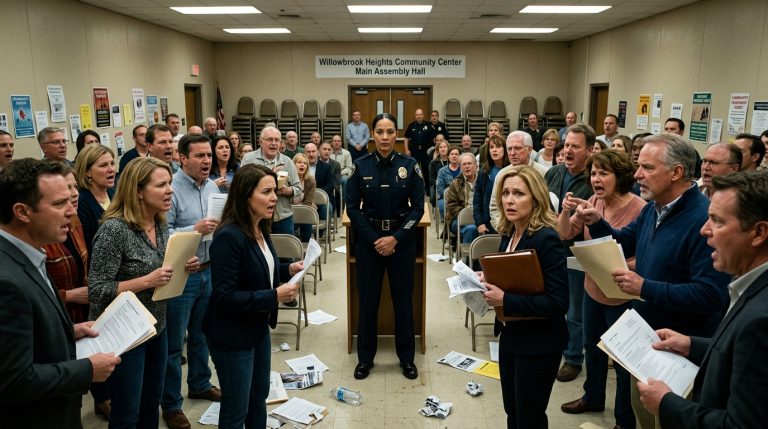
The air inside the community center’s multi-purpose room was thick with a dense, nervous heat, entirely different from the sharp chill of the autumn evening outside. Usually, these annual meetings were ghostly affairs, attended only by a scattering of lonely retirees and the board members themselves. Tonight, every folding chair was filled, and a tight cluster of residents stood packed along the back walls, their faces lit by the harsh, flat glare of the overhead fluorescent panels.
I walked in quietly with Sarah, sliding into a row near the back where the shadows offered a clear vantage point. A few rows ahead, Jessica Riley sat upright in a simple pantsuit, her leather briefcase resting upright against her knees like tactical gear. She didn’t turn around, but her posture radiated a cold, focused readiness.
At the front of the room, perched behind a long folding table draped in green felt, sat Karen. She wore a garish sequined jacket that caught the overhead light with every micro-movement, throwing hard glints across the room. Flanked by Stan and Brenda—both of whom looked nervously down at their printed agendas—Karen beamed with the absolute confidence of a monarch presiding over an unyielding domain. She tapped a small brass gavel against the table, the sharp ring cutting through the low murmur of the crowd.
“Welcome, everyone, to the annual meeting of the Whispering Winds Homeowners Association,” Karen began, her voice amplified slightly by the small podium microphone.
For the next hour, she marched through a carefully curated presentation of bureaucratic theater. She droned on about mailbox finish standards, decorative flag prohibitions, and the robust health of the community’s general ledger. When she reached the budget review, she clicked a remote, pulling up a digital slide highlighting compliance revenue.
“As you can see,” Karen said, tapping the screen with a laser pointer that danced across a bar graph, “our rigorous enforcement of community aesthetic standards has yielded a significant surplus in non-dues revenue. This has allowed us to execute several subdivision beautification projects without touching a single dollar of your quarterly assessments.”
She was openly, proudly bragging about the shakedown. A low, restless murmur rippled through the rows of homeowners. The pressure in the room climbed another notch, the air tightening like a compressed spring.
Finally, Karen clicked to the final slide of her deck. Her posture shifted, adopting a tone of solemn, theatrical gravity.
“And now,” she said, her voice dropping into an affected cadence of regret, “we must address a difficult matter under old business. The ongoing, willful non-compliance of the property at twelve-twenty Willow Creek Lane.”
Every head in the room snapped around, locking onto me. I didn’t move. I kept my expression entirely neutral, my hands resting calmly on my knees, letting the collective weight of their stares pass over me without friction.
“As many of you know,” Karen continued, oozing a sickening layer of false sympathy, “the board has attempted for months to work with Mr. Turner to resolve his structural violations. His overgrown, unapproved tree line represents a direct assault on our community’s property values. Despite repeated warnings, he has refused to comply.”
She advanced the slide. A photograph of my house appeared on the projector screen, the western windbreak circled aggressively in a thick red digital marker.
“The accumulated fines have now reached twenty-two thousand five hundred dollars,” Karen announced, letting the massive number hang in the air for maximum impact. “Consequently, the board has voted unanimously to place a formal lien on the property and initiate immediate foreclosure proceedings to protect the integrity of Whispering Winds.”
A collective gasp swept through the middle rows. This was the public execution. This was the moment she intended to grind an opponent into the dust to remind every other homeowner who held the ultimate power of life and death over their deeds.
Karen turned her gaze directly toward me, her lips curling into a triumphant smirk. “Does the homeowner have anything to say before the board entertains a final motion to proceed with legal action?”
The silence that followed was absolute. You could hear the faint, steady hum of the projector fan cooling its bulb.
I stood up slowly.
The movement drew every eye back to the rear of the room. I stepped into the center aisle, my boots clicking rhythmically against the linoleum floor as I walked toward the single microphone stationed near the front. I didn’t look at Karen; I looked at the faces of my neighbors—at George Henderson, at the Diazes, at Mrs. Gable—seeing the quiet, simmering resentment turning into resolve.
I reached the podium, adjusted the microphone stalk down to my height, and tapped the metal grill once. The sharp feedback squeal echoed briefly, then settled into a clean, resonant hum.
“Madam President,” I said, my voice steady, carrying effortlessly across the silent room. “You’ve told a very compelling story. It has a clear villain, and a heroic defender protecting the neighborhood from botanical ruin. But a story is all it is. Let’s look at the actual engineering of your claims.”
I reached into my jacket pocket, pulled out a small black USB drive, and walked straight past the front row toward the laptop connected to the projector. Before Karen could sputter a protest, I unplugged her laser pointer receiver, slid my drive into the association’s machine, and hit a single keystroke.
The picture of my house vanished, replaced immediately by a crisp, high-resolution digital scan of an official document.
“My original landscaping plan,” I said, turning back to face the room while pointing to the large, rubber-stamped approval emblem in the corner of the PDF. “Submitted, reviewed, and permanently approved by the developer’s architectural committee five years ago. These trees weren’t unauthorized violations. They were legally sanctioned capital improvements from day one.”
Karen half-rose from her chair, her face flushing a mottled, angry pink under the sequins of her jacket. “That—that was the old committee! That doesn’t apply now!”
“According to the association’s own foundational covenants,” I replied, my voice hard and flat, “architectural approvals are permanent and run with the land unless a formal, documented variance is executed. There is no such variance.”
I clicked the key again. The screen shifted to an aerial topographical map overlaid with blue and green vector arrows showing wind dispersion patterns across the prairie.
“Furthermore,” I continued, “these trees do not violate aesthetic standards because they are not mere decorations. They are a certified multi-row native windbreak constructed to strict agricultural standards for soil retention and wind-shear mitigation.”
I clicked once more, pulling up the state document bearing the official seal of the Department of Agriculture.
“Pursuant to state statute section four point seventeen,” I read aloud, highlighting the text with the on-screen cursor, “this vegetative barrier is formally designated a protected conservation feature. Any attempt by an individual, corporation, or homeowner association to mandate its removal without a state permit constitutes a class C misdemeanor. Your demand that I tear down these trees is not just a breach of our bylaws; it is a written demand that I commit a criminal act. Your twenty-two thousand dollar fine schedule is built entirely on that illegal demand, which means it is legally void.”
The room was so quiet you could hear the distant hum of traffic outside on the highway. Karen’s mouth opened and closed silently, her face draining of color as the structural foundation of her entire administrative empire cracked down the middle.
Before she could recover her voice, Jessica Riley stood up from her seat in the third row, buttoning her jacket with crisp, methodical precision.
“Point of order, Madam President,” Jessica said, her voice cutting through the silence like a scalpel. “My name is Jessica Riley. I’m an attorney representing Mr. Turner. But more importantly, I’m a resident of Ash Street.” She walked forward, taking her place at the microphone as I stepped aside. “And I have a few files of my own to enter into the record.”
CHAPTER 10: The Quiet After the Storm
Jessica’s presentation was a surgical dismantling of administrative power. She did not raise her voice; she simply laid out the certified copies of the county liens, the missing architectural voting records, and the internal accounting logs showing thousands of dollars in compliance fees funneled directly into a private legal escrow account. The decoy secret—the local revenue shakedown—shattered completely under the weight of the financial audit.
And then, as the structural walls finally gave way, the core truth surfaced.
Confronted with the ledger discrepancies, Karen did not fold quietly. Her face distorted in a flash of desperate panic, her hands trembling as she clutched the edges of the folding table.
“You don’t understand!” she shrieked, the veneer of bureaucratic control snapping entirely. “The development loans—the maintenance accounts—the reserve funds were already drained before I took over! If I didn’t generate immediate capital through compliance fees, the association accounts would have hit zero, and my own household equity would have collapsed under the shortfall!”
The room fell into a heavy, stunned silence. The absolute final reality stood exposed: her authoritarian reign of terror was never about neighborhood aesthetics or manicured lawns. It was a frantic, predatory attempt to cover up her own impending financial ruin by bleeding the neighbors dry.
The cornered beast protocol played out swiftly. Karen attempted to bolt from the table, but George Henderson stepped calmly into the aisle, blocking the exit path while George’s emergency petition for a vote of no confidence hit the table. Within minutes, a nearly unanimous sea of raised hands dissolved the board on the spot.
Denouement settled over Whispering Winds Estates over the following months like a slow-clearing fog. The civil lawsuit filed by Jessica Riley did not ask for astronomical damages; it demanded exact, calculated restitution to every homeowner who had been unlawfully penalized, holding Karen, Stan, and Brenda personally accountable. Faced with undeniable liability, Karen quietly placed her house on the market and left the neighborhood within thirty days.
The new interim board, led by George and Maria Diaz, systematically dismantled the oppressive bylaws, replacing arbitrary restrictions with common-sense guidelines. The community Facebook page transformed from a battleground of grievance into a functional bulletin board for neighborhood potlucks and children’s games.
One evening, nearly a year after the meeting, I stood out on the back patio with Sarah, holding two glasses of iced tea. The western wind blew hard across the prairie, a fierce, howling gale, but as it hit the multi-row windbreak of eastern red cedars and bur oaks, it softened into a gentle, harmless breeze.
I walked over to the edge of the patio where a small, familiar ceramic object sat restored to its place of honor—Norman the gnome, gazing out over the lawn. I reached down, my fingers tracing the smooth, painted ceramic surface, feeling the solid weight of stability restored to the earth. Sarah leaned her head against my shoulder, watching the dark green line of trees stand resolute against the twilight.
Everything was quiet. Everything was earned.