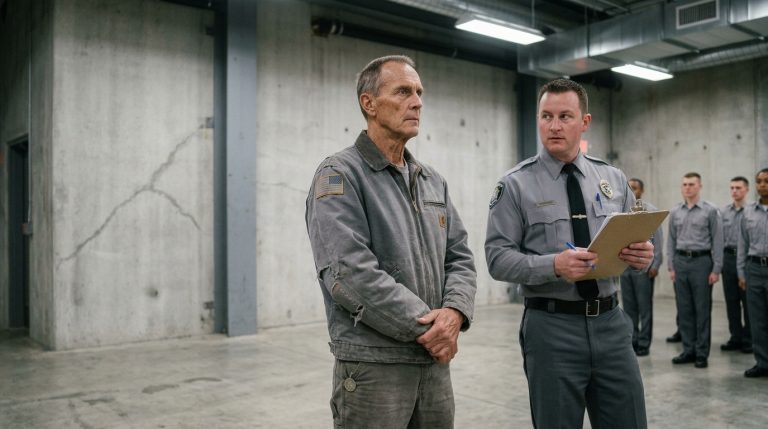
The Weight of Salt and Iron: The Belated Vindication of Roger Clayton
CHAPTER 1: THE CHALK AND THE RED TWEED
The air in Room 412 smelled of stale floor wax, sour milk from the cafeteria, and the dry, white dust of ground-out chalk. It was an environment built on thin plastic and cheap plywood, completely detached from the weight of real earth.
Mr. Henderson stood by the whiteboard, his arms crossed tightly over a polyester tie that carried the faint sheen of a grease stain near the knot. The red marker in his hand didn’t stop moving. Tap. Tap. Tap. It was a small, irritating sound that filled the gaps between the low hum of the ceiling ventilation unit.
“I have a syllabus to get through,” Henderson said, his eyes scanning the rows of small desks without really looking at the children behind them. “We have state testing next week. I appreciate that you love your grandfather, Lily, and I am sure he was a very competent clerk or mailman. But the Navy SEALs do not sit in fourth-grade classrooms wearing moth-eaten jackets from a thrift store bargain bin.”
Lily’s ten-year-old fingers tightened around the rough, abrasive wool of her grandfather’s sleeve. The red tweed was heavy, frayed at the cuffs where the white lining peeked through like salt crusting on a hull. Beside her, Roger Clayton sat compressed into a blue plastic chair that was four sizes too small for his frame. His knees, stiffened by calcified cartilage and decades of internal scarring, were forced up toward his chest. His hands, thick-knuckled and mapped with permanent tremors, rested flat on the curved handle of a simple ash-wood cane.
A boy in the back row let out a sharp, wet snicker. A girl by the window covered her mouth, her desk creaking as she leaned away from the old man. The cruelty of the room wasn’t loud; it was transactional, a reflection of the man standing by the board.
“He is not a liar,” Lily whispered. The tears were there, hot and bright in the corners of her eyes, but she refused to let them drop. Her hand dove into her denim pocket, pulling out a small, bent photograph with silver-halide edges that had turned yellow around the borders. It showed five shirtless men on a gray strip of sand, their faces blackened with grease, their shoulders broad and unyielding beneath the weight of heavy, dark receivers.
She held it out. Her small wrist shook so violently the faces blurred into dark smudges.
Henderson didn’t lean in. He took two steps forward, his leather shoes clicking sharply on the linoleum, and snatched the paper from her fingers. He didn’t look at the eyes of the men in the photograph. He glanced at the waterlines, the grain of the sand, and then tossed it onto his desk behind him. It slid across the wood, spinning until it stopped against a stack of unearned worksheets.
“Blurry men on a beach,” Henderson said, his voice dropping into a flat, professional drone. “Anyone can pull an image from a hard drive, Lily. Stolen valor isn’t a joke. Claiming historical honors you didn’t earn is a violation of institutional policy. Sir, I’m going to have to ask you to wait in the corridor.”
Roger didn’t flinch. The movement of his neck was slow, a mechanical grinding of vertebrae that had seen too many hard landings. But as his head turned, his pale, watery blue eyes caught the glare of the fluorescent tubes above. For less than a second, the gray fog of eighty-two years evaporated. What remained underneath was a cold, metallic stare—the unblinking look of an ancient tool that had survived the rust simply because the iron was too thick to die.
CHAPTER 2: THE MARINE IN THE BACK
The metallic glare of the fluorescent tubes caught the edges of Roger Clayton’s eyes, and for a suspended second, the classroom lost its soft, modern boundaries. The small plastic chairs and the brightly colored alphabet banners on the walls seemed to recede into a gray, inconsequential haze. Mr. Henderson remained frozen mid-stride, his fingers still hovering near the desk where he had dropped Lily’s crinkled photograph. The red marker on his bicep had stopped its rhythmic clicking.
Jim Miller leaned his weight harder against the particle-board cubbies at the back of the room. His boots, heavy leather broken in by thousands of miles of gravel and concrete, shifted slightly. The sour-milk smell of the fourth-grade wing was completely replaced in his mind by the sharp, sudden spike of adrenaline that tasted like tin foil behind his teeth. He had spent seventy-two months inside the structure of the Marine Corps, and his eyes were trained to read the architecture of a man’s posture before he ever spoke a word.
He looked away from the old man’s face and focused on the ash-wood cane resting against the scratched linoleum.
Something was wrong with the alignment. Jim’s eyes narrowed, tracking the physical discrepancy. The rubber tip at the base of the cane was worn heavily on the interior edge, a deep, angular bevel that suggested hundreds of miles of uneven pressure. But Roger’s bad left hip, thick with arthritis, should have forced the weight onto the outside rim of the wood. The wear pattern didn’t match the limp. It was a detail so small it would slip past any civilian, but to Jim, it looked like a calculated concealment—the physical signature of a man who was forcing his body to mimic a specific type of decay.
Jim reached slowly into his pocket, his thumb sliding over the cold glass of his phone screen. He kept his movements deliberately small, his elbows tucked into his ribs to avoid drawing Henderson’s erratic attention.
Up front, the silence was still stretching, heavy and dry. Henderson cleared his throat, the sound sharp and defensive in the quiet room. “Sir,” the teacher said, his voice tightening as he tried to regain the high ground. “The rules of this facility are clear. If you cannot provide verified documentation for a presentation, we have to terminate the segment. I am protecting the integrity of the instructional hour.”
Roger didn’t answer with words. He slowly dropped his chin, the ancient steel in his eyes masking itself behind the heavy, gray-browed veil of age once more. His thick-knuckled fingers tapped the ash handle twice. Thud. Thud. A low, dense vibration that traveled through the floorboards.
Jim didn’t look at Henderson again. His thumbs were already moving across the glass, entering the secure interface of his contacts list. The numbers there were old, mostly dormant since his discharge, but certain names remained anchored to specific operational centers. He scrolled past names of logistical officers and motor pool sergeants until he found Miller’s direct line to the Amphibious Base at Coronado.
You are not going to believe who is getting roasted by a school teacher at Lincoln Elementary right now, Jim typed, his fingers striking the digital keyboard with a hard, mechanical rhythm. Roger Clayton. The Reaper. He is sitting here taking it while some civilian mocks his service. Need immediate backup.
He pressed send. The data packet cleared the local tower with a soft chime. Jim held the phone flat against his thigh, his eyes returning to the front of the room where Lily was still clinging to the rough, red tweed of her grandfather’s sleeve. The fabric was so thick and coarse it seemed to absorb the weak yellow light of the classroom, a dense island of heavy fiber surrounded by thin, synthetic plastics.
The three dots appeared on the screen almost instantly, pulsing with an unnatural speed that indicated someone on the other end was already holding the terminal.
Roger Clayton? The Roger Clayton? The text came through without a sender name, just a secure military relay tag.
The one and only, Jim replied, his gaze locked on the small, blackened trident pin buried in the fuzzy weave of the lapel. It was old metal, dark as oxidized iron, lacking the bright, cinematic polish of modern service medals. Wearing a red tweed jacket. Teacher is calling him a stolen valor case. It is ugly.
The response took less than four seconds. Do not let him leave. We are training a tier 1 unit three miles away at the training marsh. We are rolling. Give us ten minutes.
Jim slipped the device back into his pocket, the fabric of his trousers rustling slightly against the wood of the cubby. He looked at Henderson, who was now pacing back toward the whiteboard, his confidence returning as he assumed the old man’s silence was a form of total submission. The teacher picked up a piece of white chalk, its dry tip scraping against the dark surface with a screech that made several children wince.
“Now, class,” Henderson said, his voice rising into its familiar, lecturing cadence. “When we study the timeline of modern conflict, we look for documentation. We look for official records. History isn’t built on bedtime stories or old clothes. It’s built on verified facts.”
Jim watched the clock above the door. The red second hand swept smoothly across the black numbers, a silent countdown that Henderson couldn’t hear. Every tick was a meter of distance closed by diesel engines down the highway. The physical reality of the room remained unchanged—the children shuffling their feet, the ventilation grates rattling with the standard flow of lukewarm air—but the tactical landscape had already shifted. The corridor outside was no longer just a school hallway; it was an open approach vector.
Roger Clayton remained perfectly still, his weight settled back into the low plastic chair, his large hands folded over the ash handle. He didn’t look at the whiteboard, and he didn’t look at the door. He simply sat there, enduring the dry scrape of the chalk, a mountain of rusted iron waiting for the horizon to break.
CHAPTER 3: THE BREAKING THRESHOLD
The dry scrape of the white chalk against the dark board cut off abruptly, leaving a jagged, chalky streak that terminated in a dull puff of white powder. Mr. Henderson’s hand remained suspended in the air, his wrist turning slightly as the first tremor hit the room. It wasn’t an auditory sound at first; it was a physical weight that pressed down through the roof tiles, a low-frequency oscillation that caught the glass panes in their aluminum frames and set them to vibrating with a thin, metallic chatter.
“I think it is time for you to leave, Mr. Clayton,” Henderson said, his voice dropping an octave as he turned back toward the desks, attempting to ground his authority before the environment shifted completely. He pointed a single, chalk-dusted finger toward the heavy wood of the corridor door. “And take the cane with you. I don’t want you tripping any of the students on your way out.”
Roger Clayton did not look up at the gesture. The old man’s hands remained clamped over the curved ash handle, his knuckles white and polished like smooth river stones beneath the skin. Slowly, with an agonizing deliberation that made the dry joints in his bad left hip pop with a distinct, wet click, he began to push himself upward. The blue plastic chair groaned as the weight shifted, its metal legs dragging back half an inch against the linoleum.
“No, Pop,” Lily cried out. The sound was small, muffled by the wool of his sleeve as she grabbed his wrist, trying to pull his mass back down into the safety of the low frame. Her small boots kicked against the desk leg, a frantic, useless counterweight. “Don’t go. Please.”
“Go on,” Henderson countered, his leather heels clicking closer as he smelled the compliance. He pulled his thin silver watch from his pocket with a mechanical snap of his thumb. “The principal’s office is down the hall to the left. You can wait there for Lily’s mother to arrive. I’ll be filing a formal report regarding this administrative disturbance before the next period.”
Roger adjusted the red tweed jacket, his thick, trembling fingers catching the single bone button at the center and working it into the stiff, frayed eyelet. The coarse wool rasped against his slacks with the sound of dry grass moving over sand. He leaned his entire bulk onto the ash stick, his left boot dragging forward with a heavy, scraping friction that carried no grace, only the sheer momentum of survival.
“I am sorry, Lily,” the old man whispered, his voice like two gravel bags rubbing together in the dark. He didn’t look at Henderson. He didn’t look at the rows of staring faces. “I didn’t mean to cause a fuss in the girl’s room.”
But the rhythm of his departure was broken. The window glass didn’t just chatter now; it began to ring, a high, piercing resonance that traveled into the desks and set the plastic pencil boxes to sliding across the smooth laminate surfaces. A rhythmic, heavy chopping sound—dense, metallic, and close enough to displace the air pressure inside the room—slammed down from the clouds. The ventilation system faltered, its internal fans caught in a back-draft of heavy diesel exhaust and hot turbine oil that leaked through the intake grates.
Henderson’s head snapped toward the row of glass windows. The irritation on his thin face slipped, replaced by the sudden, pale slackness of a man whose world was governed by bells and schedules, completely unprepared for an intrusion that didn’t follow the handbook. “Is that… is that a rotor?” he stammered, dropping the piece of chalk. It broke on the floorboards into three neat cylinders.
The sound intensified until the ceiling tiles shifted in their metal tracks, dropping a fine shower of old insulation dust into the middle rows. Outside in the parking lot, the dry gravel screamed as heavy, reinforced tires tore through the entrance lane, followed by the deep, air-braked hiss of industrial transporters slamming into park. The iron doors of tactical vehicles didn’t click shut; they struck their frames with the impact of sledgehammers against armor plate.
Jim Miller stood up completely from his position against the back cubbies. His arms uncoiled from his chest, his posture flattening out into a hard, professional line that made him seem twice as large as he had been five minutes prior.
“Excuse me,” Henderson said, his voice rising into a sharp, nervous squeak as he looked back at the lone parent. “What is going on out there? Is there an unscheduled drill?”
“No drill,” Jim said loudly, his voice cutting through the overhead thrum with a level, flat certainty that left no room for administrative protocol. He didn’t move toward the door; he simply watched the threshold, his fingers tracking the line of his trousers. “You wanted to talk about documentation, Henderson. You wanted to talk about verified facts. I think your lesson plan just got revised.”
The corridor outside didn’t echo with the soft scuff of sneakers. It filled instantly with the synchronized, rhythmic thud of double-soled combat boots moving at an absolute sprint—a heavy, crushing momentum that sounded like a river breaking through an old wooden dam.
Roger Clayton stopped his slow drag toward the exit. He didn’t turn back, but his right hand relaxed its white-knuckled grip on the ash cane. His shoulders, previously rounded under the weight of the red tweed, leveled out until the fabric pulled taut across his back, the blackened metal trident on his lapel catching the violent vibration of the room and remaining perfectly, inexplicably still.
CHAPTER 4: THE SHADOW CORRIDOR
The reinforced safety glass of the classroom door didn’t merely swing; it slammed backward against the concrete stopper with a violence that fractured the lower mounting bracket. The hinges screamed, a sharp screech of metal fatigue that cut cleanly through the low-frequency drone of the idling aircraft outside.
Two men occupied the threshold instantly. They did not tilt their weight or hesitate; their entry was an engineered compression of mass and calculated momentum. They wore full tactical armor—weathered multicam nylon plate carriers scraped raw along the lower seams from salt water and sand, their drop-leg holsters anchored by heavy webbing that bit into the fabric of their trousers. The black steel barrels of their weapons were oriented toward the floor tiles, yet held with a fluid, tensioned readiness that suggested the mechanics of an uncoiled spring. Their balaclavas were pulled down past their chins, exposing faces chiseled by wind, sleep deprivation, and the grey grit of the Coronado training flats.
Mr. Henderson recoiled until the small of his back struck the lower lip of the whiteboard tray. The aluminum trim groaned under his sudden weight, dropping a pair of black dry-erase markers that clattered uselessly against his heels. The color didn’t drain from his face slowly; it left in a single, sudden drop, leaving his skin the shade of wet parchment.
“Clear,” the first operator barked. The syllable was short, clipped, dry of any human inflection.
“Secure,” the second replied, his shoulders broadening as he anchored his heel against the door frame, creating a physical corridor through the narrow entrance.
Through the gap walked a third man. He was shorter than the breechers but possessed a density that made the floorboards beneath the linoleum flex. His plate carrier bore no colorful insignia, only a matte black nylon patch displaying the fouled anchor and three stars of a Master Chief. A thin, pale scar ran diagonally through his left eyebrow, pulling the skin tight against the bone. Behind him, five more operators filed into the room, their movements silent despite the fifty pounds of gear tracking with every step. The small space of Room 412 was instantly starved of volume. The air became thick with the scent of oxidized gun oil, wet cordura, and the cold, metallic ozone of industrial batteries.
“Who… who authorized this entry?” Henderson stammered, his hand lifting toward his tie but freezing halfway up his chest. “This is a public instructional space. You cannot have weapon platforms inside—”
Master Chief Hayes didn’t turn his chin. He bypassed the teacher’s desk entirely, his boots leaving dark, crescent-shaped grease smudges on the clean wax of the floor. His gaze swept the rows of silent children, passing over Jim Miller with a single, imperceptible nod of recognition, before locking entirely onto the figure in the red tweed jacket.
The granite hardness of Hayes’s jaw shifted. The muscles along his neck went slack for a fraction of a second, an internal adjustment that looked less like military discipline and more like a profound, institutional reverence.
Three feet from the low plastic chair, Hayes stopped. His heels came together with a flat, explosive snap that sounded like an dry branch breaking under pressure. His right arm moved upward, a razor-sharp, clinical arc that terminated precisely at the brim of his tactical helmet. He held the salute without a single tremor, his chest rising and falling against the nylon plates in a slow, deep rhythm.
“Master Chief Clayton,” Hayes boomed. The volume wasn’t an act of aggression; it was the structural resonance of a man speaking through the hull of a vessel.
Roger Clayton looked up. The pale, watery blue of his eyes didn’t widen. Slowly, his right hand detached from the ash-wood cane. The fingers shook—the permanent, calcified vibration of eighty-two years of physical degradation—but as his wrist cleared his shoulder, the form locked. The muscle memory was buried deeper than the arthritis, cut into the bone itself. He returned the salute, his hand angled at the exact forty-five degrees prescribed by manuals that had been out of print for forty years.
“At ease, son,” Roger said. His voice was lower than the aircraft, a dry grinding of iron filings.
Behind Hayes, the seven operators snapped to attention in perfect unison, their gear rattling like a single sheet of metal sheet.
On Hayes’s chest, a low-frequency encryption beep emitted from his tactical radio—a short, digital pulse that broke the silence. He didn’t reach down to silence it. His eyes shifted down to Lily, who was staring up at the wall of nylon and ceramic plating, her small fingers still tangled in the rough weave of her grandfather’s sleeve.
“Is this the girl, Master Chief?” Hayes asked, his tone dropping its internal brass, though remaining flat and unyielding.
“This is Lily,” Roger said, his hand returning to the ash handle with a solid, grounding thud.
Hayes went down onto one knee. The heavy magnesium buckles of his knee pad scraped against the linoleum with a dry hiss. He reached up, unvelcroed a darkened, salt-encrusted moral patch from his shoulder—a skull split by a primitive, three-pronged iron spear—and pressed the stiff fabric into Lily’s palm.
“Your grandfather isn’t just a team member, Lily,” Hayes said, his eyes level with hers. “He’s the blueprint. When the teams were built, they used his logs to teach us how to move through the black water without leaving an oil slick. There are deployments currently active that only exist because your grandfather carried the survivors out of the delta on his own shoulders.”
He stood back up, the joint of his armor casing clicking against his belt. He turned three degrees to the left, his focus centering on Henderson. The transition was immediate; the reverence vanished, replaced by the cold, tactical appraisal usually reserved for a structural obstacle.
“I… I was unaware of his specific designation,” Henderson said, his hands pressing flat against the whiteboard as if trying to find a latch. “The configuration of his attire… it didn’t align with standard military—”
“You look at the tweed,” Hayes interrupted, his voice dropping into a quiet, dangerous registry that made the air in the room feel fifty pounds heavier. “You see an old coat. I see thirty-six days in the mud flats where his core temperature dropped so low the nerve endings in his extremities permanently died. He wears that wool because his blood doesn’t register heat the way yours does.”
He took one step closer, his shadow completely obscuring the teacher’s desk.
“You mocked the cane,” Hayes continued, his gloved thumb pointing down at the ash stick. “That timber is there because he dropped sixty feet from a burning airframe in ’72 to pull an extraction officer out of a marsh. He broke both ankles on impact and walked three miles back to the extraction point through enemy territory with the man pinned to his back. He paid for that dirt with his own skeleton.”
Henderson didn’t reply. His mouth opened slightly, but no sound cleared his throat. He looked down at the broken pieces of chalk by his shoes, completely stripped of his administrative leverage.
Hayes turned back to Roger, his posture resetting. “We have the command vehicle idling at the curb, Master Chief. The Admiral is currently holding the grinder at Coronado. The new intake needs to see what the foundation looks like before they start their dive phase. We’d be honored if you and the girl would clear this area and join us.”
Roger looked down at Lily, his crinkled eyes softening as he patted her hand twice. “What do you think, sweetheart? Want to skip the remainder of the instructional hour?”
Lily didn’t look at Henderson. She looked at the blackened patch in her hand, then up at the old man. “Yes, Pop.”
Roger began his slow, mechanical rise once more, but this time, two operators stepped forward, their massive, gloved hands anchoring under his elbows, lifting his weight with an effortless, fluid motion that treated the old warrior like a piece of sacred artillery.
CHAPTER 5: THE FINAL LEDGER
The thick, split-leather gloves of the operators held Roger Clayton’s elbows with a pressurized stillness that didn’t bounce or jerk. As his bad left hip swung forward, clearing the edge of the low plastic chair, the calcified joints grated audibly, but the structural strength of the two young men absorbed the friction entirely. His scuffed leather boot came down flat against the broken cylinders of white chalk on the floor, grinding them into a fine, silent powder that left a white outline near Mr. Henderson’s trembling leather shoes.
Roger did not look back at the whiteboard. He kept his eyes fixed onto the heavy oak frame of the open door, his right hand matching the rhythm of his forward momentum by shifting the ash cane with a dull, heavy thump against the center aisle. Lily walked precisely one half-step behind his right shoulder, her small sneakers staying clear of the heavy tactical boots flanking them. Her hand remained closed around the rough morale patch Hayes had given her, the stiff velcro backing biting into her palm like a small wire brush.
Mr. Henderson did not move from the board. His hands remained flattened against the dark slate, his chest rising in shallow, irregular gasps as the physical column of modern operators moved past his desk. The room was empty of laughter now; the thirty children sat with their spines flattened against their backrests, their eyes tracking the passage of the red tweed jacket as if witnessing the relocation of an ancient monument.
The corridor opened before them like a trench. The administrative lights of the school—thin tubes behind frosted plastic grids—flickered under the persistent vibration of the diesel machinery waiting at the curb. As the group crossed the threshold of the building’s double glass doors, the warm, dry air of the school vanished, replaced instantly by a dense, salt-laden wind that carried the heavy scent of burning marine fuel and hot hydraulic lines from the three armored transports idling on the gravel driveway.
The transition into the command vehicle was executed without a single word. Two operators took Roger’s cane, storing it flat against a steel rack inside the reinforced cabin, while Hayes guided Lily into a high nylon jump seat, securing her belt with a clean click of a magnesium buckle. The door didn’t shut with the light tin rattle of a civilian sedan; it sealed itself against a thick rubber gasket with a heavy, pressurized hiss that cut the ambient noise of the school district down to an absolute zero.
The journey down the coastal highway was a continuous sequence of mechanical friction. Roger sat with his back pressed into the unyielding webbing of the troop seat, his hands resting on his knees. The red tweed of his sleeves vibrated with the rhythm of the heavy tires grinding against asphalt. He looked through the reinforced glass of the narrow porthole, watching the desaturated gray line of the Pacific Ocean rise to meet the perimeter fences of the Naval Amphibious Base at Coronado.
When the vehicle finally came to a halt, the air brakes released with a long, metallic exhale. The door was thrown wide, exposing the gray concrete expanse of the training grinder. Fifty men stood there in two immaculate lines—young, sun-baked operators with their gear stripped away, wearing only gray shirts and salt-encrusted utility trousers. They did not move, their eyes locked on the vehicle door.
At the head of the formation stood a man with silver hair cut tight to his skull, his khakis pressed with sharp creases that resisted the ocean wind. The base admiral.
As Roger’s feet touched the concrete, the operators who had helped him stepped away, leaving him to balance entirely on his own bones and the ash wood stick. The wind caught the frayed cuffs of his red tweed jacket, pulling the fabric taut across his broad shoulders.
The admiral took three steps forward, stopping exactly two paces from the old man. He didn’t look at the moth-eaten wool or the bunched slacks around Roger’s ankles. He looked at the pale, watery blue eyes that had watched the delta burn fifty-four years ago.
“The logs are secured, Master Chief,” the admiral said, his voice level and entirely free of cinematic volume. He reached into his pocket and pulled out a small, leather-bound notebook with yellowed pages—the tracking ledger Roger had kept in 1972, its cover stained with old salt water. “We located the coordinates you left in the old ordnance locker. The schematic hasn’t been touched since you closed the box.”
Roger’s fingers tightened on the ash handle. His chin dipped a fraction of an inch. “I didn’t leave it for the hardware, Arthur. I left it so nobody would go looking for what we buried out there. The teams don’t need those ghosts.”
The admiral looked at the ledger, his thumb passing over the worn leather surface before handing it back to the old man. “The tracking parameters are dropped. The base files show you as non-operational since the transition. The tracking was only to ensure the line didn’t break before we could bring you in.”
Roger took the book, his thick, trembling fingers sliding it into the deep interior pocket of the red tweed jacket, right next to his heart. The coarse fabric absorbed the shape of the book, settling flat against his frame. “The line didn’t break. The girl knows who her grandfather is. That’s all the inventory I need to clear.”
The antagonist back at Room 412 had been utterly defeated not by a fist or a weapon, but by the absolute weight of an unyielding history that he could neither measure nor comprehend. His bureaucratic authority had evaporated the moment real iron entered the room.
The admiral turned toward the mess hall doors, his arm extending to guide the old man toward the open bay where the tables had been cleared for a single, quiet lunch. “Let the new intake see the foundation, Roger. They’ve been reading your after-action reports for six months. They need to see that the metal doesn’t dissolve.”
Roger didn’t answer right away. He turned back toward the transport vehicle where Lily was stepping down, her small hand now firmly adjusted to the weight of the morale patch she held. He reached out his thick, scarred left hand and caught her shoulder, the rough wool of his sleeve pressing against her collarbone with a heavy, sheltering warmth.
“Come on, kiddo,” the old man murmured, his voice losing its gravel as he looked down at her. “Let’s show them what an old frogman looks like when he’s out of the water.”
The grinder remained completely silent as the three of them moved toward the mess hall doors, the only sound being the rhythmic, heavy thump of the ash cane against the gray concrete, a steady, unhurried pulse that carried the weight of a lifetime spent in the dark corners of the world, finally brought into the light of the midday sun.