The Echo in the Hall: A Quiet Restoration of Honor and Human Connection in Stagnant Systems
CHAPTER 1: The Threshold of Efficiency
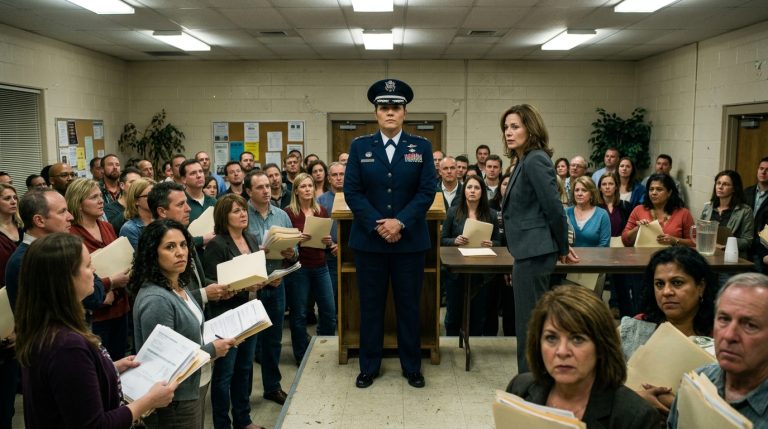
The base training hall was a cathedral of procedure, built on the steady, soul-grinding friction of boots against polished concrete. Inside, the air tasted of metallic warmth and the thin, acidic bite of coffee that had been sitting too long. Thomas Hail didn’t move to join the flow of bodies; he stood at the edge, a quiet interruption in a room that viewed interruptions as errors.
His work jacket was a map of past utility, the fabric softened into a gentle, fraying gray at the elbows. On his shoulder, a patch held the ghosts of a forgotten unit, the threads so worn that the design had dissolved into a mere suggestion of shape. No one looked. They were too busy measuring their own progress against the clipboards that tapped like metronomes in their hands.
A supervisor—man whose uniform was pressed so sharply it looked like it could cut paper—approached, his eyes fixed on the schedule before he even reached Thomas. The sound of a hissing urn near the wall filled the silence, a high, lonely note.
Sir, the supervisor said, his voice a polished instrument of dismissal. You’ll need to step aside. This area is for active ranks.
Thomas didn’t look at the floor. He didn’t tighten his jaw. He looked at the supervisor with eyes that had watched empires of procedure rise and fall. He was sixty-eight, and his movements were not those of a man who was lost, but of a man who knew exactly how much space he was entitled to occupy.
Yes, sir, Thomas replied. The lack of bite in his voice was perhaps the most jarring thing about him.
He took a step back, the soles of his boots scuffing softly against the floor. As he moved, the light caught the edge of his pocket, where a small, dull coin sat heavy with history. A young trainee, caught in the wake of the supervisor’s authority, glanced over. He started to frame a question, his hand rising in a nervous, aborted gesture, but he saw the supervisor’s gaze and let his hand drop to his side.
The room shifted around Thomas, trying to erase the vacuum he created, but the air felt heavy. The efficiency had hit a snag. The supervisor, sensing the subtle fracture in the rhythm, didn’t turn away immediately. He looked at Thomas for a fraction of a second too long, trying to categorize him, and failing.
Whatever happened, happened, Thomas said, though the words were meant for no one but the hissing coffee.
The supervisor stiffened, his clipboard dipping. He looked at the training line, then back at the empty space where Thomas had been standing. The trainee at the front of the line cleared his throat, the sound sharp as a gunshot in the suddenly fragile quiet of the hall. The room was waiting for the routine to restart, but the routine had lost its heartbeat. Thomas remained still, watching the clock he no longer needed to check, while the wall behind him seemed to press forward, closing the distance.
CHAPTER 2: The Weight of the Patch
The silence was a physical thing, thick and textured like the worn wool of the jacket Thomas wore. It wasn’t the kind of quiet that meant peace; it was the tense, vibrating stillness of a room waiting for a gear to slip. Thomas stood perfectly still, his hands folded in front of him, his weight distributed with the practiced ease of a man who had spent a lifetime adjusting to unstable ground. He didn’t look at the supervisor. He didn’t look at the trainees. He looked at the wall, where a faint watermark from an old leak traced a jagged, wandering path toward the floor.
The supervisor, a man who built his life on the predictability of schedules and the rigid geometry of the hall, was struggling. He held his clipboard like a shield, the plastic edges digging into his palm. He wanted to return to the script—the names, the call-and-response, the mechanical efficiency that kept the world turning—but the script had been pulled out from under his feet. He could still feel the phantom pressure of the moment before, when he had dared to tell a man who had clearly forgotten more about duty than he would ever know to “step aside.”
Thomas felt the shift in the room, the way the gaze of the young trainee—the one who had tried to speak—lingered on his shoulder. It was a look of dawning, confused curiosity, the kind of look that started as an annoyance and quickly became an internal crisis. The boy was looking at the patch, trying to solve the riddle of the faded threads, and he didn’t realize that in trying to solve it, he was already changing the way he stood.
A memory flickered in the back of Thomas’s mind, unbidden and sharp—the scent of burning oil and the taste of grit on his tongue, a memory of a different hall, a different war, a time when the only things that mattered were the men on your left and your right. The smell of the bitter, burnt coffee here momentarily bridged the gap between that life and this one, making the fluorescent lights above feel dangerously thin, like a veil that might tear at any moment. He blinked, pushing the sensation back into the dark corner of his mind where he kept his ghosts. This was a training hall, not a battlefield. Efficiency was the order of the day.
The supervisor cleared his throat. It was a nervous, jagged sound. He looked down at his clipboard, his eyes scanning names he suddenly didn’t want to call.
“Sir,” the supervisor began, his voice lacking its previous crispness. “I… the schedule remains in effect. We have protocols.”
“Protocols are good,” Thomas said, his voice quiet but resonant, cutting through the low hum of the ventilation system. “They give a base its shape. They keep the confusion at bay.”
He said it without malice. He said it as if he were discussing the weather. Yet, the words seemed to settle on the supervisor’s shoulders like lead. The man adjusted his collar, his face flushed. He wanted to argue, to reassert his dominion over the line, but he found he couldn’t meet Thomas’s eyes. He retreated instead, pulling back into the sanctuary of the line, his movements jerky and unpolished.
The trainee who had looked at Thomas finally spoke again, his voice little more than a murmur, but in the brittle silence of the hall, it carried.
“Is the coffee fresh?”
It was a mundane question, a desperate reach for the normal, but it was enough to break the spell. The tension fractured. A few men shifted, their boots scraping against the concrete, the sound a welcome return to the familiar. The supervisor exhaled, a long, shaky breath, and tapped his clipboard, though his touch was less forceful now.
“Next,” he muttered.
The line began to move again, but it wasn’t the same. The rhythm had changed. The trainees, who usually marched forward like parts of a machine, now walked with a strange, hesitant grace. They kept an extra foot of space between them and the wall where Thomas stood, not out of fear, but out of a sudden, newfound sense of reverence. They were watching him, even as they moved, trying to catch a glimpse of the man behind the frayed jacket, trying to understand what it meant to belong to a history they had only ever read about in manuals.
Thomas didn’t acknowledge the attention. He maintained his place, a silent anchor in a shifting tide. He was watching the supervisor, not with judgment, but with a quiet, patient expectation. He knew how this went. He knew that the hardest part of authority wasn’t giving orders—it was realizing when the orders you were giving were no longer the ones the situation required.
The supervisor looked up again, his gaze darting toward the retired officer’s desk at the far end of the hall. The officer wasn’t there, but the supervisor’s fear of him remained. He realized, with a sinking feeling in his stomach, that he was being observed by a standard he hadn’t yet learned to meet. He looked back at Thomas, his expression softening into something like an admission of defeat. He didn’t say anything, but he stepped back, leaving a wider berth between the line and the wall.
It was a small gesture, almost invisible to anyone who hadn’t been watching the friction of the last ten minutes, but to Thomas, it was everything. It was the first ripple in a wider pool. He felt the cold iron of the coin in his pocket, a steady, grounding weight, and for the first time since he’d walked through the doors, he allowed himself a small, internal nod. The process was beginning. The hall was waking up, not to the sound of orders, but to the weight of presence. He remained where he was, watching the line move, waiting for the moment when the system would have to reconcile its rigid rules with the reality of what stood at its edges.
CHAPTER 3: The Retired Officers Arrival
The silence in the hall was no longer brittle; it was heavy, the kind of silence that precedes a storm or, perhaps, a long-overdue change of season. Thomas remained positioned against the wall, a fixture of quietude amidst the restless motion of the trainees. He watched the supervisor, whose eyes were no longer anchored to the clipboard but were instead darting toward the far end of the hall, where a rhythmic, measured tapping of heels announced the arrival of the retired officer.
It was the cadence that gave him away before the man himself appeared. It was a walk born of decades on parade grounds and within the hushed, vaulted corridors of command—too precise to be civilian, too deliberate to be hurried. As the officer entered the hall, the atmosphere didn’t just shift; it pressurized. The trainees, previously focused on their own internal anxieties or the supervisor’s faltering rhythm, instinctively straightened. The disorder of the last few minutes evaporated, replaced by a reflexive, bone-deep habit of discipline.
Thomas felt the familiar weight of the moment. He didn’t look toward the officer, but he sensed the man’s presence moving through the room like a cold front. The officer was older, his hair a shock of silver against the drab, industrial backdrop of the training center, and he wore a coat that retained the ghost of a uniform’s cut. He moved past the trainees without a glance, his focus narrowed, his intent singular.
He stopped, not in front of the supervisor, but squarely in front of Thomas.
The distance between them was short, yet it felt like a gulf spanned by years. The officer stood there for a heartbeat, his gaze lingering on the faded, unrecognizable patch on Thomas’s jacket. It was a look of recognition—not necessarily of the man, but of the era, the struggle, and the quiet, stubborn endurance the patch represented.
“The air is thinner here than it used to be,” the officer said, his voice a low, gravelly rasp that seemed to belong to a different time entirely.
Thomas finally turned his head, his expression as unreadable as a closed book. “The ventilation is different,” he replied, his tone perfectly neutral.
The officer’s lips twitched—not a smile, but the acknowledgment of one. “Efficiency,” he said, gesturing with a slight nod toward the supervisor, who now stood frozen a few paces away. “We taught them to prioritize the clock over the men. I suppose we shouldn’t be surprised when they eventually start looking at us the same way.”
“They’re just following instructions,” Thomas said, his hands remaining folded at his waist. “It’s not their fault they were never taught what to look for.”
The supervisor stepped forward, his face a mixture of confusion and sudden, sharp apprehension. “Sir, if there’s a problem—”
The officer didn’t even look at him. He kept his gaze fixed on Thomas, his eyes searching, as if trying to locate a specific coordinate from a map they had both once studied. The room around them had faded into a blurred periphery; the sound of the training hall—the clicking pens, the shuffling boots, the distant, muffled calls—seemed to recede, dampened by the intensity of the exchange.
The officer’s hand hovered near the pocket of his coat. He was moving with a deliberate, slow-motion precision that made the supervisor’s frantic energy seem frantic and small. Thomas felt the weight of his own pocket—the coin, the small metal disc that had seen more hand-offs than he cared to remember. He knew what was coming. It wasn’t a confrontation; it was a handover.
“I kept this,” the officer said, his voice dropping until it was nearly a whisper, meant only for Thomas. “I thought it might be needed. The protocol around here is getting too sharp. It needs something to dull the edges.”
He withdrew his hand, holding it closed. For a brief second, Thomas looked at the officer’s palm, then up at his eyes. In that silent exchange, the whole of their shared past, the thousands of hours spent in similar, sterile rooms, passed between them. It was a heavy, unspoken burden, the weight of a generation that had built the systems everyone else was now taking for granted.
Thomas nodded, a slow, solemn movement. The trainee who had tried to speak to him earlier was staring now, openly, his curiosity having tipped over into something approaching awe. He saw the officer—a man of clear authority—treating the “lost” old man with a deference that defied every rule in the supervisor’s manual.
The officer didn’t offer the item yet. Instead, he looked around the room, taking in the trainees, the supervisor, the sterile, unyielding environment.
“They’re waiting,” Thomas said softly, referring to the line that had stalled.
“Let them wait,” the officer replied, his eyes narrowing as he looked back at Thomas. “Sometimes, the most important part of the procedure is knowing when to stop the clock.”
Thomas didn’t respond. He simply watched the officer, feeling the strange, surreal quality of the moment, as if the training hall had transformed into a theater where the play had stopped and the actors were finally stepping out of their assigned roles. The scent of floor wax, the hum of the lights, the cold metal of the structure—it all felt secondary, a background to the singular, intense reality of the man standing before him. The secret, whatever it truly was, sat in the silence between them, vibrating with the potential to unravel the entire order of the room.
CHAPTER 4: The Restoration
The officer’s hand didn’t tremble, though the silence in the hall had reached a fever pitch. He finally opened his fingers. Resting there in his palm was not just a badge, but a piece of history: a Master Sergeant’s rank insignia, the metal darkened by decades of oxidation, the edges softened by wear. It was a tangible, heavy thing that seemed to anchor the entire room to the floor.
Thomas felt a strange, quiet hitch in his chest. He didn’t reach for it immediately. He looked at the badge, then up at the officer, whose eyes held a desperate, singular intensity. The supervisor, standing just a few feet away, had stopped breathing entirely. He was staring at the insignia, his face pale, the clipboard in his hand finally sagging to his side, forgotten. The realization was spreading through the room like a sudden drop in temperature—this wasn’t just an old man with a frayed jacket; this was a piece of the base’s own missing architecture.
“I didn’t think I’d find you in this state,” the officer said, his voice barely audible over the hum of the fluorescent lights. “But I suppose the best ways to test a system are the ones that rely on it forgetting who you are.”
Thomas reached out, his own fingers steady as he took the badge. The metal was cold, biting into his skin, a sharp, metallic reminder of everything the patch on his shoulder represented. As his fingers closed around the cold steel, the supervisor stepped forward, his reflex for order fighting his newfound, paralyzing respect.
“I… I wasn’t told,” the supervisor stammered, his eyes flickering between Thomas and the badge. “There was nothing on the roster, no protocol for…”
“There wouldn’t be,” the officer interrupted, his voice cutting through the supervisor’s confusion with the precision of a scalpel. “The protocol only covers the names that are currently being checked off. It doesn’t account for the people who built the foundation you’re standing on.”
Thomas held the badge, his thumb tracing the familiar ridges of the design. He felt the gaze of every trainee in the hall. The room had changed. The atmosphere was no longer the clinical, detached air of a training center; it was heavy with the weight of unacknowledged history. He looked at the supervisor, who looked like a man who had suddenly discovered the ground he was standing on was made of glass.
“It’s not your fault,” Thomas said quietly.
But the supervisor wasn’t listening to the reassurance. He was looking at the badge, then at the trainee who had tried to speak to Thomas earlier. That trainee was standing straight, his jaw set, his eyes fixed on Thomas with a clarity that had been absent moments ago. The supervisor realized then that he had lost the room—not through force, not through an act of rebellion, but through the simple, crushing weight of a truth he hadn’t known to look for.
The officer turned to the room, his voice rising, carrying through the hall with the authority of someone who had earned the right to speak without raising his volume. “Carry on,” he commanded.
It was a test. He was watching the supervisor, watching the trainees, waiting to see if the lesson had been learned or if they would simply scramble to hide their embarrassment behind a new, different set of rigid instructions.
The supervisor took a long moment. He looked at the clipboard—the object that had defined his authority for years—and then, with a slow, deliberate movement, he tucked it under his arm and stepped back, creating a gap in the line. He turned to Thomas.
“Master Sergeant,” he said, the title landing with a weight that seemed to vibrate in the air. “The floor is yours.”
Thomas didn’t look for a place of honor. He didn’t look to be praised. He simply moved into the space the supervisor had opened, his posture shifting, his shoulders settling into the familiar, natural grace of his rank. The coin in his pocket felt like a pulse against his hip. He looked at the trainees, then at the officer. The system hadn’t broken; it had been forced to bend, and in that bending, it had revealed exactly what it was made of.
The trainee who had offered him the earlier ‘thank you’ stepped forward, mimicking the stance he’d seen the officer take. He didn’t speak, but his posture—the way he looked at Thomas—was all the validation the room needed. The atmosphere was shifting from cold, clinical efficiency to something more human, more complex, and infinitely more dangerous. They weren’t just training anymore; they were acknowledging the cost of the ground they occupied. Thomas held the badge, feeling the cold steel burn against his palm, and knew the true test was only just beginning. The room was no longer his enemy, but it had become something much more demanding: a witness.
CHAPTER 5: The Plaque
The supervisor moved toward the rolling board with a strange, frantic determination. It was the same board used for mundane schedules and training notices, a utilitarian object of peeling laminate and static-clung dust. He picked up a thick, black marker, his hand hovering over the surface. He wasn’t just writing; he was attempting a retraction. He was trying to cement, in permanent ink, the acknowledgment that had previously only existed in the fleeting, fragile space between men.
Thomas watched, his hands still loosely folded, his posture reflecting a patient, almost detached observation. He felt the shift in the room’s energy—it was no longer a silent witness; it was becoming an active participant in a process it didn’t fully comprehend. The trainees were leaning in, their shoulders no longer held in the rigid, defensive posture of subordinates, but in the relaxed, attentive stance of people who had just been granted permission to be human.
The marker squeaked, a high, lonely sound that amplified the concentration in the room. The supervisor wrote: Master Sergeant Thomas Hail. He hesitated, the black tip of the marker hovering, before adding a brief, sparse line below it. Service and Memory.
He stepped back, the marker clattering into the plastic tray. He looked at Thomas, his breath coming in short, uneven hitches. It was an act of penance performed in front of an audience that had, until ten minutes ago, been taught that such things were irrelevant.
“It’s not in the handbook,” the supervisor said, his voice raw, addressing Thomas with a desperate need for validation. “But maybe it should be.”
Thomas stepped forward. The floor beneath his boots felt different, as if the very concrete were accommodating his movement, shedding the artificial indifference of the base. He studied the board—the simple, stark lettering that had changed the geometry of the room. He didn’t see a trophy; he saw a mirror. The supervisor was looking for a sign that he hadn’t completely failed, and the room was waiting to see if Thomas would grant him that grace.
“The handbook is a starting point,” Thomas said, his voice carrying clearly to the back of the hall. “It was never meant to be the end of the conversation.”
A murmur broke out among the trainees—not a disruption, but a release. The retired officer, standing to the side, watched with a quiet, satisfied glint in his eyes. He had known Thomas would handle the weight of the moment, just as he had always handled the weight of the uniform.
However, the supervisor’s gesture had triggered an unforeseen friction. A senior instructor—a man whose entire identity was built on the absolute, unyielding nature of the base’s current efficiency protocols—walked toward the board, his face a mask of cold indignation. He had watched the ‘restoration’ with mounting irritation, and now, seeing the name of a ‘ghost’ written into the official record, he could no longer hold his silence.
“That board is for active, current assignments,” the instructor stated, his voice a sharp, cutting edge. He stood between the supervisor and Thomas, his presence physically partitioning the hall. “We don’t memorialize the past at the expense of the schedule.”
The supervisor flinched, the authority he had tentatively reached for suddenly jeopardized. The room’s newfound warmth vanished, replaced by the sterile, biting chill of the previous order. The trainees looked away, the familiar instinct to avoid conflict overriding their dawning sense of respect.
Thomas stood his ground. He didn’t look at the instructor; he looked at the board. The black ink was still wet, catching the harsh, overhead fluorescent glare. He felt the coin in his pocket, a sudden, sharp reminder of the cost of legacy. He understood then that the supervisor’s act of penance wasn’t the end; it was the catalyst for a battle over what this place was allowed to remember.
“The schedule is a guide, not a cage,” Thomas said, his voice dropping into a tone that was lower, more resonant, and unmistakably dangerous.
The instructor turned, his eyes narrowing as he confronted the man he had dismissed as a wandering, confused intruder. “You’re done, Master Sergeant. You were asked to step aside. Your presence here is an anomaly.”
Thomas didn’t move. He didn’t raise his voice. He didn’t even stiffen. But the air in the room, previously shifting toward a fragile peace, had suddenly, violently, tightened. The supervisor, caught between the instructor’s rigid demand for compliance and the undeniable weight of Thomas’s presence, looked to the floor. The hall had been pulled back into the crucible, and this time, the tension wasn’t coming from the rules—it was coming from the people who had forgotten how to live without them.
CHAPTER 6: The Quiet Departure
The senior instructor’s breath came in a short, rhythmic hiss that matched the dying cycle of the coffee urn against the wall. He stared down at Thomas, his chest heaving under his stiff, immaculate uniform, desperately searching for a line of code, a sub-paragraph, or a procedural mandate that could restore his slipping dominance. But the room had already uncoupled from his machinery.
The supervisor did not look away from the floor, yet his hand remained resting flat on the concrete counter, deliberately refusing to lift his clipboard to assist the instructor. Behind them, the young trainee took a definitive step forward, his boots clicking once against the floor—a solitary sound of alignment that was immediately duplicated by the trainee beside him, and then another, until a quiet wave of shifting weight rippled through the entire line. The trainees were standing at attention, not by the instructor’s command, but in a silent, collective shield formed around Master Sergeant Thomas Hail.
“This is an administrative infraction,” the instructor said, though the words lacked their former weight, sounding thin and hollow against the concrete walls. He reached out to drag the felt eraser across the wet ink of the board.
“Section Four, Paragraph Two,” the retired officer’s voice cut through the space, calm and absolute. He walked forward from the shadow of the corridor, his civilian coat swinging open to reveal the small, silver pin of a past command. “The base commander retains the authority to log non-active personnel of exceptional rank into the daily register for instructional reference. The board stands, Instructor. By the very rules you use to guard the door.”
The instructor’s hand stopped. The contradiction of his own gospel trapped him; his entire career had been built on absolute deference to the hierarchy, and now that hierarchy, manifested in the retired officer and the awakening supervisor, was turning the lock against him. He looked at the trainees, whose eyes remained fixed forward, ignoring his gaze entirely. He looked at Thomas, whose face held no triumph, only a deep, sorrowful patience. The instructor slowly lowered his hand, the eraser dropping back into the tray with a soft, definitive thud. Without another word, he turned on his heel and walked toward the exit, his boots echoing with a fast, defensive cadence that quickly faded into the outer corridor.
The room didn’t celebrate. The silence that returned was softer now, the harsh edges of the fluorescent lighting beginning to give way as the late afternoon sun reached the high, small windows of the hall, casting long, amber slants across the polished concrete.
Thomas looked down at the darkened metal rank insignia resting in his palm. The anti-expository barrier that had governed his quietness throughout the morning finally dissolved, his voice returning with the full, unhurried resonance of a teacher who had completed a difficult lesson.
“A building doesn’t stand because of the paint on the walls,” Thomas said, his eyes meeting the supervisor’s as the younger man finally raised his head. “It stands because of the beams buried in the dark underneath. When you build a system that only values the speed of the line, you start shaving away the wood to make it look clean. Eventually, the roof comes down on everyone.”
The supervisor swallowed hard, his posture loosening as he stepped out from behind the counter. He looked at the board, where the wet ink was beginning to dry into a permanent matte finish. “I spent three years learning how to run this hall by the second, Master Sergeant. They told us that variation was a flaw. I didn’t see you. I only saw a delay.”
“I know,” Thomas replied, his tone carrying the deep empathy of the Kintsugi lens, seeing the fracture in the supervisor’s understanding not as a permanent failure, but as a place where resilience could be joined. “The system is designed to make you look past the person. It wants a machine. But a machine doesn’t know what it’s defending. It only knows how to cycle.”
The retired officer stepped beside them, placing a hand on Thomas’s jacket shoulder, right over the faded, unreadable patch. “He didn’t come here to register for benefits, son,” the officer explained to the supervisor. “He came because the base commander wanted to know if this intake hall had completely lost its center. Thomas volunteered to stand in the line. He wanted to see if anyone would look at the cloth instead of the clipboard.”
The truth settled into the room, peeling away the last layer of the morning’s mystery. Thomas hadn’t been lost; he had been a deliberate mirror, a quiet test of the institution’s remaining capacity for grace. If the system had crushed him entirely without a single voice rising to object, the training program would have been dismantled from the top down. The supervisor’s small retreat, the young trainee’s hesitant question, the collective silence that had slowed the room—these weren’t errors in efficiency; they were the survival of the base’s soul.
The pacing of the hall slowed to an atmospheric peace. From the chapel deeper within the complex, the choir’s rehearsal reached a steady, harmonious swell, the voices layering together in a warm, unhurried cadence that floated through the ventilation ducts, completely replacing the thin, bitter ozone smell of the morning with a sense of settled community.
Thomas reached into his jacket pocket and withdrew the old, dulled coin he had carried for forty years. He walked over to the young trainee who had stood by him. The boy straightened instinctively, but Thomas simply took the young man’s hand and pressed the coin into his palm. The metal was warm from Thomas’s pocket, its edges smooth from decades of touch.
“Keep your eyes on the margins,” Thomas whispered to him. “The center takes care of itself. The margins are where people get left behind.”
The trainee’s fingers closed tightly over the silver. “Yes, Master Sergeant.”
Thomas turned back to the supervisor. With a slow, deliberate movement, he reached up to his own shoulder. His fingers traced the frayed, loose threads of the old unit patch that had started the friction hours ago. He didn’t tear it off; instead, he carefully tucked the loose, stray fibers back under the seam, smoothing the fabric down with his palm until the old outline sat flush and repaired against the jacket cloth, restored by his own hand.
He took the worn leather badge case from the counter, slipped it into his breast pocket next to his heart, and offered the supervisor a final, quiet nod of recognition.
Thomas turned and walked toward the heavy glass doors of the training hall. No one stopped him. The space opened naturally around his stride, the trainees parting with an unforced, deep reverence that wasn’t dictated by any manual. He pushed the door open, the golden afternoon light rushing in to meet him, enveloping his faded jacket in a warm, protective amber. Behind him, the hall began to move again, but the supervisors were no longer tapping their clipboards, and the boots moved with a rhythm that finally had room to breathe. Thomas stepped out into the courtyard, the door closing gently behind him, remaining shut on a lesson that would never be forgotten.