They Gave an Elderly Veteran 48 Hours to Remove His Shed – They Forgot One Critical Law
CHAPTER 1: THE FIRST NOTICE
The ceramic mug was chipped at the rim, leaking a thin line of heat against Arthur’s thumb.
He didn’t look up when the heavy thud hit the wooden porch boards.
It was the fifth time this week a courier had missed the mailbox entirely, treating his front steps like a dumping ground for paperwork he never asked for.
Arthur set the mug down on the weathered porch rail, the old wood groaning beneath the weight.
He reached down and picked up the thick manila envelope, feeling the stiffness of official cardstock inside.
No stamp. No postmark. Hand-delivered by someone who knew the exact perimeter of his property line.
The brass pocket watch in his pocket felt heavy, its scarred casing cold against his thigh as he shifted his weight.
He slid his thumb under the flap and tore the paper, pulling out a crisp, printed notice demanding the immediate removal of his garden shed.
The signature at the bottom belonged to Evelyn Vance, head of the local neighborhood committee, citing a municipal code that hadn’t applied to grandfathered structures since 1994.
Arthur stared at the words, his jaw tightening as the quiet morning air suddenly felt heavy with manufactured trouble.
CHAPTER 2: THE LINE IN THE DUST
Arthur stepped off the porch, the weathered wood creaking beneath his boots.
He didn’t raise his voice or rush his stride.
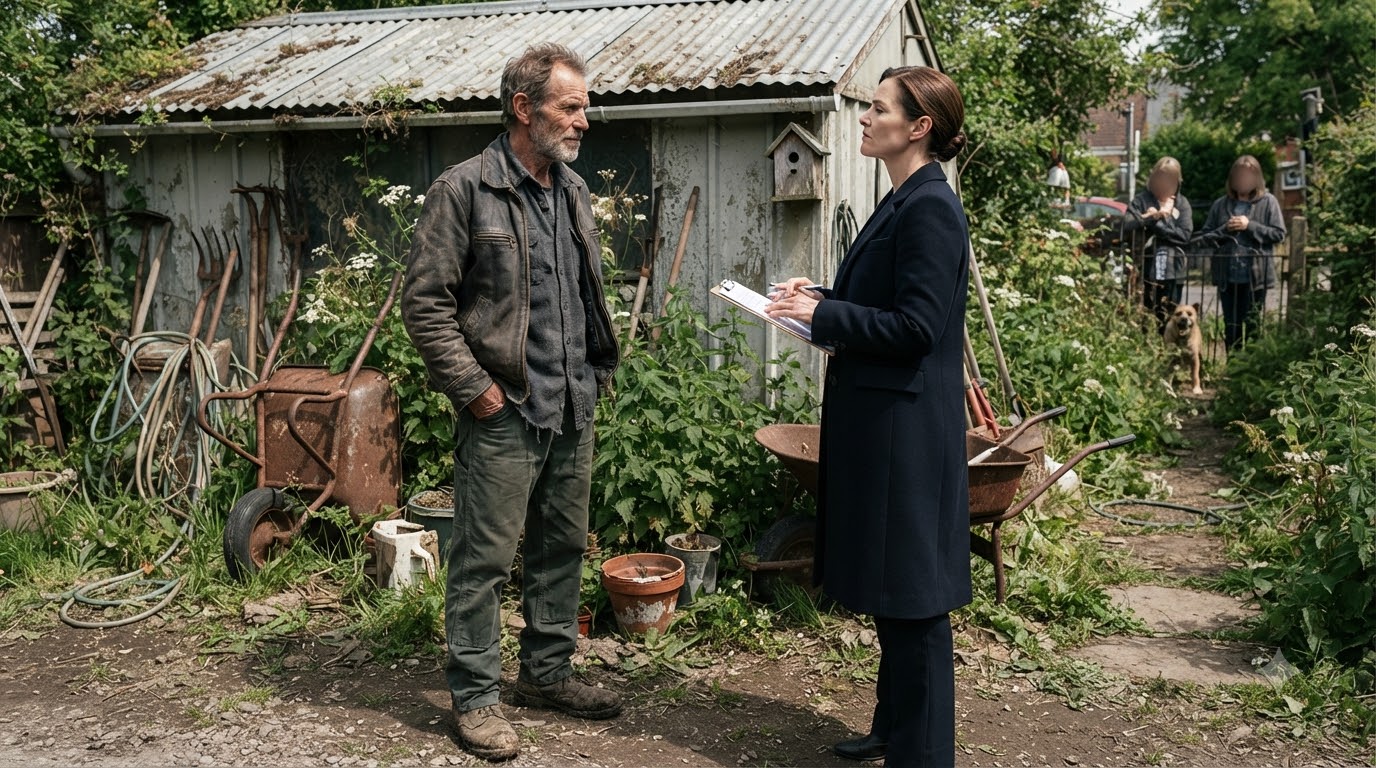
Evelyn Vance stood at the edge of his property line, clipboard pressed against her wool coat like a shield.
“I dropped off the formal warning this morning, Arthur,” she said, her chin lifting as she scanned the garden shed with practiced disapproval. “That structure violates three separate community aesthetic clauses.”
Arthur stopped two paces short of the boundary, his thumb sliding mechanically over the scarred brass casing of the pocket watch in his coat pocket.
“That shed has stood in this exact spot for thirty years, Evelyn,” he said, his voice flat and steady. “Long before this committee was ever dreamed up.”
“Rules change, and property values must be protected,” she snapped, tapping a laminated sheet on her clipboard with a manicured fingernail. “You have forty-eight hours to clear it out, or the county fines begin.”
She turned on her heel to leave, expecting the usual submissive retreat.
Arthur didn’t blink, his eyes dropping briefly to a fresh mud smudge on her expensive leather boots—a sign she’d parked too close to the damp earth near his side fence.
“You missed a spot on the county registry, Evelyn,” Arthur said quietly, stopping her retreat.
She froze, her spine stiffening as she half-turned back toward him.
“What did you say?”
“Grandfathered structures built before the ’95 ordinance are exempt from aesthetic clauses,” Arthur said, taking one slow step closer. “I suggest you check page four of the actual municipal code before you post another envelope on my porch.”
CHAPTER 3: THE SCRACILITY OF PROOF
Evelyn snapped her clipboard against her thigh, the plastic crack sounding sharp in the morning chill.
“You can reference whatever outdated texts you like, Arthur,” she said, her voice rising an octave. “The committee votes on enforcement tonight, and your little shed won’t survive the week.”
She turned and marched back toward her sedan, the gravel crunching violently beneath her tires as she backed out without a wave.
Arthur didn’t watch her drive away.
Without the security footage from the digital ring camera—fried months ago by a lightning strike he never bothered to replace—he had only paper to rely on.
He walked back inside, the floorboards cold beneath his work socks.
The heavy oak desk in his back room was stacked with decades of tax receipts, handwritten deeds, and yellowed county letters.
His fingers brushed against a faded manila folder tied with brittle cotton string, unearthing the original 1984 survey map stamped by the county clerk.
The ink was faded, but the boundary lines were unmistakable, inked by a hand that had been in the ground for twenty years.
He unrolled the map, pressing his thumb against the crease to keep it flat against the scarred wood.
If Evelyn wanted a war over inches of dirt, she would find that the ink on these old pages outlived modern committees.
CHAPTER 4: THE WEIGHT OF WHISPERS
The heavy oak front door groaned twice before the muffled knock sounded against the wood.
Arthur did not rush to answer, his thumb lingering on the margin of the old county survey map.
When he finally pulled the door back three inches, Dennis stood on the welcome mat, hands shoved deep into his canvas jacket pockets, his eyes darting toward the streetlamp.
“Evelyn stopped by the hardware store an hour ago, Arthur,” Dennis said, his voice dropping to a dry rasp as he shifted his weight against the cold. “She’s been asking folks down at the diner if anyone remembers you pulling permits back in ninety-four.”
Arthur leaned his shoulder against the doorframe, his gaze steady on the younger man’s weathered face.
“She knows the survey is older than her committee,” Arthur said.
“Doesn’t matter to her,” Dennis replied, exhaling a thin plume of cold air into the porch light. “She’s got the town council convinced you’re building a commercial storage block out here instead of keeping a garden shed.”
A distant car engine whined down the asphalt road, its headlights sweeping across the front windows before fading into the dark.
Arthur adjusted the heavy brass pocket watch in his coat pocket, feeling its reassuring metal weight against his ribs.
“Let her talk to the council all she wants,” Arthur said, his tone flat. “Paper doesn’t change just because someone raises their voice.”
CHAPTER 5: THE LETTER OF THE LAW
Arthur slid the deadbolt home with a solid, heavy metallic click.
He didn’t sleep past dawn; the morning light hit the frosted windowpanes as he pulled three pristine carbon-copy forms from his desk drawer.
If Evelyn wanted to play by committee rules, he would give her absolute, unbroken adherence to every single clause in the civil registry handbook.
He filled out each line with deliberate, block-letter precision, citing county zoning sub-article twelve verbatim.
By nine o’clock, he walked down his gravel drive and pinned the completed compliance package directly to the public notice board outside the township office.
Evelyn’s silver sedan pulled into the gravel lot ten minutes later, her heels clicking sharply against the frozen tarmac.
She marched toward the board, her eyes scanning the papers before her face drained of color.
“You can’t file an independent counter-exemption without committee review,” she snapped, her voice cracking as she jammed a finger against his paperwork.
Arthur stood beside the wooden post, his thumb resting inside his coat pocket against the cold brass watch.
“Read subsection three, Evelyn,” he said, his voice entirely even. “Grandfathered structures require zero committee review if filed within forty-eight hours of a formal dispute.”
She stared at the official stamp he had retrieved from the county clerk, her chest heaving as the trap snapped shut around her own red tape.
CHAPTER 6: THE CRACKING FAADE
Evelyn grabbed the edges of the pinned papers, her knuckles turning pale against the cardstock.
“This is a procedural error,” she stammered, her voice losing its crisp authority as three local shopkeepers paused on the sidewalk to watch. “The committee has ultimate jurisdiction over all exterior modifications, regardless of past exemptions.”
Arthur didn’t raise his voice, keeping his posture loose against the wooden post of the display board.
“Jurisdiction ends where federal grandfather clauses begin, Evelyn,” he said, his thumb brushing the cold brass watch in his pocket. “Read the signature stamp at the bottom—that’s the county clerk’s direct authorization, not mine.”
A murmur rippled through the small crowd gathering by the pavement edge.
Evelyn’s face flushed a deep, mottled crimson as she realized her public leverage had completely evaporated under the weight of plain documentation.
“You haven’t heard the last of this,” she snapped, ripping her papers from the board with a sharp tear that left the bottom margins pinned to the wood.
She spun around, nearly tripping over her own heels as she hurried back toward her sedan.
Arthur watched her go, his expression unmoved as the engine roared to life and sprayed gravel across the tarmac.
CHAPTER 7: THE QUIET AFTERMATH
The morning sun cleared the tree line, casting long, clean shadows across the frost-covered grass.
Arthur stood on his front porch, the chipped ceramic mug warming his palms without a single sound of tires or shouting to disturb the air.
The committee had dissolved its enforcement motion late last night following an emergency review of the town clerk’s master records.
Evelyn’s name had been quietly removed from the active roster, replaced by standard township oversight that respected thirty-year property lines.
Arthur took a slow sip of black coffee, his thumb brushing the smooth brass lid of the pocket watch resting quietly in his vest pocket.
The shed stood untouched against the fence line, its weathered wood holding firm against the cold morning wind.
He didn’t look for a letter in the driveway or wait for a knock at the door.
There was only the quiet creak of the porch boards and the steady, unbroken rhythm of an ordinary day restored to peace.