The Broken Sugar Flower and the Silent Maid Who Built a Future
CHAPTER 1: FROSTING ON MARBLE
Eleven thousand dollars in white fondant lay smeared across three hundred years of French oak.
Mariah knelt on the cold stone, her knees digging into the hard floor, a damp terry-cloth rag gripped tight in her right hand. She didn’t look at the sugar flowers crushed beneath three-year-old boots, nor did she look at the woman standing three feet away in beige cashmere. She kept her eyes on the white grease bleeding into the grain of the wood.
“Eight months,” Mariah said softly under her breath, her thumb smoothing the frayed edge of a creased gold napkin in her apron pocket.
“What was that?” Sibella’s voice didn’t rise. It didn’t need to. It had the sharp, weightless precision of a paper cut.
Mariah didn’t raise her head. She wiped a streak of buttercream off the skirting board with one smooth, methodical drag. “I said I’ll clean it, Miss Crane.”
“Clean it?” Sibella stepped closer. The pointed toe of her leather pump stopped an inch from Mariah’s knuckle. “You can’t clean away five tiers of French pastry flown in from Paris. You can’t clean away three weeks of scheduling.”
Rosie sat on the bottom step of the grand staircase, her thumb jammed into her mouth, her big brown eyes darting between her mother’s bent back and the tall woman in cashmere. A smear of white frosting sat like a misplaced patch of snow on the bridge of the toddler’s nose. In her tiny fist, she held a single intact sugar leaf, gold leaf flaking against her skin.
“She’s three, Sibella,” William’s voice cut through the air. He didn’t raise it either, but the heavy oak doors seemed to absorb the sound differently when he spoke.
He stood near the entryway, his sleeves rolled twice over thick forearms, a man who still looked like he belonged on a job site despite the custom linen shirt. He didn’t look at the ruined cake. He looked at Rosie.
“A three-year-old doesn’t belong in a venue space during a trial setup,” Sibella said, her eyes staying fixed on Mariah’s dark hair. “This isn’t a nursery, William. It’s a house.”
“It’s a home,” William said. He walked over, his heavy dress shoes making no sound on the runner, and crouched right beside Rosie. He didn’t care about the frosting on the floor. He lowered himself until he was eye-level with the child. “You okay, little one?”
Rosie pulled her thumb out with a soft pop. She held up the crumpled sugar leaf. “Is pretty, like her,” she whispered, pointing a small finger toward Sibella. “But it break real easy.”
Silence dropped over the hall like wet wool.
Sibella’s jaw tightened, a microscopic twitch near her ear that no one else in the room would have caught. She turned her back on the child, her silk skirt swishing with cold efficiency. “We need to discuss the replacement invoice, William. Today.”
Mariah kept her head down, her rag absorbing the last of the grease, her fingers working with a steady, mechanical rhythm that hid the heavy pulse drumming in her throat.
CHAPTER 2: TERMS ON PAPER
Cold marble bit through the cotton of Mariah’s uniform as she scrubbed the last smear of grease from the oak trim, her thumb tracing the frayed edge of the gold-leaf napkin tucked in her pocket.
The silence in the dining room hung thick, heavy with the weight of an unpayable debt. Eleven thousand dollars. The number sat in the air like an iron bar, useless to argue against, impossible to lift.
William didn’t look at the ruin on the floor. He stood up from his crouch beside Rosie, his joints making a dry, quiet pop in the stillness. He reached into his trouser pocket, pulled out a handkerchief, and gently wiped the stray bit of white frosting off Rosie’s small nose.
“Mariah,” William said, his voice flat and level. “Leave the rest for the kitchen crew.”
“I can finish it, Mr. Hayes,” Mariah said. She didn’t look up, her hands continuing their slow, circular rhythm against the baseboard. “It won’t take but ten minutes.”
“I said leave it.” The quiet authority in his tone wasn’t sharp; it was grounded, immovable. “Get up off the floor.”
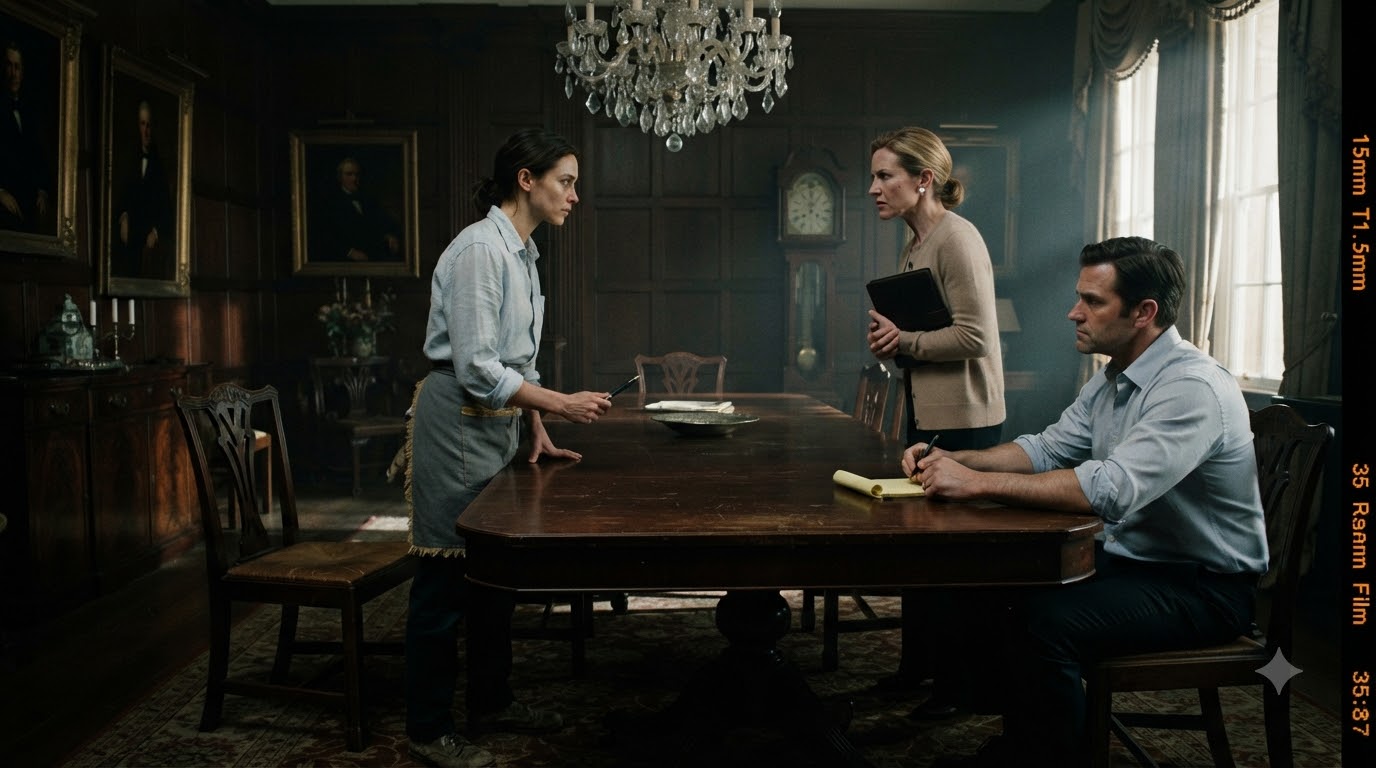
Sibella stood near the French doors, her fingers tapping a tight, arhythmic cadence against the spine of her black leather planner. “William, we have catering managers arriving in forty minutes. The floor needs to be sanitized, and we need to decide how the replacement billing is being handled.”
William walked over to the long mahogany table, ignoring the planner in Sibella’s hand. He pulled out a heavy oak chair, the legs dragging against the floor with a low, wooden groan.
“Sit down, Mariah,” he said.
Mariah stood up slowly, her knees stiff, the damp rag held firmly in her palm. She didn’t take the seat. “Mr. Hayes, if this is about Rosie being in the main house, I can call Mrs. Okonko. She can watch her during my shift—”
“I don’t want you calling anyone,” William interrupted. He reached into his breast pocket, pulled out a fountain pen, and laid it flat on the dark wood. “When I hired you two years ago, I told you this house had room for a child. I didn’t say it with conditions.”
Sibella stepped forward, the heels of her leather pumps clicking with hard, rapid authority. “A casual verbal agreement from two years ago isn’t a policy, William. A high-profile estate cannot function as an informal daycare, especially not with the wedding three weeks away. The risk is obvious.”
“The child dropped a flower,” William said quietly. He didn’t look at Sibella. He looked at the fountain pen resting on the table. “The cake was unstable.”
“The cake was eleven thousand dollars!” Sibella’s voice cracked slightly, the first thin rupture in her pristine composure. She caught herself immediately, smoothing her cashmere cardigan with two tight strokes of her manicured hands. “It was imported.”
“And it’s gone,” William said. He pulled a yellow legal pad toward himself and began to write in broad, heavy strokes. “Mariah’s employment agreement is being updated today. Effective immediately, Rosie’s presence on the grounds during shift hours is a formal clause of her employment.”
Sibella went entirely motionless. The subtle shift in her posture was instantaneous—the slight tilt of her head, the sudden stillness in her fingers. “You’re adding an indemnity clause for staff dependents? Right now?”
“I’m putting in writing what should have been written two years ago,” William said. He finished writing, capped the pen with a firm snap, and pushed the pad across the mahogany surface toward Mariah. “It guarantees your hours, your rate, and your daughter’s right to be here. No one can alter it. Not now, not after June fourteenth.”
Mariah looked down at the hand-written lines. The ink was wet, blue and precise. In the corner of her vision, she caught the edge of Sibella’s leather planner as the woman gripped it tighter. Protruding from the inner pocket of the organizer was a folded slip of heavy paper—a bank transfer receipt, heavily creased along the edges, marked with the bold red ink of an unlisted entity.
Sibella saw Mariah’s eyes drop to the planner. With a swift, silent movement, she pulled the leather cover tight against her chest, her face smoothing into a blank, cold mask.
“This is unnecessary administrative theater, William,” Sibella said, her voice dropping an octave into a low, smooth purr. “We have pre-nuptial arrangements to finalize with the attorneys at two o’clock. We shouldn’t be wasting time rewriting domestic contracts.”
“This takes two minutes,” William replied smoothly. He held the pen out to Mariah. “Sign it, Mariah.”
Mariah looked from the heavy gold nib of the pen to the quiet, weathered face of the man holding it. She took the pen. Her fingers were still cold from the floor, but her grip was steady.
CHAPTER 3: THE COLD INVENTORY
Mariah’s fingers gripped the heavy fountain pen over the yellow legal pad, the wet blue ink gleaming under the dining room chandelier while Sibella’s shadow fell long across the table.
She pressed the nib down and signed her name with steady, deliberate strokes, refusing to let the tension in the room dictate her pulse.
“There,” William said, pulling the pad back and sliding it into his leather briefcase with a quiet snap. “That’s settled.”
Sibella didn’t blink. Her gaze remained fixed on Mariah with a sterile, calculating coldness that ignored the ink entirely. “Settled for now, perhaps,” she murmured, turning toward the hallway as the grandfather clock chimed the hour. “Though people who forget their place usually require more permanent adjustments.”
William stood up, his jaw tightening into a hard, stubborn line. “She stays, Sibella. End of discussion.”
Sibella offered a thin, tight smile that didn’t reach her eyes before turning away down the corridor toward the bridal suites.
By the following Tuesday, the atmosphere in the grand estate had shifted from ordinary tension to a quiet, suffocating siege. Sibella began leaving detailed lists on the kitchen island—written in the same sharp, precise script that felt like a slap.
The east wing baseboards require re-polishing. I can still see streaks. Please keep your child out of the ground-floor corridor entirely during afternoon fittings.
Mariah wiped down the hallway console table, her thumb automatically rubbing the frayed edge of a decorative silver tray. She didn’t complain. She didn’t raise her voice. She simply moved from room to room with Rosie trailing quietly behind her, carrying a small plastic elephant.
The friction wasn’t loud; it was an unyielding weight designed to wear a person down until they broke or walked away.
While dusting the mahogany shelving in William’s study later that afternoon, Mariah noticed a stack of discarded catering invoices left near the shredder. Her eyes caught a line-item discrepancy on a secondary vendor bill marked for immediate wire transfer.
The payment wasn’t going to the florist or the bakery. It was routed to an independent holding firm matching the exact name on the creased bank slip she had glimpsed earlier in Sibella’s planner.
The surface dispute over the ruined cake wasn’t about aesthetics at all. It was a smoke screen covering a massive, systemic financial leak.
William walked into the study just as Mariah set the invoice down on the edge of the desk, her breath catching softly in her throat.
CHAPTER 4: THE UNSEEN LEDGER
Mariah stood beside the mahogany desk in William’s study, fingers resting on the edge of the vendor invoice, while William paused in the doorway holding a rolled-up set of garden blueprints.
His boots made a muffled thud against the heavy oriental rug as he crossed the room, setting the blueprints down beside the bronze lamp. “Find something that belongs in the trash, Mariah?”
She didn’t snatch her hand back. She smoothed the paper flat with two fingers, aligning the corner with the desk’s brass inlay. “It’s a secondary routing sheet for the catering staging, Mr. Hayes. Just making sure the files don’t get mixed up before the weekend.”
William leaned over the corner of the desk, his eyes narrowing slightly as he caught the firm name listed under the wire instructions—Vanguard Holdings LLC.
“That’s not the bakery’s parent company,” he said, his voice dropping into a quiet, dangerous register.
“I wouldn’t know about that, sir,” Mariah replied smoothly, stepping back and picking up her duster. “I just know the dollar amounts match the expedited staging fee Miss Crane asked to clear this morning.”
William stared at the paper for five long seconds. He didn’t explode. He didn’t call for Sibella. He simply pulled out his cell phone, snapped a direct photo of the account routing code, and tapped the paper twice with his thumb.
“Where did you find this sheet?” he asked.
“Right on top of the shredder basket,” Mariah said, meeting his eyes without flinching. “It missed the bin.”
William nodded once, a sharp, mechanical motion. The quiet patience that usually filled his eyes had hardened into something cold and structural, like rebar set in wet cement.
“Thank you, Mariah,” he said softly. “You can take Rosie downstairs now.”
Mariah picked up her cleaning basket, feeling the heavy shift in the house’s foundation beneath her feet. Layer 1—the superficial fight over cake and prenuptials—had just cracked wide open. What lay underneath was no longer a matter of hurt feelings or domestic pride; it was a cold, calculated transaction.
As she stepped into the grand hall, she saw Sibella at the end of the corridor, furiously arguing in hushed whispers with someone on her phone, her thumb digging so hard into her leather planner that the seams strained.
CHAPTER 5: THE PREWEDDING TRAP
William stood in the doorway of the office holding his phone while Sibella turned the corner of the hall with her leather planner clutched tightly against her chest, her jaw set in a hard line.
Two hours before the ceremony, the estate vibrated with frantic activity. Caterers carried silver trays, florists adjusted white arches in the courtyard, and string musicians tuned their instruments near the garden doors.
William didn’t move from the doorway. He held his cell phone in one hand and a printed wire verification sheet in the other.
“William,” Sibella said, her voice dripping with artificial grace as she smoothed her silk robe. “The photographer is waiting downstairs. We need to stay on schedule.”
“Vanguard Holdings,” William said. He didn’t raise his voice. He held up the paper. “An unlisted holding company registered in Delaware. Three transfer requests routed through the wedding expense account over the last six weeks. Totaling four hundred thousand dollars.”
Sibella’s foot froze mid-step. The color didn’t leave her face—it shifted into a sharp, defensive flush along her collarbone. She gripped the leather planner harder, her knuckles turning bone-white.
“That is administrative routing for the event management firm,” she spat out, stepping closer to weaponize her presence. “I handle the logistics so you don’t have to. You’re questioning my accounting two hours before our guests arrive?”
“I ran the tax ID twenty minutes ago,” William replied smoothly, his weathered face showing zero friction. “The company is insolvent. It’s an empty shell created to absorb capital before a personal bankruptcy filing.”
Sibella blinked, her careful composure shattering like dry glass. She turned on her heel, her gaze snapping toward Mariah, who stood near the linen cart holding a stack of fresh cloth napkins.
“You,” Sibella hissed, pointing a manicured finger directly at Mariah’s chest. “You’ve been snooping through private paperwork in the study! William, this woman has been trying to sabotage this family since the day she brought her child into our home!”
Mariah didn’t step back. She held the stack of napkins firm against her apron, her thumb catching the frayed gold napkin tucked safely in her side pocket.
“I don’t look through private papers, Miss Crane,” Mariah said, her voice low, practical, and steady. “I pick up what gets thrown toward the shredder. Common sense tells you what’s real and what’s trash.”
“She’s lying!” Sibella spun back to William, her voice rising into an angry, desperate pitch. “She’s a maid trying to protect her job because she knows she doesn’t belong in a house like this! Are you really taking the word of domestic help over your fiancee?”
“I’m taking the word of my bank’s fraud unit,” William said. He folded the paper slowly, sliding it into his jacket pocket. “The wedding is off, Sibella.”
Sibella stared at him, her lips parted, her defensive rage twisting into sheer, unadulterated shock as the realization hit her that her leverage had completely dissolved.
CHAPTER 6: THE REAL FLOWER
Sibella stood frozen in the grand hall holding her leather planner, her expensive heels motionless on the polished oak, while William turned toward the courtyard doors without looking back.
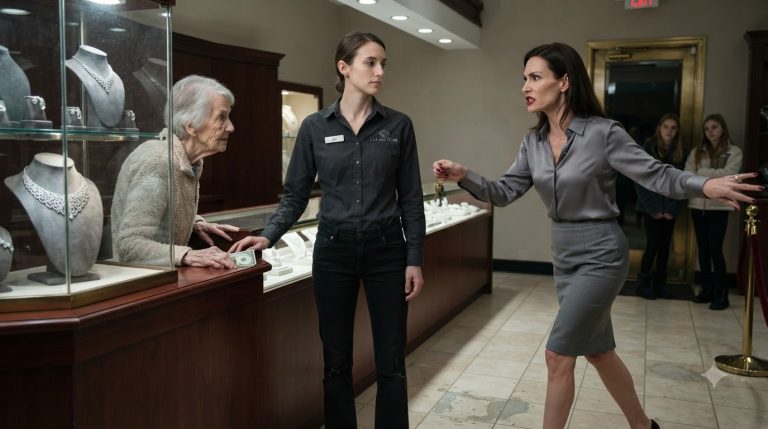
“You’re making a catastrophic mistake, William!” Sibella shouted, her voice echoing off the high ceilings as she made one final, desperate counter-move. She stepped directly into his path, her polished composure completely gone, her eyes wild as she tried to grab his sleeve. “You think you can just cancel this? The press is outside! The contracts are signed! I will sue you for breach of promise, I will tie up this estate in litigation for years!”
William stopped, his frame remaining rigid as he stepped cleanly out of her reach. “The fraud unit has already frozen the wire transfers to Vanguard Holdings, Sibella. My attorneys filed the injunction thirty minutes ago. If you take one step onto this property after today, it won’t be a civil matter.”
Sibella’s hand remained suspended in the air. The arrogance that had sustained her for months drained away, leaving only the cold, hard reality of her own undoing. She pulled her silk wrap tightly around her shoulders, spun on her heel, and walked out the heavy front doors, the loud clatter of her heels fading into the quiet afternoon.
The quiet that settled over the estate wasn’t tense or heavy; it was clean.
Later that afternoon, William sat at the kitchen island with a dark ceramic mug between his hands. The house was still, free from caterers, florists, and artificial deadlines.
Mariah stood at the counter, systematically folding clean dish towels into neat, even squares. She set the final towel on the stack and smoothed the edge with the flat of her palm.
“I have the revised house management contract ready for your signature, Mariah,” William said, his voice practical and steady as he slid a document across the granite counter. “Full payroll management, estate operations, double the previous rate, and permanent housing provisions for you and Rosie.”
Mariah picked up the pen from the counter. She didn’t hesitate or fold herself smaller. She signed her name cleanly on the line, the black ink binding her security in place.
“Thank you, Mr. Hayes,” she said softly.
Rosie ran in through the open garden door, her small boots covered in dry garden soil. She trotted over to the island, holding up a bright yellow dandelion pulled straight from the lawn.
“This one is real, Mr. Hayes,” Rosie announced, holding it out with complete three-year-old seriousness. “It didn’t break.”
William took the flower gently by its stem, looking at the bright yellow petals before placing it carefully in his shirt pocket, right next to his pen.
“Yeah, little one,” William said quietly, looking at Mariah over Rosie’s head with steady, quiet respect. “It’s real.”
Mariah picked up her daughter, feeling the solid, comforting weight against her shoulder, completely unbothered by the dirt on her apron as they walked out toward the sunlit garden.